.svg)
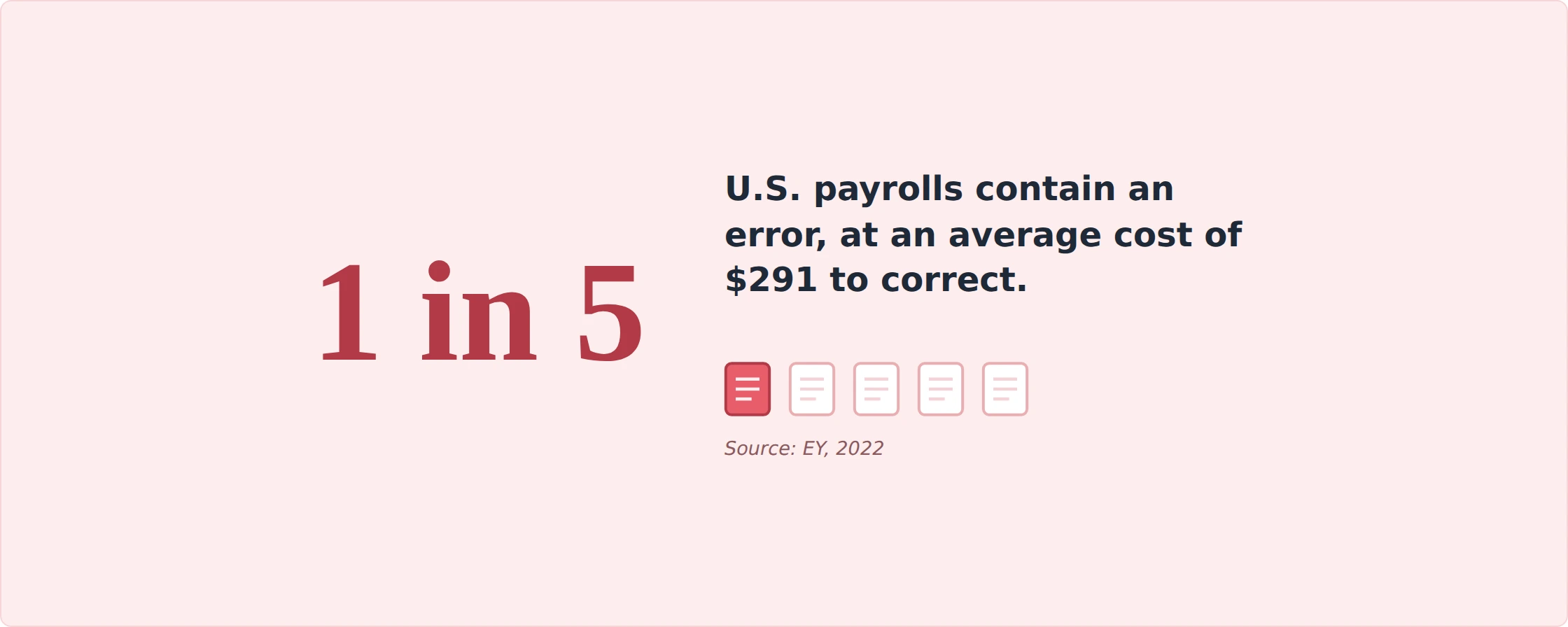
Payroll errors are more expensive than most payroll owners realize. EY research (2022) found that one in five payrolls in the United States contains errors, at an average correction cost of $291 per error.
The financial exposure compounds quickly: the IRS billions in civil tax penalties annually, and each year the U.S. Department of Labor recovers hundreds of millions of dollars in back wages from employers who get payroll wrong.
Beyond the regulatory exposure, there is the retention risk. Research by The Workforce Institute at Kronos (now UKG, 2017) found that 49% of employees say they would start looking for a new job after just two incorrect pay cycles.
Getting payroll right is not just a finance problem. Rather, it is a people problem, a compliance problem, and increasingly in 2026, a technology and transparency problem.
This guide covers the 10 practices that matter most, flags which ones have changed for 2026, and gives you the concrete action behind each one rather than the general principle.
Quick Summary: The 10 Payroll Best Practices at a Glance
The practices below apply to any organization running payroll. Use this as a quick reference before diving into each practice in full.
The 10 Payroll Best Practices
Each practice below comes with a concrete action, not just a principle. Some are foundational steps that apply to any payroll operation regardless of size. Others reflect what has changed or sharpened for 2026.
Read through all ten, or jump to the ones most relevant to where your process currently has gaps.
1. Document and Standardize Your Payroll Process
An undocumented payroll process is a liability. When the steps for each run live in one person's head, a single absence, departure, or mistake can derail an entire cycle. The single biggest source of payroll errors is not bad software or complex tax rules; it is an ad-hoc process with no written owner and no checklist.
The action: Build a written payroll calendar with deadlines, approval steps, and funding dates, then create a step-by-step checklist for each run. Assign a named owner and a backup for every step, and store both documents somewhere the whole team can access, not in a personal inbox.
Review the process at least annually and whenever a new system, pay schedule, or workforce category is introduced. A documented process also makes onboarding a new payroll administrator significantly faster and less risky.
2. Classify Every Worker Correctly
Worker misclassification is one of the most expensive payroll compliance failures, and it is more common than most organizations expect. Treating an employee as an independent contractor, or classifying a non-exempt employee as exempt from overtime, exposes the organization to back wages, interest, penalties, and in some cases litigation. The IRS and the Department of Labor both conduct misclassification audits, and enforcement has increased in recent years.
The action: Apply DOL and IRS classification criteria at hire and review them regularly, not just when a role changes. For employee vs. contractor, use the DOL's economic reality test; for exempt vs. non-exempt, confirm the current FLSA salary threshold ($684/week, confirmed by the DOL in May 2026 after the 2024 rule proposing higher thresholds was vacated and the government's appeal dismissed). Either way, document the decision so it is defensible if a regulator asks.
Note: The DOL's overtime rule has been subject to litigation. Confirm the current salary level with employment counsel before making classification decisions.
3. Automate payroll to eliminate manual errors
2026 note: This practice has intensified as AI-assisted anomaly detection becomes standard in modern payroll platforms.
Manual payroll processing is the most preventable source of errors in this list. Spreadsheet-based payroll is vulnerable to formula errors, version conflicts, and data entry mistakes that compound over time.
Roughly one-third still use spreadsheets to manage payroll manually, according to industry surveys, and the correction costs are significant: EY found that time, attendance, and expense errors together cost organizations approximately $250,000 per 1,000 employees per year.
The action: Move to dedicated payroll software that automates calculations, tax withholding, and deductions, and updates tax tables automatically. Beyond the accuracy gains, modern platforms now flag anomalies before a run is submitted, catching issues no manual review would catch consistently. If you are evaluating options, the leading payroll platforms are compared by use case, including Rippling, which combines payroll with HR and IT in one system. Also, Paycor is worth a look for mid-sized companies that want payroll and broader HR functionality without Rippling's IT-heavy scope.
4. Stay Ahead of Compliance and Tax Changes
2026 note: Pay transparency legislation has expanded to roughly 18 US states plus D.C. as of mid-2026, with Maine (effective July 29) and Virginia (effective July 1) as the newest additions.
Payroll compliance is not a one-time setup. Tax rules change, minimum wage rates update, and pay transparency requirements continue to expand. As of mid-2026, roughly 18 states plus D.C. requiring employers to disclose salary ranges in job postings, to current employees, or both, with penalties that can range from a few hundred dollars to substantial six-figure amounts in some jurisdictions. The exact count varies across trackers as new laws take effect.
The action: Assign a named owner for regulatory tracking in every jurisdiction where you have employees, and build a quarterly compliance review into the payroll calendar covering tax updates, minimum wage changes, and new pay transparency requirements. If your compensation data does not support the salary ranges you are required to post, that is a structural problem worth addressing before a posting goes live.
5. Reconcile and Verify Before Every Run
A pre-submission verification step is the most reliable way to catch errors before they reach employees' bank accounts. Correcting a payroll error after funds have been disbursed costs significantly more in time, employee relations, and potential penalties than catching it beforehand.
EY's research found that the average organization makes 15 corrections per payroll period, which suggests most organizations are correcting errors after the fact rather than preventing them.
The action: Before each submission, compare total gross payroll to the prior period and review new starters, terminations, one-time adjustments, deduction changes, and hours for non-exempt employees. Where possible, assign this review to someone other than the person who prepared the run. A second set of eyes is one of the cheapest controls in payroll.
6. Maintain Accurate, Audit-ready Records
Payroll recordkeeping requirements are set by multiple agencies, and the minimums are specific. The IRS requires employers to retain employment tax records for at least four years from the date the tax was due or paid, whichever is later (per IRS Publication 15).
Under the Fair Labor Standards Act, the DOL requires basic payroll records for at least three years, with wage computation records retained for at least two years (per DOL Fact Sheet #21). Some states require longer retention periods; California, for example, extends certain requirements to four or more years.
The action: Set retention minimums at the longest requirement that applies across all your jurisdictions: core records include pay rates, hours worked, wage computations, W-2s, W-4s, employment tax returns, and deposit confirmations. Store everything somewhere it can be retrieved quickly, because how fast you can produce organized records during an audit largely determines how long that audit takes.
7. Prioritize payroll data security and access controls
2026 note: Payroll data breaches and insider fraud involving payroll systems have increased. Role-based access and multi-factor authentication are baseline expectations in 2026, not optional enhancements.
Payroll data contains some of the most sensitive information in any organization: Social Security numbers, bank account details, compensation history, and in many cases health and benefits data. The exposure from a payroll data breach is not limited to regulatory penalties; it includes direct financial harm to employees and significant reputational damage to the organization.
The action: Enforce role-based access so users see only what their role requires, and require multi-factor authentication for all payroll system logins. For third-party providers, ask for SOC 2 Type II certification and review their breach notification obligations before signing a contract. Also review access permissions at least annually and whenever someone with payroll access changes roles or leaves.
8. Handle global and remote payroll deliberately
2026 note: Remote and distributed teams have made multi-jurisdiction payroll the norm rather than the exception for growing companies. Improvising country by country is no longer a viable approach.
International and multi-state payroll is one of the fastest-growing sources of compliance exposure for mid-market organizations. Each jurisdiction where you have employees creates obligations: local tax withholding and remittance, statutory benefits, social contributions, labor law compliance, and often mandatory employment contracts that differ materially from US agreements. Getting this wrong does not just result in fines; in some countries, it creates personal liability for directors.
The action: Choose deliberately between a global payroll platform and an employer-of-record (EOR) service rather than defaulting to contractor arrangements that may not hold up legally in every jurisdiction. Deel handles both models across a wide range of countries. For US multi-state payroll specifically, confirm your system updates state tax tables automatically and that you have nexus analysis for every state where remote employees are based.
9. Give employees self-service access and pay transparency
Employee self-service portals reduce the administrative burden on payroll and HR teams by giving employees direct access to their pay stubs, W-2s, tax withholding forms, PTO balances, and benefits summaries. They also reduce the volume of routine inquiries that pull payroll staff away from higher-value work. Beyond efficiency, pay transparency is increasingly a legal requirement: as noted in practice 4, roughly 18 states plus D.C. now have active pay transparency laws.
The action: Confirm your payroll system or HR software gives employees self-service access to pay stubs, W-2s, and tax forms. Beyond the administrative relief, self-service also supports transparency, and in many states, that transparency is now a legal requirement, so audit your job postings and internal transfer communications against each state's rules where you have employees or actively recruit.
10. Measure payroll performance
Most payroll functions are measured only by what goes wrong. A more useful approach is to define and track leading indicators that reveal where the process is performing well and where it is not, before errors reach employees or regulators.
The action: Track four KPIs each cycle: error rate, on-time payment rate, processing time, and cost per payslip. Set a baseline, review quarterly, and flag any cycle where the error rate exceeds 1% or processing time trends upward. Consistent measurement surfaces those problems before employees or regulators do.
Common Payroll Mistakes to Avoid
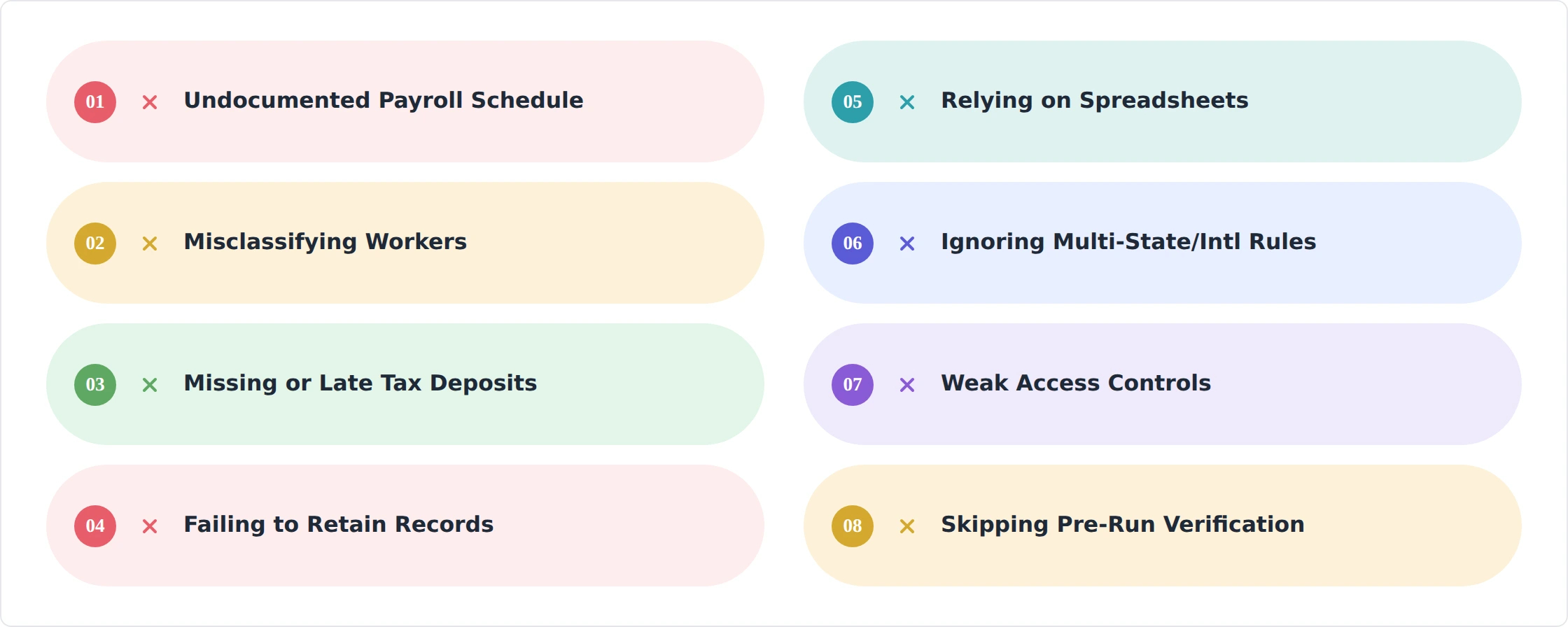
The practices above describe what to do. The following are the failure modes that most commonly create the problems payroll teams spend time cleaning up. Most are preventable with process discipline.
- Running payroll on an inconsistent or undocumented schedule. Ad-hoc processing creates missed deadlines, bank funding gaps, and employee complaints. A published payroll calendar is the simplest fix.
- Misclassifying workers. Employee vs. contractor and exempt vs. non-exempt errors are among the most expensive payroll compliance failures. Both the IRS and DOL conduct misclassification audits, and back-pay liability can extend years.
- Missing or mis-filing tax deposits. The IRS failure-to-deposit penalty is 2% for deposits 1 to 5 days late, 5% for 6 to 15 days late, 10% for more than 15 days late, and 15% after an IRS notice. These compound quickly for weekly depositors.
- Failing to retain records for the required period. The IRS minimum is four years; the DOL's FLSA minimum is three years. State rules can extend this further. Missing records during an audit shifts the burden significantly toward the employer.
- Relying on spreadsheets for payroll calculations. Formula errors, version conflicts, and manual entry mistakes are built into spreadsheet-based payroll. One incorrect formula in a shared file can affect an entire pay run.
- Ignoring multi-state or international tax obligations. Hiring a remote employee in a new state or country creates immediate payroll obligations in that jurisdiction. Assuming the home-state rules apply is one of the most common compliance errors for growing organizations.
- Weak access controls on payroll systems. Unrestricted access to payroll data increases the risk of both external breach and internal fraud. Role-based access and multi-factor authentication are the baseline controls.
- Skipping the pre-run verification step. A structured review before submission is the cheapest control in payroll. Most correction costs are incurred because errors reach employees before they are caught.
How Payroll Software Supports These Practices
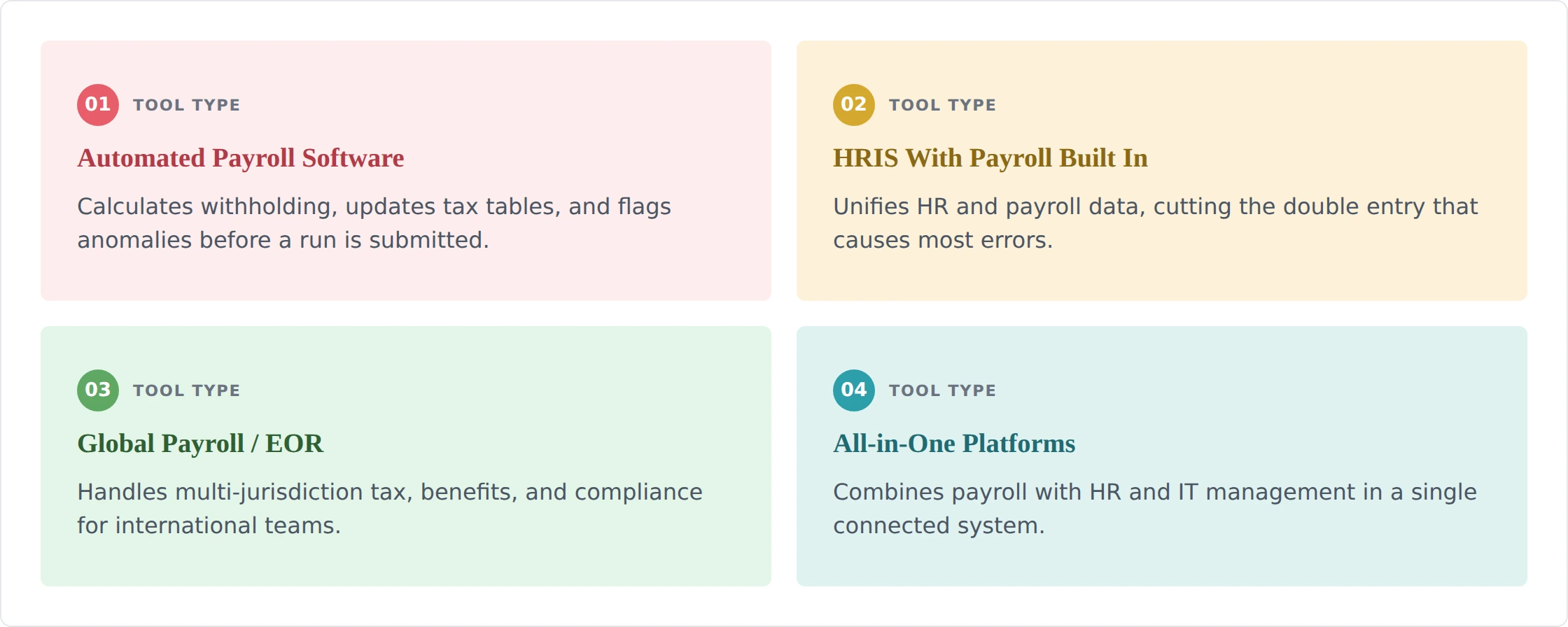
Manual payroll processes and disconnected systems create the conditions where most of the mistakes above become likely. Purpose-built payroll software addresses multiple practices simultaneously: it automates tax calculations and table updates, enforces approval workflows, maintains audit logs, and in modern platforms, flags anomalies before a run is submitted. Integrating payroll with your HRIS reduces the data entry between systems that is a primary source of errors.
If you are evaluating or upgrading payroll tools, the top payroll software guide covers the leading platforms by organization size and use case. For teams that want payroll integrated with HR and benefits in one system, the best HRIS software guide compares platforms that include payroll as a native module.
For organizations with international employees or contractors, tools designed for global payroll and employer-of-record services, such as Deel, address the multi-jurisdiction compliance challenges that practice 8 covers. And for US-based teams that want payroll automation tightly integrated with HR, IT, and finance, Rippling is one of the more commonly evaluated options in this space.
The right tool depends on your organization's size, workforce composition, and how many jurisdictions you operate in. Software does not replace process discipline, but it makes the processes in this guide significantly more reliable and less manual to execute.
Frequently Asked Questions (FAQs)
How often should payroll be run?
Biweekly is the most common frequency in the US at 43% of private-sector establishments, followed by semi-monthly, weekly, and monthly. The right choice depends on your workforce type, cash flow, and state law. Some states set minimum pay frequency requirements, so check your state labor department before deciding.
What is the fastest way to reduce payroll processing time?
Switching from spreadsheets to automated payroll software and integrating it with your time-and-attendance system eliminate the most time. Standardizing your data collection deadline and approval workflow takes care of most remaining scheduling delays.
How do we stay compliant when we have employees in multiple states?
Register with the tax authority in each new state before the employee starts, confirm your payroll system applies that state's rules automatically, and build a new-state compliance check into your hiring process. For more than three or four states, a platform that handles multi-state compliance automatically is more reliable than managing it manually.
Is payroll outsourcing a good idea for small businesses?
For many, yes. A payroll provider or PEO takes on much of the compliance burden around tax rates, filing deadlines, and regulatory changes. The trade-off is cost and reduced direct control. Either way, outsourcing does not transfer compliance responsibility, so still verify the provider's security posture and review output before each run.
.avif)