.svg)
Most people think preparation means showing up on time and knowing your job title, but it doesn't. Whether you're an employee, a manager, or on the HR team, what you do in the two weeks before a performance review has a bigger impact on how it goes than almost anything you do in the room. In the following, we'll be covering exactly what that looks like for each role.
Key Takeaways
- Preparation starts two weeks before the meeting, not the night before. If you're gathering evidence the day before the review, you've already lost the window to do it well.
- For employees, the self-assessment is the most important thing you'll submit. Vague and generic assessments hurt you even when they're positive. Specific evidence is what actually changes the conversation.
- For managers, the biggest mistake is rating from memory. Whatever happened most recently feels most significant, and that's how you end up with ratings that don't reflect the full year.
- For HR, the work happens before the cycle opens, not after. If the rating scale isn't defined in behavioral terms before managers start writing, calibration is nearly impossible to run fairly.
What Preparation Actually Changes
The two weeks before a performance review matter more than the meeting itself. If you didn't gather evidence, you're probably guessing. If you didn't review the full year, you're rating from memory. And if HR didn't lock down the process before the cycle opened, everyone is making it up as they go.
Gallup research found that only 14% of employees strongly agree that their performance reviews inspire them to improve. A well-run performance management process changes that. If you're also evaluating the tools that support this cycle, our guide to performance review software covers the leading platforms.
How to Prepare for a Performance Review as an Employee
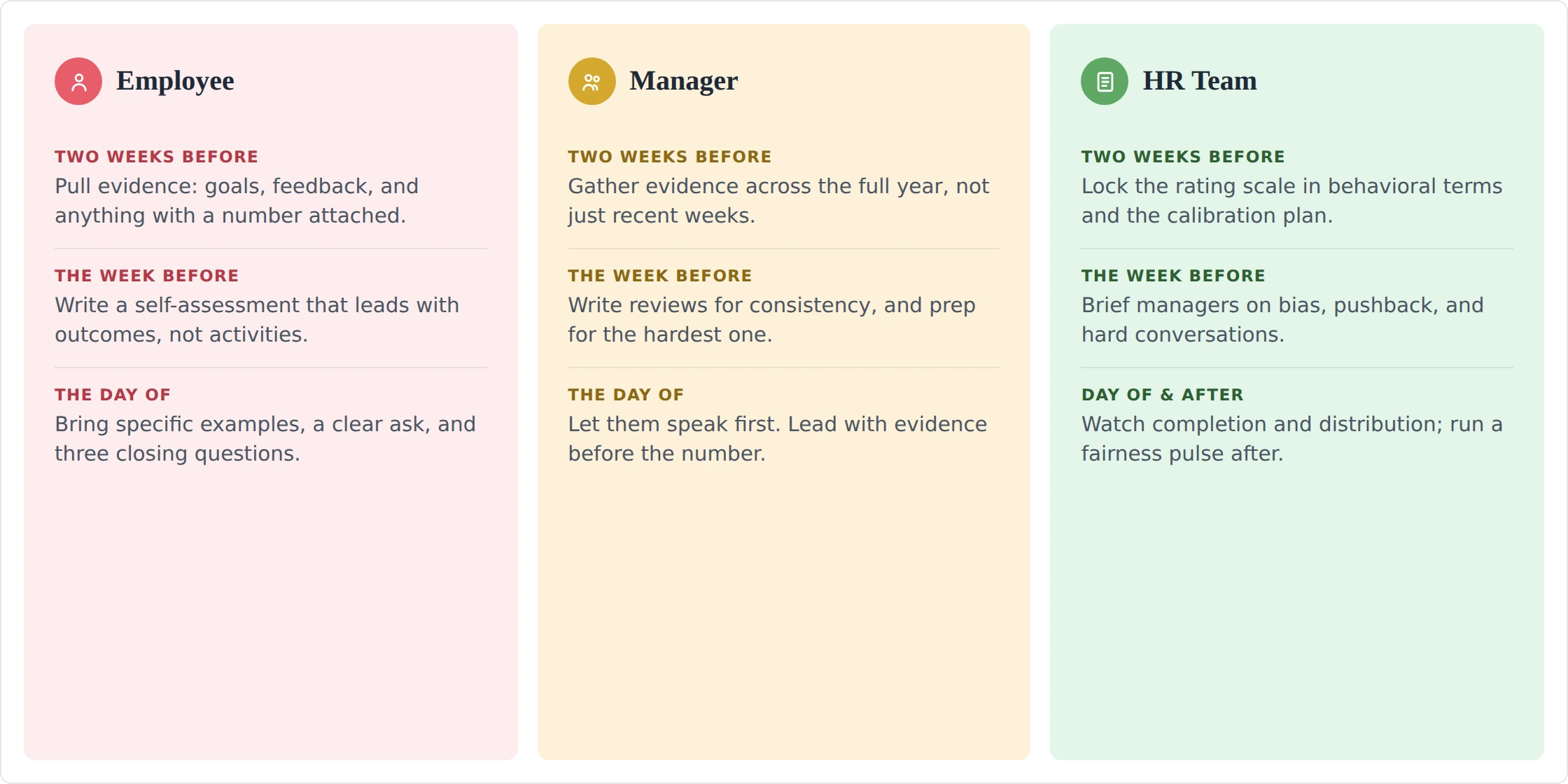
Most employees don't start preparing until the day before the meeting. By then, you've already missed your best opportunity to make the review work in your favor. In the following, we'll cover exactly what to do and when to do it so you're not scrambling at the last minute.
Two Weeks Before: Pull Your Evidence
Before you can write anything useful, you need raw material. Go back through the full year and look for anything concrete you can point to.
Here's where to start:
- Pull your goals from the start of the year and note where you actually landed against each one
- Check your email, project tools, and any feedback you received from teammates or clients
- Look for anything with a number attached (percentages improved, timelines hit, revenue touched)
- If you gave or received 360-degree feedback at any point during the year, pull that too
If you didn't track anything during the year, don't panic. Work backward from outcomes instead. What shipped? What changed because of something you did? Who did you help and what was the result? Even informal wins can be written up specifically if you take the time to think through what actually happened.
The Week Before: Write Your Self-Assessment
A self-assessment is not a summary of your job responsibilities. It's a specific account of what you actually did and what it produced. The most common mistake is writing in generalities that sound positive but don't tell the reviewer anything. Without specific evidence, you're leaving it entirely up to your manager to fill in the gaps, and they may not fill them in your favor.
Keep these in mind as you write:
- Lead with outcomes, not activities. What changed because of your work, not just what you did
- Attach a number wherever you can, even an approximate one is better than none
- If you received critical feedback earlier in the year, address it directly and show what you did about it
- Identify one or two genuine development areas and frame them as growth priorities for next year
Here's what the difference looks like in practice:
Also take this week to identify one or two areas you genuinely want to grow in. Framing them proactively shows self-awareness and makes the conversation easier. If you're thinking about development goals for the next cycle, have a rough idea ready before you go in.
The Day Of: What to Bring and What to Say
By now the hard work is done. The meeting itself is about presenting what you've already prepared and having an honest conversation about it.
Before you walk in, make sure you have these ready:
- Your self-assessment and goal list, even if you don't go through all of it
- Two or three specific examples you're ready to talk through if asked
- A clear ask if you're raising compensation or career progression, tied to the evidence you've gathered
- Three questions to close the meeting with: What would you want to see more of from me? Where do I have the most room to grow? Is there anything in this review I should push back on?
If you're raising a raise or promotion, don't wait for your manager to bring it up. A direct opener is far more effective than a tentative one. Tie it to your evidence, not to how long you've been in the role. Career management tools can help you build and track this kind of evidence across review cycles.
How to Prepare for a Performance Review as a Manager
If you're writing six to ten reviews, what you do in the two weeks before the cycle opens determines the quality of all of them. Without proper preparation, you're relying on memory, which isn't a fair or accurate basis for a rating. Here's how to prepare for a performance review and approach the process effectively.
Two Weeks Before: Gather Evidence Across the Full Year
The most important thing you can do right now is pull documentation from the full review period, not just what's fresh in your mind. Whatever happened most recently feels more vivid than it probably deserves, and that's how ratings end up skewed toward the last few weeks rather than the whole year.
Here's how to counter that before you write a single word:
- Go back through your one-on-ones, project records, and any notes you took throughout the year
- Check any skills or competency data available to you for each direct report
- For each person, identify the strongest specific thing they did this year and the clearest area where they fell short
- If you can't answer both of those with something concrete, you have a documentation gap to close before ratings go in
Two weeks is enough time to address gaps before the cycle opens. The goal is to walk into the writing process with evidence for every person, not impressions.
The Week Before: Write the Reviews and Prepare for the Hard Conversations
When you sit down to write, consistency across your team is the thing to watch for. If the same phrases are showing up for people at different rating levels, your standard is drifting from the role to the person.
Before you finalize anything, run through this checklist:
- Check that each rating maps to the role expectations, not to how the person compares to teammates
- Make sure every rating has at least one specific example behind it, not just a general impression
- For the rating that's going to land badly, write down your evidence, your response if the employee pushes back, and what you'd genuinely need to see to change your assessment
- If you have a calibration session coming up, flag any ratings you're uncertain about before you walk in
Preparing for the difficult conversation in advance is what separates a hard meeting that builds trust from one that damages it.
The Day Of: How to Open and What to Leave Them With
How you open the meeting sets the tone for everything that follows. Give the employee space to speak first before you share your assessment. It tells you what they think is being evaluated and where they may push back, before you've committed to a position.
Here are a few things to keep in mind throughout:
- Ask how they feel the year went before you share anything
- If the rating is difficult, lead with the evidence before the number
- Don't announce the score and then defend it. Walk them through what you observed and documented first, then show how it maps to the rating
- End every review with something concrete: what you want to see next cycle, what you'll do to support it, and when you'll follow up
No matter how the conversation goes, the employee should leave with a clear picture of where they stand and what comes next.
How to Prepare for a Performance Review as an HR Team
Almost everything written about performance review preparation is aimed at employees or managers. The HR team running the cycle is usually left to figure things out on their own. In the following, we'll cover what the team managing the process actually needs to do, and why it needs to happen before the cycle opens, not during it.
Two Weeks Before: Lock Down the Rating Scale and Calibration Plan
Before a single review is written, two things need to be confirmed and documented. If either of these is missing when the cycle opens, you'll spend the rest of the cycle cleaning up the mess.
Here's what to nail down now:
- Define what each rating level means in behavioral terms, not just a number, but observable behaviors a manager can point to
- Document who is in scope for calibration and share the calibration guide now, not after ratings come in
- Confirm who has the authority to change a submitted rating and under what circumstances
- Test the platform before launch day, not on it
Without behavioral definitions for the rating scale, every manager quietly applies their own, and calibration becomes nearly impossible to run fairly.
The Week Before: Brief Managers on the Conversation
A platform walkthrough is not manager preparation. Showing managers where to click does not prepare them for the conversations they're about to have. Your briefing needs to go further than that.
At a minimum, it should cover:
- What the rating criteria actually mean and how to apply them consistently across the team
- How to recognize recency bias in their own writing before they hit submit
- What to do when an employee strongly disagrees with their rating
- How to end a difficult review conversation with something concrete rather than leaving the employee with nothing to act on
If you're not covering those four things, you're running a software training and calling it manager prep. The managers who struggle most in review conversations are usually the ones HR never prepared for them.
The Day Of and After: Watch the Patterns, Rather Than Just the Deadlines
Once the cycle is live, your job shifts from preparation to monitoring. Most of the issues that surface during a review cycle are visible early if you know what to look for.
Here's where to focus:
- Track completion rates by manager from day one and follow up with anyone falling behind early, not the day before the deadline
- When ratings come in, look at the distribution before anything is finalized
- Any manager whose team sits significantly above or below the organizational norm needs a conversation before those ratings are locked
- After the cycle closes, run an engagement pulse to find out whether employees felt the process was fair
That last step is the one most HR teams skip. Without it, you're running the same cycle next year without knowing what actually needs to change.
What All Three Should Avoid
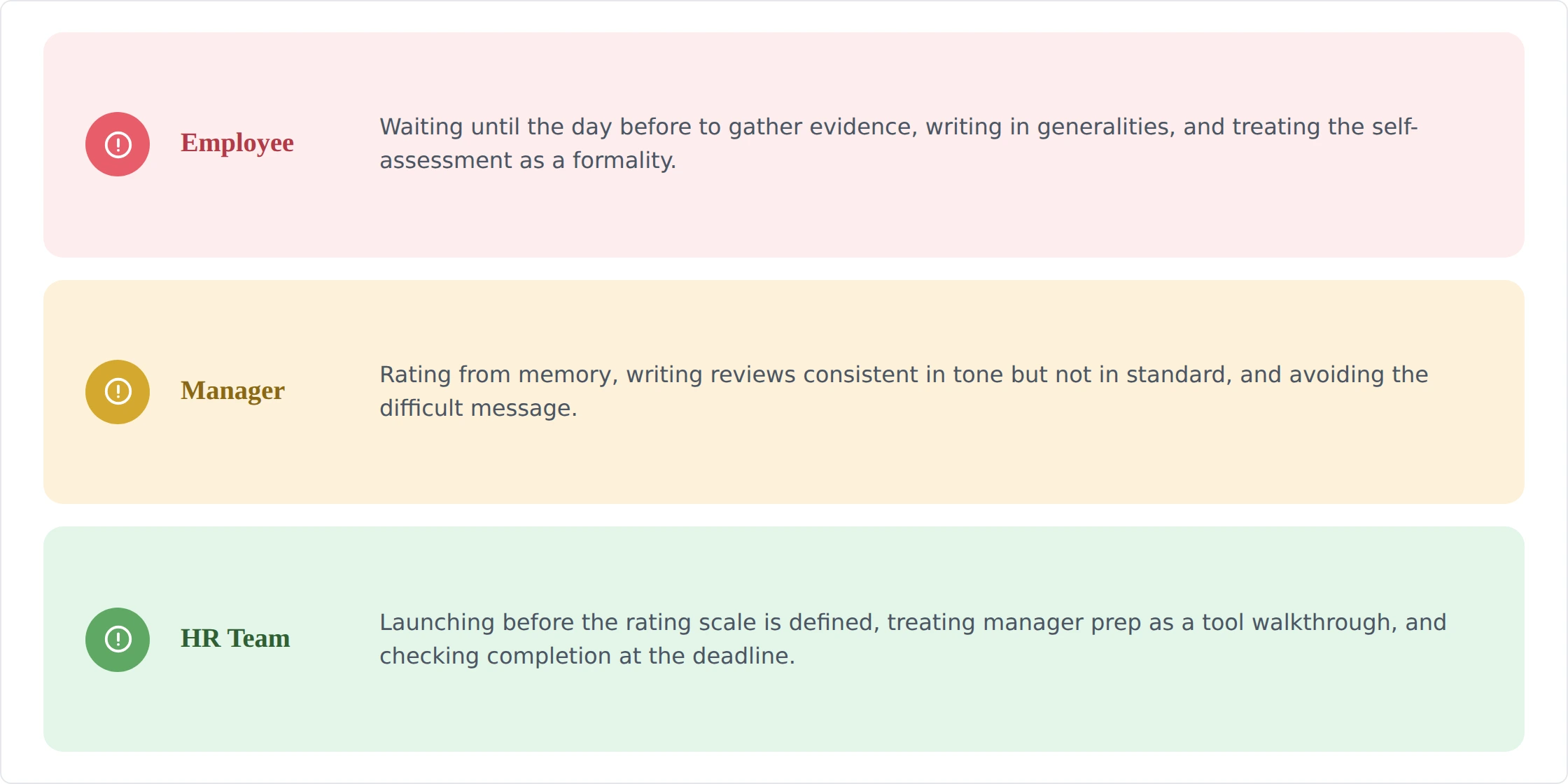
Preparation mistakes are predictable, and they tend to show up in the same places every review cycle. Here's what employees, managers, and HR teams consistently get wrong, and what it actually costs them when they do.
- Employees: Waiting until the day before to gather evidence. Writing in generalities. Treating the self-assessment as a formality rather than a tool.
- Managers: Rating from memory rather than documentation. Writing reviews that are consistent in tone but not in standard. Avoiding the difficult message and hoping the employee reads between the lines.
- HR: Launching the cycle before the rating scale is defined in behavioral terms. Treating manager prep as a tool walkthrough. Checking completion rates on the deadline rather than two weeks before it.
Frequently Asked Questions (FAQs)
How far in advance should you prepare for a performance review?
Two weeks is the minimum that gives you enough time to do it properly. You need one week to gather evidence and one week to write your self-assessment. If you're a manager writing multiple reviews, you may need a full three weeks to document the whole year fairly across your team. The day before is too late to do anything useful with.
What should you write in a self-evaluation if you didn't track your work during the year?
Work backward from outcomes. What shipped, improved, or changed because of your work? Go through your email, your calendar, and any project tools you used throughout the year and pull out the specific things that happened. Even undocumented wins can be framed specifically if you can name what you did, what it produced, and why it mattered. Vague self-assessments hurt you more than they help, even when they're positive.
What questions should you ask in a performance review?
Three questions that actually move things forward: What would you want to see more of from me next year? Where do you think I have the most room to grow? Is there anything in this review I should push back on or that I can add to? That last one is especially useful. It signals that you take the process seriously and opens the door to a more honest conversation than you'd otherwise get.
How should a manager prepare to deliver a rating the employee will disagree with?
Before the meeting, write down your specific evidence for the rating, your response if they say it's unfair, and what you'd need to see to change your assessment. In the meeting, lead with the evidence rather than the number. End with something concrete: what you want to see in the next cycle and when you'll check in on it.
Should you bring up a raise in a performance review?
Yes, if that's your goal. Don't wait for your manager to bring it up. Raise it directly and tie it to the evidence you've gathered rather than to how you feel about your current number or how long you've been in the role. Know what you're asking for before you walk in.
.avif)