
.svg)
The survey closed with a 78% participation rate. The eNPS came back at 12. Leadership asked what happens next. Six months later, the dashboard still shows the same numbers, and the managers who received their team reports have not changed anything.
This is the standard trap of survey fatigue: measuring sentiment without driving change. When done right, acting on this feedback pays off. Data shows that highly engaged teams see a 22% increase in organizational citizenship, meaning employees proactively help colleagues and support the company beyond their core duties.
This article covers the 10 best employee engagement survey platforms evaluated for survey design quality, anonymity architecture, open-text analysis, benchmarking depth, action planning workflows, and integration fit.
If you’re still deciding whether a dedicated survey platform is the right category for your problem, or whether you need broader engagement coverage that includes recognition and wellbeing, start with our employee engagement software guide first and return here when you have narrowed to the survey-first question.
What to Look for in Employee Engagement Survey Software
Not every platform in this category is solving the same problem. Before you start booking demos, the five criteria below are the ones that separate credible platforms from form builders with HR branding.
1. Anonymity Architecture: Will Employees Tell You the Truth?
Anonymity is a structural system property, not a simple toggle. To protect employees and ensure honest feedback, look for a platform that suppresses team results below a strict threshold (the industry standard is four to five respondents).
The logic must also block cross-tabulation, preventing managers from identifying individuals by combining demographic filters like department and tenure. A single data leak can ruin employee trust and tank participation rates for years.
2. Action Planning: Behavior Change or Just a Dashboard?
Most platforms fail at driving actual post-survey manager behavior. Evaluate the exact workflow: does the system provide specific, contextual action steps based on low scores, or just generic tips? Leadership needs an organizational dashboard to track which managers have launched action plans and which are stagnant. Tools like Culture Amp and Workday Peakon build action planning directly into the product core, transforming passive data into active development.
3. Open-Text Analysis: Usable Insight or Auto-Generated Word Cloud?
Large organizations can easily generate thousands of open-text comments that are impossible to read manually. Effective platforms use semantic clustering to group comments by underlying meaning rather than basic keyword matches.
Look for comment-level sentiment scoring and multi-language support. While Qualtrics Text iQ leads the market, AI-driven themes in tools like Leapsome and Workleap have improved but can still occasionally yield broad, unactionable categories.
4. Benchmarking: Is the Dataset Real, Current, and Relevant to Your Industry?
Benchmarking quality varies wildly across vendors. Before presenting data to your executive board, confirm the dataset's refresh frequency, company count, and industry alignment. Culture Amp sets the standard with continuous updates across over 5,000 companies.
Enterprise competitors like Workday Peakon and Qualtrics offer robust comparative data, whereas smaller or tech-heavy datasets from tools like Lattice or Teamflect are best used for directional guidance rather than definitive reporting.
5. eNPS, Pulse Cadence, and Survey Fatigue Management
Transitioning from annual surveys to bi-weekly pulse surveys can quickly trigger survey fatigue and tank response rates. To combat this, select software that utilizes smart sampling and automated question randomization. For eNPS tracking, the platform should treat the metric as a continuous, recurring pulse rather than a manual, one-off project, seamlessly embedding the collection into the regular flow of work.
How We Evaluated These Software
This list was not built from vendor submissions or sponsored placements. Our team ran a structured research process across several layers before a platform made the cut.
We started with review aggregators like G2 and Capterra, analyzing sentiment patterns across hundreds of verified user reviews rather than relying on star ratings alone. From there, we cross-referenced analyst coverage and community discussions to identify recurring complaints that polished marketing pages tend to hide.
Where free trials or freemium tiers were available, we tested them directly, evaluating survey builder usability, anonymity controls, reporting depth, and how far action planning actually goes beyond a dashboard. Platforms that looked strong on paper but fell short in practice were cut.
The final list reflects platforms that hold up across the criteria outlined above: anonymity architecture, action planning workflows, open-text analysis quality, benchmarking depth, and integration fit. No platform paid to be included.
10 Best Employee Engagement Survey Platforms in 2026
Here is the ranked shortlist with full entry detail. The order follows the rubric scores. Where two tools are close, the tie-breaker is specificity of fit for the most common buyer profiles.
1. Culture Amp

Culture Amp is the default starting point for HR Directors who have outgrown SurveyMonkey or an HRIS bolt-on and want a platform built specifically for organizational psychology. The Develop module, which connects survey themes to manager action plans, is the most mature action-planning workflow in the category.
For organizations with 500 or more employees and a People Analytics function that needs to report engagement trends to a board, this is the benchmark against which everything else is measured. The platform originated the modern employee engagement survey category and its benchmarking dataset remains the standard buyers cite when defending data quality to executives.
Key Features
- Annual, lifecycle, and pulse surveys with validated question banks built by organizational psychologists
- Develop module connecting survey theme scores to manager action plans with tracking and completion visibility
- Benchmarking across 5,000+ companies, filterable by industry, size, and geography, refreshed continuously
- Open-text analysis with comment-level sentiment scoring and theme extraction
- Manager-level dashboards with score breakdowns, trend lines, and recommended actions
- Skills Coach feature providing AI-driven manager development content tied to engagement theme scores
- Native integrations with Workday, BambooHR, Rippling, ADP, and Slack
Pros and Cons
Pros: "We use CultureAmp to collect and provide semi-annual peer and management performance feedback. The platform is relatively simple and straightforward." — Capterra reviewer
- Develop module is the most complete manager-to-action workflow in the category for mid-market organizations
- Benchmark dataset quality and refresh frequency are cited more often than any other platform's in G2 reviews for executive-level credibility
- Skills Coach adds a development loop between survey results and manager capability that most platforms do not offer
Cons: "It has some limitations for uploading files or evidence that can be added as a follow-up to show that some goals have been achieved or worked on." — G2 reviewer
- Custom pricing with significant year-over-year variance at renewal; budget predictability is a consistent complaint in G2 reviews
- Configuration for complex org structures (matrix reporting, multiple business units, country-level permissions) requires dedicated admin time and occasionally a Professional Services engagement
- Open-text analysis produces summaries rather than deep insights for organizations running multiple survey types simultaneously; Qualtrics Text iQ outperforms at high comment volume
Pricing
Custom pricing, so contact sales. Entry tier typically quoted at approximately $4,500 per year for organizations under 200 employees, scaling with headcount and modules. Multi-year contracts typically lower the per-employee cost.
2. Qualtrics EmployeeXM

Qualtrics EmployeeXM is the right platform for the Enterprise Listener — organizations with 2,000 or more employees running lifecycle listening across onboarding, stay, exit, and alumni surveys alongside continuous pulse programs and annual census surveys.
Text iQ, Qualtrics' open-text analysis engine, is the most sophisticated in the category: automatic theme extraction, sentiment scoring, issue flagging, and multilingual analysis at scale, verified across multiple enterprise deployments. The platform's configuration depth is both its strength and its main friction point.
For regulated industries, such as financial services, healthcare, and the federal government, where survey governance, data residency controls, and audit-trail requirements are non-negotiable, Qualtrics is typically the only platform in contention.
Key Features
- Text iQ open-text analysis: automatic theme extraction, comment-level sentiment scoring, and issue flagging across 25+ languages
- Full lifecycle listening suite: onboarding, stay, exit, and alumni surveys with automated trigger logic
- Annual census, continuous pulse, and ad-hoc survey management in one governance layer
- Segmentation and cross-tab filtering down to custom demographic combinations with suppression controls
- Multi-country, multi-language deployment with data residency options for EU, APAC, and regulated markets
- Role-based reporting with configurable access controls for business unit leaders, HRBPs, and managers
- Native integrations with Workday HCM, SAP SuccessFactors, Oracle HCM, and Salesforce
Pros and Cons
Pros: "It helps me track my performance at work. It also helps keep track of team collaboration efforts. I like the profile feature to see how well i have been doing." — Capterra reviewer
- Text iQ remains the strongest open-text analysis engine in the engagement survey category for high-volume enterprise deployments
- Lifecycle listening completeness is the most thorough available without third-party add-ons
- Data governance, residency controls, and audit capabilities meet the requirements of regulated industries and large multinational organizations
Cons: "It can be an expensive tool. For using its advanced features some training might be needed and specially to integrate it with other tools in your organization." — G2 reviewer
- Implementation is heavy: typical enterprise deployment runs 3 to 6 months and frequently requires a certified implementation partner alongside internal HRIS resources
- Pricing starts at approximately $30,000 per year and scales with seats and modules; total cost of ownership at enterprise scale routinely reaches six figures
- Action planning workflows are weaker than Culture Amp's Develop module; Qualtrics produces exceptional survey data and requires more manual effort to convert results into manager behavior change
Pricing
Custom enterprise pricing, so contact their sales team. Buyer-reported ranges from G2 and Capterra reviews indicate starting contracts at approximately $30,000 to $50,000 per year for organizations of 500 to 1,000 employees, scaling to $150,000+ for global enterprise deployments.
3. Teamflect

Teamflect operates exclusively within Microsoft 365, embedding pulse surveys, eNPS tracking, and feedback loops directly inside Microsoft Teams and Outlook. For organizations built around this ecosystem, it removes the friction of deploying a standalone tool. Surveys arrive as interactive notifications where employees already collaborate, keeping participation high without separate credentials or reminder emails.
Because Teamflect is a unified performance and alignment suite, it is perfectly suitable for enterprise organizations that want a complete view into the employee experience across both engagement and performance.
Teamflect also automatically maps organizational structures through Entra ID, pushes data to Power BI for custom reporting, and syncs with over 200 standard HRIS platforms.
Key Features
- Administer, complete, and track pulse surveys and eNPS directly inside Microsoft Teams chat and Outlook without leaving the workflow.
- Built-in AI summarizing tools and an HR Agent analyze open-text survey responses, spot sentiment trends, and flag potential burnout risks.
- Access fully customizable templates for engagement, wellbeing, manager effectiveness, and onboarding with multiple question variations.
- Deeper analysis is supported through native Power BI dashboard connections, automated workflow triggers via Power Automate, and secure data mapping using Entra ID.
- Syncs user profiles and organizational hierarchies seamlessly with over 200 HRIS platforms (including BambooHR, HiBob, Rippling, and Gusto).
- Completely free with full functionality for up to 10 users, making it highly accessible for pilot testing.
Pros and Cons
Pros: "I like Teamflect for its simplicity and how it integrates into Teams, allowing me to keep it open during a meeting. This makes it easy to track and review notes from previous meetings. The initial setup was very easy, which was a plus." — G2 reviewer
- Native Teams deployment solves the adoption problem that separate survey tools face in Microsoft 365 organizations; no separate login required for managers or employees
- Unified people platform reduces the tool count for organizations running performance, surveys, goals, and recognition on separate products
- Transparent, predictable pricing is a structural advantage over platforms requiring custom quotes for comparable headcount
Cons: "Lake of documents Approval management (GOALS ,KPIs) thats it so far." — Capterra reviewer
- Requires Microsoft 365; no viable path for Google Workspace organizations or hybrid stacks where Teams is not the primary collaboration tool
Pricing
Free plan for up to 10 users (full feature access). Essential plan: $5/user/month billed annually. Professional plan: $11/user/month billed annually.
4. Workday Peakon Employee Voice
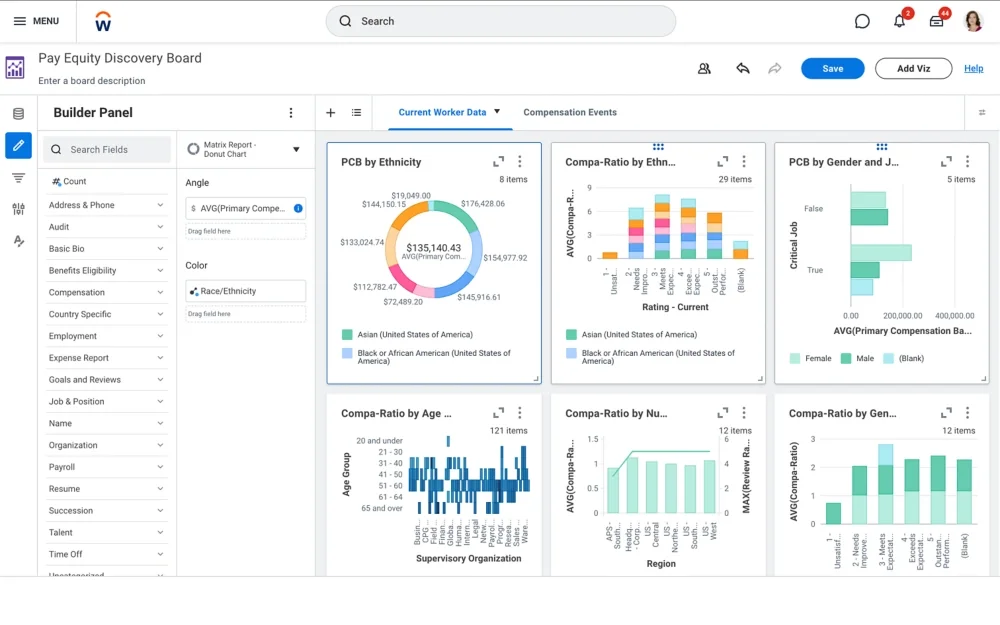
Workday Peakon is the right answer for the Enterprise Listener already on Workday HCM. Acquired by Workday in 2021, Peakon is a continuous-listening platform built around pulse cadence rather than annual surveys.
Because it runs inside the Workday ecosystem, the org chart, manager hierarchy, and employee lifecycle data that drive segment-level reporting are always current; there’s no sync delay, no integration maintenance, and no reconciliation between the engagement platform and the HRIS.
The action-planning workflow is among the strongest in the category: machine-learning-driven question selection adapts the survey to each employee's responses over time, and manager dashboards surface recommended actions alongside driver scores rather than leaving interpretation to the manager alone.
Key Features
- Continuous pulse surveys with machine-learning-driven question selection personalized per employee
- Driver analysis identifying the factors with the highest statistical correlation to engagement scores within each team
- Manager dashboards with recommended actions tied to specific driver scores and open-text themes
- Native Workday HCM integration with real-time org chart and hierarchy sync
- Lifecycle survey triggers for onboarding, promotion, manager change, and exit
- Confidentiality engine with configurable suppression thresholds and manager access controls
- Multi-language support across 58 languages with regional benchmark data
Pros and Cons
Pros: "Employee management, user friendliness, ease of use and access, and seamless collaboration are just a few of the key favorite factors within this software." — Capterra reviewer
- Native Workday integration eliminates the org-chart and hierarchy sync problem permanently; segment accuracy is the highest in the category for Workday customers
- Machine-learning question selection reduces survey fatigue over time compared to static question sets
- Driver analysis and manager-facing action recommendations are more operationally specific than most platforms' equivalent features
Cons: "It is declared as an anonymous, but it is posible to identify feedbacks if there is a need for that" — G2 reviewer
- The platform's primary value is tied to Workday HCM; organizations on other HRIS platforms get a strong engagement tool but lose the native integration advantage
- Custom pricing bundled inside Workday contracts makes total cost opaque during procurement; buyer-reported figures range from $8 to $20 per employee per month depending on contract structure
- Configuration of the confidentiality engine and segment suppression rules requires Workday admin access; HR teams without a Workday systems administrator face a longer setup timeline
Pricing
Custom pricing bundled inside Workday contracts, so contact sales or your existing Workday account manager. Buyer-reported ranges from G2 indicate $8 to $20 per employee per month depending on contract structure, organization size, and bundled modules.
5. 15Five

15Five is the right platform for the Pulse Convert who also wants survey data feeding directly into the manager's weekly workflow. The Engage module runs engagement surveys and eNPS inside the same platform as weekly check-ins, one-on-ones, and performance reviews.
A manager reviewing their team's engagement score in 15Five can move directly to their one-on-one agenda for the following week without opening a second tool. That workflow integration is the differentiator here, not the survey science itself.
For organizations evaluating the connection between engagement data and performance reviews or one-on-one meeting software, 15Five is consistently one of the top two or three options.
Key Features
- Engagement surveys and eNPS via the Engage module, integrated with weekly check-ins, one-on-ones, and performance reviews
- Pulse survey cadence with configurable frequency and smart sampling to manage participation fatigue
- Manager-level dashboards showing engagement scores alongside performance data and recent check-in themes
- Benchmarking against industry and size-band peers within the 15Five customer network
- HR Outcomes Dashboard connecting engagement trends to retention, absenteeism, and performance metrics
- AI-driven manager coaching suggestions tied to engagement driver scores
- Native integrations with BambooHR, Workday, ADP, Slack, and Microsoft Teams
Pros and Cons
Pros: "It was great. Very easy to use and learn and all of the performance reviews were simple to submit and it was clear how it would work." — Capterra reviewer
- Cross-module integration between engagement, check-ins, and reviews is the strongest workflow connection in the category for organizations with a manager-led culture
- HR Outcomes Dashboard is one of the few platforms to surface the correlation between engagement trends and workforce metrics like turnover and absenteeism
- Transparent, predictable pricing is a practical advantage over custom-quote platforms at comparable headcount
Cons: "The engagement benchmarks skew heavily toward tech companies. Our benchmarks as a healthcare organization were not useful for the reports we needed to present to our board." — G2 reviewer
- Benchmark dataset skews toward technology and software organizations; less reliable for healthcare, manufacturing, retail, and other non-tech industries
- Open-text analysis is functional but produces broader theme labels than culture-specialist platforms; organizations processing large comment volumes will need supplemental manual review
- Engage module is priced as an add-on to the Perform plan; full platform cost of $15/user/month or more is a significant step up from entry-level survey-only pricing
Pricing
Engage plan (surveys only): $4/user/month billed annually. Perform plan (performance reviews and check-ins): $11/user/month billed annually. Total platform (both modules): $16/user/month.
6. Workleap Officevibe
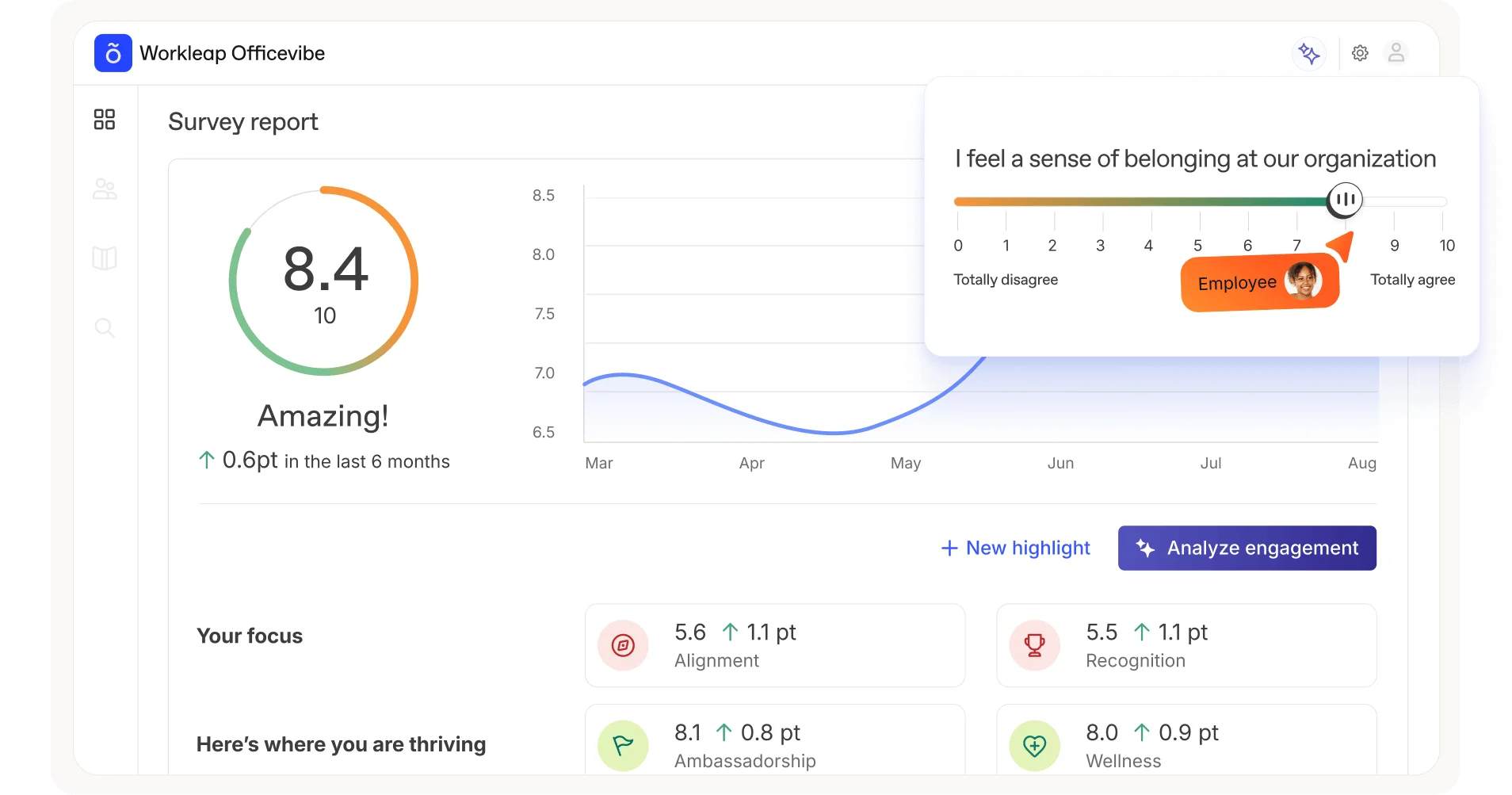
Workleap Officevibe is the right starting point for the First-Timer and the Pulse Convert at smaller organizations. The platform pioneered the weekly pulse format and its deployment speed is genuinely faster than any other platform in this list.
The Workleap umbrella, which now includes Workleap Performance and Workleap Onboarding alongside Officevibe, adds a broader people platform story for organizations that want to grow into adjacent modules. For organizations that primarily need good employee feedback software without enterprise-level complexity, Officevibe is the most practical entry point in the category.
Key Features
- Weekly pulse surveys with 26 engagement metrics organized across five categories
- eNPS tracking as a standard recurring measurement with trend visualization
- Anonymous Good Vibes recognition and direct anonymous employee feedback to managers
- Manager-level reports with comparison to the Workleap benchmark dataset and recommended conversation starters
- Automated survey cadence with rotating question sets to reduce fatigue
- Custom survey builder for ad-hoc questions alongside the standard pulse
- Native integrations with Slack, Microsoft Teams, BambooHR, ADP, and Google Workspace
Pros and Cons
Pros: "I think the product is good and certainly what our company was looking for regarding surveys." — Capterra reviewer
- Fastest deployment path in the category; no implementation timeline, no dedicated admin requirement, and no professional services budget needed
- Anonymous Good Vibes and direct anonymous feedback channel add a recognition and feedback layer that most pure-play survey platforms lack at this price point
- Transparent pricing with a free trial available makes procurement straightforward for SMBs without a formal software evaluation process
Cons: "An improvement would be the ability for a trainer to send a reminder to complete a training to a user on an ad-hoc basis. The reminder option exists, but only if it is scheduled in advance." — G2 reviewer
- Benchmarking dataset and open-text analysis depth are suitable for directional reporting but not for executive or board-level presentations at organizations above 400–500 employees
- Custom survey design flexibility is limited relative to Culture Amp, Qualtrics, or Lattice for organizations that want to add validated psychometric scales alongside the standard pulse
- No lifecycle survey triggers for onboarding, stay, or exit without the broader Workleap bundle
Pricing
At $99 per manager, per month (billed annually), this tier is positioned to yield up to $11,000 in saved organizational value per manager each year by automating and optimizing leadership workflows.
7. Lattice Engagement
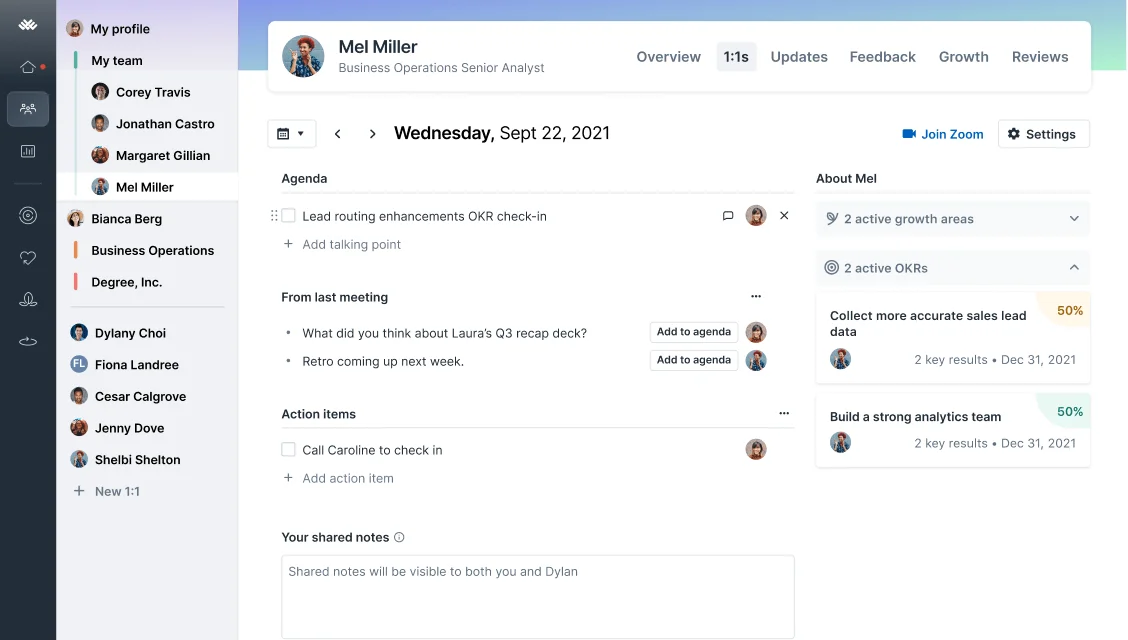
Lattice Engagement is the right choice for organizations already evaluating or using Lattice for performance reviews, OKRs, and growth conversations, and who want engagement surveys in the same platform rather than running a separate survey vendor.
The integration story is genuine: a driver theme surfacing in an engagement survey can be linked to an OKR adjustment, a development conversation, or a compensation review within the same workflow.
For organizations looking for a platform that connects performance reviews, goals, and engagement data in one place, Lattice is one of the three or four platforms that actually delivers on that connection rather than just promising it.
Key Features
- Engagement surveys, pulse surveys, and eNPS within the broader Lattice platform
- Survey analytics with driver analysis, team-level breakdowns, and trend tracking
- Integration with Lattice performance reviews, OKRs, and growth modules for cross-module insight
- AI-driven insights connecting engagement themes to performance and development data
- Manager-level dashboards with engagement scores alongside performance and feedback history
- Configurable anonymity thresholds and segment suppression controls
- Benchmarking against the Lattice customer network with industry and size-band filters
Pros and Cons
Pros: "The workflows and onboarding templates. They were easy to use and easy to create and personalize. Great support team to work with." — Capterra reviewer
- Cross-module data connection between engagement, performance, and OKRs is more operationally useful than maintaining two separate platforms with manual data exports
- Strong G2 rating of 4.7/5 reflects consistent user satisfaction with the integrated workflow rather than the survey module in isolation
- Engagement add-on pricing ($4/user/month on top of the Talent Management base) is transparent and allows organizations to evaluate the full cost before committing
Cons: "The global salary calculator or assessment bit is challenging, and I wish the pricing model was a bit different. Also, I feel like the 'growth' and 'grow' functions do something similar, so I wish there was a better distinction between the two functions." — G2 reviewer
- Benchmarking dataset is smaller and more technology-company-weighted than Culture Amp or Workday Peakon; less reliable for industries outside tech and professional services
- AI-driven insights are improving but still maturing; users report that theme suggestions occasionally miss nuance that a human analyst would catch
- Engagement is an add-on to the base Lattice platform; organizations that need engagement surveys without performance reviews are paying for functionality they do not need
Pricing
Engagement, Grow, or Compensation add-on: $4/user/month each, billed annually. Requires Talent Management base plan at $11/user/month. Minimum annual spend of $4,000 applies. Total platform cost for engagement plus performance: approximately $15/user/month for organizations above the minimum.
8. Medallia for Employee Experience
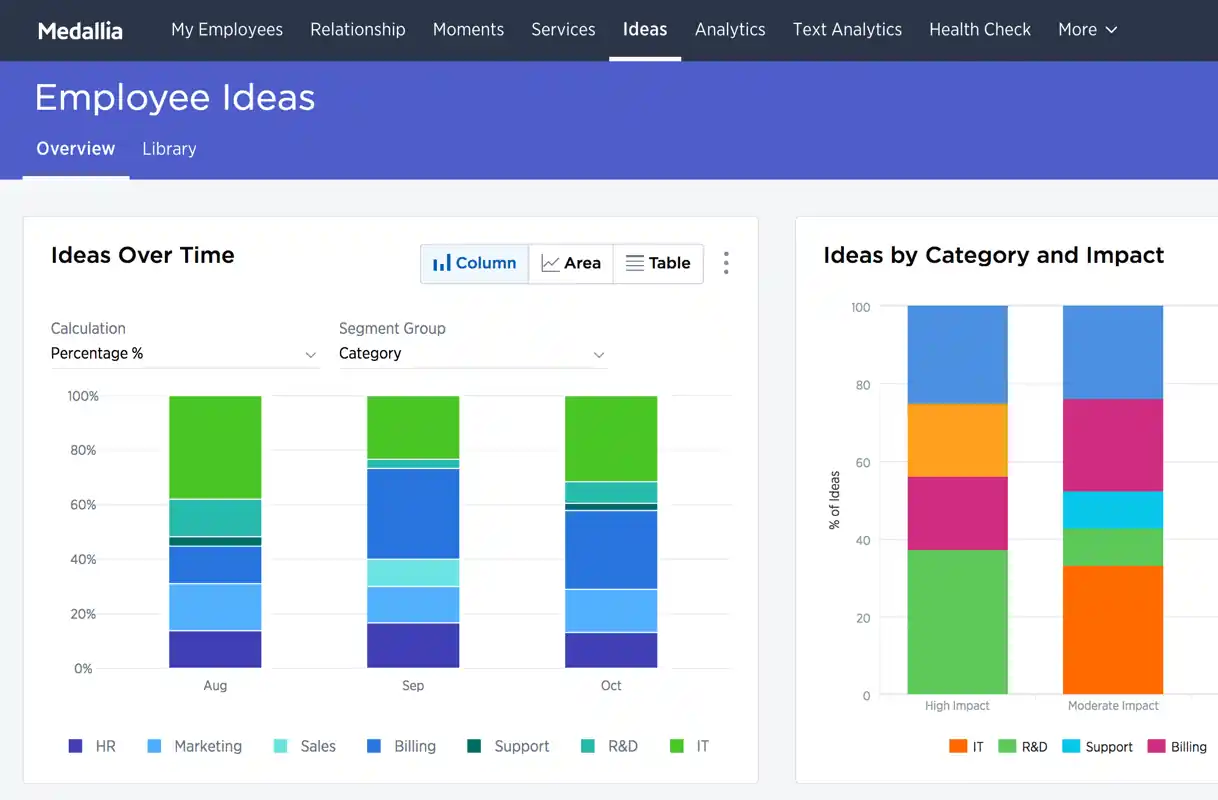
Medallia originated in customer experience and brought enterprise-grade text analytics, sentiment analysis, and action management workflows into employee experience. The platform's distinctive fit is for organizations, particularly in retail, hospitality, healthcare, and financial services, where frontline employee experience directly drives customer experience and where HR and CX teams share a strategic reporting line.
For organizations where that CX/EX connection is genuinely part of the strategy, Medallia offers something no other platform in this list provides: a single analytics layer across both employee and customer listening programs. For organizations where that connection does not exist, the platform's complexity and enterprise pricing are harder to justify against pure-play alternatives.
Key Features
- Enterprise-grade open-text analytics with sentiment scoring and automatic theme extraction across employee and customer feedback
- Lifecycle listening across onboarding, continuous pulse, stay, exit, and alumni surveys
- Action management workflows with owner assignment, due dates, and completion tracking
- Role-based reporting with configurable access controls across business units, regions, and functions
- Multi-channel survey distribution: email, SMS, mobile app, kiosk for frontline workers
- Native integration with Workday, SAP SuccessFactors, and Salesforce
- CX/EX unified reporting for organizations running Medallia across both employee and customer programs
Pros and Cons
Pros: "The feedback from customers and the ability to rank our performance and acknowledge the associate. Also, if it was a complaint, we had the chance to fix what was wrong" — Capterra reviewer
- CX/EX integration is genuinely unique in this category and delivers measurable strategic value for frontline-heavy organizations
- Open-text analysis quality and action management workflow depth are among the strongest available for enterprise deployments
- Multi-channel distribution including SMS and kiosk makes the platform suitable for frontline and non-desk workers who are systematically underrepresented in email-based survey programs
Cons: "The delay between the shiny new features and the actual implementation can take some time." — G2 reviewer
- Implementation timelines of 6 to 12 months are consistent across G2 reviews; this is not a platform for organizations that need to be live in a quarter
- Pricing is enterprise-tier and typically requires a multi-year contract; not a practical option for organizations below 1,500 to 2,000 employees
- The CX/EX integration value is only realized if Medallia is already deployed or is being deployed for customer experience; HR teams evaluating Medallia without the CX context are paying for a capability they cannot use
Pricing
Software directory listings like Capterra note a nominal starting price of $5, but Medallia operates on a strictly custom, enterprise-grade pricing model. To get an accurate quote, you will need to contact their sales team directly for a scoped proposal.
9. Leapsome
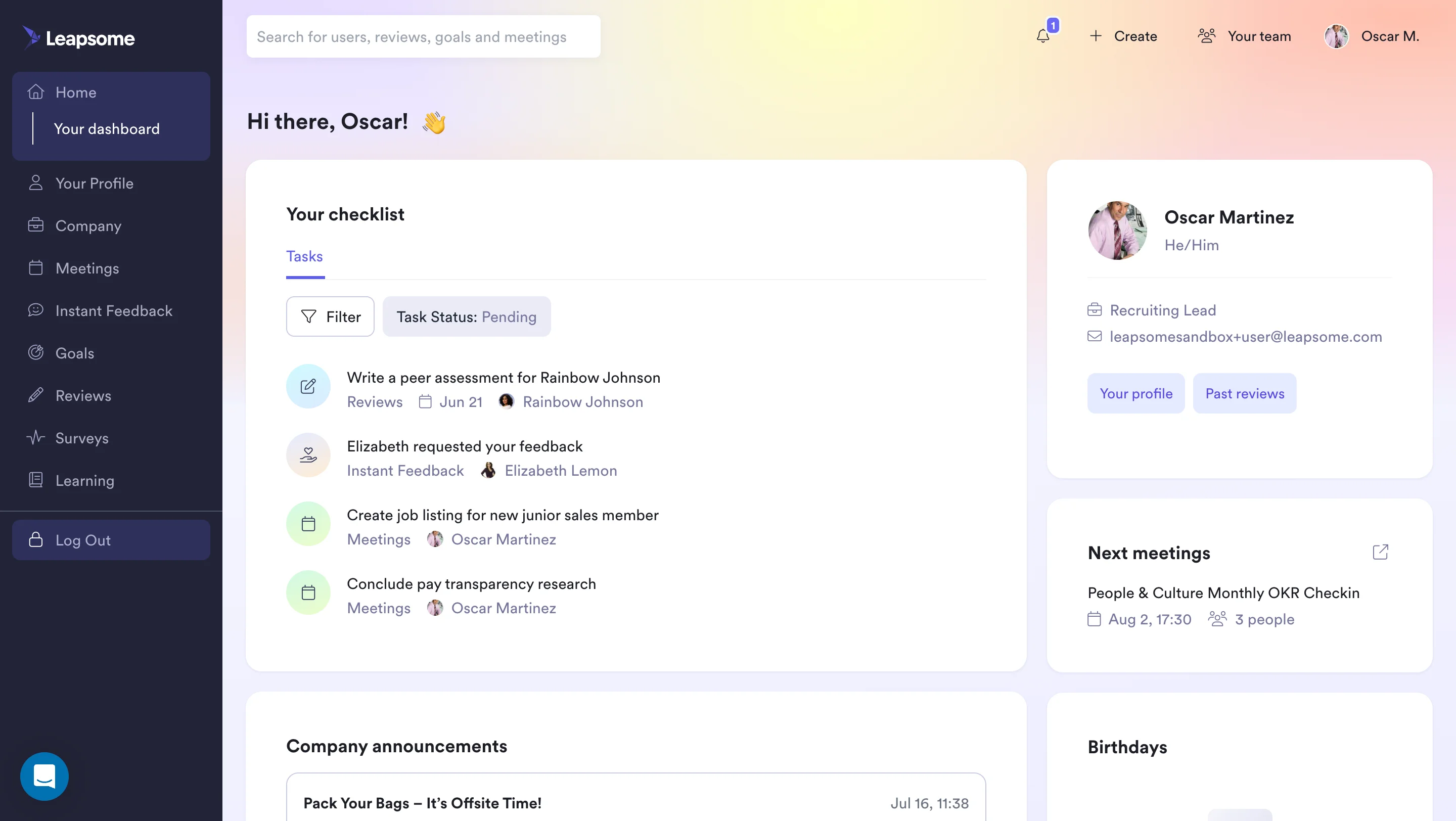
Leapsome is the strongest option for European organizations that need a unified people platform, engagement surveys, performance reviews, goals, one-on-ones, learning, and compensation in one place, with GDPR-native architecture built in from the start rather than added as a compliance layer.
The platform's user base skews heavily toward DACH (Germany, Austria, Switzerland) and broader European markets, and its data residency, consent management, and anonymity controls reflect that regulatory context.
Leapsome AI, overhauled in 2024, produces credible theme extraction and action recommendations from open-text survey data. For 360-degree feedback buyers who also need engagement surveys, the cross-module connection between feedback results and engagement data is among the strongest available without custom development.
Key Features
- Engagement surveys, pulse surveys, and eNPS with GDPR-compliant anonymity architecture and consent management
- Leapsome AI for survey theme extraction, sentiment analysis, and action recommendation generation
- Unified platform covering performance reviews, goals, one-on-ones, learning, and compensation
- Benchmarking with peer set filtering by industry, company size, and geography
- Manager-level dashboards with driver analysis and trend tracking
- Multi-language support across 13 languages, with EU data residency options
- Native integrations with BambooHR, HiBob, Personio, Workday, and Slack
Pros and Cons
Pros: "I like Leapsome's UI because it's easy to use and has in-app instructions showing me how to do different tasks. The UI is really great. Setting up was easy, and the team supported me well on how to use it, with no obstacles." — G2 reviewer
- GDPR-native architecture is a structural advantage over US-first platforms that add EU compliance as a configuration layer
- Unified people platform coverage at a price point ($8/user/month) that is competitive with running two or three separate tools
- Leapsome AI theme extraction is the most improved open-text capability in the category since 2024; competitive with Culture Amp for organizations under 1,000 employees
Cons: "The loading of the was very slow at uploading customers support was slow." — Capterra reviewer
- Benchmark dataset is smaller than Culture Amp's and more Europe-weighted; less useful for US-headquartered or APAC organizations
- AI-driven action recommendations are credible but occasionally surface suggestions too generic for managers to act on without reinterpretation
- Custom pricing with opaque quote process makes budget planning slower than for transparent-pricing competitors; most buyers need a demo before receiving a figure
Pricing
Leapsome operates on a modular, quote-based pricing structure tailored to your specific organizational needs. Your total cost is determined by three primary factors: your total employee headcount, the specific platform modules you choose to activate, and your committed contract length.
Please note that Leapsome requires a minimum commitment term of one year for all contracts. To receive an accurate quote for your organization, you will need to contact their sales team directly.
10. WorkTango

WorkTango is the right platform for organizations whose engagement strategy treats recognition as a primary driver of sentiment and not a separate program running alongside surveys. The platform combines engagement surveys, pulse surveys, and eNPS with a recognition and rewards module in one unified product.
For organizations where the employee recognition software and the survey program are currently managed by two separate vendors, WorkTango offers a practical consolidation path.
The survey module is solid for mid-market use. The differentiator is the recognition integration: engagement trends and recognition activity sit in the same analytics view, making it easier to correlate recognition programs with sentiment movement over time.
Key Features
- Engagement surveys, pulse surveys, and eNPS with configurable anonymity and suppression thresholds
- Integrated recognition and rewards module with point-based rewards, nominations, and company value alignment
- Manager-level dashboards showing engagement scores alongside recognition activity trends
- Survey analytics with driver analysis and benchmark comparisons
- Automated survey cadence with pulse scheduling and fatigue management
- Goal setting and check-in features as optional modules
- Native integrations with Workday, BambooHR, ADP, Slack, and Microsoft Teams
Pros and Cons
Pros: "WorkTango is extremely easy to use and very intuitive, even for first-time users. The layout is clean, making it simple to navigate through different features without confusion." — Capterra reviewer
- Recognition and survey integration is genuinely useful for organizations where recognition is a primary engagement lever; no other platform in this list combines both at this level of integration
- Mid-market pricing and ease of configuration are competitive relative to enterprise-tier alternatives with similar survey feature depth
- Goal setting and check-in modules provide a growth path without requiring a separate platform change
Cons: "WorkTango is a great platform for employee recognition, but there are a few areas where it could improve. For example, the reporting and data export features could be more customizable, especially for teams that need detailed reports or specific data formats." — G2 reviewer
- Open-text analysis is the weakest feature relative to the rest of the platform; organizations with large survey volumes will need supplemental manual review for executive-quality theme reporting
- Benchmarking dataset scope is not publicly documented; vendor transparency on dataset size, industry coverage, and refresh frequency is lower than Culture Amp or Workday Peakon
- Custom pricing with no published figures makes initial budget planning slow; not a practical evaluation option for organizations with a tight procurement timeline
Pricing
WorkTango uses a modular, quote-based pricing structure where cost is determined by your chosen package and total employee headcount. They offer three distinct solution tiers (Employee Surveys & Insights, Recognition & Rewards, and Full Employee Experience Platform), all requiring a direct custom quote from their sales team.
Why Finding the Right Engagement Survey Software Matters?
The survey closed with a 78% participation rate. The eNPS came back at 12. Leadership asked what happens next. Six months later, the dashboard still shows the same numbers, and the managers who received their team reports have not changed anything.
This is the standard trap of survey fatigue: measuring sentiment without driving change. The problem usually is not the survey itself. It is the platform behind it.
The wrong tool creates a predictable chain of failures:
- Managers receive reports with no clear path to action
- HR spends weeks manually combing through open-text responses
- Employees see nothing change and disengage from the next cycle entirely
The right platform closes that loop automatically. It surfaces patterns in open-text responses, routes insights to the right managers with context they can act on, and tracks whether anything actually improved after the last survey cycle. Data shows that highly engaged teams see a 22% increase in organizational citizenship, meaning employees go beyond their core duties to support colleagues and the company.
Find the Right Employee Engagement Survey Platform for Your Team
The right platform depends on where your current program is actually failing.
If the problem is that managers receive survey results and nothing changes, Culture Amp's Develop module or Workday Peakon's action workflows will serve you better than a platform with a stronger benchmark dataset. If the problem is survey fatigue from an annual-only program, Workleap Officevibe or
15Five will get you a pulse program running in weeks. If you’re on Microsoft 365 and want surveys in the same environment as performance reviews and one-on-ones, Teamflect eliminates the adoption friction that makes standalone survey tools struggle.
For enterprise organizations in regulated industries, Qualtrics EmployeeXM or Medallia are the serious options. For European teams that need GDPR-native architecture and a unified platform, Leapsome is the strongest mid-market fit.
Pay equity compliance and workforce analytics are adjacent questions that often surface during engagement program reviews. Our performance review software and 360-degree feedback guides cover the categories that most often come up in the same procurement cycle.
Most platforms in this category require custom quotes. Use the criteria and entry detail in this article to sharpen your demo questions before you book the first call. The vendors who cannot answer the anonymity architecture and action planning questions concretely during the demo are telling you something.
Frequently Asked Questions
What is the difference between employee engagement survey software and generic survey tools?
Generic tools like SurveyMonkey, Typeform, and Google Forms are basic form builders. They lack critical workplace features: anonymity architecture that meets legal standards, question banks validated by organizational psychologists, automated manager-level reporting, and structured action planning workflows. Dedicated platforms build these workplace requirements directly into the core product.
What is eNPS, and which platforms handle it best?
Employee Net Promoter Score (eNPS) measures how likely employees are to recommend your organization as a place to work, scored on a 0–10 scale. Executive teams favor it because it provides a single, easy-to-track headline metric. While all 10 reviewed platforms support eNPS, Workleap Officevibe, 15Five, and Teamflect integrate it most effectively into automated, recurring pulse survey programs.
How is employee engagement survey software different from performance management platforms?
Performance platforms manage individual growth through reviews, goals, and feedback cycles. Engagement platforms measure collective sentiment to uncover workplace trends.
Because modern tools often combine both, choose based on your primary requirement:
- Performance first, surveys second: Choose Lattice or 15Five.
- Surveys first, performance secondary: Choose Culture Amp or Workleap Officevibe.
How do I run a successful engagement survey?
Software alone will not change company culture. True success depends on your internal rollout: intentional question design, a clear communication strategy, adequate manager training, and structured accountability for action planning. Without a commitment to act on the data, the software cannot prevent survey fatigue.
.png)