.svg)
Today, more and more employees expect feedback in the workplace to be an ongoing conversation, supported with standardized formats, timely recognition, and a touch of coaching.
In fact, according to Gallup, 80% of employees who receive meaningful feedback in a given week are fully engaged.
Yet many organizations still rely on scattered e-mails or cumbersome software solutions to manage their feedback process, resulting in low adoption rates and inconsistent follow-through on feedback.
The market is full of amazing feedback software that can help you overcome all of these issues, but an abundance of choice also brings with it certain difficulties. In an oversaturated software ecosystem, how do you choose the right feedback software for your organization?
The decision goes far beyond feature lists. The right solution should support continuous conversations, integrate with your existing workflow, and drive measurable impact across engagement and performance.
In this guide, we’ll walk through exactly how to evaluate and compare feedback tools, so you can choose a system that actually improves the way your organization grows.
Here's a video covering the 6-step guide to choosing the right feedback software:
Analyzing the Modern Feedback Software
By definition, feedback software is a digital platform designed to help organizations collect, organize, and act on employee feedback in a structured way. Instead of relying on ad-hoc conversations, email threads, or scattered notes, it centralizes feedback into a system that is trackable, searchable, and measurable.
To avoid any confusion, here is what the term feedback software does NOT include:
Feedback Software vs. Performance Review Software
| Feature | Feedback Software | Performance Review Software |
|---|---|---|
| Core Focus | Real-time feedback | Structured review cycles |
| Recognition | Peer-to-peer recognition | Formal evaluation forms |
| Communication Style | Continuous conversations | Scheduled performance reviews |
| Cadence | Often informal & ongoing | Typically periodic & structured |
Feedback software focuses on continuous, ongoing input. It allows employees and managers to share observations, recognition, and coaching in real time. The goal is to create a culture of regular communication rather than waiting for formal evaluation cycles.
Performance review software, on the other hand, is structured around scheduled evaluations. It supports quarterly, biannual, or annual review cycles with standardized forms, ratings, and documentation. These systems are designed for formal assessment, calibration, and performance scoring.
In an ideal world, the best option is to find software that includes both capabilities and connects them seamlessly. Continuous feedback should lead into performance reviews, becoming a core part of the evaluation process.
What to Expect From Modern Feedback Software
Modern feedback software, contrary to what the name suggests, do far more than collect input. They aim to create a structured environment where feedback feedback is a natural part of everyday work. Some of the features and capabilities you can come to expect from feedback software include:
- Real-Time & Continuous Feedback: Good platforms enable employees and managers to share feedback when it matters most. This supports timely coaching and problem-solving.
- 360-Degree Feedback Capabilities: Tools often support multi-source feedback from peers, managers, and direct reports, giving a more balanced and comprehensive picture of performance.
- Surveys & Pulse Check-In: Beyond freeform feedback, many solutions include built-in pulse surveys to gauge sentiment and engagement regularly.
- Recognition & Peer Appreciation: Encourage positive reinforcement through structured recognition tools that reinforce culture and values.
- Automated Reminders & Nudges: Reduce feedback drop-off with intelligent prompts that encourage consistent participation without overwhelming users.
Recommended Reading: Top 10 Feedback Software of 2026
6 Steps to Choose the Right Feedback Software
Now that we’ve established everything you should come to expect from a feedback software in 2026, here is a step-by-step breakdown of just how you can build a decision making framework around selecting feedback software.
1. Define Your Feedback Strategy First
Before looking at vendors, clarify what you’re trying to fix or improve. While many feedback software cover similar feature sets, there are subtle nuances and differences that make one software better at feedback collection for your organization than the other.
So ask yourself the following questions:
- Are you moving from annual reviews to continuous feedback?
- Do you want structured 360-degree feedback?
- Is your goal to improve manager coaching?
- Are you trying to increase recognition and engagement?
2. Identify Core Use Cases and Must-Have Features
Based on your organization's feedback culture and strategy that you’ve determined in the first step, map out a list of use cases for the tool you are considering.
Common use cases include:
- Peer-to-peer feedback
- Manager coaching conversations
- Skip-level feedback
- Project-based feedback
- Onboarding feedback
- Development-focused 360 reviews
Be clear on which scenarios matter most in your environment.
3. Prioritize Usability and Adoption
Even the best feedback management system fails if employees don’t use it. Consider what your user experience and customer journey will be like if you go with a particular software.
Evaluate:
- How easy it is to submit feedback
- Whether the interface feels intuitive
- Mobile accessibility
- In-workflow prompts or nudges
If the platform feels like “extra work,” adoption will decline quickly. Simplicity drives participation.
4. Evaluate Integrations and Ecosystem Fit
Adoption and simplicity tie directly into integrations. To implement a continuous feedback strategy, you need a tool that doesn’t live in isolation but actually inside the platforms you team uses every day.
Look for integration with:
- Microsoft Teams or Slack
- Outlook and calendar systems
- Your HRIS or people management software
- Reporting tools like Power BI
Native integrations reduce friction and increase consistency. The fewer platforms employees need to switch between, the higher your engagement.
5. Assess Security, Compliance, and Trust
When we are talking about security here, we mean security on all fronts. Both at an emotional level for your employees, and at digital level for your company. Feedback requires psychological safety on behalf of your employees, and any software you implement in your organization should pass rigorous security standards.
Ensure the platform supports:
- Role-based permissions
- Anonymous feedback controls
- GDPR compliance
- SOC 2 certification
- Secure data encryption
6. Plan for ROI and Long-Term Scalability
Finally, think beyond implementation. What conditions would the platform need to meet in order to be considered a successful implementation?
Define how you will measure impact:
- Feedback frequency
- Manager participation
- 1:1 consistency
- Engagement shifts
- Retention trends
5 Common Mistakes to Avoid When Choosing Feedback Software
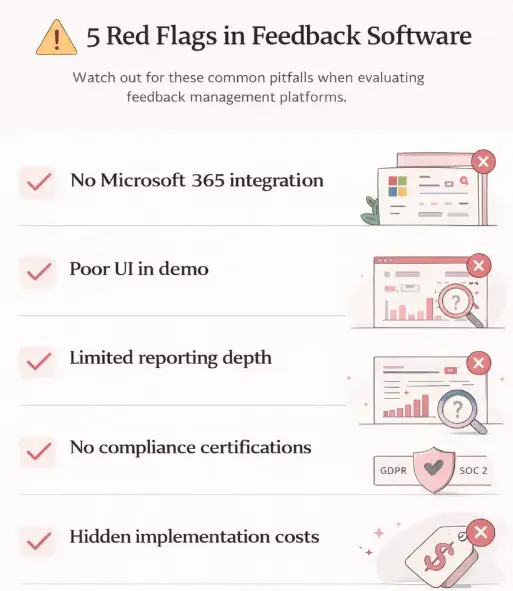
While following these steps, many organizations fall into predictable traps that limit adoption and long-term impact. Avoiding these common mistakes can save you time, budget, and frustration.
1. Focusing only on 360 reviews
360-degree feedback is powerful, but it shouldn’t be the entire strategy. If feedback only happens during structured cycles, you miss the day-to-day coaching moments that drive real improvement. Continuous feedback matters just as much as formal evaluation.
2. Ignoring manager training
Even the best feedback software won’t fix poor feedback habits. Managers need guidance on how to give constructive, specific, and development-focused feedback. Without training and enablement, the platform becomes a storage system instead of a coaching tool.
3. Choosing tools without integrations
Feedback doesn’t exist in isolation. Selecting a tool that doesn’t integrate with Microsoft Teams, Slack, your HRIS, or your performance management system creates silos and reduces visibility. Lack of integration is one of the fastest ways to kill adoption.
4. Prioritizing features over usability
Long feature lists can be misleading. If the platform feels complicated or time-consuming, employees simply won’t use it. Usability drives participation and participation drives value.
5. Not planning rollout communication
Software implementation in 2026 is more cultural than technical. Employees need to understand why the tool is being introduced, how it benefits them, and what is expected of them. Without a clear communication plan, even strong platforms struggle to gain traction.
Conclusion
The right platform should make feedback easier, more consistent, and more actionable. It should fit naturally into your existing workflow, integrate with your broader performance strategy, and provide the visibility leaders need to support employee growth. Most importantly, it should encourage real conversations — not just collect comments.
As you evaluate options, focus on alignment over complexity. Look for a system that supports continuous feedback, connects to goals and performance reviews, integrates with your existing tools, and provides measurable insights over time. Avoid feature overload, siloed systems, and tools that feel like extra work.
When implemented thoughtfully, feedback software becomes more than a productivity tool. It becomes the infrastructure for stronger managers, clearer expectations, and a culture built on continuous improvement.
.avif)