.svg)

.svg)
.svg)
.svg)
Quick Verdict
Employee recognition software promises a lot, like stronger engagement, better retention, and a culture where good work actually gets noticed. Bonusly's approach is to make recognition as frictionless as possible by embedding it directly into the tools employees already use. This review covers what Bonusly does well, where it falls short, how it's priced, and who it's actually built for, so you can decide whether it belongs in your HR stack.
What Is Bonusly?
Bonusly is a peer-to-peer employee recognition and rewards platform founded in 2013 by Raphael Crawford-Marks and headquartered in Boulder, Colorado. The company is currently led by CEO Charles Hough and operates with between 51 and 200 employees. Bonusly has been named to the Inc. 5000 list of fastest-growing private companies, and has raised outside funding including an $18.9 million Series B round in 2023, per Bonusly's own company page.
The platform serves more than 3,250 companies and 400,000 users (per Bonusly) globally, including DoorDash, Toast, SeatGeek, and Magna-Tiles. Its core mechanic is straightforward: every employee receives a monthly allowance of points to give to colleagues as recognition for contributions, tied to company values.
Recipients accumulate points and redeem them from a global rewards catalog covering gift cards, charitable donations, and custom company rewards. Bonusly has expanded beyond pure recognition to include continuous feedback tools, structured 1:1s, pulse check-ins, and performance recaps, positioning itself as a broader engagement platform.
Key Features
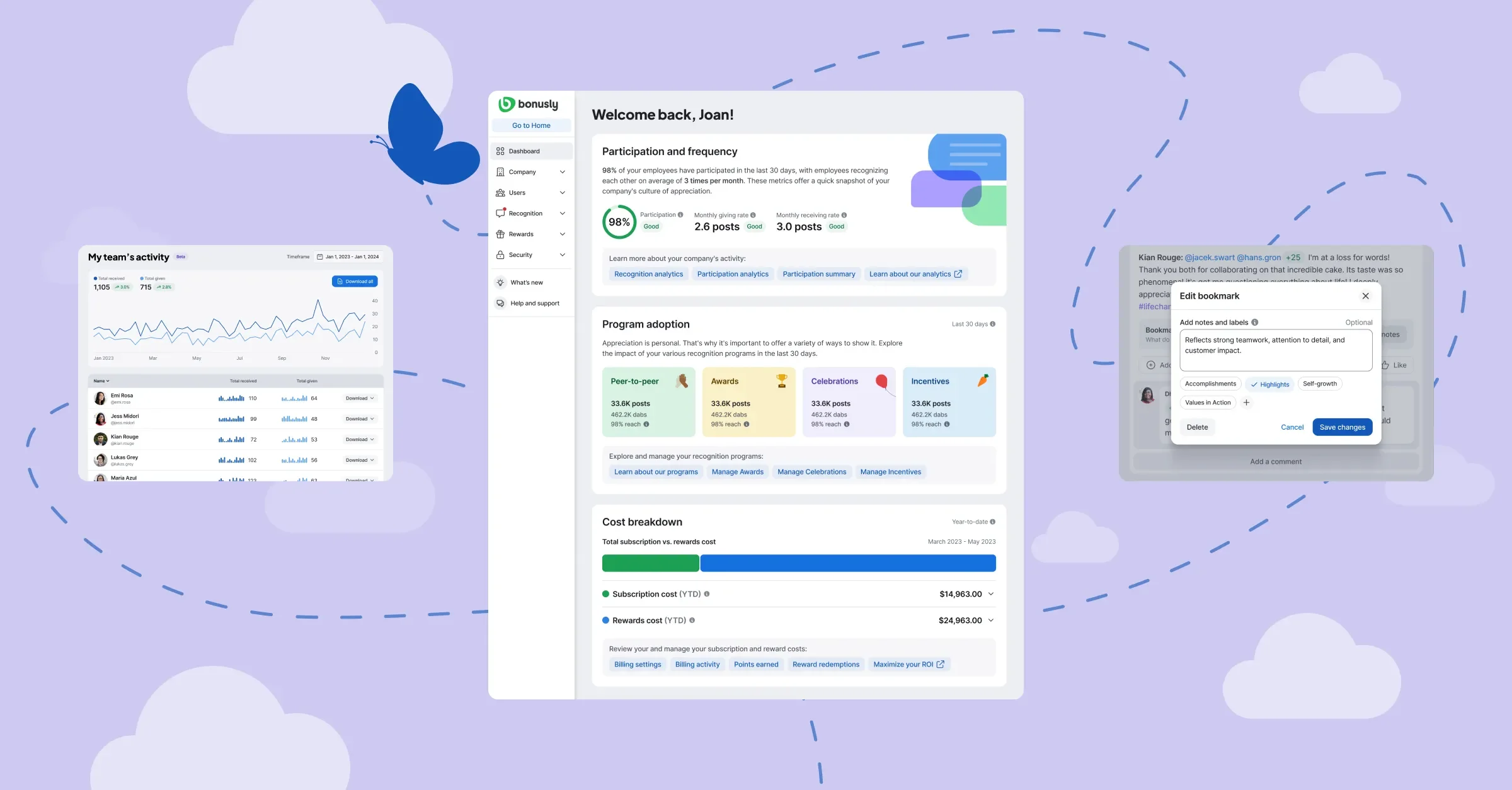
Bonusly sits in the employee recognition and rewards category alongside Motivosity, Nectar, Workhuman, and Awardco. It is designed primarily for knowledge-worker organizations, particularly those using Slack or Microsoft Teams.
Below are some features you can expect:
1. Peer-to-Peer Recognition and Social Feed
The recognition feed is a central and frequently praised feature of Bonusly. Employees give each other point-based shoutouts with value hashtags, messages, GIFs, and emojis, visible to the whole organization in a real-time social feed. Recognition can happen directly in Slack or Microsoft Teams without leaving the conversation.
“What I like best about Bonusly is how it makes employee recognition a natural part of everyday work. I especially appreciate its peer-to-peer approach and the way recognition is tied to company values, because it encourages collaboration, reinforces positive behaviors, and helps employees feel genuinely appreciated.” – G2 reviewer
2. Global Rewards Catalog
Accumulated points are redeemable through a global catalog covering gift cards from major retailers, charitable donations, PayPal and Visa cash-out options, and custom company rewards configured by the employer. According to Bonusly, the catalog includes 1,200+ rewards across 200+ countries, making it a practical option for distributed teams that need internationally available rewards.
3. Continuous Feedback and Check-ins
Beyond recognition, Bonusly includes lightweight tools for continuous feedback: structured spaces for peer feedback, pulse check-ins that managers can send to their teams, and 1:1 agenda tools that carry shared notes and context across meetings. These features are available on paid plans and are designed to make recognition data more actionable by contextualizing it alongside ongoing performance signals.
“I appreciate that this platform allows us to recognize both team members and cross-functional partners for the entire company to see. It's a meaningful way to strengthen collaboration, celebrate contributions, and build camaraderie across teams.” – G2 reviewer
4. Performance Recaps
Bonusly automatically aggregates recognition received, feedback given and received, and check-in data into organized performance recaps. These are designed to give managers a clear picture of an employee's contributions over time, not just what is top-of-mind at review time. The feature addresses one of the most common performance management failures: recency bias in evaluations. It is most valuable for organizations where Bonusly is actively used throughout the year, as sparse data produces sparse recaps.
“What I like best about Bonusly is that it makes it easy to recognize and appreciate my teammates' efforts. It encourages a positive work culture, boosts morale, and helps everyone feel valued for their contributions. I also like that the recognition is visible to the team, which promotes collaboration and motivates people to keep doing their best.” – G2 reviewer
5. Analytics and Reporting
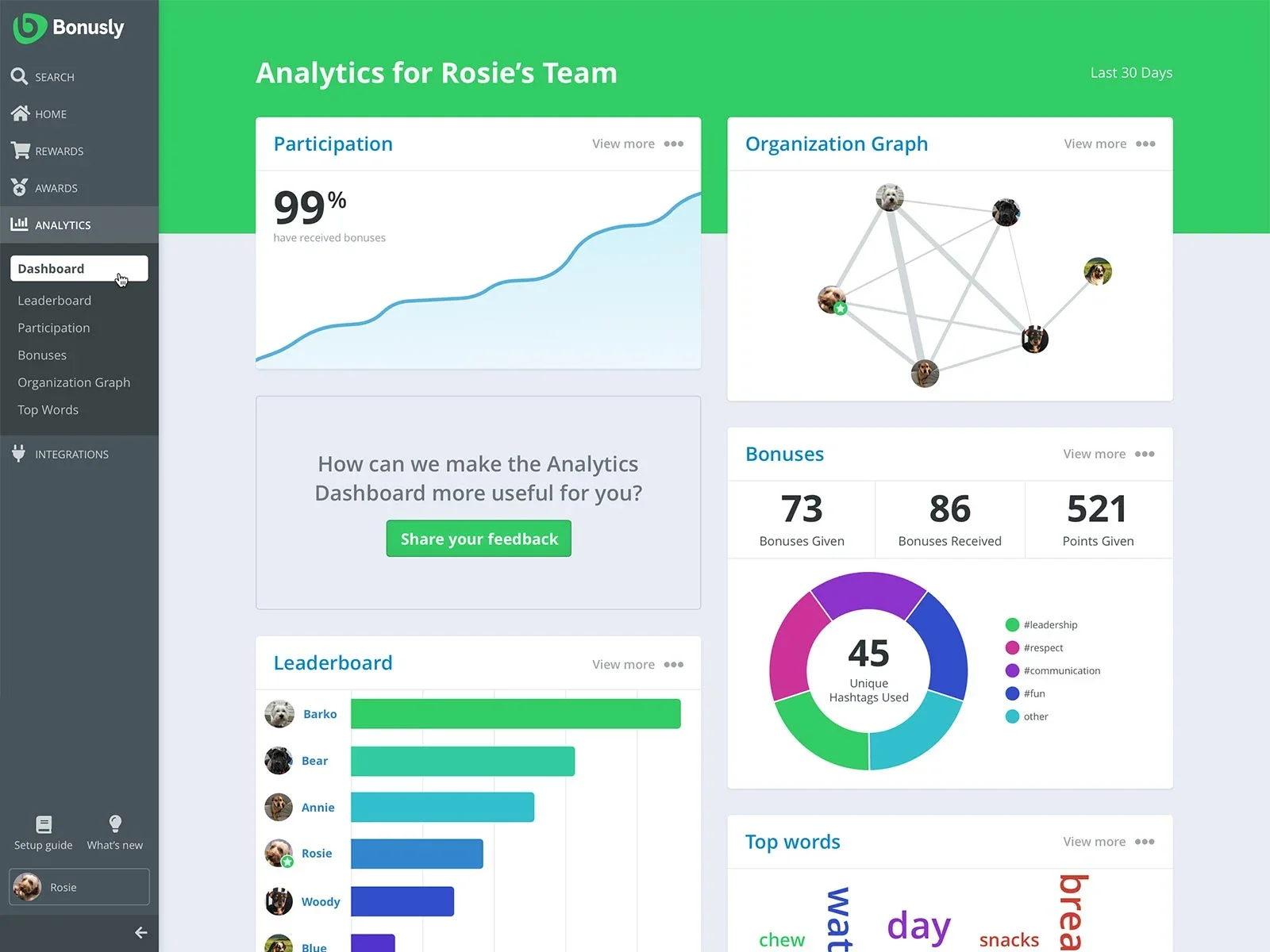
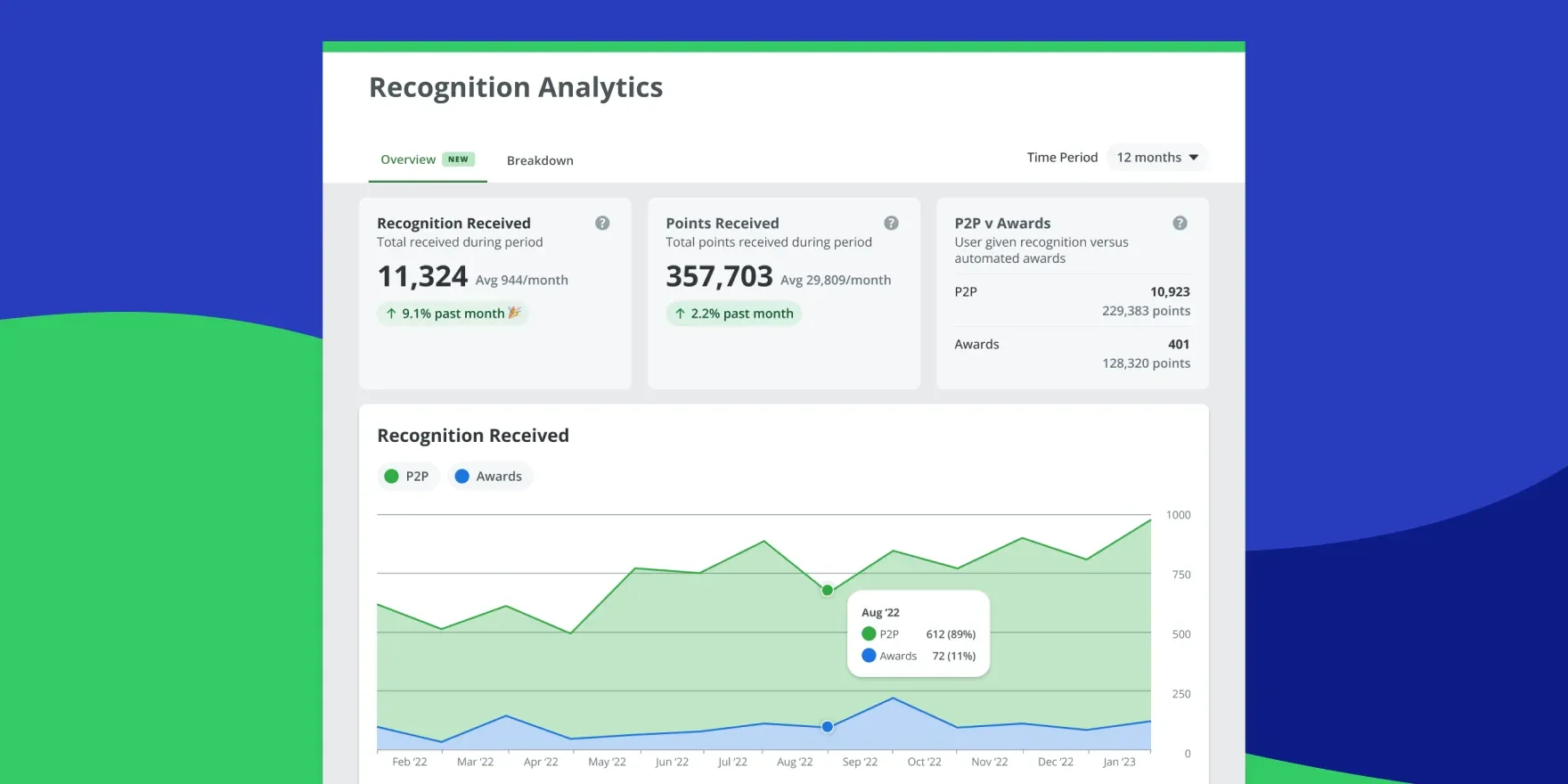
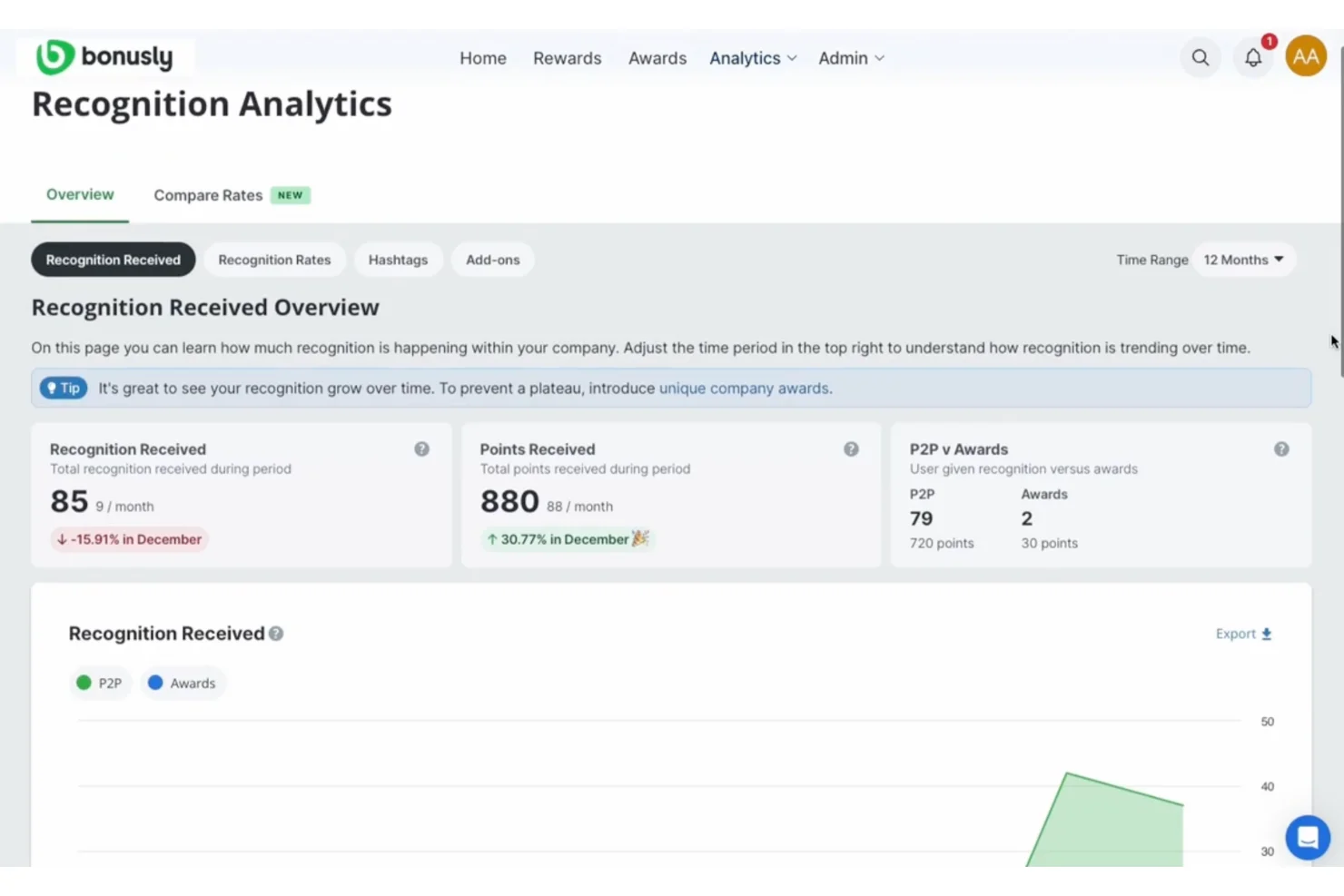
Bonusly's analytics dashboards show recognition participation rates, frequency by team and department, values alignment (which hashtags are being used and by whom), and engagement trends over time. Manager dashboards surface which team members are receiving less recognition, allowing proactive intervention. Organization-level analytics give HR leaders exportable reports for demonstrating program ROI.
6. Integrations
Bonusly integrates with Slack, Microsoft Teams, Google Chat, Zapier, and 30+ HRIS platforms, including Workday, ADP, BambooHR, UKG, Rippling, Namely, and Paylocity. It supports SAML SSO, SCIM provisioning, and a REST API, with SSO via Google, Office 365, Okta, OneLogin, and OpenID. The breadth of the integration library is one of Bonusly's practical strengths, particularly for organizations that want recognition to happen in the flow of work rather than in a separate app.
“The Slack integration makes it super easy to use, and people get excited about redeeming points for Amazon gift cards or donating to charity.” – G2 reviewer
Pros
“What I like best about Bonusly is how easy it is to recognize the people I work with. I use it whenever a teammate goes out of their way to help me or does a great job, and it's a nice way to show appreciation for the little things that often go unnoticed.” – G2 reviewer
- In our assessment, recognition is more likely to become a daily habit. The peer-to-peer model, in-flow Slack and Teams integration, and social feed are designed to make recognition a daily behavior rather than a program that fades after launch. This is Bonusly's core value proposition, and it is the outcome most frequently described by reviewers with active adoption.
- Fast to set up, genuinely easy to use. Multiple reviewers note that initial setup time varies depending on HRIS integrations, program configuration, and rollout requirements. The interface is accessible to non-technical users, which reduces the adoption friction that undermines more complex platforms.
- Global rewards catalog with real flexibility. The combination of gift cards, cash-out options (PayPal and Visa), charitable donations, and custom company rewards gives employees meaningful choice in how they use their points, which increases perceived value relative to catalog-only platforms.
- Values alignment built into recognition. Value hashtags are embedded in the recognition workflow, not bolted on. Over time, recognition data reveals which company values are being reinforced by whom, giving HR leaders a qualitative signal about cultural health that goes beyond participation rates.
- Transparent, self-serve pricing with a free tier. The published pricing page, free tier for small teams, and 30-day trial give buyers the ability to evaluate Bonusly without a sales conversation. This is a meaningful differentiator from recognition platforms that require a demo before disclosing any pricing.
Cons
“One thing I dislike about Bonusly is that the monthly points can run out quickly, especially if you want to recognize several teammates who have helped you throughout the month. There are times when I wish I had a few more points so I could acknowledge everyone's efforts.” – G2 reviewer
- Monthly point limits can disrupt recognition momentum. The monthly reset model is a design choice, but some reviewers report that frequent recognizers exhaust their allowance before the period ends. When a colleague does something noteworthy and a teammate has no points left to give, the system creates friction at exactly the wrong moment. This is among the limitations most commonly cited in reviews.
- Not a performance management system. Bonusly's feedback and recap features add genuine value, but the platform does not include structured review cycles, formal goal-setting, or competency frameworks. Organizations that want unified recognition and performance management may need to supplement Bonusly with a dedicated performance tool.
- Cost can add up at scale. The Team plan at $5/user/month (or $50/user/year) is mid-range for the recognition category, but the effective total cost combines the platform fee with the reward budget (typically $10 to $30 per employee per month). For a 200-person team with an active program, the all-in annual cost can reach $70,000 to $90,000, which warrants careful budget modeling before committing.
- Analytics depth is limited. Bonusly's dashboards cover the essential recognition metrics well, but reviewers who expected deeper trend analysis, cohort comparison, or integration with broader engagement data often find the analytics underwhelming. The platform is best understood as a recognition tool with solid reporting rather than an analytics-first engagement platform.
- Less suited to deskless or frontline workforces. Organizations with large frontline or deskless populations should test the mobile experience, access model, and rollout process before committing. Bonusly offers native iOS and Android apps, but the platform's primary integrations (Slack, Teams) assume knowledge-worker workflows.
First-Hand Evaluation
This evaluation is based on our review of platform documentation, the Bonusly pricing page, and verified reviewer data from G2 and Capterra as of August 2026. The following observations draw on those sources and published user feedback:
The Slack integration is consistently described by reviewers as seamless. Recognition given inside a Slack channel shows up both in the channel and in the main Bonusly feed simultaneously. Reviewers cite in-flow recognition. Keeping recognition inside existing communication tools can reduce context switching and may support participation.
Reviewer feedback consistently describes the rewards redemption experience as smooth and quick. A clunky redemption process reduces the perceived value of recognition, and this is an area where Bonusly draws relatively few complaints.
The feedback and check-in tools are useful but clearly secondary. They work well for teams already active on Bonusly, but they would not be a primary reason to choose the platform over a dedicated performance management tool. The performance recap feature is the most promising of the newer additions, particularly for managers who want a record of employee contributions at review time without having to reconstruct it manually.
Pricing and Plans
Bonusly uses transparent, published pricing with three tiers. The reward budget is a separate cost from the platform subscription.
The most important pricing consideration is the all-in cost. A 100-person team on the annual Team plan pays $5,000 per year in platform fees, but a reward budget of $15 per employee per month adds $18,000 in annual reward spend, bringing the effective total to approximately $23,000 per year. Building out this two-component model before comparing vendors prevents late-stage budget surprises.
Our Rating
Ratings reflect our independent assessment based on product documentation, verified user-review data, and market positioning as of August 2026.
Best Use Cases
Bonusly Is a Strong Fit For:
- Mid-size knowledge-worker teams that use Slack or Microsoft Teams daily. Bonusly's in-flow recognition is its defining feature. Organizations where employees already communicate in Slack or Teams tend to see stronger adoption, because recognition requires no context switch. The peer-driven model scales from 50 to several hundred employees without losing the social dynamic that makes it effective.
- Companies replacing top-down or manager-only recognition programs. Organizations that have tried manager-only recognition and found it inconsistent or unmaintainable often switch to Bonusly specifically for the peer-to-peer model. When every employee has a monthly allowance to give, recognition is not dependent on manager behavior or HR administration.
- Distributed and remote-first teams. The public feed, Slack and Teams integration, and global rewards catalog make Bonusly one of the more practical recognition platforms for teams spread across locations, time zones, and countries.
- Organizations that want transparent, self-serve pricing. For HR leaders who want to model costs, compare vendors, and make a decision without a sales-led process, Bonusly's published pricing and free trial make it one of the easiest recognition platforms to evaluate independently.
Consider Looking Elsewhere If:
- Your workforce is primarily deskless, frontline, or field-based. Bonusly offers mobile apps, but organizations with large frontline, retail, field, or manufacturing populations should test the mobile workflow, access model, and deployment process during their evaluation.
- You need performance management in the same platform. Bonusly's feedback and recap features are useful complements but are not a substitute for structured review cycles, OKR tracking, or competency frameworks. For a unified recognition and performance system, dedicated performance management platforms are typically a better fit.
- Your budget is very tight at scale. The combination of platform fee and reward budget means Bonusly's effective cost per employee per month is higher than the listed platform price alone. Teams with very limited recognition budgets, or those choosing between Bonusly and alternatives like Nectar or Matter that start lower, should model the all-in cost carefully before deciding.
Alternatives and Competitors
If Bonusly is not the right fit, these are the platforms most frequently evaluated alongside it:
- Motivosity: A stronger fit for organizations that want deeper manager tools, engagement surveys, and a ThanksMatters Visa card for reward flexibility. Higher minimum annual spend and less pricing transparency, but a broader feature set for EX-mature organizations.
- Nectar: A mid-market alternative with more transparent pricing, a combined recognition and perks platform, and a lower entry point than Bonusly's effective all-in cost. Worth evaluating for budget-conscious teams that want comparable peer recognition features.
- Workhuman: The enterprise-grade alternative for organizations with 1,000+ employees. More sophisticated recognition analytics, service anniversary programs, and enterprise HRIS integration depth, at a higher price point.
- Awardco: Strong for service award programs and reward catalog breadth through its Amazon Business integration. A better fit for organizations that prioritize reward depth and milestone recognition over the social feed model.
Final Verdict
Bonusly earns its high ratings in the mid-market recognition category for straightforward reasons: it makes peer recognition genuinely easy, it embeds that recognition into the tools employees already use, and the rewards experience is smooth enough that points feel like actual value rather than a loyalty point gimmick. For mid-size knowledge-worker teams, particularly those with remote or distributed employees, it is, in our view, one of the more reliable ways to build a daily recognition culture without depending on manager behavior or HR administration to sustain it.
The limitations are worth sizing carefully before committing. The monthly point allowance model creates friction for high-engagement users. The analytics are solid but not deep. The performance management additions are useful supplements, not substitutes for a dedicated system. And the all-in cost, once reward budget is added, is meaningfully higher than the platform fee alone.
For the buyer Bonusly is designed for, these are manageable trade-offs. For buyers who need more than recognition, there are better-matched platforms. Our rewards and recognition software roundup covers additional options if you are still evaluating the category.
.png)
.avif)