.svg)
At first glance, Perdoo and Profit.co seem pretty similar. Both are built around OKRs and KPIs, but they take different approaches to helping organizations turn goals into day-to-day execution.
Perdoo is more focused on strategy execution, keeping OKRs and KPIs at the center of the platform. Profit.co takes a broader approach, with more tools for managing work and performance alongside your goals. That makes Perdoo a better fit for teams looking for a focused strategy tool, while Profit.co may make more sense if you want more of your planning and performance processes in one place.
So which one makes more sense for your organization? This comparison breaks down where each platform stands out, where it falls short, and which one is the better fit for how your teams actually work.
Perdoo Overview
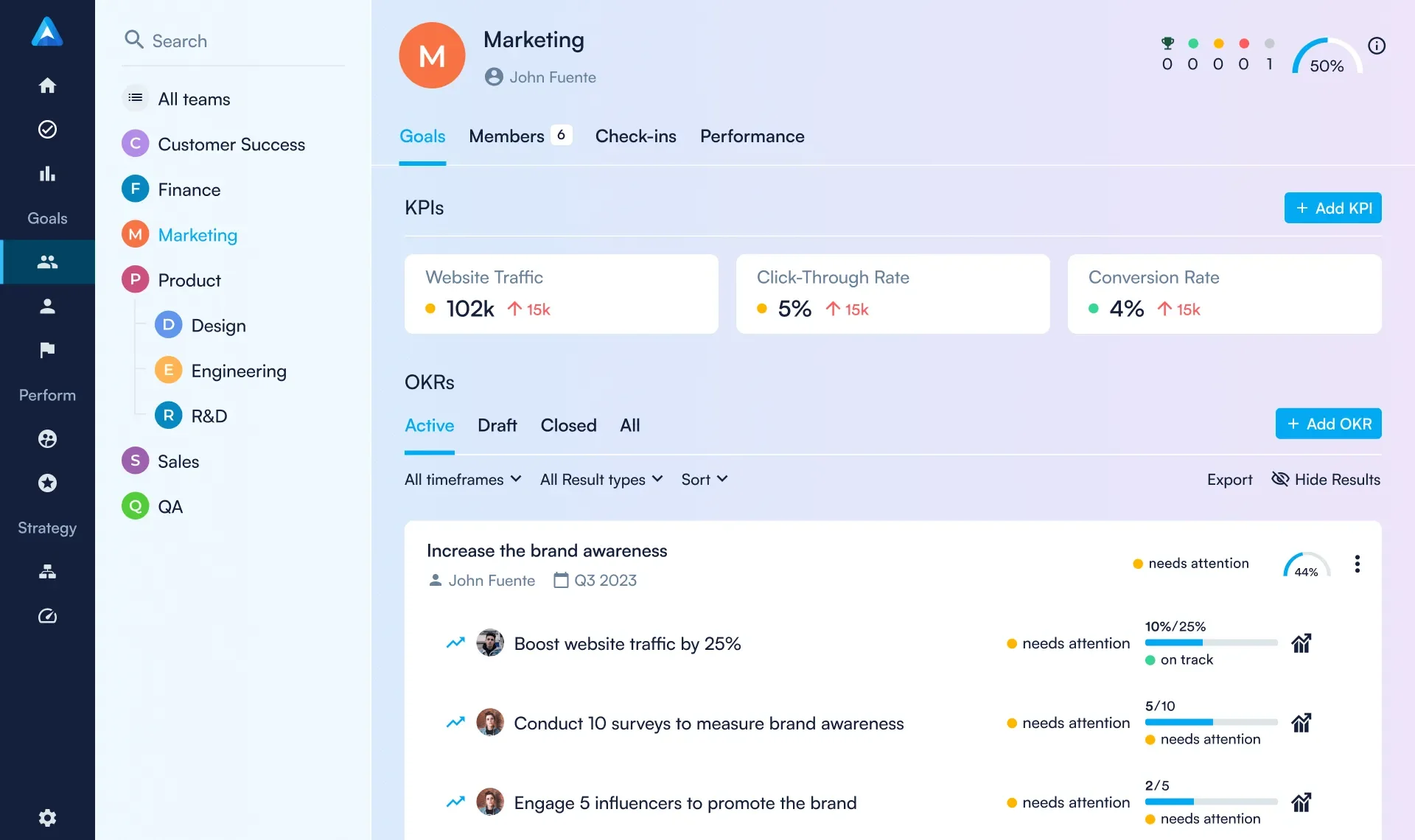
Perdoo brings strategy, KPIs, and OKRs into one place. Its Strategy Map helps teams see how company priorities connect to the goals and KPIs underneath them, while regular check-ins give teams a way to keep those goals updated.
The platform is a good fit for teams that want a dedicated strategy and OKR tool without adding project management or a full HR system. Perdoo also supports frameworks such as 4DX, Balanced Scorecard, EOS, and OGSM, so teams aren't limited to using OKRs as their only planning method.
Key features include:
- Strategy Maps and strategic pillars that connect company strategy to KPIs and OKRs
- Company, team, and individual OKRs and KPIs, plus sub-Key Results, goal weighting, and goal-alignment views
- Initiatives and tasks connected to OKRs, with progress propagation from aligned goals and sub-goals
- Configurable check-ins, user and team reviews, progress reports, 1:1s, pulse surveys, and peer Kudos
- AI Assistant for drafting strategic pillars, KPIs, OKRs, Key Results, initiatives, and progress-update comments, plus an in-app AI Coach
- Slack and Microsoft Teams workflows, Google Sheets, Zapier, and integrations with Jira, Asana, Salesforce, HubSpot, Power BI, Tableau, Snowflake, and other tools
- Performance and engagement dashboards on Premium, with custom dashboards, custom reporting, private goals, and KPI Boards on Supreme
Pros:
“What I like most about Perdoo is that it’s very easy to use while still offering all the functionality we need to manage our OKRs effectively. The platform is highly customisable, allowing us to adapt it to our processes rather than changing our processes to fit the tool.” – G2 reviewer
- Perdoo’s visual strategy layer is unusually clear. Strategy Maps, strategic pillars, KPIs, and OKRs are designed to be viewed as one connected system rather than as a flat list of quarterly goals.
- It provides a usable free plan for up to five users, making it practical for a leadership team or small company that wants to establish an OKR rhythm before committing to an enterprise contract.
- Pricing is transparent. Paid plans start at €8 per user per month for Premium and €10 per user per month for Supreme before volume discounts, with a five-user minimum on paid subscriptions.
- The platform includes people-performance basics, including check-ins, 1:1s, reviews, Pulse, and Kudos, without forcing buyers into a much broader HR suite.
- Supreme offers a broad set of execution and data integrations, including Jira, Asana, Azure DevOps, Salesforce, HubSpot, Power BI, Tableau, and API access.
Cons:
“The main limitation from a HR Perspective is there isn’t a HR view option to track 1:1's or see performance reviews. These are only visible to the team member and their direct manager.” – G2 reviewer
- Perdoo does not provide a native project portfolio management environment with resource planning, timesheets, budget governance, risk tracking, and earned-value management. Teams that need those capabilities will need another system or a different platform.
- Its performance layer is useful for reviews and accountability, but it is not designed as a deep talent-management suite with features such as 360-degree feedback, talent grids, PIPs, or advanced calibration workflows.
- Several advanced controls, including custom reports, custom dashboards, private goals, KPI Boards, and many native work-management integrations, are reserved for the Supreme plan.
- The product is more opinionated around strategy maps, KPIs, and OKRs than organizations that want to configure an extensive enterprise planning or portfolio-management process may prefer.
Profit.co Overview

Profit.co lets teams manage OKRs alongside their day-to-day work. Goals and tasks sit in the same system, with Kanban, Gantt, and sprint views available for teams that want a more detailed way to track projects.
It also offers modules for performance management, project portfolio management, and Balanced Scorecard. This can be useful for organizations that currently rely on separate tools for these processes.
The downside is that there's more to figure out before you buy. With different modules and plans available, it can take more time to decide what you actually need compared with a simpler OKR-focused platform.
Key features include:
- OKR creation, progress tracking, 300+ built-in KPIs, alignment, cascading, custom priority weights, templates, dashboards, and PPP review cycles
- Task management with Kanban, Gantt, and sprint views, plus project workspaces, boards, workflow stages, reminders, and email-to-task conversion
- Performance management with objective-based reviews, 360-degree feedback, custom competency frameworks, weighted score calculations, bell-curve calibrations, talent grids, IDPs, and PIPs
- Project portfolio management with resource management, timesheets, earned-value management, budget planning, replanning, risk and issue tracking, and approval flows
- Balanced Scorecard with strategy maps, customizable perspectives, KPI cockpit views, weightings, meetings, and alignment tools
- Optional strategy roadmaps, 1:1 and team meetings, rewards and recognition, and employee engagement surveys
- Enterprise features including SSO, enterprise integrations, dedicated customer success management, guided onboarding, and a 99.9% uptime SLA according to the vendor’s pricing page
Pros:
“The tool is very intuitive & really helps to put in our OKRs and execute them in a well-defined manner, even tuned for niche industries like education excellence. Their support in the Implementation phase & training they provide is tailor-made based on our industry & the team also supports us on both concept & product.” – G2 reviewer
- Profit.co has materially broader execution coverage. Organizations can combine OKRs, task management, performance management, portfolio management, and Balanced Scorecard in one platform rather than stitching together several specialist tools.
- Its native project portfolio management is the clearest differentiator in this comparison. Resource planning, budgets, timesheets, risks, and delivery governance are in scope, not merely linked through integrations.
- The performance module is deeper than Perdoo’s, with 360-degree feedback, competency frameworks, weighted scores, calibration, talent assessments, individual development plans, and performance-improvement plans.
- It supports multiple formal strategy approaches, especially OKRs and Balanced Scorecard, while offering strategy roadmaps as an add-on for executive planning and initiative visualization.
- The pricing page describes a dedicated CSM and guided onboarding for every plan, which can matter for complex or multi-region rollouts.
Cons:
“Custom Power BI integration/reporting requires DAX queries, which adds a bit of technical complexity.” – G2 reviewer
- Profit.co does not publish standard per-user prices. Pricing is quote-based and depends on selected modules, user count, and deployment requirements, which makes early budgeting less straightforward.
- It offers a 30-day no-card trial, but the current public pricing page is enterprise-proposal oriented rather than a transparent permanent-free-plan model.
- The platform’s module breadth can be excessive for a small team that only needs strategy maps, KPIs, OKRs, and regular check-ins.
- A successful rollout requires clear governance: decisions on which modules to buy, who owns administration, how goals cascade, how projects update goals, and how performance workflows will be used.
Perdoo vs Profit.co: Feature Comparison
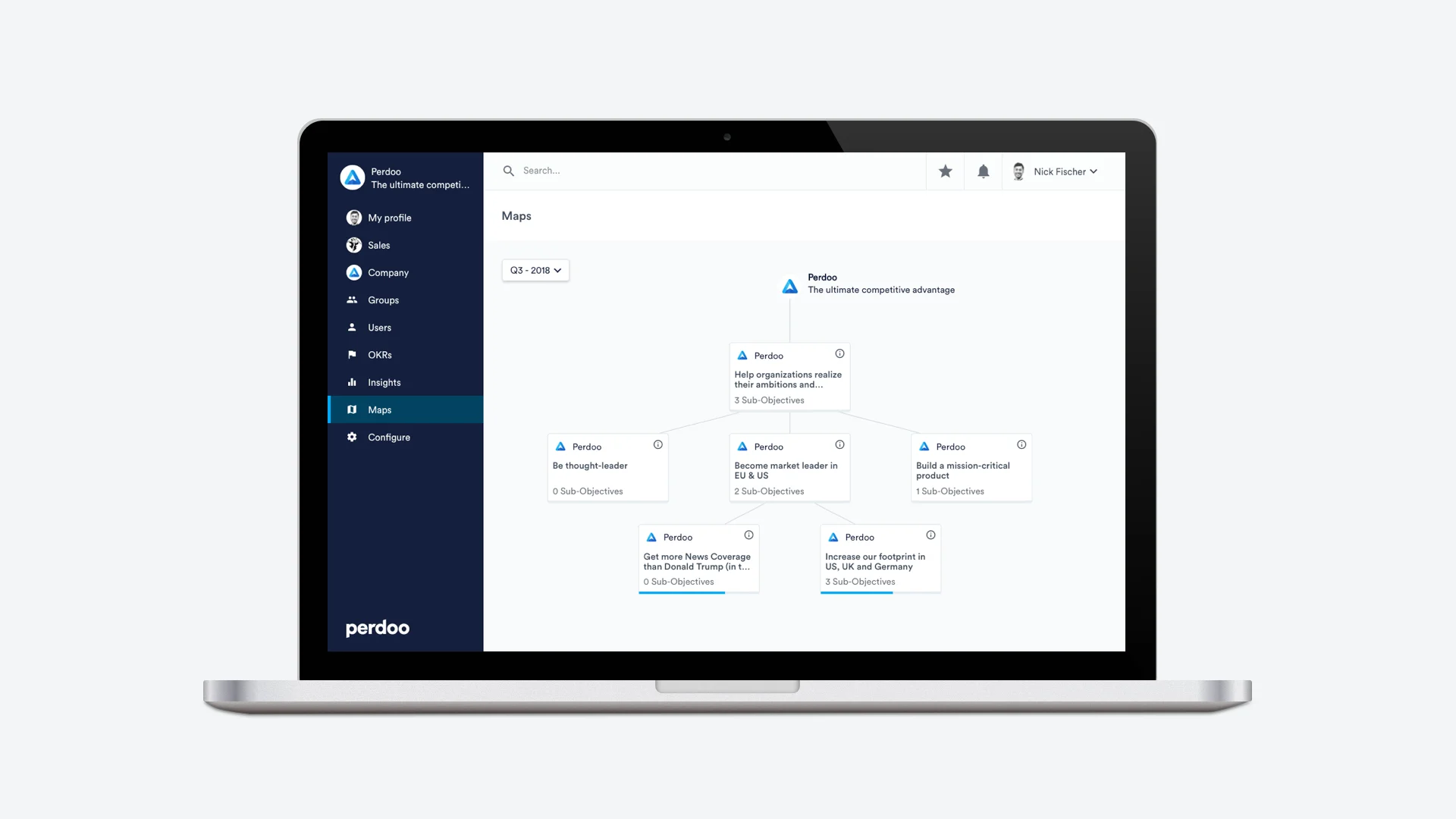
Both platforms can support an organization-wide OKR program, but the differences become clearer once you look beyond the basics. Perdoo keeps the focus on strategy and goal execution, while Profit.co covers more of the work and people processes that sit around OKRs.
Strategy Maps, OKRs, and KPIs
Perdoo puts strategy at the center of the platform. Its Strategy Maps, KPIs, and OKRs are designed to show how day-to-day goals connect back to the bigger picture.
By comparison, Profit.co takes a more configurable approach. It gives teams more ways to structure and present their goals, along with support for Balanced Scorecard if that's part of their strategy framework.
Verdict: Perdoo is the better choice if you want a straightforward, strategy-led OKR setup. Profit.co makes more sense if you need more flexibility or want to bring Balanced Scorecard into the mix.
Tasks, Projects, and Portfolio Management
Perdoo works best when your actual project work already happens somewhere else. It can connect initiatives and tasks to your goals, while integrations with tools like Jira, Asana, and Azure DevOps bring that progress back into the OKR system.
Profit.co, on the other hand, takes more of that work into the platform itself. Its project and portfolio management capabilities make it a better fit for organizations that want to manage delivery alongside their goals.
Verdict: Go with Profit.co if you need project and portfolio management built in. Perdoo is a better fit if you already have a project management stack you like.
Performance, Check-Ins, and Engagement
Perdoo keeps its people-management features fairly lightweight. Check-ins, 1:1s, reviews, pulse surveys, and Kudos give teams a way to keep conversations connected to their goals without turning the platform into a full HR system.
Profit.co takes things further. Its performance management tools support more structured processes around feedback, competencies, calibration, and employee development.
Verdict: Perdoo works well if you want simple performance workflows tied to your OKRs. Profit.co is the stronger option if performance management is a bigger part of what you need from the platform.
Reporting, Analytics, and AI
Perdoo's reporting is centered around goals and performance, with dashboards, custom reporting on higher plans, data exports, and integrations with tools like Power BI. Its AI features are also geared toward helping teams write and update goals.
Meanwhile, Profit.co takes a broader reporting approach, with dashboards and reporting that can bring together information from goals, projects, and performance. Its Athena AI also helps identify objectives that may be at risk or out of alignment.
Verdict: Perdoo is a good choice if your reporting needs are mainly focused on OKRs and strategy. Profit.co has the edge if you want to bring more types of business and performance data into the same view.
Integrations and Enterprise Controls
Perdoo has a broad integration library, so it can fit into an existing tech stack rather than asking teams to move everything into one platform. It also offers enterprise features such as API access, SSO, and SCIM on eligible plans.
For larger organizations, Profit.co puts more emphasis on the deployment side. It offers enterprise integrations, guided onboarding, dedicated support, and additional infrastructure options for organizations with more specific requirements.
Verdict: Perdoo is a good fit if integrations are a priority and you want to understand how the platform will fit into your existing stack. Profit.co makes more sense for larger organizations that need more hands-on implementation and enterprise-specific support.
Pricing Comparison
Pricing transparency is the most immediate commercial difference. Perdoo publishes a free tier and paid per-user prices. Profit.co uses custom enterprise proposals based on the modules and user count an organization selects.
Perdoo:
- Free: €0 per user per month for a maximum of five users. Includes Strategy Maps, OKR and KPI tracking, check-ins, reviews, 1:1s, Pulse, Kudos, Slack and Teams, Google Sheets and Zapier integrations, AI Assistant, and AI Coach.
- Premium: €8 per user per month before volume discounts. Adds performance and engagement dashboards, goal cloning, SSO and SCIM, data exports, Excel Online, API access, multi-lingual chat support, and MCP server access.
- Supreme: €10 per user per month before volume discounts. Adds KPI Boards, private goals, custom fields, custom reports and dashboards, Jira and Asana integrations, Power BI, and view-only licenses from €1.50 per user per month.
- Terms: Paid subscriptions have a five-user minimum; annual billing carries a stated 10% discount. Perdoo states that there are no implementation fees, although dedicated CSM, onboarding, and SLA options require at least 25 purchased user licenses.
Profit.co:
- Custom enterprise pricing: The vendor does not publish standard per-user prices. Pricing is based on user count and the modules selected.
- Core modules: OKRs & Task Management, Performance Management & Goals, Project Portfolio Management, and Balanced Scorecard.
- Optional add-ons: Strategy Roadmaps, 1:1 & Team Meetings, Rewards & Recognition, and Employee Engagement.
- Trial and implementation: Profit.co publicly promotes a 30-day no-credit-card trial. Its pricing page says that plans include a dedicated CSM, guided onboarding, SSO, enterprise integrations, Athena AI, 300+ KPI templates, and a 99.9% uptime SLA; confirm the exact proposal terms during procurement.
For a small team or early-stage OKR rollout, Perdoo’s published pricing and free five-user plan are a practical advantage. For a larger company that is considering project portfolio management, formal performance management, and Balanced Scorecard alongside OKRs, Profit.co’s custom quote may be more appropriate, but compare the total cost of modules, implementation scope, and any services in writing.
Why Teams Choose Perdoo
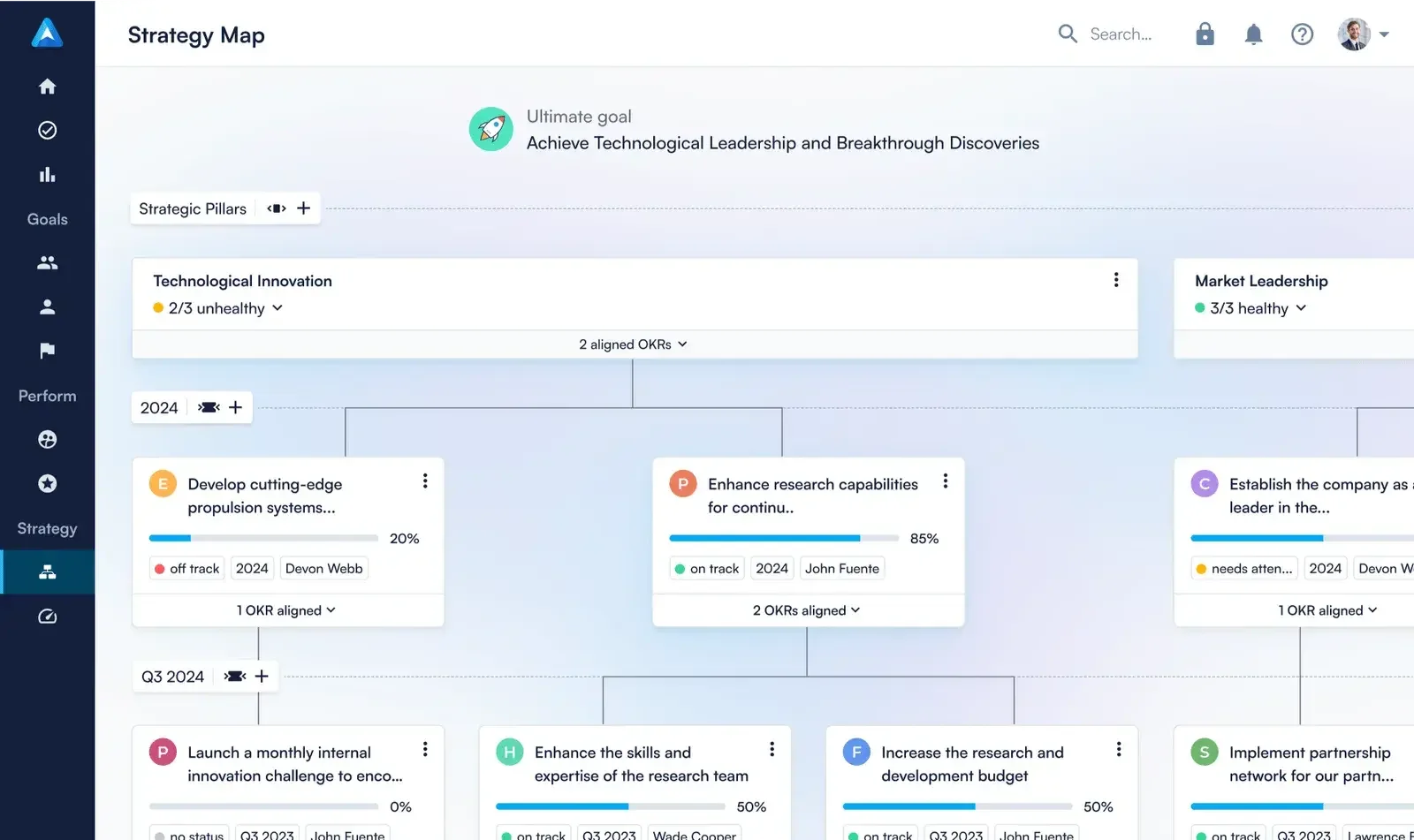
- They want strategy maps, KPIs, and OKRs to live in one visual system rather than treating quarterly OKRs as an isolated planning exercise.
- They want a lower-friction starting point: a free plan for up to five users and paid pricing that is published before a sales conversation.
- They need weekly check-ins, 1:1s, light reviews, Pulse, and Kudos, but do not need a full performance-management suite.
- They already use a project-delivery system such as Jira, Asana, Azure DevOps, or Monday.com and want to synchronize goal progress rather than replace it.
- They value a detailed public feature matrix, self-serve setup, and incremental adoption of more advanced reporting and integration capabilities.
Why Teams Choose Profit.co
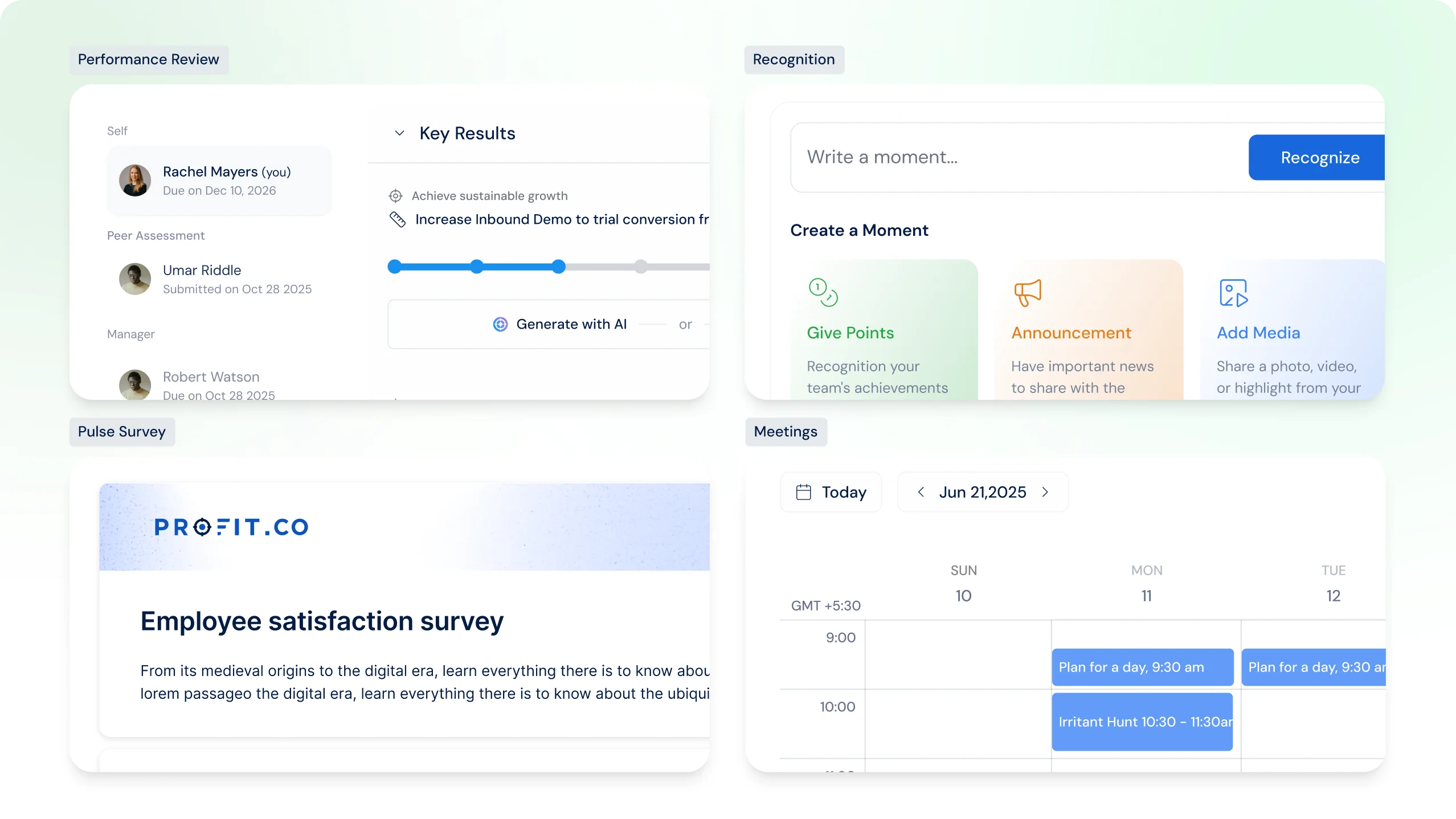
- They need one broader platform for OKRs, task management, formal performance management, portfolio management, and Balanced Scorecard.
- They need portfolio-level controls such as resource planning, budget governance, timesheets, risks, earned-value management, and project replanning.
- They want performance reviews with competency frameworks, 360-degree feedback, calibration, talent grids, IDPs, and PIPs.
- They are running a formal strategy-management program and need Balanced Scorecard plus strategy maps, KPI cockpits, and strategy roadmaps in addition to OKRs.
- They have enterprise deployment requirements and value vendor-led onboarding, a dedicated CSM, enterprise integrations, and potentially on-premises or multi-region rollout options.
Which Tool Is Right For You?
Choose Perdoo If:
- You want a focused strategy-execution system that makes the link between strategic pillars, KPIs, and OKRs easy for employees to understand.
- You are a small or mid-sized team and transparent pricing or a free plan for up to five users matters to your buying process.
- You need check-ins, 1:1s, light reviews, Pulse, and Kudos, but not advanced talent management or portfolio governance.
- Your delivery work is already handled in Jira, Asana, Azure DevOps, or another project tool, and you mainly need goal alignment plus progress automation.
- You want to start with a simple strategy and OKR rollout, then add advanced dashboards, custom reports, privacy controls, or more integrations only as adoption matures.
Choose Profit.co If:
- You need a broader strategy-execution platform, not only an OKR and KPI system.
- Project portfolio management, including resources, budgets, timesheets, risks, delivery controls, and portfolio alignment, is a firm requirement.
- Your HR or people team needs formal performance reviews, 360-degree feedback, calibration, competency frameworks, talent assessment, IDPs, or PIPs.
- You need to run Balanced Scorecard alongside OKRs, or want strategy roadmaps and portfolio data in the same platform.
- Your organization can support a vendor-led evaluation and rollout, and you are comfortable obtaining a module-based custom proposal rather than purchasing from a public price list.
Final Verdict
Perdoo is generally better if you mainly need a place to manage strategy, KPIs, and OKRs. It keeps things fairly focused and works well if your teams already use tools like Jira or Asana for project work. There's also a free plan for up to five users, so smaller teams can try it without committing right away.
Profit.co is more ideal if you need more than OKRs. It covers project and portfolio management as well as performance management, Balanced Scorecard, and strategy roadmaps. The trade-off is that there's more to set up and more to consider when you're choosing and rolling it out.
In simple terms, choose Perdoo if you want to keep your OKR process focused. Choose Profit.co if you want one platform to handle a wider range of planning, project, and performance needs.
Frequently Asked Questions
Is Perdoo or Profit.co better for a small business?
Perdoo is usually the more practical starting point for a small business. It has a free plan for up to five users, publishes paid pricing, and includes Strategy Maps, KPIs, OKRs, check-ins, 1:1s, Pulse, and Kudos without requiring a custom enterprise proposal. Profit.co can work for small teams, but its module-based enterprise model is best evaluated when broader execution, portfolio, or formal performance requirements are already clear.
Does either platform offer a free plan?
Perdoo offers a free plan for up to five users. Profit.co publicly promotes a 30-day no-credit-card trial; its current pricing page is built around custom enterprise proposals rather than a published permanent-free-plan tier.
Which platform is better for project management?
Profit.co is stronger for native project and portfolio management. Its platform includes task views, project workspaces, and a dedicated PPM module with resource management, timesheets, budgets, risks, and earned-value management. Perdoo is better viewed as a goal-alignment layer that connects to project tools such as Jira, Asana, Azure DevOps, Monday.com, and Trello.
Which platform is better for performance management?
Profit.co has the deeper formal performance-management suite, including 360-degree evaluations, competency frameworks, weighted score calculations, bell-curve calibrations, talent grids, IDPs, and PIPs. Perdoo is suitable for lightweight performance conversations linked to strategy through check-ins, 1:1s, reviews, Pulse, and Kudos.
How does Perdoo pricing compare with Profit.co?
Perdoo publishes pricing: Free for up to five users, €8 per user per month for Premium, and €10 per user per month for Supreme before volume discounts. Profit.co does not publish standard per-user prices; it creates a proposal based on selected modules, user count, and deployment requirements.
Can Perdoo support frameworks beyond OKRs?
Yes, Perdoo states that it supports 4DX, Balanced Scorecard, EOS, OGSM, and OKRs, and lets organizations customize terminology for other frameworks. Profit.co also supports OKRs and a dedicated Balanced Scorecard module, with strategy roadmaps available as an add-on.