.svg)
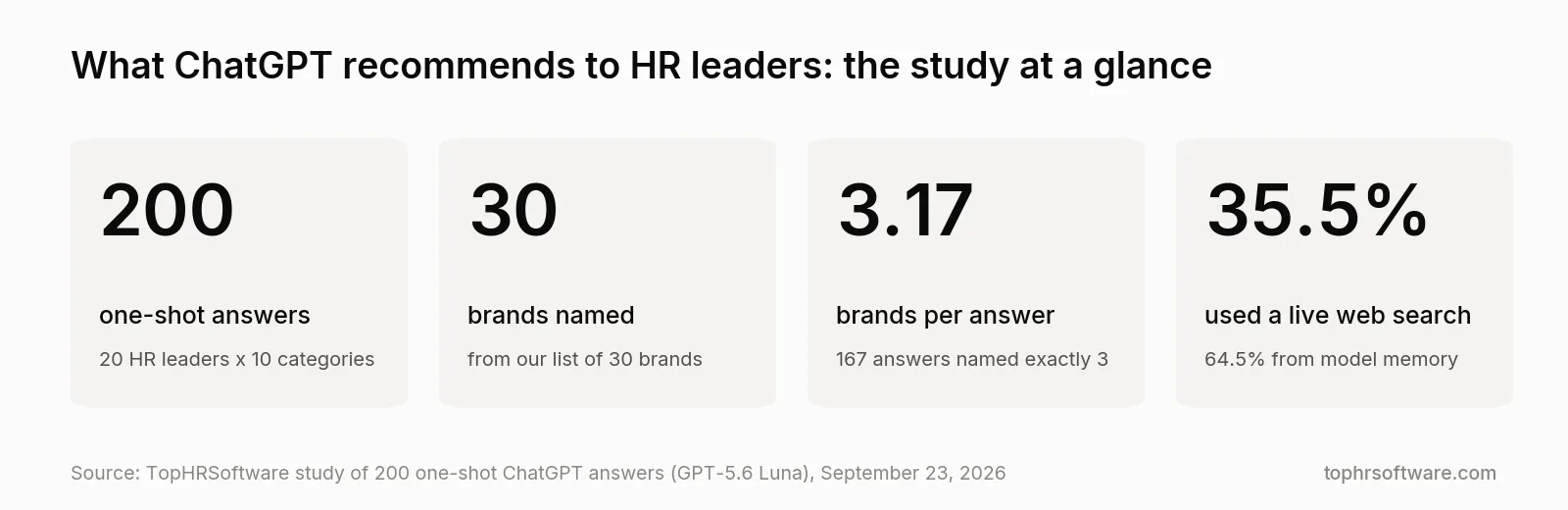
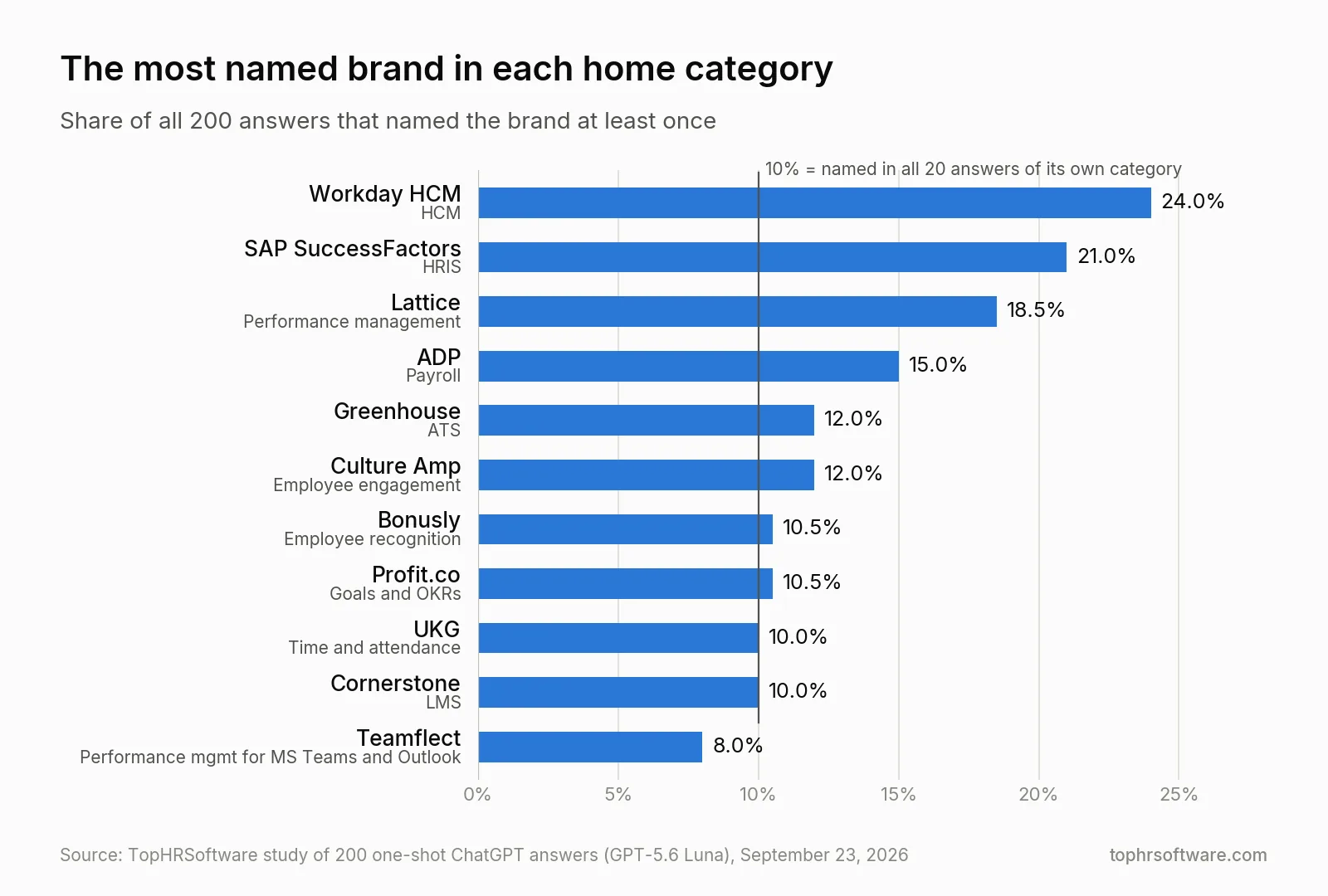
We asked ChatGPT 200 HR software questions, written as 20 different HR leaders shopping in 10 software categories. It named 30 brands in total and about three brands per answer. Workday HCM appeared most often overall, in 24% of all answers. In 8 of the 10 categories, at least one brand appeared in every single answer.
The shortlist ChatGPT gives is a fair place to start. It is also narrow, it repeats the same names across very different companies, and in one category its top pick is a product that no longer exists. This page shows the data, how we collected it, and how to use a ChatGPT shortlist without inheriting its blind spots.
Key findings
- The default answer is a short list. Every answer named at least three brands from our list. 167 of 200 answers named exactly three, 31 named four and 2 named five.
- Each category has a fixed core. In 8 of 10 categories, one or two brands appeared in all 20 answers. Greenhouse and Lever were in every ATS answer. UKG and Dayforce were in every time and attendance answer.
- Suites show up outside their category. Workday HCM appeared in 29 answers that were not about HCM, across 7 other categories. 79 of the 200 answers named at least one brand outside its home category.
- Company size barely changes the list. BambooHR appeared in all 20 HRIS answers, including the ones for companies with 60,000 and 90,000 employees. Workday appeared in 15 of the 50 answers written for companies with fewer than 500 employees.
- Some picks are out of date. Microsoft Viva Goals appeared in 17 of 20 OKR answers and opened 8 of them. Microsoft retired Viva Goals on December 31, 2025.
Why we ran this study
Software buyers now ask a chatbot before they ask a search engine. In a March 2026 survey of 1,076 B2B software decision makers, G2 found that 51% start their software research with an AI chatbot more often than with Google, up from 29% a year earlier. 69% said they chose a different vendor than they had planned because of what a chatbot told them, and 33% bought from a vendor they did not know before. Chatbots were the top source that shaped their shortlist.
Forrester's 2025 Buyers' Journey Survey points the same way: 94% of business buyers use AI somewhere in their buying process, and 61% use private AI tools such as ChatGPT. On February 27, 2026, OpenAI said ChatGPT had passed 900 million weekly active users.
For an HR leader, this means the first vendor list is often written by a model. We compare HR software for a living, so we wanted to see that list directly: when a CHRO or VP of People asks ChatGPT for recommendations, which brands come back, in what order, and on what basis?
How we ran the study
- Model and surface: GPT-5.6 Luna, called through the OpenAI API.
- Date and location: all 200 answers were collected on September 23, 2026, from a New York City request origin.
- Personas: 20 synthetic buyer profiles, mostly CHROs, Chief People Officers, VPs of HR and Heads of People. Each profile had a US headquarters, a headcount between 85 and 90,000, an industry, a city and a company stage.
- Categories: 10 HR software categories: performance management, employee recognition, goals and OKRs, HRIS, HCM, payroll, applicant tracking (ATS), learning management (LMS), employee engagement, and time and attendance.
- Prompts: every profile asked once in every category, for 200 prompts in total. Each prompt included the role, company size, industry, city, a category-specific problem and a direct request for software recommendations. No prompt named a vendor or asked the model to exclude one.
- One shot, clean session: one question and one answer. No follow-up questions, no chat history and no memory carried from one prompt to the next.
- What we counted: a brand counted when its name appeared in the answer text. A brand named several times in one answer counted once. Citation links alone did not count. We coded against a closed list of 30 brands; names outside that list were not counted.
- Web or memory: we marked an answer as web-enriched when it showed visible signs of a live search, such as fresh pages, dated sources or browse-style wording. All other answers were marked as knowledge-only.
The answers had a median length of 406 words, with a range of 220 to 618.
Limits of this study
This is a directional snapshot, and we read it that way.
- Real buyers have conversations. They add constraints, name their current systems and ask about price. We measured only the opening shortlist.
- We asked each prompt once. The same prompt asked again can change the order or swap a brand.
- A logged-in ChatGPT user with memory, uploaded files or a different location can get a different answer. API answers can also differ from the consumer app.
- The web-enriched label is based on visible signals. It can miss silent retrieval.
- Being named often does not mean a product is better. This study does not measure product quality, customer results or pricing.
Overall: the HR software ChatGPT named most
Share of answers is the percentage of all 200 answers that named the brand at least once. Mention share is the brand's share of all 635 brand mentions. The table shows the most named brand in each of the 11 home categories in our brand list, ordered by share of answers.
| # | Brand | Home category | Share of answers | Mention share | Named first |
|---|---|---|---|---|---|
| 1 | Workday HCM | HCM | 24.0% | 7.6% | 13 |
| 2 | SAP SuccessFactors | HRIS | 21.0% | 6.6% | 13 |
| 3 | Lattice | Performance management | 18.5% | 5.8% | 13 |
| 4 | ADP | Payroll | 15.0% | 4.7% | 11 |
| 5 | Greenhouse | ATS | 12.0% | 3.8% | 13 |
| 6 | Culture Amp | Employee engagement | 12.0% | 3.8% | 5 |
| 7 | Bonusly | Employee recognition | 10.5% | 3.3% | 8 |
| 8 | Profit.co | Goals and OKRs | 10.5% | 3.3% | 5 |
| 9 | UKG | Time and attendance | 10.0% | 3.1% | 10 |
| 10 | Cornerstone | LMS | 10.0% | 3.1% | 7 |
| 11 | Teamflect | Performance management for Microsoft Teams and Outlook | 8.0% | 2.5% | 5 |
Six more brands also reached 10.0% (20 answers each): BambooHR, Awardco, Docebo, Dayforce, Gusto and Lever.
Because every category had the same number of answers, a specialist tool that ChatGPT names in all 20 answers of its own category reaches exactly 10%. Anything above 10% comes from appearances in other categories. Lattice, for example, appeared in all 20 performance management answers and in 17 answers about other topics. The overall ranking is therefore partly a measure of how widely a brand travels, and the category view below is the better guide for a buyer.
Category by category: who ChatGPT recommends
Each category had 20 answers. The percentage is the share of those 20 answers that named the brand. The number in brackets is how many of the 20 answers named that brand first.
| Category | #1 | #2 | #3 |
|---|---|---|---|
| Performance management | Lattice 100% (8) | 15Five 90% (4) | Teamflect 80% (5) |
| Employee recognition | Bonusly 100% (7) | Awardco 100% (6) | Kudos 80% (6) |
| Goals and OKRs | Quantive 95% (6) | Profit.co 90% (3) | Microsoft Viva Goals 85% (8) |
| HRIS | BambooHR 100% (8) | SAP SuccessFactors 95% (6) | HiBob 60% (3) |
| HCM | Workday HCM 95% (7) | ADP Workforce Now / Lyric 90% (3) | Oracle 60% (4) |
| Payroll | Gusto 100% (4) | ADP 90% (9) | Rippling 85% (5) |
| ATS | Greenhouse 100% (11) | Lever 100% (4) | Ashby 90% (3) |
| LMS | Cornerstone 100% (7) | Docebo 100% (6) | 360Learning 85% (7) |
| Employee engagement | Culture Amp 100% (4) | Workhuman 90% (10) | Glint 85% (2) |
| Time and attendance | UKG 100% (10) | Dayforce 100% (5) | Deputy 65% (3) |
The top of most categories is tight. In performance management, Lattice, 15Five and Teamflect appeared in 20, 18 and 16 of the 20 answers. In ATS, the top three were each in at least 18 answers. The third slot is where categories differ: HRIS, HCM and time and attendance drop to 60% or 65% for the third brand, which means the model's list in those categories has two fixed names and a rotating third.
If you want to go past the first three names, our independent lists cover the wider field: best HRIS software, best applicant tracking systems, best employee engagement software and Lattice alternatives for performance management.
Being on the list and opening the list are different
The brand that appears in the most answers is often not the brand ChatGPT names first. Readers skim, so the first name in an answer gets more attention than the third.
- Payroll: Gusto was in all 20 payroll answers but opened only 4. ADP was in 18 and opened 9.
- Employee engagement: Culture Amp was in all 20 answers and opened 4. Workhuman was in 18 and opened 10.
- Goals and OKRs: Quantive was in 19 answers and opened 6. Microsoft Viva Goals was in 17 and opened 8, more than any other OKR brand.
- LMS: 360Learning was in 17 answers and opened 7, the same number as Cornerstone, which was in all 20.
- ATS: Greenhouse was in every answer and opened 11, the strongest first position in the study.
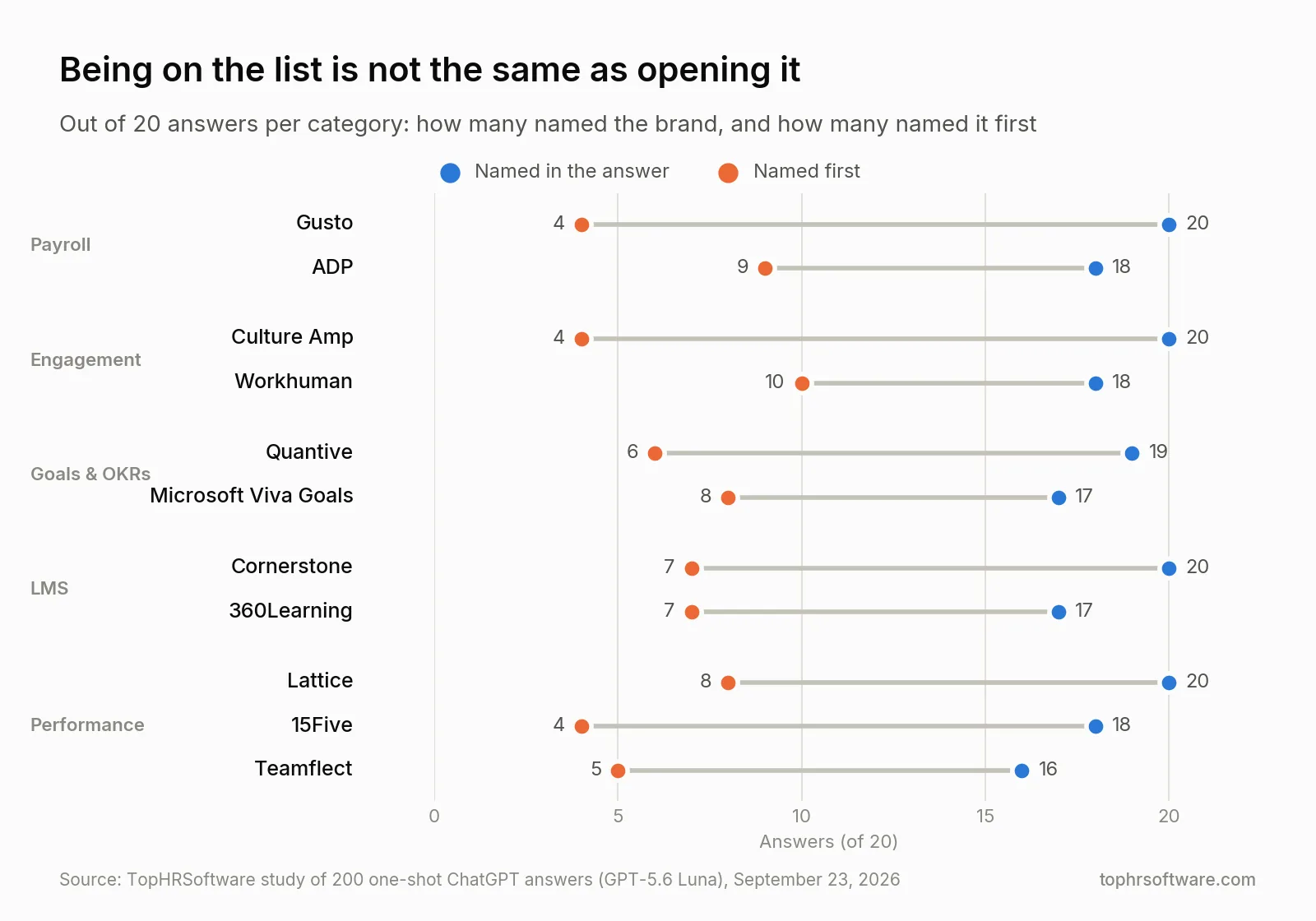
The order of a ChatGPT list is not a ranking. The first slot moved between brands even when the list itself did not change. 17 of the 20 ATS answers named the same three brands (Greenhouse, Lever and Ashby), and each of the three opened at least one of those answers. In performance management, 12 answers named the same trio of Lattice, 15Five and Teamflect, and each of the three was named first at least once.
Suites appear in questions that were not about them
79 of the 200 answers named at least one brand outside its home category, and 26 answers opened with such a brand.
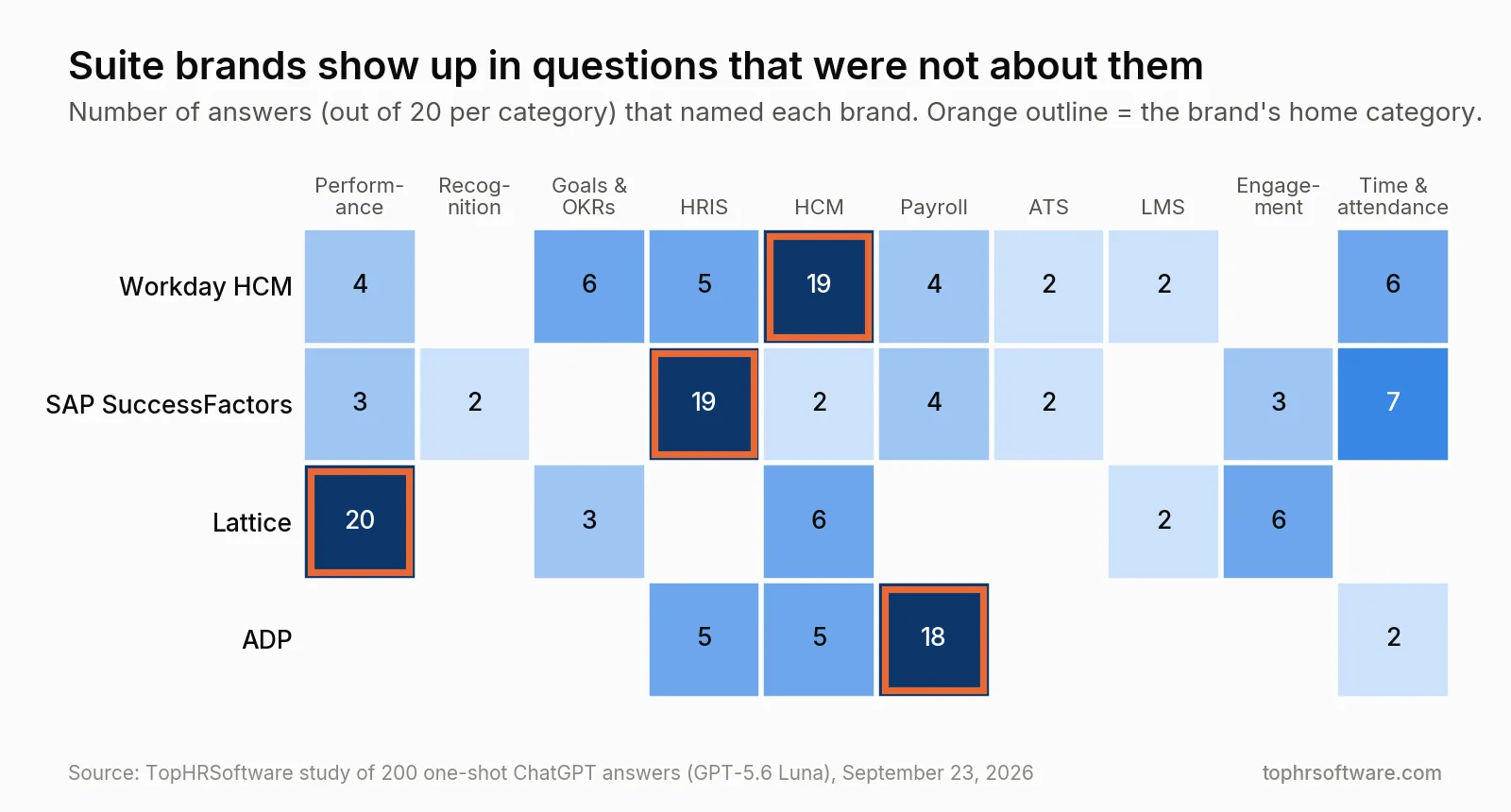
- Workday HCM appeared 29 times outside HCM, across 7 categories: goals and OKRs (6), time and attendance (6), HRIS (5), performance management (4), payroll (4), LMS (2) and ATS (2).
- SAP SuccessFactors appeared 23 times outside HRIS: time and attendance (7), payroll (4), performance management (3), engagement (3), recognition (2), HCM (2) and ATS (2).
- Lattice appeared 17 times outside performance management: HCM (6), engagement (6), goals and OKRs (3) and LMS (2).
- ADP appeared 12 times outside payroll.
This is useful when you already run one of these suites, because the module you own may cover the need. It is noise when you do not. A 350-person company asking for OKR software can get an enterprise HCM suite in its list without asking for one. If the category lines are unclear to you, our guide to HRIS vs HCM vs HRMS explains the difference.
Most answers came from model memory
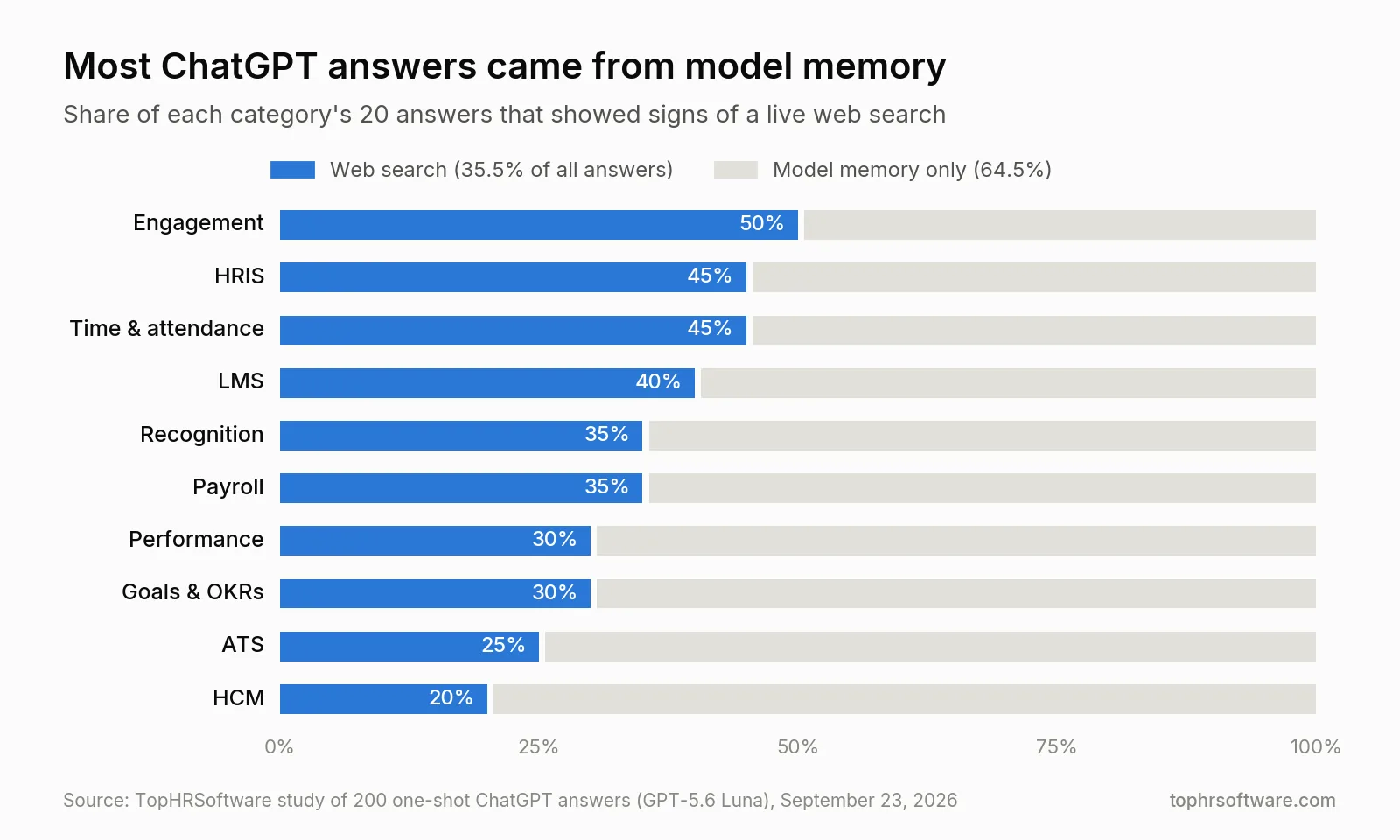
129 of 200 answers (64.5%) were knowledge-only. 71 answers (35.5%) showed signs of a live web search.
| Category | Web-enriched answers |
|---|---|
| Employee engagement | 50% |
| HRIS | 45% |
| Time and attendance | 45% |
| LMS | 40% |
| Employee recognition | 35% |
| Payroll | 35% |
| Performance management | 30% |
| Goals and OKRs | 30% |
| ATS | 25% |
| HCM | 20% |
In HCM, 16 of 20 answers came from what the model already knew. So most of these shortlists show what ChatGPT learned during training, not what vendor sites or review pages said on September 23, 2026. That is one reason a product can stay on the list after it stops being sold.
Two blind spots: company size and freshness
Company size
Our profiles ranged from 85 to 90,000 employees. The lists did not narrow much as headcount changed.
- BambooHR appeared in all 20 HRIS answers, for the 85-person company and for the 60,000- and 90,000-person companies.
- Gusto appeared in all 20 payroll answers, across the full size range.
- Workday appeared in 15 of the 50 answers written for the five profiles with fewer than 500 employees (85, 140, 220, 350 and 480).
Every prompt stated the headcount, and the lists stayed almost the same. Whether a product fits a company of that size is a check the buyer still has to do.
Freshness
Microsoft Viva Goals appeared in 17 of the 20 OKR answers and was named first in 8, more often than any other OKR tool. Microsoft retired Viva Goals on December 31, 2025, nine months before we collected the answers.
A live search did not fix this. 6 of the 17 answers that named Viva Goals were web-enriched, and 2 of its 8 first slots came from answers with a web search.
How to use a ChatGPT shortlist
Many answers ended by telling the buyer to check the list. The most common closing advice across the 200 answers was:
| Closing advice in the answer | Answers |
|---|---|
| Run a structured vendor evaluation | 48 |
| Fit depends on your existing HR stack | 47 |
| Run a 3-vendor bake-off with a security review | 41 |
| Involve Finance and IT early | 32 |
| Confirm pricing with the vendors | 32 |
Based on what we saw in the data, five steps make the first list more useful:
- Give the model your real context. Include headcount, countries, your current HRIS or payroll system and the tools your people already use every day, such as Microsoft Teams or Slack. In our test the lists barely changed with headcount, so do not expect the model to adjust on its own.
- Ask why each brand is on the list. Ask for the reason it fits a company of your size, not a feature summary.
- Check that each product is still sold. Ask the model to confirm the current status of each product, and check the vendor site yourself. The Viva Goals result shows why.
- Separate suite modules from specialist tools. If a suite you do not run appears in a non-suite category, decide whether you want a new suite before you spend time on a demo.
- Take the list outside the chat. Compare pricing, contract terms and reviews from independent sources, then run your own three-vendor evaluation. Our guide on how to choose HR software covers that process, and our methodology explains how we score the products we review.
We plan to repeat this study with the same profiles and categories and publish what changes.
.png)