

Quick Verdict
Perdoo is built for companies that want a clearer way to connect high-level strategy with everyday work. This review breaks down what the platform does well, where it falls short, how much it costs, and who is most likely to benefit from it.
| What it is | A cloud-based strategy execution platform that connects strategy maps, OKRs, KPIs, weekly check-ins, 1:1s, performance reviews, employee feedback, and recognition in one system. |
| Best for | Small to mid-market organizations that want to make strategy visible, run a structured OKR program, and connect goals to ongoing performance conversations without buying a heavyweight enterprise HCM platform. |
| Not for | Teams that only need lightweight personal goal tracking, organizations that require deep workforce planning or compensation calibration, or companies needing a standalone HRIS, payroll, or benefits platform. |
| Starting price | Free for up to five users. Premium is €8 per user/month and Supreme is €10 per user/month at standard monthly pricing, before volume discounts. |
| G2 / Capterra | 4.4/5 on G2 from 500+ reviews and 4.4/5 on Capterra from 79 reviews. |
| Our overall rating | 4.2/5 |
Perdoo is one of the more complete platforms in the OKR market because it does not treat goals as an isolated process. Instead, it connects strategic priorities, measurable KPIs, quarterly OKRs, regular progress updates, and performance management into one operating system.
A lot of platforms let you create and track OKRs. Perdoo goes further by connecting those goals to the company’s broader strategy, core KPIs, and regular performance conversations. Its strongest features are the Strategy Map, native KPI tracking, goal cascading, check-ins, and broad performance-management layer.
This software review covers everything you need to know about what Perdoo delivers, where it is strongest, and when another platform may be a better fit.
What Is Perdoo?
Before getting into the individual tools and workflows, it helps to understand how Perdoo positions itself. The platform is designed around strategy execution, not just goal tracking.
Perdoo is a strategy execution and OKR management platform founded in 2015. The company is headquartered in Berlin, Germany, and positions its product around helping organizations turn strategy into measurable execution.
At its core, Perdoo gives organizations a visual framework for connecting the following:
- An organization’s high-level mission or “Ultimate Goal”
- Strategic Pillars, which represent the few priorities the business chooses to win on
- KPIs that monitor the ongoing health of the business
- OKRs that create time-bound improvements in those priority areas
- Weekly check-ins, 1:1s, reviews, and recognition tied back to goal progress
This makes Perdoo more than a conventional OKR tracker. It sits somewhere between an OKR platform, a strategic planning tool, and a lightweight performance management platform.
For example, a SaaS company could define “Improve profitable growth” as a Strategic Pillar, track net revenue retention as a KPI, and create a quarterly marketing OKR to improve activation rates. Perdoo’s structure lets employees see how the work connects instead of treating departmental goals as disconnected projects.
Key Features
Perdoo combines strategy planning, goal management, reporting, and people-management tools. The sections below cover the features that matter most during evaluation.
1. Strategy Maps and Strategic Pillars
The platform starts with a strategic framework that gives teams context for the goals they are setting and tracking.
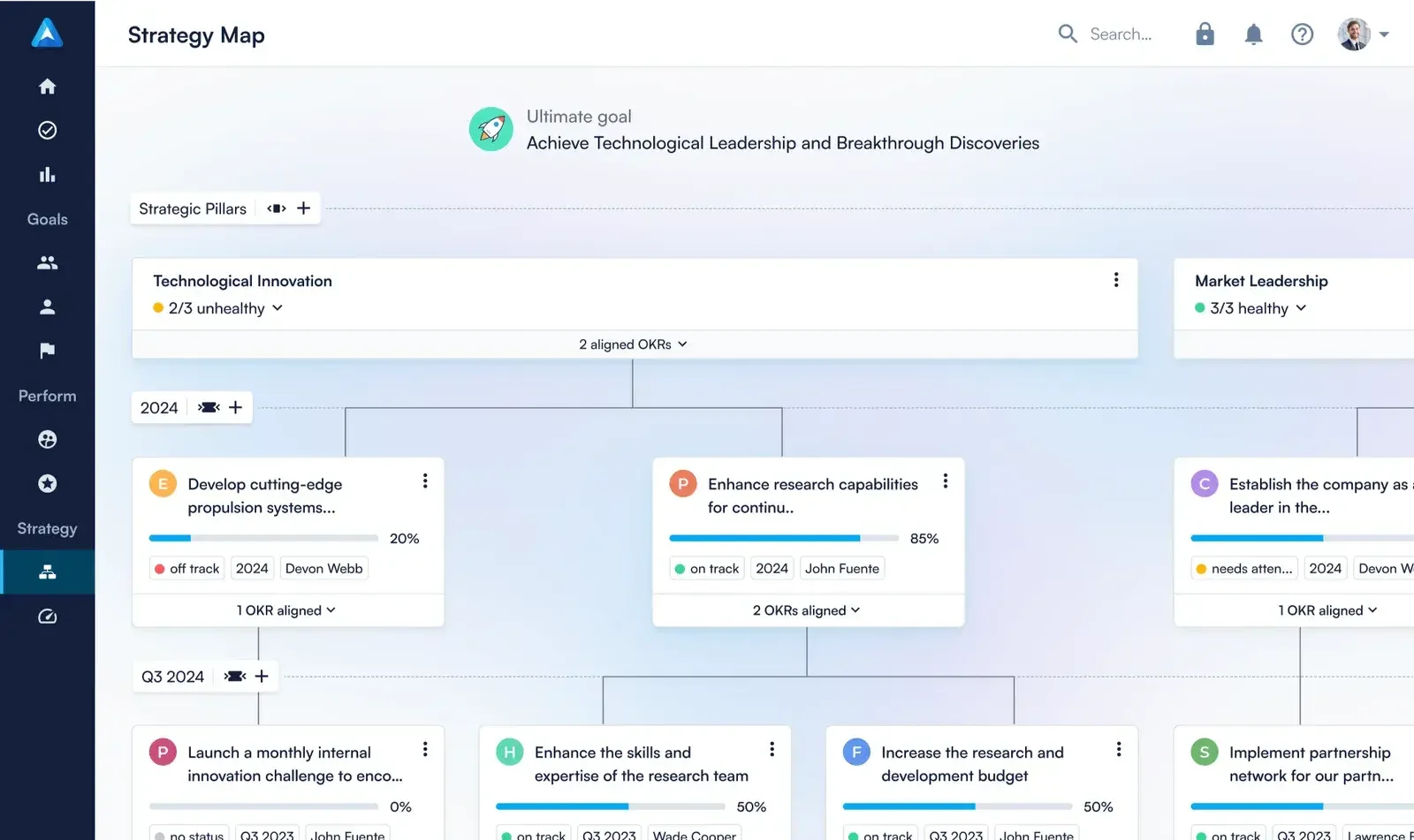
Perdoo starts with the bigger picture. Leaders can map out the company’s Ultimate Goal and the Strategic Pillars that support it, then tie team OKRs and KPIs back to those priorities.
That makes it easier to see whether a team’s work is genuinely aligned with the plan or simply another item on the quarterly to-do list.
2. OKR and KPI Management
Once the strategy is in place, Perdoo gives teams tools to translate it into measurable ongoing metrics and time-bound priorities.
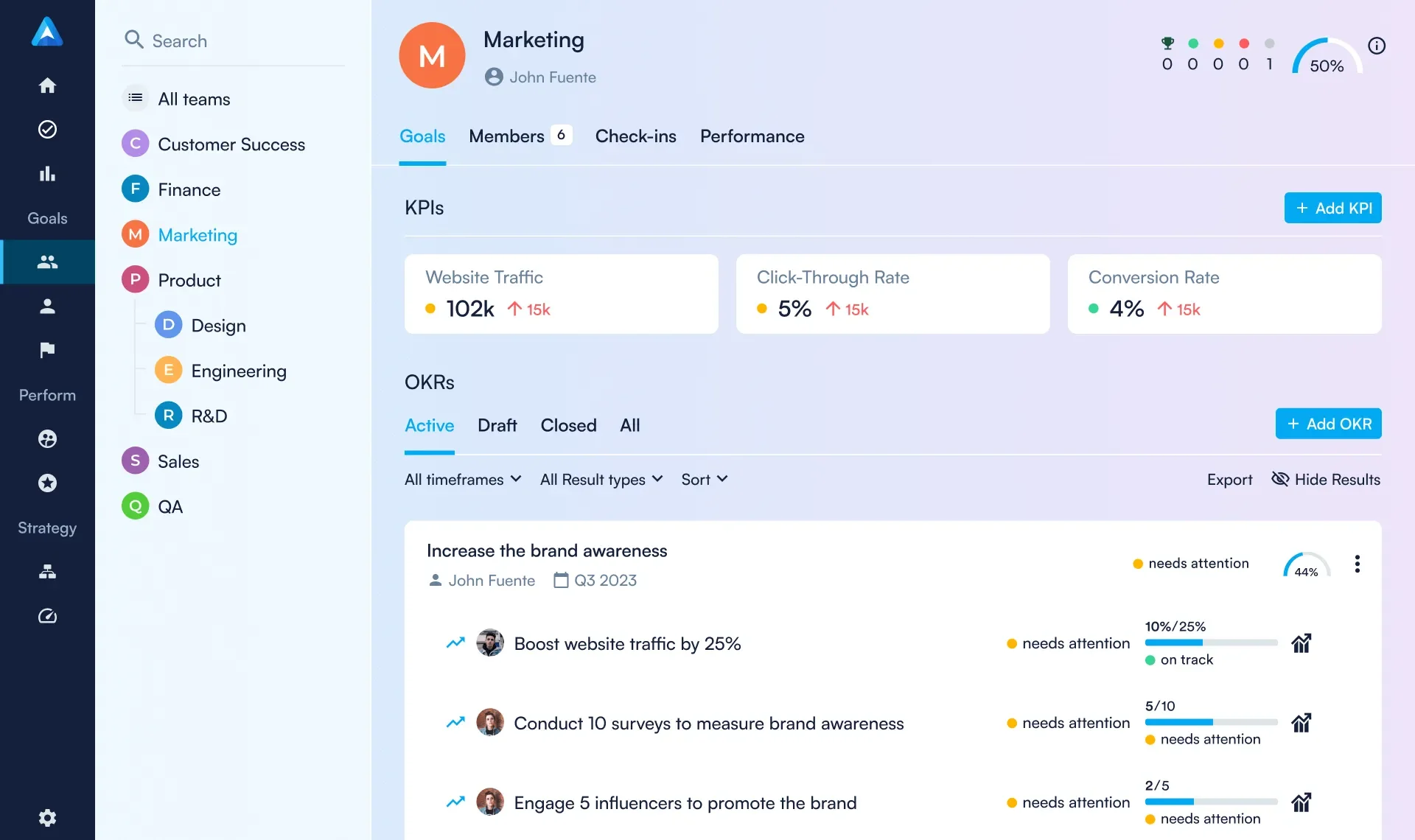
Perdoo lets teams manage company, team, and individual OKRs alongside the KPIs they watch all year. You can assign owners, link goals across teams, add sub-Key Results, and use weighting when certain outcomes matter more than others.
- Goal cascading and linking
- Sub-Key Results and progress rollups
- Goal owners and contributors
- KPI tracking for metrics such as retention, revenue, or customer satisfaction
3. Cascading and Alignment Views
Goal-setting only becomes useful at scale when people can see how work connects across departments. Perdoo handles this through linked goals and visual alignment views.
The Cascade View is where Perdoo’s strategy-first approach becomes most practical. It shows how a company priority connects to department, team, and individual goals, which is helpful when several groups are working toward the same outcome.
It is not perfect, though. In a large organization with a long list of active OKRs, locating one specific goal can take more effort than it should.
4. Weekly Check-Ins and Progress Reporting
Setting goals at the start of a quarter is only one part of the process. Perdoo also provides a regular rhythm for reporting progress and surfacing problems early.
Teams do not have to wait until the end of a quarter to see how things are going. Employees can post updates, call out blockers, share wins, and indicate how confident they are about meeting a goal.
Those updates appear in reports and dashboards, while Slack and Microsoft Teams integrations make it easier to keep the habit going without adding another app to everyone’s routine.
5. Performance Management and Engagement
Perdoo extends beyond strategy and goal tracking with features that support manager conversations, employee feedback, and engagement monitoring.
Perdoo also includes people-management tools, so managers can bring actual goal progress into 1:1s and review discussions instead of relying on whatever they remember from the last few months.
- 1:1 meeting agendas and notes
- Team and individual reviews
- Performance reviews
- Pulse surveys and feedback
- Kudos and engagement reporting
It works well as an added performance layer, but it is not meant to replace a full HRIS or a deep enterprise talent-management platform.
6. AI, Reporting, and Integrations
Perdoo includes its AI Assistant and AI Coach on the Free plan. Paid plans expand the platform with stronger reporting, admin controls, security features, and deeper integrations.
Premium and Supreme users can access features such as custom reporting, dashboards, API access, SSO, SCIM provisioning, and more advanced integrations. Supreme adds greater customization, privacy controls, and additional connections for business systems.
Integration coverage includes Slack, Microsoft Teams, Google and Outlook Calendar, Google Sheets, and Zapier. Higher plans add options such as Jira, Asana, HubSpot, Salesforce, HRIS platforms, and BI tools.
Pros and Cons
The platform has real strengths for strategy-led teams, but its structure and feature set will not be the right fit for every organization.
Pros
“What I like most about Perdoo is that it’s very easy to use while still offering all the functionality we need to manage our OKRs effectively. The platform is highly customisable, allowing us to adapt it to our processes rather than changing our processes to fit the tool.” – G2 reviewer
“One of the most impactful features is the platform's ability to provide a comprehensive and high-level view of overall company and team OKR progress.” – G2 reviewer
These are the areas where Perdoo stands out most against simpler OKR trackers.
- Excellent Strategy-to-Execution Structure: The Strategy Map and Strategic Pillar model create a clearer connection between corporate strategy, KPIs, and team-level OKRs than most basic goal trackers.
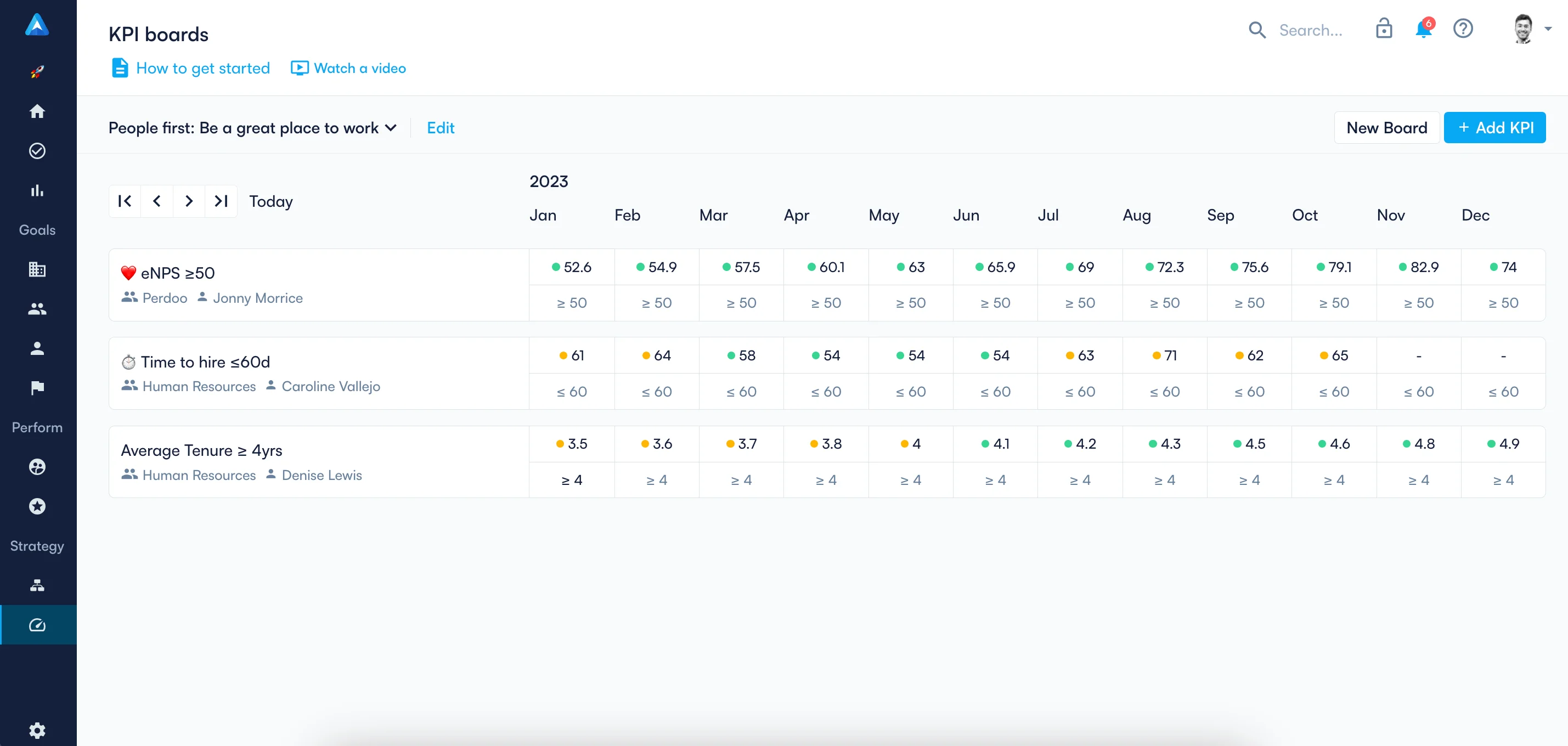
- Native KPI and OKR Support: Perdoo treats KPIs as ongoing health metrics and OKRs as time-bound improvement initiatives, letting organizations manage both without forcing either into an unsuitable framework.
- Generous Free Plan: Up to five users can access core strategy mapping, OKRs, KPIs, cascading, check-ins, meetings, Slack and Teams integrations, mobile apps, recognition functionality, and Perdoo’s AI Assistant and AI Coach.
- Strong Collaboration Workflows: Slack and Microsoft Teams integrations reduce the friction of regular check-ins, while calendar integrations support 1:1 and team meeting workflows.
- Useful Performance-Management Layer: 1:1s, reviews, Pulse surveys, Kudos, and engagement features make the platform more valuable for teams that want goals and people-management workflows in one place.
- Positive User Sentiment: Perdoo holds a 4.4/5 G2 rating from more than 500 reviews and a 4.4/5 Capterra rating from 79 reviews. Capterra users rate customer service at 4.5/5.
- Accessible Pricing Relative to Enterprise Suites: Paid plans start at €8 per user/month at standard monthly pricing, with a 10% annual-billing discount and additional volume discounts available.
Cons
“The main limitation from a HR Perspective is there isn’t a HR view option to track 1:1's or see performance reviews. These are only visible to the team member and their direct manager. However, we currently work around this by having managers export performance reviews and we store them elsewhere.” – G2 reviewer
“What I like less are small usability details, for example, the expanding and collapsing of Key Results or subordinate goals. It doesn't always work on the first click and can be a bit annoying in everyday work.” – G2 reviewer
The following limitations are worth considering before committing to a rollout.
- Navigation Can Get Difficult at Scale: The platform’s detailed hierarchy is useful, but users in organizations with many teams and OKRs may find it harder to locate a specific goal quickly.
- Strategy-Led Setup Can Feel Complex Initially: Perdoo’s value comes from its structured framework, but that also means teams must invest time in defining Strategic Pillars, KPIs, and goal relationships correctly. A poor rollout can make the platform feel more complicated than a simple spreadsheet.
- Advanced Features Require Higher Plans: Private goals, custom dashboards, performance reviews, deeper business-system integrations, and KPI Boards sit in the Supreme plan rather than the free or Premium tiers.
- Not a Full HR Suite: It supports performance workflows but does not replace payroll, benefits, HR compliance, workforce planning, or advanced talent-management functionality.
- Potential Pricing Sensitivity for Smaller International Teams: One G2 reviewer described Perdoo as slightly expensive due to currency considerations, although the reviewer also praised the platform’s support and reported receiving nonprofit pricing.
- Success Depends on Organizational Discipline: Weekly check-ins and alignment views only work when leadership consistently uses them. Teams looking for a passive reporting dashboard rather than a behavioral operating rhythm may not capture the product’s full value.
First-Hand Evaluation
We tested Perdoo using its free plan, which supports up to five users and includes the core strategy, OKR, KPI, and check-in tools. The setup is straightforward, but Perdoo makes more sense once you take time to map out the company’s Strategic Pillars before creating goals.
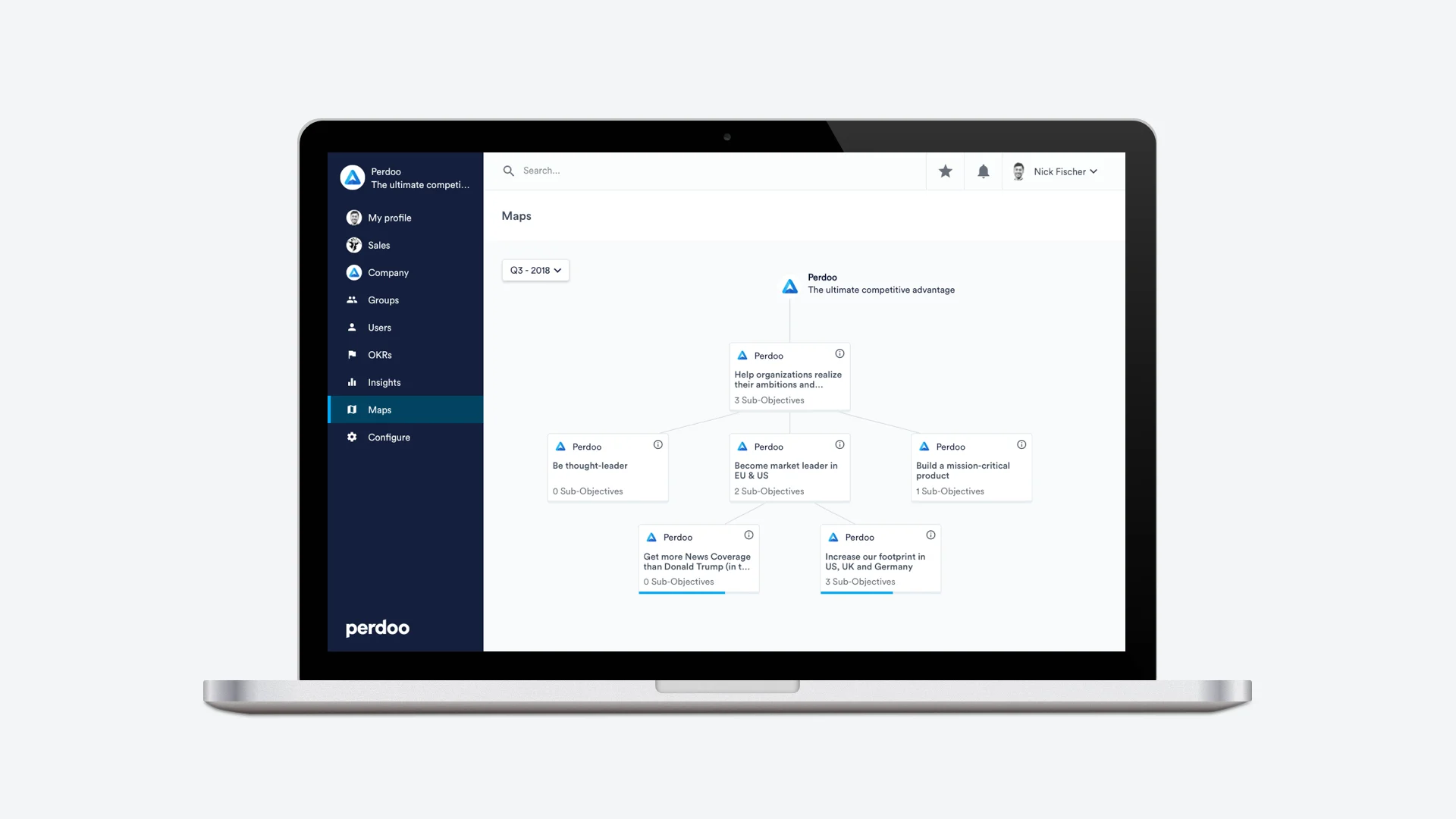
- Strategy Maps: The platform makes it easy to connect company priorities with KPIs and team OKRs. This gives goal-setting more context than a basic tracker, especially when several teams contribute to the same outcome.
- Cascade View: It clearly shows how goals connect across the organization. However, once several teams and OKRs are active, finding a specific goal can take a few extra clicks.
- Check-Ins: Employees can post updates, flag blockers, share wins, and update confidence levels without much friction. The Slack and Microsoft Teams integrations should also help teams keep the process inside the tools they already use.
- Performance Tools: The included 1:1s, reviews, Pulse surveys, and recognition tools are useful additions, but Perdoo is still strongest as a strategy and OKR platform rather than a dedicated HR or performance-management system.
Pricing and Plans
Perdoo offers a free plan for up to five users, plus Premium and Supreme paid plans. Paid subscriptions are available quarterly or annually, with annual billing priced 10% lower. Perdoo also applies volume discounts as license counts increase. Perdoo’s pricing page lists a five-user minimum for paid subscriptions.
| Plan | Price | Best For | Key Inclusions |
|---|---|---|---|
| Free | €0 for up to 5 users | Small teams piloting OKRs | Strategy Maps, OKRs, KPIs, check-ins, reviews, Slack/Teams integrations, and AI Assistant/Coach |
| Premium | €8/user/month | Growing teams formalizing strategy execution | Everything in Free, plus performance dashboards, SSO, SCIM, API access, and exports |
| Supreme | €10/user/month | Organizations needing governance, privacy, and deeper systems integration | Everything in Premium, plus KPI Boards, private goals, custom reports, and Jira/Asana/Power BI integrations |
At standard monthly list pricing, 50 Premium licenses would cost €400 per month, while 50 Supreme licenses would cost €500 per month. Actual costs may be lower with annual billing or volume discounts. These figures exclude optional coaching and any separately purchased view-only licenses.
Perdoo says there are no separate implementation fees. The company includes some coaching with paid subscriptions, while additional coaching can be purchased if needed.
Our Rating
We scored Perdoo across the areas buyers are most likely to weigh during an evaluation.
| Dimension | Score | Notes |
|---|---|---|
| Strategy and Goal Management | 4.8/5 | Strategy Maps, Strategic Pillars, KPI Boards, goal alignment, and cascades are the product's strongest capabilities. |
| OKR Execution Workflows | 4.5/5 | Strong check-ins, goal linking, progress tracking, reporting, and collaboration integrations. |
| Performance Management | 4.0/5 | Good coverage of 1:1s, reviews, Pulse, recognition, and engagement, but not a substitute for enterprise HCM suites. |
| Integrations and Extensibility | 4.2/5 | Strong Slack, Teams, calendar, API, Zapier, BI, project-management, CRM, and HRIS options, although many advanced integrations require Supreme. |
| Ease of Use | 3.9/5 | The core experience is approachable, but larger goal hierarchies and strategy configuration can introduce complexity. |
| Pricing and Value | 4.3/5 | The free plan is unusually useful, and paid pricing is transparent; advanced requirements may push buyers to Supreme. |
| Overall | 4.2/5 | A strong choice for organizations that want a strategy-centered OKR system rather than a standalone goal tracker. |
Best Use Cases
Fit matters more than feature count. Perdoo works best when an organization is prepared to maintain a regular strategy and check-in cadence.
Perdoo is a strong fit for:
- Organizations rolling out OKRs for the first time and wanting a guided system instead of spreadsheets.
- Growing companies that need to make strategic priorities visible across departments.
- Leadership teams that want to manage both KPIs and OKRs in one platform.
- Remote or hybrid teams that rely heavily on Slack or Microsoft Teams for updates and collaboration.
- Companies that want weekly execution rhythms, regular 1:1s, and performance discussions connected to goal data.
- Small teams that want to test a full-featured goal-management workflow before paying for software.
Look elsewhere if:
- You need payroll, benefits administration, HR compliance, recruiting, or a full HRIS.
- Your primary requirement is advanced compensation planning, succession planning, or enterprise talent calibration.
- Your team only needs a lightweight personal task or habit tracker.
- You need highly flexible, custom strategic-planning frameworks outside Perdoo’s Strategy Map and Pillar approach.
- Your organization is unlikely to maintain a consistent check-in cadence; the platform’s value depends substantially on active adoption.
Alternatives and Competitors
Perdoo is not the only option for OKRs, strategy execution, or performance management. These alternatives are worth considering depending on your main priority:
- Lattice: A better fit when performance reviews, engagement, and compensation planning matter more than strategy mapping.
- 15Five: A strong option for teams focused on check-ins, engagement, manager coaching, and continuous performance conversations.
- Profit.co: Worth considering for companies that need a broad OKR toolkit with task management and more configurable goal workflows.
- Betterworks: Better suited to larger organizations that need deep calibration, enterprise performance workflows, and HRIS integrations at scale.
- WorkBoard: A better match for companies with more formal strategic-planning and transformation-management requirements.
Final Verdict
Perdoo is a strong choice for teams that want to connect strategy, KPIs, and OKRs in one place. Its Strategy Map, goal alignment, and check-in workflows make it more useful than a basic goal tracker.
The free plan is a good starting point for small teams. Larger organizations that need advanced reporting, private goals, performance reviews, or deeper integrations should look at the Supreme plan.
Choose Perdoo if your main goal is to build a consistent strategy-execution process. Look at Lattice, 15Five, or Betterworks if performance management, compensation, or enterprise HR functionality is the bigger priority.