.svg)
Enterprise performance management is not primarily a manager-conversation problem. Rather, it is a governance problem. Thousands of managers must apply a common rubric consistently, preserve evidence that supports consequential ratings, and operate within local employment and employee-representation requirements.
Key Takeaways
- Build controls around the rating, not just the review form. A common scale is only useful when managers support ratings with evidence and calibration tests whether that scale is being applied consistently across units.
- Review patterns before ratings drive decisions. Check proposed outcomes for unexpected distribution and disparity patterns before they feed compensation, promotion, succession, or performance action.
- Use distribution data to investigate, not to impose a curve. A rating distribution can reveal inconsistency; a fixed quota can override individual evidence and create avoidable risk.
- Design for real manager capacity. A check-in cadence that works for a manager with six reports may fail for one with eighteen, regardless of the software in place.
- Bring local stakeholders into the design phase. Legal, privacy, local HR, and employee representatives may need to shape assessment criteria, monitoring features, data use, and rollout before configuration is final.
What Changes at Enterprise Scale
A March 2023 Gartner survey of HR leaders found that only 29% felt confident their organization's current processes were effective at helping employees achieve and sustain their best performance.
Performance management becomes a governance system rather than a series of manager conversations at enterprise size. The comparison below shows where a small-team process stops being sufficient:
The technology should support those controls, not define them. When evaluating performance-management platforms, look beyond review forms and reminders to permissions, calibration workflows, audit history, reporting, and the ability to handle local process variations.
The Enterprise Performance Management Process
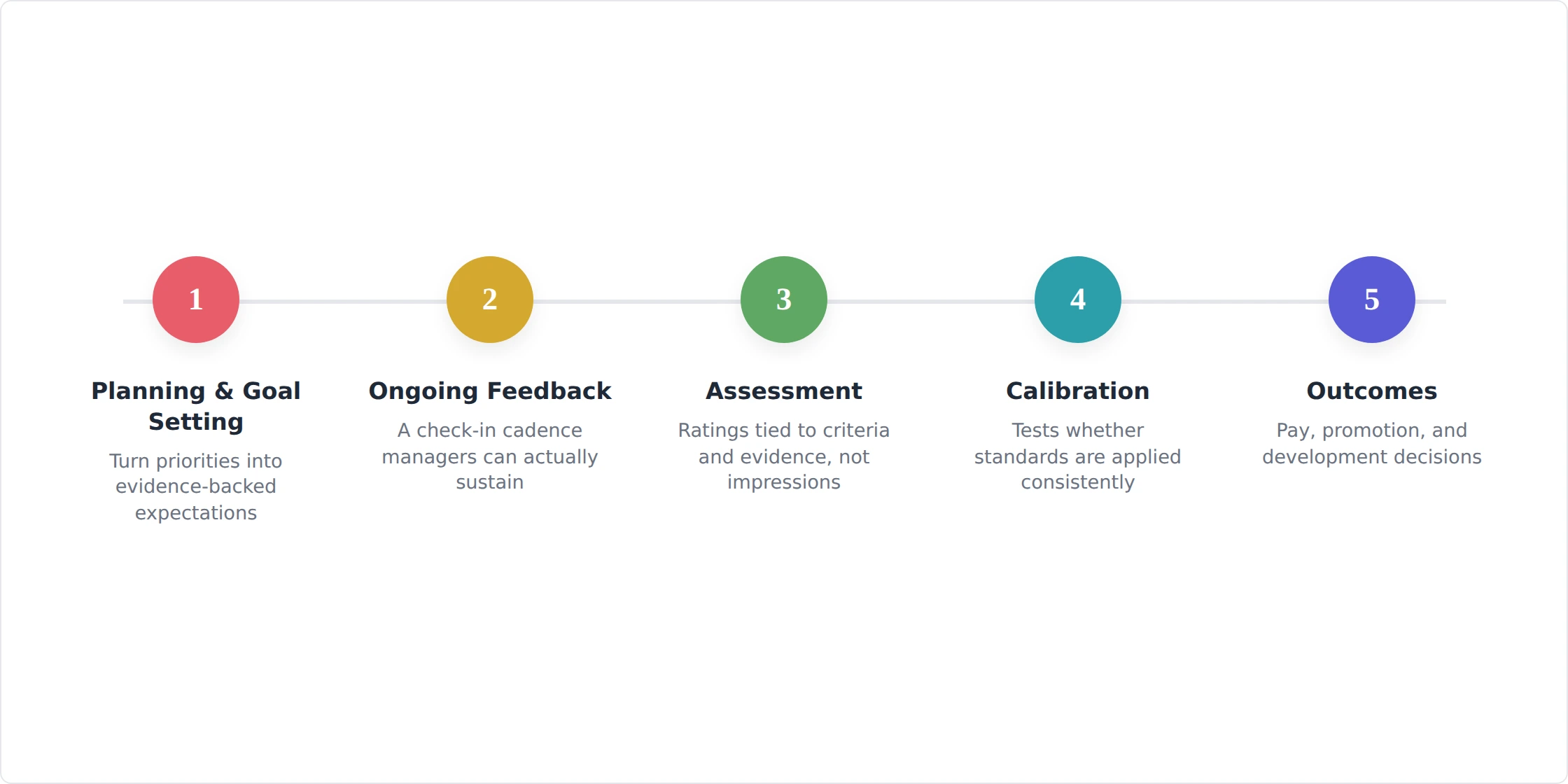
The performance management process usually has five connected stages: planning and goal setting, ongoing feedback and check-ins, assessment, calibration, and outcomes. The stages themselves aren't complicated. The harder part is making sure information carries over from one stage to the next without losing context or creating gaps in the decision trail.
1. Planning and Goal Setting
Planning turns your business priorities into expectations employees can actually work toward. At the enterprise level, however, alignment can get messy when different business units follow different planning calendars or when shared teams have competing priorities from multiple leaders.
You need a consistent baseline for every goal record. Make it clear what the employee is expected to achieve, when the goal should be completed, and how you'll measure progress. If a priority changes later, document why instead of quietly replacing the original expectation.
Goal completion also isn't the only evidence you should consider. Roles can change significantly during the year, so you may want to combine goal records with information from your skills-management system to get a broader view of employee capability.
2. Ongoing Feedback and Check-ins
A formal review shouldn't be the first time an employee hears about a performance concern. Regular check-ins give you a chance to address problems while there's still time to do something about them.
You don't necessarily need a weekly meeting for every employee, either. The frequency matters less than whether managers can actually maintain the routine. A monthly check-in might work well for a manager with six direct reports but become difficult to sustain with eighteen.
For that reason, don't create a schedule just to satisfy a process requirement. Set a rhythm managers can realistically maintain, then be clear about what needs to be documented when priorities change or a performance issue comes up.
3. Assessment
When you reach the assessment stage, you’re bringing the employee's perspective together with the manager's evaluation. Depending on the role, you may also collect feedback from colleagues or other people who have worked closely with the employee.
The important part isn't how many sections your review form has. It's whether the assessment gives you enough evidence to support the conclusions being made.
Ask managers to connect their ratings to agreed performance criteria and specific evidence rather than general impressions. They should also make clear which period the assessment covers.
The U.S. Equal Employment Opportunity Commission recommends communicating performance standards, applying them consistently, and including relevant facts in evaluations. The EEOC's guidance on conducting performance evaluations provides a useful baseline for U.S. employers.
If multi-source feedback is part of your review cycle, a 360-degree feedback tool can make the process easier to manage. However, make sure respondents aren't exposed and that open-ended feedback doesn't get reduced to an arbitrary rating.
4. Calibration
Calibration gives you a chance to step back and ask a different question: are managers across the organization actually applying the same performance standards?
One manager might rate their team consistently while still using a noticeably different standard from another department. At enterprise scale, that difference can have a real impact on employee ratings and the decisions that follow.
During calibration, compare proposed ratings with the evidence behind them. Previous ratings can provide useful context, as can the employee's role and broader distribution data. If you change a rating during the discussion, record why so there's a clear trail behind the decision.
On the other hand, calibration shouldn't turn into a meeting where leaders negotiate ratings from memory or try to force employees into a predetermined distribution. You want the evidence to drive the discussion.
5. Outcomes
The final stage is where your performance process starts affecting decisions outside the review itself. A rating might influence compensation or a promotion decision. It could also determine what kind of support an employee needs next.
The connection becomes even more important when performance data feeds into leadership planning. If that's part of your process, consider review outcomes alongside other inputs in the organisation's succession-planning process.
Don't let development become a generic training assignment after the review is over. Instead, use the assessment to identify a specific capability or performance gap that needs attention. An employee-development platform can then help you assign the relevant development action and track what happens after the review.
Eight Best Practices for Enterprise Performance Management
he practices below focus on organizations managing performance across multiple teams and business units. At that scale, you need controls that keep ratings consistent, make decisions defensible, and account for differences in local requirements.
Practice #1: Calibrate Across Business Units
Calibrating within one leadership team is useful, but it doesn't solve inconsistencies between business units. Build calibration in layers, starting with team discussions before comparing standards across functions and then reviewing cross-unit patterns at the enterprise level.
SHRM's survey of organizations with at least 2,500 employees found that 54% used formal calibration sessions. Among those organizations, 69% of respondents who changed ratings said inconsistent standards were the reason. SHRM's survey findings on calibration provide the full context.
Failure prevented: Employees with comparable contributions receive different ratings because managers apply different informal standards.
Practice #2: Treat Every Consequential Rating as a Legal Artefact
Once a rating affects pay, promotion, succession, a performance improvement plan, or an exit decision, you should be able to explain how the organization reached it. Keep the record tied to the relevant performance criteria, supporting evidence, and assessment period.
You don't need every review to read like a legal submission. However, another person should be able to follow the reasoning without relying on a manager's memory.
Failure prevented: A manager's rating becomes the organization's only explanation for an employment decision.
Practice #3: Govern Rating Distributions Without Forcing Them
Use rating distributions to spot unusual patterns across managers and functions, not to force employees into fixed percentages. If a distribution looks unusual, review the evidence behind it rather than assuming the numbers need to be corrected.
SHRM's 2011 survey found that 39% of respondents cited fitting ratings to a planned distribution as a reason ratings changed during calibration. Set thresholds for review instead of quotas, then document how significant differences were addressed.
Failure prevented: You either overlook meaningful rating anomalies or let a numerical target override the evidence.
Practice #4: Run Disparity Checks Before Ratings Are Final
Don't wait until compensation decisions are underway to look for rating disparities. Review proposed ratings before they're finalized and break the results down by relevant groups such as gender, age, tenure, job level, or location.
You're not trying to make every group produce identical results. You want to spot patterns that deserve a closer look while you can still act on them. If you're doing this at scale, HR analytics platforms can help you review distributions during the cycle rather than after it ends.
Failure prevented: You discover a potentially adverse pattern only after consequential decisions have already been made.
Practice #5: Consult Works Councils Before Rollout, Not After
If you're rolling out a performance system across multiple countries, don't assume the same implementation process will apply everywhere. In Germany, for example, Section 94 of the Works Constitution Act covers general assessment principles, while Section 87 covers certain technical facilities used to monitor employee performance.
Bring local legal, HR, privacy, and works-council stakeholders into the process while the design can still change. For global programs, keep a country-by-country rollout plan and get jurisdiction-specific advice before implementing changes that may trigger statutory rights.
Failure prevented: Your rollout is delayed or challenged because consultation or co-determination requirements were addressed too late.
Practice #6: Size the Process to Manager Span of Control
Your performance process needs to match the time managers actually have. A manager with six reports may be able to maintain regular check-ins, while someone with eighteen may struggle to sustain the same cadence.
Use your system to flag missing check-ins, overdue reviews, or unusual rating changes, but don't treat completion rates as proof of quality. SHRM's enterprise-focused survey found that 98% of respondents had a formal evaluation process, yet only 46% required people managers to complete formal process training.
Failure prevented: The process turns into recency bias and generic comments because managers can't realistically maintain the expected cadence.
Practice #7: Keep Performance and Conduct on Separate Tracks
Performance and conduct can overlap, but they shouldn't become the same record. Use the performance process for role expectations and observed work behavior, while policy violations, harassment, discrimination, or serious misconduct should follow the appropriate employee-relations or investigation process.
If conduct affects performance, you can document the business impact without combining the two processes. Managers should also know where to go when they're unsure which process applies.
Failure prevented: A manager uses a low performance rating to address a conduct issue, creating an unclear record and a weaker foundation for later action.
Practice #8: Hold Mid-cycle Ratings to the Same Rubric
Important performance decisions don't always happen at the end of the formal cycle. You may need to assess someone after a role change, during a performance improvement plan, or following a leadership transition. Keep the same rating definitions and evidence expectations for these interim decisions.
The assessment can be shorter, but it should still state its scope and the evidence considered. Preserve relevant context when someone changes roles or managers, and keep the decision in your system of record. An enterprise HR platform can provide the permissions and version history needed to maintain that record.
Failure prevented: A promotion, PIP, or role-change decision relies on an informal rating that can't be reconciled with your formal process.
Where Enterprise Programs Fail
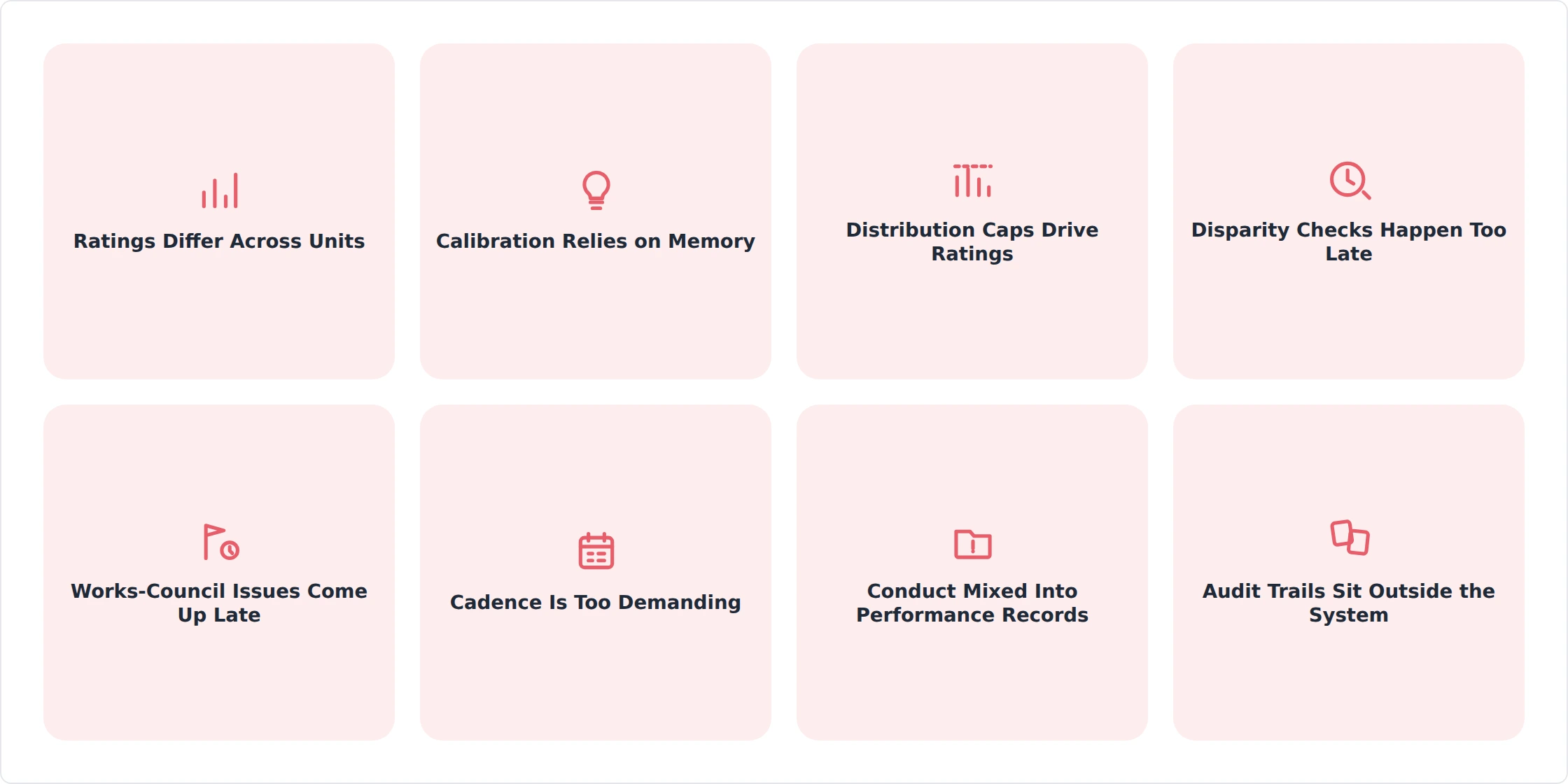
Enterprise performance programmes usually don't fall apart because the rating form is bad. More often, the problems show up between managers, systems, and different parts of the organization. These are the warning signs to watch for.
- Ratings Differ Across Units: You may calibrate within teams without checking how other units use the scale. As a result, similar performance can receive very different ratings.
- Calibration Relies on Memory: Leaders may debate reputations or recent events instead of the evidence behind a rating. Instead, use pre-read data and clear rating definitions to keep the discussion grounded.
- Distribution Caps Drive Ratings: A fixed curve can push managers to lower ratings simply because too many employees are already in the top category. Rather than using quotas, treat unusual distributions as a reason to look closer.
- Disparity Checks Happen Too Late: You may spot a concerning pattern only after compensation or promotion decisions are underway. For that reason, review proposed ratings before they're finalized.
- Works-Council Issues Come Up Too Late: A global team may configure a new tool before checking local requirements. Instead, involve the relevant stakeholders while you can still change the process.
- The Cadence Is Too Demanding: A monthly check-in may work for a manager with six reports but not eighteen. As a result, feedback can become rushed or generic when expectations don't match workload.
- Conduct Issues End Up in Performance Records: A manager may use a performance rating to address a conduct issue because it feels easier. However, keeping the two processes separate gives you a clearer record.
- Audit Trails Sit Outside the System: Rating explanations and calibration notes can end up scattered across spreadsheets or email. More importantly, that makes decisions harder to reconstruct later.
FAQs
What are the steps in the performance management process?
The components of the performance management process include planning and goal setting, ongoing feedback and check-ins, assessment, calibration, and outcomes. In an enterprise performance management process, each stage must transfer usable evidence to the next. The rating should be traceable to the rubric, calibration should occur before final decisions, and the outcome should follow documented rules.
How does performance management differ at enterprise scale?
The problem is not simply helping one manager give better feedback. The organization has to govern thousands of managers applying common criteria across different functions and jurisdictions. Ratings need to be comparable, decision-ready, and supported by records. Local legal, privacy, and employee-representation requirements can also shape the process design.
What is calibration in performance management?
Calibration is a structured review of proposed ratings and their evidence. It tests whether similar performance is being assessed similarly across managers and business units. It is not a meeting to force a curve. Strong calibration uses role context, evidence, historical patterns, and distribution data, then records any material rating changes and the rationale.
Is forced distribution still used in large organizations?
Some organizations retain distribution expectations or legacy ranking models, but a fixed forced-distribution model is different from distribution governance. Monitoring distributions helps identify anomalies and potential disparity. Requiring a preset percentage in each rating group can force managers to downgrade employees to meet a quota and can create unnecessary employee-relations and legal risk.
What documentation makes a performance rating defensible?
A defensible rating is tied to a clear, role-relevant rubric and supported by contemporaneous examples from the assessment period. It should show relevant feedback, material changes in expectations, the reasoning for the conclusion, calibration treatment, and how the rating was later used. Keep conduct investigations and performance evidence on separate documentation tracks.
.png)