.svg)
15Five and Betterworks are both continuous performance management platforms with strong ratings and genuine feature depth, but they were built for different buyers. 15Five was built mid-market-first: transparent pricing, modular plans, and a philosophy that treats manager effectiveness as the central lever for engagement and retention.
Betterworks was built enterprise-first: cascaded OKR execution, formal calibration workflows, and deep enterprise HRIS integration are its origin and core. They overlap in feature lists but diverge in depth, orientation, and cost. What you prioritize, and the scale at which you need to execute it, determines which one fits.
15Five Overview
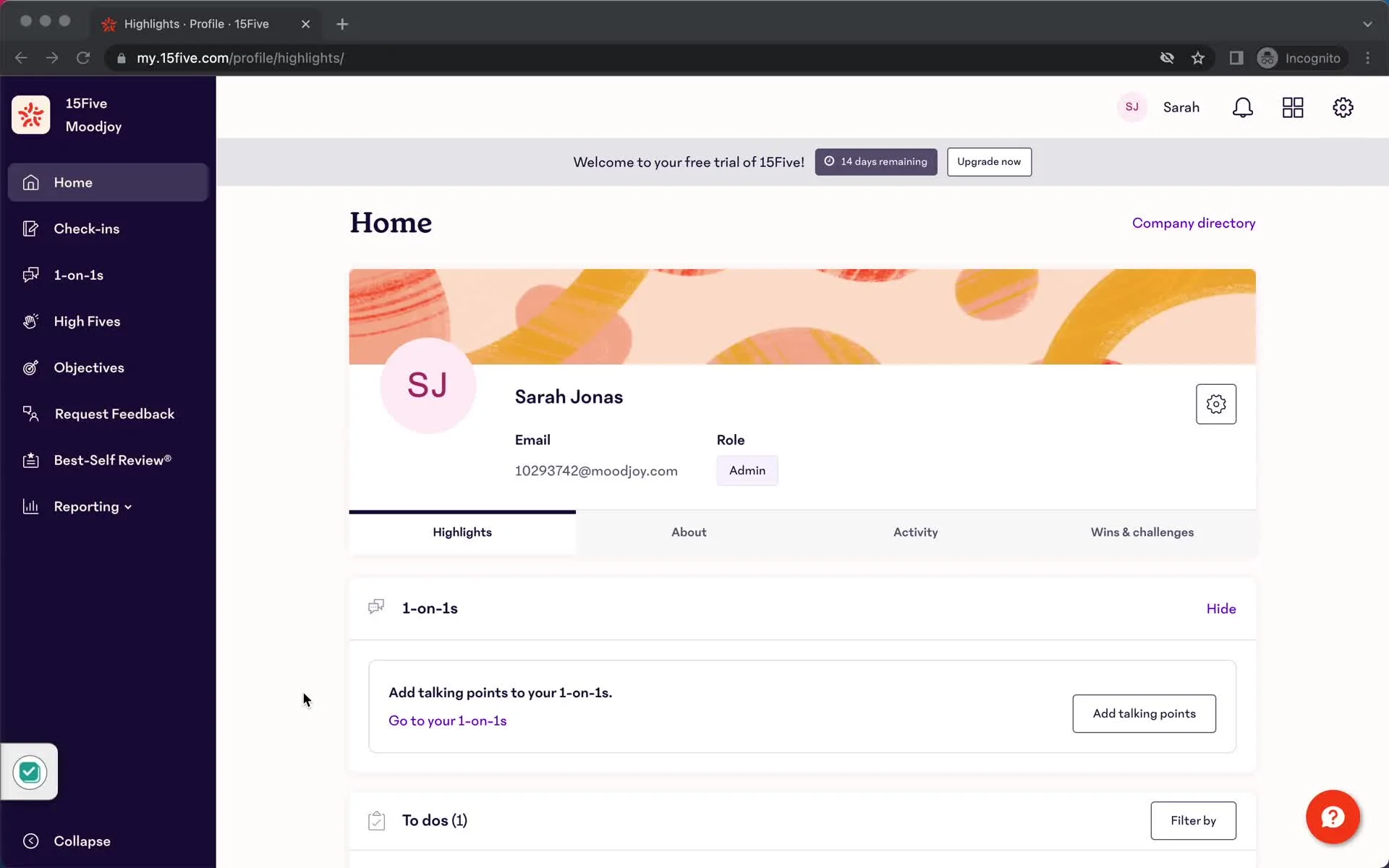
15Five is a continuous performance management platform founded in 2011 in San Francisco. David Hassell returned as CEO in July 2025; Dr. Jeff Smith succeeded him as CEO in May 2026. According to a July 2025 company announcement, 15Five served more than 3,500 organizations and 400,000 users.
Its current website cites over 3,000 customers and 250,000 employees served, with a majority of its G2 reviewers coming from mid-market organizations (per G2 category data as of August 2026). 15Five holds a 4.6/5 rating on G2 as of August 2026 (ratings and review counts change over time). Pricing is published on the 15Five website, and plans run from $4 to $16/user/month depending on tier.
15Five's defining philosophy is Best-Self Management, which treats manager effectiveness as the primary lever for engagement and retention. Check-ins, 1:1 agendas, the Manager Effectiveness Indicator, and the Kona Meeting Assistant are all built to develop manager habits continuously, not just at review time.
Key Features
- Weekly check-ins and structured 1:1 agendas with shared talking points, goal updates, and action items carried across meetings
- Performance reviews (Best-Self Review) with customizable cycles: self, peer, manager, and upward reviews configurable in one cycle, with calibration tools
- OKR and goal tracking as a core module with company, team, and individual-level alignment and progress visibility
- Engagement and pulse surveys (Engage tier); HR and turnover analytics available in Perform
- 360-degree feedback, continuous feedback, and peer recognition (High Fives)
- Manager training microlearnings (Total Platform tier)
- Kona Meeting Assistant: an AI tool that joins supported 1:1 meetings to capture notes and action items ($2/user/month add-on)
- Compensation module: merit cycles, pay bands, and compensation review (add-on)
Pros
“I really love how easy it is to use the weekly check-ins and 1-on-1 meetings because it keeps everyone on the same page and furthermore the High Fives feature is great for team morale which is something we use every single week.” – G2 reviewer
- Manager development depth is a genuine differentiator. Between structured 1:1 agendas, check-in frameworks, the Manager Effectiveness Indicator, manager training microlearnings, and the Kona Meeting Assistant, 15Five has invested more in manager enablement than most platforms in its tier. For organizations that treat manager quality as a strategic lever, this is the most distinctive capability on the list.
- Transparent, modular pricing allows independent evaluation. Published pricing and clearly defined tiers let buyers model costs and evaluate the platform without a sales conversation. This is a meaningful differentiator against most enterprise competitors, including Betterworks.
- Engagement and performance are genuinely integrated. The HR Outcomes Dashboard connects engagement survey data, performance review signals, and turnover risk indicators in one view. G2 reviewers consistently cite this consolidation as a practical advantage over using separate tools for listening and performance.
- High adoption ease across both managers and employees. G2 reviewers regularly describe 15Five as intuitive and quick to roll out. The check-in cadence and Slack integration keep the platform in the flow of work rather than requiring a separate login habit.
Cons
“The templates available for performance reviews could be a bit more varied but overall the platform has been working really well for our team and there are no major issues I have come across so far.” – G2 reviewer
- Platform value is adoption-dependent. 15Five's data quality and insight reliability are directly proportional to how consistently managers and employees complete check-ins and 1:1s. Organizations without strong HR-led accountability structures may find the platform underperforms against expectations.
- Calibration requirements vary by organization. Organizations with formal enterprise governance requirements should compare each platform's calibration controls, audit history, and compensation-workflow support during evaluation.
- Modular pricing escalates as modules stack. The Engage tier at $4/user/month is accessible, but organizations that need Perform ($11), Compensation ($9), and the Kona Meeting Assistant ($2) can find the all-in cost higher than the headline price suggests. Pricing is subject to change; verify current rates with 15Five.
Betterworks Overview
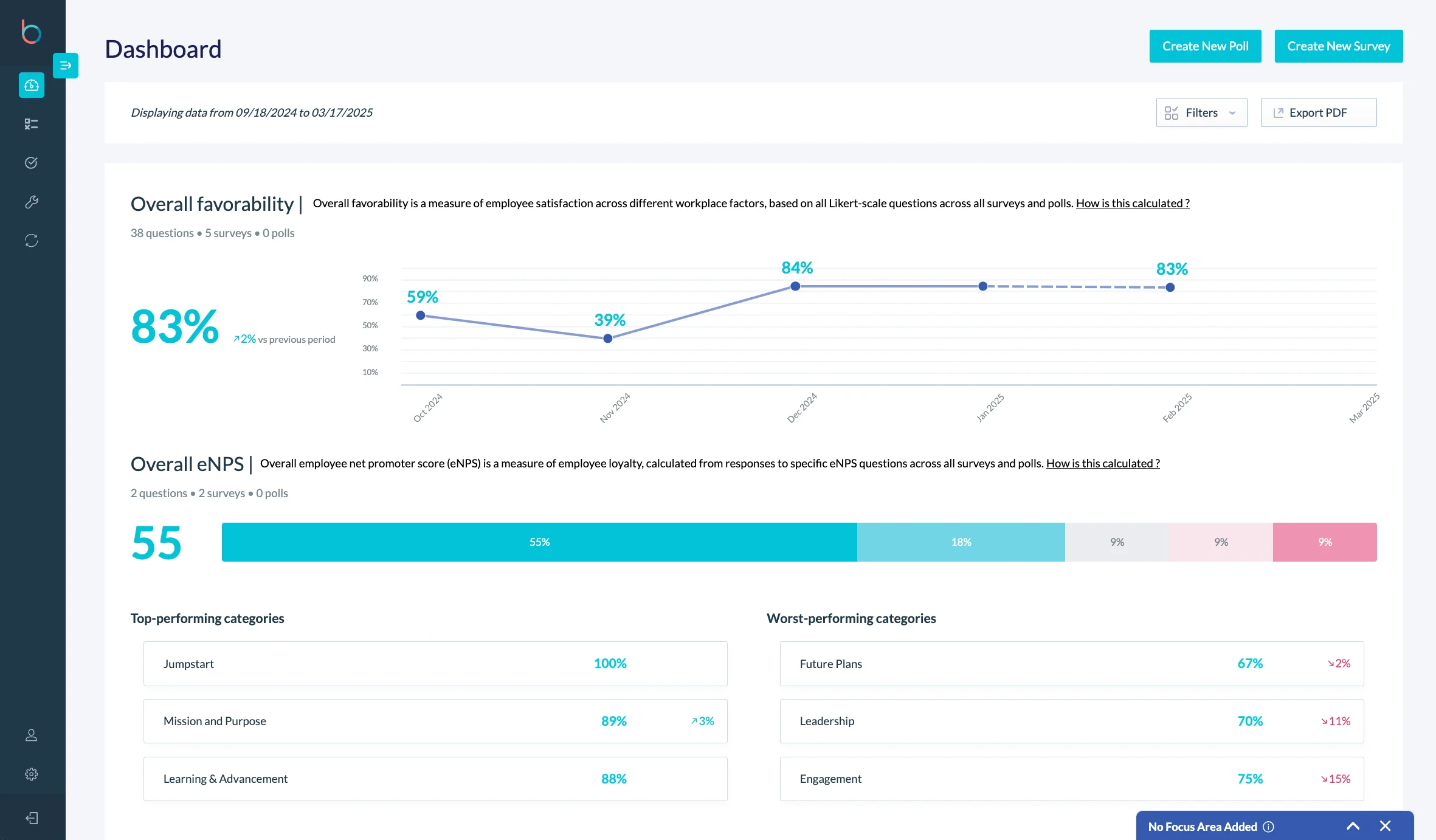
Betterworks is an enterprise performance management platform founded in 2013 in Menlo Park, California. The company has raised significant outside funding across multiple rounds. Its customer base skews enterprise, with a majority of G2 reviewers from enterprise organizations (per G2 category data as of August 2026).
Betterworks holds around a 4.3/5 rating on G2; ratings and review counts change over time. Pricing is not published; all plans require a sales conversation, and the platform is designed primarily for organizations with 500 or more employees.
OKR alignment is the organizing principle of Betterworks. Its goal-cascading architecture connects company-level objectives through departments and teams down to individual contributors in real time. In 2026, Betterworks launched AI-powered Talent Intelligence capabilities, expanding beyond OKR and calibration into workforce intelligence and succession planning.
Key Features
- OKR and goal management with enterprise-grade cascading: company, department, team, and individual levels with real-time alignment visibility
- Continuous check-ins and structured conversation frameworks integrated with the goal and review workflow
- Performance reviews with a calibration module designed for large-scale, formal review cycles with configurable calibration and audit history
- Employee engagement surveys (Engage module); organizations for which engagement surveys are a primary criterion should evaluate them alongside dedicated platforms
- Succession planning and Talent Intelligence (AI-powered, launched 2026)
- Deep enterprise HRIS integrations: Workday, SAP SuccessFactors, ADP, BambooHR, and UKG
- Integrations with Slack, Microsoft Teams, Outlook, Gmail, Jira, and Salesforce for in-flow goal updates and feedback
- SAML SSO and SCIM provisioning for enterprise identity management
Pros
“Betterworks offers a modern interface for tracking goals, sharing feedback, and collaborating with others. Also I really appreciate the AI tools to enhance feedback texts, this is maybe my major advantage. In addition I never had issues with performance - the system seems to be stable and scalable.” – G2 reviewer
- OKR cascading and alignment visibility are among the most mature in the category. For organizations running enterprise-wide OKR programs, the ability to connect company objectives to individual key results in a single, real-time view is one of Betterworks' clearest differentiators. G2 reviewers consistently praise how the platform makes individual contributions visible within the larger organizational context.
- Calibration module is purpose-built for enterprise review cycles. Configurable calibration with audit history, talent-profile context, and succession workflows addresses the governance and consistency requirements that large HR teams running formal review cycles need, and that mid-market-oriented platforms typically do not provide at this depth.
- Enterprise HRIS integration depth. Native connections to Workday, SAP SuccessFactors, ADP, and BambooHR with bidirectional data sync make Betterworks a natural fit for organizations running complex HR tech stacks where data fidelity is a compliance and operational requirement.
- 2026 Talent Intelligence and AI capabilities add succession and workforce planning depth. The 2026 AI launch positions Betterworks beyond performance reviews into workforce intelligence, adding skills insights and succession signals that go beyond what most point solutions in the category currently offer.
Cons
“I feel the user interface could be a little more user-friendly, some features take time to load, and the navigation can occasionally feel confusing. A cleaner layout and simpler workflows would make it more efficient, the graphics as well.” – G2 reviewer
- Implementation is a significant investment. Betterworks is not a self-serve platform and requires a structured rollout. Organizations without dedicated change management capacity may find it difficult to realize the platform's full value.
- OKR methodology requires organizational commitment to succeed. The platform's power is contingent on the organization actually running OKRs as an operating discipline. Buyers evaluating Betterworks as a goal-tracking layer without committing to OKR methodology tend to find the implementation overhead disproportionate to the outcome.
- Engagement surveys are not a primary differentiator. Organizations for which engagement surveys are a primary buying criterion should evaluate Betterworks' survey capabilities alongside dedicated engagement platforms before committing.
- Pricing opacity complicates early budget planning. The absence of any published pricing makes it difficult for buyers to model costs, compare vendors on a level basis, or qualify the platform against budget constraints without first engaging sales.
Pricing Comparison
15Five publishes its pricing on its website. Betterworks requires a sales conversation before disclosing any pricing information. This difference is material for buyers who want to model costs and compare vendors before entering a sales process.
| 15Five | Betterworks | |
|---|---|---|
| Pricing Model | Modular, per user/month, billed annually | Custom enterprise pricing; fully quote-based |
| Engage / Surveys Tier | $4/user/month (annual) | Included in enterprise plan; not sold standalone |
| Core Performance Tier | $11/user/month (Perform, annual) | Not published; contact Betterworks for a quote |
| Total / Combined Platform | $16/user/month (annual) | Single enterprise plan; no tiered structure |
| Add-Ons | Compensation: $9/user/month; Kona Meeting Assistant: $2/user/month | Not published; structured rollout required |
| Free Trial | Not advertised; demo available | Not available; demo only |
| Pricing Transparency | Published on website | Custom quote required; no published rates |
15Five pricing is verified from the 15Five pricing page as of August 2026 and is subject to change. Betterworks pricing figures are not published. Contact Betterworks directly for a current quote.
Because Betterworks does not publish pricing and may involve implementation services, meaningful cost comparison is not possible without a direct quote. The more relevant difference for most buyers is earlier in the process: 15Five lets you model costs independently before speaking to sales; Betterworks does not.
Feature Comparison: 15Five vs Betterworks
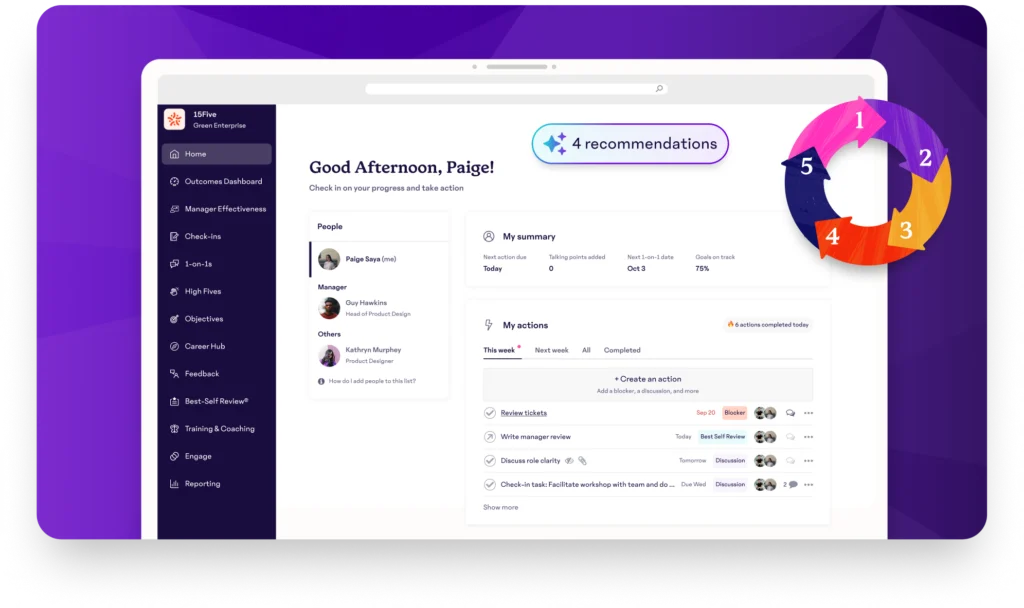
The two platforms overlap in feature categories but diverge substantially in depth. These are the six areas where the choice is most consequential.
OKR and Goal Management
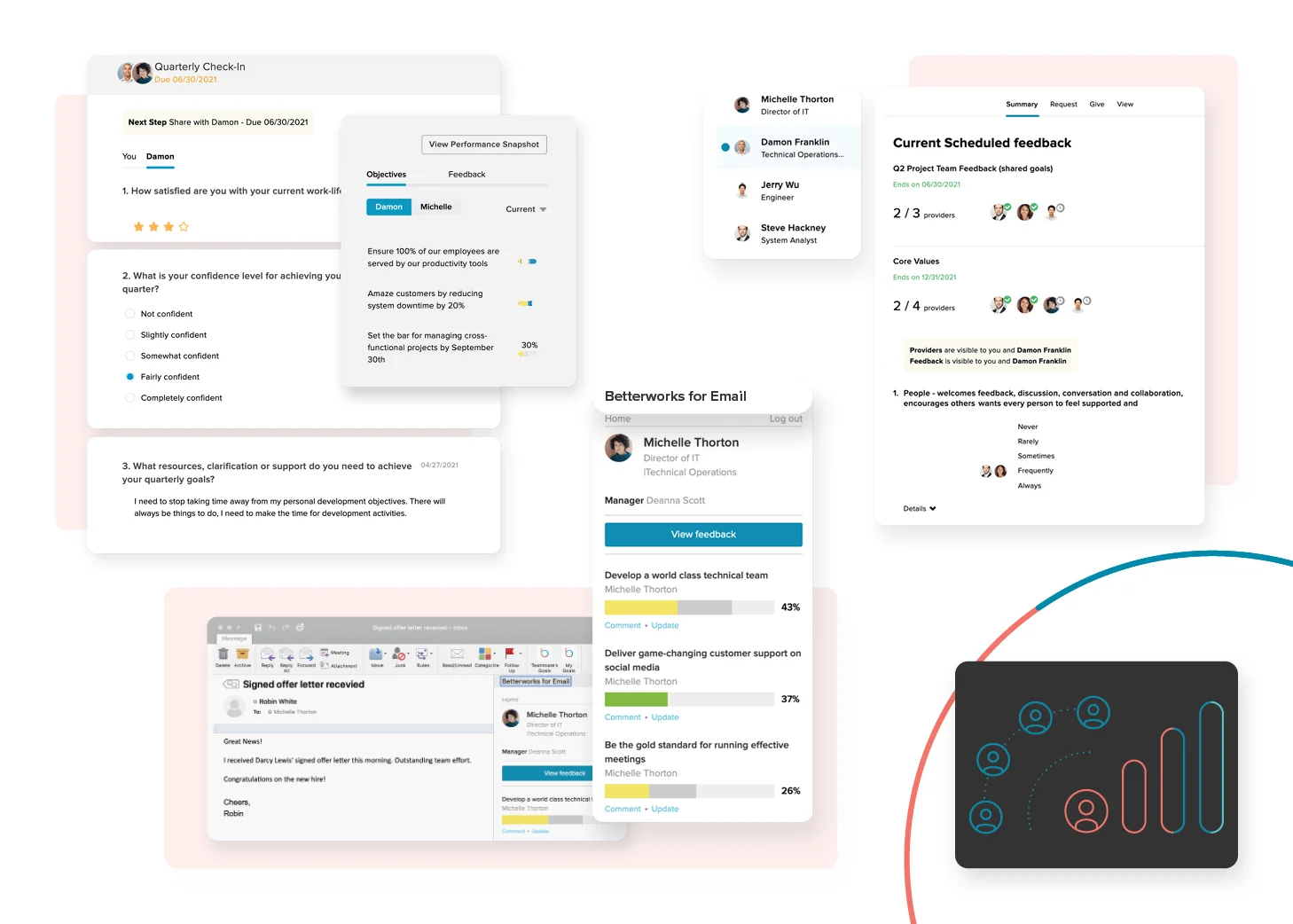
Betterworks has OKR alignment at the center of its product architecture. Goal cascading connects company-level objectives through departments and teams down to individual contributors in a single, real-time view. G2 reviewers consistently describe this visibility as one of the platform's clearest differentiators. For organizations committed to OKR-driven execution at scale, Betterworks' goal management is one of the more mature implementations in the category. Enterprise teams should factor this in when choosing what best OKR software for enterprise organizations.
15Five includes OKR tracking in its Perform and Total Platform tiers. The module is capable and well-integrated with check-ins and reviews, but OKRs are one feature within a broader suite rather than the product's organizing principle. Teams that want OKRs alongside surveys and reviews find the approach practical; organizations running large-scale cascaded OKR programs may find it less purpose-built for that complexity.
Verdict: Betterworks for enterprise OKR programs requiring cascading alignment at scale; 15Five for mid-market teams that want OKRs as part of a broader performance workflow.
Performance Reviews and Calibration
15Five offers customizable Best-Self Review cycles including 360-degree feedback, talent matrices, and AI-assisted review writing. The review workflow draws on check-in and 1:1 data accumulated throughout the year, addressing recency bias. Reviewers describe this continuity as the feature that most distinguishes 15Five's experience from point-in-time alternatives.
Betterworks supports configurable calibration with talent-profile context, change and audit history, and succession-planning workflows, designed for large HR teams running formal review cycles at scale. Performance review calibration helps HR teams align ratings and make calibration decisions more consistent throughout formal review cycles.
Verdict: 15Five for continuous reviews built on an ongoing performance record; Betterworks for enterprise HR teams running formal, configurable calibration at scale.
Employee Engagement Surveys
15Five's Engage tier offers engagement surveys, assessments, benchmarking, action planning, and heat maps. The Perform tier adds HR and turnover analytics. The Engage tier is available standalone, letting organizations start with listening programs and add performance management later.
Betterworks includes an engagement module. Organizations for which engagement surveys are a primary buying criterion should evaluate its survey capabilities alongside dedicated engagement platforms before committing.
Verdict: 15Five for organizations where engagement surveys are a primary use case; Betterworks' engagement module supplements its performance core but is not a primary reason to choose the platform.
Manager Development and 1:1 Tools
Manager development is where 15Five most clearly differentiates itself. The 1:1 tooling, Manager Effectiveness Indicator, manager training microlearnings, and Kona Meeting Assistant together make it a well-regarded option for organizations that treat manager quality as a strategic investment.
Betterworks includes 1:1 templates and conversation frameworks integrated with its OKR and review workflow. The tooling is functional but does not have an equivalent manager development content library or AI coaching layer.
Verdict: 15Five for organizations investing in manager development as a primary outcome; Betterworks for structured manager-employee conversations within an enterprise OKR model.
HRIS Integrations
15Five integrates with Workday, BambooHR, ADP, Rippling, Namely, and UKG, along with SSO providers and Slack and Microsoft Teams for in-flow check-in prompts.
Betterworks is known for deeper enterprise HRIS integration, with native bidirectional connections to Workday, SAP SuccessFactors, ADP, BambooHR, and UKG. Organizations running Workday or SAP SuccessFactors as their system of record tend to find Betterworks integrates more seamlessly into those environments.
Verdict: Both integrate with major HRIS platforms; Betterworks has a meaningful edge for organizations deeply invested in Workday or SAP SuccessFactors at enterprise scale.
AI Features
15Five uses AI for review writing assistance, manager coaching prompts via Kona, predictive turnover and engagement risk modeling, and automated 1:1 agendas. These features are manager-facing, oriented toward improving day-to-day management behaviors.
Betterworks' 2026 AI launch added Talent Intelligence covering goal recommendations, performance pattern analysis, skills insights, and succession signals, focused on organizational and HR leadership decision support.
Verdict: 15Five's AI is manager-facing and coaching-oriented; Betterworks' AI targets HR leadership, organizational analytics, and workforce planning.
Choose 15Five If:
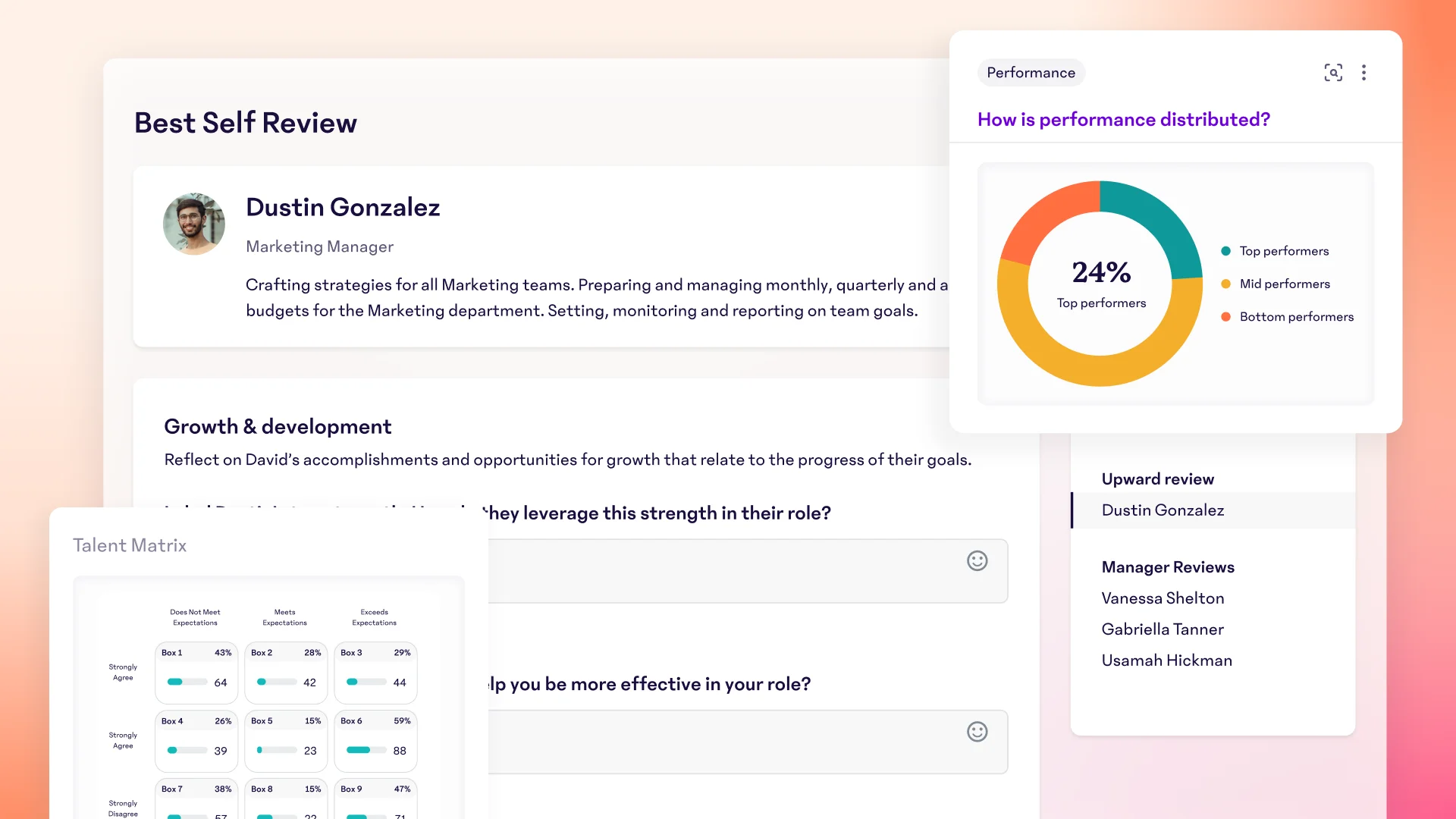
- Your organization is a coaching-focused team of roughly 50 to 1,000 employees and wants a continuous performance management platform with published, predictable pricing and the option to evaluate independently before engaging sales.
- Manager development is a named strategic priority. 15Five's 1:1 tooling, manager training microlearnings, Manager Effectiveness Indicator, and Kona Meeting Assistant represent a level of investment in manager enablement relative to most platforms in this tier.
- You want engagement surveys, performance reviews, OKRs, and 1:1 tools in one integrated platform without a custom enterprise contract.
- Your team uses Slack or Microsoft Teams and wants check-ins, feedback, and recognition to happen inside existing communication tools without requiring a separate login habit.
- You are transitioning from annual reviews to continuous performance management and need a platform that builds the habit gradually, starting with weekly check-ins, rather than requiring a full organizational change management program before you see value.
Choose Betterworks If:
- Your organization has roughly 500 to 5,000 or more employees and is running, or planning to run, a formal enterprise OKR program that needs to cascade company strategy down to individual contributors in a single, real-time view.
- You run formal performance calibration cycles and need configurable calibration with audit history, talent-profile context, and succession-planning workflows across a large, complex workforce.
- Your HR technology stack is built around Workday or SAP SuccessFactors, and you need performance management that integrates natively and bidirectionally into that HRIS environment with enterprise-grade data fidelity.
- You have the organizational capacity and budget for a structured enterprise implementation, including dedicated change management support, and you are prepared to invest in OKR methodology as an organizational operating discipline.
- HR leadership and executives, rather than front-line managers, are the primary stakeholders driving the platform decision and will be the primary users of analytics, calibration reporting, and workforce intelligence features.
Final Verdict
15Five is the stronger fit for mid-market organizations that want transparent pricing, integrated engagement and performance, and a platform built around manager habit formation. For coaching-focused teams of roughly 50 to 1,000 employees moving away from annual reviews, it is a practical and accessible starting point.
Betterworks is a stronger fit for enterprise organizations committed to OKR-driven execution at scale, with configurable calibration, audit history, and HRIS integration depth. The trade-off is implementation complexity and pricing opacity. For organizations that do not fit that enterprise profile, 15Five is the more practical long-term choice. Our performance management software roundup covers Lattice, Leapsome, Culture Amp, and others evaluated against the same criteria.