.svg)
You might not realize this, but the rating your employee receives may have less to do with their actual performance than with who is doing the rating. Performance review bias is one of the most common and least-discussed problems in HR, and the fix isn't a training program. It comes down to having the right structure in place before the review even begins.
Key Takeaways
- Performance review bias is more common than you think, and a large portion of what gets rated has more to do with the rater than it does with the employee being reviewed.
- There are eight common bias types to be aware of. Most of them won’t show up in a single rating. You have to look at the bigger picture, meaning distributions, patterns, and the language used in written feedback.
- If you want to actually reduce bias, the answer is structural. Defined rating criteria, calibration sessions, and consistent documentation throughout the year are what work.
- Standalone unconscious bias training is widely recommended, but the evidence simply isn’t there. In some cases, it made outcomes worse. Process changes outperform awareness training, and that’s worth knowing before you invest in one over the other.
What Is Performance Review Bias?
Performance review bias is when your rating reflects something other than your actual performance. Maybe it's what your manager happened to observe in the last few weeks. Maybe it's how you compared to the person reviewed right before you. Either way, the root cause is the same either way. Something other than your actual work against a defined standard is driving the number.
This matters because performance management decisions around pay, promotion, and development are all downstream of that rating. If the number is distorted, everything built on it is too.
Before we go further, it helps to know what bias actually isn't. Not every rating you disagree with is a result of bias. The table below breaks down the difference:
The 8 Most Common Types of Performance Review Bias
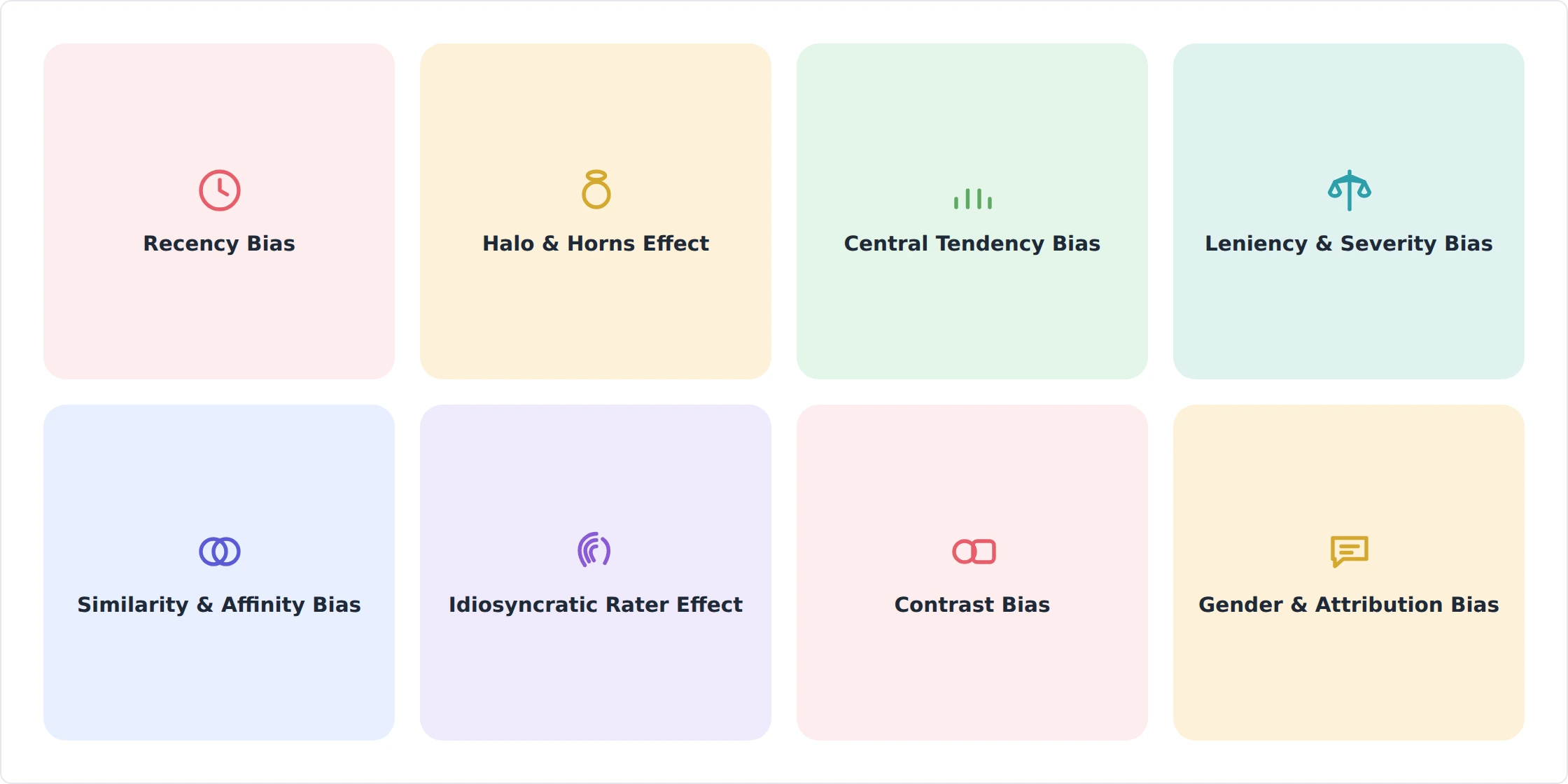
Most people who have experienced performance review bias knew something felt off before they could even name it. In the following, we'll be going through the eight most common types, what they actually look like in a real review, and the one signal that tells you it's happening.
1. Recency Bias
Ask yourself this: if your manager sat down to write your review today, how much of the last twelve months would they actually remember?
More likely than not, they're going to remember the last few weeks far more clearly than anything that happened in March. That's recency bias, and the tricky part is that it's almost automatic. Your last month essentially stands in for your entire year, even if your strongest quarter happened long before review season.
You should look for a rating that closely tracks the employee's most recent high-visibility project rather than their consistent output over time. The fix is simple in theory, but harder in practice. Managers need to document observations throughout the year instead of trying to reconstruct them at the end. We'll cover that in more detail in the interventions section below.
2. Halo and Horns Effect
Imagine rating someone who excels technically but struggles with communication. If their technical work is exceptional enough, then there's a good chance that strength bleeds into how you score everything else, even the areas where they genuinely fall short. That's the halo effect. The horns effect works in reverse, where one glaring weakness pulls every other rating down with it, regardless of where the person actually stands on those dimensions.
Watch for rating profiles where most dimensions land in the same direction, regardless of whether the employee's actual performance varied across those areas. When everything is consistently high or consistently low across very different competencies, that's more often than not the halo or horns effect at work.
3. Central Tendency Bias
Have you ever looked at a team's performance ratings and noticed that almost everyone landed somewhere in the middle? That's not a coincidence. Central tendency bias happens when a manager consistently avoids the extremes of a rating scale, placing nearly everyone at the midpoint regardless of how different their actual performance really is. The result is a distribution so flat you genuinely can't tell your strongest performers from your average ones, which makes merit budgets and promotion decisions nearly impossible to defend.
Look at the distribution, and not the individual scores. A manager whose entire team shows almost no outliers in either direction is a strong indicator of central tendency bias. More often than not, it has less to do with having a genuinely average team and more to do with the rater's discomfort in having to justify an extreme score to anyone.
4. Leniency and Severity Bias
The thing is, you can't spot leniency or severity bias by looking at a single rating. It's completely invisible at that level. You only see it when you step back and look at a manager's entire team distribution. A lenient manager rates everyone high, consistently and across the board. A severe manager does the opposite. Neither pattern is obvious until you compare them against the rest of the organization.
This is exactly why calibration sessions that surface distribution data by manager are so much more useful than reviewing ratings one at a time. Without the full picture, you won't even know the problem exists in the first place. And the longer it goes unnoticed, the more it distorts your merit and promotion decisions.
5. Similarity and Affinity Bias
People naturally gravitate toward others who are like them. That's human nature, and it doesn't require bad intentions for it to show up in a performance review. When a manager rates employees who share their background, communication style, or general approach to work more favorably than those who don't, that's similarity bias. It's not always deliberate. The employee who reminds a manager of themselves simply tends to get the benefit of the doubt when performance is ambiguous, and that benefit compounds over time.
What gives it away is a pattern where ratings correlate more with demographic similarity or shared characteristics than with measurable output. Without multiple raters in the mix, this kind of bias can go completely unnoticed for years.
6. The Idiosyncratic Rater Effect
Of all the biases on this list, this one is the most important to understand, and also the most uncomfortable to sit with. Research by Scullen, Mount, and Goff found that idiosyncratic rater effects, meaning raters’ individual rating tendencies, accounted for 62% and 53% of rating variance across two large samples of managers, or about 58% on average. The combined effects of general and dimension-specific performance accounted for 21% and 25%, respectively.
Think about what that really means for your organization. More than half of what a rating captures reflects the manager's own standards, their interpretation of the scale, and their private definition of what 'good' looks like. Adding more raters helps dilute this effect, but it doesn't eliminate it entirely. It's a structural problem, and it needs a structural response.
7. Contrast Bias
Without realizing it, managers often rate employees not against the defined standard but against whoever they reviewed last. Follow three high performers in the review queue and you're almost certainly going to look average by comparison, even if your work is genuinely strong. That's contrast bias, and it has nothing to do with your actual performance. It has everything to do with the sequence you happened to be reviewed in.
You'll notice it when a rating shifts based on review order rather than on what the employee actually did. The straightforward fix is evaluating each person against written criteria before making any comparisons at all. Otherwise, contrast bias can slip through without the manager ever noticing it happened.
8. Gender and Attribution Bias
Gender bias in reviews doesn't always show up in the numeric score. A lot of the time, it lives in the language. Research by Correll and Simard, published in Harvard Business Review, found that women consistently receive vaguer written feedback than men, which makes it harder for them to know what to improve and harder to make a case for advancement. A 2020 study drawing on performance reviews from a Fortune 500 technology company found that the exact same behavior, specifically taking charge, was rated more positively for men than for women.
On top of that, attribution bias tends to follow a consistent pattern. A man's success gets credited to skill; a woman's gets credited to effort or circumstance. Diversity and inclusion tools designed to flag these language patterns are one option, though it's worth knowing that most of the evidence for their effectiveness comes from the companies selling them.
How Much Does Bias Actually Change Outcomes?
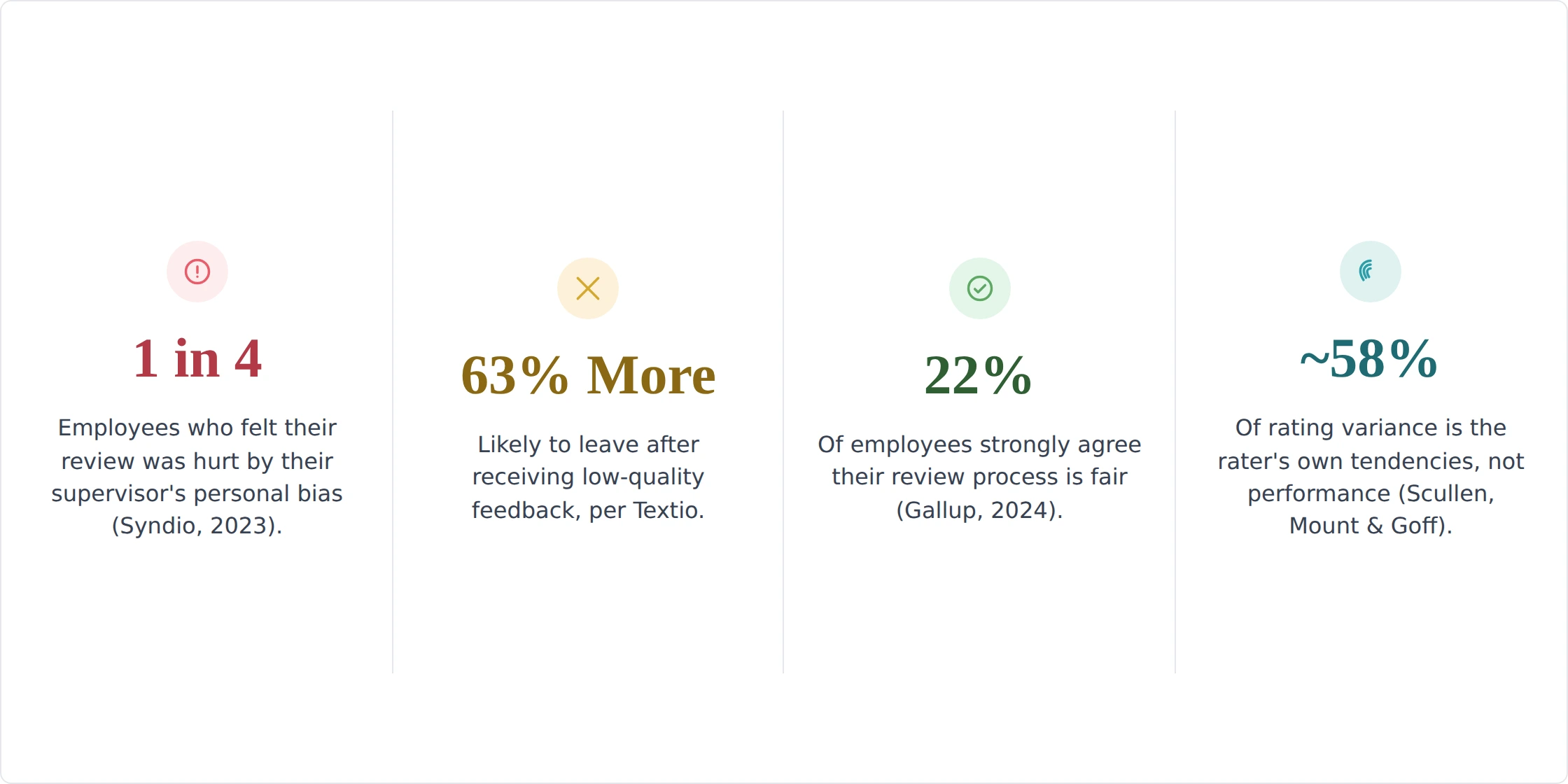
The effects show up across the entire employee lifecycle, and they're bigger than most organizations want to acknowledge. A Syndio survey of more than 1,000 employees (2023) found that one in four felt their review was negatively affected by their supervisor's personal biases.
Additionally, Textio's analysis found that employees who received low-quality feedback were 63% more likely to leave than those who received higher-quality feedback. Performance review bias doesn't just feel unfair, but it pushes people out the door.
Gallup's 2024 research also found that only 22% of employees strongly agree their review process is fair and transparent. When pay, promotion, and development decisions are all built on biased ratings, that distortion works its way into every talent decision the organization makes going forward.
How to Reduce Performance Review Bias
The thing is, not all interventions work equally well, and a lot of the advice out there exists because someone is selling something.
The six options below are organized by strength of evidence, and each comes with an honest look at what it actually can and can't do.
- Structured Criteria and Behaviorally Anchored Rating Scales: This is the most evidence-backed fix you can make. Instead of asking raters to use a blank scale, you give them a defined standard that spells out what "meets expectations" actually looks like in that specific role. When everyone is measuring against the same benchmark, contrast bias and idiosyncratic rater effects both go down. Performance review software can help embed these criteria, but the criteria themselves matter more than the tool you use to store them.
- Calibration Sessions with Distribution Visibility: Calibration is when managers have to sit in a room together and justify their ratings before they're finalized, with everyone's score distributions visible to the group. It's one of the most effective ways to catch leniency, severity, and central tendency bias because the patterns that are invisible at the individual level become obvious when you compare them side by side. For a step-by-step walkthrough, check out our performance review calibration guide.
- Multi-Rater Input: Bringing in more raters through peer reviews, upward feedback, or 360-degree assessments helps dilute the idiosyncratic rater effect. The more perspectives you add, the less any one person's tendencies can dominate the outcome. That said, it doesn't eliminate bias entirely. If everyone rating someone shares the same blind spot, the average just reinforces it. Our 360 feedback software roundup covers the top platforms if you're comparing options.
- Continuous Documentation Across the Review Period: If you want to fix recency bias, this is how you do it. Managers write down specific observations as they happen throughout the year instead of trying to piece everything together from memory come review season. It sounds simple, but it requires a real habit change. The preparation process should start well before the review itself, with managers gathering evidence from across the full review period rather than relying on what they remember most recently. Our guide on how to prepare for a performance review explains how to build that evidence-based approach into the review process. Our performance review prep guide covers exactly how to make it work in practice.
- Rating Distribution Analysis by Manager and Demographic Group: Running the numbers on how ratings are distributed across managers, teams, and demographic groups can reveal patterns you'd never spot by looking at individual reviews. You can see which managers consistently rate above or below the norm and whether certain groups are being rated differently in ways that role or function alone don't explain. HR analytics platforms make this easier, though finding the pattern is only the first step.
- Language Review of Written Feedback: The numbers don't tell the whole story. Written feedback is where a lot of bias actually hides, showing up in vague language, gendered framing, and what researchers call "doubt raisers." Some AI-powered HR platforms now flag these patterns automatically, which is useful, but most of the evidence for how well those tools work comes from the companies selling them.
What Does Not Work
The most widely recommended intervention for performance review bias is standalone unconscious bias training. And the evidence against it, believe it or not, is consistent enough that it's worth stating plainly.
Frequently Asked Questions (FAQs)
What is the most common bias in performance reviews?
Recency bias tends to show up most often, simply because it's almost automatic. Whatever happened recently is what your manager remembers most clearly, and that ends up standing in for your whole year. That said, the idiosyncratic rater effect is arguably more damaging, even if it's less visible. When more than half of a rating reflects the rater's personal tendencies rather than your actual performance, that's a structural problem that recency alone doesn't explain.
What is the difference between leniency bias and central tendency bias?
Both are distribution problems, but they show up differently. Leniency bias is when a manager rates their entire team high across the board, so the whole team average sits well above the organizational norm. Central tendency bias is when a manager avoids the extremes altogether and clusters everyone in the middle, making it nearly impossible to tell your strongest performers from your average ones. You can't spot either of these by looking at a single rating. You need to look at the full distribution.
Does unconscious bias training reduce performance review bias?
Not on its own. Awareness can play a role when it's part of a broader structural process, but if training is the only thing you're doing, you're not actually fixing the problem. The research consistently shows that standalone bias training doesn't reliably change behavior, and in some cases, it makes things worse.
Can software remove bias from performance reviews?
No tool removes it entirely, and you should be skeptical of any platform that claims otherwise. Software can do useful things like support structured criteria, flag language patterns, and surface distribution anomalies. But a lot of the bias that shows up in ratings happens before the rater even opens the form. When a platform says it removes bias, what it usually means is that it addresses one specific pattern, typically language in written feedback, and most of the evidence for that comes from the companies selling the tool.
How do you tell bias apart from a rating you simply disagree with?
A rating you disagree with means you and your manager interpreted the same evidence differently, and that's actually normal. Bias is something different. It's when the rating would change based on who reviewed you, when they reviewed you, or how you personally came across to that specific rater, rather than what you actually did against a clear standard. A good way to test it is to ask whether the same work, evaluated by a different manager using the same criteria, would have landed in the same place.
.avif)