.svg)

.svg)
.svg)
.svg)
Quick Verdict
Nobody sets out to be a bad manager. Most managers became managers because they were good at something else, were handed a team, and were expected to figure out the rest. Leadr is built on that observation. The platform does not try to be a comprehensive HR system. It focuses on the one thing it argues matters most: giving managers the structure and tools to have better conversations with their people, consistently, before those conversations become overdue.
That is a narrower bet than most platforms in this category are willing to make. This software review covers what that bet looks like in practice, where it pays off, and what you give up by choosing a tool built around coaching depth rather than HR breadth.
What Is Leadr?
The name gives it away. Leadr is not trying to be your HRIS or your payroll system. It is trying to make the people in your organization better at leading. The platform is built around the argument that the manager-employee 1-on-1 is the most consistently underdeveloped management practice in most organizations, and that giving it structure, preparation, and a shared record is the highest-leverage intervention HR can offer at the team level.
In practice, that means a workspace for structured meeting agendas, goal tracking that surfaces automatically in those meetings, continuous feedback outside of formal review cycles, basic performance reviews, pulse surveys, and a library of leadership development content managers can assign to direct reports. It does not mean employee records, payroll, benefits administration, or the calibration and compensation tools that come with mid-market performance platforms. That scope is intentional.
Leadr's founding team comes from a faith-based leadership background, and the platform's language and design reflect that. The review evidence base is concentrated in churches, non-profits, and mission-driven organizations, which shapes how much can be inferred about performance in corporate or mid-market contexts. That context matters for any buyer evaluating this platform outside its primary user base.
Key Features of Leadr
Leadr's feature set is deliberately focused. It covers the manager-employee development cycle without trying to be an all-in-one HR platform.
1. 1-on-1 Meeting Tools
Leadr's 1-on-1 workspace is the platform's core feature and the clearest expression of its design philosophy. Both the manager and employee can add agenda items, comments, and talking points before a meeting takes place, so conversations arrive prepared rather than improvised. Notes, decisions, and action items are captured during the meeting and persist in a historical record that carries forward into future sessions, making it possible to reference past conversations during review cycles without digging through email threads.
2. Goal Setting and Tracking
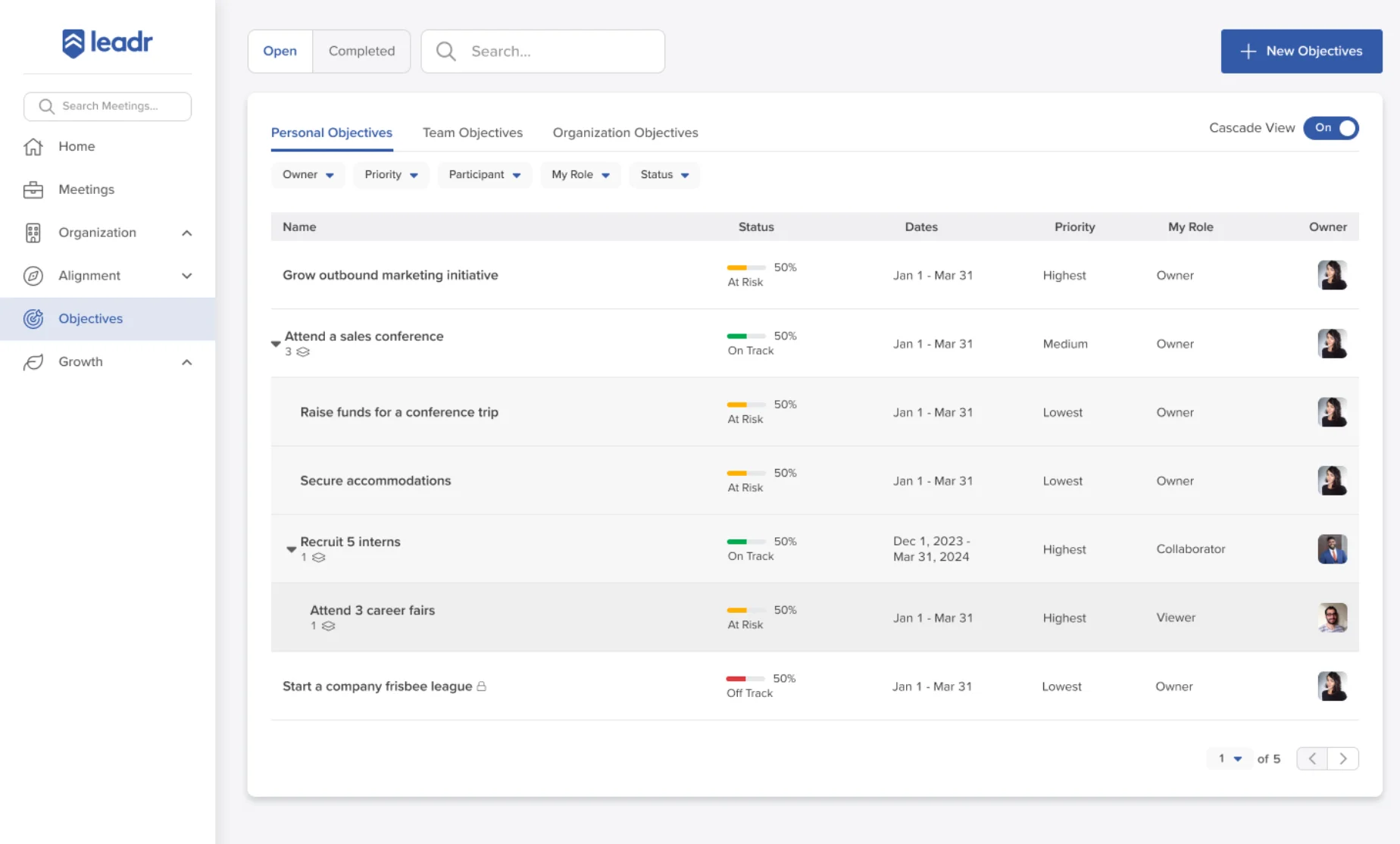
Goals are set at the individual and organizational level and tracked with progress visibility in the manager dashboard. Where Leadr differentiates from a standalone goal tracker is that goals surface automatically in 1-on-1 meeting agendas, keeping priorities front of mind between formal review cycles rather than sitting in a separate tool. Goal collaboration features are limited: commenting and discussion within goal items is less developed than in dedicated OKR platforms like Lattice or 15Five.
3. Performance Reviews
Review cycles are configurable with templates supporting self-assessment and manager evaluation. The module works for organizations running straightforward annual or semi-annual reviews. Review forms cannot be adapted to non-standard terminology or complex multi-level workflows without workarounds, and the calibration tools available in mid-market platforms are absent. For organizations with simple review requirements this is adequate; for those with more complex performance architecture it is a structural constraint.
4. Continuous Feedback
Feedback requests and responses sit outside of formal review cycles, supporting structured prompts and peer recognition between scheduled conversations. The continuous feedback module covers the basics of creating a feedback habit but does not include the analytics depth or feedback trend reporting available in platforms like 15Five or Leapsome.
5. Pulse Surveys and Engagement
Basic pulse survey capability covers eNPS and engagement check-ins, with auto-generated staff NPS visible on the LeadrHome dashboard. It provides a lightweight signal for managers who want a read on team sentiment without running a full survey program. Organizations that need deep survey customization, industry benchmarking, or demographic segmentation will find the survey tools here insufficient for that level of measurement.
6. Learning Content Library
A curated library of leadership development videos and articles is available for managers to assign to direct reports and track for completion. Managers can search the library, assign specific content, and monitor progress from their dashboard. This is an unusual inclusion at this product tier and reflects Leadr's development-first positioning. The library adds practical value for organizations where manager skill-building is an explicit priority alongside performance tracking.
7. LeadrHome Dashboard
LeadrHome is the central daily view for managers, consolidating team overview, action items, upcoming meetings, goal progress, and engagement signals in one place. It is designed as a starting point for the manager's day rather than an analytics tool for HR. The platform surfaces what a manager needs to act on in the near term rather than providing historical reporting for quarterly review.
How Leadr Works
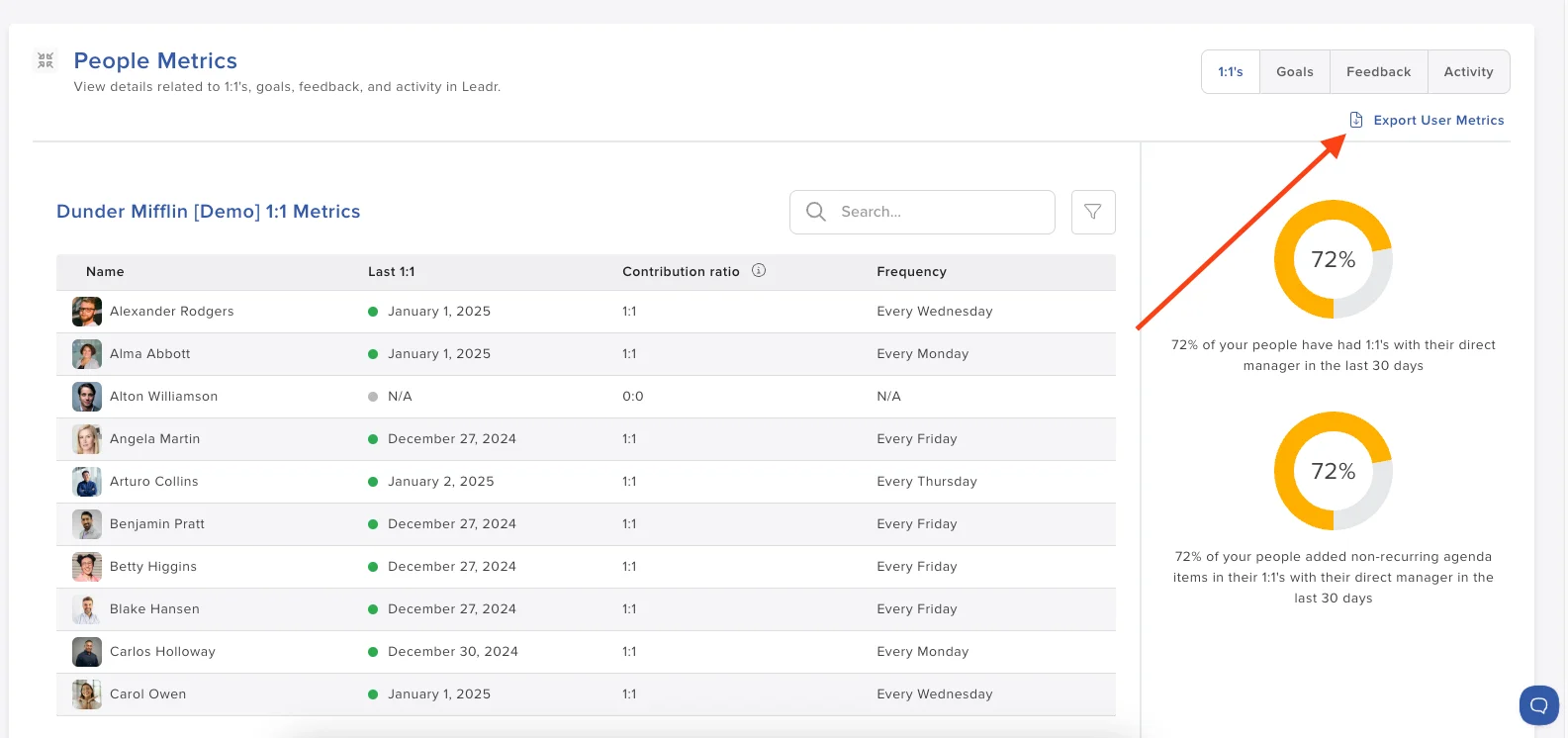
Leadr is organized around a weekly rhythm. Managers and employees each have a shared meeting space where agenda items accumulate between sessions. Before a scheduled 1-on-1, both parties can see what topics are queued, add their own items, and review outstanding action items from prior meetings. During the meeting, notes are captured in real time. After the meeting, those notes are searchable and carry forward into the next session.
Setup is relatively fast. G2 reviewers and the platform's own documentation indicate onboarding typically takes days rather than weeks, which is consistent with the platform's focused scope. Organizations do not need to configure complex HRIS integrations, review calibration workflows, or approval hierarchies to get the core features working.
The platform's primary adoption challenge is the same one that affects any tool built around manager habits: if managers do not engage with the meeting preparation workflow consistently, the platform's value diminishes quickly. G2 reviewers note that getting teams to build the habit takes deliberate effort from leadership, and that organizations which treat Leadr as a passive tool rather than an active behavioral investment tend to see lower engagement over time.
Pros
One G2 reviewer writes: "I like the collaborative nature of the program. We spend WAY less time discussing a topic and the story behind it. When we attend a meeting, we already have a response/decision made. Saves SO much time."
Another Capterra reviewer notes: "I liked the accuracy of the contact details and how easy it was to find decision-makers by company size and revenue. The data enrichment tools helped clean up our old lists quickly, and it saved us time on outreach."
- Meeting preparation and record-keeping are the platform's clearest strength. Multiple G2 reviewers independently cite the pre-meeting agenda system and the searchable meeting history as the features that deliver the most immediate value. Organizations that previously managed 1-on-1s through email threads or informal notes report that Leadr creates a structured record that improves both meeting quality and accountability.
- Onboarding and implementation are consistently rated as smooth. G2 reviewers across organization sizes describe setup as straightforward and the Leadr support team as responsive and helpful. For organizations that have been burned by complex HR software implementations, the low setup friction is a genuine differentiator.
- The learning content library is an unusual inclusion at this price tier. A curated library of leadership development videos and articles that can be assigned to direct reports and tracked for completion is not a standard feature in small-business people management tools. For organizations where manager development is an explicit organizational priority, this adds practical value that comparable tools do not offer.
- Goal visibility in the manager dashboard creates day-to-day accountability. G2 reviewers note that having goals surface automatically in meeting agendas keeps priorities visible between formal review cycles in a way that standalone goal-tracking spreadsheets do not. One reviewer specifically credits this with reducing the time managers spend re-establishing context at the start of each 1-on-1.
- The platform is actively developed with a responsive product team. Multiple G2 reviewers note that feature requests are taken seriously and that improvements ship regularly. For a relatively young product with a limited feature set, this responsiveness mitigates some of the 'still developing' criticism and suggests that current gaps are more likely to close than to persist.
Cons
One G2 reviewer writes: "Biggest complaint from my team was that it was "another platform" - it didn't integrate into Office365 but required a separate login and platform to manage. Additionally, the performance review module is very limited in it's customizations to make it specific to our company and processes."
Another Capterra reviewer notes, "The Coverage in some niche industries is inconsistent and the web interface has a few small quirks."
- No Microsoft 365 or Google Workspace SSO in standard configurations. The most consistently cited friction point across G2 reviews. Requiring a separate login to a standalone platform is a meaningful adoption barrier, particularly in organizations where employees already manage multiple tools. Reviewers who flag this issue note that it increases the behavioral cost of daily use and reduces organic engagement.
- Performance review customization is limited. The review module supports standard templates but does not accommodate non-standard rating scales, terminology, or complex multi-level workflows. For organizations with specific performance frameworks or calibration requirements, this is a structural constraint rather than a configuration issue.
- The mobile app and calendar sync are inconsistent. Multiple G2 reviewers note that the mobile app has reliability issues (pages updating slowly, meetings not displaying correctly) and that Google Calendar syncing is 'spotty.' For organizations where mobile access or calendar integration is part of the daily workflow, these are practical friction points.
- No search function for historical meeting notes. More than one G2 reviewer specifically requests a search tool to find agenda items and decisions from past meetings. The absence of this feature limits the value of the historical record the platform creates, particularly for managers who want to reference past conversations during annual reviews.
- The review base is too thin for high-confidence evaluation. Twenty-six G2 reviews, the majority from 2022-2023 and concentrated in faith-based small businesses, is not sufficient to draw conclusions about how Leadr performs across industries, company sizes, or use cases that differ from its primary user base. Buyers in corporate or mid-market contexts should weight this limitation heavily.
First-Hand Evaluation
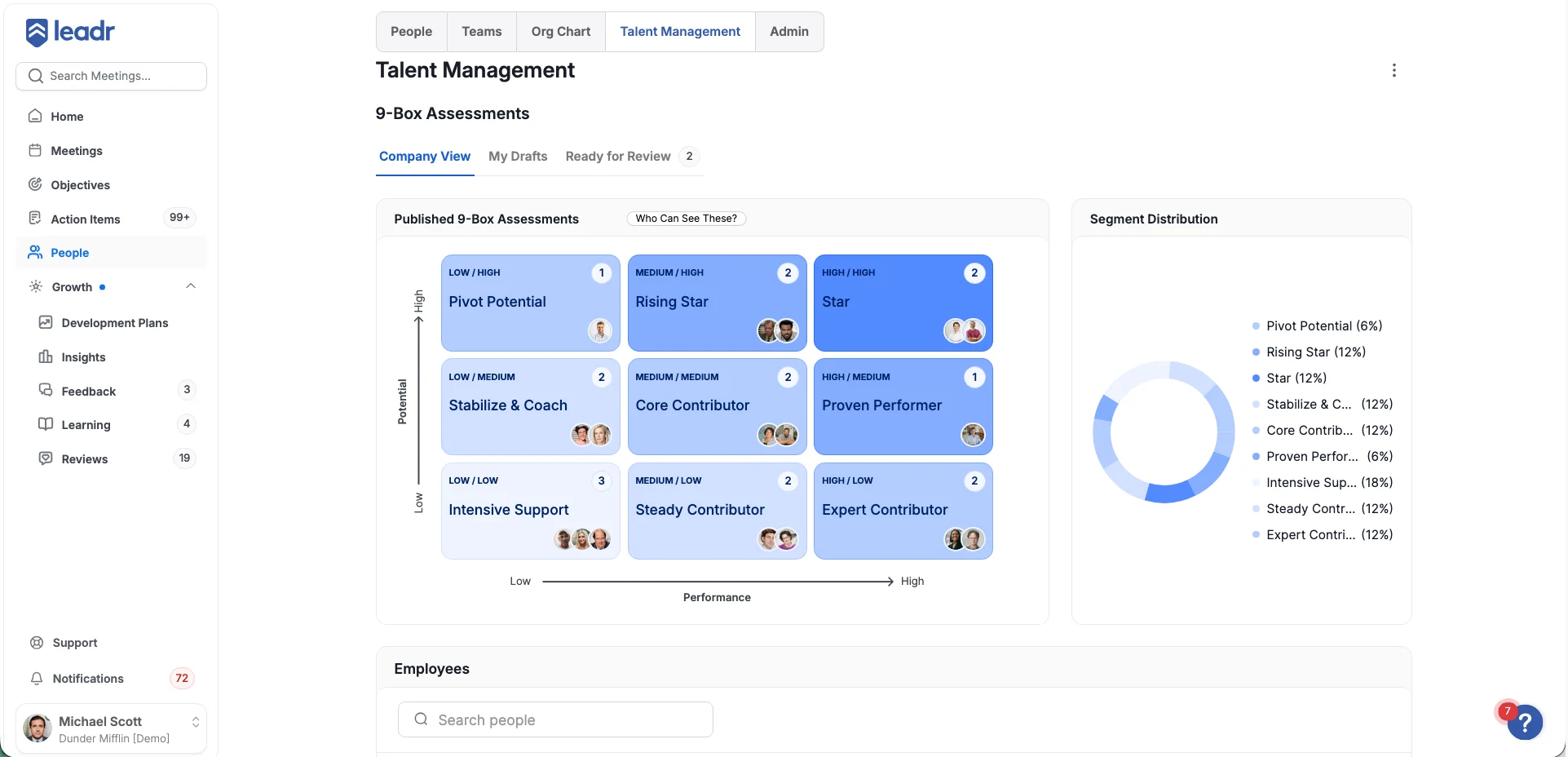
We requested a product demo from Leadr on 15 May 2026. As of publication, the demo had not been completed and this section will be updated when it is. In the absence of a hands-on trial, this review relies entirely on G2 verified reviews and publicly available product documentation. Buyers should request their own demo before making a purchasing decision.
Key observations from product documentation and G2 review descriptions:
- The meeting workspace interface appears straightforward based on screenshots and reviewer descriptions. The dual-entry model where both parties can add agenda items ahead of a meeting is the platform's most distinctive UX feature.
- The LeadrHome dashboard consolidates goals, action items, upcoming meetings, and eNPS in a single view. G2 reviewers describe it as a practical daily starting point for managers, not an analytics tool.
- The learning content library is accessible from the main navigation and allows managers to assign content with one click. Reviewers describe the library as genuinely useful and the assignment tracking as a practical management tool.
- The mobile app reliability issues cited in G2 reviews could not be independently verified without hands-on testing. Buyers who rely heavily on mobile access should specifically test this during their own trial.
Pricing and Plans
Leadr does not publicly disclose pricing. No verified third-party contract data was found. SelectHub estimates a starting range of $10 to $100 per month based on limited data, but this range is too broad to be useful for budgeting. The only reliable way to get pricing is to contact Leadr directly.
What is known from the platform's positioning and user base: Leadr targets organizations with 10 or more employees and serves small businesses, non-profits, and churches alongside larger organizations. Given this positioning and the platform's feature scope, it is unlikely to be priced at the same tier as mid-market platforms like 15Five ($11/user/month) or Leapsome ($7-$8/user/month per module). But that is an inference, not a verified figure.
If pricing transparency is important to your evaluation process, 15Five publishes its pricing publicly at $4/user/month (Engage), $11/user/month (Perform), and $16/user/month (Total Platform). That makes it a more comparable alternative for budget planning purposes, regardless of which platform ultimately wins the evaluation.
Our Rating
Ratings below carry less confidence than our assessments of more widely reviewed platforms. A rating built on 26 G2 reviews should be interpreted as directional, not definitive.
Best Use Cases
The evidence base points clearly to a specific buyer profile. Extrapolating beyond it would be speculative given the available data.
Leadr is a plausible fit for:
- Small organizations (10-200 employees) in faith-based, non-profit, or mission-driven sectors where the platform's language and philosophy will land naturally and where the existing review base is most representative.
- Organizations where the primary people problem is inconsistent or low-quality manager-employee conversations rather than HRIS administration, payroll complexity, or sophisticated performance analytics.
- HR or people operations leaders who want to create a structured development culture without committing to the implementation complexity and cost of a mid-market platform like 15Five or Lattice.
- Organizations that already have an HRIS handling employee records, payroll, and compliance, and are specifically looking for a lightweight tool to improve manager effectiveness on top of that existing infrastructure.
Look elsewhere if:
- You need native HRIS, payroll, or benefits administration. Leadr does not cover any of these functions and is not designed to.
- You need Microsoft 365 or Google Workspace SSO. The absence of this integration is Leadr's most commonly cited practical limitation and has not been resolved as of the most recent G2 reviews.
- You need deep performance review customization, calibration tools, or compensation management connected to review outcomes. 15Five, Lattice, or Leapsome are more appropriate depending on budget and scope.
- You are a mid-market or enterprise organization looking for a platform with a verified track record across diverse industries and company sizes. The available evidence does not support that conclusion for Leadr at this time.
Alternatives and Competitors
These platforms address overlapping use cases with a stronger evidence base:
- 15Five: The most direct comparable for organizations that want a manager-first performance and feedback platform. Publicly listed pricing ($11/user/month for Perform), a 14-day free trial, 1,857+ G2 reviews, and a proven track record across corporate mid-market organizations. The weekly check-in model overlaps significantly with Leadr's 1-on-1 philosophy. The better-evidenced choice for buyers outside the faith-based non-profit sector.
- Teamflect: A strong option for organizations running Microsoft 365 that want performance reviews, OKRs, 360 feedback, and 1-on-1 tools built natively inside Microsoft Teams. Directly addresses the standalone login friction that Leadr reviewers cite as their primary complaint.
- Lattice: The appropriate step-up for organizations that need deeper review customization, compensation management, and analytics alongside the continuous feedback and 1-on-1 tooling that Leadr provides. Starts at $11/user/month with a $4,000 annual minimum.
- PerformYard: Worth evaluating for organizations where flexible, configurable review cycles are the primary need. Comparable price tier to Leadr's estimated range, with a larger and more diverse review base.
Final Verdict
If you are a small faith-based, non-profit, or mission-driven organization looking for a structured tool to improve manager-employee conversations, Leadr is worth requesting a demo. The 1-on-1 meeting tools and goal visibility are well-designed for the use case, the implementation is low-friction, and the support team is consistently rated as responsive. Go in with realistic expectations about what the platform does not cover: it is a development and coaching tool, not an HR system.
If you are outside the faith-based non-profit sector or need a platform with a verified track record across corporate and mid-market organizations, the evidence base for Leadr is too thin to recommend it with confidence. 15Five covers most of the same manager-first philosophy at a published price point, with 1,857 G2 reviews to draw from rather than 26. That is a meaningful difference in the confidence level a buyer can attach to their decision.
If the standalone login issue is a dealbreaker for your organization, Teamflect solves it directly by building the same 1-on-1, OKR, and feedback workflows natively inside Microsoft Teams. For Microsoft 365 organizations, the adoption argument for Teamflect over Leadr is straightforward.
.png)
.avif)