.avif)
.svg)

.svg)
.svg)
.svg)
Lattice costs $10 per seat per month for Performance, $8 for Goals & OKRs and $4 for Engagement, or $13 for the Foundations bundle. Every contract is billed annually with a $4,000 minimum. Compensation (+$6) and Grow (+$4) are add-ons, and Enterprise pricing is quoted.
Who this is for: HR and People Ops leads at companies with 50 to 1,000 employees who are pricing Lattice for performance reviews, goals or engagement surveys and need to know the full annual cost before the demo call.
Choosing the right HR software is rarely straightforward. The market has no shortage of platforms promising to fix performance management, boost engagement, and align your workforce all at once. Lattice is one of the more prominent names in that conversation, and for good reason.
This Lattice software review breaks down what the platform actually does, how it's priced, where it performs well, and where it falls short, so you can decide whether it fits your organization before you book a demo.
Lattice at a glance
Quick facts
| Field | Value | Source |
|---|---|---|
| Pricing model | Per seat, per month, sold by product | lattice.com/pricing, Sep 2026 |
| Starting price | $4 per seat/month (Engagement); $13 for Foundations | lattice.com/pricing, Sep 2026 |
| Minimum spend | $4,000 per year | Lattice pricing FAQ, Sep 2026 |
| Billing | Annual only, USD only | Lattice pricing FAQ, Sep 2026 |
| Implementation fee | None for performance management | Lattice pricing FAQ, Sep 2026 |
| Free plan / trial | No free plan listed; interactive product tour available | lattice.com/pricing, Sep 2026 |
| SSO / SCIM | SSO with any SAML 2.0 provider (Entra ID, Okta, OneLogin, Google Workspace, ADP, TriNet); SCIM with Entra ID, Okta, OneLogin, Sapling. No plan requirement stated | Lattice help center, Sep 2026 |
| HRIS | No HRIS product on the current pricing page; syncs employees from 13 HRIS tools including Workday, BambooHR, ADP, HiBob and Rippling | lattice.com/pricing and help center, Sep 2026 |
| Best fit | 50 to 1,000 employees | TopHRSoftware assessment |
What Is Lattice?
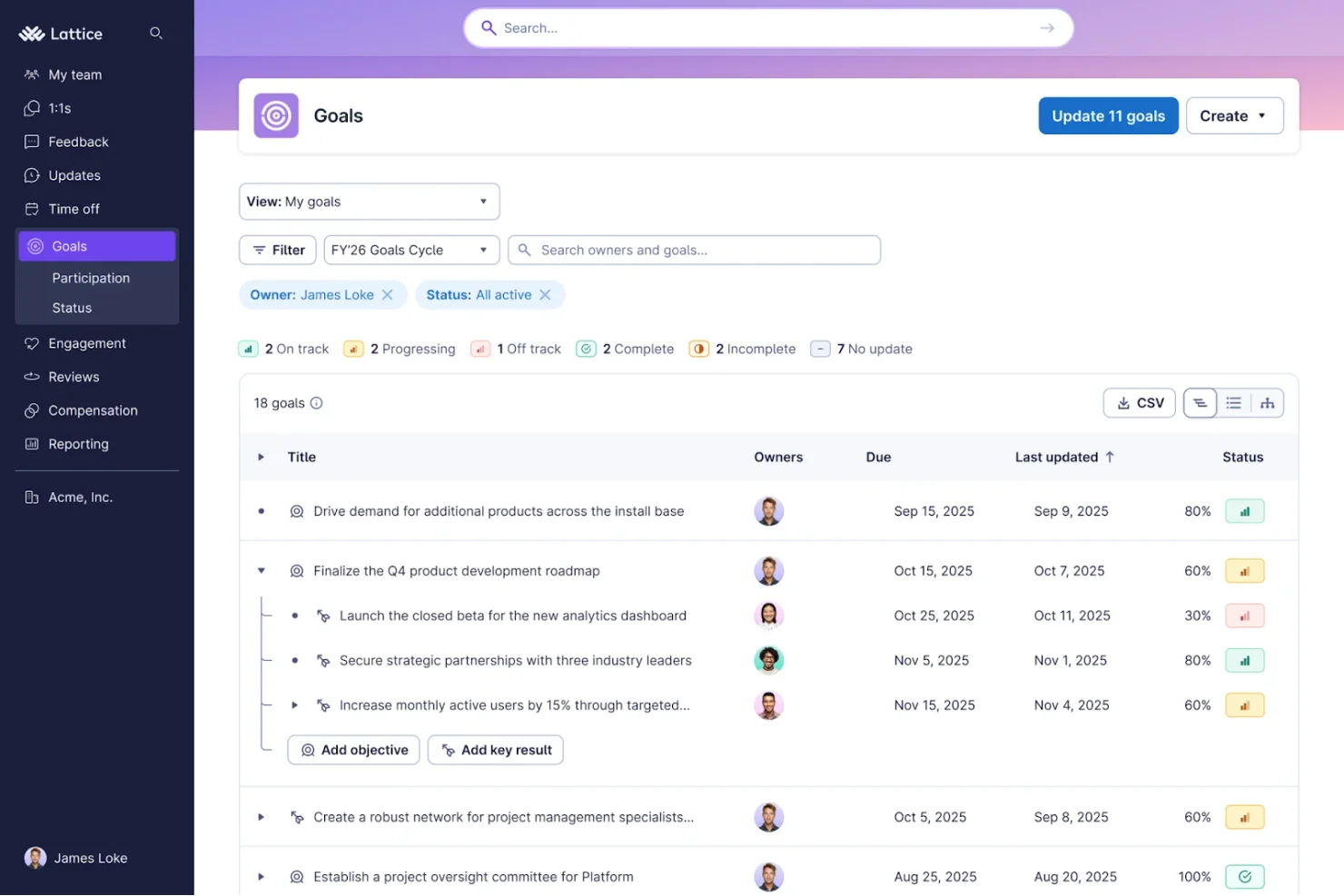
Lattice is a cloud-based people management platform built primarily around performance management, employee engagement, and HR operations. Founded in 2015 by Jack Altman and Eric Koslow, the platform has grown to serve more than 5,000 organizations worldwide, including well-known names like Robinhood, Discord, and Gusto.
At its core, Lattice connects performance reviews, goal-setting, continuous feedback, and engagement surveys into a single, unified system. Lattice also sells a Compensation add-on and connects to more than a dozen HRIS tools to keep employee data in sync. Payroll and time tracking are not on its current pricing page, so those stay in your HRIS or other tools.
Key Features of Lattice
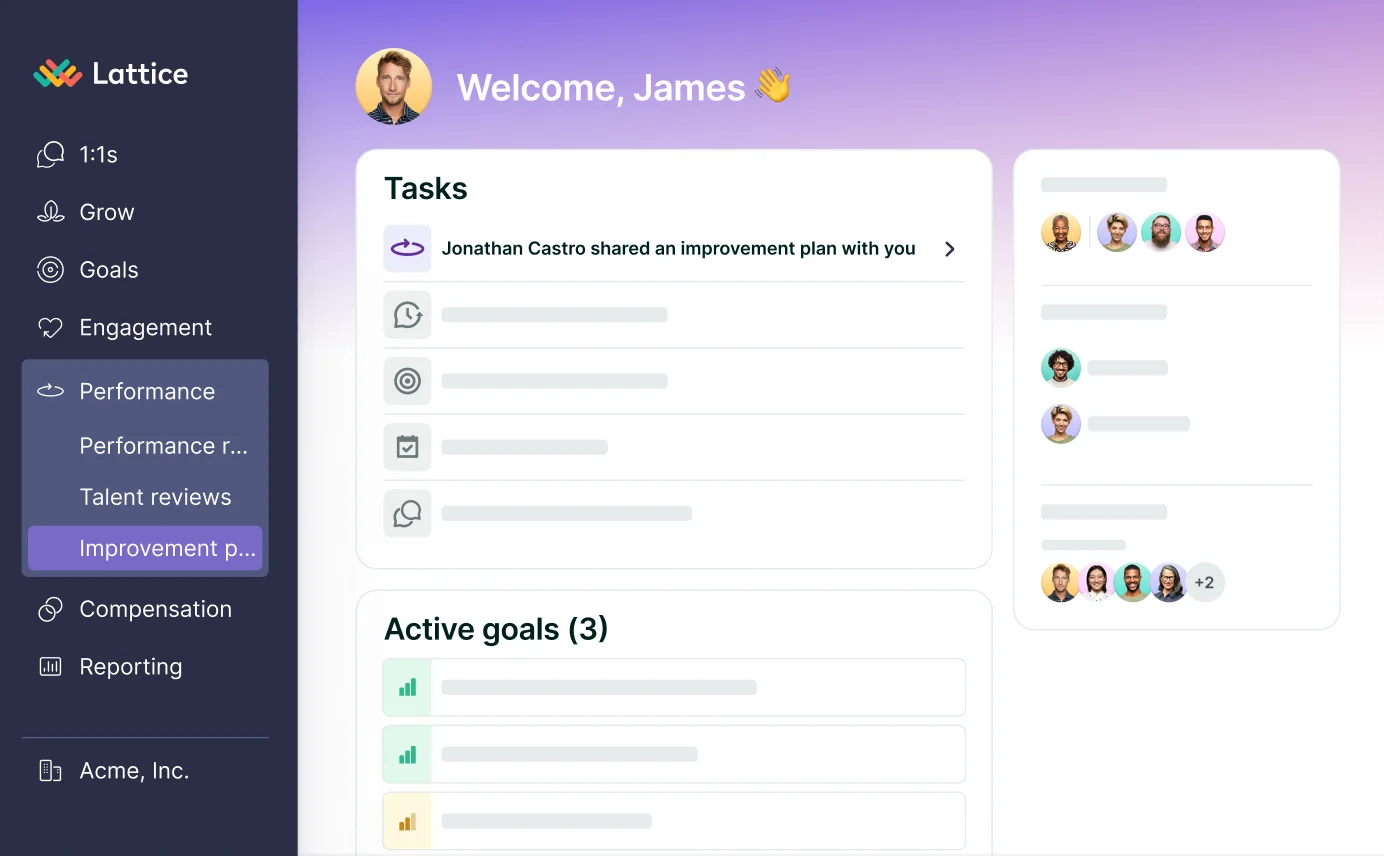
Lattice is built around a modular feature set. Organizations can choose the modules that match their current needs and add more over time. Here is a breakdown of the platform's main capabilities:
1. Performance Reviews
Lattice allows HR teams to build and run fully customizable review cycles. Managers can tailor question sets, configure review frequency, and support self-assessments, peer reviews, and 360-degree feedback, all within the same workflow. Automated reminders reduce the administrative effort of chasing submissions. These review formats are more useful when employees come prepared with specific examples of their work, progress against goals, and areas for development, making how to prepare for a performance review an important part of getting meaningful input from each participant.
2. Goals and OKRs
The platform supports structured goal-setting at the individual, team, and company level. Goals can cascade from company-wide priorities down to individual contributors, and progress updates feed directly into review cycles without requiring manual re-entry.
3. Continuous Feedback and 1:1s
Rather than waiting for formal review periods, Lattice enables managers and employees to exchange feedback on an ongoing basis. The 1:1 feature includes personalized agenda templates and action item tracking, making regular check-ins easier to run and easier to document.
4. Employee Engagement Surveys
HR teams can run pulse surveys, full engagement surveys, and eNPS (Employee Net Promoter Score) checks through Lattice. Surveys are configurable, support optional anonymity, and integrate with Slack and Microsoft Teams to drive participation rates.
5. Compensation Management
Lattice includes tools for running compensation cycles, modeling salary adjustments, and improving pay transparency. The compensation module connects to performance data, making it easier to tie pay decisions to documented results.
6. People Analytics and Reporting
The analytics suite gives HR teams access to workforce data across performance, engagement, retention, and demographics. Managers can monitor team trends in real time, and HR leaders can generate reports for leadership without exporting data to separate tools.
7. HRIS Integrations
Lattice's current pricing page lists no HRIS product. Instead, Lattice syncs employee data from your existing HRIS: its help center lists integrations with Namely, Zenefits, BambooHR, Workday, ADP, Sapling, Gusto, Personio, UKG, TriNet, Humaans, HiBob and Rippling. If you need employee records, time off and payroll in the same tool, ask Lattice sales whether an HRIS product is still available before you buy.
8. Lattice AI
AI-powered features are available across the platform. These include review-writing assistance, calibration summaries, personalized development suggestions, and manager coaching prompts. The quality of these outputs depends heavily on how the prompts feeding them are written, an area where ChatGPT prompts for HR teams make a measurable difference.
What Lattice Covers and What It Does Not
Lattice covers performance, goals, engagement, compensation and career growth; it does not sell payroll, time tracking or recruiting, so those stay in your HRIS or other tools.
Lattice feature coverage
| Need | Covered by Lattice? | Product |
|---|---|---|
| Performance reviews and calibration | Yes | Performance ($10) |
| Goals and OKRs | Yes | Goals & OKRs ($8) |
| Engagement, onboarding and exit surveys | Yes | Engagement ($4) |
| Compensation bands and cycles | Yes, add-on | Compensation (+$6) |
| Career paths and IDPs | Yes, add-on | Grow (+$4) |
| Employee records (HRIS) | Through integration with your HRIS | 13 HRIS integrations |
| Payroll | Not listed | None on the pricing page |
| Time tracking and time off | Not listed | None on the pricing page |
| Recruiting (ATS) | Not listed; no ATS integration article in the help center | None |
| Single sign-on and provisioning | Yes | SAML 2.0 SSO, SCIM |
Sources: lattice.com/pricing and the Lattice help center, checked September 2026.
How Lattice Works
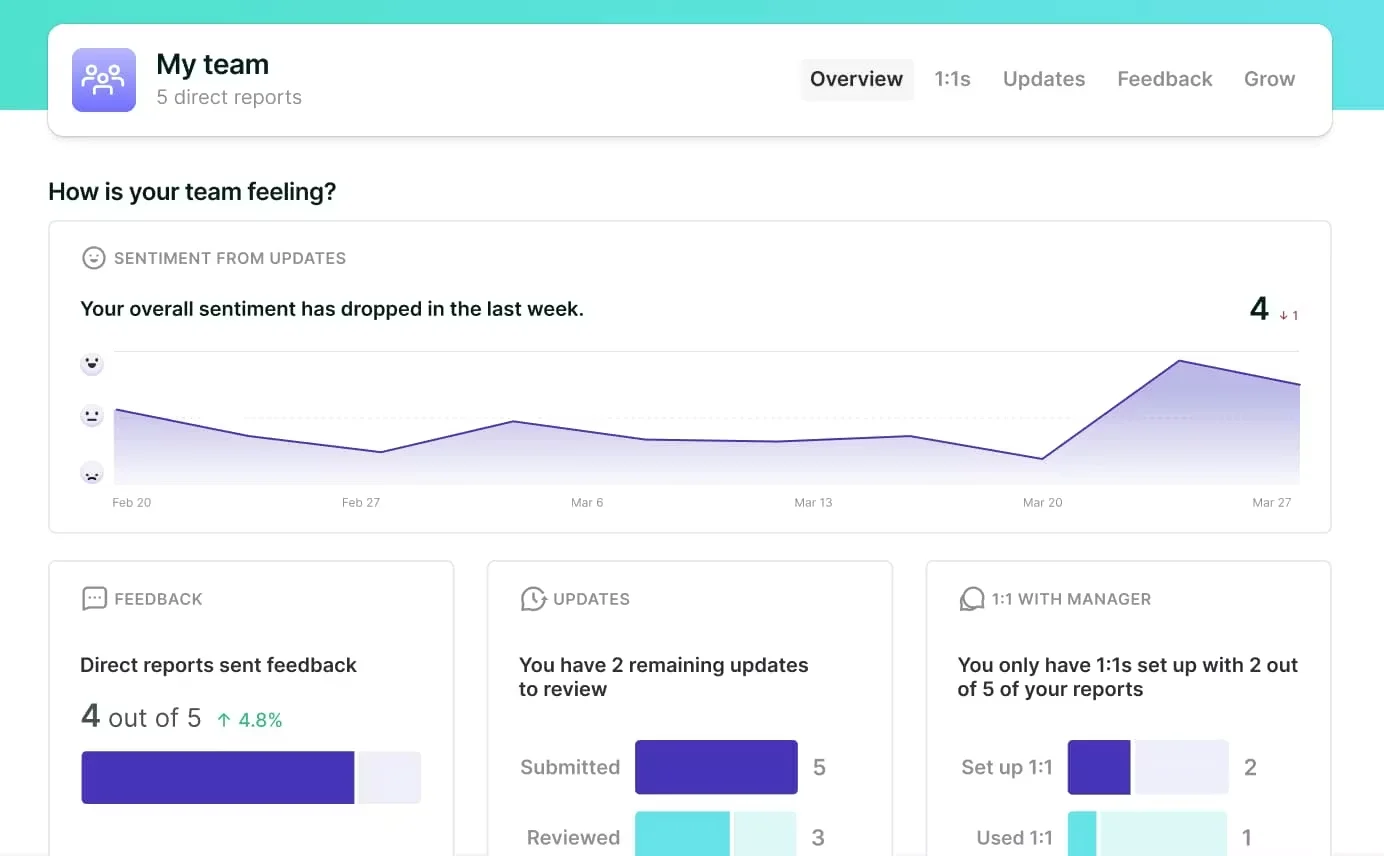
Lattice operates as a modular, cloud-based platform with role-based access for employees, managers, and HR administrators.
HR teams configure the platform by setting up review templates, goal frameworks, survey schedules, and reporting structures. Once configured, the system runs largely on automation: sending reminders, prompting check-ins, and collecting feedback according to the cadences HR sets.
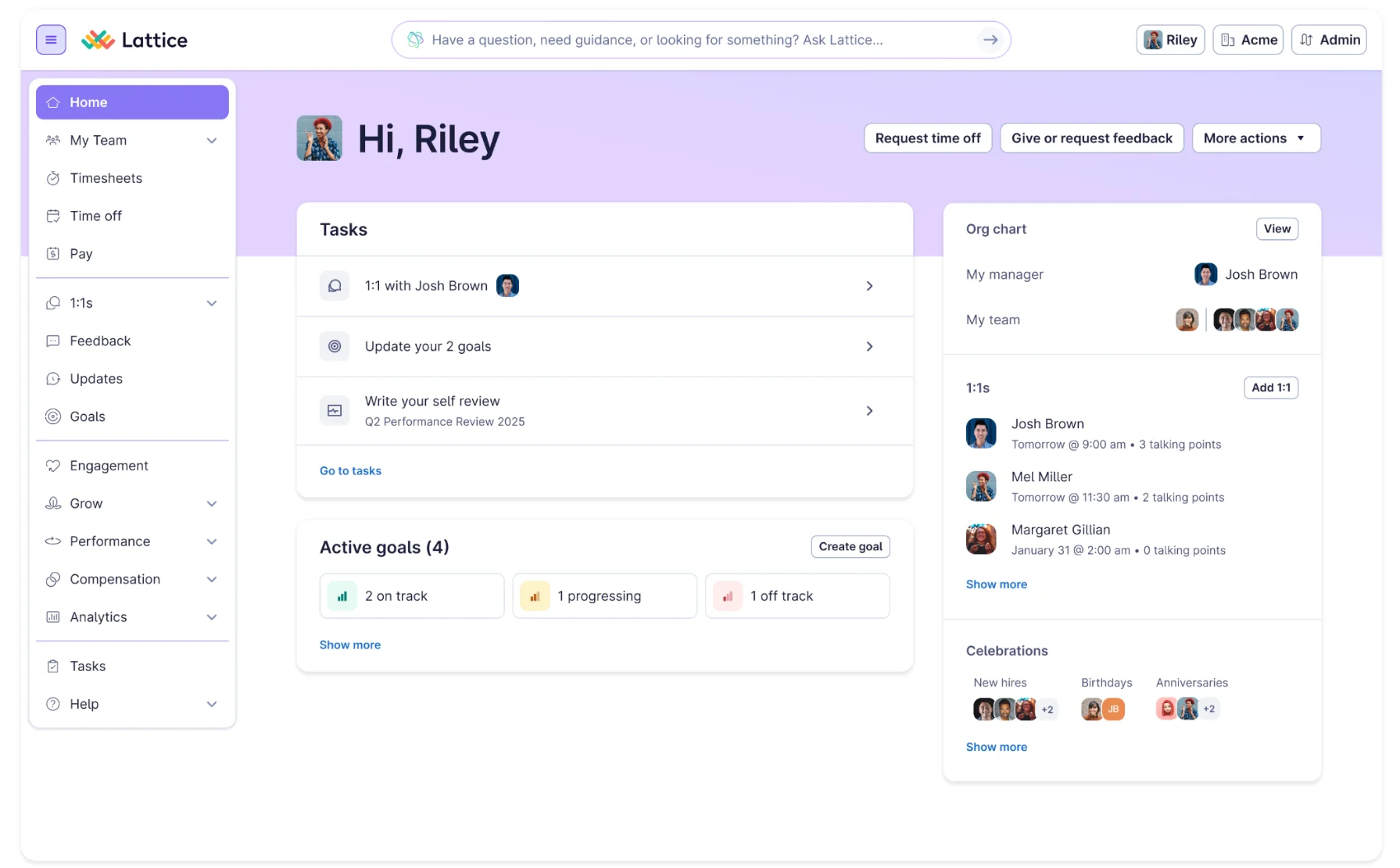
Employees interact with Lattice through a clean dashboard where they can view goals, complete reviews, submit feedback, and track their development. Managers have a separate view with team-level visibility, including upcoming review deadlines and goal progress.
Because Lattice integrates directly with tools like Slack, Microsoft Teams, Google Workspace,
Outlook, and major HRIS platforms such as BambooHR, Rippling, and ADP, much of the day-to-day interaction can happen without employees leaving the tools they already use.
Pros and Cons
Pros: “Lattice is a high performance system that facilitates the management of your business strategies and operations, promoting the digital unification of all your business processes to achieve better business results.” - G2 Review
- Comprehensive feature set: Lattice covers performance reviews, goal-setting, continuous feedback, engagement surveys and compensation within a single platform, and syncs employee data from your HRIS.
- Strong customization options: Review templates, goal frameworks, survey questions, and platform terminology are all configurable by HR admins without requiring vendor support.
- Well-regarded integrations: Native connections with Slack, Teams, and major HRIS platforms reduce friction and support higher adoption rates.
- Responsive customer support: User feedback across multiple review platforms consistently highlights strong customer service and a well-maintained help center.
- AI features that add real value: Review-writing assistance and calibration summaries are practical additions that reduce administrative load.
- Modular design: Organizations can start with a focused set of features and expand as their needs grow, rather than paying for capabilities they are not ready to use.
Cons: “The tool is laid out very well. The biggest complaint about it that I have is understanding how to set up goals. There is a SMART goals section and a grow section. For setting up personal goals, the right selection is "grow", but I often forget and select SMART goals which are more department or company-wide things in my experience with the tools.” - Capterra Review
- Complexity for new users: The platform's depth can be difficult to navigate without adequate onboarding. Smaller teams without dedicated HR support may find the initial setup demanding.
- Cost adds up quickly: The modular pricing model is flexible, but layering add-ons onto the base plan can push total costs above what smaller organizations expect.
- Reporting limitations for some users: While the analytics suite covers most use cases, some organizations with more advanced data requirements find the reporting tools fall short of their needs.
- Goal-setting can feel tedious: Several user reviews note that configuring and updating OKRs involves more steps than expected, which can reduce adoption among employees.
- Manager data portability: When a manager leaves, HR teams cannot transfer records to a new account within the platform; files must be exported manually, which creates extra work.
- Mobile experience: The mobile app receives less consistent feedback than the desktop version, with some users reporting a less intuitive experience on smaller screens.
How Much Does Lattice Cost?
Lattice charges per seat per month by product, bills every contract annually and sets a $4,000 minimum annual spend.
Lattice plans and list prices
| Product | Price | What it includes |
|---|---|---|
| Foundations (bundle) | $13 per seat/month | Performance, Goals & OKRs, 1:1s, Weekly Updates, Feedback, Q&A Boards, Analytics, AI Agent |
| Performance | $10 per seat/month | Reviews, calibration, succession, promotions, PIPs, talent reviews |
| Goals & OKRs | $8 per seat/month | Cascading goals, progress updates, Jira and Salesforce integrations |
| Engagement | $4 per seat/month | Pulse, onboarding and exit surveys, eNPS, action planning |
| Compensation (add-on) | +$6 per seat/month | Benchmarks, comp bands, cycle management, statements |
| Grow (add-on) | +$4 per seat/month | Competencies, IDPs, career tracks |
| Enterprise | Custom quote | Based on seats, complexity and scale |
Source: lattice.com/pricing, checked September 2026.
If engagement surveys are your main need, our Lattice vs Culture Amp comparison looks at that module side by side.
What Lattice costs by team size (list prices)
| Seats | Performance ($10) | Foundations ($13) | Foundations + Engagement ($17) |
|---|---|---|---|
| 25 | $4,000 (minimum) | $4,000 (minimum) | $5,100 |
| 50 | $6,000 | $7,800 | $10,200 |
| 100 | $12,000 | $15,600 | $20,400 |
| 250 | $30,000 | $39,000 | $51,000 |
| 500 | $60,000 | $78,000 | $102,000 |
Annual list prices before negotiation, calculated from lattice.com/pricing in September 2026. Vendr reports a median Lattice contract of $30,240 per year across 637 purchases (vendr.com, checked Sep 2026).
Pricing and hidden costs
| Cost item | What we found | Source |
|---|---|---|
| Minimum spend | $4,000 per year. Foundations teams under 26 seats, Performance-only teams under 34 seats and Engagement-only teams under 84 seats pay the minimum, not the seat price | Lattice pricing FAQ, Sep 2026 |
| Billing | Annual contracts only, billed in USD | Lattice pricing FAQ, Sep 2026 |
| Implementation | No extra fee for performance management rollout or change management | Lattice pricing FAQ, Sep 2026 |
| Add-ons | Compensation +$6 and Grow +$4 per seat raise a 100-seat Foundations contract from $15,600 to $27,600 per year | lattice.com/pricing, Sep 2026 |
| Unbundled price | The FAQ says Performance or Goals & OKRs can be bought alone "for $8/month", while the Performance card shows $10. Confirm the price in your quote | lattice.com/pricing, Sep 2026 |
| SSO / SCIM | Supported (SAML 2.0 SSO; SCIM with Entra ID, Okta, OneLogin, Sapling). The help center does not say which plan includes it, so confirm it is in your quote | Lattice help center, Sep 2026 |
| Renewal terms | Not published on lattice.com. Ask for the renewal cap in writing | lattice.com/pricing, Sep 2026 |
User Experience and Interface
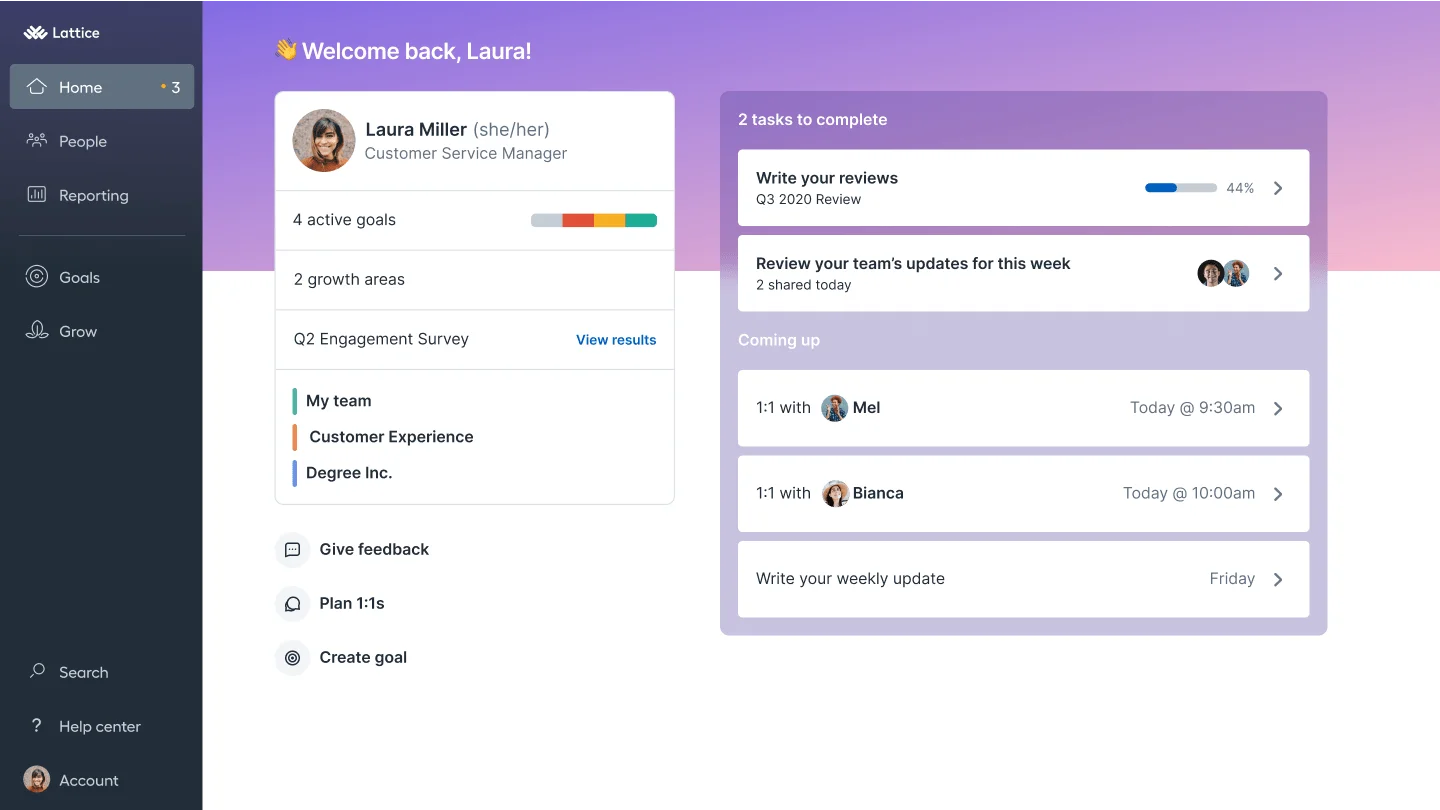
Lattice generally earns strong marks for usability. On G2 and Capterra, the platform carries ratings in the 4.4 to 4.6 range, with users frequently citing the clean interface and the ease of running 1:1s and review cycles.
What users appreciate:
- An intuitive layout that most employees can navigate without significant training
- Clear workflows for performance reviews and 1:1s
- Slack and Teams integrations that keep participation high
- Strong onboarding materials and a self-service help center
Where users report friction:
- Initial setup can be time-consuming, especially for teams without dedicated HR admin support
- The goal-setting module can feel process-heavy, particularly when updating OKRs regularly
- Some administrative tasks involve more steps than users expect
- The mobile version is functional but receives less consistent feedback than the desktop experience
Overall, Lattice performs well for teams willing to invest time in proper configuration. Organizations that approach implementation without a clear plan tend to underuse the platform's capabilities.
Who Is Lattice Best For?
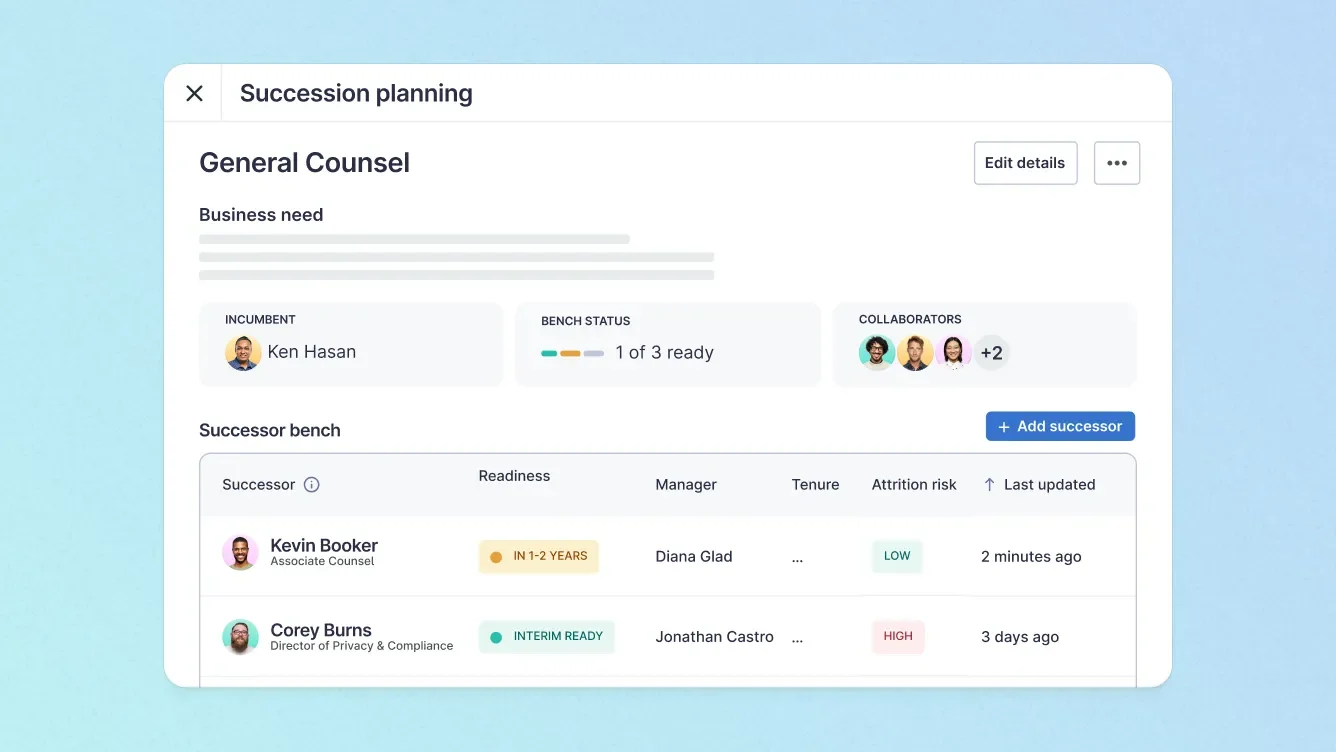
Lattice is best suited for:
- Mid-sized organizations with 50 to 1,000 employees that want structured performance management and engagement tools in one place
- HR teams moving away from spreadsheets, particularly those looking to formalize review cycles and track feedback over time
- Companies using Slack or Microsoft Teams as primary communication tools, where native integrations drive adoption
- Organizations prioritizing data-driven HR decisions, including compensation cycles tied to performance data and engagement trend analysis
- Businesses already managing OKRs or those looking to introduce a structured goal-setting framework
Lattice may be less suitable for:
- Very small teams or early-stage companies that need a lightweight, low-configuration solution
- Organizations requiring highly advanced reporting or custom analytics beyond the platform's built-in tools
- Businesses with tight budgets where add-on costs could become a barrier as needs grow
- Teams that want payroll, time tracking or recruiting in the same product as performance reviews
Buyers should verify first
- Whether your headcount clears the $4,000 minimum for the products you need.
- Whether SSO and SCIM are included in your quote at no extra cost.
- Whether the unbundled Performance price in your quote is $8 or $10 per seat.
- Whether Lattice still sells an HRIS product, if you need employee records in the same tool.
- The renewal price cap after year one.
Overall, Lattice performs well for teams willing to invest time in proper configuration. Organizations that approach implementation without a clear plan tend to underuse the platform's capabilities. For mid-sized teams weighing OKR functionality specifically against Lattice's broader suite, OKR software built for mid-size companies narrows the comparison to that one feature.
Alternatives and Competitors
If you are evaluating Lattice alongside other platforms, these are the most commonly considered alternatives. For a ranked list, see our Lattice alternatives guide.
- 15Five: A strong option for manager coaching and continuous feedback, though it offers less depth in analytics and compensation management
- Betterworks: A performance and goals platform aimed at larger organizations; see our Betterworks vs Lattice comparison
- Leapsome: Covers performance and learning in one platform, with a focus on employee development
- HiBob: An all-in-one HRIS with built-in performance and engagement tools, well suited for global teams
- Workday HCM: A more enterprise-grade option with broader HR and financial management capabilities
- BambooHR: A user-friendly HRIS for small to mid-sized organizations that prefer simplicity over feature depth
- Rippling: Combines HR, IT, and payroll management, particularly appealing to tech-forward organizations
- Teamflect: A performance management app that runs inside Microsoft Teams and Outlook, built for Microsoft 365 companies; see our Teamflect vs Lattice comparison
Questions to Ask Lattice Before You Sign
Use these questions on the sales call to turn the list price into a real annual cost.
- Which products does our quote include, and what is the per-seat price for each?
- Does our seat count clear the $4,000 annual minimum, or are we paying the floor?
- Are SSO (SAML) and SCIM included in our plan at no extra cost?
- Is there a cap on price increases at renewal?
- Which HRIS integration will we use, and is there any setup fee for it?
- Can we add Engagement or Compensation mid-contract, and how is it prorated?
Final Verdict
Lattice is a well-built people management platform with genuine strengths in performance management, employee engagement, and goal alignment. Its modular design gives organizations room to grow without overcommitting from the start, and its integrations with Slack, Teams, and major HRIS systems make adoption more practical than platforms that require employees to switch tools.
The platform is not without trade-offs. Smaller teams or those without dedicated HR resources may find the setup process demanding. And for organizations that add multiple modules, the total cost can climb above what they initially plan for.
For mid-sized organizations that are serious about building a structured, data-informed approach to performance and engagement, Lattice is a competitive and credible choice. It rewards teams that invest in proper configuration and ongoing adoption, and delivers less value to those that treat it as a set-it-and-forget-it tool.
Lattice Pricing FAQ
How much does Lattice cost per user?
Lattice lists Performance at $10, Goals & OKRs at $8 and Engagement at $4 per seat per month, or $13 for the Foundations bundle. Compensation adds $6 and Grow adds $4 per seat. Prices are from lattice.com/pricing, checked September 2026.
Does Lattice have a minimum contract?
Yes. Lattice's pricing FAQ sets a minimum annual agreement of $4,000. On Foundations at $13 per seat, any team under 26 seats pays the minimum. Engagement-only teams pay the minimum below 84 seats.
Is Lattice billed monthly?
No. Lattice bills all contracts annually and only in US dollars, according to its pricing FAQ. There is no monthly plan, so budget for the full annual amount at signing.
Is there a free version of Lattice?
Lattice does not list a free plan or a free trial on its pricing page. It offers a demo call and an interactive product tour. Enterprise pricing is quoted based on seats, complexity and scale.
Does Lattice charge an implementation fee?
For performance management, Lattice says there are no additional costs for implementation or change management. Ask for confirmation in writing if you also buy other products, because the FAQ statement covers performance management only.
See How Lattice Stacks Up
If you’re still weighing your options, exploring a side-by-side comparison of Lattice against its closest competitors can save you time before the vendor demos begin. Our performance management software reviews cover the top platforms across each use case, helping you identify the right fit for your organization's size, budget, and goals.
.avif)