.svg)

.svg)
.svg)
.svg)
Building a strong workplace culture is hard to do when you are guessing. HR choices are often based more on intuition than on facts. As such, it’s important to have a trusted method to gauge employee satisfaction, determine what is effective, and address what is not.
Culture Amp has become one of the most recognized names in the employee experience software category, but high brand recognition does not always translate to the right fit for every organization.
This software review breaks down Culture Amp's core features, pricing structure, and real-world performance to help you determine whether it is the right employee experience platform for your team.
What Is Culture Amp?

Culture Amp is a cloud-based employee experience platform designed to help organizations listen to their employees, develop their teams, and improve performance over time. Founded in 2009 and headquartered in Melbourne, Australia, the platform now serves over 6,500 companies and supports more than 25 million employees worldwide.
The core idea behind Culture Amp is straightforward: most organizations collect employee feedback through disconnected surveys, run performance reviews in spreadsheets, and track development plans in separate tools.
Culture Amp positions itself as the answer to that fragmentation, bringing engagement surveys, performance management, employee development, and people analytics into one unified platform.
It is used across technology, financial services, retail, healthcare, and professional services, making it one of the more versatile options in the employee experience software category.
The platform is backed by a team of organizational psychologists and people scientists, which shapes the science behind its survey library, benchmarking data, and analytics models.
Key Features of Culture Amp
Culture Amp is built around a focused and research-backed feature set. Here is a closer look at what the platform offers:
1. Employee Engagement Surveys
At the heart of Culture Amp is its survey platform. Organizations can run annual engagement surveys, pulse surveys, onboarding surveys, and exit interviews using a library of more than 30 science-backed templates developed with organizational psychologists.
Results appear in real-time dashboards with heat maps segmented by team, location, or tenure, and benchmarking draws from a dataset of over 25 million employees so organizations can compare their scores against industry peers rather than internal baselines alone.
2. Performance Management
Culture Amp's performance module supports continuous feedback, structured 1-on-1 meeting templates, peer recognition through a Slack-integrated Shoutouts feature, 360-degree feedback cycles, and formal review workflows with calibration tools.
Goal management covers OKRs at the individual, team, and company level, though the platform does not support individual-level due date customization or 9-box talent grid visualizations, which can be a limitation for larger or more complex organizations.
3. Employee Development
The development module provides career path visualization, skills assessment, competency tracking, and personalized learning recommendations. The AI Coach layer surfaces insights and action recommendations for managers based on aggregated employee experience data, helping them identify development opportunities before engagement starts to slip.
4. DEI Analytics
Culture Amp offers dedicated diversity, equity, and inclusion survey modules that allow organizations to measure belonging and inclusion across demographic groups. Results can be segmented and benchmarked to identify gaps between employee populations, and the analytics layer helps HR teams track DEI progress over time in a way that most general-purpose performance platforms do not offer out of the box.
5. Retention Insights and Predictive Analytics
Culture Amp uses machine learning on its dataset to surface retention risk signals and turnover predictions, giving HR teams visibility into which employee segments are at higher risk of attrition and which engagement drivers are most correlated with departure. This capability delivers the most value for organizations with dedicated HR analytics resources who have the bandwidth to act on those signals.
6. Integrations
Culture Amp integrates natively with Workday, BambooHR, SAP SuccessFactors, HiBob, Slack, Microsoft Teams, and a range of other HRIS and communication platforms, with an open API for custom connections.
That said, HRIS data does not sync automatically in all configurations, and the native integration library is narrower than some competitors, which can be a consideration for organizations running less common HR systems.
How Culture Amp Works
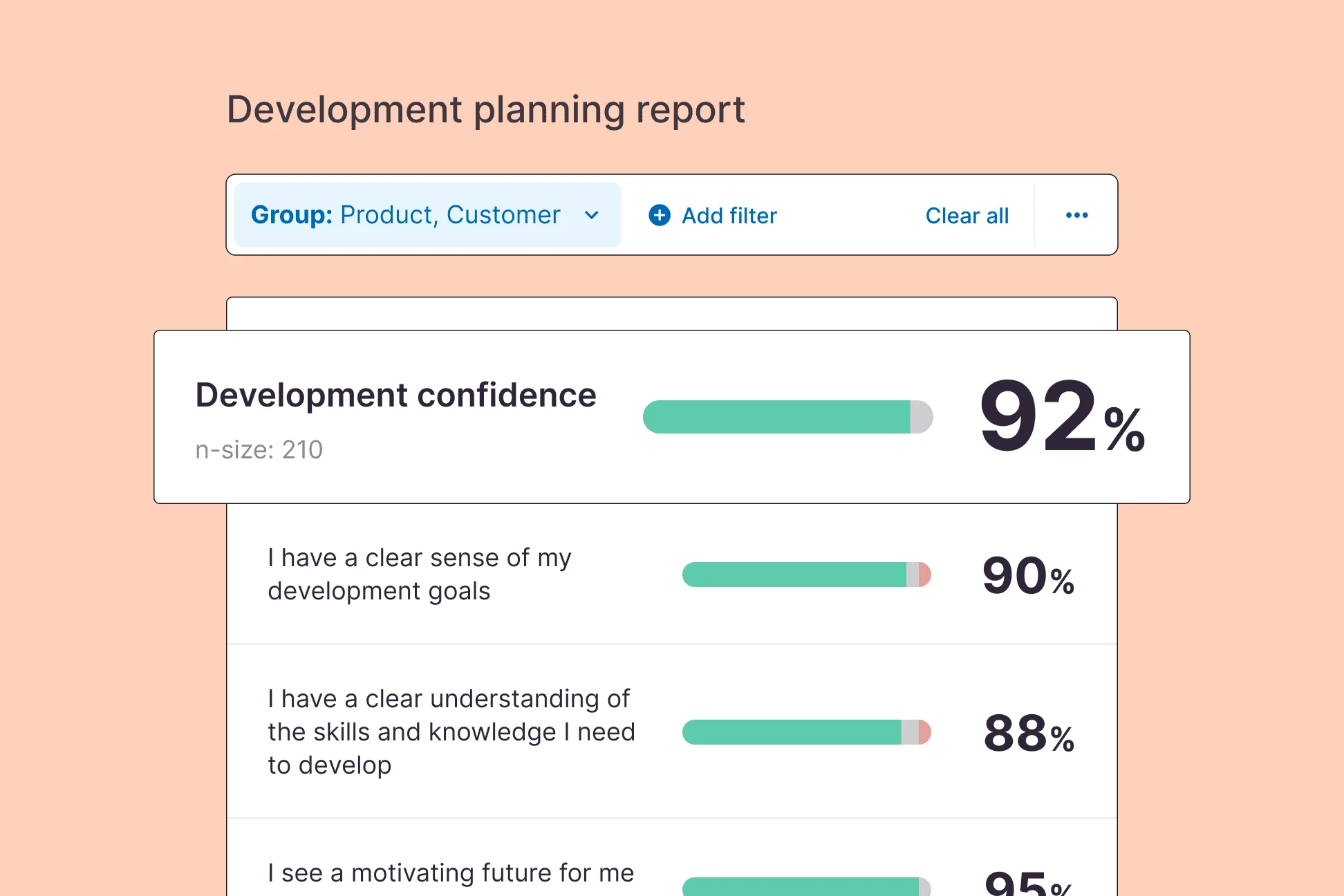
Culture Amp is organized around an administrator-managed workspace. HR teams configure their employee population, typically by syncing with a connected HRIS or uploading employee data directly, and then build surveys or performance cycles using the platform’s template library. Onboarding is guided by the Culture Amp team and typically includes dedicated setup sessions.
Once live, employees receive email or Slack notifications when a survey or review is assigned to them. Completing a survey takes a few minutes, and results aggregate in the analytics dashboard in real time as responses come in. HR administrators can drill into results by team, department, demographic group, or any other configured segment.
Managers access a separate view of their team’s results and development conversations. The 1-on-1 module provides guided templates and tracks action items between sessions. For performance cycles, the platform walks managers through each step of the review process, from goal review to calibration to final submission.
Culture Amp also publishes webinars, guides, and community content on a regular basis. Several reviewers cite this content as a meaningful part of the platform’s value beyond the software itself, particularly for HR teams looking to build their people strategy capabilities alongside the tool.
Pros and Cons
While Culture Amp offers a well-rounded set of tools for employee experience, no platform is a perfect fit for every organization. Choosing the right software requires weighing the depth of its analytics and science-backed approach against the cost and complexity that comes with it.
Below is a breakdown of where Culture Amp performs well and where teams may encounter friction:
Pros: “Easy to use and navigate, with a clear and intuitive flow. Collaboration is seamless, and the added Employee Skills Coach section is a valuable feature that enhances the overall experience.” - Capterra Review
- Culture Amp’s survey library is built on organizational psychology research, meaning the questions are designed to measure what actually drives engagement rather than surface-level satisfaction. That scientific foundation extends to the benchmarking data, which draws from a dataset of over 25 million employees across 6,500 companies.
- Engagement, performance, and development are all managed within a single platform, reducing the need to stitch together separate point solutions and keeping people data in one place for more coherent analysis.
- The benchmarking capability lets organizations compare their engagement scores against industry peers, which adds meaningful context to results that internal-only data cannot provide.
- DEI survey modules and analytics are more developed than most competitors at this tier, offering organizations with active inclusion programs dedicated measurement tools rather than generic survey add-ons.
- Customer support is consistently rated as responsive, and the onboarding process is guided. The platform’s library of webinars, guides, and HR community content is also frequently cited as a genuine value-add beyond the software itself.
Cons: “I find that in some ways, Culture Amp is not very intuitive. It's a bit hard to know whether you've saved a response or not. It's not very intuitive in terms of knowing what you need to do after your manager and you have caught up. Validating things that have been put in the system so you get an automated check-in for the next time is also unclear. Understanding when you're saving something and when you're not saving something is confusing.” - G2 Review
- Pricing sits at the premium end of the employee experience market and can be difficult to justify for smaller organizations where the per-seat cost is significant relative to simpler alternatives.
- HRIS data does not sync automatically in all configurations. Some implementations require manual updates or IT involvement to keep employee records accurate across survey cycles, which adds ongoing administrative overhead.
- Performance workflow customization has real limitations: due dates cannot be set at the individual employee level, and the platform does not natively support 9-box talent grids or talent matrix visualizations that some HR teams rely on.
- Advanced reporting features are gated to higher-tier plans. Teams on entry-level contracts may find themselves without access to the analytics depth they expected when they signed up.
- Administrator navigation carries a learning curve. The experience is smooth for employees and managers completing surveys and reviews, but HR admins managing configurations, survey logic, and complex performance cycles often need additional onboarding time to get comfortable.
Pricing and Plans
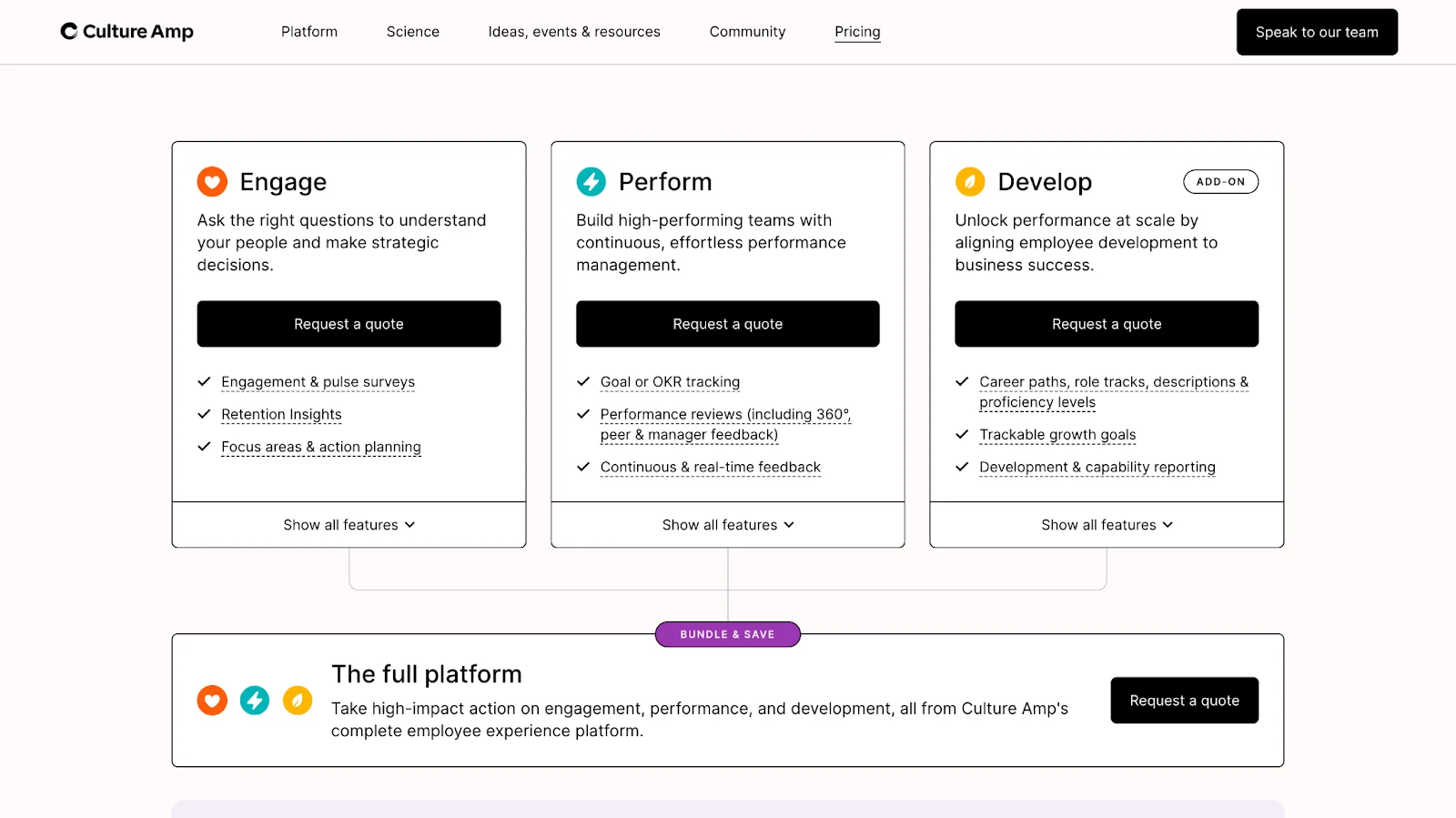
Culture Amp does not publicly list its pricing. All plans are billed annually and quotes are customized based on company size, selected modules, and service tier. Organizations must contact Culture Amp directly for a quote.
User Experience and Interface
Culture Amp holds strong ratings across major software review platforms, with a 4.6/5 rating from over 1,500 reviews on G2 and a 92% user satisfaction rating on SelectHub. Users frequently highlight the quality of the survey templates, the clarity of the analytics dashboards, and the responsiveness of the support team.
What users appreciate most:
- The science-backed survey templates that make it easy to launch meaningful surveys without starting from scratch
- Analytics dashboards that present results clearly and make it straightforward for HR teams and managers to identify trends
- The quality of educational content, webinars, and HR community resources that come alongside the software
- Smooth integrations with Workday, BambooHR, and Slack for teams already running those tools
Where users report friction:
- Initial administrator setup and configuration takes more time than most teams anticipate, particularly for performance cycle workflows
- HRIS data syncing is not always seamless and can require IT involvement to maintain accuracy over time
- Some advanced analytics and reporting features are only accessible on higher-tier plans, which can feel limiting on entry-level contracts
- The performance management module lacks flexibility in certain areas, such as individual-level due date customization, that larger or more complex organizations need
Overall, Culture Amp performs well for HR teams willing to invest time in proper configuration and onboarding. Teams that approach it as a plug-and-play survey tool tend to get less out of it than those who build it into a broader people strategy.
Best Use Cases
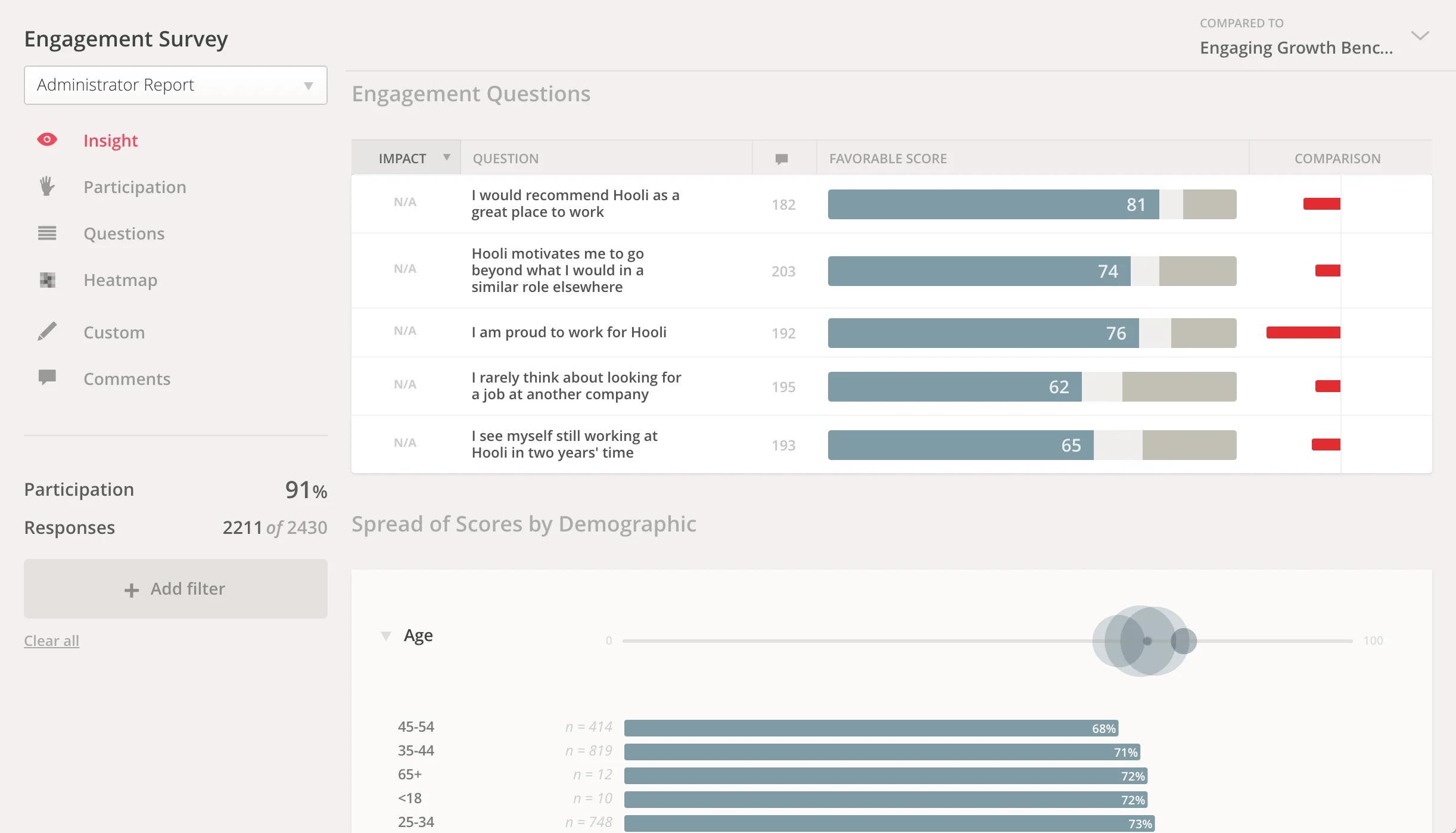
Because Culture Amp is designed around the full employee experience lifecycle, it appeals to a wide range of HR teams - from people-focused mid-size companies to large enterprises building data-driven people strategies. The platform performs best for organizations that are serious about using employee data to drive decisions, not just check a compliance box.
Culture Amp is a strong fit for:
- Mid-size to enterprise organizations (typically 200+ employees) that want engagement, performance, and development managed in one platform with a research-backed foundation
- HR teams that prioritize benchmarking and want to compare engagement scores against industry peers rather than relying on internal data alone
- Organizations with active DEI programs that need dedicated measurement tools and analytics built specifically for inclusion work
- Distributed and global teams that need multi-language survey support and engagement tools that work consistently for remote and in-office employees alike
- Companies building a data-driven people strategy where retention insights, turnover prediction, and people analytics are a strategic priority
Culture Amp may be less suitable for:
- Small organizations under 100–200 employees where the per-seat cost and implementation investment are harder to justify against simpler, lower-cost alternatives
- Teams that require highly customized performance workflows, 9-box talent grids, or individual-level review scheduling that the platform does not natively support
- HR teams without dedicated analytics resources who may find the advanced reporting and predictive features underutilized relative to the investment
- Organizations running niche HRIS systems outside Culture Amp’s primary integration ecosystem, where data syncing may require ongoing manual effort
Alternatives and Competitors
If you are evaluating Culture Amp alongside other platforms, these are the most commonly considered alternatives:
- Lattice: A strong alternative for teams that want performance management and engagement surveys tightly integrated, with deeper OKR tracking and slightly more customization flexibility in review workflows. Pricing is comparable to Culture Amp.
- 15Five: Well-suited for smaller to mid-size organizations looking for a more approachable platform that covers continuous feedback, weekly check-ins, OKRs, and engagement surveys without the complexity of a full enterprise suite.
- Leapsome: A competitive option that combines performance reviews, engagement surveys, learning management, and compensation tools in one platform. Rated slightly higher than Culture Amp on G2 and considered the top overall alternative in the category.
- Workday Peakon Employee Voice: A better fit for large enterprises already running Workday for HRIS and payroll, where tight native integration is a priority over standalone deployment.
- Teamflect: A strong option for organizations already running Microsoft 365, with performance reviews, OKR tracking, 360 feedback, engagement surveys, and 1-on-1 tools built natively inside Microsoft Teams and Outlook.
Final Verdict
Culture Amp is one of the most complete employee experience platforms available today. Its combination of science-backed engagement surveys, continuous performance management, employee development tools, and predictive analytics in a single interface is genuinely difficult to match at this scale. The ratings across G2 and SelectHub reflect a platform that works well for its target audience: HR teams that want to build a data-driven people strategy and have the resources to do it properly.
For HR teams serious about moving from instinct-based to evidence-based people decisions and willing to invest in the configuration and onboarding required to get there, Culture Amp rewards that investment. It is especially well-suited for growing, distributed organizations that need a platform sophisticated enough to handle the full employee lifecycle without requiring a different tool for each part of it.
.avif)
.avif)