.svg)
Teamflect and Lattice both sit firmly in the performance management category, and on paper, their feature lists overlap in meaningful ways. Both cover reviews, goals, feedback, and one-on-one meetings. Both are used by companies in the 50 to 500 employee range. But the two platforms are built around different assumptions about how work gets done, and those differences matter when you're making a final buying decision.
This comparison breaks down both platforms across pricing, core features, and real-world fit. The goal isn't to name a universal winner. It's to help you identify which platform is the right answer for your organization's specific setup.
Teamflect Overview
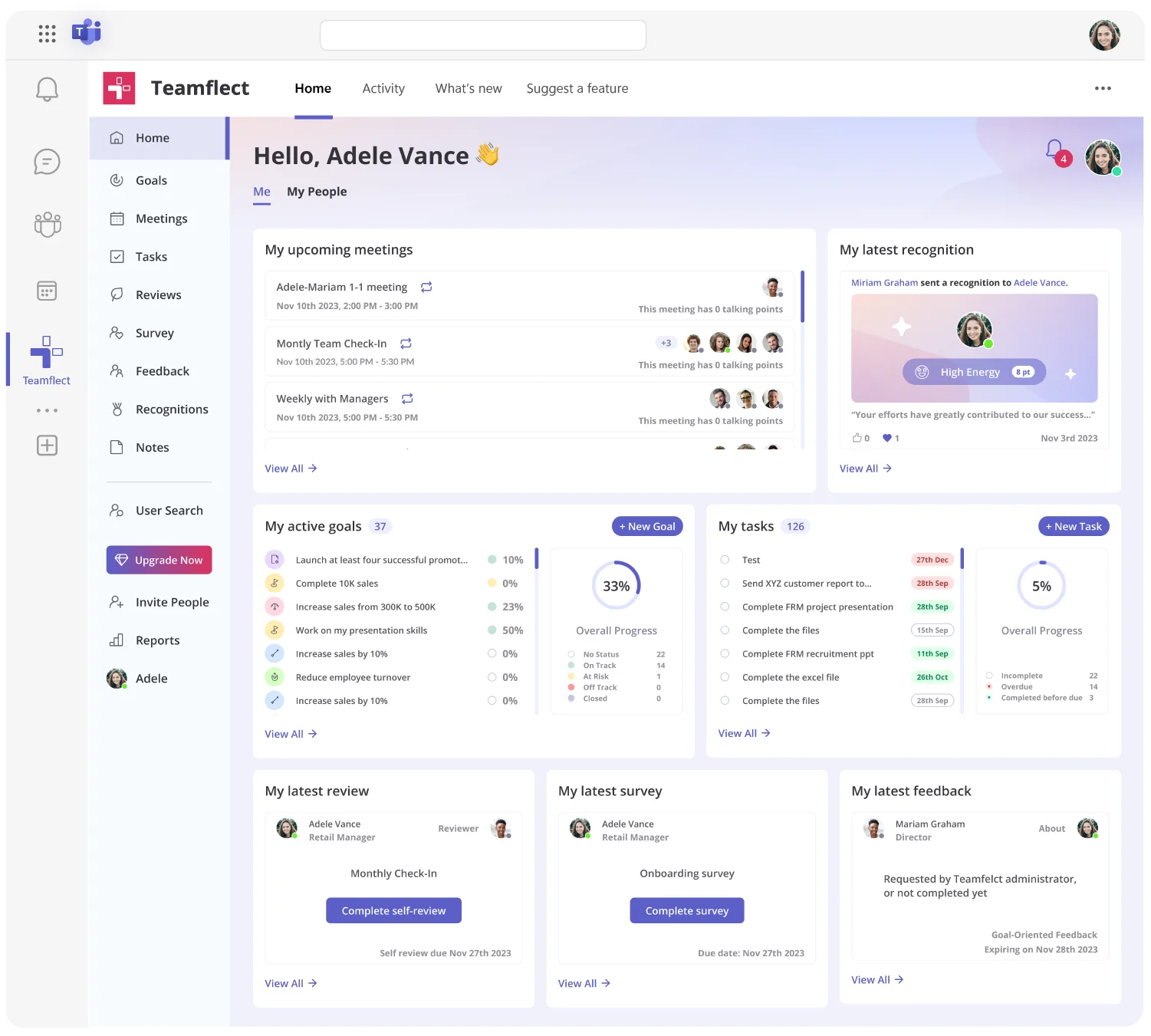
Teamflect is a performance management and employee engagement platform built natively for Microsoft 365. It runs directly inside Microsoft Teams and Outlook, embedding performance workflows, including goals, reviews, feedback, one-on-ones, and recognition, into the tools employees already use every day.
Because there's no separate login and no new application to learn, Teamflect is designed to drive adoption through familiarity rather than training.
Key Features
- Performance reviews with customizable templates and automated review cycles
- Goals and OKR tracking with cascading objectives
- 360-degree and ad hoc feedback
- One-on-one meeting agendas with shared notes and action item tracking
- Employee engagement surveys and pulse data
- Rewards and recognition tools
- Individual development plans and succession planning (Professional plan)
- AI agent for review summaries and goal insights
- Integration with 200+ HRIS systems and the native Microsoft 365 ecosystem, including Teams, Outlook, Planner, Power BI, Excel, and To Do
Pros
- Operates natively inside Microsoft Teams and Outlook with no separate login or context switching
- High adoption rates tied to the familiar Microsoft interface
- Transparent, publicly listed pricing with no modular surprises
- Free Starter plan for up to 10 users with no time limit, useful for testing before a wider rollout
- Strong customer success and onboarding support, consistently cited in user reviews
Cons
- Requires Microsoft 365. Organizations on Google Workspace or without a Teams deployment cannot use the platform
Lattice Overview

Lattice is a standalone performance management and people enablement platform. It connects performance reviews, goal tracking, engagement surveys and compensation management in one system, accessible across Slack, Microsoft Teams, and email. Its current pricing page lists no HRIS product: Lattice syncs employee records from the HRIS you already use.
Unlike Microsoft-native tools, Lattice operates independently of any single ecosystem and offers modular pricing that lets organizations add functionality over time. Lattice holds a 4.7/5 rating on G2 based on 4,079 reviews and a 4.5/5 on Capterra from 204 reviews, as of April 2026.
Key Features
- Performance reviews with customizable cycles, including self-review, peer review, and manager review in one packet
- Goals and OKR tracking with team and company alignment
- Continuous feedback and recognition
- One-on-one meeting management with an Updates feature for async check-ins
- Engagement surveys with anonymity controls, Slack integration, and benchmarking data
- Career pathing and growth tracking (Grow add-on, +$4 per seat)
- Compensation management with benchmarking and pay equity insights (Compensation add-on, +$6 per seat)
- Employee data sync from 13 HRIS tools, including Workday, BambooHR, ADP, HiBob and Rippling (no HRIS product on the current pricing page)
- Lattice AI for calibration summaries and performance insights
- 50+ native integrations including Slack, BambooHR, Workday, Rippling, ADP, and Jira
Pros
“I liked how intuitive the high-level layout of Lattice is. I specifically really like the 1:1 capability and got really comfortable in that format.” - Capterra Review
- Performance reviews, goals, and engagement surveys in one system. Reviewers consistently cite this as the platform's core value
- Engagement surveys delivered via Slack drive higher participation rates in non-Microsoft environments
- Compensation management capabilities not found in Teamflect
- Ecosystem-agnostic, works across Slack, Teams, and email without platform lock-in
Cons
“The integration between Lattice and ADP doesn't allow us to not have worker status as one of the qualifiers, and so we have to turn off the integration and manually upload and terminate employees from Lattice. The cost of Lattice is very expensive, which makes it almost neutral to recommend.” - G2 Review
- Navigation is not always intuitive. Some features are described as "buried" in consistent G2 and Capterra feedback
- Modular pricing means costs rise with each add-on: Grow adds $4 and Compensation adds $6 per seat per month
- OKR configuration can be complex for organizations new to the framework
- Outlook integration is weaker than Slack integration, a documented limitation for Microsoft-heavy teams
- Every contract is billed annually in USD with a $4,000 minimum, so a 25-seat team on Foundations pays more than its seat price
Pricing Comparison
Both vendors publish per-seat prices. The difference is the floor: Teamflect has a free plan for up to 10 users and states no seat minimum on paid plans, while Lattice bills annually with a $4,000 minimum annual spend.
Teamflect Pricing
Teamflect's pricing is fully transparent and publicly listed. The Starter plan is free for up to 10 users and includes core features. The Essential plan is $9 per user per month billed monthly, or $7 billed annually, and adds usage analytics, data export, a dedicated customer success manager, and training support. The Professional plan is $14 per user per month billed monthly, or $11 billed annually, and includes HRIS integration, individual development plans, succession planning, an employee intranet, an internal job board, and the Voice-of-Employee module. Annual billing saves 22%.
Lattice Pricing
Lattice lists prices per seat, per month, by product. The Foundations bundle is $13 and covers Performance, Goals & OKRs, 1:1s, Weekly Updates, Feedback, Q&A Boards, Analytics and the AI Agent. Sold on their own, Performance is $10, Goals & OKRs is $8 and Engagement is $4. Compensation adds $6 and Grow adds $4 per seat. Enterprise pricing is quoted.
Every Lattice contract is billed annually, in USD only, with a $4,000 minimum annual agreement. At 100 seats, Foundations costs $15,600 a year and Foundations plus Engagement costs $20,400. The current pricing page lists no HRIS, payroll or time tracking product. Prices are from lattice.com/pricing, checked September 2026.
Our Lattice review breaks the cost down by team size and lists the hidden costs we found.
Pricing verdict: Both vendors now publish seat prices, so the real gap is the minimum spend. A 50-person team on Teamflect Essential pays $4,200 a year on annual billing ($7 x 50 x 12). The same team on Lattice Foundations pays $7,800 a year. A 25-person team on Lattice pays the $4,000 minimum, even though 25 Foundations seats list at $3,900.
Teamflect vs Lattice: Feature Comparison
Both platforms cover the same core territory but handle individual features in ways that matter depending on your organization's setup. We compared each platform on the dimensions most relevant to a final buying decision.
Goals and OKR Tracking
.webp)
Both platforms support OKR tracking with cascading objectives, key result weighting, and progress visibility across teams. Where they diverge is in how those goals connect to the rest of an employee's day.
Teamflect's goal module is built directly into Microsoft 365. Goals appear in the sidebar of Teams meetings, link to Planner tasks for action item tracking, and surface in Power BI dashboards for organizations that want custom reporting. Managers can review goal progress during one-on-ones without leaving Teams, and goals can be tied to performance review templates so progress data flows directly into review cycles. Check-in cadence is configurable per goal.
Lattice's goal module is more standalone but visually richer. The platform offers OKR trees that map alignment from company down to individual level, and goals connect to Lattice's Growth and Compensation modules so progress can feed directly into career conversations and pay decisions. Reviewers consistently note that initial OKR configuration in Lattice has a learning curve, particularly for organizations that haven't run formal OKR cycles before.
Verdict: Teamflect leads for Microsoft-native goal management and faster time-to-value. Lattice leads for organizations that want OKRs to feed directly into compensation planning and growth conversations.
Performance Reviews and Calibration

Both platforms support customizable review cycles that include self-reviews, peer reviews, manager reviews, and 360-degree feedback. Teamflect ships with a library of review templates for annual, quarterly, probationary, and project-based reviews, all of which can be edited or built from scratch. Reviews can be launched, completed, and signed off inside Teams without a separate login. The platform's AI agent generates draft review summaries based on goal data, feedback history, and one-on-one notes, which managers can edit before finalizing.
Lattice covers the same review types but adds dedicated calibration tools that help HR teams normalize ratings across managers. Calibration sessions can be run inside the platform with side-by-side rating views, AI-generated calibration summaries, and audit trails. For organizations running formal calibration as part of their performance process, this is a meaningful workflow advantage. This makes Lattice particularly relevant for larger teams evaluating performance review software for enterprise organizations.
Verdict: Lattice leads for organizations with formal calibration requirements and HR teams that want a dedicated calibration workspace. Teamflect leads for teams that want reviews to happen inside Teams, and for organizations where AI-assisted draft summaries matter more than calibration tooling.
Employee Engagement Surveys

Both platforms include engagement surveys, but they're built around different distribution and analytics philosophies, which reflects their target environments more than any quality gap.
Teamflect delivers surveys directly inside Microsoft Teams. Pulse surveys, eNPS, and custom engagement surveys can be scheduled, sent, and completed without leaving Teams, and anonymity controls are built in. Results flow into manager and HR dashboards with filters for team, department, and tenure, and Power BI integration allows for deeper custom analysis when needed. For Microsoft 365 organizations, in-Teams delivery typically drives strong response rates because employees don't have to open a separate app or click through from email.
Lattice's engagement survey module is more analytics-heavy out of the box, with industry benchmarking data that lets HR teams compare scores against peer companies of similar size and sector. Survey delivery via Slack is a documented strength, and reviewers in Slack-first organizations specifically cite it as a reason for choosing the platform. Lattice's longitudinal trend analysis is also more sophisticated by default, without requiring a separate BI layer.
Verdict: It depends on your ecosystem. For Microsoft 365 organizations, Teamflect's in-Teams delivery drives high participation rates without asking employees to learn a new tool. For Slack-first organizations or HR teams that need industry benchmarking as a core requirement, Lattice has the deeper out-of-the-box feature set.
Microsoft 365 and Ecosystem Integration
This is Teamflect's clearest area of strength. The platform operates natively inside Teams, Outlook, Planner, Power BI, and To Do. There is no separate application to open, no additional login, and no context switching required. Performance workflows appear where employees already spend their time. Lattice integrates with Teams and Outlook but functions as a connected third-party tool, not a native application. Multiple Lattice reviewers on Capterra cite weak Outlook integration as a specific limitation.
Verdict: Teamflect leads decisively for Microsoft 365 organizations. For teams on Google Workspace or in Slack-first environments, Lattice is the stronger fit.
Compensation Management and HRIS
Lattice sells Compensation as a +$6 per seat add-on with benchmarks, comp bands, cycle management and statements. Teamflect has no compensation module.
Neither product is an HRIS today. Lattice's current pricing page lists no HRIS product, and Lattice syncs employee data from 13 HRIS tools, including Workday, BambooHR, ADP, HiBob and Rippling. Teamflect integrates with HRIS systems on its Professional plan. Either way, you keep your existing HRIS. For the wider category, see our performance management software guide.
Verdict: Lattice leads on compensation. On HRIS, both tools expect you to keep a separate system.
Start With Teamflect If You Need Microsoft-Native Performance Management
- Your organization runs primarily on Microsoft 365 and Microsoft Teams is the main communication platform
- Employee adoption of HR tools is a known challenge. You want performance management to happen inside an app employees already use
- You want transparent, predictable per-user pricing with no modular cost surprises
- You need performance management without a full HR platform. You already have a separate HRIS
- Implementation speed matters. Teamflect can be deployed inside a Microsoft tenant quickly
- Your organization has 50 or more employees and wants per-user pricing without a minimum annual spend
Choose Lattice If You Need a Standalone People Platform with Compensation Tools
- Your organization is Slack-first or ecosystem-agnostic and does not rely primarily on Microsoft Teams
- Engagement surveys with industry benchmarking are a core requirement. Lattice's survey module is meaningfully more advanced
- You want compensation management and performance data in the same platform
- Your seat count clears Lattice's $4,000 annual minimum (26 or more seats on Foundations)
- Your People Ops team runs formal calibration sessions and needs AI-assisted calibration summaries
- Your team is 200 to 500 employees with a dedicated HR function that can manage the platform's configuration complexity
Final Verdict
Teamflect and Lattice are both credible choices at the 50 to 500 employee range, but they serve different organizational profiles. Teamflect is the better fit when Microsoft 365 is already the center of daily work and adoption matters more than breadth. Lattice is the better fit when you need engagement benchmarking, compensation tools, or a system that isn't tied to any single ecosystem.
For related comparisons, see our comparison guide on Leapsome vs Teamflect and Teamflect vs Engagedly. If neither tool fits, our Lattice alternatives list compares ten tools, including Teamflect.
.png)