



.svg)
OKRs can get complicated quickly when you're managing them across thousands of employees. In a 2026 benchmark of more than 200 organizations, 65% of teams reported that their OKRs weren't linked to company goals. A system that works well for a 50-person startup may start to feel limiting once you're dealing with multiple layers of leadership and teams working toward different goals.
That's what we focused on when putting together this list. We looked at the OKR software that can actually support larger organizations in 2026 and paid close attention to what matters once you're operating at scale.
If you're working with fewer than 1,000 employees, you'll likely find more relevant options in our OKR software for startups comparison instead.
What Makes OKR Software Enterprise-Grade
Not every OKR platform is built to handle an enterprise environment. Once you're managing thousands of employees across multiple teams and business units, the basics of setting goals and tracking progress are no longer enough. Companies with 200 to 1,000 employees may have different requirements and can often get what they need from OKR software for mid-size companies.
For this comparison, we focused on six criteria that separate enterprise-ready OKR software from tools that are better suited to smaller organizations. A platform that checks all six boxes can realistically support an enterprise rollout. A platform that only checks a few may still be a good option, but it's probably better suited to the mid-market.
Here's what we looked at:
1. Security and Compliance
Security is one of the first things enterprise buyers will look at, and for good reason. SOC 2 Type II, GDPR compliance, SSO and SAML, encryption at rest and in transit, and regional data hosting are all important considerations.
Without proper security documentation, even a great OKR platform can get stuck during the IT or legal review. Depending on your industry, you may also need certifications such as ISO 27001 or TISAX. We recommend checking the vendor's actual trust or security documentation rather than relying solely on what's listed on a marketing page.
2. Cascading and Alignment
Enterprise OKRs need to connect the dots across the entire organization. A company objective should be able to flow down to divisions, business units, teams, and individual employees while keeping that original goal in view.
A platform that handles two levels of alignment may work perfectly well for a smaller organization. At 5,000 employees, though, you'll want deeper cascading, dependency mapping, and clear visibility into how individual goals connect to broader company objectives.
3. HRIS Integration and Write-Back
HRIS integration sounds great on a feature list, but there's an important distinction to make: does the integration actually write data back to your HRIS, or does it only pull information from it?
If goal and performance data has to be manually transferred back into Workday or SuccessFactors at the end of every cycle, your HR team is still doing a lot of the work behind the scenes. Before committing to a platform, check exactly what each HRIS integration supports and whether write-back is available for your specific connector.
4. Scale and Performance
Being able to technically support thousands of users isn't quite the same as having thousands of employees actively using the platform.
For enterprise software, we looked for evidence of real-world deployments at scale, including named enterprise customers and case studies where available. A pricing page saying enterprise doesn't tell you much on its own. What matters is whether the platform has actually been used successfully across large organizations and concurrent OKR cycles.
5. Executive Reporting
Executives shouldn't have to wait for a quarterly spreadsheet to understand how the organization is tracking against its goals.
The best enterprise OKR platforms give leadership a live view of which objectives are on track, which are at risk, and where teams are running into blockers. That visibility makes OKRs much more useful as a management tool rather than just another quarterly reporting exercise.
6. Implementation and Change Management
Rolling out OKRs across an enterprise is about much more than getting everyone set up with an account. Implementation can take months, and adoption is often a bigger challenge than the technology itself.
There's a big difference between a vendor that gives you access to the software and a knowledge base and one that provides a dedicated customer success team, structured onboarding, and change management support. We looked at what vendors actually provide to help administrators and employees adopt the platform, since that support can make a significant difference to the success of an enterprise rollout.
How We Evaluated Each Platform
We scored each of the 10 platforms against the criteria above to determine how well they fit the needs of enterprise organizations in 2026. The rankings reflect overall enterprise fit, not a single best tool across all company sizes. If you're still narrowing down your requirements, our broader OKR software comparison covers the full range of options.
1. Independent Review Evidence
We looked at G2 ratings as verified in August 2026, taking both the overall rating and the number of reviews into account. A 4.9 rating based on 12 reviews tells us something different from a 4.7 based on 100 reviews, so review volume was considered alongside the rating itself.
2. Cascading and Alignment Depth
We looked for documented support for multi-level cascading, objective dependencies, and alignment visualization. The goal was to determine whether these features can support alignment across multiple business units rather than simply helping individual teams track their own goals.
3. HRIS Write-Back
Nearly every platform claims to offer HRIS integrations. We went a step further and looked at which platforms support actual write-back of goal and performance data, as well as which specific HRIS connectors support bidirectional integration.
4. Security Posture
We verified security features such as SOC 2 Type II, GDPR, SSO/SAML, and regional data hosting using each vendor's available trust or security documentation wherever possible. Marketing claims alone were not treated as sufficient evidence.
5. Pricing Transparency
Where vendors publish pricing, we included the available tiers. For platforms that use quote-based pricing, we've clearly indicated that instead. Any third-party or anonymized pricing estimates are labeled as estimates and should be treated as directional rather than an official quote.
OKR Software at a Glance
Ratings and review counts are from G2, verified August 2026, and are subject to change.
The Rankings: Top 10 Enterprise OKR Platforms
Enterprise OKR software brings objectives, key results, progress tracking, and alignment into one structured workflow for large organizations.
The right platform depends on your company size, existing tech stack, and whether your priority is visibility, alignment, or ease of adoption. Here are 10 enterprise-ready options to consider in 2026.
1. Betterworks
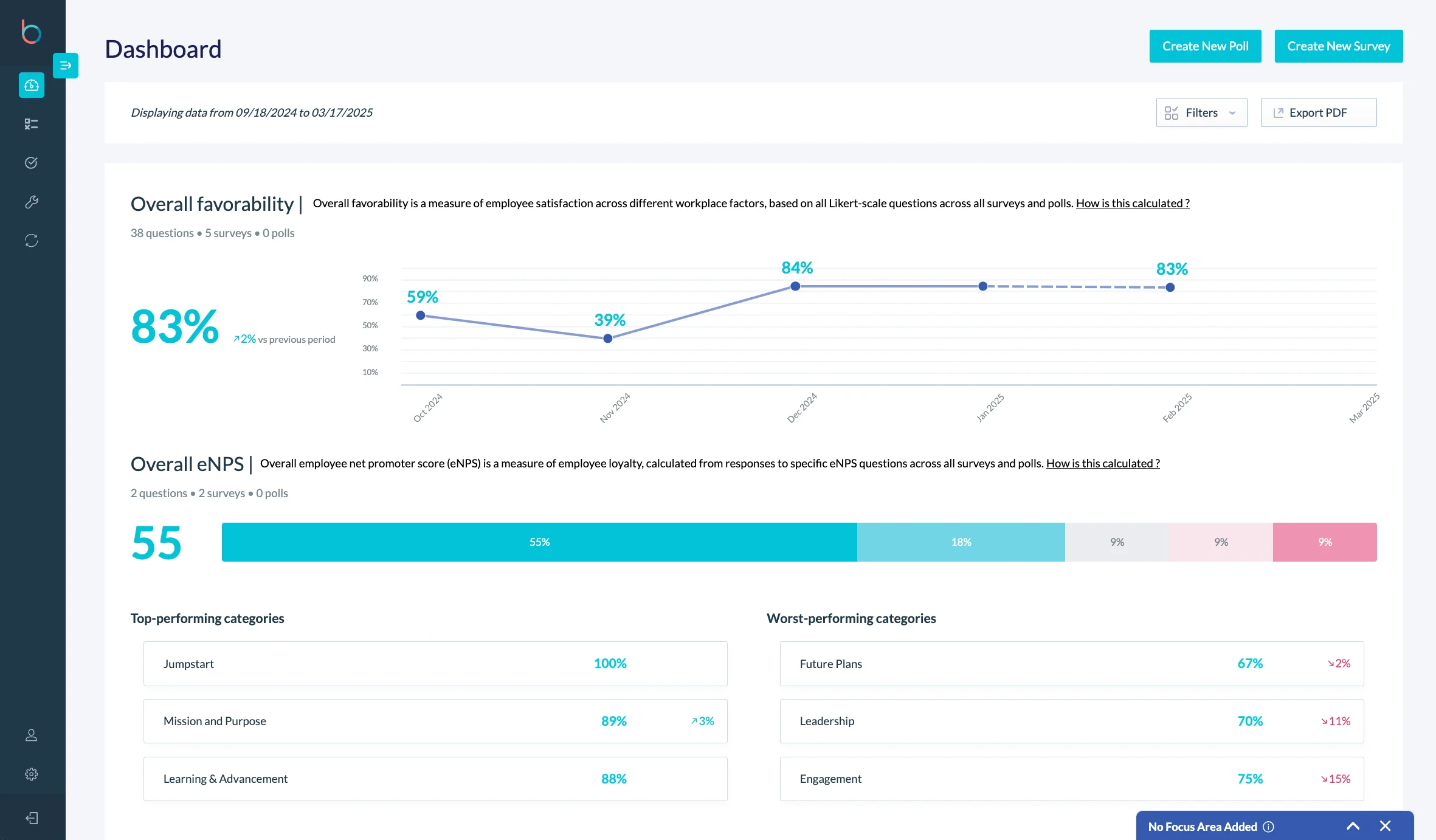
Betterworks takes the top spot because it was built around the needs of large organizations. Four-level cascading and cross-business-unit dependencies give it the depth needed when goals span multiple teams and regions. It also supports bidirectional write-back to Workday and SAP SuccessFactors. Named customers like Colgate-Palmolive and Informatica further support its enterprise positioning. The main trade-offs are quote-only pricing and more configuration complexity than simpler OKR tools.
Key Features
- Multi-level OKR cascading with dependency mapping across business units and geographies
- Bidirectional integration with Workday and SAP SuccessFactors for automatic goal data write-back
- Executive dashboards with live execution visibility, not quarterly exports
- AI-powered goal writing, check-in summaries, and execution risk identification
- Continuous feedback and performance review connected to OKR outcomes in the same platform
- SOC 2 Type II, GDPR, SSO/SAML, and role-based access controls
Pros and Cons
Pros: "Betterworks offers a modern interface for tracking goals, sharing feedback, and collaborating with others. Also I really appreciate the AI tools to enhance feedback texts, this is maybe my major advantage. In addition I never had issues with performance - the system seems to be stable and scalable." – G2 reviewer
- Purpose-built for enterprise OKR cascading, not adapted from a general HR tool
- Bidirectional HRIS write-back confirmed for Workday and SAP SuccessFactors
- Executive reporting gives leadership live visibility into execution risk
Cons: "Sometimes you have to search for settings just to change other settings, and it doesn’t feel well integrated with other tools like Microsoft Teams. Also, I don’t like that requested feedback expires after a certain time." – G2 reviewer
- Smaller G2 review base than category leaders limits independent evidence
- Pricing is quote-only with no published tiers
- Configuration complexity is higher than lighter OKR tools; internal admin expertise required
Pricing
- Quote-only, no published tiers
- Anonymized contract sources suggest $8-15/user/month at enterprise scale
2. WorkBoard
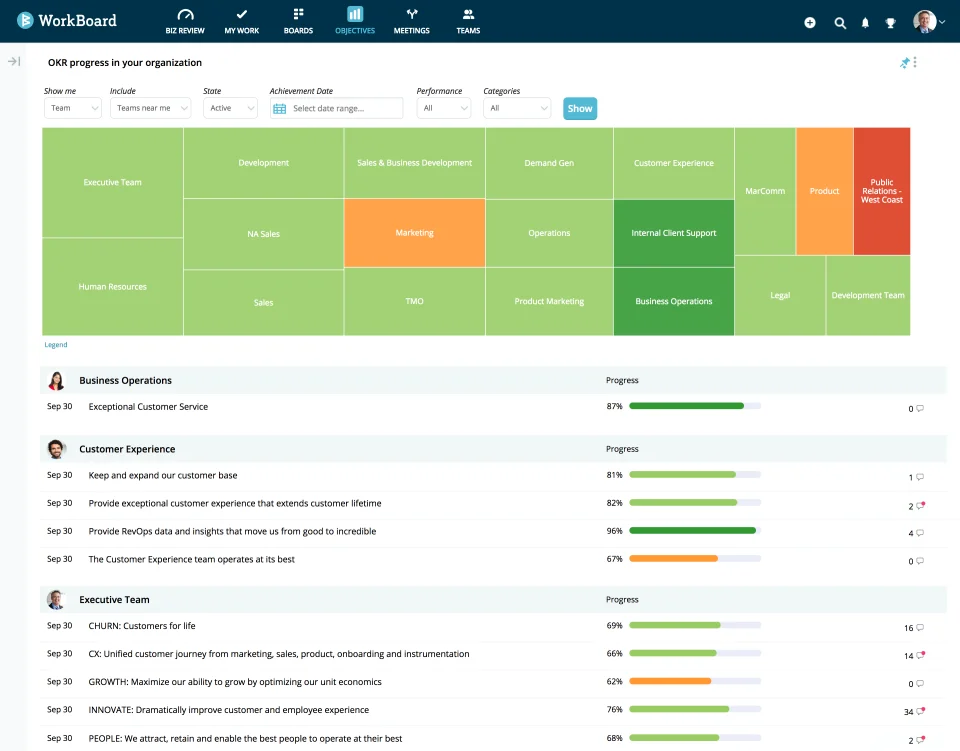
WorkBoard puts company strategy at the center of its OKR approach. Its business review workflows help leadership track how strategic priorities are progressing instead of treating OKRs as a separate HR process. Customers include Boeing, 3M, Capital One, Experian, and State Street.
Key Features
- Strategy-to-OKR alignment with executive operating rhythm built into the core workflow
- Business review dashboards surfacing execution status, blockers, and accountability in real time
- Multi-level OKR cascading with confidence scoring and milestone tracking
- AI-assisted goal writing and execution risk identification
- HRIS and enterprise system integrations including Workday, ServiceNow, and SAP
- SOC 2 Type II, GDPR, SSO/SAML, and enterprise-grade access controls
Pros and Cons
Pros: "I like how structured, well planned, and clear WorkBoard is. Goals, targets, updates, and priorities are off my shoulders and easy to track in one place. Having everything in one place makes it easier to stay clear on priorities." – G2 reviewer
- Executive-level strategy execution layer is more developed than any other platform on this list
- Named enterprise customers at the top end of the market support the procurement case
- Acquisition of Quantive strengthens the underlying data model and analytics depth
Cons: "The interface can feel a bit complex at first, and it takes some time to get used to all the features. Making it beginner friendly would make it so easy." – G2 reviewer
- G2 review count of 103 is smaller than most platforms on this list; independent evidence is limited
- Built primarily for exec-led operating rhythms; HR-led goal programs may find it less intuitive
- Pricing is quote-only; no published tiers or public contract estimates available
Pricing
- Quote-only, no published tiers or anonymized contract estimates available
3. Teamflect
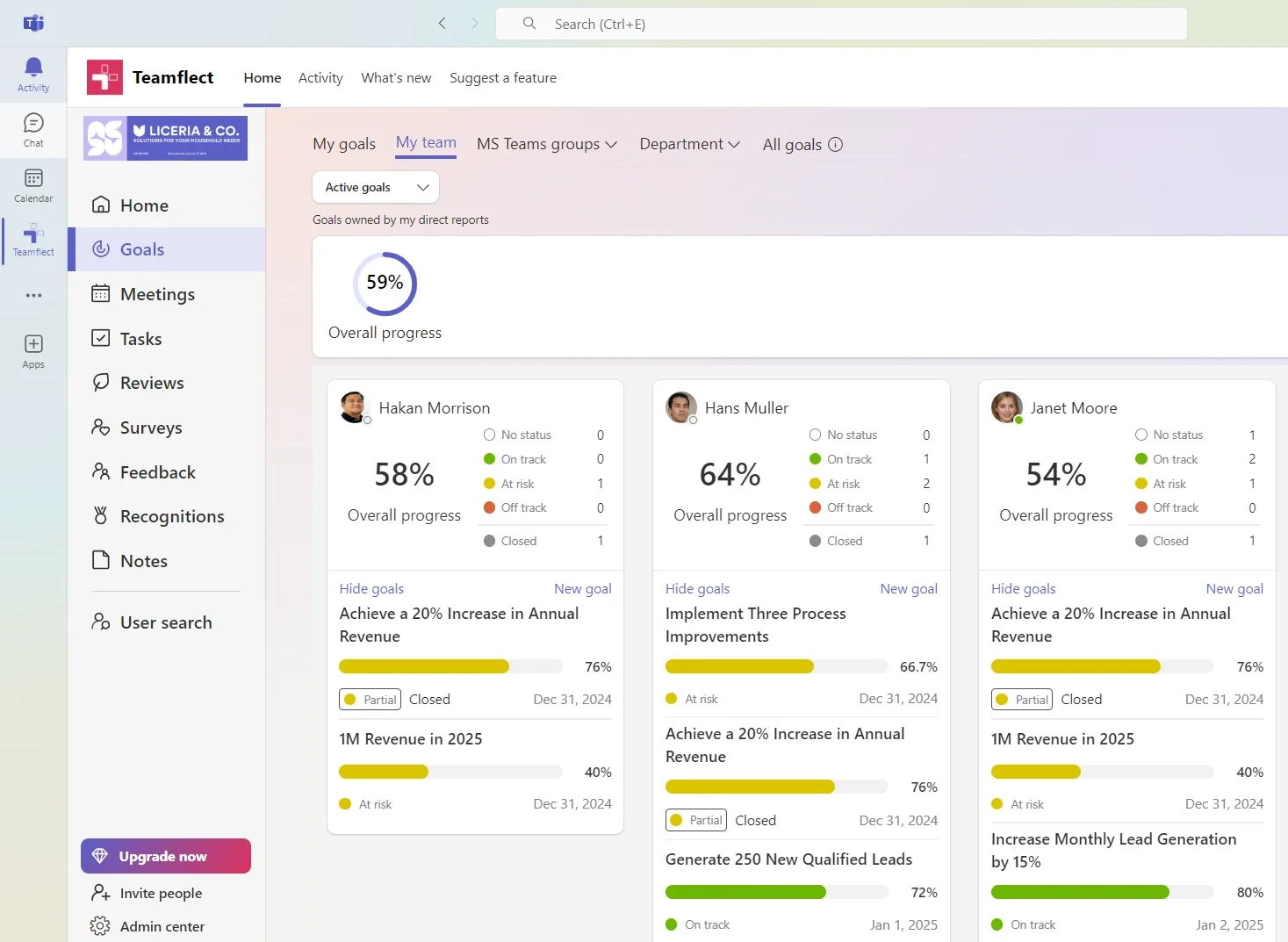
Teamflect's biggest advantage is that employees don't have to leave the tools they already use. Its OKRs and other performance management features work directly through Microsoft Teams and Outlook, which can make adoption much easier. Enterprise deployments with Securitas and Invacare show that this approach can work at scale.
Key Features
- OKRs, reviews, feedback, and 1:1s within Microsoft Teams and Outlook without a separate login
- Goal cascading with alignment views connecting company, team, and individual OKRs
- Custom goal terminologies including OKRs and KPIs.
- Goal progress syncing automatically from live documents such as Excel sheets and Power BI reports
- Goals connecting to performance appraisals alongside competencies and feedback
- SOC 2 Type II, GDPR, Azure data residency, and BYOK encryption options
- HRIS integrations with Workday, SuccessFactors, BambooHR, HiBob, and others
- AI-assisted goal writing and progress summarization within the Teams workflow
Pros and Cons
Pros: "Completing review cycles inside Microsoft Teams has removed the usual chase for form submissions. Managers and employees work in the same environment they already use, which has improved both speed and consistency." – G2 reviewer
- Microsoft Teams integration may support adoption for organizations already standardized on Microsoft 365
- SOC 2 Type II, GDPR, and Azure data residency options cover enterprise security requirements (verify by plan)
- Named as the leading Viva Goals replacement for Microsoft 365 organizations
Cons: "On Integrations, it works best within the Microsoft ecosystem, so it may feel limiting for companies using a wider mix of third-party tools." – G2 reviewer
- Does not come with any built-in Core HR features like some other enterprise grade hris tools that also have goal setting capabilities
- Organizations outside the Microsoft 365 ecosystem lose the native-workflow advantage that underpins Teamflect's enterprise pitch
Pricing
- Starter: Free for up to 10 users with full functionality
- Essential: $7/user/month (billed annually)
- Professional: $11/user/month (billed annually)
- Enterprise: Custom Quote
4. Perdoo
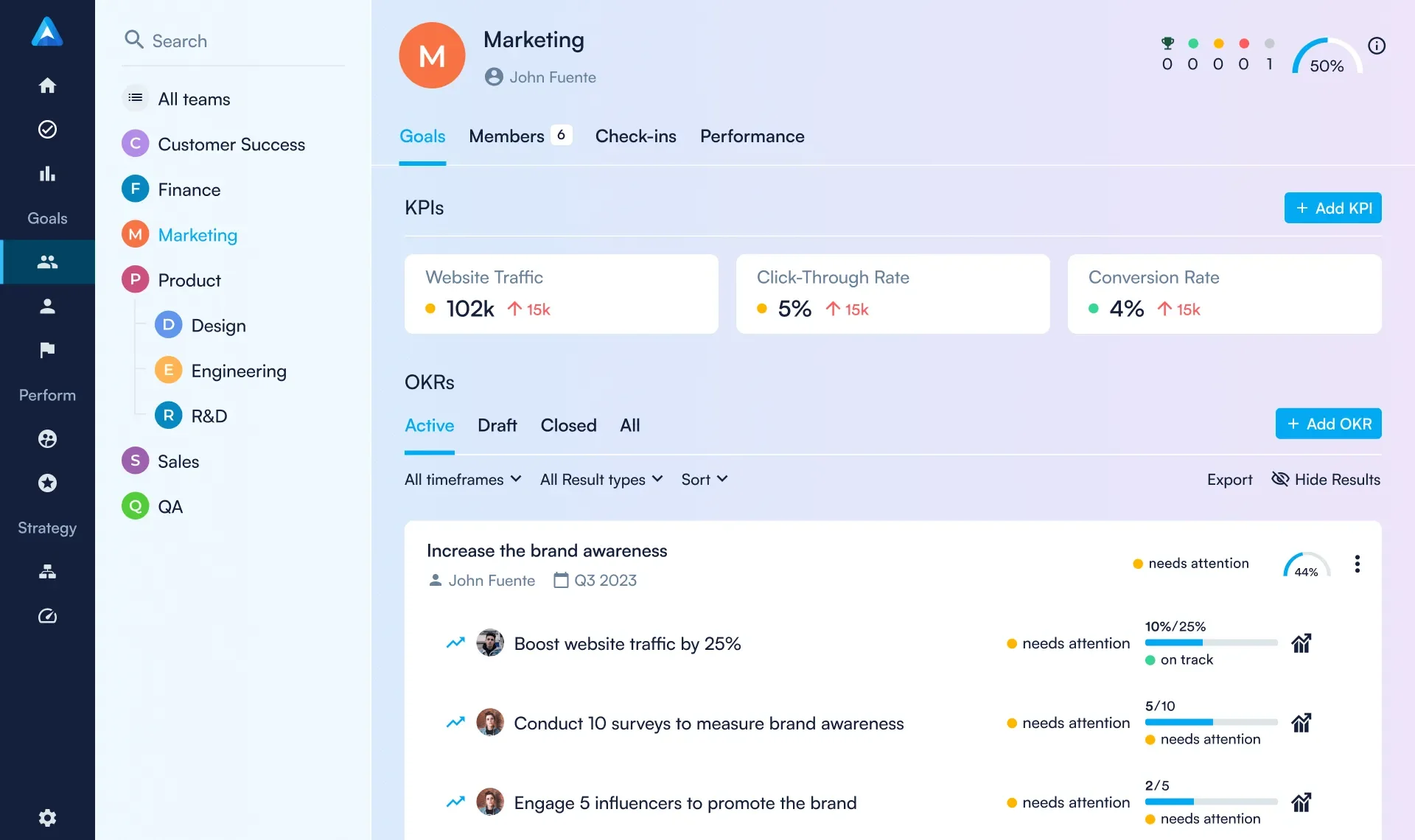
Perdoo brings OKRs, KPIs, and company strategy together in one place. Its strategy roadmap connects quarterly goals with longer-term priorities, while the Goal Tree shows how individual objectives fit into the wider company strategy. This makes it more than a basic goal-tracking platform. Its G2 reviewer base does lean toward smaller organizations, though, so larger companies should take a closer look at its enterprise capabilities before committing.
Key Features
- OKRs, KPIs, and strategy roadmap in one unified view connecting quarterly execution to multi-year strategy
- Goal Tree view showing cascading alignment from company objective to individual key result
- Weekly check-in rhythms with automated nudges to maintain OKR engagement
- HRIS integration with Workday, BambooHR, HiBob, and others
- SOC 2 Type II, GDPR, SSO/SAML, and role-based access controls
- Free tier for up to 5 users; paid plans scale by headcount
Pros and Cons
Pros: "What I like most about Perdoo is that it’s very easy to use while still offering all the functionality we need to manage our OKRs effectively. The platform is highly customisable, allowing us to adapt it to our processes rather than changing our processes to fit the tool." – G2 reviewer
- OKR, KPI, and strategy roadmap in one view is a genuine differentiator at this position
- 4.4/5 G2 rating across 546 reviews is a well-evidenced score in the OKR category
- Weekly check-in infrastructure and methodology guidance are among the strongest on this list
Cons: "The main limitation from a HR Perspective is there isn’t a HR view option to track 1:1's or see performance reviews. These are only visible to the team member and their direct manager." – G2 reviewer
- G2 reviewer base skews toward small-to-mid-market; enterprise-specific evidence is limited
- Per-user pricing without bundle discounts can become expensive at 1,000+ employees
- HRIS write-back depth varies by connector; verify for your specific integration
Pricing
- Free tier for up to 5 users
- Paid plans from approximately $9/user/month (billed annually); enterprise pricing on request
5. Mooncamp

Mooncamp strikes a good balance between functionality and ease of use. The platform connects OKRs with strategy and KPIs without making the experience unnecessarily complicated. It is particularly appealing for scale-ups and mid-enterprise companies, while larger organizations should confirm that the platform can support their specific organizational structure.
Key Features
- OKRs connected to a strategy map layer and KPI tracking in a single closed-loop system
- Multi-level cascading with alignment visualization across teams and business units
- Microsoft Teams integration for check-ins and updates without leaving the M365 environment
- Automated check-in rhythms and reporting for leadership review sessions
- HRIS integrations with Workday, BambooHR, Azure Active Directory, and others
- GDPR compliance with data encryption; SSO via Okta, Azure AD, and Google
Pros and Cons
Pros: "Mooncamp is comprehensive but at the same time so simple to use. I found the learning curve manageable, helped by the fact it is all very intuitive. The UX is great and our team have had no trouble adopting Mooncamp as a daily tool." – G2 reviewer
- 4.8/5 G2 rating across 297 reviews is one of the highest of any dedicated OKR platform on this list
- Strategy map layer connects quarterly OKR execution to multi-year strategic themes
- Among the cleaner user experiences in the enterprise OKR category, reducing adoption friction
Cons: "The CFR (Conversation, Feedback and Recognition) process could be more flexible. The registration area does not allow each participant to express their personal and individual opinions. This would be especially useful for discussing private issues that should not be visible to all members of the organization, but are necessary for personal development." – G2 reviewer
- Organizations at 10,000+ should verify configuration depth and global org-structure support with Mooncamp
- Enterprise-specific case studies with named customers are less prominent than at Betterworks or WorkBoard
- HRIS write-back depth varies by connector; verify for your specific integration
Pricing
- Published pricing starts at approximately $6/user/month (billed annually)
- Enterprise pricing varies by headcount and configuration
6. Profit.co

Profit.co gives companies more guidance around the OKR process than many of the other platforms here. Its eight alignment views make it easier to look at goals from different perspectives, while its built-in methodology resources can help teams establish a consistent process. An on-premises deployment option is another advantage for organizations with strict data requirements.
Key Features
- Eight alignment view formats including alignment tree, heatmap, Gantt, and hierarchy views
- Built-in OKR methodology coaching, templates, and step-by-step rollout guidance
- On-premises deployment option for organizations with strict data sovereignty requirements
- Performance reviews, pulse surveys, and task management connected to OKR outcomes
- SAML 2.0 SSO, SCIM, and integration with Microsoft Entra ID and Okta
- SOC 2 Type II, GDPR, and ISO 27001 compliance
Pros and Cons
Pros: "The tool is very intuitive & really helps to put in our OKRs and execute them in a well-defined manner, even tuned for niche industries like education excellence." – G2 reviewer
- Broadest set of OKR alignment views on this list, with eight visualization formats
- On-premises deployment is rare in this category and matters for strict data sovereignty requirements
- G2 Leader status for 18 consecutive quarters is a sustained evidence signal
Cons: "At times, I have problems with the UI being super slow at loading my data. I do not think this is an internet issue since I can load other pages on the web super fast. So I think an improvement would be how fast data gets rendered on the platform." – G2 reviewer
- G2 reviewer base skews mid-market; large-enterprise-specific evidence is limited
- Dashboard complexity and data loading speed are recurring criticisms at larger deployments
- HRIS write-back depth varies by connector; verify bidirectionality for your specific HRIS
Pricing
- Quote-only for enterprise; no publicly listed per-user tiers on the enterprise pricing page
- A free tier and lower-cost SMB plans exist but are not the enterprise offering
7. Workpath
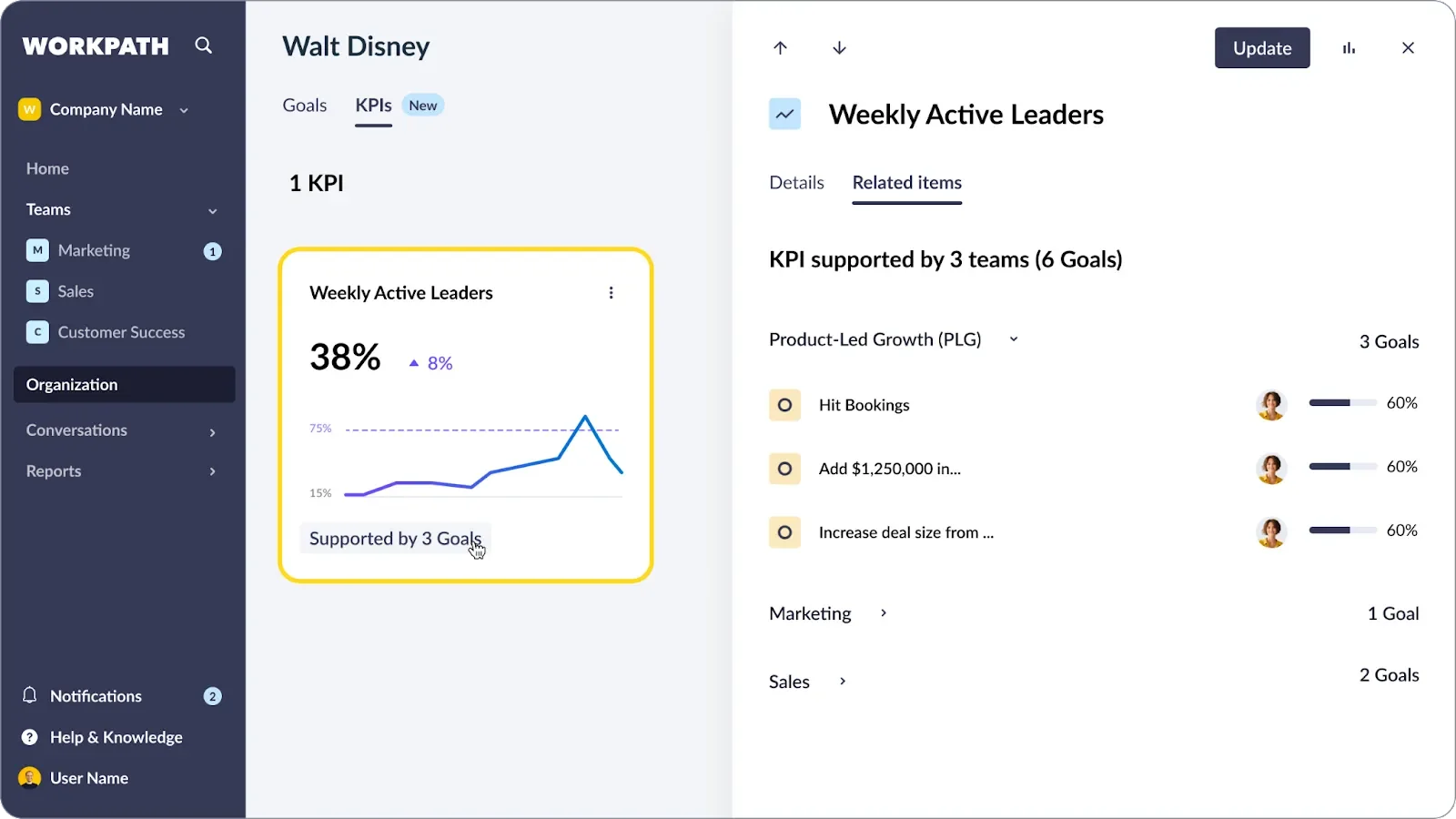
Workpath stands out most for its security and compliance credentials. Its ISO 27001 and TISAX certifications add another layer of reassurance for European organizations dealing with strict data requirements. The platform also brings KPIs and initiative management into the same system.
Key Features
- Multi-level OKR cascading with KPI tracking and initiative management in a single platform
- Analytics suite for leadership review sessions with execution status and alignment visibility
- ISO 27001 and TISAX certification in addition to GDPR and SOC 2 compliance
- European data residency with strong data sovereignty posture for EU-regulated sectors
- Integrations with Jira, Microsoft Teams, Slack, and HRIS platforms
- Dedicated customer success and OKR coaching built into the contract
Pros and Cons
Pros: "I appreciate its user-friendly interface and ease of use. The software is designed to be intuitive and customizable, making it easy for businesses of all sizes to streamline their workforce management processes." – G2 reviewer
- ISO 27001 and TISAX certification is not available at most platforms on this list
- Purpose-built for enterprise strategy execution with KPI and initiative management connected to OKRs
- Dedicated customer success and OKR coaching included in the contract
Cons: "One area with room for improvement is the integration with the Microsoft Office suite, which isn’t yet as seamless as some of the other tools Workpath connects with." – G2 reviewer
- 12 G2 reviews as of August 2026 is a very small sample; evaluate via direct trial and reference calls
- Platform complexity creates a steeper learning curve than lighter OKR tools
- Integration with Microsoft Office suite is not yet fully seamless per reviewer feedback
Pricing
- Quote-only; no public rates or anonymized contract estimates available
8. Quantive StrategyAI
.avif)
Quantive StrategyAI tackles one of the bigger headaches with enterprise OKRs. For instance, it keeps progress data updated across multiple systems. It also connects to more than 170 business data sources and can use that information to automatically update key results. However, its recent rebrand from Gtmhub and acquisition by WorkBoard means buyers should confirm the current product direction and capabilities before signing up.
Key Features
- Automated key result progress updates from 170+ connected business systems, without manual data entry
- AI-powered strategic planning tools translating high-level strategy into measurable OKRs
- OKR whiteboard for visual planning sessions with one-click conversion to structured objectives
- Insighboards for customizable KPI visualization and real-time strategic monitoring
- Multi-level cascading with dependency mapping and alignment visualization
- SOC 2 Type II, GDPR, SSO/SAML, and ISO 27001 certification
Pros and Cons
Pros:
- Automated KR progress from 170+ data sources reduces manual update burden significantly
- AI-powered strategic planning layer is more developed than most platforms on this list
Cons:
- Rebrand from Gtmhub and acquisition by WorkBoard have created feature-direction uncertainty for some users
- Pricing gets expensive quickly at enterprise scale; no public tiers available
- Verify current feature availability directly with Quantive for any critical capability
Pricing
- Quote-only, no published tiers
- Enterprise pricing confirmed as custom; confirm at pricing page
9. Lattice
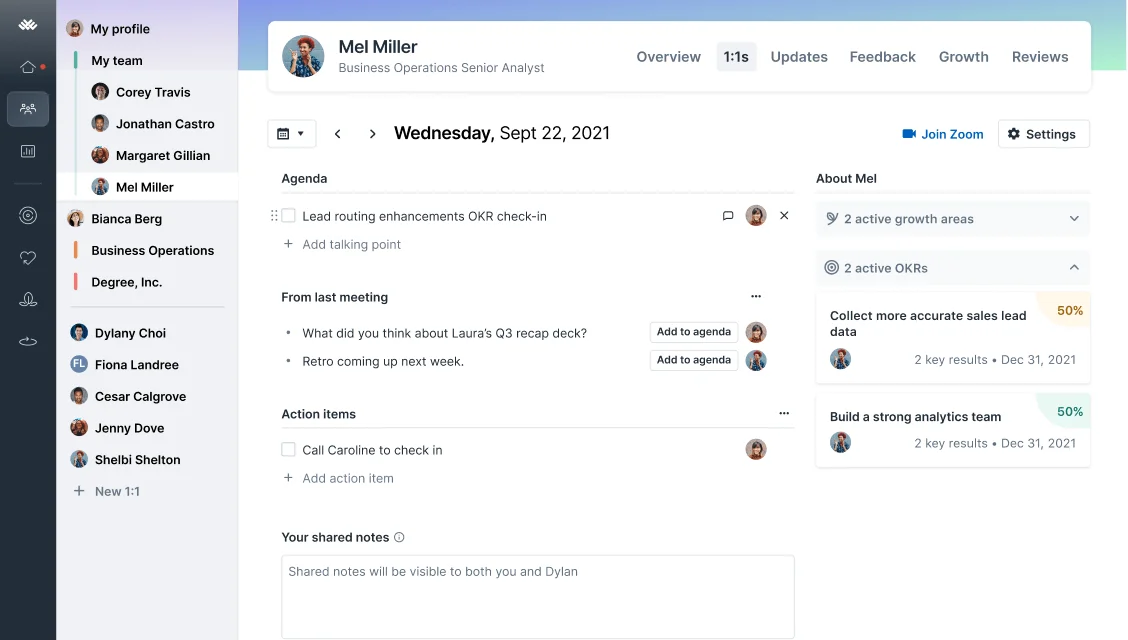
Lattice makes the most sense when OKRs are only one part of a much bigger people management strategy. Goals can connect with performance reviews and compensation decisions, allowing companies to keep these processes within the same system. The downside is that OKRs aren't the main focus of the platform, so companies looking for highly specialized OKR functionality may find other options more suitable.
Key Features
- OKR and goal management connected to performance reviews, compensation, and career development in one platform
- Calibration view with manager distribution analytics and 9-box placement tied to goal outcomes
- Bidirectional HRIS integration with Workday, SuccessFactors, HiBob, and others (verify by connector)
- AI-powered goal writing, feedback summaries, and performance insights
- Compensation management connected to goal and performance outcomes within the same platform
- SOC 2 Type II, GDPR, SSO/SAML, and role-based access controls
Pros and Cons
Pros: "Lattice's UI/UX stands out - it's intuitive and clean, making navigation effortless even for first-time users. The performance review management module is particularly strong, streamlining the entire review cycle from goal-setting to feedback collection.” – G2 reviewer
- Largest independent review base of any platform on this list, with 4,118 G2 reviews at 4.6/5
- OKR outcomes connect directly to performance, compensation, and career development without a separate tool
- Among the most mature AI implementations in the performance and goal management category
Cons: "A few areas for improvement include limited flexibility in custom reporting/analytics, occasional integration constraints with third-party tools, and pricing that could be more modular for smaller teams." – G2 reviewer
- OKR module is not the primary product; purpose-built OKR platforms offer more developed goal-specific workflows
- Automated reminders not available for all goal cycle types; verify for your specific configuration
- Admin complexity increases meaningfully when running many concurrent goal types across large populations
Pricing
- Goals and OKRs module starts at $8/seat/month; Foundations bundle (Performance + Goals) at $13/seat/month
- $4,000/year minimum annual contract regardless of headcount
10. Leapsome
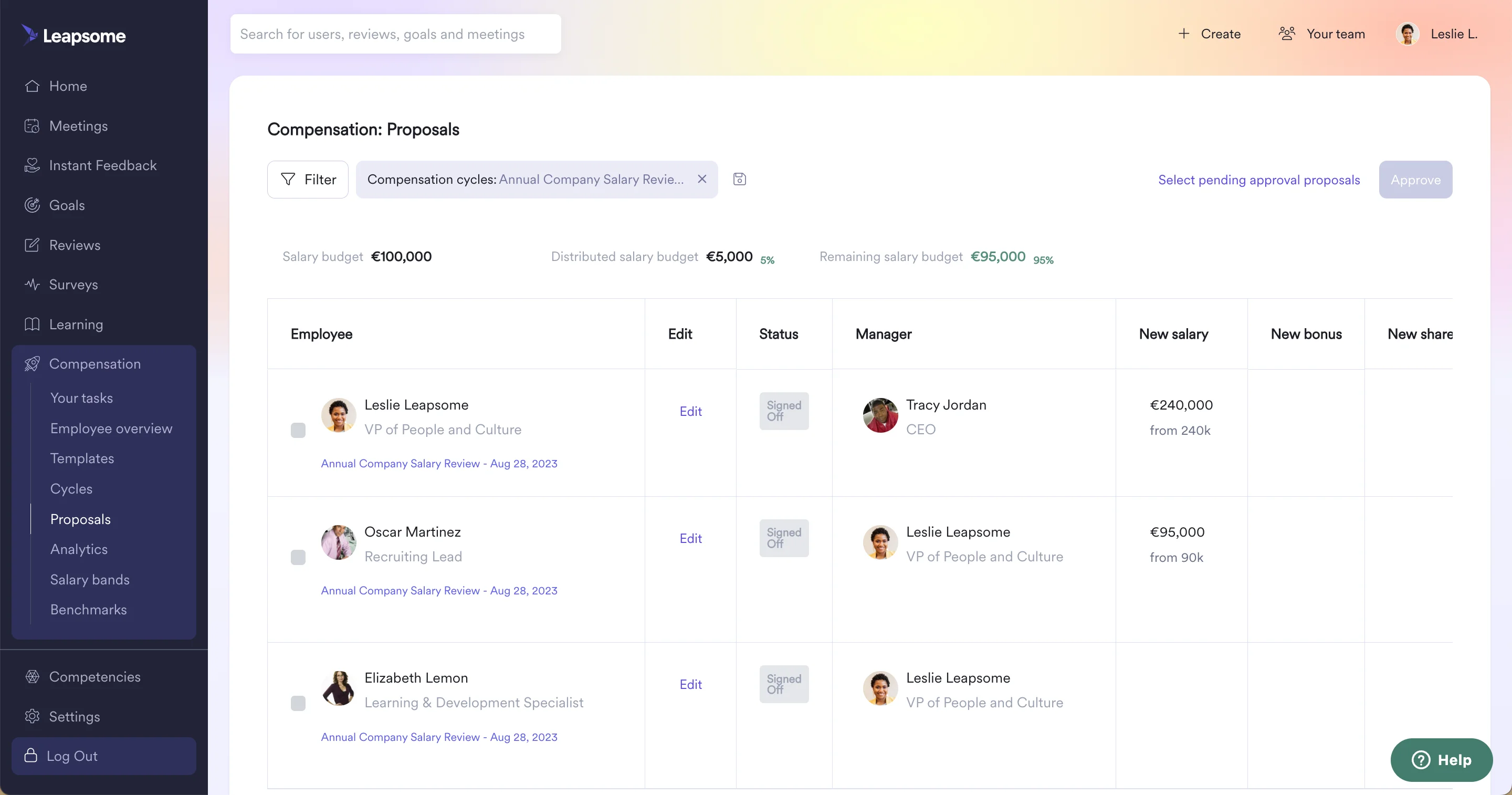
Leapsome gives companies the flexibility to expand their people management tools over time. Its modular setup allows organizations to start with goals and later add other areas such as performance or engagement. Still, Leapsome isn't a dedicated OKR platform, so organizations with complicated cascading requirements may want something built more specifically around enterprise OKRs.
Key Features
- Modular architecture: deploy OKRs alongside or separately from reviews, engagement, learning, and compensation
- Goal management with multi-level cascading, check-ins, and progress tracking across teams
- Bidirectional HRIS integration with Workday, SuccessFactors, HiBob, and others (verify by connector)
- AI-assisted goal writing, OKR suggestions, and performance summaries
- External benchmarking data for engagement and performance across the Leapsome customer base
- SOC 2 Type II, ISO 27001, GDPR, and regional data hosting
Pros and Cons
Pros: "What I like best about Leapsome is how it brings performance, feedback, and learning into one place. Instead of using different tools or spreadsheets to keep track of goals, feedback, and development, everything is centralized and easy to access." – G2 reviewer
- 4.8/5 G2 rating across 2,551 reviews is the highest user satisfaction score on this list
- Modular architecture lets you expand from OKRs into performance, engagement, and compensation without switching vendors
- ISO 27001 and strong GDPR posture are well-documented for European procurement requirements
Cons: "While the UI/UX is generally friendly and easy to use, the home page/dashboard could be improved so that it provides a more useful overview of key processes, actions, and even news. This would help employees more easily follow the company’s rhythm of business and keep up with their actions." – G2 reviewer
- Goals and OKR module is not a purpose-built OKR platform; cascading depth is lighter than Betterworks or WorkBoard
- Organizations at 10,000+ employees should verify configuration depth and global org-structure support with Leapsome
- Pricing is quote-only for enterprise; total cost of ownership requires a vendor conversation
Pricing
- Modular pricing from $3/user/month for individual modules (billed annually)
- Enterprise pricing is custom; contact Leapsome for a quote based on your headcount and modules
How to Choose Enterprise OKR Software
The right platform depends on a clear answer to one question before you evaluate anything else: who owns the OKR program, and what problem are they actually solving? That answer will tell you more than any feature matrix. If OKRs are just one piece of a broader performance management rollout, it's worth looking at how they fit within enterprise performance management software before committing to a standalone tool.
- If the primary problem is executive operating rhythm and strategy execution, WorkBoard's business review layer and executive dashboards are built for that use case in a way that HR-led OKR platforms are not.
- If the primary problem is adoption inside a Microsoft 365 organization, Teamflect removes the login friction that kills OKR programs at most organizations. The OKR depth trade-off is real; the adoption advantage is also real.
- If you are running a first-time enterprise OKR rollout and need methodology support built in, Profit.co's coaching library, eight alignment views, and plan-execute-engage-learn structure reduce the rollout risk that comes with self-implementing OKRs at scale.
Whatever shortlist you build: model total cost at your actual headcount including implementation, run a pilot in one business unit before full deployment, and ask each vendor for a reference customer at your headcount running your specific HRIS stack. Enterprise OKR programs fail most often not because of the software but because of change management. The platform you pick should have a documented answer to how it handles that.
Final Words
Most organizations shopping for enterprise OKR software aren't making a software decision. They're making a decision about whether strategy execution will be a discipline or a quarterly ritual. The platform matters less than the operating model it enables, and more often than not, the organizations that fail at OKRs picked a tool that worked for their pilot team and couldn't hold up when the program went organization-wide.
To narrow the shortlist, identify the one constraint that will kill the program if it isn't solved: cascading depth, adoption, HRIS write-back, or security posture. Build your evaluation around that constraint first, then evaluate features. The right answer is the tool that solves the constraint you actually have, not the one with the most features or the best demo.
.avif)