.svg)

.svg)
.svg)
.svg)
If you are an HR manager weighing your options for a human capital management (HCM) system, SAP SuccessFactors is likely already on your list. It is one of the most widely deployed HR platforms in the world, trusted by organizations across more than 200 countries. But with that scale comes real complexity, and this SAP SuccessFactors HCM review will help you cut through the noise.
In this article, we will walk through what the platform actually does, where it excels, where it falls short, how it is priced, and who it is genuinely built for.
What is SAP SuccessFactors?
.webp)
SAP SuccessFactors HCM is a cloud-based suite of HR applications designed to manage the full employee lifecycle, from recruitment and onboarding through performance management, learning, compensation, and workforce planning. The platform is AI-enabled, meaning it uses machine learning to surface insights, automate routine tasks, and personalize the employee experience.
Originally founded in 2001 by Lars Dalgaard under the name SuccessFactors, the company was acquired by SAP in February 2012. Since then, it has grown into one of the flagship products in SAP's cloud portfolio, sitting alongside tools like SAP Concur, SAP Fieldglass, and SAP S/4HANA.
The platform operates as part of SAP Business Suite, which means it can function as a standalone HR system or integrate deeply with other SAP enterprise applications. For organizations already running SAP ERP or SAP S/4HANA, the migration path to SuccessFactors is relatively straightforward compared to switching to a different vendor entirely.
Key Features of SAP SuccessFactors HCM
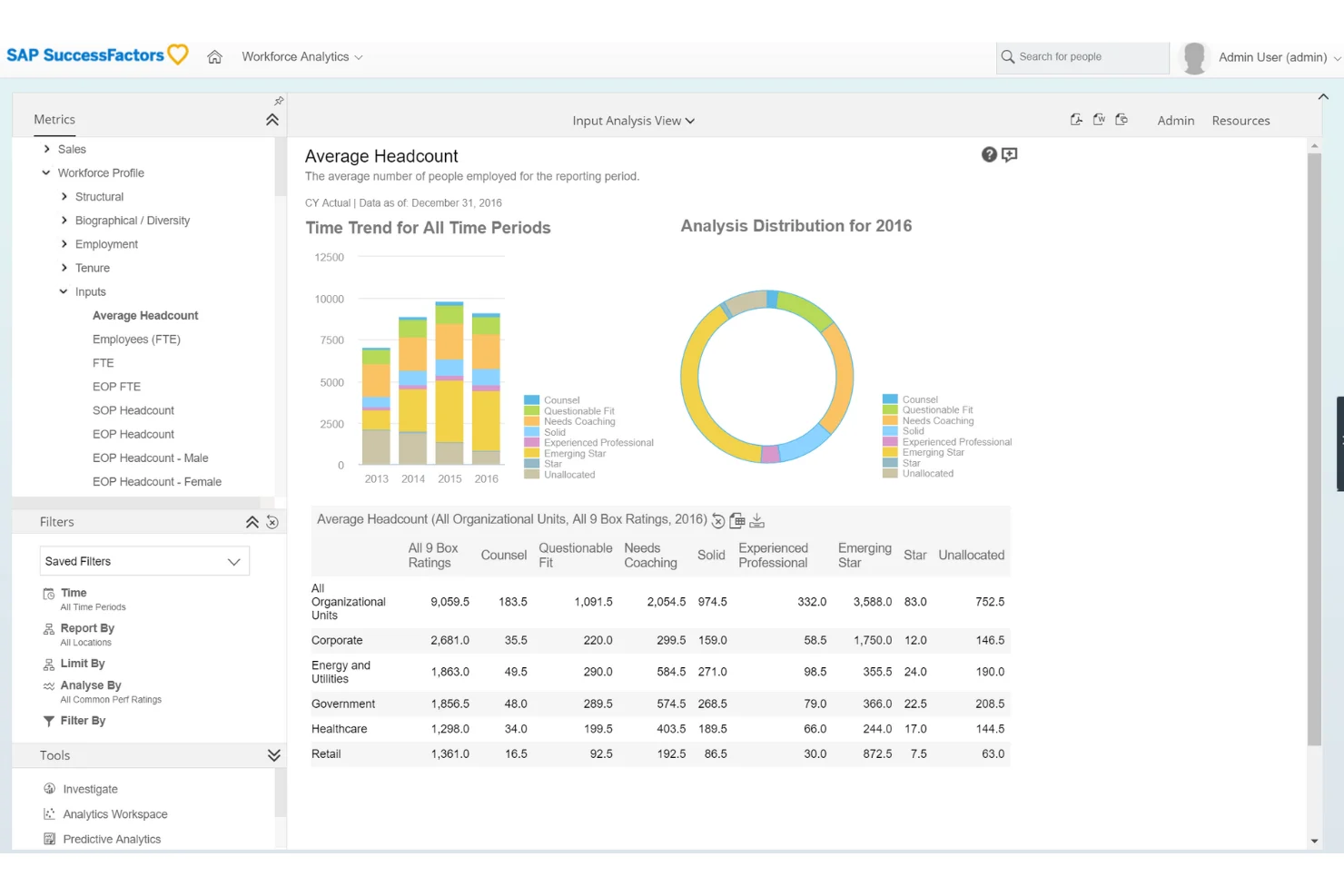
Here is a breakdown of the core modules and what each one covers.
1. Core HR and Payroll
Employee Central serves as the central employee database. It handles organizational management, position management, time and attendance, and global benefits. SAP SuccessFactors Employee Central Payroll automates payroll processing, handles tax calculations, and supports multi-country payroll requirements. For large organizations managing payroll across multiple jurisdictions, this is one of the platform's stronger selling points.
Getting the underlying process right matters as much as the software itself; knowing the payroll best practices covers the operational side that even a strong platform like this one depends on.
2. Talent Management
This module covers the full talent lifecycle. SAP SuccessFactors Recruiting uses AI to screen applicants and reduce bias in the selection process. Onboarding tools help new hires complete required tasks and connect with their teams before their first day. Performance and Goals enables continuous development conversations alongside formal review cycles. Compensation management tools support salary planning, merit increases, and incentive modeling.
3. Learning and Development
SAP SuccessFactors Learning is a built-in learning management system (LMS) that supports compliance training, skills-based learning paths, and external content integrations. The AI layer can recommend courses based on an employee's current role, stated goals, and identified skill gaps. Career and Talent Development tools help managers identify high-potential employees and plan succession paths. Career coaching software usually operates at a narrower scope than this, focused specifically on one-on-one coaching relationships rather than succession infrastructure. Buyers who need internal mobility as the primary focus rather than a module within a larger suite generally find a better match among dedicated talent marketplace platforms.
4. People Analytics and Workforce Planning
The analytics module provides real-time reporting on headcount, turnover, compensation equity, and workforce composition. Scenario modeling tools allow HR leaders to plan for organizational changes, such as restructuring or expansion, and model the cost and talent impact of different decisions. Reports can be shared across teams and connected to SAP Analytics Cloud for more advanced visualization.
5. Employee Self-Service and Experience
Employees access the platform through a self-service portal available on web and mobile (iOS and Android). Common tasks like submitting leave requests, updating personal details, reviewing pay stubs, and completing assigned training are all available without HR intervention. Joule, SAP's AI assistant, is also embedded in the platform to answer HR-related questions and guide employees through workflows.
6. Global and Compliance Capabilities
SAP SuccessFactors supports over 100 country-specific localizations, covering labor law compliance, language requirements, and regional payroll regulations. For multinational HR teams, this is one of the most compelling reasons to choose the platform over lighter-weight alternatives.
How SAP SuccessFactors Works
SAP SuccessFactors is modular by design. Organizations can adopt the full suite or implement individual modules based on their priorities. Each module handles a specific HR function, and they are connected through a shared data layer, which means employee records, performance data, and workforce analytics all feed into a single system of record.
At the core is Employee Central, the platform's HR information system (HRIS). It stores employee data, manages organizational structures, and powers the self-service portal that employees use to update personal information, request time off, and access documents. Everything else, including talent management, learning, and payroll, connects to this central hub.
HR teams configure workflows, approval processes, and compliance rules through the back end. Managers can initiate performance reviews, track goal progress, and pull workforce reports without leaving the platform. The AI layer, branded as SAP Business AI, assists with tasks like writing performance review summaries, identifying skills gaps, and matching candidates to open roles.
SAP SuccessFactors: Pros and Cons
Based on verified user reviews and platform analysis, here is an honest look at where SAP SuccessFactors performs well and where it has room to improve.
Pros: “I am super delighted to use this software because it enables me to manage my team very efficiently. It reminds me of performance management of mine as well as my team. In addition to these, it allows you to request for any HR related letters and it reaches you on time without wasting your time physically.” - Capterra Review
- Strong global compliance and multi-country support
- Comprehensive HR suite covering the full employee lifecycle
- Deep integration with SAP ERP and S/4HANA
- Robust analytics and workforce reporting tools
- AI-assisted features across recruiting, performance, and learning
- Highly scalable for large and enterprise organizations
- Large network of certified implementation partners worldwide
Cons: “SuccessFactors often feels complicated because its different parts don’t always match. It can be hard to learn, making simple updates usually requires hiring expensive experts, and the reporting tools are sometimes frustrating to use compared to newer, simpler apps.” - G2 Review
- Implementation can be complex and time-intensive
- Pricing is above average for small and mid-sized businesses
- Module experience can feel inconsistent across the platform
- Many configuration changes require a third-party SAP partner
- Customer support response times have received mixed reviews
- Mobile app functionality is more limited than the desktop version
- Steeper learning curve for administrative users
User Experience and Interface
User ratings for SAP SuccessFactors sit around 4.0 out of 5 across major review platforms, which reflects a platform that is functionally strong but not always the easiest to use. The experience tends to be better for end users (employees and managers) than for administrators handling configuration and customization.
Common praise from reviewers includes the clarity of workflows for performance reviews and goal management, the usefulness of the reporting tools, and the ease of handling payroll and compensation tasks. Users who have migrated from older on-premise SAP HR systems also note that the transition to the cloud version is relatively smooth.
On the other hand, a recurring complaint is that the interface feels inconsistent when moving between modules. The learning module, for example, has a noticeably different look and feel compared to the performance or recruiting sections. Some administrative tasks are described as clunky, and configuration changes beyond basic settings typically require working through a certified SAP partner, which adds cost and delays.
The mobile app covers core tasks adequately but is not as full-featured as the desktop version. Users who rely heavily on mobile access for approvals or HR workflows may find it limiting.
SAP SuccessFactors Pricing
SAP SuccessFactors follows a subscription-based pricing model. Costs vary depending on the number of users, the modules selected, and the scope of implementation. The Core HR package starts at approximately $18 per user per month, billed annually with a minimum one-year contract.
That entry price is higher than many mid-market HR platforms, and the total cost of ownership rises considerably when you factor in implementation fees, configuration support, third-party partner costs, and ongoing training. Organizations adopting the full suite should plan for a structured, multi-phase implementation rather than a quick setup.
SAP does not publish a comprehensive pricing breakdown publicly. Most enterprise deployments go through a sales-led evaluation, and pricing is negotiated based on organizational size and contract length. Free trials are not broadly available, though SAP does offer product tours and demo environments for prospective buyers.
Best Use Cases
SAP SuccessFactors is built for organizations that have outgrown simpler HR tools and need a comprehensive, enterprise-grade platform.
It is particularly well suited for:
- Large enterprises managing complex, multinational workforces
- Organizations already using SAP ERP, SAP S/4HANA, or other SAP business applications
- HR teams that require strong compliance support across multiple countries and jurisdictions
- Companies prioritizing workforce analytics and data-driven HR decision-making
- Industries with significant compliance requirements, such as healthcare, manufacturing, financial services, and energy
It is less ideal for very small businesses or teams looking for a lightweight, fast-to-deploy HR tool. The setup investment and ongoing maintenance requirements make it a better fit for organizations with dedicated HR technology resources or access to implementation support.
SAP SuccessFactors Alternatives and Competitors
If SAP SuccessFactors is not quite the right fit, several strong alternatives are worth considering depending on your organization's size, budget, and priorities.
- Workday HCM: A close competitor in the enterprise space, often preferred for its more modern interface and stronger financial management integration.
- Oracle HCM Cloud: Another enterprise-grade option with deep global capabilities, particularly strong for organizations already in the Oracle ecosystem.
- BambooHR: Better suited for small to mid-sized businesses looking for an intuitive, lower-cost HR platform without the complexity of a full enterprise suite.
- Rippling: A good option for growing companies that want HR, IT, and payroll managed in one place with fast setup times.
- HiBob: Worth considering for mid-market companies that prioritize employee experience and culture management alongside core HR functions.
When comparing options, the key factors to weigh are implementation timeline, total cost of ownership, depth of global compliance support, and whether the platform integrates with your existing enterprise systems.
Final Verdict
SAP SuccessFactors HCM is a genuinely capable platform for organizations that need enterprise-level HR management at scale. Its global compliance coverage, depth of talent management tools, and integration with the SAP ecosystem make it a strong choice for large, complex organizations with the resources to implement and maintain it properly.
That said, it is not a plug-and-play solution. The implementation process requires planning, the pricing is on the higher end, and some parts of the user experience still feel uneven. For HR teams in smaller organizations or those with limited IT support, the complexity may outweigh the benefits.
If your organization is large, globally distributed, and already invested in the SAP ecosystem, SAP SuccessFactors is one of the most complete HR platforms available. For everyone else, it is worth a close look, but compare it carefully against lighter alternatives before committing.

.avif)