.svg)
HR teams are under more pressure than ever to do more with less, and artificial intelligence is quickly becoming the difference between an HR function that keeps pace and one that falls behind. This is especially true with the transformation of 30 million jobs happening by 2030 because of AI.
The best AI-powered HR software tools go well beyond automation. They analyze performance data, predict attrition, screen candidates, and help managers have better conversations with their teams.
But with so many options on the market, knowing where to start is the real challenge. This guide cuts through the noise. We researched and compared the top 10 AI-driven HR platforms based on current pricing, verified user reviews on G2, and real feature depth, so you can build a shortlist with confidence.
Getting real value out of any of these platforms often comes down to knowing how to prompt them well, which is where ChatGPT prompts for HR teams become useful once a tool is in place.
What to Look for in AI-Powered HR Software
Before diving into specific tools, it helps to know what separates a genuinely useful AI HR platform from one that just puts "AI" in the marketing. Here are the key criteria worth evaluating.
1. Core AI capabilities
Look for tools where AI does something meaningful: pattern recognition in performance data, sentiment analysis on survey responses, automated candidate screening, or predictive analytics on attrition risk. A chatbot that answers FAQs is useful, but it's not the same as true AI-driven decision support. Lattice and Culture Amp split roughly along those first two lines: Lattice's AI leans toward performance-data pattern recognition, while Culture Amp's is built more around sentiment analysis from its survey data.
2. Integration with your existing stack
The best AI HR tools connect to your HRIS, payroll system, ATS, and communication tools. If a platform creates another data silo, you'll spend more time reconciling information than acting on it.
3. Scalability
A tool that works well for 50 employees should also hold up at 500. Check whether pricing scales reasonably and whether the platform's features grow with your organization. Very early-stage teams that mainly need AI-assisted goal tracking rather than a full HR suite often find a better match in OKR software built for startups, scaled to that size instead.
4. Pricing model and total cost
Some platforms list a low per-seat price but charge separately for modules like engagement surveys, analytics, or learning tools. Always calculate the total cost of ownership, not just the starting price.
5. Ease of adoption
AI tools are only valuable if employees and managers actually use them. Platforms that fit inside tools your team already uses daily, like Microsoft Teams or Slack, tend to see much higher adoption rates.
Top 10 Best AI-Powered HR Software in 2026
HR leaders are increasingly turning to AI-powered software to manage the complexities of modern work. These advanced tools do more than just automate repetitive administrative tasks; they provide predictive insights into employee retention, personalize professional development, and streamline the entire lifecycle from recruitment to offboarding.
Here are the top AI-powered HR solutions leading the market this year:
1. Teamflect: Best AI-Powered HR Software for Microsoft 365 Teams
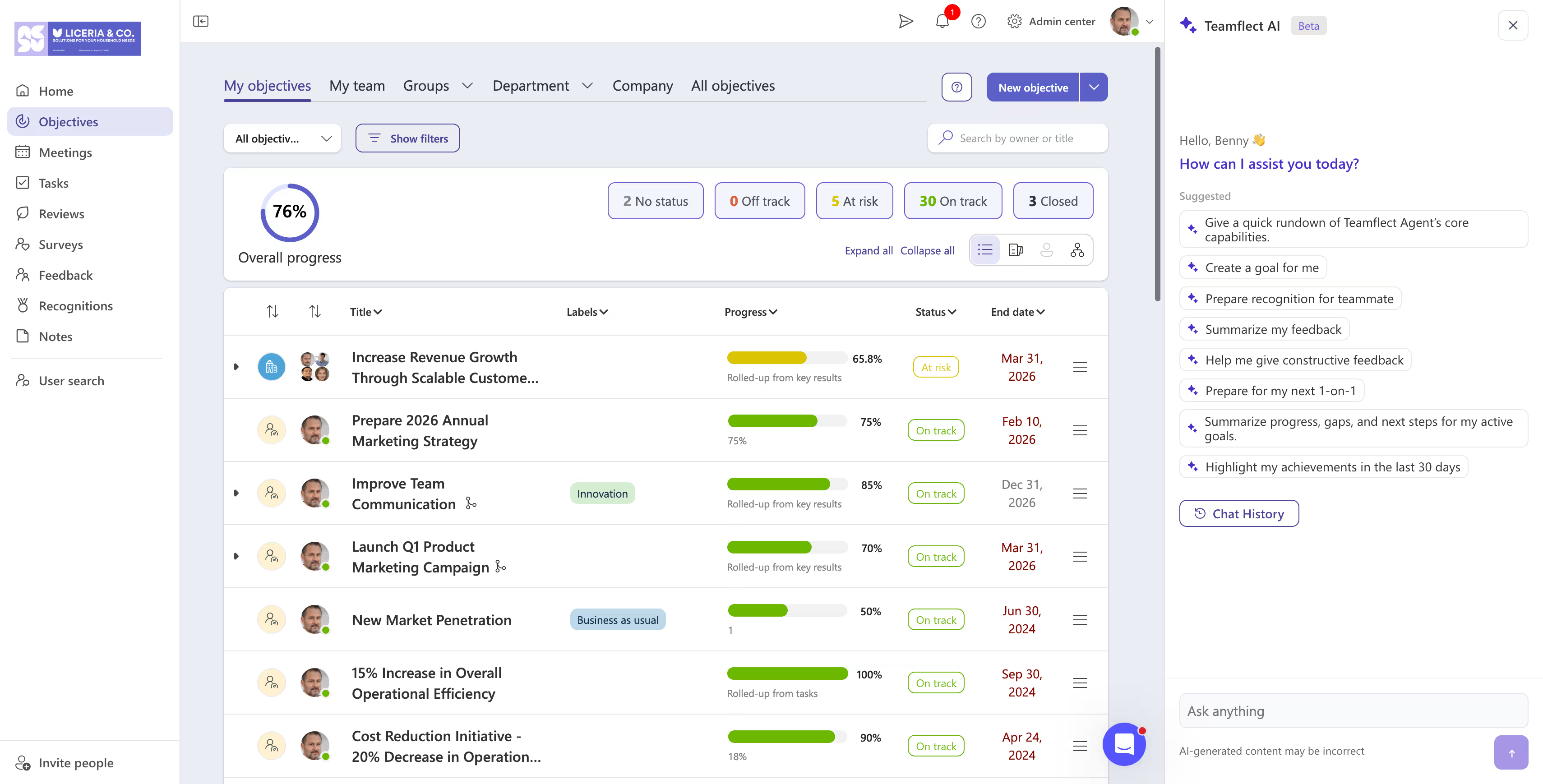
If your organization runs on Microsoft 365, Teamflect is the strongest AI-powered HR platform available today. Unlike standalone HR tools that require separate logins and onboarding, Teamflect lives entirely inside Microsoft Teams and Outlook. Performance reviews, goal tracking, feedback, 1-on-1 meetings, and employee recognition all happen within the tools your people already use every day.
What earns Teamflect the top spot on this list is how deeply AI runs through the entire platform, not as a bolted-on chatbot but as an operational layer across every HR process. Teamflect Agent is a full AI assistant built into Microsoft Teams that goes beyond answering questions. It takes action: generating OKRs from strategy inputs, preparing 1-on-1 agendas with suggested talking points pulled from goal progress and recent feedback, surfacing disengaged employees based on activity patterns, and drafting feedback summaries that managers can review and send in seconds.
Key AI Features
- Teamflect Agent: an agentic AI assistant inside Microsoft Teams that generates OKRs, preps 1-on-1 agendas, surfaces disengaged employees, and drafts feedback — all based on your company's actual performance data
- AI-enhanced performance reviews: refine review responses with tone adjustment, bias detection, grammar correction, and evidence-based expansion
- AI survey analysis: automatically summarize open-ended responses, identify sentiment trends, and compare results against previous survey cycles
- AI talent management: generate job descriptions, core competencies, and career roadmaps by scanning your org chart through Microsoft Entra ID
- AI goal generation: create OKRs from strategy prompts with aligned metrics and formatting based on your company's established rules
- Microsoft Copilot integration: goals, feedback, reviews, and employee data flow into Copilot for AI-powered insights across the Microsoft 365 suite
Other Key Features
- Native Microsoft Teams and Outlook integration: no additional logins or separate interfaces
- Goals and OKR management: cascading objectives at individual, team, and company level
- 360-degree performance reviews: customizable review cycles with built-in templates
- 1-on-1 meeting management: structured agendas that appear directly inside meeting invites
- Employee recognition and rewards: peer-to-peer recognition built into daily workflows
- Power BI reporting: advanced dashboards for HR analytics and performance trend tracking
- Succession planning and nine-box grid: talent mapping for identifying and developing future leaders
What Makes Teamflect Stand Out
- The AI layer is integrated across every module — reviews, goals, surveys, talent management, and meetings — rather than limited to a single chatbot feature
- Teamflect Agent is trainable: admins can feed it company documents, policies, and formatting preferences so responses match internal workflows and tone
- Runs entirely inside Microsoft 365, which means virtually zero adoption friction for Teams-first organizations
- One of the few platforms that combines performance management, engagement, recognition, and meeting tools in a single Microsoft-native solution
- Dedicated customer success manager included on every paid plan, along with free implementation support
- Connects with 200+ HRIS systems, making it compatible with most existing HR stacks
Pros and Cons
Pros: "Real-time feedback and recognition features; Cost efficiency compared to current tools." — Capterra Review
- AI features are available on all plans, including the free tier — no paywalled AI add-ons
- High adoption rates because it fits inside existing Microsoft tools
- Quick implementation: most organizations are up and running without lengthy onboarding
- Customizable review templates, feedback forms, and goal frameworks
- Strong customer support with a dedicated success manager on paid plans
- Free plan available for teams of up to 10 users
Cons:
- Requires a Microsoft 365 environment; organizations outside the Microsoft ecosystem cannot use Teamflect
- Doesn't offer core HR features like time-tracking, compensation, leave management
Pricing
- Free (up to 10 users, all core features and AI included)
- Essential: $7/user/month (billed annually); includes analytics and premium support
- Professional: $11/user/month (billed annually); adds talent management and advanced integrations
- Nonprofits receive up to 60% off annual contracts
- 30-day free trial available on Essential and Professional plans
2. Kvistly: An AI Engagement Tool for Interactive HR Programs
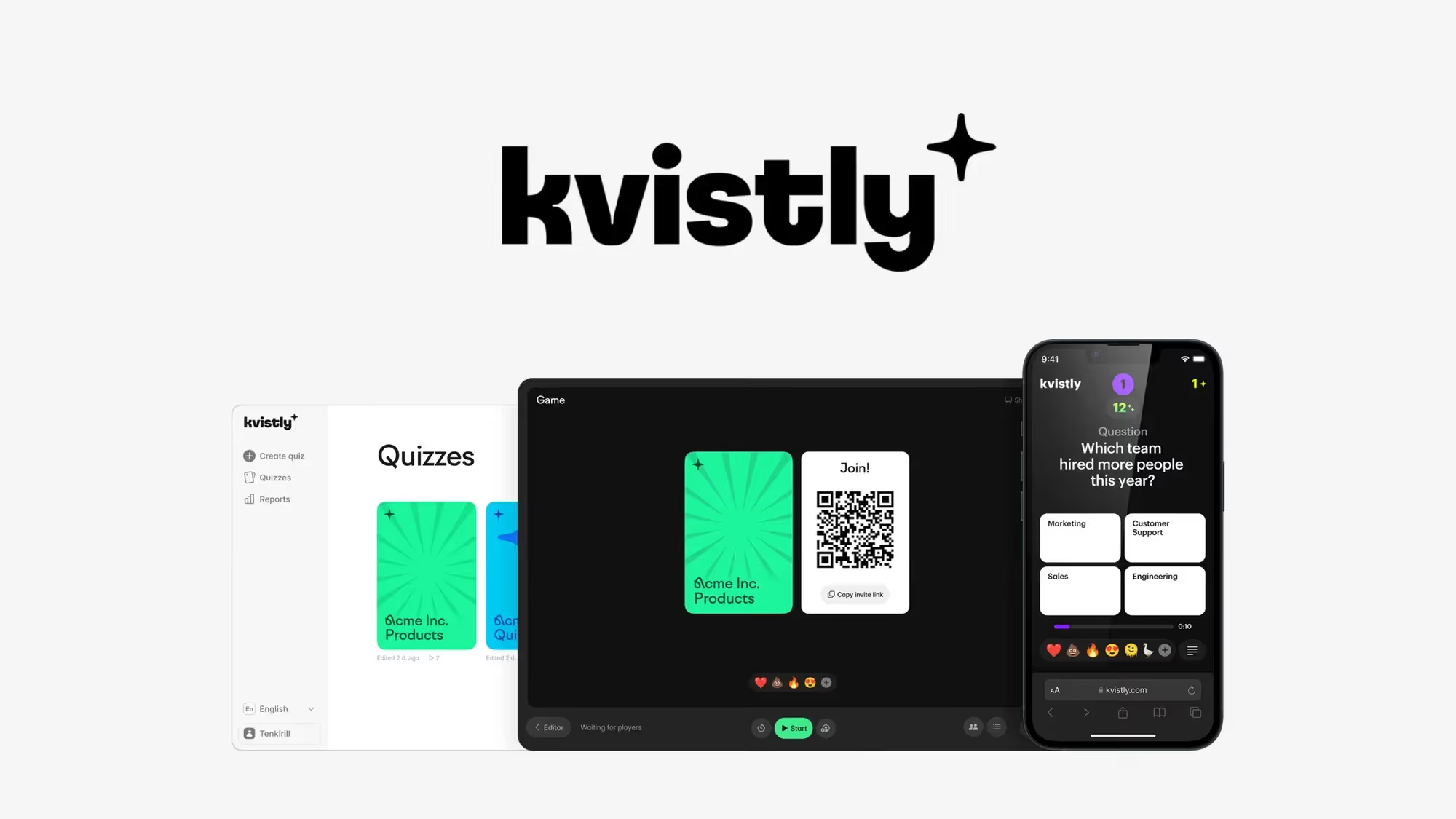
Kvistly is an AI-powered employee engagement platform focused on making participation in surveys, polls, and training sessions genuinely interactive. Where traditional engagement tools deliver static forms that employees fill out reluctantly, Kvistly uses AI to build content on the fly — generating quiz questions, analyzing sentiment in real time, and surfacing patterns across team responses.
The platform is particularly useful for HR teams that run frequent engagement activities but lack the bandwidth to manually design each session. Kvistly handles content creation and analysis, which frees
HR professionals to focus on acting on the results rather than producing them. It is a good fit for small and mid-sized organizations looking for an accessible, affordable way to improve participation in regular engagement programs.
That said, Kvistly has a limited presence on major review platforms compared to more established tools on this list. Organizations that need enterprise-grade analytics, deep HRIS integration, or comprehensive performance management features should consider pairing Kvistly with a broader HR platform.
Key Features
- AI-generated surveys, quizzes, and polls tailored to team context
- Real-time sentiment analysis across employee responses
- Predictive insights to flag potential retention risks early
- Free plan available for small teams
- Lightweight setup with a short learning curve
Best For
- Small to mid-sized teams running frequent employee engagement programs
- HR teams looking to reduce manual content creation for surveys and training
- Organizations piloting AI engagement tools without committing to enterprise pricing
Pros and Cons
Pros: “I was a bit lost when I started, but I just asked a few questions in the chat and everything got better. Now I have my own website that I created in about an hour!” - G2 Review
- Free plan available, making it accessible for smaller teams
- AI handles the heavy lifting of content creation and analysis
- Fast to set up and easy to use without HR or technical expertise
Cons: “A mobile-view designer isn’t available at the moment.” - G2 Review
- Limited presence on major review platforms; independent verification is difficult
- Not a full HR platform — does not cover performance management, payroll, or talent management
- May not scale well for large enterprise use cases
Pricing
- Free plan available
- Start: 37 €/month (billed annually)
- Pro: 74 €/month (billed annually)
- Enterprise: Custom pricing
3. HireVue: A Robust Video Interviewing Platform for Enterprise Hiring
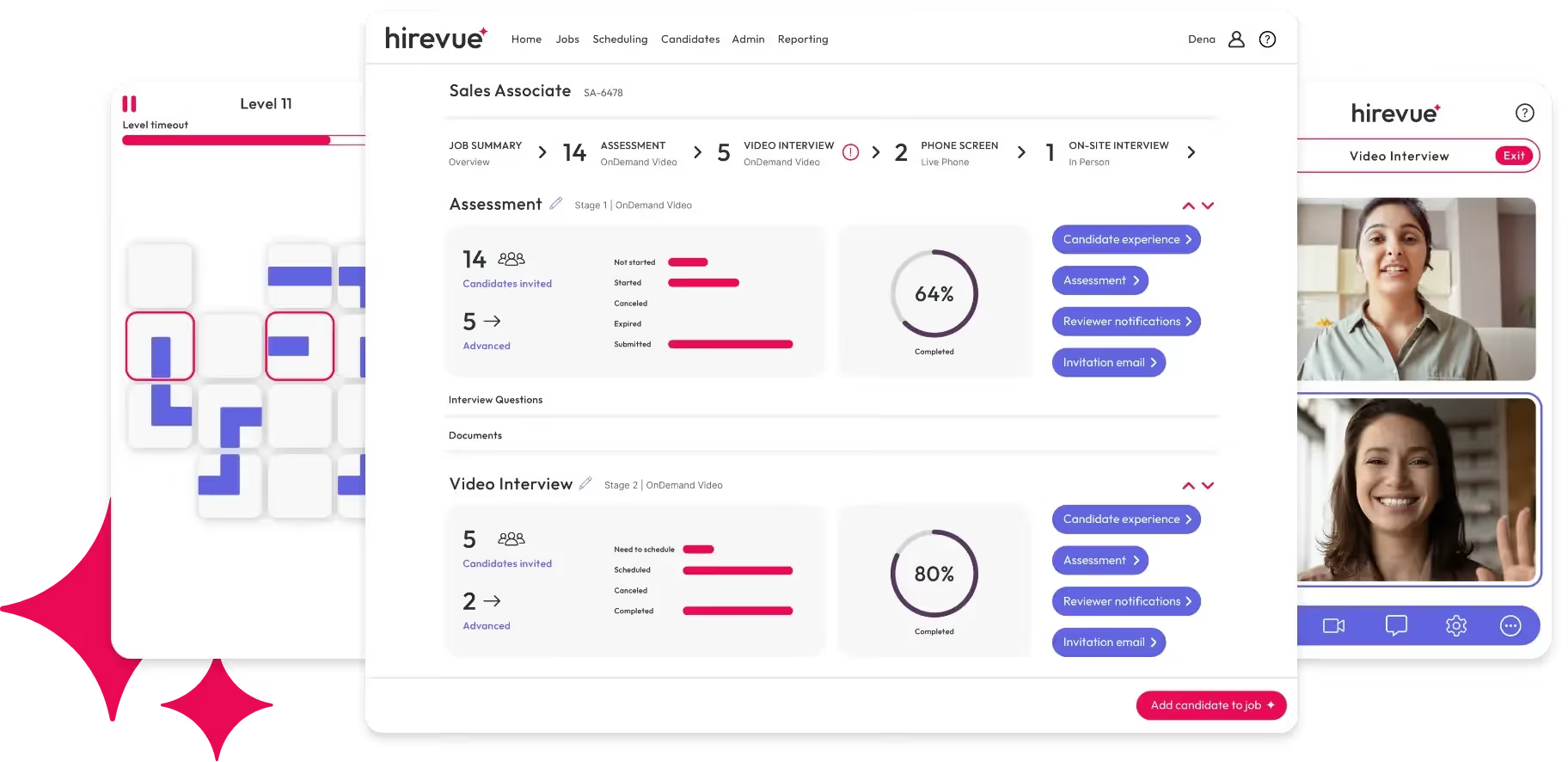
HireVue is one of the most established names in AI-powered recruitment. Built for high-volume hiring at enterprise scale, it combines video interviewing, game-based skills assessments, and AI candidate evaluation to help large talent acquisition teams screen and rank applicants more efficiently.
The platform's AI analyzes candidate responses to identify patterns tied to job performance, reducing the time recruiters spend on early-stage screening.
HireVue supports both live and on-demand video interviews, integrates with major ATS platforms including Workday and Greenhouse, and covers candidates across 40+ languages. Leading enterprises have reported substantial time-to-hire reductions after implementation.
The trade-off is cost and complexity. HireVue is built for organizations with large recruiting volumes and dedicated HR technology teams. Pricing starts at approximately $35,000 per year for the Essential package, which puts it out of reach for most small and mid-sized businesses. Implementation typically takes three to six months.
Key Features
- AI-powered on-demand and live video interviewing
- Game-based assessments for cognitive ability and job fit
- Multilingual support across 40+ languages
- Structured interview builder to reduce bias and improve consistency
- Integrations with Workday, SAP SuccessFactors, Oracle Taleo, and Greenhouse
Best For
- Large enterprises with high-volume hiring needs and dedicated recruiting teams
- Organizations operating across multiple regions and languages
- Talent acquisition leaders looking to reduce time-to-hire at scale
Pros and Cons
Pros: “It is a simple, clear and well done app. convenience, flexibility, and efficiency. Candidates appreciate being able to record answers on their own schedule from home, eliminating travel, while employers value the faster, standardized screening process that allows them to review more applicants quickly.” - Capterra Review
- Proven ROI at scale
- Strong integrations with leading ATS and HRIS systems
- Robust analytics and compliance features for global operations
Cons: “While HireVue offers great convenience and efficiency, one downside is that the platform can feel impersonal to candidates, especially in one-way video interviews. Some candidates may struggle to express themselves without real-time interaction, which could impact their performance.” - G2 Review
- Enterprise pricing starting at ~$35,000/year excludes most SMBs
- No API available
- Some candidates report an impersonal or technically unreliable interview experience
Pricing
- Custom pricing
4. Eightfold AI: A Strong Talent Intelligence Platform for Large Enterprises
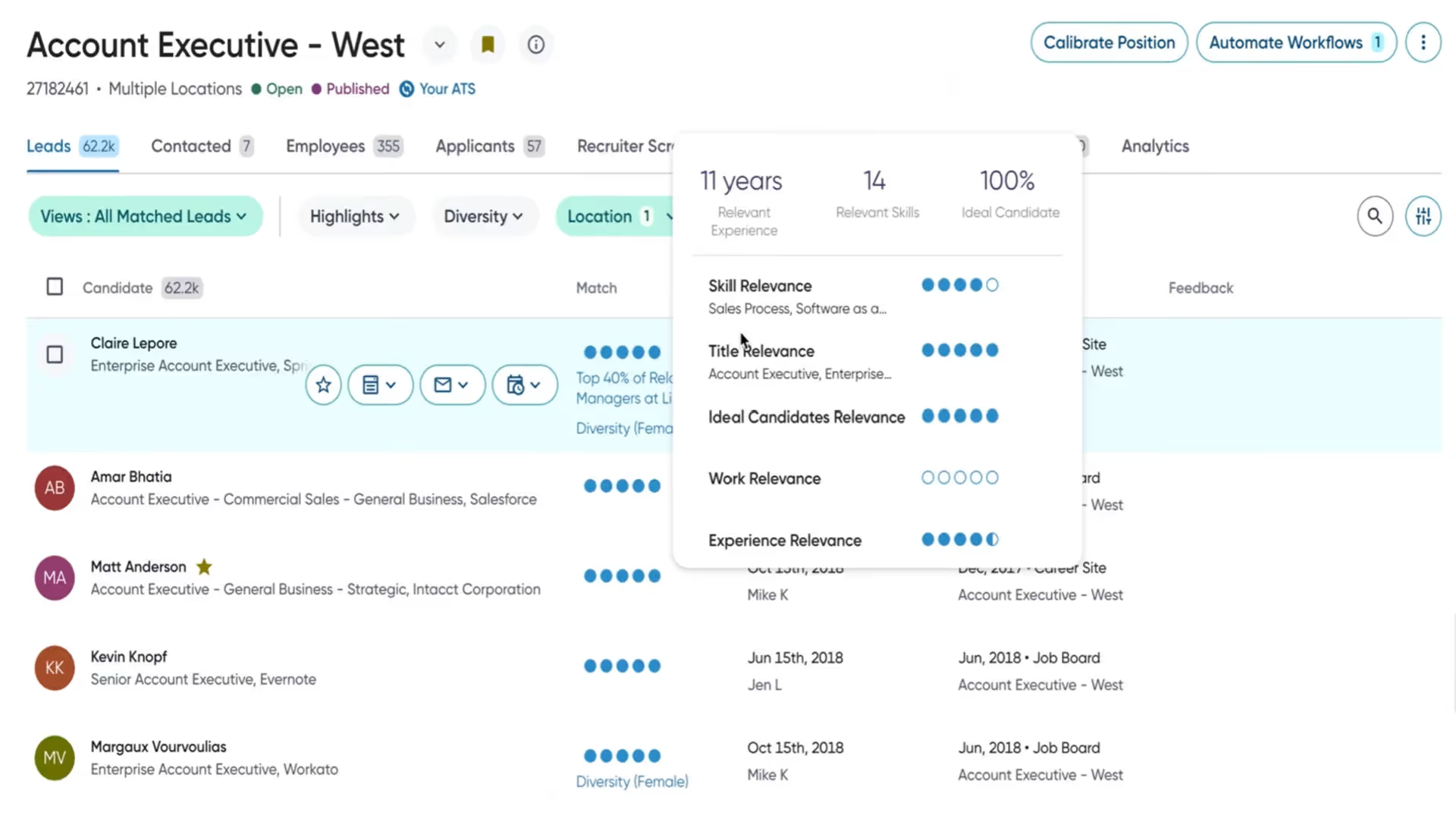
Eightfold AI is purpose-built for organizations managing complex, multi-function talent needs at scale. At its core is a deep learning model trained on over one billion career data points, which maps candidate and employee capability at the skills level rather than relying on job titles or keyword matching.
The platform spans the full talent lifecycle, external sourcing, candidate screening, internal mobility, career development, and workforce planning, all from a single system. This breadth makes Eightfold genuinely useful for large organizations tired of managing point solutions across different parts of the talent workflow. About a third of its customers are from the Fortune 500. Organizations comparing internal mobility platforms more broadly have several strong options beyond Eightfold worth reviewing in our best talent marketplace software roundup.
Recent updates include agentic AI that can screen candidates around the clock and conduct preliminary interviews autonomously, which frees recruiters to focus on relationship-building and higher-level evaluation. The platform also supports diversity analytics and candidate masking to support fairer hiring outcomes.
The main limitations are cost and complexity. Enterprise contracts typically run from $150,000 to $500,000 annually, and implementation takes three to six months. Eightfold is best suited for organizations with 500 or more employees running multiple concurrent talent programs.
Key Features
- Deep learning AI for skills-based candidate and employee matching
- Internal talent marketplace connecting employees to open roles and career paths
- AI-powered workforce planning and skills gap analysis
- Agentic AI for 24/7 candidate screening and preliminary interviews
- Diversity analytics and candidate masking for equitable hiring
- Integrations with Workday, Lever, Greenhouse, and major ATS platforms
Best For
- Enterprises with 500+ employees running external hiring and internal mobility programs simultaneously
- Organizations focused on skills-based hiring and workforce planning
- Talent acquisition teams dealing with high-volume recruiting across multiple business units
Pros and Cons
Pros: “I think it is a great HR tool that uses AI and provides an easy to use and great way for managing internal HR and applications” - Capterra Review
- Covers the full talent lifecycle in one platform, reducing reliance on point solutions
- Strong diversity analytics and skills intelligence tools
- Trusted by major global enterprises including Vodafone, Micron, and Chevron
Cons: “They can focus on mentoring features, it is great but still need more to it.” - G2 Review
- High cost: enterprise contracts typically start at $150,000+/year
- Long implementation timelines of three to six months
- Steep learning curve, and customer support has received mixed reviews on G2
Pricing
- Custom pricing
5. Leena AI: An Agentic AI Platform for HR Service Automation
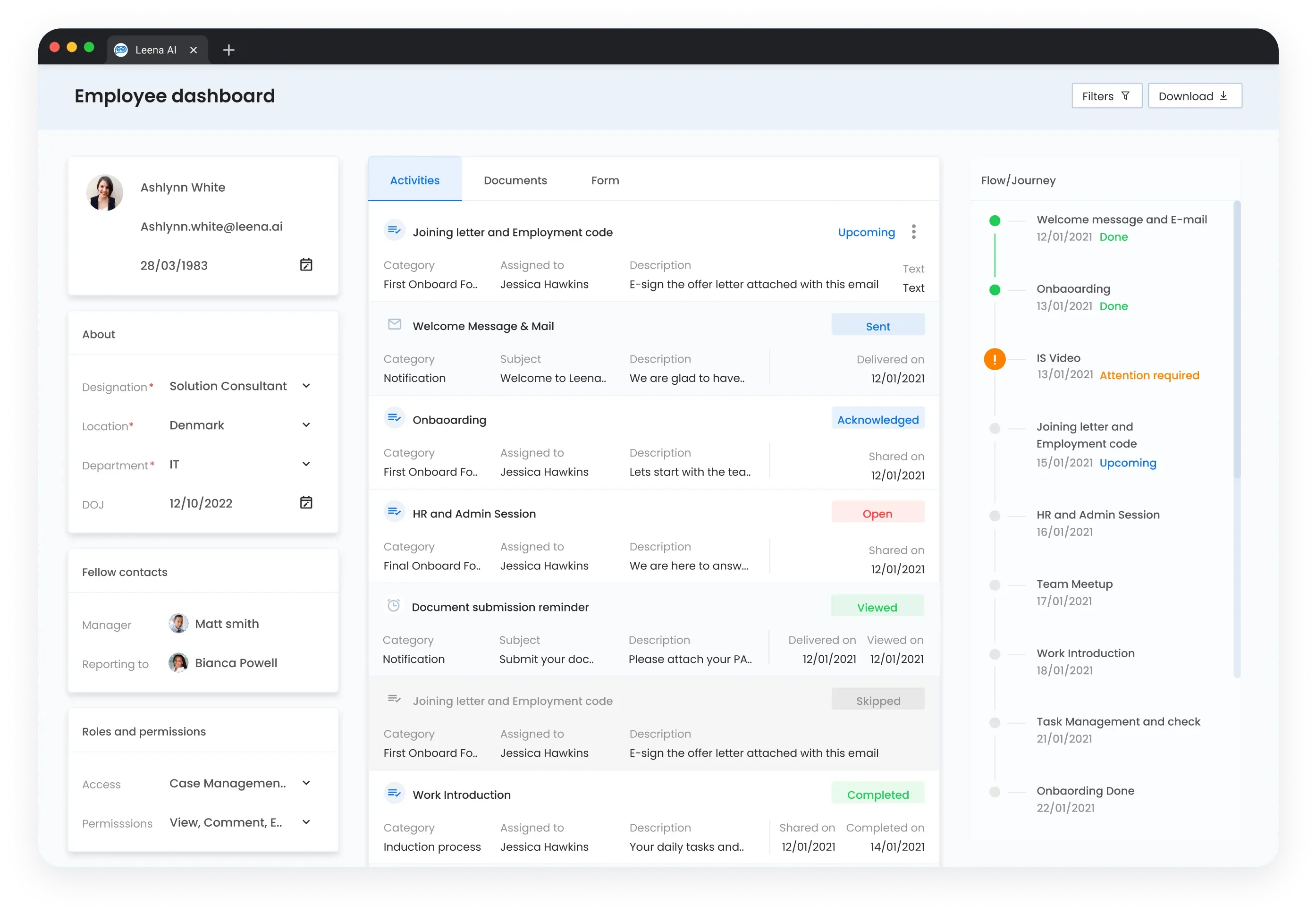
Leena AI takes a different approach to the HR technology stack. Rather than managing the performance review cycle or the hiring funnel, it focuses on the day-to-day volume of employee questions, requests, and tickets that keep HR teams buried in reactive work.
Its agentic AI framework deploys virtual AI colleagues that understand employee intent, execute multi-step tasks across enterprise systems, and complete end-to-end workflows, applying for leave, generating payslips, resolving IT tickets, or escalating HR cases, all through a conversational interface.
The platform integrates with Workday, SAP SuccessFactors, ADP, ServiceNow, and Microsoft 365, among others, and is available via web, mobile, Slack, Teams, and WhatsApp.
Customers report ticket resolution rates of around 90% and self-service adoption above 70%, which translates to meaningful time savings for HR and IT support teams. Leena AI is a strong fit for large organizations with complex service delivery needs across HR, IT, and finance. It is less relevant for organizations primarily looking for performance management or recruiting tools.
Key Features
- Agentic AI colleagues that autonomously handle HR, IT, and finance support workflows
- Natural language processing across 100+ languages
- Integration with Workday, SAP, ADP, Oracle, ServiceNow, and Microsoft 365
- Automated case management, leave requests, payslip generation, and expense claims
- Employee engagement surveys and sentiment analysis
- Deployment in 14 days with GDPR compliance and enterprise-grade security
Best For
- Large enterprises managing high volumes of employee support queries across HR, IT, and finance
- Organizations looking to reduce HR and IT ticket volume through self-service automation
- Global companies needing multilingual employee support at scale
Pros and Cons
Pros: “It's easy to use. It runs on many platforms. The Leena team is open to changes and improvement of the system.” - Capterra Review
- Proven reduction in ticket volumes
- Broad integration with major enterprise HR and IT systems
- High adoption rates due to conversational, familiar interface
Cons: “Speaking of drawbacks, there are technical issues, software [issues] and limitations to AI understanding.” - G2 Review
- Enterprise-only positioning means limited options for smaller organizations
- Complex or emotionally sensitive queries can still challenge the AI's understanding
- Customization timelines can be lengthy, particularly for non-standard workflows
Pricing
- Custom pricing; contact vendor for a quote
- Free trial available
6. Lattice: An AI-Powered Platform for Performance and Engagement
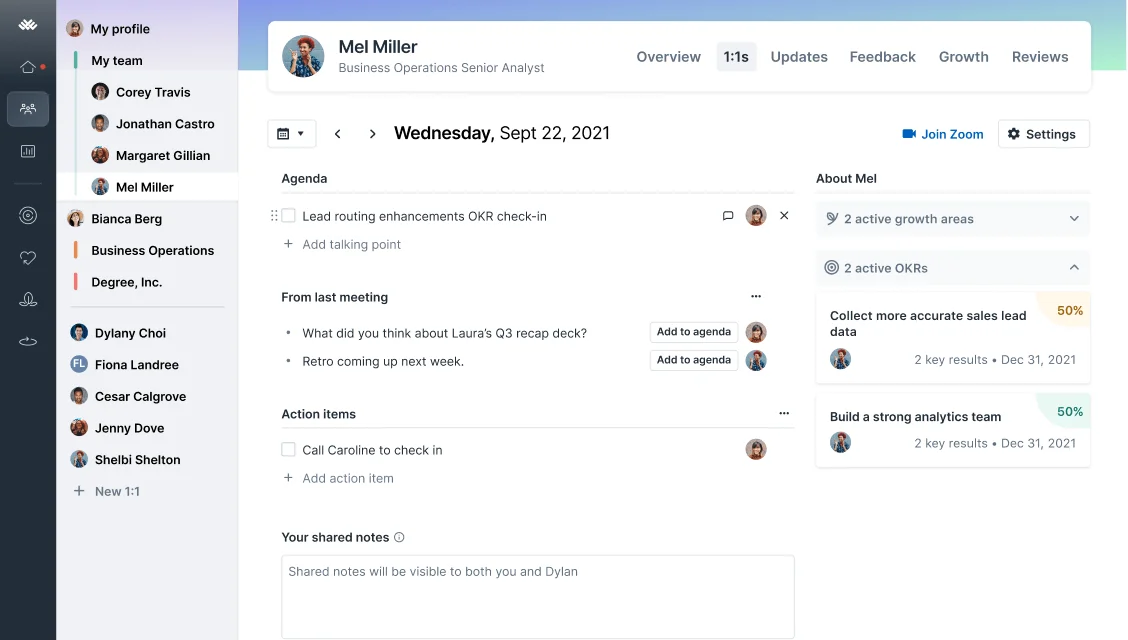
Lattice is one of the most widely adopted performance management platforms for mid-market companies, trusted by over 4,500 organizations. It brings performance reviews, goal setting, employee engagement surveys, and compensation management together in a single connected system. In 2026, it added a dedicated AI agent to help HR teams answer employee questions and surface insights at scale.
What makes Lattice compelling is the depth of its performance management workflows. Review cycles are fully customizable, from quarterly check-ins to annual appraisals, and the platform supports multi-rater feedback, calibration sessions, and performance improvement plans. Engagement surveys are built in, so HR teams can measure sentiment and track trends without purchasing a separate tool.
The modular pricing structure is a double-edged sword. Lattice starts at $11 per user per month for the Performance bundle, but adding engagement, compensation, and growth modules can push costs to $25+ per person. For smaller teams, the $4,000 annual minimum also means the effective per-seat cost can be higher than it first appears.
Key Features
- Customizable performance review cycles with 360-degree feedback and calibration
- Goal setting and OKR tracking connected directly to performance reviews
- Built-in employee engagement surveys and pulse checks
- AI-powered sentiment analysis and performance comment summaries
- Compensation management with pay equity analysis
- 50+ native integrations including Slack, Jira, and major HRIS platforms
Best For
- Mid-market companies building structured performance management processes for the first time
- HR teams that want performance reviews, engagement, and goal tracking under one roof
- Organizations using OKRs as a core part of their planning process
Pros and Cons
Pros: “It does a ton - employee reviews, 1:1 meeting tracking, employee org chart, employee feedback, performance summaries.” - Capterra Review
- One of the highest-rated HR platforms on G2 with 4,000+ reviews
- Strong goal and OKR management with clear team-level visibility
- Regular product updates that incorporate customer feedback
- Recognized on G2's 2026 Best Software Awards for HR products
Cons: “Nothing really stood out for us. It also seemed to be missing some of the features we needed to use it as a full HRIS system, which is ultimately why we stopped using it.” - G2 Review
- Modular pricing means adding features pushes costs up significantly
- $4,000 annual minimum makes it less accessible for very small teams
- Goal tracking has a learning curve and can require extra setup for non-standard workflows
Pricing
- Performance + OKRs bundle: $11/user/month
- Engagement add-on: additional per-seat cost
- Full platform (all modules): estimated $25+/user/month
- Minimum annual agreement: $4,000
- Free trial available; no self-serve free plan
7. BambooHR: A Well-Rounded HRIS for All Sizes
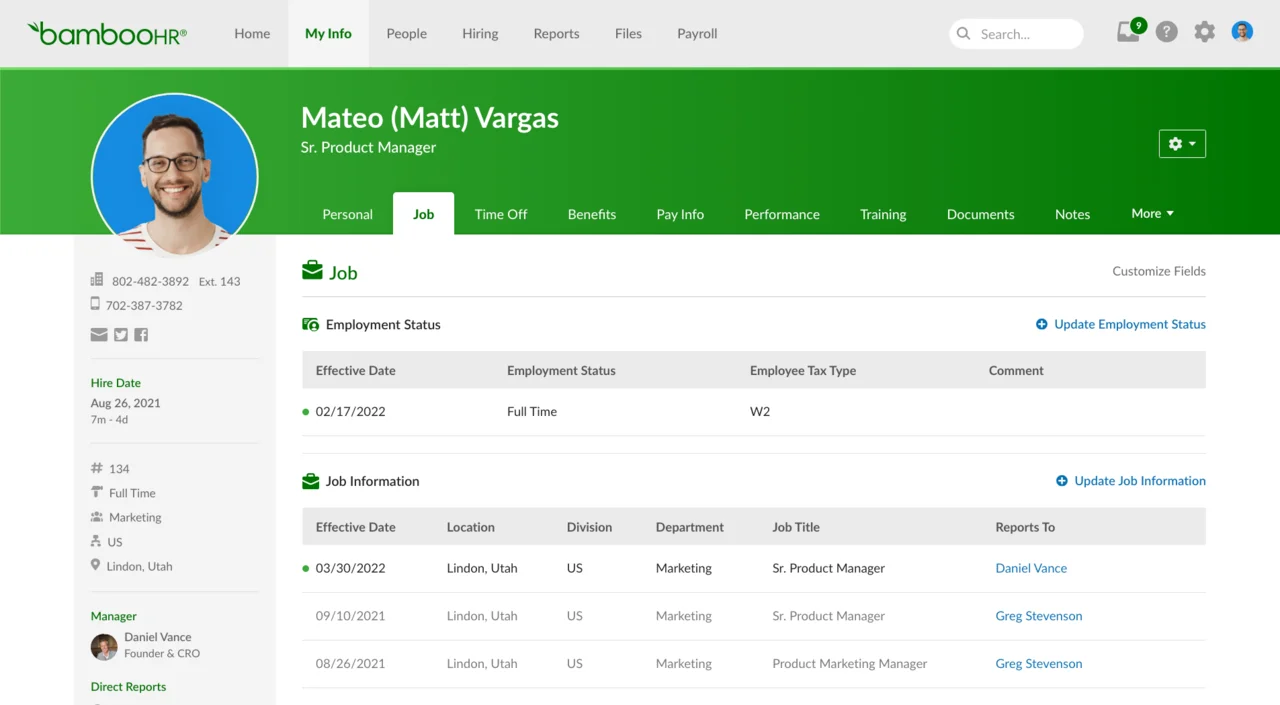
BambooHR is one of the most trusted HRIS platforms for small and mid-sized businesses, serving over 34,000 customers across 150+ countries. It covers the core employee lifecycle, onboarding, time-off management, document storage, applicant tracking, payroll, and basic performance management, in a clean, user-friendly interface that even non-technical HR teams can navigate without much training.
In recent years, BambooHR has added AI-powered reporting features that surface workforce insights from employee data. These capabilities are more lightweight than what you'd find in dedicated AI platforms, but they are useful for HR teams at smaller organizations that need practical visibility without complex analytics tooling.
BambooHR is particularly strong for companies in the 50-500 employee range that have outgrown spreadsheets but don't yet need enterprise-level complexity. Its main limitations are on the recruiting side. The ATS is basic, and there is no candidate sourcing, AI matching, or outreach automation. Organizations with active, high-volume hiring will likely need a separate recruiting tool.
Key Features
- Centralized employee data management and org chart
- Applicant tracking system (ATS) with job board posting
- Onboarding workflows with electronic signature collection
- Time-off tracking and payroll (U.S. only)
- AI-powered reporting and workforce analytics
- Performance management with self-assessments and manager reviews
Best For
- Small and mid-sized businesses in the 50-500 employee range
- HR teams moving away from spreadsheets and email-based processes
- Organizations that need a reliable all-in-one HRIS without enterprise complexity
Pros and Cons
Pros: “Very easy way to communicate with HR, plan annual leave, handle goals and admin.” - G2 Review
- Consistently rated among the easiest HRIS platforms to use
- Strong onboarding workflows and document management
- Month-to-month contracts with no long-term lock-in
Cons: “I wouldn’t really say I had any cons with his software. I wouldn’t use it for a large company. Its more for small businesses.” - Capterra Review
- Payroll and benefits management limited to U.S. employees
- ATS is basic; limited candidate sourcing and no AI matching
- Reporting has customization limitations for more complex data needs
Pricing
- Core: $10/user/month
- Pro: $17/user/month
- Elite: $25/user/month
- Free trial available
8. Diversio: A Dedicated DEI Analytics Platform
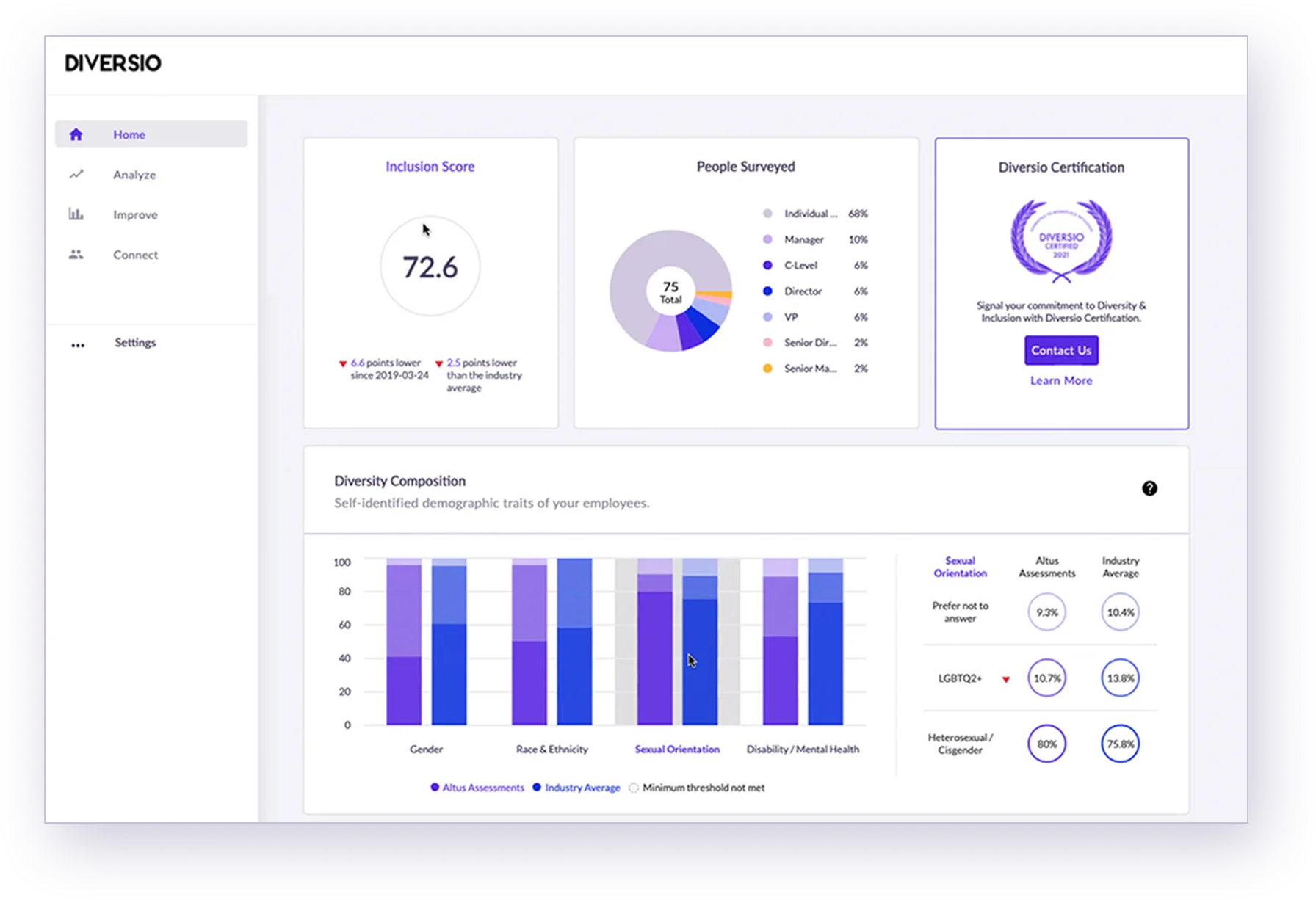
Diversio fills a gap that most general HR platforms don't address well: giving organizations a structured, data-driven way to measure, track, and improve diversity, equity, and inclusion across the workforce.
The platform collects employee feedback through short, anonymous surveys, typically four minutes, and maps responses against a six-part Inclusion Framework. AI analyzes the results and delivers a benchmarked Inclusion Score, pain point heat maps, and a prioritized action plan with projected ROI for specific interventions.
Customers can compare their performance against a database of over 5,000 organizations across industries.
Diversio is trusted by companies including Unilever, Deloitte, and Danone. It integrates with Workday, BambooHR, and SAP SuccessFactors. The platform is best positioned as a focused DEI complement to a broader HRIS rather than a replacement for one.
Pricing starts at approximately $10,000 annually for smaller organizations, with enterprise pricing scaling by workforce size and analytics complexity. There is no publicly listed G2 rating, as the profile has been inactive, so independent review validation is limited compared to more established tools.
Key Features
- AI-powered DEI analytics with a six-part Inclusion Framework
- Anonymous pulse surveys to gather honest, high-participation employee feedback
- AI recommendation engine with prioritized action plans and ROI projections
- Industry benchmarking against 5,000+ organizations
- DEI training programs for employees, managers, and HR practitioners
- Integrations with Workday, BambooHR, and SAP SuccessFactors
Best For
- Organizations with a dedicated DEI function seeking measurable, data-backed progress
- HR and People teams preparing ESG or DEI reports for leadership or investors
- Companies with complex, diverse workforces that need structured inclusion tracking
Pros and Cons
Pros:
- One of the few platforms that benchmarks DEI performance against a broad, cross-industry dataset
- High survey participation rates due to strict anonymity protocols
- AI-generated action plans reduce the gap between data collection and meaningful intervention
Cons:
- No publicly listed rating on G2 or Capterra, and limited independent review data
- No mobile app; desktop only
Pricing
- Contact vendor for a quote; no free trial listed
9. HeyGen: An AI Video Platform for HR Training and Internal Communications
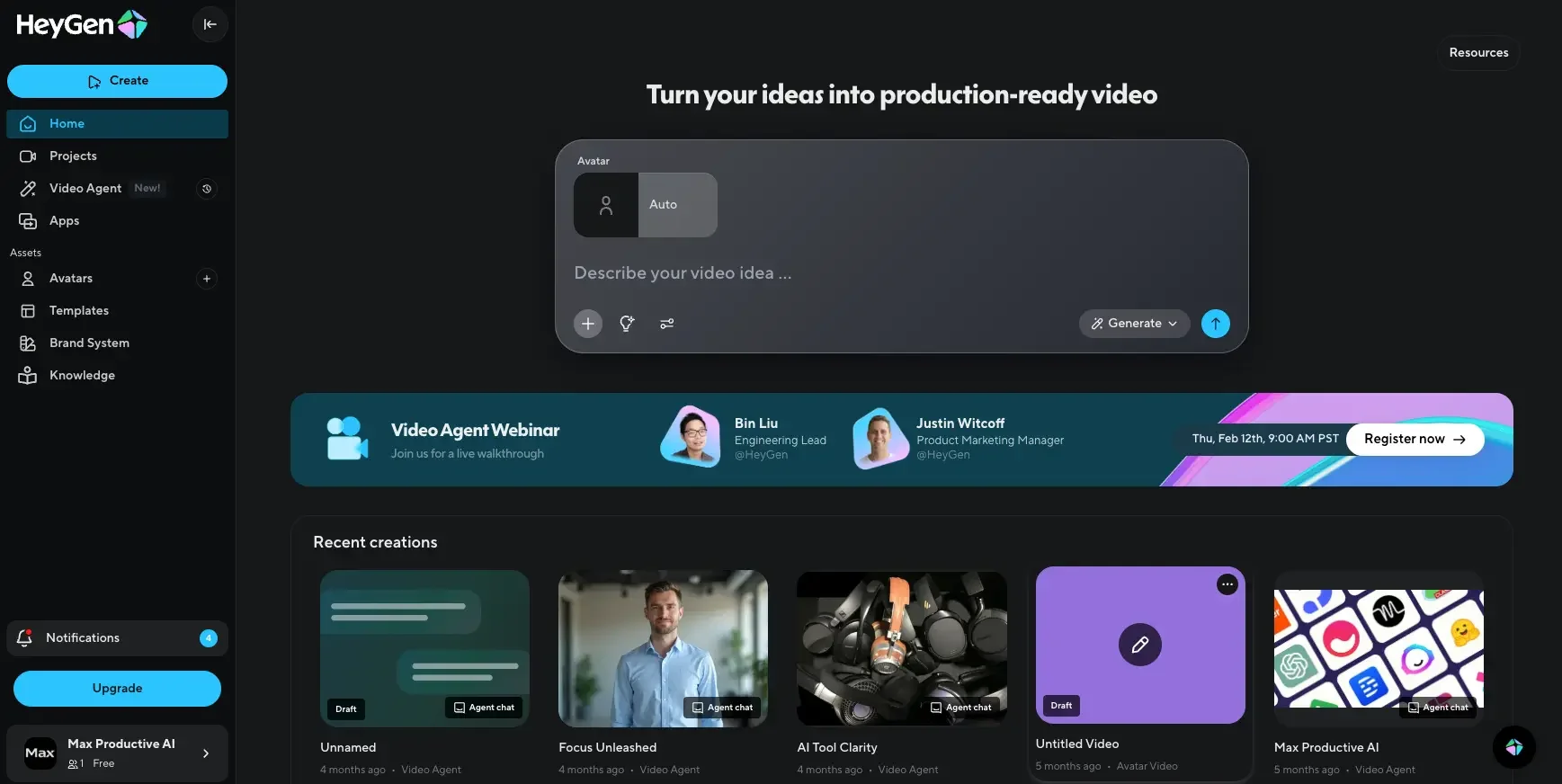
HeyGen is not a traditional HR software platform. It is an AI video generation tool that HR teams use to create training content, onboarding videos, internal communications, and employer branding materials, without a camera, studio, or professional production budget.
The platform uses realistic AI avatars and voice cloning to turn a written script into a polished video in minutes. It supports over 175 languages with lip-synced translation, which makes it particularly useful for global teams that need to localize training content quickly.
HeyGen was named G2's number one fastest-growing product of 2025 and holds a 4.8/5 rating from over 1,000 verified reviews.
For HR teams, the most practical use cases are onboarding videos that can be updated without a reshoot, compliance training content in multiple languages, and executive communication videos where leadership needs to "appear" in team-wide content without being on camera. HeyGen is not an HRIS, ATS, or performance management tool. It works best as part of a broader HR tech stack.
Key Features
- AI avatar video creation from written scripts; no camera or editing skills required
- Video translation with lip-sync across 175+ languages
- Digital Twin feature: create a custom avatar from two minutes of recorded footage
- Voice cloning and tone control for natural-sounding narration
- 700+ pre-built public avatars organized by industry and use case
- SCORM-compliant exports for LMS integration
Best For
- HR and L&D teams creating scalable training and onboarding video content
- Global organizations that need training materials in multiple languages
- Companies looking to reduce video production costs without sacrificing quality
Pros and Cons
Pros: “Although this is not 100% perfect for creating video or lip syncing, this is the best for its price and this is the only software I use for my job.” - Capterra Review
- Fastest-growing HR-adjacent AI tool of 2025
- Supports SCORM exports for direct LMS integration
- Strong multilingual capability with genuine lip-sync accuracy
Cons: “What I dislike about HeyGen is that the avatars can sometimes feel a bit unnatural, especially in more detailed or emotional content. Also, customization options are still somewhat limited, and rendering times can occasionally slow things down.” - G2 Review
- Premium features like Avatar IV and lip-synced translation consume monthly "Premium Credits" that can run out quickly
- Not a full HR platform; limited to video creation and communication
- Some users report a confusing or occasionally unstable user interface
Pricing
- Creator: $24/month (billed annually)
- Pro: $79/month (billed annually)
- Free plan available
10. Personio: A Solid All-in-One HR Platform for SMBs
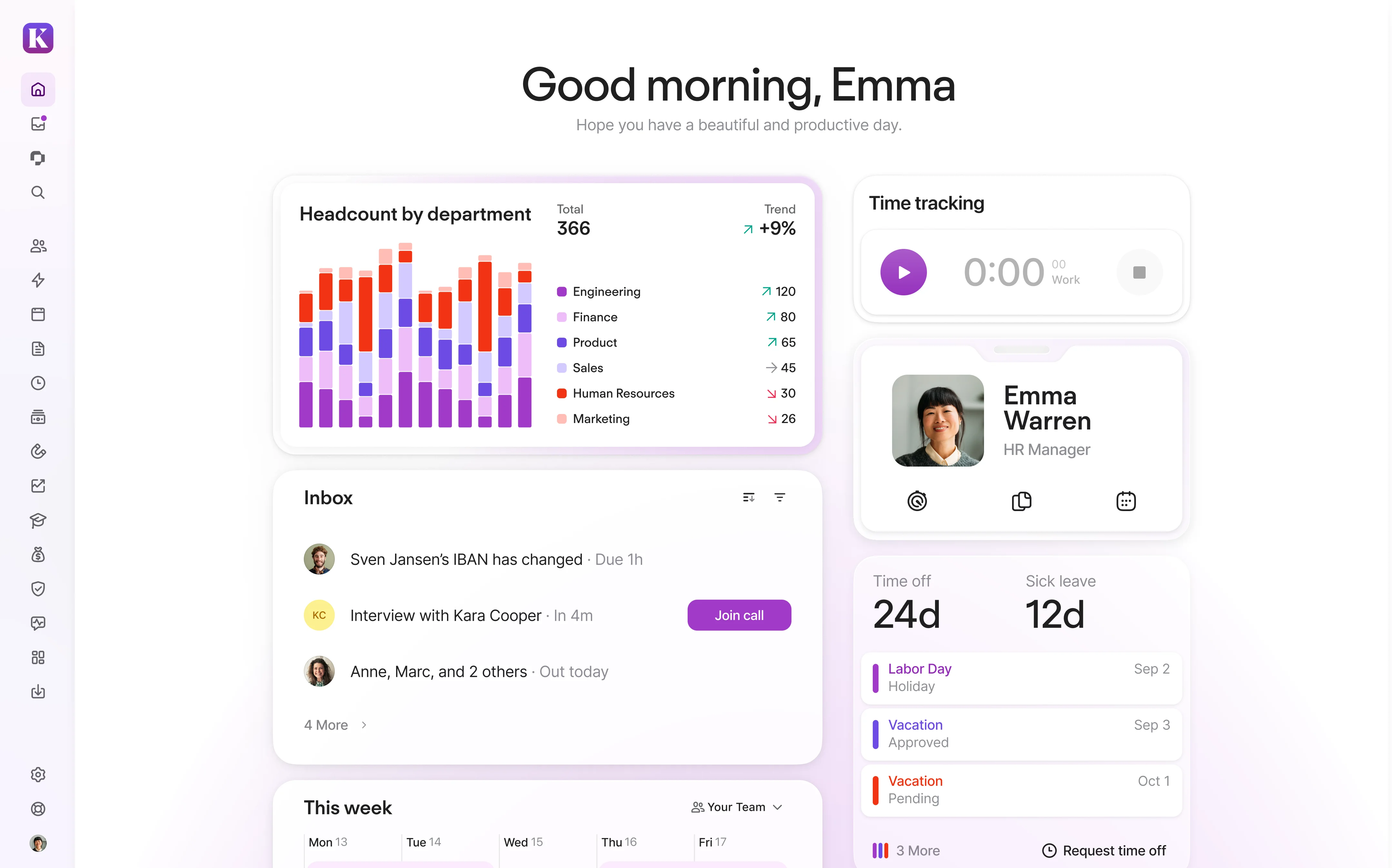
Personio is one of Europe's leading HR software platforms for small and mid-sized businesses. Founded in Munich in 2015 and now serving over 15,000 companies, it covers the full employee lifecycle, recruiting, onboarding, payroll, time tracking, performance management, and HR analytics, in a single modular system.
The platform is particularly well-suited for organizations operating within Europe, thanks to its native GDPR compliance, European payroll processing (Germany, UK, Austria, Spain), and adherence to regional labor laws. For companies managing cross-border HR operations within Europe, Personio removes significant compliance complexity. The compliance layer only works if the underlying process is sound, which is where payroll best practices fills the gap software alone doesn't close.
AI capabilities in Personio are still maturing. The platform includes a Conversations chatbot for common employee queries and increasingly automated workflows that reduce manual HR tasks. It is not yet at the level of dedicated AI platforms like Leena AI or Eightfold, but for SMBs that need a solid operational foundation with some smart automation, it delivers well.
Key Features
- Applicant tracking system with pipeline management and job board posting
- Onboarding automation with e-signature and document management
- Payroll processing for European markets (Germany, UK, Austria, Spain)
- Time tracking and absence management
- Performance review cycles with continuous feedback
- 200+ integrations for SSO, calendars, job boards, and HR tools
Best For
- European SMBs with 10 to 2,000 employees looking for an all-in-one HR system
- Companies that prioritize GDPR compliance and European labor law support
- HR teams moving from spreadsheets to a centralized platform for the first time
Pros and Cons
Pros: “What I like best about Personio is how it centralizes all core HR processes in one intuitive platform. I like how easy it is to sign documents when needed, to check how many hours of time off we have and to schedule said time off.” - G2 Review
- Intuitive interface with minimal training required for daily HR tasks
- Strong compliance and GDPR features for European operations
- Modular pricing lets organizations add features as they grow
Cons: “Some "improvements" - especially in design - are not really steps forward but seem to complicate work - but usually respective suggestions are heard and drawn into account.” - Capterra Review
- Payroll limited to select European markets; no U.S. payroll support
- Quote-based pricing lacks transparency for early-stage evaluation
- Some workflows and reporting features can feel rigid for non-standard organizational structures
Pricing
- Quote-based pricing structured around company size and selected modules
How to Choose the Right AI-Powered HR Software
With ten strong options on the table, the right choice comes down to a few practical considerations.
Start with your primary pain point. Are you trying to reduce administrative volume? Improve performance conversations? Hire faster? The best AI HR tool for your team is the one that directly addresses your biggest bottleneck, not the one with the longest feature list.
1. Assess Your Existing Tech Stack
If your team lives in Microsoft Teams, Teamflect eliminates the context-switching that kills adoption on other platforms. If you use Slack primarily, tools like Lattice or Leena AI integrate well there. Compatibility with your daily environment matters more than raw feature depth.
2. Match the Tool to Your Team Size and Complexity
HireVue and Eightfold are built for enterprises with dedicated HR technology teams and six-figure software budgets. BambooHR and Personio work better for teams that need a practical, well-organized HRIS without enterprise complexity. Kvistly and HeyGen are best as focused additions to a broader stack rather than standalone platforms.
3. Calculate Total Cost of Ownership
Modular platforms like Lattice can look affordable at the base tier but become expensive once you add engagement surveys, compensation tools, and growth modules. Always model the full cost at your actual headcount before comparing options.
4. Run a Pilot Before Committing
Most platforms on this list offer free trials. Take the time to test the tool with a real team of managers and employees, not just the HR team. Adoption rates are often the single biggest predictor of whether an HR platform delivers value.
Final Thoughts
As early as now, you should already consider the transition toward AI-driven HR as a 2026 industry standard. As technical skills continue to have a shorter shelf life and workforce demands grow more complex, the tools you choose today will determine how effectively your organization can adapt through 2030.
The right platform should do more than just automate repetitive tasks. It should provide the data-driven insights, like attrition forecasting and sentiment analysis, that allow your team to move from a reactive posture to a proactive, strategic one.
FAQs About the Best AI-Powered HR Software in 2026
What is AI-powered HR software and why do I need it?
AI-powered HR software uses machine learning, natural language processing, and predictive analytics to automate routine HR tasks and surface insights that would be difficult to detect manually. This includes screening candidates, analyzing employee sentiment, identifying attrition risk, generating performance summaries, and automating support workflows.
The practical case for AI in HR is straightforward: HR teams are expected to support larger workforces with smaller teams and tighter budgets. AI tools help by handling high-volume, repetitive tasks, so HR professionals can spend more time on the work that requires human judgment.
How much does AI-powered HR software typically cost?
Pricing varies significantly depending on the tool's scope and target market. Broad platforms like BambooHR start around $10 per employee per month. Performance-focused tools like Lattice start at $11 per seat. Teamflect starts at $7 per user per month with a free plan for up to 10 users. Enterprise tools like
HireVue and Eightfold AI use custom pricing, with annual contracts often starting at $35,000 or more.
The most important factor is the total cost of ownership, not just the starting price. Many platforms charge separately for modules like engagement surveys, advanced reporting, or compensation management.
What is the best free AI-powered HR software?
Teamflect offers the most generous free plan among the tools on this list, covering all core features for teams of up to 10 users with no time limit. HeyGen also has a permanent free plan, though it is limited to 3 videos per month with a watermark. Most other platforms, including Lattice, BambooHR, and Personio, offer free trials rather than ongoing free plans.
How long does it take to implement AI-powered HR software?
Implementation time ranges from a few days to several months, depending on the platform and organization size.
Teamflect can be up and running within days for most Microsoft 365 organizations, since it operates inside tools employees already use. BambooHR and Personio typically take two to six weeks for full setup. Meanwhile, enterprise platforms like HireVue and Eightfold AI can require three to six months of implementation, including data migration, integrations, and staff training.
The most reliable predictor of implementation speed is whether the platform fits into your existing workflow, or requires employees to adopt an entirely new one.
.png)