.svg)
When teams start comparing performance management tools, the conversation usually comes down to three things: features, pricing, and how well the software fits into the way they already work. Teamflect and Perdoo are both solid options in this space, but they serve quite different needs.
Perdoo has built a strong reputation as an OKR and strategy execution platform. It helps organizations set goals, track key results, and align teams around company-wide priorities. For teams that are serious about the OKR methodology, it offers a clean, structured approach.
Teamflect takes a broader view of performance management and builds it directly into Microsoft Teams and Outlook. Rather than asking employees to log into a separate platform, it brings reviews, goals, feedback, recognition, and surveys into the tools they use every day.
This comparison breaks down how Teamflect and Perdoo stack up across features, pricing, integrations, and real-world usability, so you can make the right call for your team.
Perdoo Overview
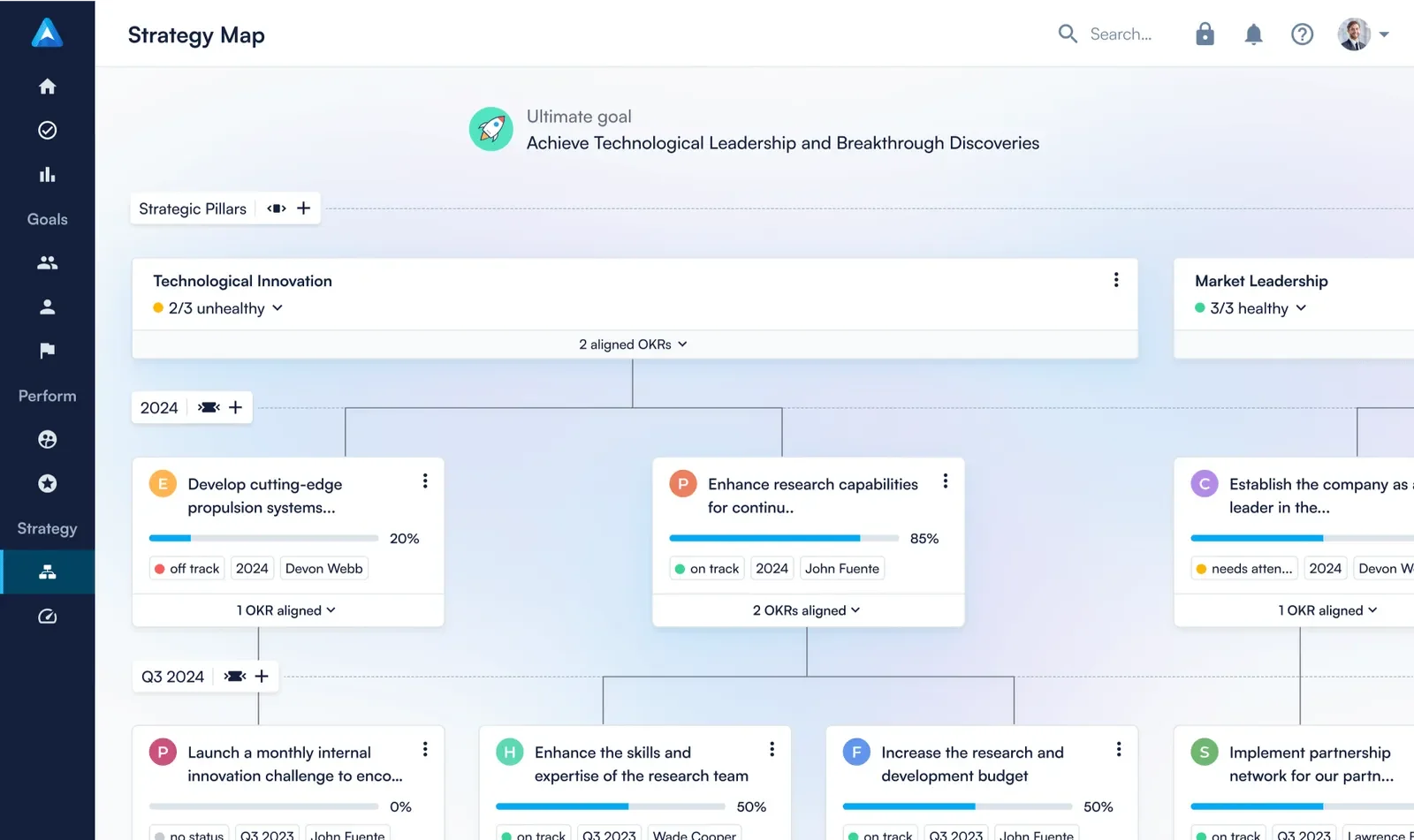
Perdoo is a cloud-based strategy execution platform designed to bridge the gap between company goals and daily execution. It is highly regarded for its clean interface and structured approach to the OKR methodology.
The platform serves as a central hub where leadership communicates priorities and employees track how their output impacts the broader organization. While it includes tools for meetings and basic assessments, its primary value lies in its visual goal-mapping.
Key capabilities include:
- Strategy Mapping: A visual interface showing the direct link between company objectives, department KPIs, and individual goals.
- OKR and KPI Tracking: Tools to set and monitor progress for both aspirational goals and core business metrics.
- Multi-Platform Integration: Syncs with Google Workspace, Slack, Asana, HubSpot, Salesforce, and Microsoft Teams.
- Visual Progress Reporting: Dashboards and a Power BI connection that highlight bottlenecks in strategy execution.
Perdoo is ideal for organizations prioritizing rigorous goal alignment and transparency. However, teams requiring deep career development or highly customized performance reviews may find its non-goal features limited.
Teamflect Overview
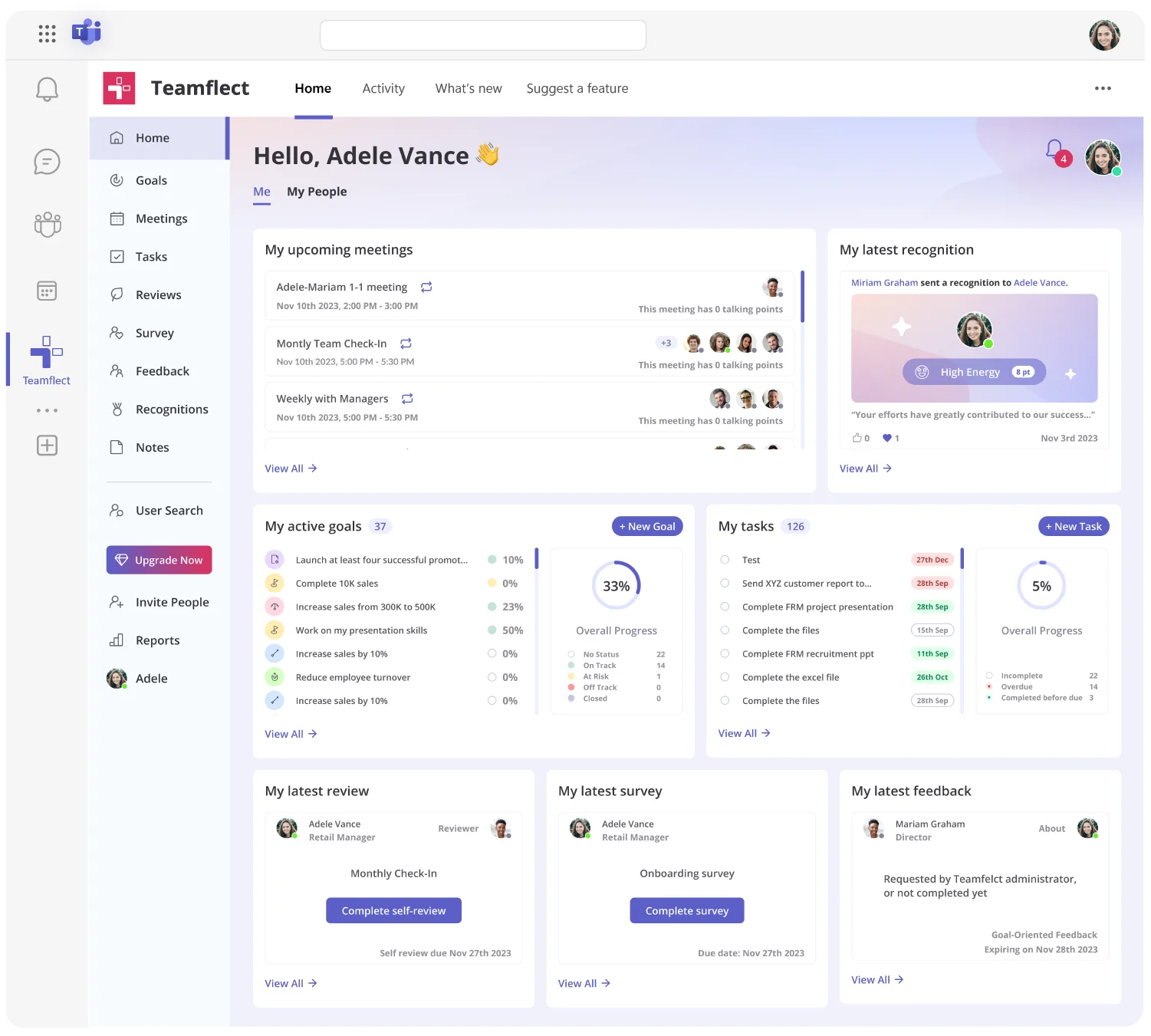
Teamflect is a full performance management platform built natively for Microsoft 365. It runs directly inside Microsoft Teams and Outlook, covering the complete employee lifecycle without requiring a separate login or application.
The platform includes seven core modules: performance reviews, OKRs and goals, continuous feedback, one-on-one meetings, recognition, employee engagement surveys, and career development. Each module connects to the others, so data from goals feeds into reviews, meeting notes carry over into development plans, and recognition activity builds into employee profiles over time.
Key capabilities include:
- Microsoft 365 Integration: Operates natively within Teams and Outlook, keeping all performance activity in one place
- AI Capabilities: The Teamflect AI agent generates review comments, suggests development goals, provides coaching prompts, and surfaces real-time insights based on performance data
- Analytics: Power BI integration for custom dashboards, talent mapping, and workforce planning
- Customer Support: Dedicated implementation support and ongoing account management from day one
For organizations already working within the Microsoft ecosystem, Teamflect's greatest advantage is adoption. Employees don't need to learn a new system. The work happens where they already spend their day.
Teamflect vs Perdoo: Feature Comparison
Choosing between Teamflect and Perdoo often comes down to a choice between workflow integration and strategic focus. While both platforms aim to drive employee performance, they approach the problem from different angles. One is designed to be an inseparable part of your daily communication tools, while the other is built as a dedicated command center for goal setting and strategy execution.
The following comparison breaks down how these two platforms handle the core pillars of people management, from AI-driven reviews to the technical depth of their OKR frameworks.
Performance Reviews
Teamflect supports annual, quarterly, 360-degree, and custom review cycles, all managed directly from Microsoft Teams. Centralized dashboards show completion status across teams, and automated reminders arrive through Teams chat. The AI review comment feature pulls from goals, feedback history, and meeting notes to help managers write specific, useful evaluations faster. If Culture Amp is on your shortlist too, Teamflect vs Culture Amp shows where the two platforms overlap and where they diverge.
Perdoo includes basic performance review functionality, but it is not the core of the platform. Reviews are available and can tie into OKRs, but the simplicity of the review module may not be enough. Customization options are more limited, and the review experience is simpler than what dedicated performance management tools offer.
Verdict: Teamflect is the stronger option for teams that want a complete, structured review process. Perdoo's reviews work well enough when OKR alignment is the main priority, but they don't go as deep.
Goals and OKRs
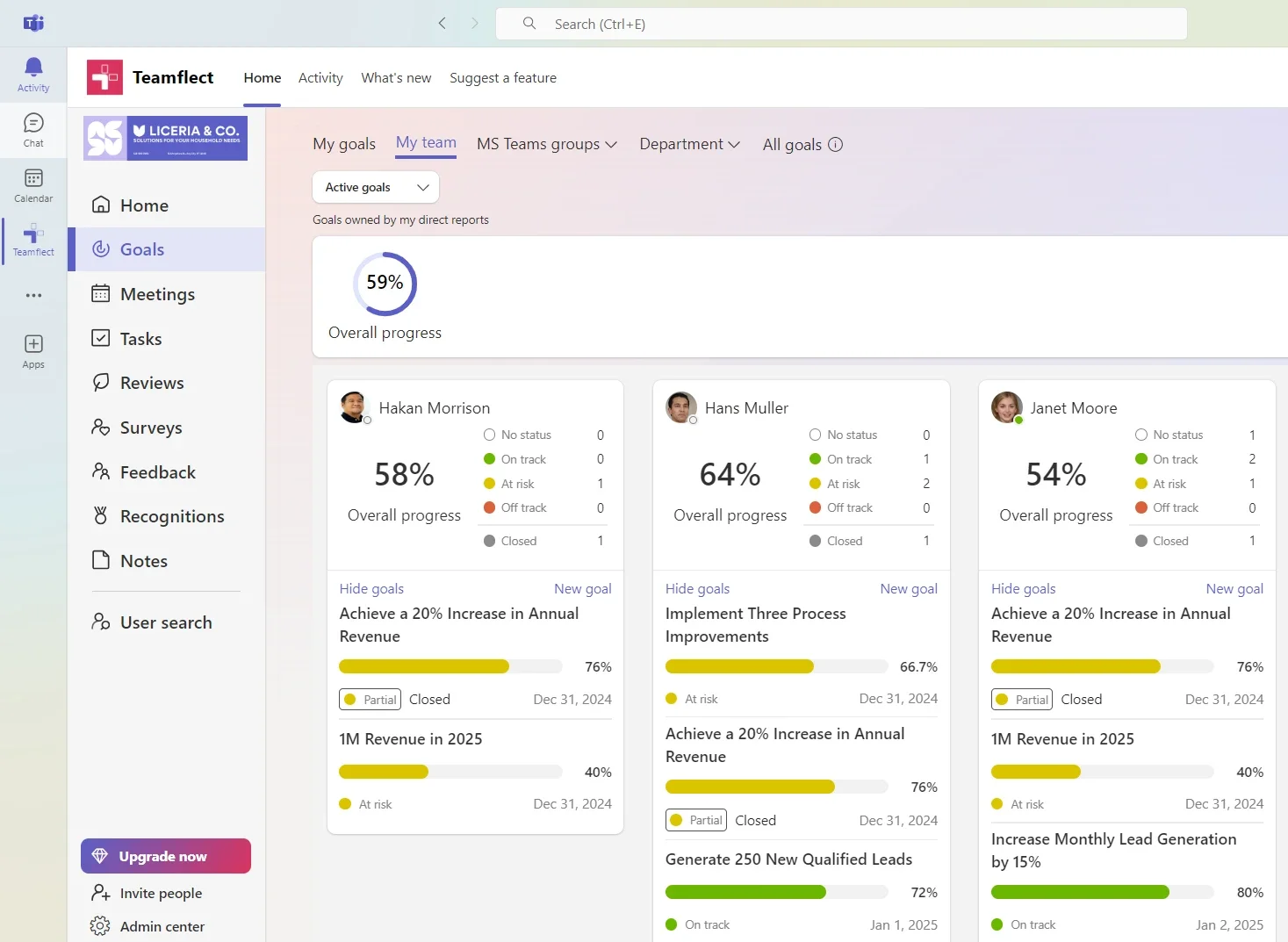
Teamflect's OKR tools sit inside Teams through adaptive cards. Employees can update goal progress, run check-ins, and view alignment without leaving the app. Goals cascade from company level down to individuals, and real-time visibility helps managers spot issues early. Goal data flows automatically into performance reviews.
Perdoo is purpose-built for OKRs. Its Strategy Map, cascading goals, KPI boards, and visual progress tracking are genuinely strong. Teams that want rigorous goal management with clear line-of-sight from strategy to individual output will find Perdoo's approach thorough and well-considered. That combination makes Perdoo worth considering alongside best OKR software for enterprise organization, particularly when evaluating multi-level goal alignment and the governance requirements that come with larger deployments.
Verdict: Perdoo has more depth in pure OKR management. Teamflect holds its own and adds the advantage of keeping goal management inside Teams, which improves participation and accuracy for Microsoft 365 teams.
Feedback and 1-on-1s
Teamflect syncs one-on-one meetings directly with Teams and Outlook calendars. Agendas pull in recent feedback, goal updates, and action items from previous sessions automatically. Action items sync to Microsoft Planner, and all meeting history stays accessible inside Teams.
Perdoo offers one-on-one meeting tools with check-in questions and meeting notes. The Outlook Calendar sync is available, which is useful. However, the experience is more manual, and follow-up tracking relies on the platform rather than connecting to broader Microsoft tools.
Verdict: Teamflect's approach reduces prep time and keeps meeting outputs connected to the rest of the workflow. Perdoo's one-on-one tools are functional but less automated.
Recognition and Engagement
Teamflect recognition happens through Teams channels, where badge-based praise tied to company values is visible to the whole team. Engagement surveys can be deployed through Teams chat, making participation straightforward. All recognition feeds into employee profiles.
Perdoo includes a Kudos feature for peer appreciation and basic engagement tracking through its Engagement dashboard. It monitors OKR adoption and participation rather than broader employee sentiment. Dedicated pulse surveys and structured engagement programs are not a central part of the platform.
Verdict: Teamflect offers a more complete engagement toolkit. Perdoo's recognition feature is a nice addition but is not built for comprehensive employee engagement management.
AI Capabilities
The Teamflect AI agent works across the full platform. It drafts review comments, suggests development goals based on performance data, flags engagement risks, answers HR policy questions, and provides on-demand coaching prompts. It is designed to reduce administrative work while improving the quality of people management.
Perdoo includes AI-assisted goal imports, which uses AI to pull goals from text or CSV. Beyond that, AI capabilities are limited. The platform automates reminders and check-in nudges, but there is no interactive AI assistant or real-time coaching support.
Verdict: Teamflect's AI offering is more capable. For teams that want AI to actively support managers and HR, Perdoo's current features won't match that.
Reporting and Analytics
Teamflect connects with Power BI for advanced, custom reporting. HR teams can build dashboards that track performance trends, engagement, goal completion, and review cycles. Talent mapping and succession planning views are built in, and the platform maintains a full audit trail for compliance.
Perdoo offers reporting dashboards that cover goal progress, check-in completion, and KPI performance. A Power BI integration is available, which is a genuine strength. Standard exports are available in CSV format, but reporting customization beyond the built-in dashboards requires the Power BI connection.
Verdict: Both platforms support Power BI, which puts them closer together on analytics than other areas. Teamflect's broader data scope, covering reviews, engagement, and career development alongside goals, gives it more to report on overall.
Pricing Comparison
Teamflect's pricing is transparent and publicly available. The Essential plan at $7/user/month covers all core modules, and the Professional plan at $11/user/month adds Power BI integration, advanced analytics, custom workflows, and priority support.
Perdoo's free plan covers up to 5 users, which is useful for small teams testing the platform. Paid plans start at $7.20/user/month, though costs can scale quickly as teams grow, and access to advanced features may require higher tiers or custom agreements.
For a 100-person team, Teamflect's Professional plan runs $1,100 per month and covers the full feature set. With Perdoo, a comparable setup covering goals, reviews, check-ins, and analytics would likely fall in a similar range, but with a narrower overall feature scope.
Which Tool Is Right for You?
Both Teamflect and Perdoo are well-built tools with genuine strengths. The decision comes down to what your team actually needs.
Choose Perdoo if:
- Your primary focus is OKR and strategy execution rather than full employee performance management
- You want a purpose-built OKR platform with strong visual strategy mapping
Choose Teamflect if:
- Microsoft Teams is your team's main hub for daily communication and collaboration
- You need a full performance management platform covering reviews, goals, feedback, recognition, surveys, and career development
It all comes down to preference and needs—both tools do what they’re designed to do well. Perdoo is a focused OKR tool, while Teamflect provides a broader approach to performance management.
FAQs
What is the main difference between Teamflect and Perdoo?
Perdoo is focused primarily on OKR and strategy execution. It does a solid job of helping teams set and track goals, but broader performance management features like career development and engagement surveys are limited. Teamflect covers the full performance management lifecycle and runs natively inside Microsoft Teams and Outlook, making it a better fit for teams that need more than goal tracking.
Which is more affordable, Teamflect or Perdoo?
Both platforms offer free tiers, though Teamflect's free plan covers up to 10 users compared to Perdoo's 5. At the paid level, pricing is comparable, but Teamflect's Professional plan at $11/user/month includes a wider feature set without add-ons.
.png)