.svg)

.svg)
.svg)
.svg)
If your business is spending too much time on payroll, benefits, and compliance paperwork, TriNet is likely on your radar. The platform has built a solid reputation as a full-service HR solution for small and mid-sized businesses, offering everything from payroll processing to employee benefits and risk management.
But is TriNet the right fit for your organization? This software review covers what TriNet does well, where it falls short, and who will get the most value from it.
What Is TriNet?
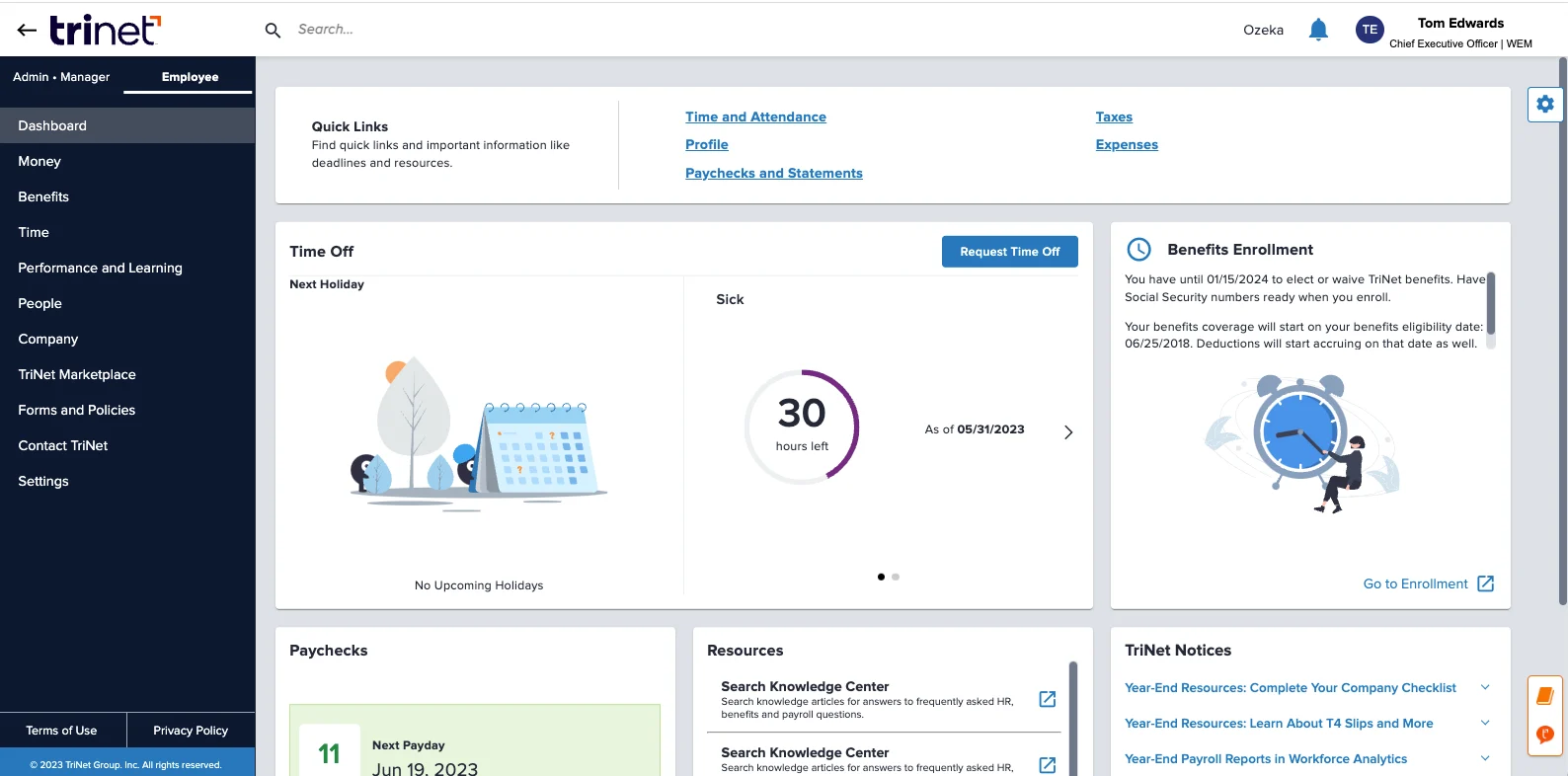
TriNet is a cloud-based HR platform and Professional Employer Organization (PEO) that has served small and mid-sized businesses for more than 30 years, founded in 1988 in the San Francisco Bay Area. The company is publicly traded on the NYSE under the ticker TNET and is certified by the IRS as a Certified Professional Employer Organization. For companies also hiring outside the US, it's worth understanding how PEO differs from EOR, since TriNet's co-employment model is a domestic-only structure.
The platform supports two distinct service models. The first is a full PEO arrangement, where TriNet acts as a co-employer and takes on HR administration responsibilities on your behalf. The second is HR Plus, an Administrative Services Organization (ASO) model for businesses that want to stay in control as the employer of record while still getting expert support for HR and payroll tasks.
Both options centralize core HR tasks, including payroll, benefits administration, compliance, onboarding, and workforce analytics, through a single platform.
Key Features of TriNet
TriNet covers a broad set of HR functions. Here is what the platform includes:
1. Payroll Processing
TriNet handles payroll calculations, tax withholding, filings, and direct deposits, including e-pay stubs, pay cards, and electronic W-2 preparation. The platform integrates with accounting tools such as QuickBooks Online for general ledger syncing. Time and attendance tracking are also built in, connecting directly to payroll to reduce data-entry errors.
2. Benefits Administration
One of TriNet's genuine strengths is its benefits offering. Because the company pools employees across its client base, smaller businesses gain access to health, dental, vision, and retirement plans that would otherwise be out of reach for their size. A single shared dashboard allows HR teams, employees, and benefits brokers to manage open enrollment and plan selections in one place, including via the mobile app.
3. HR Compliance and Risk Management
TriNet helps businesses stay current with federal, state, and local employment laws. Under the PEO model, the company shares employer liability with clients. Services include workers' compensation management, Employment Practices Liability Insurance (EPLI), and expert guidance for complex HR situations. This is especially relevant for businesses operating across multiple states.
Compliance support like this works best paired with sound internal process, the operational habits that payroll best practices walks through, since even a strong PEO can't fully substitute for a company's own payroll discipline.
4. Onboarding and Offboarding
New hire workflows are automated through the platform. HR administrators can manage job postings, candidate tracking, onboarding documentation, and task assignments without switching between systems. Under the HR Plus HR Manager tier, TriNet's team also handles unemployment claims representation and policy reviews.
5. Workforce Analytics and Reporting
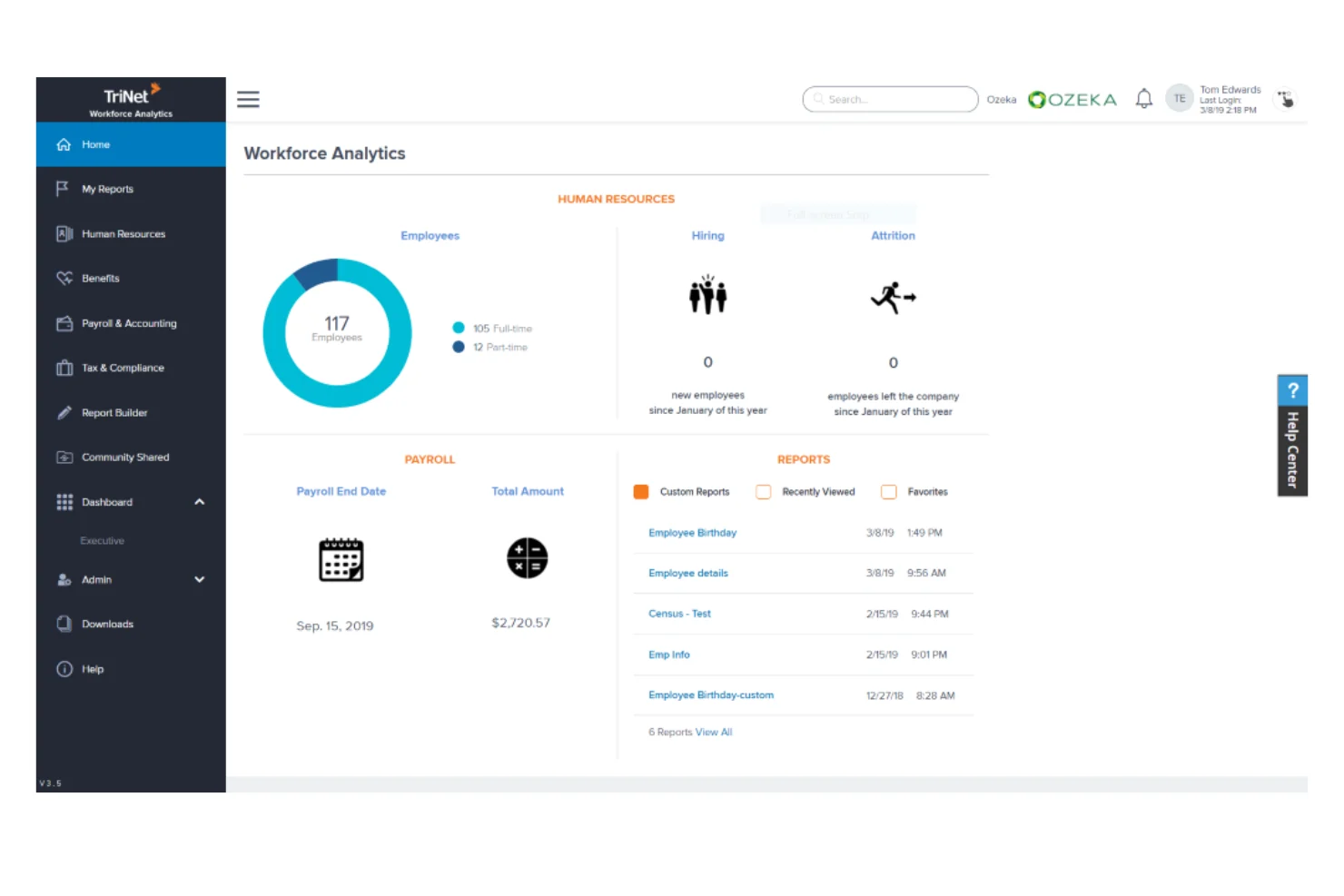
The platform provides customizable dashboards and reporting tools covering payroll, headcount, turnover, and benefits data. HR Plus clients report that the platform has helped them access the data needed to make better-informed business decisions.
6. Employee Self-Service
Employees can access pay stubs, manage time-off requests, update personal details, and review benefits through both the desktop platform and the TriNet mobile app.
7. Contractors and Global Workforce
TriNet includes a contractor payments application and integrates with leading global HR providers, making it easier for businesses that work with independent contractors or have international employees.
8. Integrations
TriNet connects with a range of third-party applications, including QuickBooks Online, and supports integrations across recruiting, HR, payroll, and benefits platforms. An open API is available for custom connections on higher service tiers.
How TriNet Works
Getting started with TriNet involves a conversation with their sales team, who will assess your company size, industry, and service needs before recommending a plan. From there, you choose between the full PEO model or one of the HR Plus service tiers.
Under the PEO model, TriNet becomes a co-employer, handling the bulk of HR administration while your team stays focused on the business. HR Plus offers more flexibility. You can choose from four service levels: HR Advisory, Payroll Tax Compliance Manager, Payroll Manager, and HR Manager, each adding a deeper layer of support.
Once live, HR administrators manage everything from a central dashboard. Payroll, time tracking, benefits, and compliance sit side by side, reducing the need to switch between tools. The platform is accessible via desktop and a mobile app, so employees and managers are not tied to a desk to complete HR tasks.
Pros and Cons
Pros: “I use TriNet to clock in and manage my pay, and I appreciate how easy and simple it is to navigate. I also find the initial setup was super easy and fast.” - G2 Review
- Established Track Record: With over 30 years in business, IRS certification as a PEO, continuous ESAC accreditation since 1995, and a Better Business Bureau A+ rating, TriNet brings a level of institutional credibility that newer platforms have not yet earned. The company processed more than $70 billion in payroll in 2025 across its PEO and HR Plus clients.
- Strong Benefits Access for Smaller Teams: For businesses with fewer than 50 employees, access to competitive health insurance and retirement plans is a real differentiator. TriNet's pooled buying model means small companies can offer benefits packages that rival those of much larger organizations.
- Flexible Service Models: Whether you want to hand off HR entirely through the PEO model or maintain employer of record status while getting targeted support through HR Plus, TriNet gives you options that scale with your business. Few providers offer this range of engagement under one roof.
- Industry-Specific Expertise: TriNet organizes its support around specific industries, including technology, financial services, life sciences, and nonprofits. HR professionals familiar with your sector's compliance requirements and talent environment are available, which adds practical value beyond software access alone.
- Solid Compliance Coverage: For companies operating across multiple states, keeping up with varying labor regulations is a real operational burden. TriNet monitors regulatory changes, manages workers' compensation, and provides expert guidance on employment matters, helping reduce that risk considerably.
Cons: “It's not the most aesthetically pleasing platform. Like I said it's a reliable platform functionally but it doesn't have the most refined UI.” - Capterra Review
- Pricing Lacks Transparency: TriNet does not publish standard pricing on its website. Custom quotes are required, and the final cost depends on company size, location, and the services selected. This makes it difficult to compare TriNet against alternatives without going through the sales process first.
- Customer Support Can Be Inconsistent: While many users praise the platform's responsiveness, a notable number of reviews flag slow response times and difficulties reaching knowledgeable support quickly. The experience appears to vary depending on your plan level and assigned account team.
- HR Plus Scope Has Limits: HR Plus is well-suited for companies that want targeted support, but it does not cover the full range of HR functions that a standalone HRIS might. Teams looking for deep performance management, learning and development, or advanced succession planning tools may find themselves needing to supplement with additional software.
- Cost May Be High for Very Small Teams: For micro-businesses or startups with just a handful of employees, TriNet's pricing structure can feel steep. The platform is built for businesses that need comprehensive HR support, and the cost reflects that scope.
Pricing and Plans
TriNet's pricing is quote-based for both the PEO and HR Plus models.
The PEO service is priced on a “per-employee, per-month” basis, where the flat monthly fee is charged based on the number of active worksite employees.
Meanwhile, HR Plus is available at four service levels:
- HR Advisory: Expert guidance on HR and payroll questions.
- Payroll Tax Compliance Manager: Dedicated support for payroll tax account setup and ongoing monitoring.
- Payroll Manager: A dedicated manager to handle payroll runs and tax compliance.
- HR Manager: Comprehensive support covering HR and payroll tasks, onboarding, offboarding, unemployment claims, and policy reviews.
Pricing for all tiers depends on your employee count and the level of service selected. There is no free trial, but TriNet offers demos and a 20-minute introductory call to help you assess the right fit before committing.
Best Use Cases
TriNet is a strong fit for:
- Small to mid-sized businesses that want to offload HR administration without building a large in-house team.
- Companies in regulated industries such as healthcare, financial services, or life sciences that need sector-specific compliance support.
- Multi-state employers managing payroll and labor law complexity across different jurisdictions.
- Growing startups that need access to enterprise-level benefits to stay competitive in hiring.
- HR teams seeking an all-in-one platform that combines payroll, benefits, compliance, and workforce analytics in one place.
It’s less suited for very small operations looking for a lightweight, low-cost tool, or for businesses that require deep workflow customization and advanced talent management features.
Alternatives to Consider
If TriNet does not match your needs exactly, these platforms are worth evaluating:
- Gusto: Simpler setup and transparent pricing; strong for very small teams.
- BambooHR: Better suited for growing companies focused on core HRIS and performance management.
- Rippling: More flexible and highly customizable; strong IT and HR integration.
- ADP Workforce Now: Better fit for larger organizations with complex payroll needs.
- Paychex Flex: A solid alternative for businesses wanting PEO-like services with more pricing transparency.
Final Verdict
TriNet is one of the more complete HR solutions available to small and mid-sized businesses. Its combination of payroll, benefits, compliance, and flexible service models addresses a wide range of HR needs in a way that few platforms can at this company size.
The platform is not without its limitations. Pricing is not publicly listed, support quality varies by plan level, and very small teams may find the cost hard to justify. However, for companies that want to reduce time spent on HR administration and gain access to quality employee benefits, TriNet has a strong case to make.

.avif)