.svg)

.svg)
.svg)
.svg)
Quick Verdict
| What it is | A purpose-built enterprise performance management platform covering OKRs, continuous feedback, 360-degree reviews, calibration, engagement surveys, and AI-assisted coaching. Designed to layer on top of existing HRIS systems, not replace them. |
| Best for | Mid-market and enterprise organizations (500+ employees) running Workday or SAP SuccessFactors that need a dedicated performance management layer with serious calibration depth and real-time OKR visibility. |
| Not for | Organizations under 250 employees, teams looking for a standalone HRIS or native payroll, or buyers who want transparent pricing before a sales conversation. |
| Starting price | Not publicly disclosed. Estimated $8-$15/user/month for enterprise deployments based on G2 and Capterra buyer reports (verified March 2026). A 1,000-person organization at $12/user/month pays approximately $144,000 annually before implementation fees. Contact Betterworks directly for a quote. |
| G2 / Capterra | 4.3/5 on G2 (220 reviews); 4.3/5 on Capterra (36 reviews). Verified June 2026. |
| Our overall rating | 3.8/5 (see rating rubric below) |
Most performance management software solves an HR compliance problem: make sure reviews happen, store the ratings, move on. Betterworks is built on a different premise. The bet is that performance management should run continuously, connect to how work actually gets done, and give managers enough data to coach rather than just evaluate.
Whether that ambition translates into something an HR Director can actually deploy and sustain depends heavily on the organization. Betterworks is not a tool you pick because it is simple. You pick it because you have 500 or more employees, your current setup is producing performance data that nobody trusts, and you need calibration, OKR alignment, and manager coaching infrastructure at scale.
This software review covers what the platform delivers in 2026, where the evidence supports the claims, and where the limitations are specific enough to send certain buyers elsewhere.
What Is Betterworks?
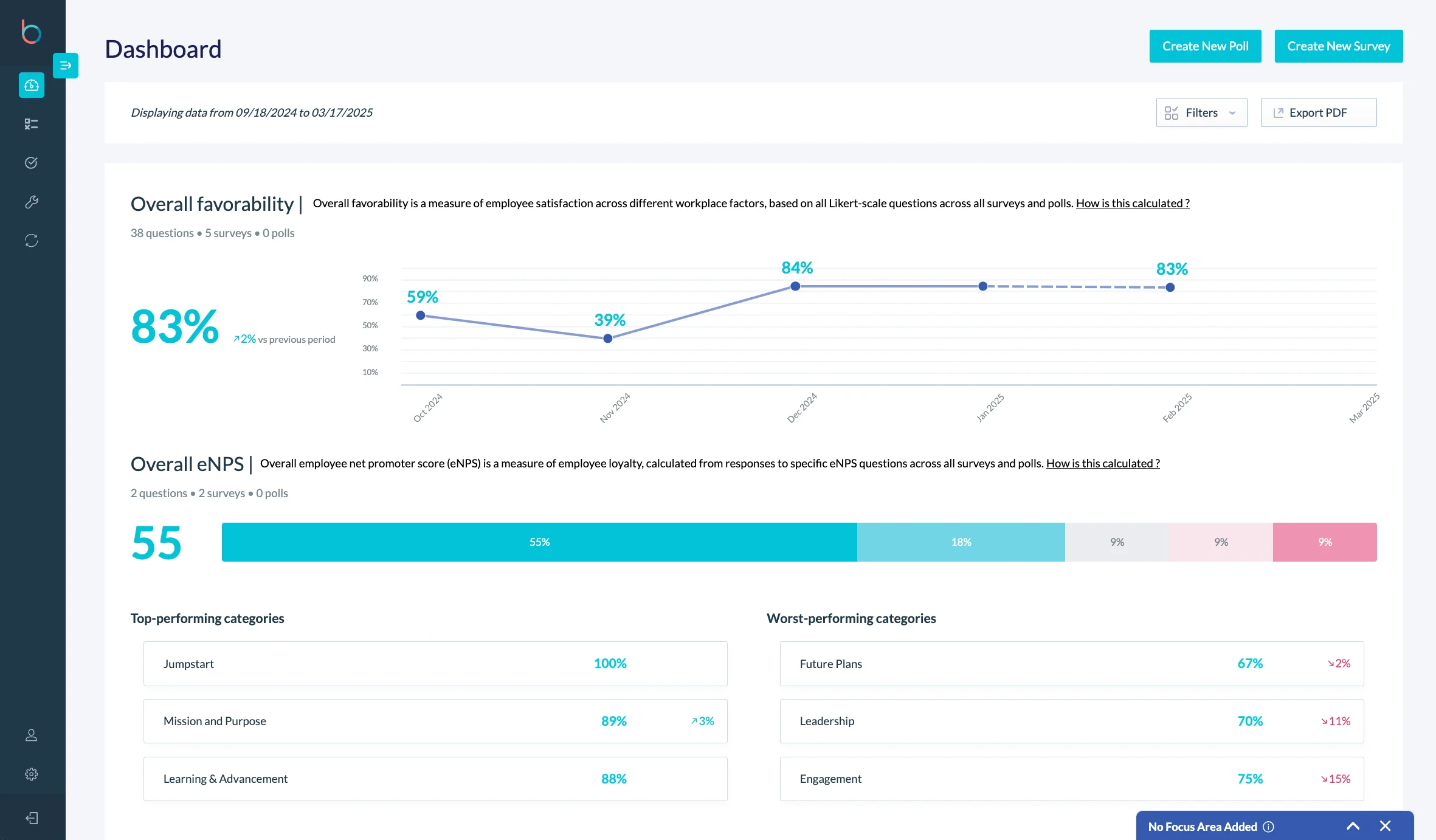
Betterworks was founded in 2013 in Menlo Park, California, with a focus on OKR-driven goal alignment at enterprise scale. The platform has since expanded into a continuous performance management suite covering the full cycle: goal setting, manager check-ins, peer and 360-degree feedback, engagement surveys, performance reviews, and talent calibration.
What distinguishes Betterworks structurally from HCM suites like Workday and SAP SuccessFactors is its positioning as a performance layer rather than a system of record. The platform sits on top of existing HRIS infrastructure, syncing employee data bidirectionally with Workday and SAP rather than competing with them.
Organizations at Colgate-Palmolive, Intuit, ATB Financial, and the University of Phoenix run Betterworks alongside their HRIS for exactly this reason: the HCM handles payroll, org structure, and benefits; Betterworks handles the performance cycle.
The January 2026 NextGen platform launch added 400+ enterprise-requested features and an AI-native architecture, including embedded goal-writing assistance, calibration bias detection, and performance trend analysis across the full review cycle.
Key Features of Betterworks
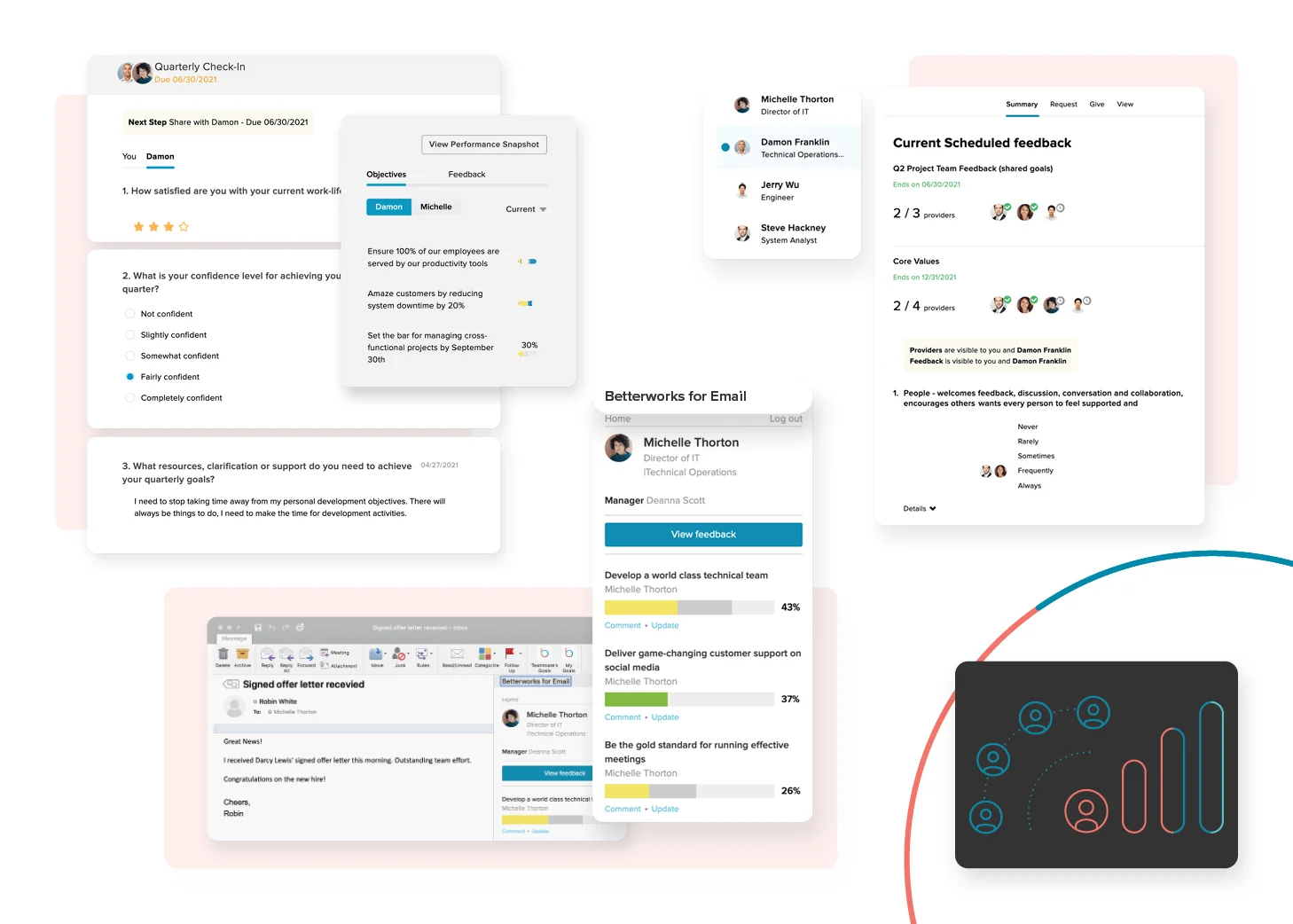
Betterworks organizes its capabilities across seven areas. The core performance functions cover what you would expect from an enterprise platform. The differentiators are in how those features connect to each other and to the HRIS systems most large organizations are already running.
1. OKRs and Goal Cascading
Goal alignment from company-level objectives down to individual OKRs, with real-time progress tracking visible across the hierarchy. Senior leaders can see which departments are on track and where gaps exist without waiting for a quarterly review cycle. Betterworks supports four levels of cascading (company, department, team, individual) and allows parallel updates rather than requiring sequential input.
The goal-setting module includes AI-assisted writing to help employees draft more specific, measurable goals. G2 reviewers note that goal tracking is among the platform’s clearest strengths, particularly for organizations that have previously managed OKRs in spreadsheets or disconnected tools.
“I use Betterworks in my work environment to keep track of my objectives during the calendar year and review them, which is great for gathering everyone's objectives and key results. I find it great for reminding me to work towards my goals and letting me know about last week's process every Monday.” - G2 reviewer
2. Continuous Feedback and Check-Ins
Structured check-in conversations between managers and employees, with conversation templates and prompts built in. The platform surfaces relevant goal progress, recent feedback, and recognition moments inside the check-in interface, so managers arrive prepared rather than improvising.
Betterworks integrates with Microsoft Teams, Slack, Outlook, and Google Workspace so that feedback prompts reach managers and employees in the tools they already use rather than requiring a separate platform login.
“Great way to schedule check ins and see global visibility of goals for company transparency. Brings uniformity to management process and gives team members a literally platform to discuss concerns on a regular basis.” - Capterra reviewer
3. Performance Reviews and 360-Degree Feedback
Configurable review cycles supporting self-assessment, manager evaluation, peer review, and upward feedback. Parallel review workflows allow all participants to submit simultaneously, removing the bottlenecks common in sequential review engines. Review templates are configurable, and multiple Capterra reviewers note that the interface for setting up and completing reviews is cleaner than legacy platforms. Preparing for the review matters just as much as the review process itself, employees need to gather evidence of their accomplishments, revisit their goals, and identify areas for development. How to prepare for a performance review offers practical guidance to help employees bring more useful input to the conversation.
“What I like best about Betterworks is how clearly it connects individual goals to broader company objectives. The platform makes goal-setting, check-ins, and performance tracking simple and transparent, which helps drive alignment, accountability, and meaningful conversations between managers and employees.” - G2 reviewer
4. Calibration
The calibration module is Betterworks’ most differentiated feature relative to competitors at this tier. Managers propose ratings, HR facilitates calibration sessions using visual distribution curves, drag-and-drop placement in a 9-box grid, and side-by-side employee comparisons. Filters by department, level, job type, and gender allow HR to surface equity concerns during calibration rather than after.
The NextGen platform added bias detection to the calibration workflow, flagging statistical anomalies in rating distributions that may indicate manager-level bias.
5. Employee Engagement Surveys
Betterworks acquired Hyphen in 2020, bringing automated survey and pulse poll capabilities into the core platform. Engagement data sits alongside performance data in the same system, enabling correlation analytics: HR can see whether teams with low engagement scores are also showing goal progress declines, rather than tracking these signals in separate tools.
6. AI-Assisted Coaching and Analytics
The 2026 NextGen platform introduced AI features across the review cycle: goal-writing assistance, writing quality nudges for manager feedback, performance trend analysis, and flight-risk indicators. The analytics dashboard is designed for HR leaders who need actionable signals rather than raw data exports. G2 reviewers in enterprise environments specifically credit the AI insights for surfacing patterns that manual analysis would have missed.
“I like the newly incorporated AI tool. It saves me time because I don’t have to go in and out of the app to use an external tool.” - G2 reviewer
7. HRIS Integrations
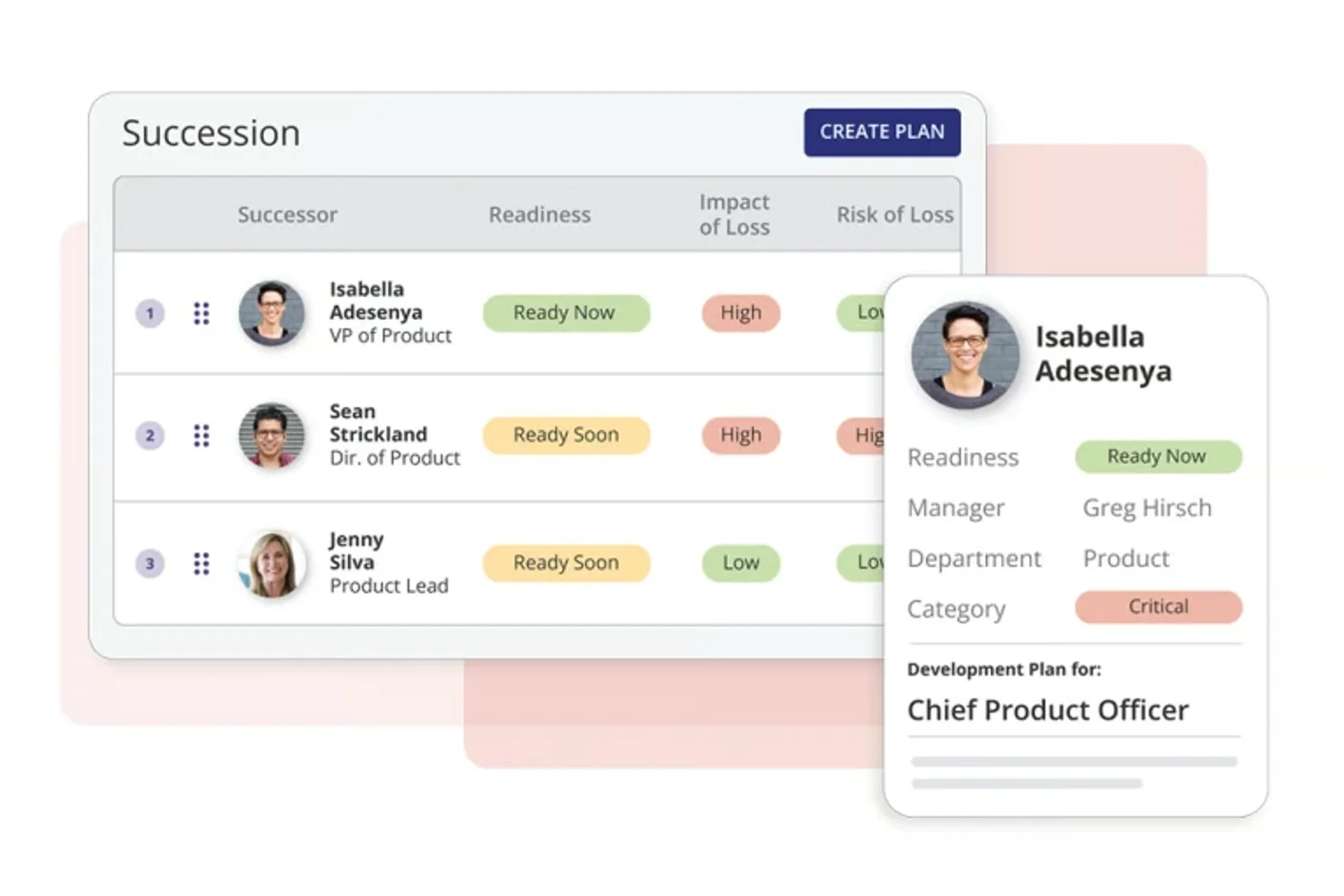
Bidirectional sync with Workday and SAP SuccessFactors, plus connections to ADP, Oracle, BambooHR, UKG Pro, Slack, Microsoft Teams, Outlook, Google Workspace, Jira, Asana, GitHub, and Salesforce. For organizations running Workday or SuccessFactors, performance data, including ratings, goal progress, summaries, and feedback, writes back to the HRIS automatically, meaning compensation planning and succession decisions work from current data rather than last year’s review export.
How Betterworks Works
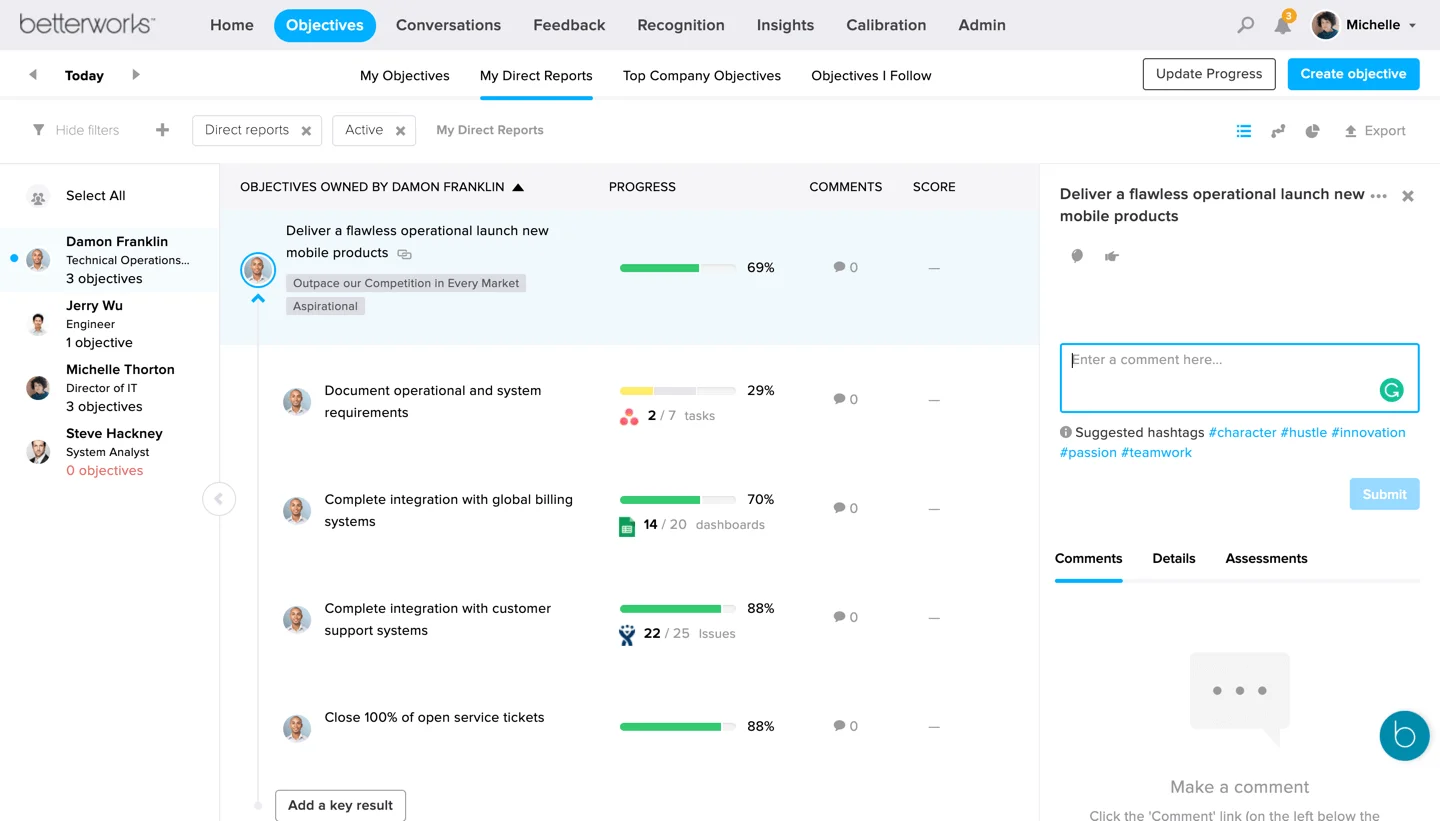
Betterworks is organized around a continuous performance loop rather than a point-in-time event. Goals are set at the company level, cascade to departments and teams, and land as individual OKRs employees can update in real time. Check-in prompts surface within Slack and Teams on a configurable cadence, keeping goal progress visible between formal review cycles rather than only at quarter-end. Organizations building a similar approach can learn more about setting up continuous performance management and the steps involved.
The review cycle itself runs through a parallel submission model: self-assessment, manager review, peer input, and upward feedback are all available simultaneously rather than sequentially unlocking. Once reviews close, the calibration module gives HR a structured environment to align ratings across managers before results are communicated. 15Five vs Betterworks breaks down how they compare on OKRs, feedback, and calibration.
Implementation runs approximately two months for mid-market deployments, per G2’s average time-to-implement data. Organizations with dedicated HRIS administrators and existing Workday or SAP infrastructure set up faster than those configuring from scratch. The platform is not designed for self-serve deployment; professional services support is part of the standard enterprise onboarding package.
Pros
One G2 reviewer writes, “Betterworks offers a modern interface for tracking goals, sharing feedback, and collaborating with others. Also I really appreciate the AI tools to enhance feedback texts, this is maybe my major advantage. In addition I never had issues with performance - the system seems to be stable and scalable.”
Another Capterra reviewer writes, “I like that I'm able to track my goal progress and also connect with my team members and see what their goals are.”
- Calibration depth is the clearest competitive differentiator. The drag-and-drop 9-box, rating distribution curves, bias detection, and demographic filtering are more developed than what Lattice, 15Five, or Leapsome offer at the calibration level. For enterprise HR teams where calibration consistency across dozens of managers is the primary headache, this is the feature that justifies the platform.
- Bidirectional HRIS sync is production-grade. The Workday and SAP SuccessFactors integrations write performance data back to the system of record automatically, meaning compensation cycles start from calibrated ratings rather than manually exported spreadsheets.
- The platform embeds into existing workflows. Feedback prompts, check-in reminders, and goal updates surface inside Slack, Teams, Outlook, and Google Workspace. G2 reviewers at enterprise organizations cite this as the reason manager engagement holds up over time, removing the separate-login friction that kills adoption on standalone platforms.
- G2 reviewers rate quality of support at 9.1/5. Above most competitors at this tier. For a platform with meaningful implementation complexity, post-go-live support quality is a real evaluation criterion, and Betterworks rates well on it consistently.
- The 2026 NextGen launch addressed a significant backlog of enterprise requests. 400+ features shipped in a single major release, including AI-native tooling across goal-setting, writing, and calibration. One enterprise G2 reviewer notes that performance trend anomalies and flight-risk indicators now surface patterns that manual analysis previously missed.
Cons
One G2 reviewer notes, “The overall appearance, as a quick tool that you only visit from time to time, is not perfectly intuitive. Sometimes you have to search for settings just to change other settings, and it doesn’t feel well integrated with other tools like Microsoft Teams. Also, I don’t like that requested feedback expires after a certain time.”
Another Capterra reviewer writes, “I think we approached Betterworks as an organization with a great idea of aligning more across teams, and working together toward organizational priorities. In practice, however, it has been a bit of a flop despite our team's best efforts to implement. It felt like people were setting OKRs more out of necessity than actual usefulness, and the conversations were just a formality.”
- No public pricing, and the cost is enterprise-grade. Custom quotes only, with estimated rates of $8–$15/user/month for enterprise deployments. A 500-person organization likely pays closer to $15/user/month ($90,000 annually). Implementation fees add meaningful upfront cost, estimated at $25,000–$50,000 for mid-market deployments. Organizations under 250 employees will find the economics punishing.
- No free trial; evaluation is demo-only. The buying cycle is 2–4 weeks for organizations that know what they want and 4–8 weeks for those still assessing fit. For HR teams under time pressure, the demo-only model adds overhead that platforms with self-serve trials do not.
- Customization has documented ceilings. Multiple G2 and Capterra reviewers note that while the platform is configurable, it does not accommodate every specific workflow or terminology requirement. SelectHub’s aggregate analysis identifies “limited customization” as one of the most repeated friction points in the review base.
- The mobile experience lags the desktop. Multiple sources flag the mobile app as less developed relative to the desktop version. For organizations where a meaningful share of employees and managers work primarily on mobile, this is a structural limitation rather than a minor UX issue.
- Complex goal hierarchies can be cumbersome to manage. SelectHub reviewers flag that setting and aligning goals within intricate organizational structures requires more administrative overhead than simpler platforms. Organizations with matrix reporting or cross-functional OKR ownership will feel this friction most.
- Notification volume frustrates some users. A recent G2 reviewer specifically flags excessive email and chat notifications as a usability complaint. Default settings require deliberate configuration to manage to a reasonable level.
First-Hand Evaluation
Key observations from the demo:
- OKR cascading: The four-level cascade from company to individual was visible in the hierarchy view with real-time progress bars. Creating a department-level OKR and linking it to two team-level key results took approximately 11 minutes, including approval routing configuration. The AI goal-writing assistant suggested three alternative phrasing options when we entered a vague objective draft; two of the three were measurably more specific than the original.
- Calibration module: We walked through a mock calibration session for a 15-person team. The drag-and-drop 9-box was responsive and the rating distribution overlay flagged a simulated skew in one manager’s ratings. The demographic filter highlighted a potential gap in promotion-rate distribution. This specific combination of features is not available at the same depth in Lattice or 15Five’s calibration tools.
- Workday integration: The solutions team demonstrated a bidirectional data flow where an updated organizational chart in Workday propagated to Betterworks within the session. Calibrated ratings written back to Workday were visible in the HRIS record within the demo environment. We could not independently verify the sync latency in a production environment.
- Review configuration: Setting up a 360-degree review cycle with self-assessment, manager, and two peer reviewers took 31 minutes from blank slate to launch-ready. The parallel submission model meant all four review types were available simultaneously. Custom rating scale labels beyond the default required support assistance, confirmed by the solutions team.
- Notification settings: The demo account had notifications enabled at default settings. The volume of in-app prompts for goal check-ins and feedback requests was noticeable within the session, consistent with the user complaint flagged in G2 reviews. The solutions team confirmed this is configurable but not off by default.
Pricing and Plans
| Configuration | Estimated Price | What's Typically Included |
|---|---|---|
| Per-employee range (all configurations) | $6-$18/employee/month | Range reflects single-module buyers at the low end and full-suite, multi-module deployments at the high end. Per Vendr transaction data, March 2026. |
| Full suite (Goals + Performance + Engagement) | Median $56,400/year | Vendr observed range: $7,430 (low) to $124,267 (high) across anonymized buyer transactions. Most organizations land well below the published per-user ceiling through volume and multi-year negotiation. |
| Implementation fee | ~$25,000-$50,000 | Varies by deployment complexity and HRIS integration depth. Quoted separately from platform licensing. |
| Employee Engagement Standalone | Custom quote | Engagement survey module available separately; typically lower per-employee rate than full suite. |
What buyers actually pay: Vendr’s dataset of anonymized Betterworks contracts shows a median annual contract value of $56,400, with a low of $7,430 and a high of $124,267. The per-employee rate runs $6–$18/month depending on module selection, headcount, and negotiated terms — with single-module or smaller deployments landing toward the lower end and full-suite enterprise contracts toward the higher end. There is no free trial; evaluation requires a demo call. Organizations that want hands-on access before committing should request a paid pilot deployment.
Our Rating
| Dimension | Score | Notes |
|---|---|---|
| Core feature depth | 4.5/5 | Calibration, OKR alignment, continuous feedback, and AI coaching are enterprise-grade. No native HRIS or payroll; designed to complement existing HR systems. |
| Integration ecosystem | 4.3/5 | Bidirectional Workday and SAP SuccessFactors sync is production-tested. 24+ verified integrations including Slack, Teams, Outlook, Jira, Asana, and GitHub. |
| User ratings (G2 + Capterra avg.) | 4.3/5 | 4.3/5 on G2 (220 reviews); 4.3/5 on Capterra (36 reviews). Verified June 2026. Enterprise segment represents 57% of G2 reviews. |
| Pricing transparency and value | 2.0/5 | No public pricing, demo-only evaluation, enterprise-grade cost structure. Appropriate for the complexity, but a meaningful barrier for buyers at mid-market scale or below. |
| Implementation and onboarding | 3.5/5 | G2 average time-to-implement is 2 months. Quality of support rated 9.1/5 by G2 reviewers. Initial configuration complexity is real; organizations with dedicated HR ops administrators fare better. |
| Overall | 3.8/5 | — |
Best Use Cases
Betterworks performs best for a specific organizational profile. When the fit is right, the calibration depth, OKR infrastructure, and HRIS integration deliver real operational value. When it is not, the pricing structure and implementation complexity work against the buyer.
Betterworks is a strong fit for:
- Enterprise organizations (500+ employees) running Workday or SAP SuccessFactors that need a dedicated performance management layer with calibration depth, OKR alignment, and AI-assisted coaching without replacing their HRIS.
- HR teams where calibration consistency across multiple managers is a documented problem; organizations that have lost employee trust in the review process due to perceived rating inconsistency or manager bias.
- Companies managing geographically distributed workforces where goal visibility across the hierarchy is a real operational need. The OKR cascade and real-time progress tracking become more valuable as organizational complexity increases.
- Organizations already embedded in Microsoft or Google ecosystems that want performance workflows to surface inside Slack, Teams, and Outlook rather than requiring a separate platform login.
Look elsewhere if:
- You have fewer than 250 employees. The per-user cost, implementation fee, and configuration complexity are misaligned with smaller organizations. 15Five ($11/user/month, Perform plan) covers most of the continuous feedback and OKR functionality at a fraction of the cost and with a self-serve free trial. Smaller teams generally have more luck with OKR software built for startups, where pricing and setup match their scale.
- You need an HRIS, native payroll, or benefits administration. Betterworks is a performance management layer, not an HR system of record. BambooHR, HiBob, or Rippling are the appropriate conversations for those needs.
- Your HR team does not have the operational bandwidth to run a 2-month implementation and manage ongoing configuration. Betterworks rewards organizations that invest in setup; it underperforms for those expecting out-of-the-box deployment with minimal IT involvement.
- Pricing transparency is a hard requirement before engaging with a vendor. There is no public pricing and no free trial. Buyers who need to budget-qualify before a sales call will hit a wall.
Alternatives and Competitors
These platforms address overlapping use cases and are the most commonly evaluated alternatives when Betterworks is on the shortlist:
- Lattice: The most direct comparable for mid-market and enterprise organizations that want performance management, OKRs, and compensation planning in one platform. Individual modules start at $8/seat/month (Performance or Goals & OKRs); the Foundations bundle — combining Performance, Goals & OKRs, Analytics, and AI Agent — runs $11/seat/month, with a $4,000 annual minimum. More transparent pricing and a more developed compensation module. Calibration depth is lighter than Betterworks. The better call for organizations under 500 employees or where compensation planning is the primary need.
- 15Five: A stronger fit for organizations under 500 employees that want continuous feedback, OKRs, and manager check-ins without enterprise-grade complexity or cost. Published pricing at $4/user/month (Engage) and $11/user/month (Perform), plus a 14-day free trial. 1,857 G2 reviews compared to Betterworks’ 220, giving buyers considerably more data during evaluation.
- Leapsome: Worth evaluating for organizations that want learning management integrated alongside performance management, or for European market buyers where GDPR compliance architecture is a primary concern. Rates at 4.8/5 on G2. Calibration tools are less developed than Betterworks.
- Culture Amp: The stronger alternative when employee engagement measurement is the primary investment and performance management is secondary. Deep survey and benchmarking capabilities, particularly for organizations that want to correlate engagement data against industry peers.
- Workday HCM: The right conversation for organizations that want performance management tightly embedded in their system of record rather than running it as a separate platform. Workday’s native module is less configurable at the review and calibration level than Betterworks, but removes the integration dependency entirely.
Final Verdict
If you are running Workday or SAP SuccessFactors at 500+ employees and your current performance process is producing ratings your managers do not trust: Betterworks is one of the strongest options in the market and worth a serious demo. The calibration module and the bidirectional HRIS sync are the features that differentiate it from mid-market alternatives. Budget accurately: the first-year cost including implementation is meaningful, and the 2-month implementation timeline is real.
If you are a mid-market organization under 500 employees, or one without a dedicated HRIS administrator: the platform’s complexity and pricing structure work against you. 15Five covers the core continuous feedback and OKR workflows at a published price with a free trial. Lattice covers the full performance-plus-compensation suite with more transparent economics. Both are better-calibrated to organizations at that scale.
If you need native HRIS, payroll, or benefits administration alongside performance management: Betterworks is the wrong category. It is built to complement an HRIS, not to be one. HiBob or Rippling are the more appropriate starting points depending on size and geographic complexity.

.avif)