.svg)
Betterworks and HiBob end up on the same shortlists for a structural reason. Companies outgrowing a lightweight HRIS often look at both simultaneously: HiBob because it handles core HR and performance in one system, Betterworks because it handles performance at a depth that HRIS-native modules rarely reach. This software comparison is for HR and People Ops leaders who have both on the list and need to know where the line actually is.
The deciding frame is not features. It is what problem you are solving. If performance management, engagement, and core HR are scattered across too many tools, HiBob consolidates them. If your HRIS is fine but performance management specifically is not working, Betterworks adds the depth. Neither replaces the other.
Betterworks Overview
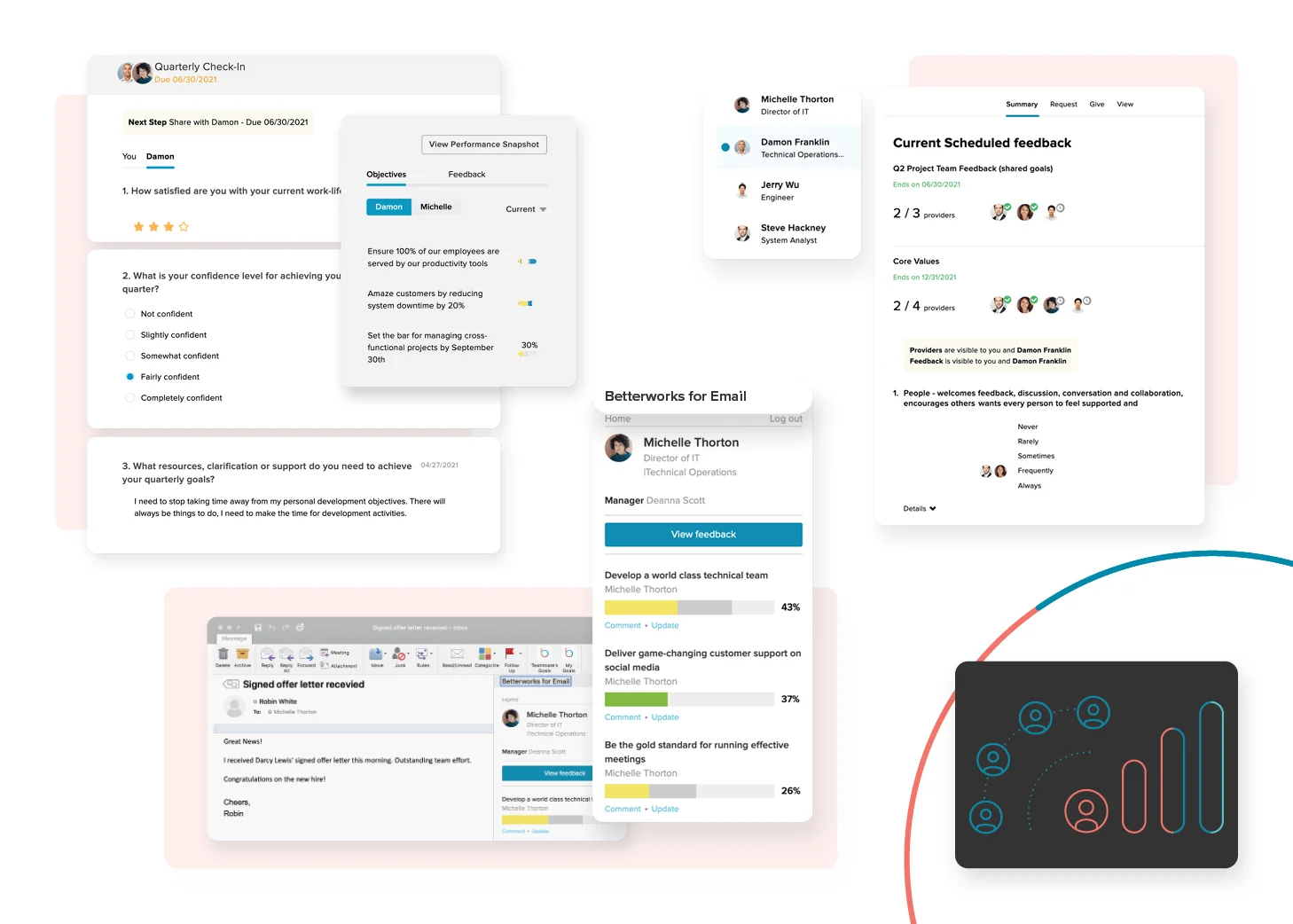
Betterworks was founded in 2013 in Menlo Park, California, and has operated on a consistent premise since: large organizations run on goals, and HR's job is to make that goal cascade visible from company strategy to individual execution. The platform has since grown into a full continuous performance management suite, earning a G2 rating of 4.3/5 from 220 verified reviews (June 2026), with 57% of reviewers from organizations with 1,000+ employees. Customers include Colgate-Palmolive, Intuit, and ATB Financial.
Betterworks is not an HRIS. It is designed to sit alongside Workday or SAP SuccessFactors, syncing bidirectionally so calibrated performance data writes back to the system of record automatically. That positioning is the source of both its greatest strength and its clearest limitation: it goes very deep on performance, and it covers nothing else. Organizations that need payroll, benefits, core employee data management, or onboarding workflows are looking at the wrong platform.
The January 2026 NextGen platform update added 400+ enterprise-requested features including AI execution-risk detection for goals, a Manager Command Center surfacing real-time alignment gaps, and performance trend anomaly detection.
Key features include:
- Enterprise OKR and goal cascading: four-level alignment from company strategy to individual OKRs, with AI execution-risk detection that flags at-risk programs before the quarter closes
- Continuous feedback via the CFR model (Conversations, Feedback, Recognition) with AI-assisted conversation prompts and Slack and Microsoft Teams delivery
- Calibration module: side-by-side employee comparisons, visual rating distribution curves, drag-and-drop 9-box placement, demographic filtering, and bias detection
- Engage module: pulse surveys and engagement analytics that connect to performance data in the same system (Hyphen acquisition, 2020)
- Bidirectional HRIS integrations with Workday, SAP SuccessFactors, ADP, Oracle, Rippling, and BambooHR; collaboration integrations with Slack, Microsoft Teams, Outlook, Google Workspace, Jira, Asana, GitHub, and Salesforce
HiBob Overview
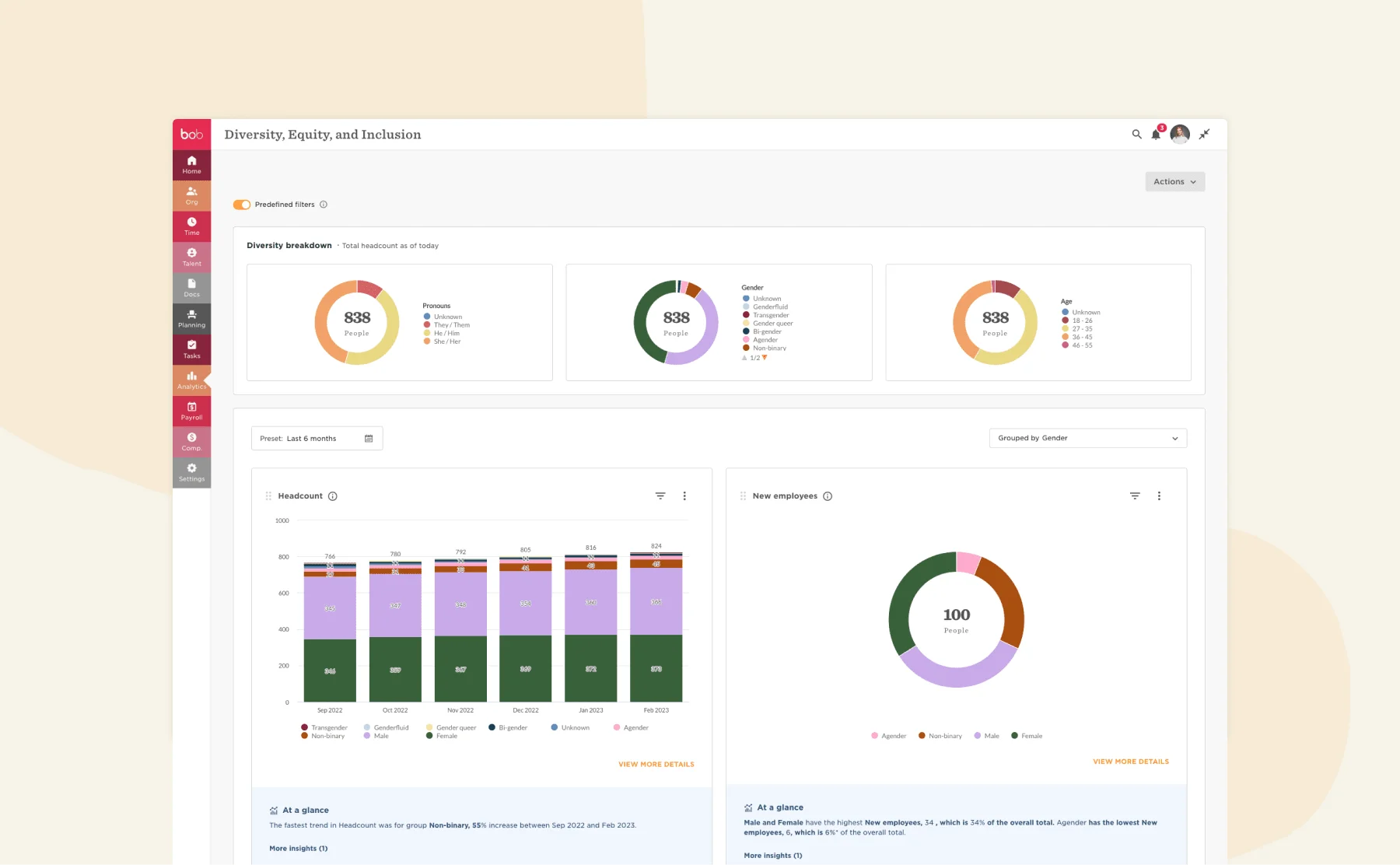
Where Betterworks goes deep on one workflow, HiBob goes wide across the full employee lifecycle. Founded in Tel Aviv in 2015, with principal offices in London, New York, Tel Aviv, Amsterdam, Berlin, and Lisbon, HiBob serves 4,400+ organizations with a G2 rating of 4.5/5 from 2,340 verified reviews (June 2026) and 4.6/5 on Capterra from 177 reviews. That review volume and those ratings reflect a mid-market HRIS that has earned consistent trust from fast-growing, globally distributed companies.
HiBob's design premise is different from Betterworks' in a fundamental way: it is built to be the system of record, not a layer on top of one. Core HR, performance reviews, goal tracking, engagement surveys, compensation management, and onboarding workflows all live inside the same platform. For organizations that want to reduce tool sprawl and manage their people from one place, that consolidation is the primary value proposition.
The platform is particularly well-suited to global and hybrid organizations. Multi-currency support, localized time-off policies, multi-entity workflows, and compliance tooling for distributed teams are built into the core product. Bob's mobile app, social homepage, Shoutouts feature, and Clubs tool reflect a platform built as much around employee experience as HR administration.
Key features include:
- Core HRIS: centralized employee records, org charts, custom fields, document management, onboarding workflows, and automated HR processes
- Performance management: configurable review cycles, 360-degree feedback, goal and OKR tracking with manager-to-individual cascading, continuous feedback, and 1:1 meeting tools
- Engagement: pulse surveys, annual surveys, anonymous reporting (Your Voice), employee recognition (Shoutouts), Clubs, and a social homepage feed
- Compensation: salary planning, merit cycle workflows, and pay equity analysis with Mercer salary benchmarking data
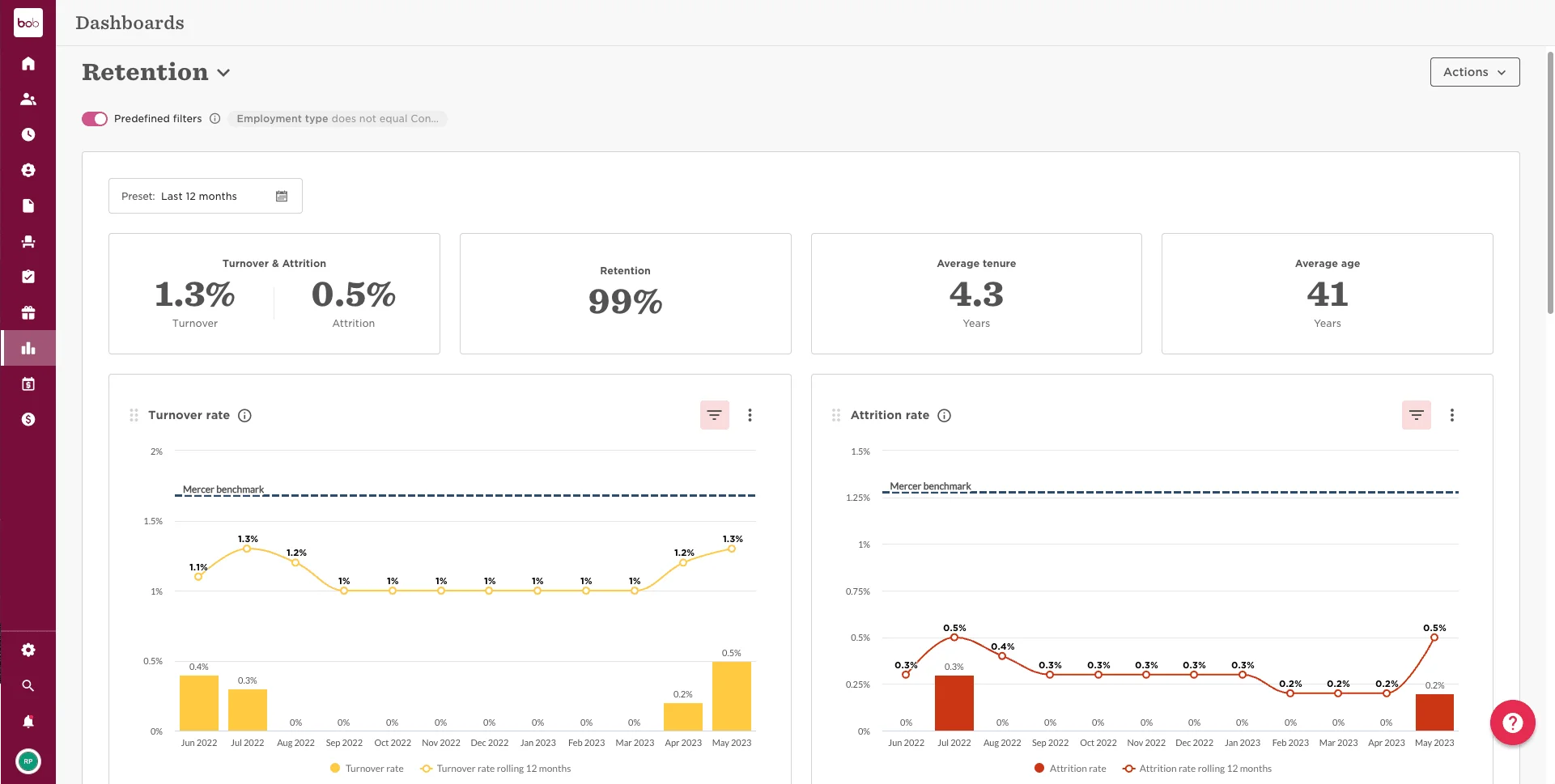
- People analytics: real-time dashboards covering headcount, attrition risk, turnover, and engagement trends, with AI-powered indicators
- Mobile-first design with a native iOS and Android app covering core HR, recognition, time off, and org visibility
- 100+ integrations including Slack, Google Workspace, Workday, Greenhouse, Rippling, ADP, Lattice, Culture Amp, and Personio
Betterworks vs HiBob: Feature Comparison
These platforms serve overlapping but distinct buyer profiles. The following breakdown covers the dimensions where the difference is most consequential.
Goal and OKR Management
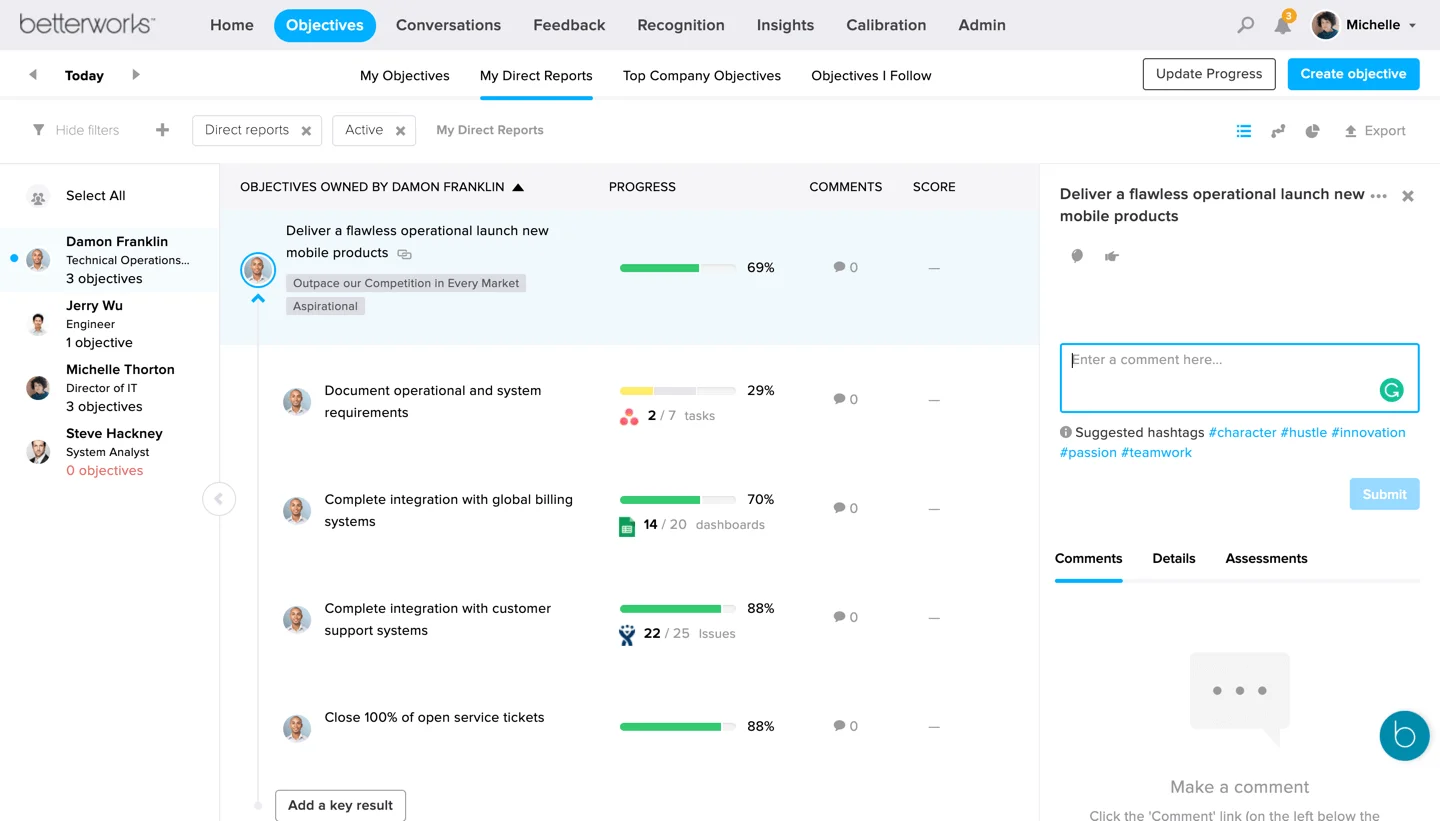
Betterworks is OKR-native. The four-level cascade from company strategy to individual OKRs, AI execution-risk detection, and the Manager Command Center for real-time alignment visibility are not features bolted onto a broader platform: they are the architectural center of the product. For enterprises where OKRs are the operating model, no other platform at this price point delivers this depth.
HiBob's goal module covers individual and team objectives with cascading and direct linkage to performance reviews. For mid-market teams where goals are one part of a broader HR workflow, it is sufficient. G2 reviewers who need dedicated OKR depth sometimes flag it as lighter than purpose-built platforms.
Verdict: Betterworks for enterprises where OKRs are the operating model and leadership visibility into execution is a primary concern. HiBob for mid-market teams that want goals integrated into a broader HR workflow rather than running a dedicated OKR methodology.
Performance Reviews and Calibration
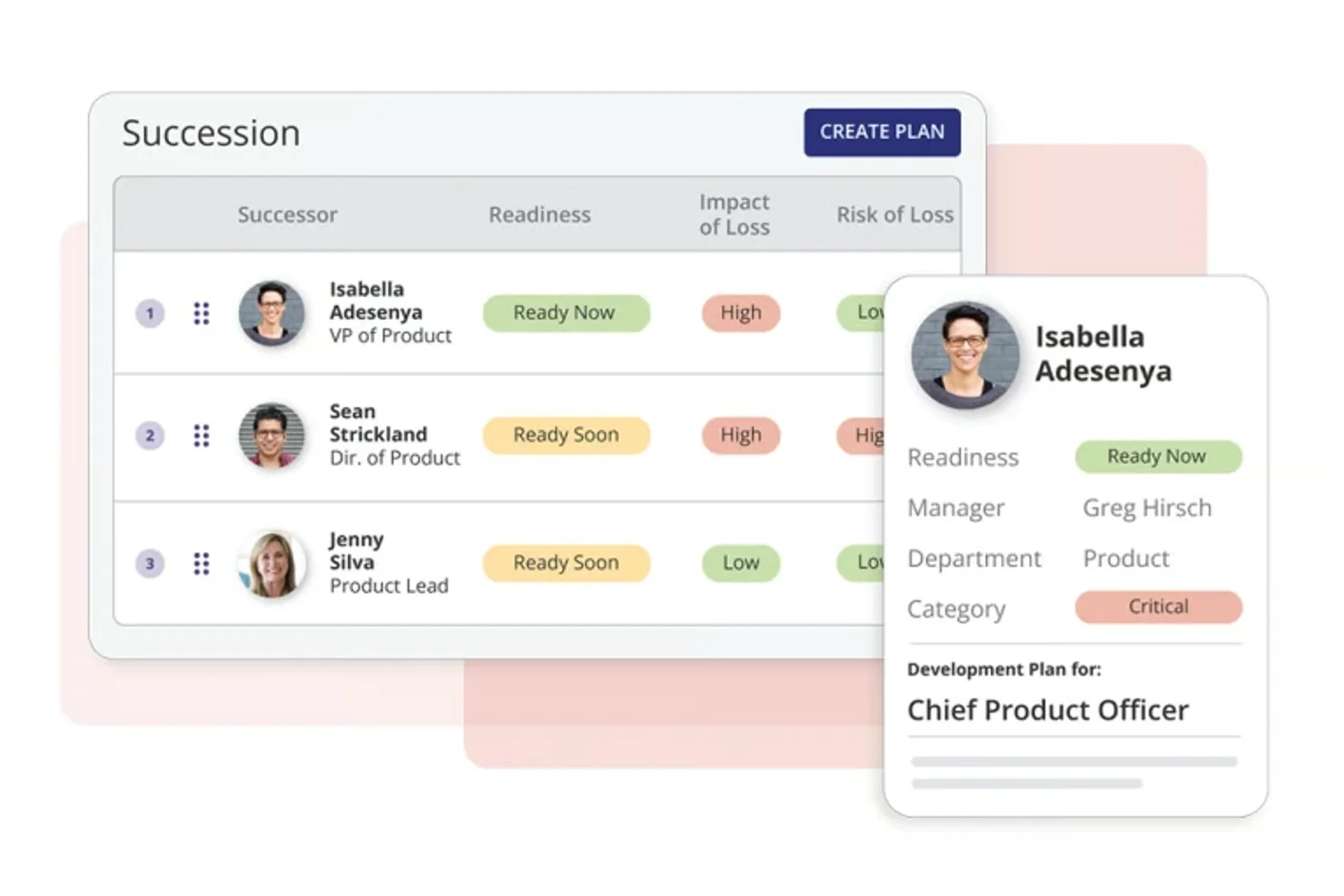
Betterworks' calibration module is the clearest differentiator here. Side-by-side comparisons, distribution curves, demographic filtering, bias detection, and 9-box placement make rating normalization a data-driven exercise at a level HiBob's performance module does not reach.
HiBob's reviews are configurable and well-integrated: 360-degree feedback, self-assessments, and manager evaluations with custom question sets. Its review data connects directly to compensation workflows, which Betterworks cannot offer.
Verdict: Betterworks for enterprise-scale calibration with equity concerns across dozens of managers. HiBob for mid-market organizations where performance reviews connecting to compensation inside one system is the primary requirement.
Core HR and HRIS Functionality
Betterworks has no core HR layer at all: no employee records, no onboarding, no time-off, no compliance, no payroll. It requires an existing HRIS to operate.
HiBob is a full HRIS. Employee records, org charts, onboarding automation, time and attendance, document management, and multi-entity global compliance are the foundation, not add-ons. For organizations that need HR and performance in one system, this dimension is settled before the demos begin.
Verdict: HiBob, without qualification, on this dimension. If HRIS functionality is a hard requirement, Betterworks is the wrong category.
Engagement Surveys and Culture Tools
HiBob's engagement layer is native and deep: pulse surveys, Your Voice (anonymous reporting), Shoutouts, Clubs, and a social homepage that G2 reviewers consistently describe as producing actual cultural adoption rather than survey compliance.
Betterworks' Engage module is functional and benefits from sitting alongside performance data in the same system. It does not include the social and recognition features that drive HiBob's adoption numbers, and it is the newer of the two offerings.
Verdict: HiBob. The depth of native engagement tooling, the social features, and the cultural adoption they generate are not replicated in Betterworks' Engage module.
Compensation Management
Betterworks has no compensation module. HiBob includes salary planning, merit cycle workflows, pay equity analysis, and Mercer benchmarking data. If compensation planning is in scope, this dimension is settled.
Verdict: HiBob, by default. Compensation management is outside Betterworks' scope entirely.
People Analytics
Betterworks' analytics are performance-focused: goal completion rates, feedback volume, manager-employee conversation quality, calibration distribution, and the AI-powered execution-risk and flight-risk indicators introduced in the 2026 NextGen update. For HR leaders who need performance analytics specifically, the Manager Command Center provides leadership-level visibility that most HRIS-native analytics do not approach.
HiBob's people analytics span the broader HR picture. Real-time dashboards covering headcount, attrition risk, diversity, turnover, and engagement connect to the same data as performance reviews and compensation, giving HR and Finance shared visibility into workforce trends. The 3.7 sub-rating on reporting from some aggregate sources reflects that custom exports and highly granular breakdowns can require workarounds, but the standard dashboards are consistently praised.
Verdict: Context-dependent. Betterworks for performance-specific analytics at enterprise scale. HiBob for broad workforce analytics connecting HR, engagement, and compensation data in one view.
Mobile Experience
HiBob has a native iOS and Android app covering HR actions, recognition, time off, org visibility, and performance. G2 reviewers consistently rate the mobile experience as one of the platform's strongest attributes.
Betterworks' mobile experience is functional but consistently flagged as less developed than the desktop version across G2 and Gartner reviews.
Verdict: HiBob. The native mobile app is a meaningful differentiator for organizations where managers and employees work on mobile, and Betterworks' gap here is documented across multiple review sources.
Implementation and Ease of Use
HiBob takes 6 to 12 weeks to implement depending on deployment complexity, with no professional services requirement. G2 reviewers consistently rate the interface as the most intuitive in the HRIS category.
Betterworks takes 2 to 4 months with structured change management. Organizations without a dedicated HR ops administrator consistently report a harder go-live experience.
Verdict: HiBob for faster time-to-value and lower implementation overhead. Betterworks for organizations that have the infrastructure to absorb a longer implementation in exchange for deeper performance capability.
Pricing and Transparency
Neither platform publishes pricing publicly. Both are quote-only with annual contract minimums.
Betterworks: Vendr's anonymized contract dataset shows a median annual contract of $56,400, with a per-employee rate of $6 to $18/month and a range of $7,430 to $124,267. Implementation fees run approximately $25,000 to $50,000 separately. All figures from Vendr's buyer guide (verified June 2026).
HiBob: Vendr's dataset shows a median annual contract of $36,504, with most buyers paying $6 to $18/employee/month for the core platform and additional module fees on top. Implementation fees typically run 10 to 20% of the first-year contract value. All figures from Vendr's buyer guide (verified June 2026).
Verdict: Neither platform has a transparency advantage. HiBob's lower observed median contract value reflects its mid-market positioning. Betterworks' broader range reflects deployment complexity. Both require a sales conversation before any budgeting is possible.
Pricing Comparison
Neither Betterworks nor HiBob publishes pricing publicly. Both figures below are drawn from Vendr's anonymized contract dataset and third-party buyer reports and should be treated as market estimates rather than quotes. Contact each vendor directly for pricing relevant to your organization and headcount.
Betterworks:
- Quote-only at all tiers. No published pricing, no free trial.
- Per-employee rate: $6 to $18/month depending on module selection and negotiated terms (Vendr, 2026)
- Median annual contract: $56,400 (observed range: $7,430 to $124,267)
- Implementation fee: approximately $25,000 to $50,000, quoted separately
- Buying cycle: 2 to 8 weeks. Implementation: 2 to 4 months.
HiBob:
- Quote-only at all tiers. No published pricing, no free trial.
- Per-employee rate: $6 to $18/month for core platform; additional modules quoted separately (Vendr, 2026)
- Median annual contract: $53,685 (Vendr, 90 verified purchases)
- Implementation fee: approximately 10 to 20% of first-year contract value
- Implementation timeline: 6 to 12 weeks typical
Worked example at 200 employees: At Vendr's median rate, HiBob runs approximately $36,504/year for the core platform. A full-suite Betterworks deployment at 200 employees typically falls below the observed median, but implementation fees add meaningfully to the first-year total for both. The only reliable figures for your specific configuration come from the vendors directly.
Why Teams Choose Betterworks
"Great way to schedule check ins and see global visibility of goals for company transparency. Brings uniformity to management process and gives team members a literally platform to discuss concerns on a regular basis." – Capterra reviewer
- Enterprise OKR infrastructure with AI execution-risk detection and a Manager Command Center that gives leadership real-time visibility into program execution, not just a goal list
- Best-in-class calibration for large organizations: bias detection, demographic filtering, distribution overlays, and 9-box placement in a workflow that makes rating normalization a data-driven exercise
- Production-tested bidirectional sync with Workday and SAP SuccessFactors, so calibrated ratings write back to the system of record automatically and merit cycles start from current data
- Support quality rated 9.1/5 by G2 reviewers, which matters significantly for a platform with 2 to 4 month implementation complexity
Why Teams Choose HiBob
"Overall, the basic functions available to all employees are very intuitive. The UI is lovely, the features are great, and I love how centralized everything is. It's really easy to get to things like payroll and different surveys and engagement opportunities the People Team puts out." – Capterra reviewer
- HRIS and performance management in one system, eliminating the integration dependency and data lag that comes from running a separate performance layer on top of an HRIS
- Employee-experience design: the social homepage, Shoutouts, Clubs, and mobile app produce adoption rates that HRIS-native platforms rarely achieve and that G2 reviewers consistently describe as meaningful rather than decorative
- Mercer salary benchmarking in the compensation module gives HR and Finance a common external reference point without a separate subscription
- Multi-entity, multi-currency, and localized compliance workflows make it the better call for globally distributed organizations where HR processes vary by country
- 6 to 12 week implementation versus Betterworks' 2 to 4 months, with self-service HR operations rather than a structured change management program
Which Tool Is Right For You?
Choose Betterworks If
- Your organization has 500+ employees and OKRs are the operating framework, with leadership visibility into goal execution as a primary HR challenge. The AI execution-risk detection and Manager Command Center are built for organizations running OKRs at scale, not exploring them.
- You are already running Workday or SAP SuccessFactors and need performance data to write back to the system of record automatically. Betterworks is a performance layer on top of a functioning HRIS, not a replacement for one.
- Calibration consistency across 20 or more managers is a documented problem. The bias detection, distribution overlays, and 9-box placement are built for this specific challenge at enterprise scale.
- Your HR team has the bandwidth for a 2 to 4 month structured implementation and dedicated HR ops support post-launch.
Choose HiBob If
- You need an HRIS and want performance management, engagement, and compensation included rather than managed through a separate vendor. If running multiple platforms is the problem, HiBob is built to be the consolidation.
- Your organization is 50 to 500 employees, scaling globally, and needs a platform that handles localized HR processes, multi-currency compensation, and multi-entity compliance without custom development.
- Employee experience and adoption are primary concerns. The mobile app, social homepage, and Shoutouts feature consistently produce higher engagement with HR processes than standard HRIS interfaces.
- Compensation planning is in scope. HiBob's merit cycle workflows and Mercer benchmarking data connect directly to performance review outcomes. Betterworks has no compensation module. See the best compensation management software roundup for dedicated tools if compensation is the primary requirement.
Final Verdict
The core distinction is what you already have and what you need to add.
If you have a functioning HRIS (Workday, SAP SuccessFactors, or another enterprise system of record) and performance management is the specific thing not working well enough, Betterworks is the right addition. The OKR cascade, the calibration module, and the AI execution-risk detection solve problems at a depth that HiBob's performance module is not designed to match.
If you do not have a consolidated HRIS, or you are running one that employees dislike and your HR team is spending too much time in spreadsheets, HiBob is the more complete answer. It covers core HR, performance, engagement, and compensation in one system with the kind of employee-facing design that produces adoption without mandating it. For buyers still evaluating the broader HRIS category, the HiBob vs Rippling comparison covers the adjacent alternatives worth evaluating next.
Frequently Asked Questions
What is the main difference between Betterworks and HiBob?
Betterworks is a dedicated performance management platform built to sit on top of an existing HRIS. HiBob is a full HRIS with performance management, engagement, and compensation built in. If you already have an HRIS and need better performance management, Betterworks is the conversation. If you need a complete HR platform that includes performance, HiBob is the more natural fit.
Does Betterworks replace HiBob?
No, Betterworks requires an existing HRIS to function and does not cover core HR data management, onboarding, payroll, or benefits. HiBob handles all of those. They are complementary in principle but typically evaluated as alternatives because most organizations want to avoid running both.
Which is better for global teams?
HiBob, in most cases. Multi-currency support, localized time-off policies, multi-entity compliance workflows, and a native mobile app make it the stronger platform for globally distributed organizations where HR processes vary by country. Betterworks handles global OKR cascading well but is not built around global HR compliance.
Which has better user ratings?
HiBob leads on review volume and overall rating: 4.5/5 from 2,340 G2 reviews versus Betterworks' 4.3/5 from 220 reviews (both verified June 2026). HiBob's larger review base reflects broader mid-market adoption. Betterworks' smaller but enterprise-skewed base reflects its narrower target market.
Can HiBob replace a dedicated performance management platform?
For most mid-market organizations, yes. HiBob's performance module covers 360-degree reviews, goal tracking, continuous feedback, and 1:1 tools at a depth that is sufficient for 50 to 500 employee organizations. For enterprises running formal OKR programs with complex calibration across many managers, the performance depth of a dedicated platform like Betterworks is typically more appropriate.
.png)