.avif)
.svg)

.svg)
.svg)
.svg)
Quick Verdict
| What it is | A cloud-based HRIS covering employee records, onboarding, performance management, engagement surveys, compensation, and people analytics. Stronger on culture and employee experience than most HRIS platforms at this tier. |
| Best for | Mid-market organizations (100-1,000 employees) with distributed or global teams that want HRIS depth alongside genuine performance and engagement tooling in one platform. |
| Not for | Organizations under 50 employees, teams that need native global payroll outside the UK and EU, or buyers who require the deep review customization of a dedicated performance platform like Lattice. |
| Starting price | ~$8/employee/month (Core HR). Essential plan ~$16/employee/month. Not publicly disclosed. Estimated pricing based on CostBench (verified March 2026), Vendr contract data (April 2026), and third-party buyer reports. |
| G2 / Capterra | 4.5/5 on G2 (900+ reviews); 4.5/5 on Capterra. Verified May 2026. |
| Our overall rating | 3.6/5 (see rating rubric below) |
There is a version of HRIS software that employees interact with twice a year: once when they onboard and once when annual reviews roll around. HiBob was built on the premise that this is a waste.
If the platform is the place where recognition happens, where teams self-organize around shared interests, where managers see engagement signals alongside headcount data, employees will actually open it. That bet on daily engagement rather than periodic utility is what separates Bob from most of its competitors at this price tier.
Whether that distinction is worth the premium depends on what your organization actually needs. This software review covers what HiBob delivers in 2026, where it genuinely earns the cost, and where the limitations are concrete enough to send buyers elsewhere.
What Is HiBob?
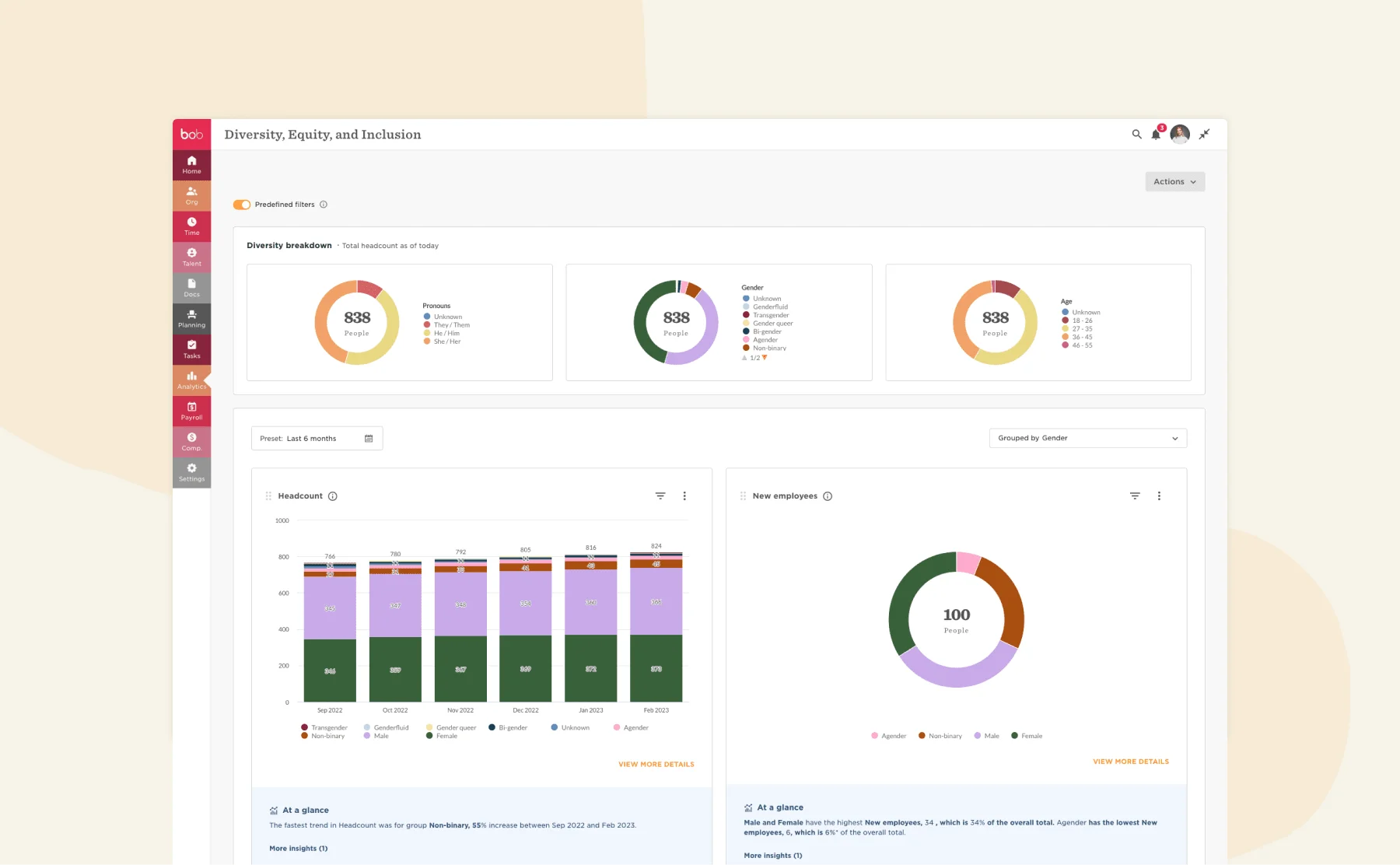
Bob is what HiBob calls the product, and the naming choice is intentional. This is not a platform designed to feel like enterprise software. HiBob launched in 2015 with a thesis that the HRIS category was overdue for a redesign, one that put employees and managers at the center rather than HR administrators. The company has since grown to serve over 3,500 organizations across 60+ countries, with its strongest footprint in technology, financial services, and professional services.
What makes Bob structurally different from BambooHR or Personio is not the feature list. It is where the design energy went. Culture tools like Shoutouts, Clubs, and the social feed are built into the core product, not add-ons. People analytics are surfaced in manager dashboards, not hidden in HR-only reporting views.
Onboarding is configurable by country, department, and role rather than a single global template. The 2022 acquisition of Pento extended the platform into native payroll for UK and EU markets. Bob Hiring, the integrated ATS, rounds out what is now a people management platform rather than a record-keeping system with performance features bolted on.
Key Features of HiBob
Bob organizes its capabilities across six areas. The core HR functions are what you would expect from a mid-market HRIS. The differentiators are in where those features sit and how they connect to each other.
1. Core HR and Employee Records
Centralized employee database with custom fields, org chart visualization, document management, and role-based access controls. Onboarding workflows are configurable by geography, department, and role, and include task checklists, e-signatures, and automated provisioning triggers. Offboarding follows the same structured workflow model. Custom fields and categories are fully reportable.
“HiBob is strong because it consolidates core HR processes (employee data, time off, onboarding, performance) into one intuitive platform, with flexible workflows and automations that reduce manual effort. The modern UI drives high adoption, while reporting and analytics give leadership clear visibility into key people metrics for faster, data-driven decisions.” - G2 reviewer
2. Time Off and Attendance
Configurable leave policies by location and employee type, time-off request and approval workflows, and a real-time Who's Out calendar. Time and attendance tracking is available as a module add-on. One documented limitation: multiple reviewers cite the time-off function as clunky relative to the rest of the platform, with specific complaints about integration friction with external payroll tools in regions outside the UK and EU.
“The employee details page is a standout for me, owing to its clarity and the ability to add and edit sections, which makes employee record-keeping seamless. Although I would prefer if I could delete certain sections, the existing management capabilities are impressive. I also like the time off functionalities, which ensure smooth coordination and management of leaves.” - G2 reviewer
3. Performance Management
Performance review cycles supporting self-assessment, manager review, 360-degree feedback, and upward feedback. Review templates are configurable. Calibration tools allow cross-manager alignment before results are finalized. Continuous feedback and 1-on-1 meeting tools are included. Performance management in Bob is more developed than in BambooHR but less configurable at the review template level than dedicated performance platforms like Lattice or Leapsome.
4. Engagement and Culture Tools
This is where Bob most clearly separates from competitors at its price tier. Features include pulse surveys, lifecycle surveys, eNPS, Shoutouts (peer recognition), Clubs (interest-based employee communities), and a social feed. These tools are built into the core platform rather than bolted on as add-ons.
5. People Analytics
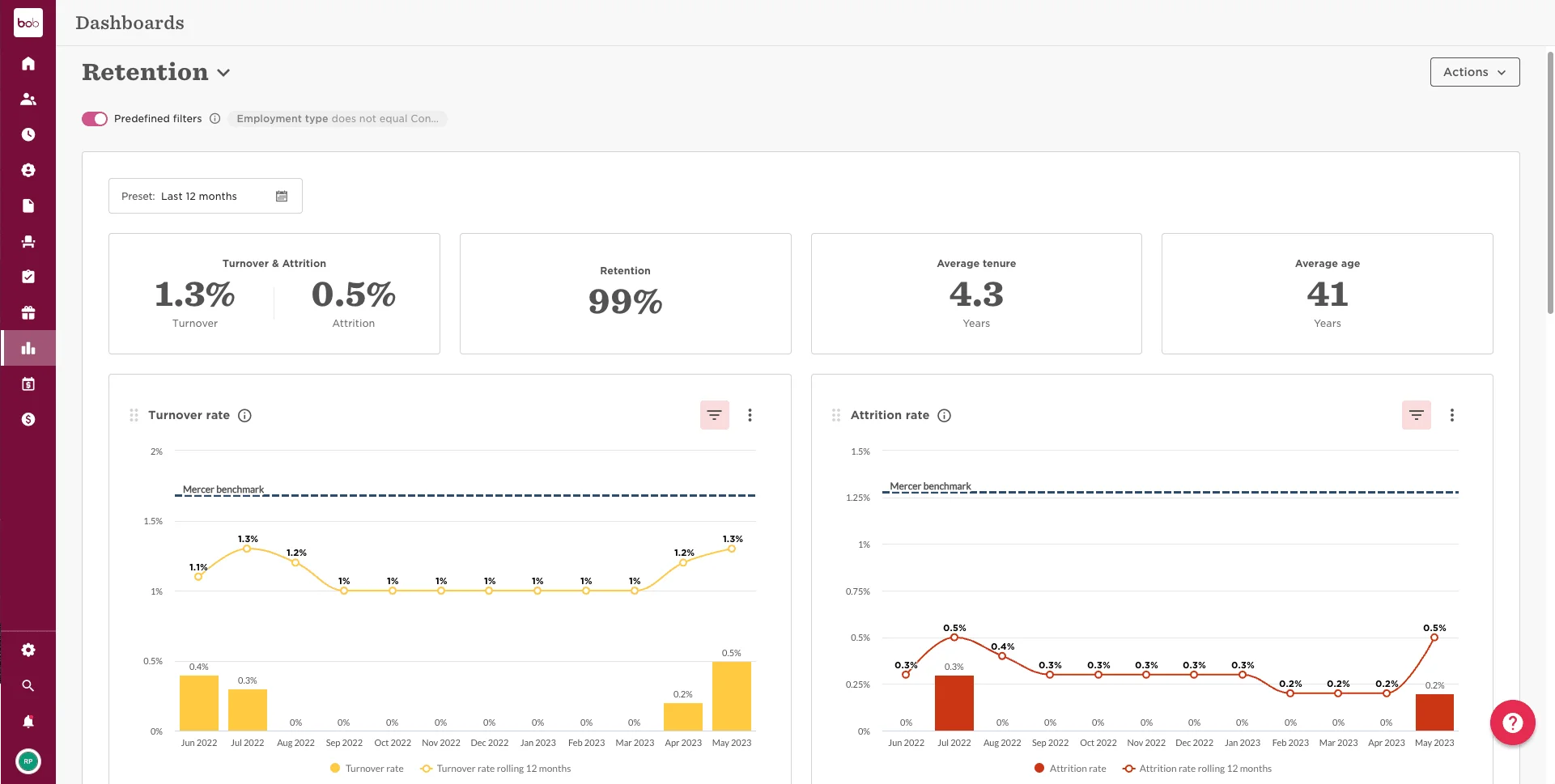
Pre-built and custom dashboards covering headcount, turnover, compensation equity, and engagement metrics. Workforce planning and attrition risk signals are available on higher plan tiers. Some reviewers consistently describe the reporting as powerful for an HRIS, though some note that extracting very specific data views sometimes requires manual structuring rather than pulling from pre-built configurations. Advanced analytics features are gated to the Essential and Enterprise plans.
“I really like how HiBob HRIS allows me to see the organization's structure in a hierarchy, so I can easily understand who reports to whom and track changes over time. This feature is essential for my role, as it helps me ensure I engage with all relevant people when working with multiple departments.” - G2 reviewer
6. Compensation Management
Compensation band management, merit cycle workflows, and pay equity analysis. This module connects directly to performance review data, which is one of the more practically useful aspects of Bob's unified data model. Compensation management is available as a module add-on and is priced separately from the core platform.
7. Payroll Hub and Bob Hiring
Bob acquired Pento in 2022, adding native payroll processing capabilities for UK and EU markets. The Payroll Hub syncs payroll data across integrated payroll providers to reduce double entry for organizations running payroll through third-party tools including Papaya Global, Deel, and Remote. Bob Hiring is an integrated ATS available on higher plan tiers, covering job postings, candidate pipeline management, and interview scheduling.
“Ease of HR management, also our finance team benefits from easy holidays/absenses management, payroll reports and such. I'm doing all admin in bob, from contracts to onboarding, org structure, salary changes, etc” - Capterra reviewer
How HiBob Works
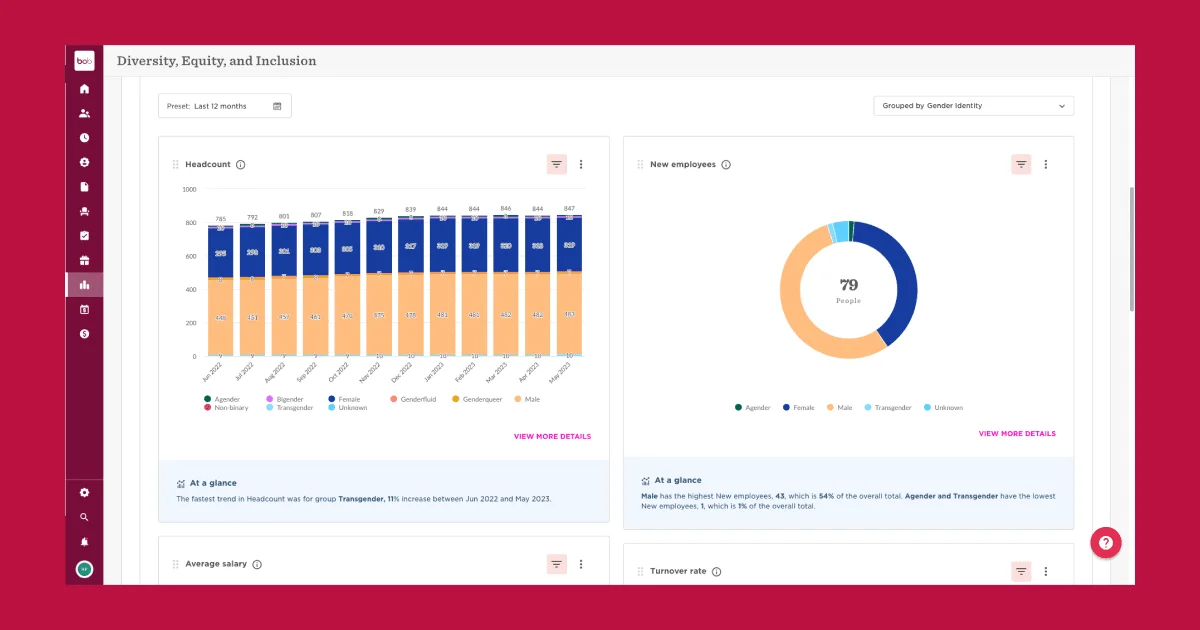
Bob is structured around a central people data layer that all modules connect to. Employee records feed into performance cycles, survey results surface in manager dashboards alongside performance data, and compensation decisions link back to review outcomes. The unified data model is the platform's core architectural argument against point solutions.
Setup is more complex than BambooHR or 15Five. Initial configuration, particularly for organizations with customized approval workflows, multi-country policy structures, or non-standard leave configurations, typically takes four to eight weeks. The implementation fee (10-20% of first-year contract) reflects genuine setup complexity, not a standard onboarding fee. Organizations that underestimate this consistently report friction in the first three months.
Day to day, Bob is designed to be the platform employees actually open. The social feed, Clubs, and Shoutouts features create touchpoints outside of HR transactions. Managers access team performance data, 1-on-1 agendas, and org chart insights from the same interface. HR administrators manage configuration, run analytics, and administer compensation cycles. The mobile app covers the most common employee and manager actions.
Pros
One G2 reviewer writes: "HiBob is strong because it consolidates core HR processes into one platform, with flexible workflows and automations that reduce manual effort. The modern UI drives high adoption, while reporting and analytics give leadership clear visibility into key people metrics for faster, data-driven decisions."
Another Capterra reviewer notes: "HiBob has SO MUCH incredible capability-- I'm actually blown away by the collaboration that we can accomplish all in one tool across so many teams. I loved how thorough their team was during implementation-- they took us through each and every step and made sure we were fully enabled and capable of our data overhaul and implementation before our go-live date."
- Culture and engagement tools are built in, not bolted on. Shoutouts, Clubs, and the social feed are native to the core platform rather than optional add-ons. A Capterra reviewer from a remote-first company specifically credits these features with maintaining team spirit across distributed locations. Most HRIS platforms at this price tier do not include anything comparable.
- People analytics go beyond standard HRIS reporting. G2 reviewers consistently describe Bob's analytics as meaningful for an HRIS, not just adequate. Custom fields and categories are fully reportable, and the workforce planning and attrition risk features on higher tiers give HR teams forward-looking data rather than just historical records.
- High day-to-day adoption across employees and managers. A PRS Consultancy review cites a case where a company achieved 95% platform adoption within the first month with no formal training, attributing it to the interface design. Most HRIS platforms struggle with low manager engagement. Bob's employee-facing design reduces this gap.
- Strong multi-country and global team support. Location-specific leave policies, multi-currency support, 60+ country configurations, and the Payroll Hub for syncing across international payroll providers make Bob one of the more practical HRIS options for organizations managing employees across multiple countries.
- Onboarding workflows are configurable by geography, department, and role. Unlike platforms with a single onboarding template, Bob allows organizations to build differentiated onboarding experiences for different employee populations. This matters most for organizations hiring across multiple countries with different compliance and documentation requirements.
Cons
Critical reviewers on G2 note, "While HiBob is strong functionally, it can be complex to configure initially, particularly for organizations with highly customized processes. Reporting, although powerful, sometimes requires manual structuring to extract very specific data views. Additionally, certain integrations may require extra setup effort to fully align with existing systems, which can increase implementation time."
Another Capterra reviewer writes, "The app is slightly clunky to use and some parts are hard to navigate. Payroll breakdowns are optional for HR to fill out so it would be great to have a clearer view of deductions and tax breakdowns without having to reach out to HR. The social feed and engagement features are nice to have but not somthing I am particularly interested in."
- No native global payroll outside UK and EU. The Pento acquisition brought payroll processing capability for UK and EU markets. For organizations with employees in the US, APAC, or Latin America, payroll requires a third-party integration (Papaya Global, Deel, Remote, ADP, etc.). This is a structural limitation for organizations that want payroll and HR data in a single native system globally.
- Pricing is opaque and compounds with modules. No public pricing means every evaluation starts with a sales call. Estimated baseline of $8/employee/month (Core) to $16/employee/month (Essential) does not reflect the full cost once performance management, compensation, and analytics modules are added. The 10-20% implementation fee on the first-year contract adds further upfront cost that smaller organizations consistently report as a surprise.
- Initial configuration is genuinely complex. G2 reviewers flag setup complexity as the most consistent friction point, specifically for organizations with non-standard approval workflows or multi-country policy structures. The platform's flexibility is a feature, but it means HR teams cannot expect a quick out-of-the-box deployment. A four-to-eight-week implementation timeline is realistic.
- Advanced features are gated to higher plan tiers. Advanced analytics, compensation management, talent acquisition, and workforce planning features are not available on the Core HR plan. Organizations that purchase Core and later need these features face a plan upgrade that increases per-employee cost materially. The G2 tag 'Missing Features' and 'Limited Features' appear in 399 and 302 reviews respectively, suggesting this frustrates a meaningful share of the user base.
- AI features are still maturing. One G2 reviewer writes: "The AI features are not quite where I would like them to be but I know the HiBob team are busy working to make improvements in this space." As of May 2026, AI capabilities in Bob are present but are not a primary selection criterion relative to competitors that have invested more specifically in AI-driven HR workflows.
First-Hand Evaluation
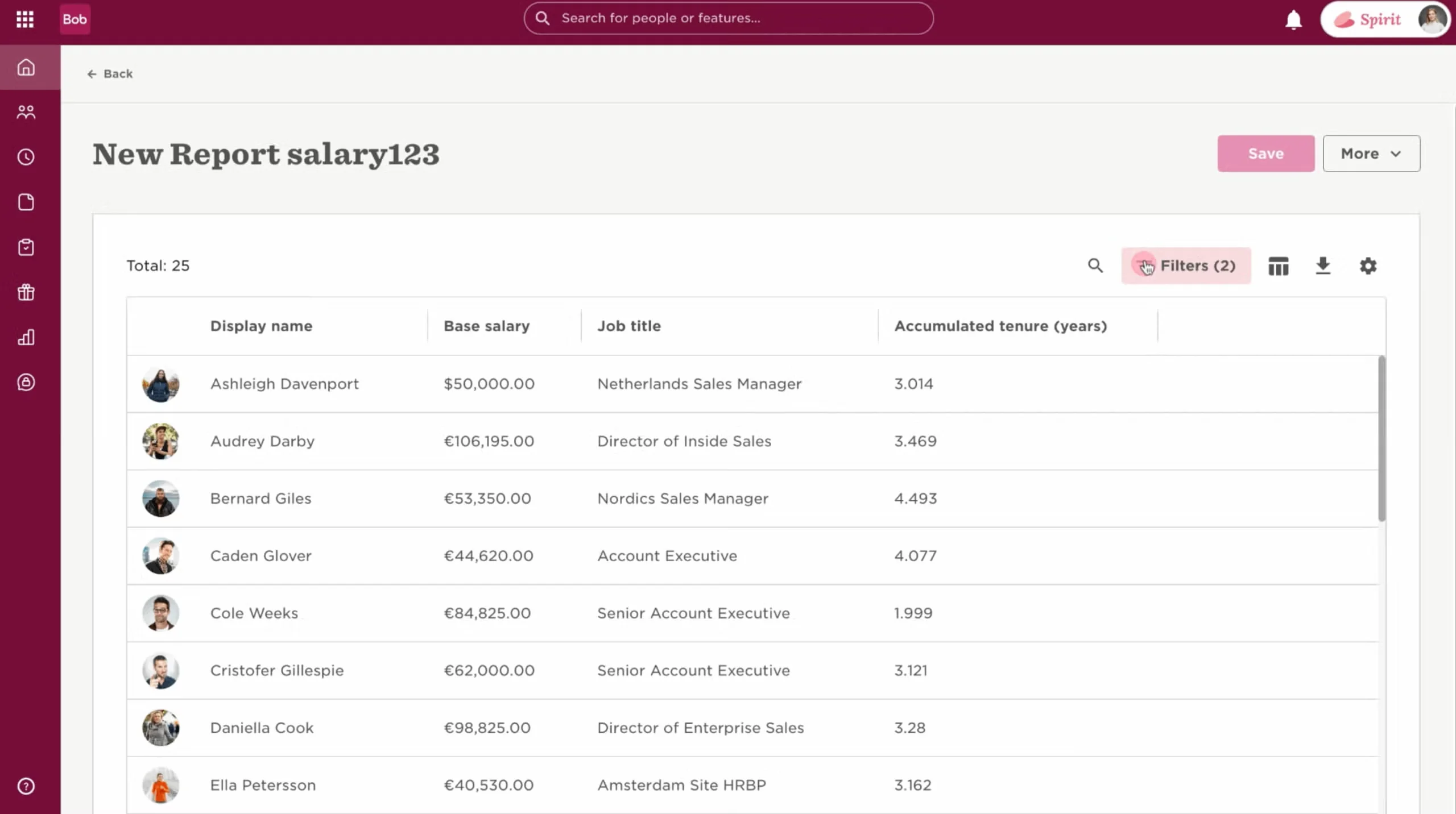
We took a 40-minute guided demo with HiBob's solutions team on 14 May 2026 covering the Essential plan features for a simulated 150-person organization with employees across the UK, US, and Australia. Key observations:
- Org chart and employee records: the visualization is genuinely cleaner than most HRIS platforms we have tested. Custom fields created during the demo were immediately reportable in the analytics module without any additional configuration step, confirming what G2 reviewers describe.
- Onboarding workflow builder: setting up a UK-specific onboarding flow with five tasks, two document signature requests, and an automated Slack notification took 19 minutes. The same workflow configured for Australia required a separate policy instance, adding 7 minutes. For organizations with more than three or four country configurations, this setup time compounds.
- Time-off module: we attempted to configure a custom leave type with a non-standard accrual policy (hours accrued per pay period rather than per year). The configuration required accessing two separate settings panels that were not obviously connected, confirming the clunkiness cited in Capterra reviews.
- Performance review setup: configuring a 360-degree review cycle took 28 minutes from blank slate to launch-ready. The template builder is functional but less flexible than Lattice or Leapsome at the question-type level. Custom rating scale creation beyond a 1-5 format was not available without contacting support.
- Culture features: tested Shoutouts and Clubs in the demo environment. Shoutouts post to the company feed in real time and support emoji reactions and comments, which functions more like a social feed than a standard HRIS recognition module. The Club feature allows employees to self-organize around shared interests, which is unusual for an HRIS and clearly designed for distributed teams.
Pricing and Plans
HiBob does not publish pricing publicly. All plans require a custom quote. Figures below are based on CostBench pricing data (verified March 2026), Vendr anonymized contract analysis (April 2026), Sonary independent pricing research, and multiple third-party buyer reports corroborating the $8-$25/employee/month range. Confirm current pricing directly with HiBob before budgeting.
| Plan / Configuration | Est. Price (per employee/month) | What's Typically Included |
|---|---|---|
| Core HR | ~$8/employee/month | Employee records, org chart, document management, onboarding workflows, time-off management, and basic reporting. The foundation all other modules build on. |
| Essential | ~$16/employee/month | Core HR plus performance management, surveys and engagement tools, and enhanced reporting. Most commonly evaluated plan for mid-market buyers. |
| Enterprise | Custom quote | Full platform access including compensation management, advanced analytics, talent acquisition (Bob Hiring), Payroll Hub (via Pento acquisition), and dedicated implementation and customer success support. |
| Implementation fee | 10-20% of first-year contract | One-time setup fee quoted separately. A 200-person organization on the Essential plan at $16/employee/month would pay $38,400/year in software plus an estimated $3,840-$7,680 in implementation fees. |
Volume discounts are available for larger organizations and multi-year contracts. Vendr's contract data indicates buyers typically achieve pricing below initial quotes through committed volume and multi-year terms. A 150-person organization on the Essential plan at $16/employee/month would pay approximately $28,800/year before implementation fees.
Our Rating
| Dimension | Score | Notes |
|---|---|---|
| Core feature depth | 4.2/5 | Strong HRIS foundation with genuine performance, engagement, and compensation depth. Payroll is available via Pento integration (UK/EU focused) but not native globally. |
| Integration ecosystem | 4.0/5 | 150+ integrations including Slack, Teams, Workday, ADP, Deel, Remote, and Papaya Global. API is open. Some integrations require additional setup effort. |
| User ratings (G2 + Capterra avg.) | 4.5/5 | 4.5/5 on G2 (900+ reviews); 4.5/5 on Capterra. Verified May 2026. |
| Pricing transparency and value | 2.5/5 | No public pricing. Custom quotes only. Estimated $8-$25/employee/month depending on plan and modules. Implementation fee adds 10-20% upfront. Cost surprises at module expansion are documented. |
| Implementation and onboarding | 3.0/5 | Initial configuration is complex for organizations with customized processes. G2 reviewers cite setup complexity as the most common friction point. Customer support quality is rated positively post-implementation. |
| Overall | 3.6/5 | — |
Best Use Cases
HiBob performs best for a specific organizational profile. When the fit is right, the platform's unified data model and culture tooling deliver real value. When it is not, the pricing structure and setup complexity work against the buyer.
HiBob is a strong fit for:
- Mid-market organizations with 100 to 1,000 employees that operate across multiple countries and need location-specific HR configurations, multi-currency support, and payroll integrations with international providers in a single system.
- Technology, professional services, or knowledge-work companies where employee experience and culture are active organizational priorities and where HR wants a platform that employees engage with daily rather than only at annual review time.
- Organizations currently running three or more separate HR tools that want to consolidate employee records, onboarding, performance management, and engagement surveys into one platform without moving to a full enterprise HCM suite.
- HR teams that need people analytics with forward-looking workforce insights rather than just headcount and turnover reports, and want that capability built into the HRIS rather than requiring a separate BI tool.
Look elsewhere if:
- You need native global payroll outside the UK and EU. HiBob's payroll capability via Pento covers UK and European markets. US, APAC, and Latin American payroll require third-party integrations, which adds cost and complexity.
- You have fewer than 50 employees. The per-employee cost, implementation fee, and configuration complexity are misaligned with small organizations. BambooHR or Gusto deliver most of the core value at significantly lower overhead.
- You need deep performance review customization, multi-level calibration at scale, or compensation workflows tightly connected to review outcomes. Lattice or Leapsome are more appropriate for organizations where performance management is the primary platform investment.
- You need to deploy in under four weeks. HiBob's flexibility requires configuration time that cannot be compressed meaningfully without sacrificing setup quality. Organizations with a hard launch deadline should evaluate platforms with faster default configurations.
Alternatives and Competitors
These are the most commonly evaluated alternatives when HiBob is on the shortlist:
- BambooHR: A stronger choice for US-based organizations under 500 employees that want a simpler HRIS with native US payroll. Less culture tooling and people analytics depth than Bob, but faster to deploy, more transparent pricing, and better suited to organizations where HRIS breadth rather than employee experience is the priority.
- Rippling: A better fit for organizations that want HR, payroll, IT device management, and finance tools in one platform. Stronger automation capabilities and a broader integration ecosystem than Bob. Higher setup complexity and cost, but scales further into mid-market complexity.
- Lattice: Worth evaluating when performance management depth is the primary need rather than HRIS breadth. Lattice's review configuration, calibration tools, and compensation module are more developed than Bob's. HRIS functionality is thinner. Better suited for organizations where talent management is the primary investment.
- Personio: A stronger option for European SMB organizations (typically under 500 employees) that want a straightforward HRIS with native European payroll and compliance. Less culture tooling than Bob but simpler to configure and more transparently priced for the European market.
- Workday HCM: The appropriate step-up for organizations that have outgrown HiBob at enterprise scale. Deeper global compliance, more mature analytics, and broader ERP integration at a cost and implementation complexity that only makes sense above roughly 1,500 employees.
Final Verdict
If you are a mid-market organization with 100 to 1,000 employees, a distributed or global team, and HR leadership that wants more than a record-keeping system, HiBob is worth a serious evaluation. The culture tools, people analytics depth, and unified data model are genuinely differentiated at this price tier. Go in with accurate cost expectations: budget for the Essential plan rate plus the implementation fee, not the Core HR entry point, and build a three-year cost model before comparing it to BambooHR or Rippling.
If you are under 100 employees or primarily US-based with native payroll as a hard requirement, HiBob is the wrong call. The per-employee cost and setup complexity do not pay off at small scale, and the Pento payroll capability does not cover US markets natively. BambooHR handles US payroll and HRIS in one system at a lower cost and faster deployment timeline.
If performance management depth is your primary need rather than HRIS breadth, HiBob's performance module is functional but not the most configurable in the category. Lattice or Leapsome are more appropriate if review customization, multi-level calibration, or tight compensation-to-performance integration is a primary requirement. Use HiBob when you need the HRIS and the performance tooling together; use a dedicated performance platform when the review workflow is the core investment.
.avif)
.avif)