.svg)
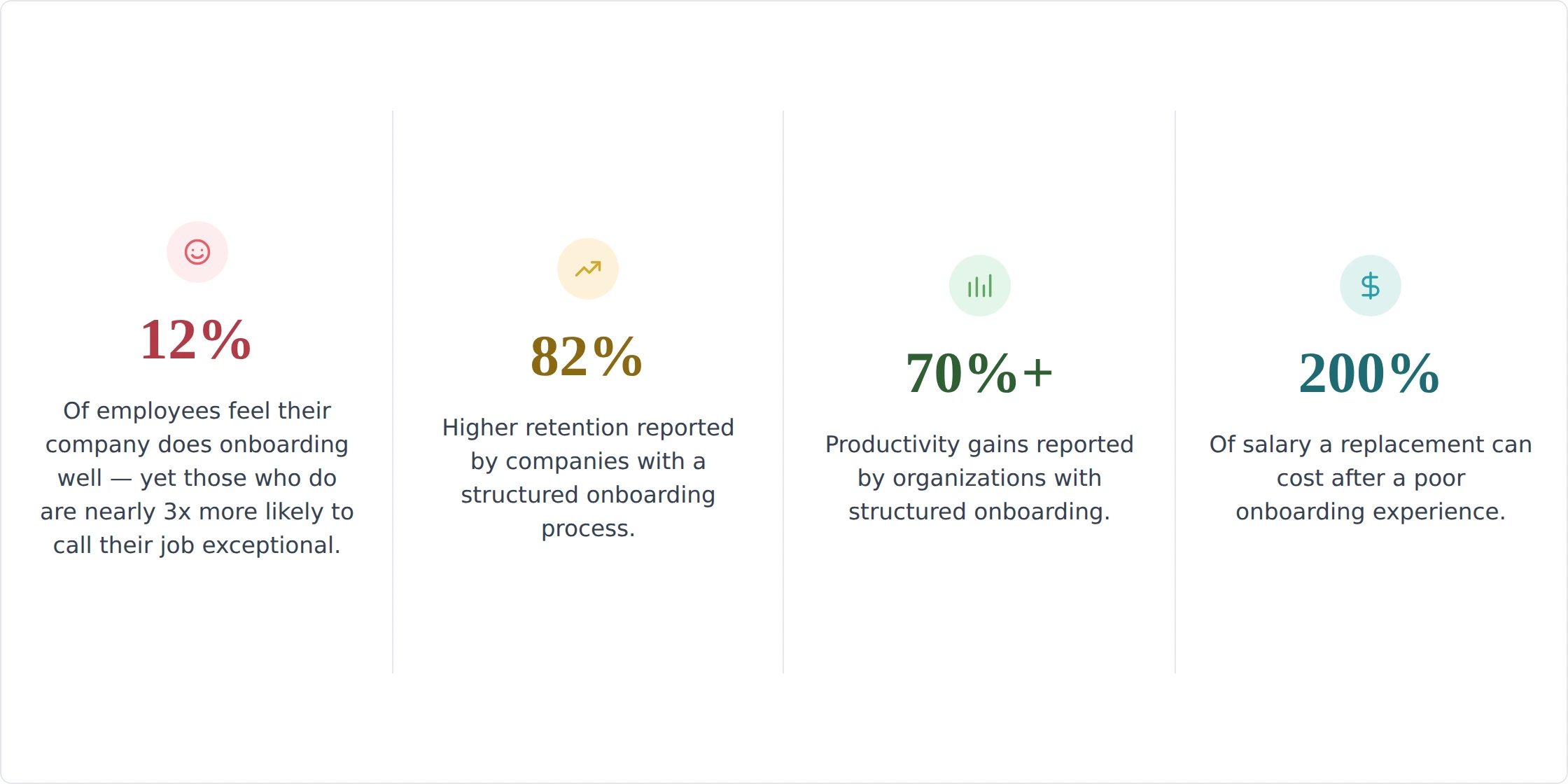
The onboarding process is another aspect that can predict the overall contribution and engagement of an employee, making it just as critical as finding the right candidate. Research shows that only 12 percent of employees feel their company does a great job with onboarding, yet those individuals are nearly three times as likely to consider their job exceptional.
To help you get onboarding right, we described 12 best practices for employee onboarding, a 30/60/90-day framework, and a ready-to-use checklist to help turn your first-quarter process into a retention advantage.
Key Takeaways
- Structured onboarding programs improve new-hire retention.
- Organizations with a standard onboarding process report percent higher retention and greater new-hire productivity.
- Managers account for at least 70 percent of the variance in team engagement, more than any single company-wide program or perk.
- Close to a third of new hires leave within their first 90 days, and replacing someone after a poor onboarding experience can cost up to 200 percent of that employee's salary.
Why Onboarding Matters
The employee onboarding process sets expectations, introduces the people a new hire will depend on, and signals what the company actually values, as opposed to what the offer letter claimed.
Skip that work and the effects show up fast.
Roughly a third of new hires leave within 90 days, and a meaningful share of early turnover traces back to confusion or neglect in the first few weeks rather than any mismatch in skill.
The upside runs the other way, too. Companies with a structured onboarding process report retention gains near 82 percent compared with those that improvise, and productivity gains above 70 percent in the same studies.
Clearly, good new employee onboarding is not a soft benefit. It is one of the more measurable levers HR teams have.
The 12 Employee Onboarding Best Practices
The practices below cover the full arc from offer acceptance through the first quarter on the job. They apply to any US-based team, whether the new hire works in an office, at home, or somewhere in between.
A few sections call out where remote or international hiring changes the approach, but the core list works for domestic hiring first.
1. Start Before Day One With Structured Preboarding
Send paperwork, equipment, and system access ahead of the start date so day one feels like a welcome instead of an intake form. New hires who go through preboarding tend to arrive more engaged and less anxious, since the uncertainty of "what happens when I walk in" has already been resolved. This is one of the highest-leverage steps on this list, and it costs almost nothing beyond a bit of advance planning.
2. Handle Compliance and Paperwork Early (I-9, W-4, State Reporting)
For US-based hires, Form I-9 verification through E-Verify, the W-4, and state new-hire reporting need to happen correctly and on time. Treat this as a domestic compliance task first, not a global one. If the company also hires internationally, note that those hires add statutory complexity on top of the domestic baseline, covered later under localization.
3. Assign an Onboarding Buddy or Mentor
A peer buddy answers the small day-to-day questions a new hire might feel awkward asking their manager. This matters even more for remote employees, who lack the hallway conversations that used to answer those questions informally. Buddy programs are also linked to faster social integration and stronger early engagement.
4. Define Clear Ownership Across HR, IT, Finance, and the Manager
Most onboarding breaks down in the handoffs between departments, not within any one department's own tasks. Assign an explicit owner to each task, whether it's provisioning a laptop, setting up payroll, or scheduling the first 1-on-1, so nothing falls through the cracks between teams. A simple ownership table, with one row per task and one column per owner, solves most of this problem on its own.
5. Give Every New Hire a 30/60/90-Day Roadmap
Make expectations visible from the start: what the new hire is responsible for, what milestones they should hit, and what "good" looks like at 30, 60, and 90 days. This single document reduces a lot of early-tenure anxiety, because the new hire is no longer guessing whether they're on track. It also gives managers a shared reference point for the first real check-in conversations.
6. Make the Hiring Manager Visibly Involved
The manager relationship shapes onboarding outcomes more than any software tool or checklist. Gallup's research found that managers account for at least 70 percent of the variance in team engagement, which means a disengaged manager can undo almost everything else on this list. Build in a first-week check-in and a role-clarification conversation, and treat both as required, not optional.
7. Structure the First Week Instead of Improvising It
A planned first week, with a clear agenda, scheduled introductions, and one small early win, beats an ad-hoc one every time. A workable structure might look like: day one for orientation and setup, day two for team introductions and tool training, days three and four for shadowing or paired work, and day five for a short check-in with the manager. New hires remember whether their first week felt organized long after the details fade.
8. Balance Automation With Human Connection
Automate the paperwork, the account provisioning, and the repetitive scheduling so people can spend their time on welcome and coaching instead. The failure mode worth naming here is over-automated onboarding, where a new hire receives a string of emails, system prompts, or generic ChatGPT prompts for welcome messages, but never talks to an actual human for the first few days. The onboarding software should remove friction from the process, not replace the people in it.
9. Build Feedback Loops Into the First 90 Days
Structured check-ins at week one, and again at day 30, 60, and 90, surface small problems before they turn into resignations. These conversations work best when they run in both directions: ask the new hire what's unclear or missing, not just how they're doing on their tasks. Use what you learn to adjust the onboarding process itself, not only the individual hire's plan.
10. Onboard for Culture and Connection, Not Just Tasks
Introduce the company's mission and values, but also the informal reality of how work actually gets done, since the two don't always match on paper. This is the belonging piece of onboarding, and it correlates closely with whether a new hire sticks around past the first year. Task lists alone rarely build that sense of connection.
11. Adjust for Remote and International Hires
Remote onboarding best practices lean on async-first resources, since a fully scripted, live-only onboarding schedule falls apart across time zones. Recorded walkthroughs, written documentation, and a buddy who checks in asynchronously all matter more here than they do for in-office hires. For international hires specifically, an Employer of Record can help with locally compliant contracts and benefits, though it's worth treating that as one option among several rather than the default answer for every global hire.
12. Measure Onboarding, Then Improve the Process Every Quarter
Treat onboarding as a program to refine, not a one-time event to set up and forget. Track completion rates, time-to-productivity, and 90-day retention, and revisit the process on a quarterly basis based on what those numbers show. This last practice is the one most onboarding programs skip, and it's often the difference between a process that improves and one that quietly decays.
The 30/60/90-Day Onboarding Framework
A 30 60 90 day onboarding plan gives structure to what would otherwise be a vague first quarter. The table below breaks out what each group, the new hire, the manager, and HR, should focus on at each phase. Copy it directly into your own onboarding documentation and adjust the specifics to the role.
The New Hire Onboarding Checklist
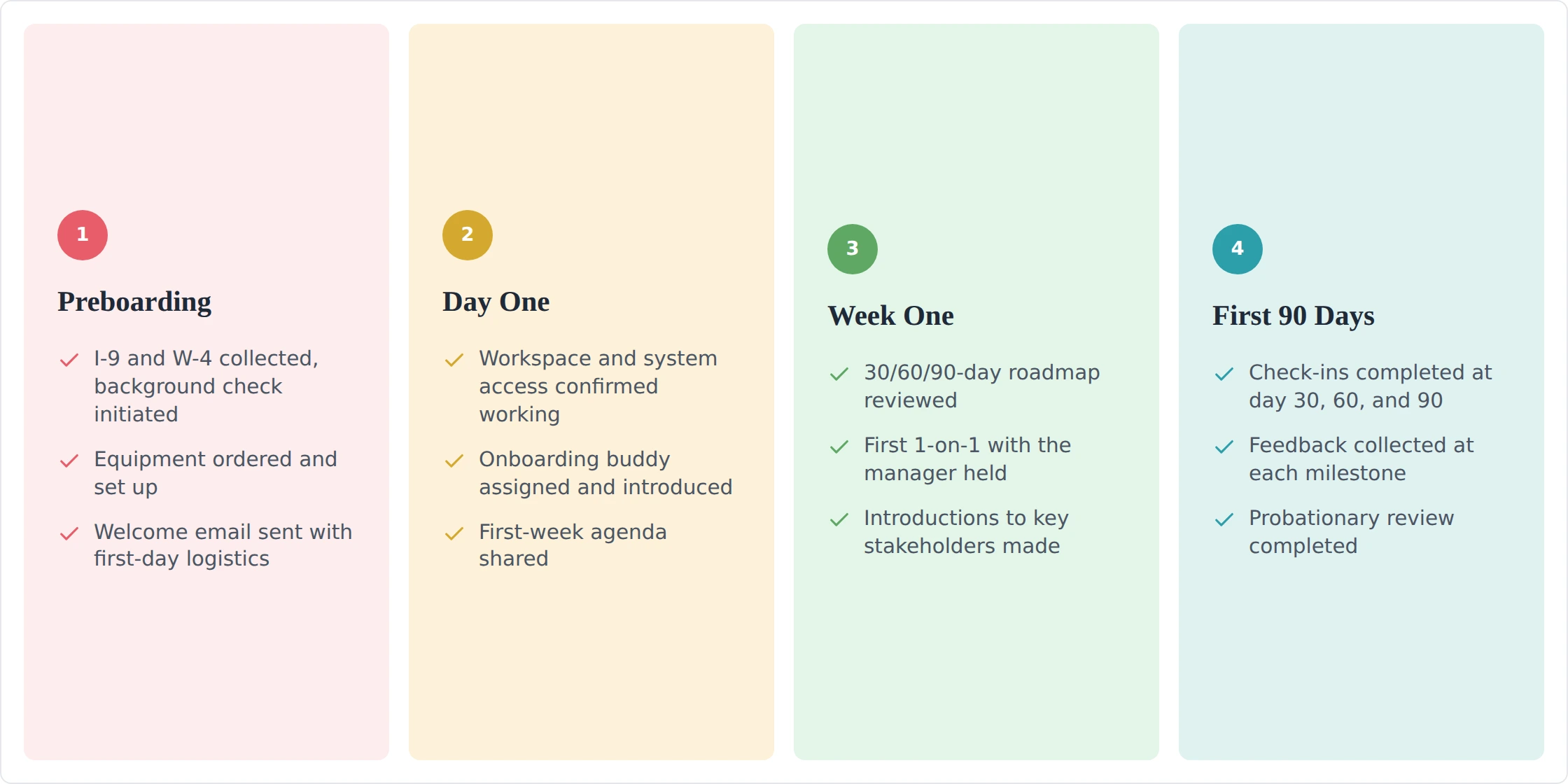
A real checklist beats a vague promise of one. Use the phases below as a starting structure, and adjust the specific tasks to match your company's tools and process.
Preboarding (offer accepted through day one):
- Offer letter signed and filed
- I-9 and W-4 collected, background check initiated
- Equipment ordered and shipped or set up
- System accounts and access provisioned
- Welcome email sent with first-day logistics
Day one:
- Workspace and system access confirmed working
- Welcome and team introductions completed
- Onboarding buddy assigned and introduced
- First-week agenda shared with the new hire
- Benefits enrollment started
Week one:
- Role expectations and 30/60/90-day roadmap reviewed
- Core training sessions scheduled
- First 1-on-1 with the manager held
- Introductions made to key stakeholders and cross-functional partners
First 90 days:
- Check-ins completed at day 30, 60, and 90
- Benefits enrollment confirmed as finalized
- Feedback collected from the new hire at each milestone
- Probationary or initial performance review completed
Common Onboarding Mistakes to Avoid
A handful of mistakes show up again and again in poorly designed onboarding programs. Watching for these is often more useful than adding another tool to fix them.
- Treating onboarding as a single day instead of a process: A one-day orientation cannot cover what a new hire needs across their first quarter.
- Leaving compliance paperwork until the last minute: I-9 and W-4 delays create real legal exposure and a rushed, unwelcoming first impression.
- Skipping the manager's role: Handing onboarding entirely to HR or an automated system removes the person whose involvement matters most.
- No feedback loop: Without check-ins at 30, 60, and 90 days, small problems go unnoticed until the new hire has already decided to leave.
- Over-automating the experience: A new hire buried in system emails with no human contact rarely feels welcome, however efficient the process looks on paper.
- No measurement: Without tracking completion rates or retention outcomes, there's no way to know whether the process is actually working.
Avoiding these missteps turns a passive orientation into a predictable engine for retention and productivity.
How to Measure Onboarding Success
Measurement turns onboarding from a guess into a program you can actually improve. A few core metrics cover most of what matters.
- Time-to-productivity: how long it takes a new hire to reach full performance in their role.
- 90-day retention: the percentage of new hires still employed at the three-month mark, a period when a meaningful share of early departures happen.
- Onboarding completion rate: the percentage of new hires who finish every scheduled onboarding task and check-in on time.
- New-hire satisfaction or NPS: a simple survey score asking new hires how they'd rate their onboarding experience, collected at 30 and 90 days.
Track these figures by quarter and compare them against the previous period, not just against an industry average. A process that's slowly improving matters more than one that hits an arbitrary benchmark once and then stalls.
How Software Supports Onboarding
Software can't fix a poorly designed onboarding process, but it removes a lot of the manual tracking that causes tasks to slip through the cracks. Look for tools that automate document collection, route tasks to the right owner across HR, IT, and the hiring manager, and send automatic reminders for 30/60/90-day check-ins.
Many companies house onboarding inside a broader top HRIS software platform, since new-hire data often needs to flow into payroll and benefits systems anyway. Others use dedicated onboarding tools that hand off cleanly from a top recruiting software platform once an offer is accepted. If the 30/60/90 roadmap is tied to broader goal-setting, it's also worth checking how the tool connects to your performance management software.
FAQs
How long should employee onboarding take?
Most HR practitioners recommend treating onboarding as a 90-day process, not a single orientation day, with check-ins built in at 30, 60, and 90 days. Some organizations extend structured onboarding through the first six months to a year, especially for more complex roles.
What should be included in an onboarding checklist?
A complete checklist covers four phases: preboarding tasks like paperwork and equipment setup, day-one logistics, first-week training and introductions, and 90-day check-ins with feedback collection at each stage. See the full checklist above for a ready-to-use version.
How do you onboard remote employees effectively?
Remote onboarding best practices rely on async-first documentation, recorded training sessions, and a buddy system that doesn't depend on being in the same office. Video check-ins should replace hallway conversations, and expectations need to be written down rather than assumed.
What is the 30/60/90-day onboarding framework?
It's a plan that breaks the first quarter into three phases, each with specific goals for the new hire, their manager, and HR. It gives everyone a shared reference point for what progress should look like at each stage, rather than leaving expectations vague.
Does onboarding really affect retention?
Yes. Structured onboarding programs are linked to substantially higher retention and productivity compared with unstructured ones, and a meaningful share of early turnover is tied directly to a poor first few months rather than a mismatch in skill.
.png)