.svg)

.svg)
.svg)
.svg)
Quick Verdict
| What it is | An AI-powered performance management platform covering review cycles, 360-degree feedback, goal tracking, 1-on-1 meetings, continuous feedback, and engagement surveys. Built for HR flexibility and high review completion rates. |
| Best for | Organizations of 50 to 1,000 employees that want highly configurable review cycles, strong customer support, and a platform that handles compliance documentation and audit trails. Strong fit for regulated industries: financial services, healthcare, legal, and federal contractors. |
| Not for | Organizations that need a full HRIS, enterprise-grade OKR cascading, deep engagement benchmarking, or Microsoft Teams-native performance management. Also not the right fit for teams that need date-triggered automated review launches. |
| Starting price | Performance Management: $5–10/person/month (annual, minimum pricing applies). PerformYard AI: +$1–3/person/month. Employee Engagement: $1–3/person/month. Meetings: +$2–4/person/month. Surveys: +$2–4/person/month. No free trial; demo-led evaluation. Verified July 2026. |
| G2 / Capterra | 4.7/5 on G2 (1,260 reviews); 4.7/5 on Capterra (179 reviews). Verified July 2026. |
| Our overall rating | 4.0/5 (see rating rubric below) |
Most performance management software fails for the same reason: HR builds a process, deploys the tool, and then spends every subsequent cycle chasing managers to complete it. PerformYard was designed around the assumption that completion rates are the real problem, and the platform’s configuration flexibility, automated reminders, and dedicated customer support model all follow from that.
This software review examines whether the flexibility lives up to the promise once a review cycle is actually running.
What Is PerformYard?
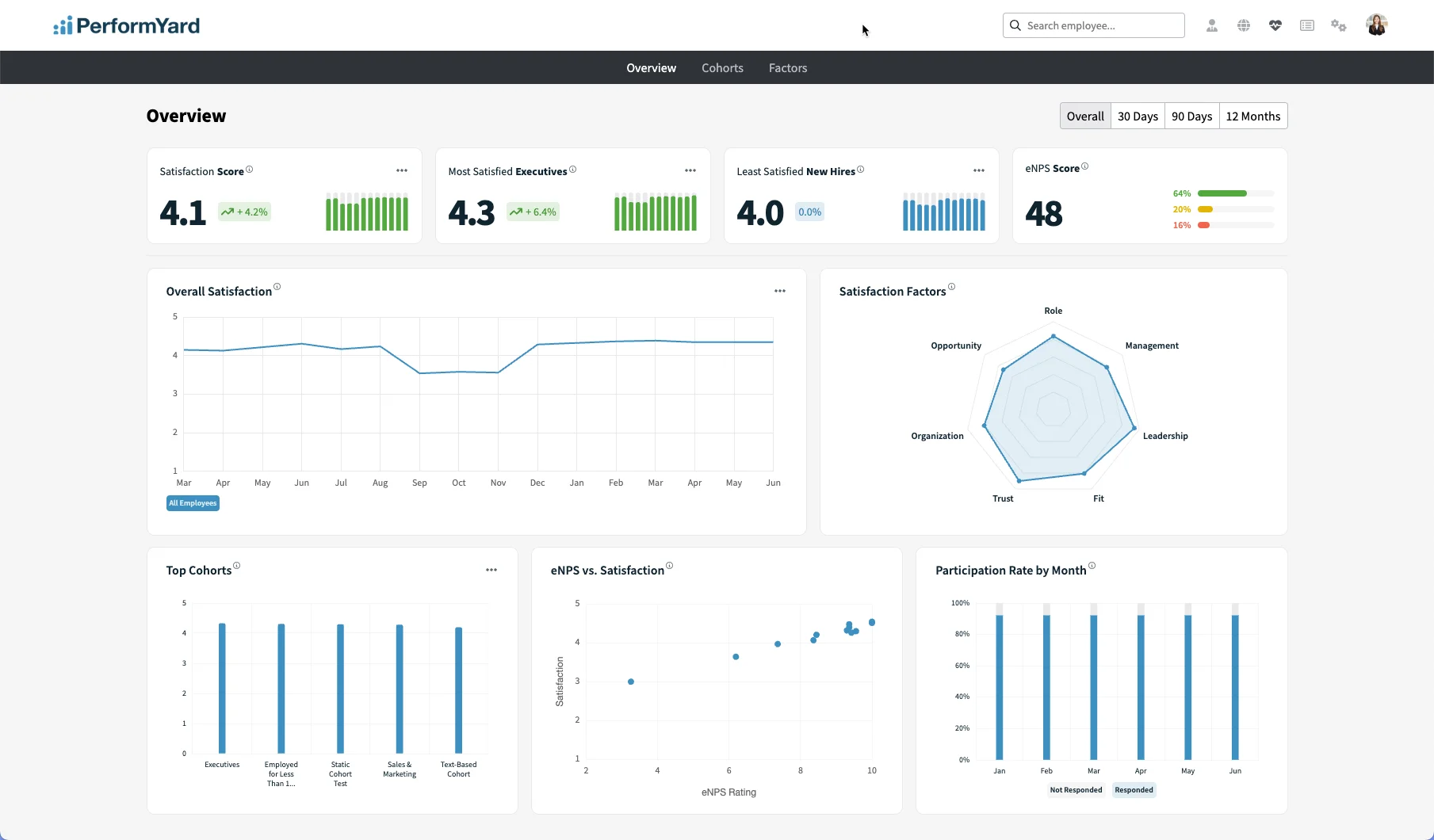
PerformYard is a Virginia-based performance management platform serving organizations from 50 to 1,000+ employees. Its 2026 positioning centers on AI-assisted review workflows: every piece of review data, goal progress, 1-on-1 note, and engagement survey feeds into an AI layer that surfaces summaries, recommendations, and action items for managers and HR. The platform does not try to be an HRIS. It is a dedicated performance management layer designed to sit alongside one.
PerformYard’s review base skews toward smaller organizations. Capterra data shows 64% of reviewers from small businesses, with 30% from mid-market. The industries most represented are information technology (11%), real estate, and accounting. Healthcare, financial services, and federal contractors are common use cases, partly because of PerformYard’s documentation and audit trail capabilities.
The platform’s 2026 State of Performance Management report, based on anonymized data from more than 2,000 customers, found that consistent PerformYard users complete 27% more goals by Year 4 compared to Year 1. Employee satisfaction scores were 7% higher and eNPS scores 6.5% higher by Year 4.
Key Features

PerformYard covers the core performance management workflow. It is not trying to add an HRIS layer or match the breadth of platforms like Lattice. The depth is in review cycle flexibility, feedback structure, and AI tooling.
1. Performance Reviews
Configurable review cycles are PerformYard’s core strength. HR can run multiple review types concurrently: annual, quarterly, 30/60/90-day, project-based, and exit reviews. Self-assessments, manager evaluations, peer reviews, and upward feedback all plug into one cycle. Rating scales, question formats, and visibility settings are adjustable per question. Multiple reviewers describe this flexibility as the reason they chose PerformYard over simpler tools that locked them into one review format.
“What I like best about PerformYard is its simplicity and flexibility. It allows us to manage quarterly performance reviews efficiently while customizing our evaluation process to fit our company’s specific goals, scoring structure, and feedback needs.” – G2 reviewer
2. 360-Degree Feedback and Continuous Feedback
PerformYard manages the entire 360-degree feedback cycle: HR sets up the structure, employees nominate peers, and the system routes completion notifications automatically. Peer input, upward feedback, and self-assessments connect directly to the review form. Continuous feedback is separate from formal cycles, letting managers and employees exchange feedback throughout the year and store it for review context.
“Our organization recently switched to PerformYard for self-evaluations and direct-report performance reviews, and the transition has been seamless. The platform is easy to use—intuitive and efficient. As a first-time user, I’ve especially appreciated how straightforward everything feels, and I can’t say enough about how much I’m enjoying the side-by-side view feature.” – G2 reviewer
3. Goal Tracking and OKRs
Goals and OKRs sit alongside review cycles and connect to performance ratings. Employees and managers can collaboratively set, update, and track goal progress. The goal module is functional and well-integrated with reviews. It does not match the cascading alignment depth of dedicated OKR platforms. PerformYard’s own research shows goal completion drops to 60% when managers oversee 20+ direct reports, suggesting the goal module is more effective for smaller team structures.
“PerformYard is easy to use and the UI is clean, so it doesn’t take much training to get started. I especially like how clearly it shows performance goals that are set by my manager, along with progress and expectations in one place. The workflows feel structured (goals → check-ins/reviews → feedback), which helps keep performance conversations consistent and reduces back‑and‑forth in emails.” – G2 reviewer
4. 1-on-1 Meetings
Collaborative agendas, task tracking, and AI-generated meeting summaries. Notes from 1-on-1s feed into performance review context, reducing the blank-page problem for managers writing evaluations. The AI meeting summary feature surfaces key discussion points and suggested action items after each session.
“At least I don’t have my OKRs lost in a dead/spreadsheet anymore. At least my 1:1s are all in one spot (it feels a lot stiffer than just using a normal document). At least HR isn’t bugging me as often because they can see my progress without asking them.” – Capterra reviewer
5. AI Insights
PerformYard’s AI layer operates across the platform. Review Assist provides real-time writing suggestions and feedback consistency coaching for managers during review completion. Review Summary condenses all forms from a review cycle into a single coherent summary with suggested action items. Engagement AI surfaces recommendations from survey results. Ask PerformYard is a conversational AI that lets employees and managers ask policy questions in natural language. The AI supports multiple writing styles and respects exclusion rules for specific content.
6. Engagement Surveys
Standardized engagement survey templates with AI-driven recommendations. Survey results connect directly to reviews, goals, and reporting, so engagement data has a path to action rather than sitting in a separate dashboard. The engagement module is newer and more basic than dedicated engagement platforms. It covers the essentials but lacks external benchmarking data and the social recognition features that platforms like Workleap or HiBob offer.
7. Integrations
Connects to Workday, BambooHR, ADP Workforce Now, Gusto, Rippling, Paylocity, UKG, Slack, Microsoft Teams, Okta, and Google Workspace. SFTP support for compatibility with any HRIS not on the native list. Multiple reviewers flag HRIS sync as a pain point when employee data changes do not propagate automatically; confirm sync cadence with PerformYard before relying on it for real-time data.
Pros
“What I like most about PerformYard Performance Management is how it makes performance tracking structured, transparent, and continuous, instead of feeling like a once-a-year review. It helps managers and employees align goals clearly, share ongoing feedback, and track progress in real time.” – G2 reviewer
“It helps in review and check-in, and goal management for all employees. We majorly use 30 days and 90 days feedback.” – Capterra reviewer
- Review cycle flexibility is the clearest strength. Multiple concurrent review types, fully configurable question sets, rating scales, and visibility controls give HR real control over how the process works. G2 reviewers most frequently cite ease of use (364 mentions) and customization as the defining traits. The depth of review configuration is consistently described as matching or exceeding platforms at twice the price.
- Customer support is a genuine differentiator. PerformYard assigns a dedicated customer success manager to each account. Capterra’s customer service score is 4.8/5, among the highest in the performance management category. Reviewers describe the support team as responsive, patient, and genuinely helpful during setup and ongoing cycles. For organizations without dedicated HR ops expertise, this functions as an extension of the HR team.
- Regulated industry fit is specific and well-documented. Financial services, healthcare, legal practices, and federal contractors with OFCCP compliance requirements consistently appear in PerformYard’s review base. The documentation trail, searchable and exportable history of every review and rating, supports audit requirements without additional manual work.
- AI tooling addresses real review workflow problems. Review Assist reduces feedback inconsistency by coaching managers on phrasing in real time. Review Summary condenses multi-form review packets into actionable summaries. These are practical time-savers rather than AI features added for marketing reasons.
- Pricing is published and modular. PerformYard lists all four add-on modules with price ranges on its public pricing page, which is unusual in this category. Performance Management runs $5–10/person/month; AI, Engagement, Meetings, and Surveys are each priced separately. Support and implementation are included free. The value-for-money score of 4.6/5 on Capterra reflects strong ROI perception among buyers.
Cons
“It would be nice to have different questions populate throughout the performance time period, if one question was asked on the first review, maybe changing some questioning for the second biannual review will be helpful to continue the conversation on performance changes.” – G2 reviewer
“After 3 years we decided to go another direction. Functionally, this will get the job done. We wanted a performance management tool that helped remove the human error to the process, so we went another direction for that automation.” – Capterra reviewer
- Date-triggered automation is not available. Review cycles cannot launch automatically based on hire date or tenure. This is the most consistently reported limitation across G2 and Capterra reviews. HR must manually initiate cycles or run them on a fixed calendar cadence. For organizations with rolling hire dates and anniversary-based reviews, this requires a workaround that adds ongoing administrative overhead.
- Reporting needs work. Multiple reviewers flag that the reporting module is less intuitive than the rest of the platform. Custom report building requires more effort than most HR teams expect. Data exports are functional but not flexible. The AI summary features help at the individual review level; aggregate analytics and cross-cycle trend reports are where the gaps show up.
- Navigation has documented friction points. G2 reviewers flag navigation difficulty as a recurring issue, particularly for admins managing complex multi-cycle configurations. The double confirmation step in the approval workflow is specifically called out: managers consistently miss the second step, leaving HR to follow up manually.
- Contract terms deserve scrutiny. Capterra reviewers mention multi-year contract requirements. One reviewer described being locked into a three-year contract with no exit clause. Confirm renewal terms, contract length, and exit conditions explicitly before signing.
- Engagement module is basic compared to dedicated platforms. The engagement surveys are functional and AI-augmented, but they do not match the benchmarking depth, social recognition features, or external comparison data that Workleap, HiBob, or Culture Amp offer. For organizations where engagement measurement is a primary investment, PerformYard is a secondary tool.
First-Hand Evaluation
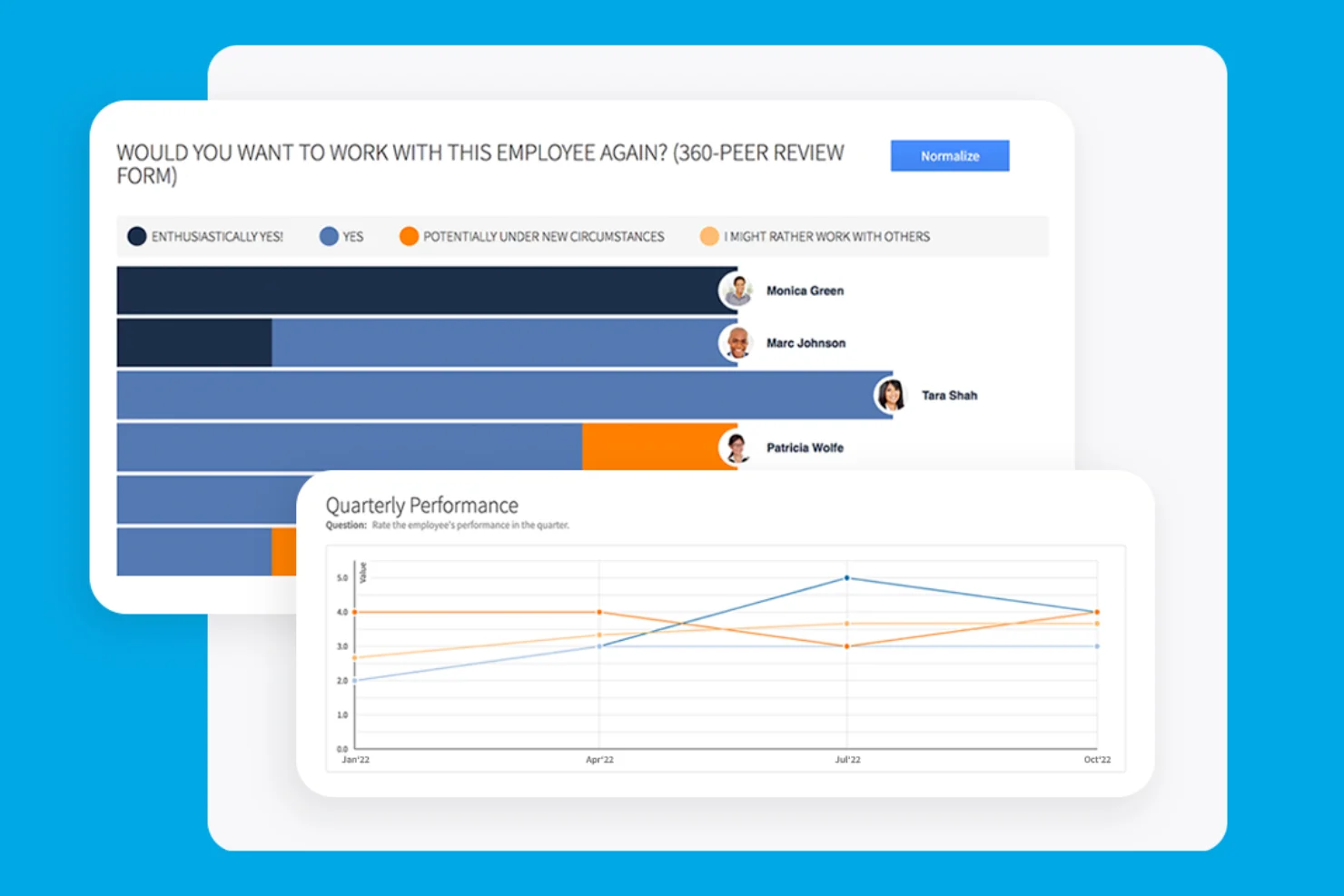
Our team evaluated PerformYard through product documentation, the vendor’s own research and help center, and verified reviewer data across G2 and Capterra. Key observations:
Review cycle setup is where PerformYard genuinely delivers on its flexibility claim. The ability to run annual, quarterly, 30/60/90-day, and project-based cycles simultaneously, with different question sets, rating scales, and reviewer configurations for each, is meaningfully deeper than most platforms in this price range. Capterra reviewers consistently describe being up and running within two to three weeks of initial setup.
The customer success model is unusual for this price point. Most platforms at $5 to $7/user/month route support through help articles and ticketed requests. PerformYard’s dedicated success manager model is verified across dozens of non-incentivized reviews and appears to be a genuine structural difference rather than a marketing claim.
The hire-date automation gap is real and worth evaluating carefully before purchase. For organizations that onboard regularly and want anniversary-based reviews to launch without HR intervention, this is not a minor inconvenience. It requires either a monthly cadence review for all employees or manual cycle launches per cohort.
Reporting is the other documented gap. The platform surfaces review completion rates and goal status clearly. Cross-cycle trend analysis, cohort comparisons, and custom data exports require more effort than the rest of the platform suggests. The AI summary layer helps at the individual level but does not resolve the aggregate analytics gap.
Pricing and Plans
PerformYard does not publish detailed plan breakdowns publicly, but starting prices and module structure are confirmed from Capterra and third-party sources (July 2026). Final pricing requires a sales conversation. No free trial is available; PerformYard evaluates through a demo-led process.
| Module | Price | Notes |
|---|---|---|
| Performance Management | $5–10/person/month (annual) | Reviews & check-ins, 360 peer reviews, goal management, continuous feedback, reporting & analytics, sign-off workflows. Minimum pricing applies; enterprise discounts available. |
| PerformYard AI | +$1–3/person/month | AI review writing assistance, feedback summaries, engagement and performance insights across all modules |
| Employee Engagement | $1–3/person/month | Engagement surveys with AI-driven recommendations; connects to review and goal data |
| Meetings | +$2–4/person/month | 1-on-1 meeting agendas, task tracking, AI meeting summaries |
| Surveys | +$2–4/person/month | Fully custom surveys including pulse, onboarding, and exit surveys |
| Support | Free for every customer | Dedicated success manager, hands-on implementation, unlimited trainings, phone and video support, HRIS integrations, SSO |
Annual cost example at 200 employees: Performance Management at the $5 floor runs $12,000/year; at $10 it runs $24,000/year. Adding AI ($1–3) and Engagement ($1–3) modules adds $4,800–$14,400/year on top. Meetings and Surveys each add $2–4/person/month further. Total cost requires a vendor quote; the ranges above give a planning floor and ceiling. Support, implementation, and your dedicated success manager are included free at all tiers.
Contract terms are worth negotiating explicitly. Capterra reviewers report multi-year contract requirements in some cases. Ask about annual renewal options and exit terms before signing.
Our Rating
| Dimension | Score | Notes |
|---|---|---|
| Core feature depth | 4.0/5 | Review cycle flexibility is genuinely strong. Goal tracking and engagement are functional but lighter than dedicated platforms. AI tooling is practical and well-integrated. |
| Integration ecosystem | 3.5/5 | Covers major HRIS platforms and Slack/Teams. HRIS sync reliability flagged by multiple reviewers. SFTP fallback covers edge cases. |
| User ratings (G2 + Capterra avg.) | 4.7/5 | 4.7/5 on G2 (1,260 reviews); 4.7/5 on Capterra (179 reviews). Verified July 2026. One of the highest sustained ratings in the category. |
| Pricing transparency and value | 3.5/5 | Published starting prices; final cost requires a sales call. No free trial. Value-for-money score of 4.6/5 on Capterra reflects strong ROI perception among buyers. |
| Implementation and onboarding | 4.5/5 | Dedicated customer success manager is a structural advantage. Most teams up and running in 2 to 3 weeks. Admin configuration curve is real for complex multi-cycle setups. |
| Overall | 4.0/5 | — |
Best Use Cases
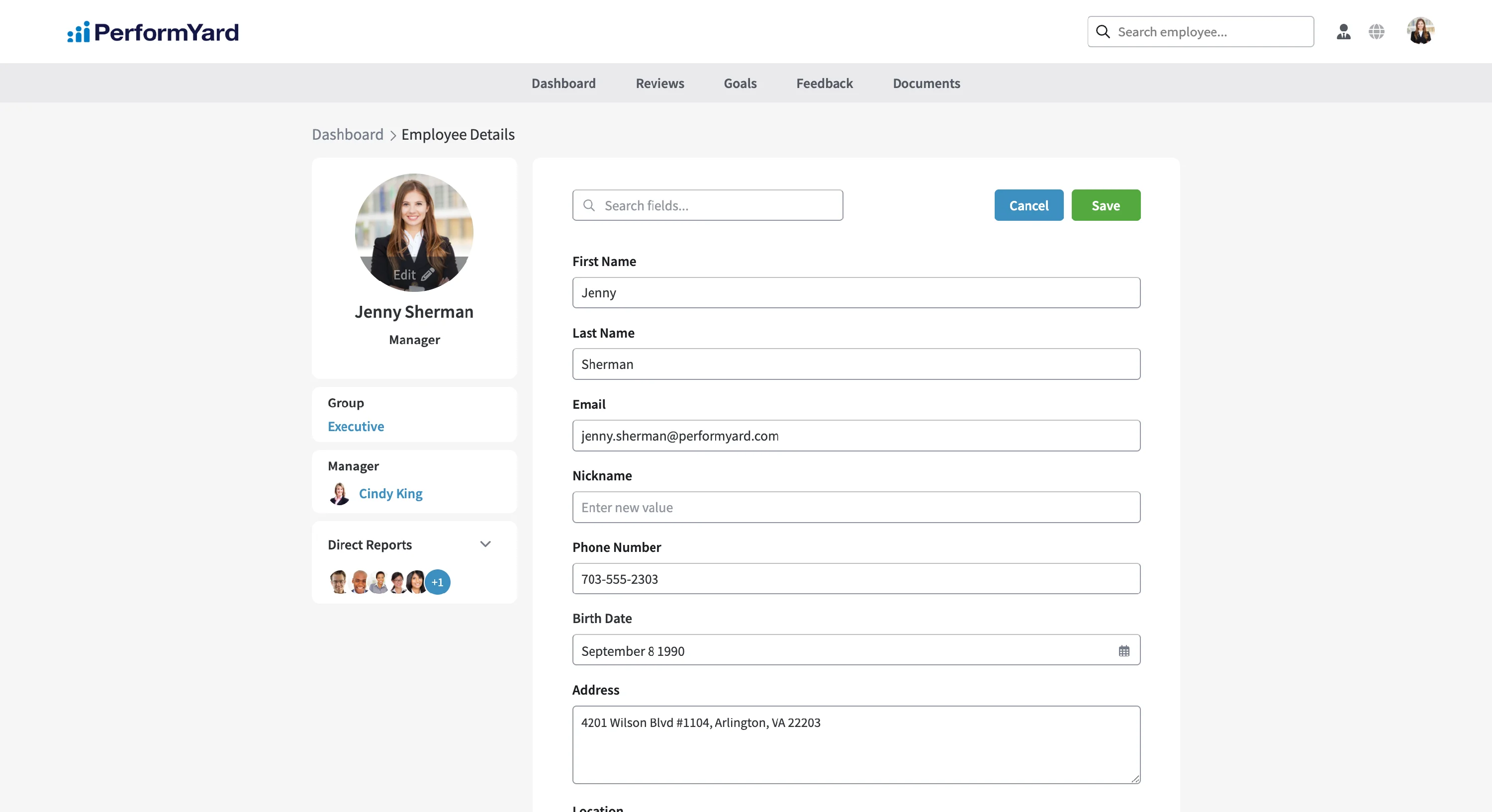
PerformYard earns its place on a shortlist for specific organizational profiles. The strengths are real and specific; so are the gaps.
PerformYard is a strong fit for:
- Organizations of 50 to 500 employees that have outgrown spreadsheet-based reviews and need a structured, configurable system without a six-figure enterprise platform budget. The platform is particularly strong for moving from annual-only cycles to a continuous feedback and multi-cadence review structure.
- Regulated industries with compliance and audit requirements. Financial services, healthcare, legal practices, and federal contractors with OFCCP compliance needs consistently appear in PerformYard’s satisfied reviewer base. The searchable and exportable documentation trail is a specific fit for these environments.
- HR teams without deep technical resources. The dedicated customer success model means HR teams that cannot build complex configurations independently get hands-on support rather than ticket queues. Multiple reviewers cite this as the reason they stayed after initial setup.
- Organizations running multiple review types simultaneously. Project-based reviews, 30/60/90-day check-ins, annual evaluations, and exit reviews can all run concurrently with separate configurations. This is not available in most platforms at this price point.
Look elsewhere if:
- Anniversary-based review automation is a hard requirement. PerformYard cannot trigger cycles from hire date. This is not on a confirmed roadmap. Consider 15Five or Lattice for this specific workflow.
- Enterprise-grade OKR cascading is a primary need. Goal tracking is functional but light. Betterworks is the more appropriate conversation for organizations where OKRs are the operating model.
- Engagement benchmarking or social recognition are primary investments. The engagement module is an add-on with AI-augmented surveys but no external comparison data and no recognition features. Culture Amp or Workleap are better fits when engagement is the primary requirement.
- Microsoft Teams-native performance management is required. PerformYard integrates with Teams for notifications but is not a Teams-embedded platform. For Microsoft-first organizations that want performance management inside Teams, Teamflect is designed for that requirement.
Alternatives and Competitors
These are the platforms most commonly evaluated alongside PerformYard, depending on which capability gap is the deciding factor:
- 15Five: The closest comparable in target market. Published pricing starts below PerformYard on the Engage tier and above it on the Perform tier. Stronger OKR and manager coaching tools than PerformYard, with a larger G2 review base for evaluation signal.
- Lattice: Worth evaluating when compensation planning, Mercer engagement benchmarking, or enterprise-scale goal alignment is the priority. More configuration complexity and higher cost than PerformYard.
- Small Improvements: A close comparable for SMBs prioritizing simplicity and fast setup. Published pricing starts below PerformYard. Lighter on review cycle flexibility but faster to deploy and easier to administer.
- Workleap: Better fit when engagement measurement, Good Vibes recognition, or a flat annual platform fee is the priority. Covers performance and engagement together under one plan rather than per-module pricing.
- Betterworks: The right conversation when OKR cascading at enterprise scale, calibration across many managers, and Workday/SAP HRIS sync are the primary requirements.
- Engagedly: A close comparable for organizations that weigh learning management as heavily as performance reviews. See PerformYard vs Engagedly for the full feature and pricing breakdown.
Final Verdict
PerformYard does one thing better than almost any platform at its price point: it makes performance reviews actually happen. The review cycle flexibility, the automated reminders, the dedicated customer success model, and the AI tooling all serve that single goal. The 4.7/5 ratings across both G2 and Capterra, sustained across 1,400+ combined reviews, reflect organizations that went from spreadsheets and missed deadlines to running structured, documented review cycles that complete on time.
The limitations are equally specific. If anniversary-based review automation matters, PerformYard is not the platform. If aggregate reporting, OKR depth, or engagement benchmarking are primary requirements, the gaps are real. And the contract terms deserve careful review before signing.
For organizations that are currently running reviews in spreadsheets, Google Forms, or no formal system at all, PerformYard is a defensible first step and often the right one. For organizations that have outgrown PerformYard’s feature ceiling, the top performance management software roundup covers the broader field.

.avif)