.svg)

.svg)
.svg)
.svg)
Quick Verdict
Workleap used to be three separate products you might not have realized were related: Officevibe for engagement surveys, Softstart for onboarding, and a newer Performance module for reviews. The 2023 rebrand pulled them under one name and one dashboard, and 2026 added an AI Manager Agent layered across the whole suite.
The pitch is that smaller HR teams can get engagement, performance, and compensation management without buying an enterprise HRIS or hiring more HR headcount to run it. This software review looks at whether that modular, AI-assisted approach holds up once you are actually running review cycles and reading survey data, not just looking at the pricing page.
What Is Workleap?
Workleap grew out of Montreal-based GSoft, the company behind Officevibe (launched 2013) and Softstart, its onboarding product launched in the early 2020s. The products were unified under the Workleap brand in 2023, with performance management added in subsequent years, compensation added via the July 2025 Barley acquisition, and AI-powered features expanding through 2025 and 2026. Workleap reports more than 70,000 leaders worldwide use the platform, primarily at SMBs and mid-market companies in the 50 to 1,500 employee range.
The platform is not a monolithic HRIS. It covers engagement (formerly branded Officevibe), performance reviews and goals, and compensation planning under the Standard and Pro platform tiers, with each tier a flat annual fee rather than a per-module purchase. This is the core trade-off to understand before evaluating Workleap: it covers a meaningful slice of HR work at SMB-friendly pricing, but it is not trying to be the system of record for core HR functions like payroll, benefits, or employee records.
The 2026 addition is the AI Manager Agent, which Workleap positions as the platform's main differentiator: it drafts performance reviews from engagement and feedback data, prepares 1:1 agendas, and flags engagement risk before a manager would otherwise notice.
Key Features
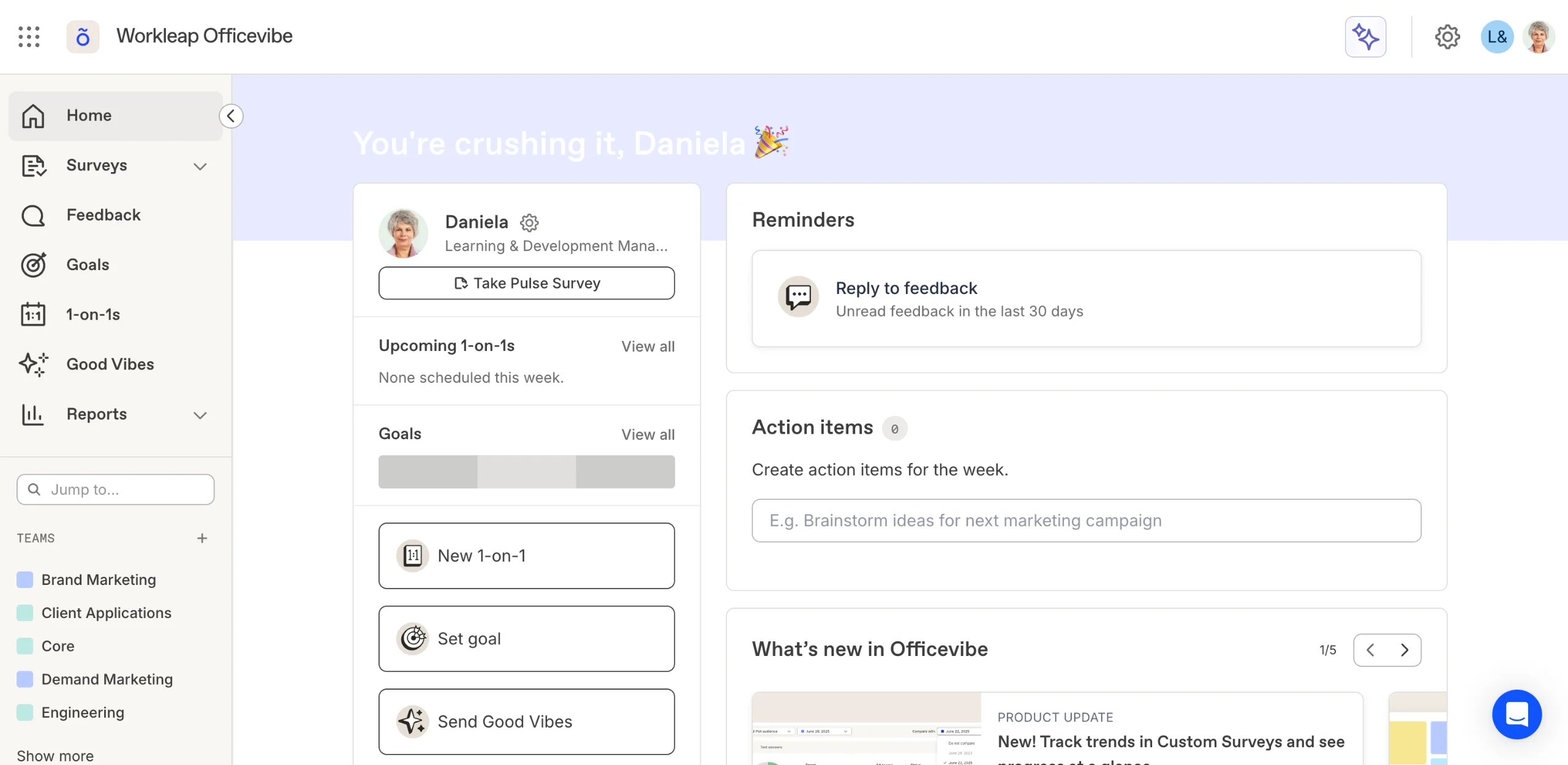
Workleap’s core capabilities cover different parts of the employee lifecycle and are bundled into the Standard and Pro platform tiers under the current flat-fee pricing structure, which is a change from the per-module pricing the platform used historically.
1. Officevibe (Engagement)
Automated weekly pulse surveys covering 10 engagement metrics including recognition, wellness, and manager relationship quality. The anonymous feedback channel lets employees message their manager directly through the platform without revealing identity, which G2 reviewers consistently cite as the feature that surfaces issues regular surveys and 1-on-1s miss. The Good Vibes peer recognition feature is widely mentioned in reviews as the most visible adoption driver, particularly at smaller companies.
“What I like most about Workleap is the insight it gives us as HR managers. The Pulse Surveys are excellent tools for helping gauge employee satisfaction as well as dissatisfaction. I also appreciate having options for one-on-one interactions with both employees and managers. The Good Vibes platform is great, too, for encouraging employee morale and recognition.” – G2 reviewer
2. Performance
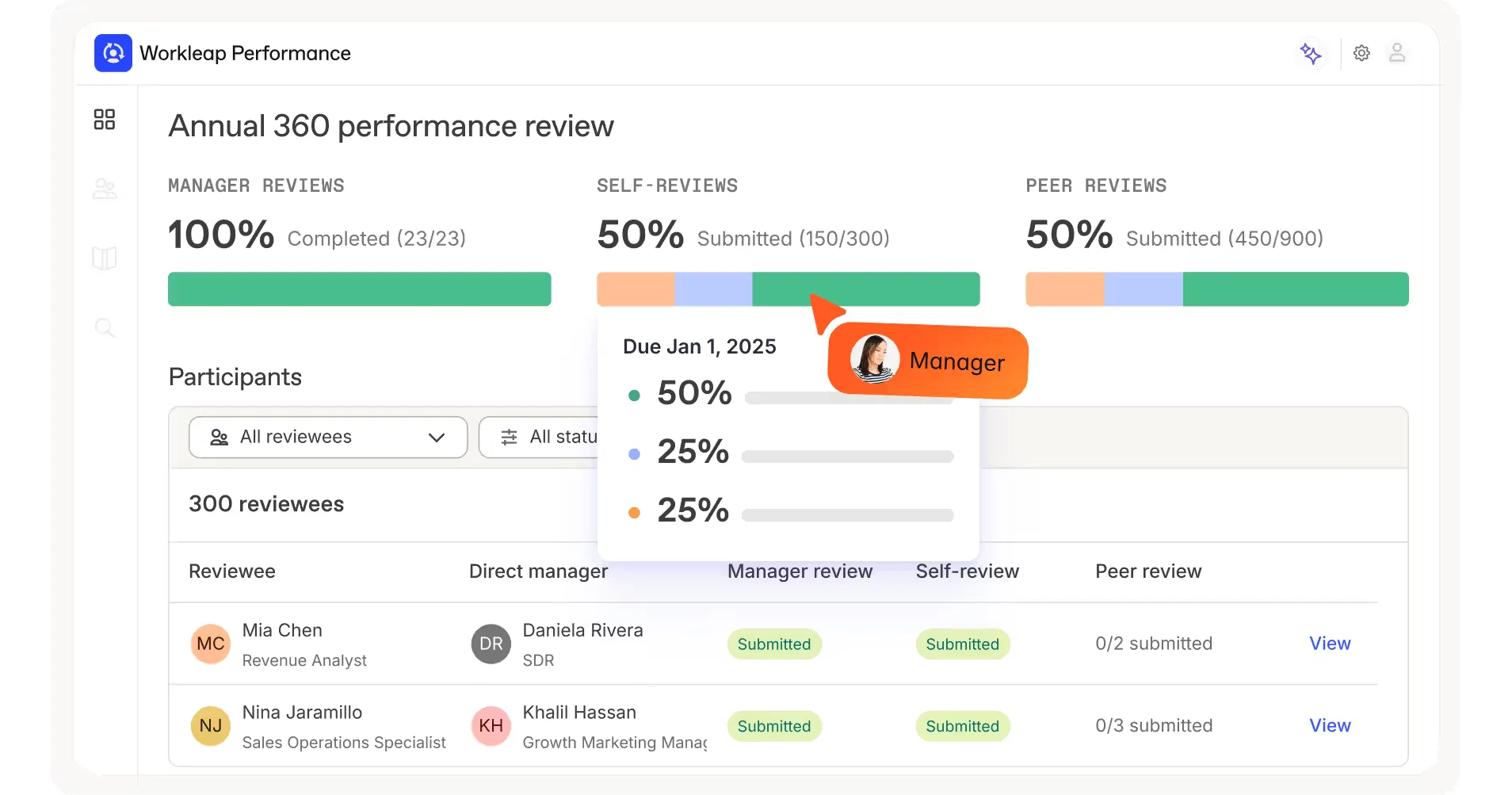
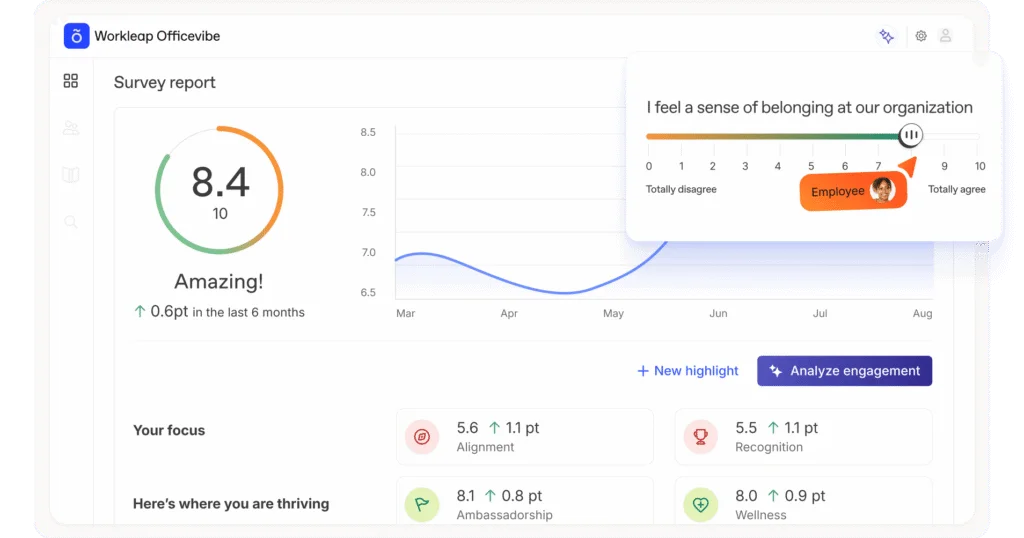
Configurable review cycles supporting self-assessment, manager review, and 360-degree peer feedback. The AI Manager Agent drafts review content from accumulated engagement and feedback data before the manager starts writing, which Workleap markets as removing most of the blank-page problem in performance reviews.
Review cycles connect to OKR-style goal tracking, though the goal module is lighter than dedicated OKR platforms and is better understood as goal tracking integrated with reviews rather than a standalone OKR system.
“Workleap makes it incredibly easy to collect and analyze employee feedback through intuitive survey templates and real-time reporting. I appreciate how the platform encourages open communication and helps leadership quickly identify areas for improvement. The clean UI and actionable insights stand out the most.” – G2 reviewer
3. Compensation
Added through the July 2025 acquisition of Barley, a Toronto-based compensation management platform. Availability differs by tier: Workleap’s pricing page lists compensation benchmarking and pay bands as included in the Pro plan ($11,999/year).
In contrast, compensation planning and analytics and pay equity and analytics are listed as “Coming soon” specifically on the Standard plan. In other words, some compensation functionality may already be live for Pro customers even though related features are still rolling out on Standard. Buyers should confirm exactly which compensation capabilities are active on their specific tier directly with Workleap before budgeting around them.
4. AI Manager Agent
Workleap distinguishes between baseline AI included in both the Standard and Pro platform tiers (AI analyses, summaries, and chat) and the separate, paid Workleap Agent add-on at $99/manager/month, which adds MCP access, advanced memory, proactive insights and action plans, performance review drafting, and a decisions assistant for calibration.
The add-on pulls from surveys, feedback, performance data, and recognition activity to draft reviews and prepare 1:1 talking points; HR configures the cadence and frameworks, and managers receive the output. Early reviews are positive on the time savings for review drafting specifically, though the broader claim that it makes “every manager equally effective” is a vendor framing that the review evidence does not yet fully support.
5. Integrations
Connects to Slack, Microsoft Teams, Microsoft 365 (user provisioning, daily data sync, SharePoint as a connected document source for AI Review context), Workday, HiBob, BambooHR, ADP Workforce Now, Dayforce, UKG Pro, Paylocity, Paycor, Google Workspace, Jira, Confluence, and Notion, per Workleap's help center and integrations pages.
Slack and Teams are the most deeply integrated channels for survey delivery, recognition, and notifications. The broader integration ecosystem is still smaller than what Lattice or 15Five offer, which G2 reviewers flag as a limitation for organizations with more complex tool stacks beyond these core connections.
“The integration of the platform into our work environment turned out to be a step without major difficulty. The platform has become a highly appreciated tool among our employees. Their willingness to regularly return to consult new content and deepen their knowledge demonstrates the added value of this resource.” – G2 reviewer
Pros
“It's been one of the most truly one-stop platforms/tools for bringing employee experiences together in a single, cohesive place. It covers engagement, performance, recognition, and feedback in a way that genuinely feels integrated rather than stitched together. It's also easy to use and intuitive, which makes it a strong fit as an all-in-one platform.” – G2 reviewer
“It improves the employee experience with engagement tools that provide recognition and better drive performance with an easy-to-use interface that we can all learn very quickly. Weekly surveys ensure that employees receive accurate recognition. All the features provide a clear view of each employee's performance in their area, allowing them to properly incentivize those who deserve it.” – Capterra reviewer
- Genuinely easy to deploy without HR hand-holding. G2 reviewers most frequently cite ease of use (31 mentions) as the platform's defining trait, and multiple sources confirm managers can launch surveys and review cycles with minimal training. For SMBs without a dedicated HR ops function, this matters more than feature depth.
- Anonymous feedback and recognition tools drive real cultural adoption. The anonymous feedback channel and Good Vibes recognition feature are consistently described across G2 and TrustRadius as producing genuine engagement rather than survey fatigue, which is the opposite of what most mandatory HR tools achieve.
- One flat fee covers engagement, performance, and goal tracking together. A single $4,999/year Standard plan covers these core workflows rather than requiring separate purchases, which simplifies the buying decision compared to assembling a stack from multiple vendors.
- Compensation is partially available today, with more on the way. Compensation benchmarking and pay bands are already positioned as part of the Pro plan, while planning and pay equity analytics are listed as “Coming soon” specifically on Standard. The module does not uniformly live across tiers yet, but it is further along than a pure roadmap item.
- Pricing is published rather than quote-only. Both the Standard and Pro tiers list exact annual figures on Workleap’s own site, which is a real advantage over the quote-only model most performance management platforms use, even though the underlying structure shifted significantly in 2026.
Cons
“Customization can be one of the downsides of Workleap. You may run into challenges when trying to tailor it to your specific needs and use cases. Pricing can also become a consideration as you scale, especially for smaller teams or startups that are trying to balance cost with the features they need.” – G2 reviewer
“The customer support service is slow in responding to tickets because they have limited hours, and if an urgent ticket is submitted, it can take up to 3 days to be resolved.” – Capterra reviewer
- Flat-fee pricing can work against smaller teams. A $4,999/year minimum is a fixed cost regardless of headcount, which means very small teams pay a higher effective per-employee rate than larger ones. G2 reviewers have previously flagged Workleap’s per-employee economics as expensive for non-enterprise buyers under the prior pricing model, and the new flat-fee structure does not necessarily resolve that for companies under roughly 50 employees.
- Integration ecosystem is smaller than dedicated performance platforms. Workleap connects to the essentials (Slack, Teams, Microsoft 365, and major HRIS platforms) but does not match the breadth of Lattice or 15Five's integration catalogs, which matters for organizations with more complex tool stacks beyond these core connections.
- Reporting and analytics are described as basic by reviewers who need more. Multiple sources note that survey trend analysis and custom reporting are adequate for SMB use but fall short of what Culture Amp or Qualtrics deliver for organizations that need statistical depth or highly customized dashboards.
- Support response time outside North American hours is a recurring complaint. G2 and independent reviews consistently flag slower support for teams operating outside North American business hours, and ticket history visibility has also been raised as a friction point.
- The OKR and goal-tracking module is lighter than dedicated OKR platforms. Goal tracking is functional and connects to reviews, but it is not built for the kind of multi-level cascading alignment that Betterworks or Lattice offer, and should not be evaluated as a standalone OKR replacement.
Pricing and Plans
Workleap's pricing model changed materially in 2026. The platform moved away from the per-module, per-seat structure ($5/user/month for Officevibe, Performance, etc.) that older third-party reviews still cite, toward a flat annual platform fee with an optional AI Manager Agent add-on. All figures below are verified from Workleap's own pricing page and G2's pricing data, both last updated within the past several weeks as of this writing (June 2026). Given how recently this changed, confirm current pricing directly with Workleap before budgeting.
What this means for budgeting: Workleap is no longer priced per employee for the core platform; the Standard and Pro tiers are flat annual fees regardless of headcount, which is unusual in this category and worth factoring into any per-employee cost comparison against competitors.
The Workleap Agent add-on is priced per manager, not per employee, so the total cost scales with how many people manage others rather than total headcount. There is no published free trial at the platform level; Workleap has previously offered a free Officevibe starter tier for very small teams, though this is not confirmed as still active under the current pricing structure.
Our Rating
Best Use Cases
Workleap's flat-fee structure and SMB-friendly pricing point toward a specific buyer profile. Outside that profile, the lighter feature depth in any single category becomes more of a constraint than the price.
Workleap is a strong fit for:
- SMBs and mid-market companies (50 to 1,500 employees) that want engagement and performance management together in one flat-fee platform without paying enterprise-platform prices.
- Organizations without a dedicated HR ops function that need a platform managers can use with minimal training. The consistent ease-of-use praise across G2, Capterra, and TrustRadius reflects a genuinely low learning curve.
- Companies that want to be ready to add compensation planning once Workleap’s Compensation features move out of “Coming soon” status, while benefiting from engagement and performance tools today.
- Teams already using Slack as the primary collaboration tool, where survey delivery and recognition through Slack drive materially higher engagement than email-based alternatives.
Look elsewhere if:
- You need enterprise-grade OKR cascading or calibration tooling. Workleap's goal tracking is integrated with reviews but not built for multi-level alignment at scale. Betterworks or Lattice are the more appropriate conversations.
- Your organization has 1,500+ employees and needs deeper analytics, custom reporting, or statistical rigor in engagement data than the standard dashboards provide.
- You need a broad third-party integration catalog beyond Slack, Teams, and major HRIS platforms. Workleap's ecosystem is noticeably smaller than Lattice or 15Five's.
- Compensation planning or benchmarking is a current requirement. Workleap lists compensation planning and pay equity analytics as “Coming soon” on Standard, while compensation benchmarking and pay bands appear on Pro; availability may not be fully rolled out on every tier yet, so confirm exact current scope with Workleap before relying on it. Lattice has a more mature, broadly available compensation module.
Alternatives and Competitors
These platforms compete most directly with Workleap depending on which module or capability gap is the deciding factor:
- 15Five: The closest comparable in target market and pricing philosophy. Published pricing starting at $4/user/month (Engage) and $11/user/month (Perform), with considerably more G2 reviews (1,900+) to evaluate against. Stronger OKR and manager coaching tools than Workleap's Performance module.
- Lattice: Worth evaluating when deeper compensation benchmarking, Mercer-grade engagement data, or enterprise-scale goal alignment is the priority. Considerably more expensive and configuration-heavy than Workleap.
- Culture Amp: The better choice when engagement analytics and benchmarking depth matter more than bundled performance and compensation. Workleap's survey reporting is consistently described as more basic by comparison.
- Leapsome: Comparable in combining performance, engagement, and learning, with a stronger G2 rating (4.8/5) and a more mature feature set, at a higher price point than Workleap’s $4,999/year Standard tier.
- Small Improvements: A close comparable for SMBs prioritizing simplicity and fast setup over AI-driven features. Small Improvements lacks Workleap's compensation module and AI Manager Agent but has a tighter, more focused feature set for review cycles specifically.
- Teamflect: The better fit for Microsoft-centric organizations, since it lives natively inside Microsoft Teams. About 4.5/5 on G2 (176 reviews) as of July 2026 (subject to change), but lacks Workleap's compensation module.
Final Verdict
If you are an SMB or mid-market company that wants engagement and performance management in one flat-fee platform without assembling a multi-vendor stack: Workleap’s Standard plan covers both from $4,999/year, and the published pricing makes it easier to budget against than the quote-only model most competitors use.
Compensation features vary by tier and some, including planning and pay equity analytics on Standard, are listed as “Coming soon” rather than confirmed live, so verify exact current availability with Workleap rather than assuming the full Compensation module is active on your plan. The ease of use that shows up consistently across every review source is not marketing language; managers actually adopt this without much training, and that matters more than a longer feature list for most companies in this size range.
If you are evaluating this against enterprise OKR platforms, need deep compensation benchmarking, or have a complex integration stack beyond Slack and Teams, Workleap's lighter feature depth in each individual category will show up quickly. The AI Manager Agent is a genuine 2026 differentiator for review drafting specifically, but it is not yet evidence that the platform has closed the gap with dedicated performance or compensation tools.

.avif)