.svg)

.svg)
.svg)
.svg)
Quick Verdict
| What it is | An AI-powered people platform combining HRIS, performance management, engagement surveys, goals, learning, and compensation in a modular system. |
| Best for | Mid-market organizations (100-1,000 employees) with a dedicated People Ops function that can manage a multi-module implementation and sustain ongoing admin across the platform. |
| Not for | Organizations under 50 employees, teams without dedicated HR admin capacity, frontline or field-based workforces, or buyers who need native payroll in the same system. |
| Starting price | ~$3-$8/user/month per module (billed annually). Full platform typically $20-$40/user/month depending on modules selected. Not fully publicly disclosed. Verified May 2026 via G2, OutSail, and Leapsome's pricing page. |
| G2 / Capterra | 4.8/5 on G2 (2,200+ reviews); 4.6/5 on Capterra. Verified May 2026. |
| Our overall rating | 3.6/5 (see rating rubric below) |
Most HR teams evaluating Leapsome are not looking for more software. They are looking for fewer tools. Reviews in one system, surveys in another, goals in a spreadsheet, learning in a third platform, and core employee data somewhere else entirely. Leapsome's pitch is that all of that can live in one place, and for organizations with the HR capacity to set it up properly, that pitch holds up.
This software review covers what Leapsome actually delivers, where it falls short, and which buyer profiles it fits and does not fit.
What Is Leapsome?
Leapsome is an AI-powered people platform founded in 2016 by Kajetan Armansperg and Jenny Podewils, headquartered in Berlin with offices in New York. It serves over 2,000 organizations globally, with a strong footprint in Europe and growing presence in North America. The platform combines HRIS, performance management, engagement surveys, goals and OKRs, learning, and compensation management in a modular structure, allowing organizations to adopt individual modules or the full suite.
Leapsome is used primarily by mid-market technology, professional services, and knowledge-work organizations. It is ISO 27001 and GDPR compliant, supports 38 languages, and includes AI Copilot across all plans at no extra cost. Native payroll is not part of the platform. Payroll data preparation is available within the HRIS module, but processing connects to external payroll providers.
Key Features of Leapsome
Leapsome's feature set spans six core modules. Each can be purchased separately or combined.
1. Performance Management
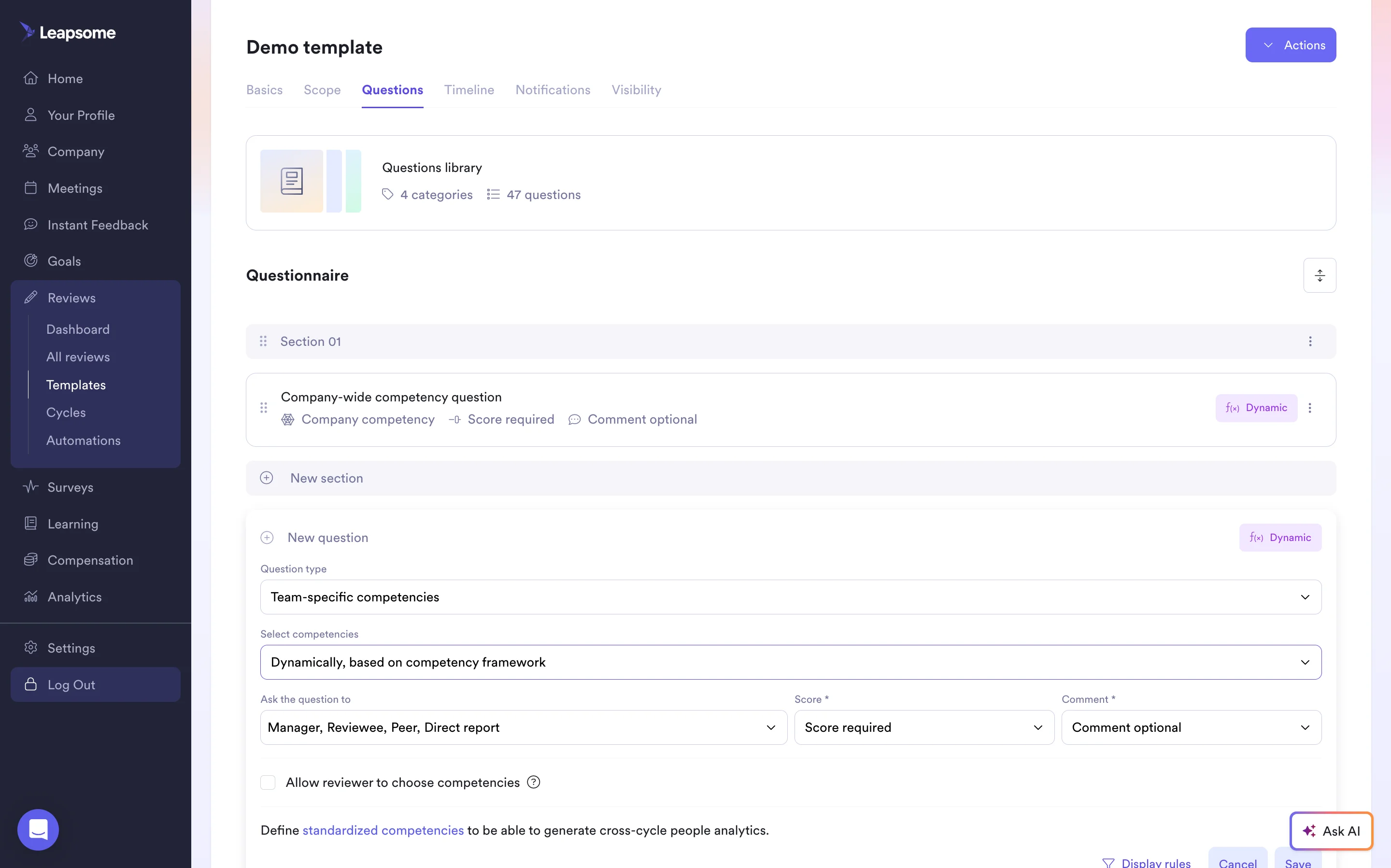
Flexible review cycles with configurable templates supporting self-assessment, manager review, peer review, and upward feedback. Calibration tools allow HR teams to align ratings across managers before results are finalized. Continuous feedback runs outside of formal review cycles through the instant feedback feature, and 1-on-1 meeting tools include agenda templates and carry-forward action items. Review comments and summaries are searchable and connected to goal data within the platform. For organizations managing more complex review programs, the right software can also help standardize processes across teams and make performance data, it becomes especially important when evaluating performance review software for enterprise organizations.
“In my work, I use Leapsome mainly for performance reviews, goal tracking, peer feedback, and 1:1 discussions. Earlier, review comments and action items were usually scattered across mails or separate notes, which made follow-ups difficult during review cycles.” - G2 reviewer
2. Goals and OKRs
OKR tracking at the company, team, and individual level with goal cascading and progress visualization. Parent goals aggregate completion percentages from child goals automatically when goals are set up numerically. Quarterly check-in workflows and progress nudges are configurable. The key result metric system does not support high-to-low value ranges, a limitation flagged in multiple G2 reviews as of early 2026. Leapsome's goal management supports multi-level cascading and progress tracking across teams, making it a good fit for organizations seeking the best OKR software for enterprise organizations.
“It has been really helpful to be able to prepare my 1:1 annotations at any time, allowing me to track my progress effortlessly throughout the week. The praise system gives everyone a sense of accomplishment and provides a rewarding feeling that makes the overall environment feel more human.” - G2 reviewer
3. Engagement Surveys
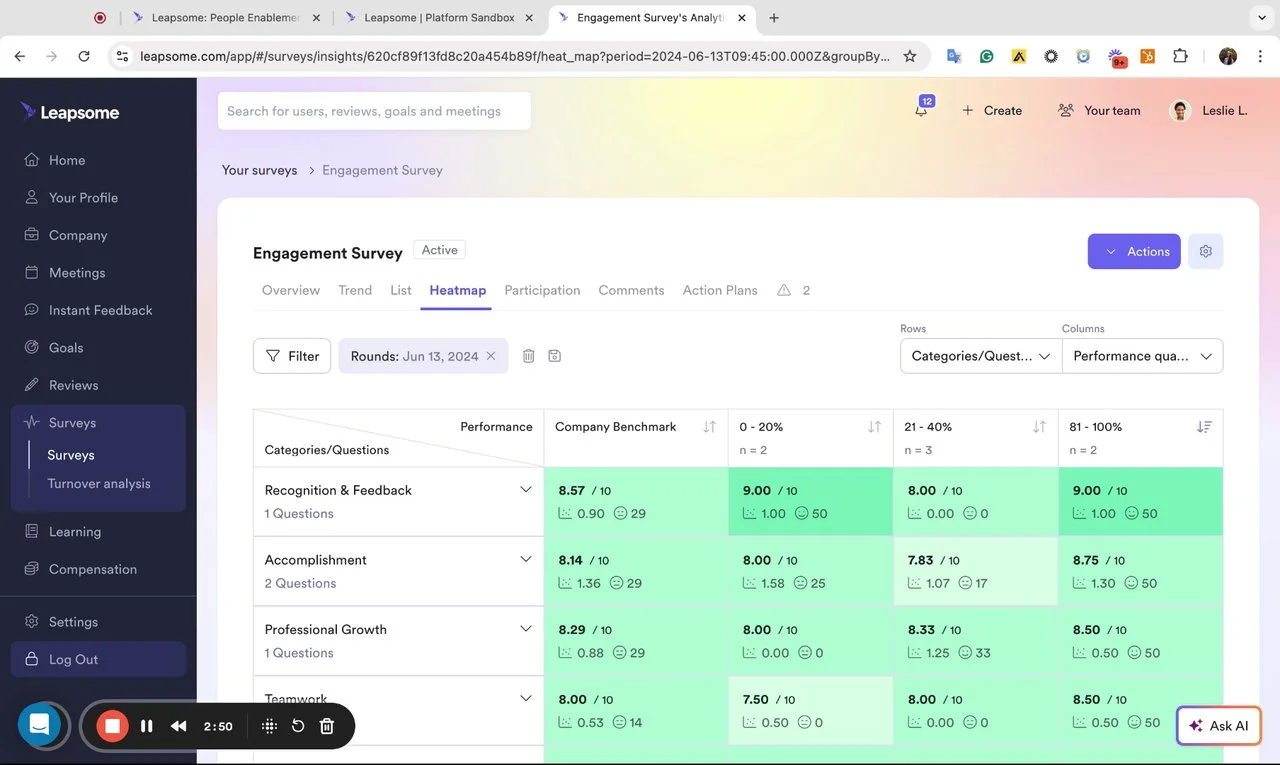
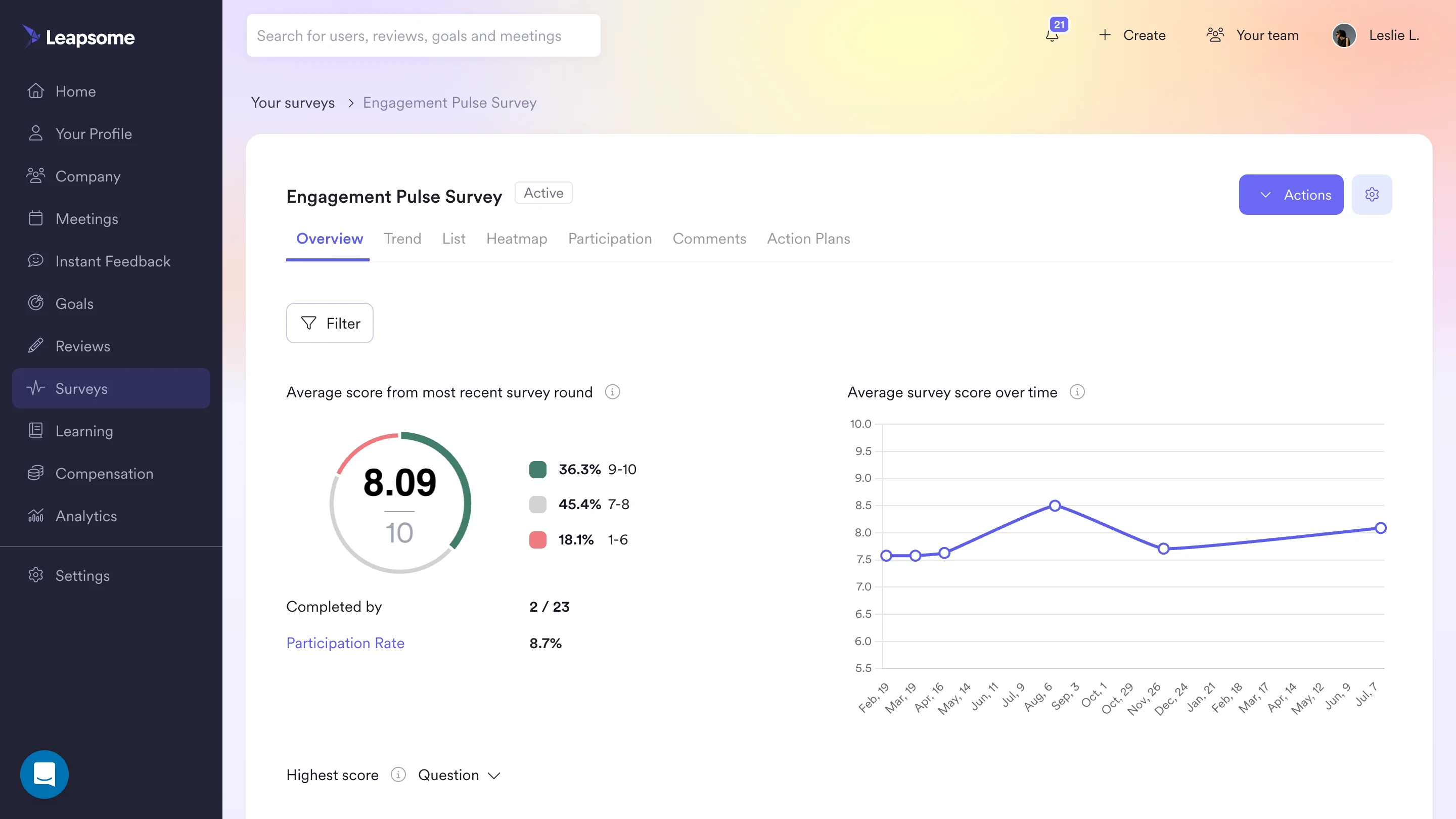
Custom and research-backed pulse surveys, lifecycle surveys, and eNPS. AI-powered response analysis extracts themes and surfaces actionable insights from open-text answers. Survey benchmarks allow comparison against industry data. One structural limitation worth noting upfront: once a survey is launched, it cannot be edited. Teams that need to adjust questions mid-cycle must wait until the next round.
4. Learning and Development
Structured learning paths, skill-based content delivery, and individual development plans linked to performance review data and goal progress. Course tracking and completion reporting give HR teams visibility into development activity across the organization. Learning paths feature was rated by Capterra reviewers as one of the stronger elements of the platform for building structured employee development programs.
5. HRIS
Employee records, org chart, role and permissions management, onboarding workflows, absence management, and payroll data preparation. The HRIS module centralizes people data and connects it to performance, goals, and compensation data within Leapsome. It is not a full HRIS replacement for organizations that need native payroll, deep compliance tooling, or complex benefits administration.
6. Compensation Management
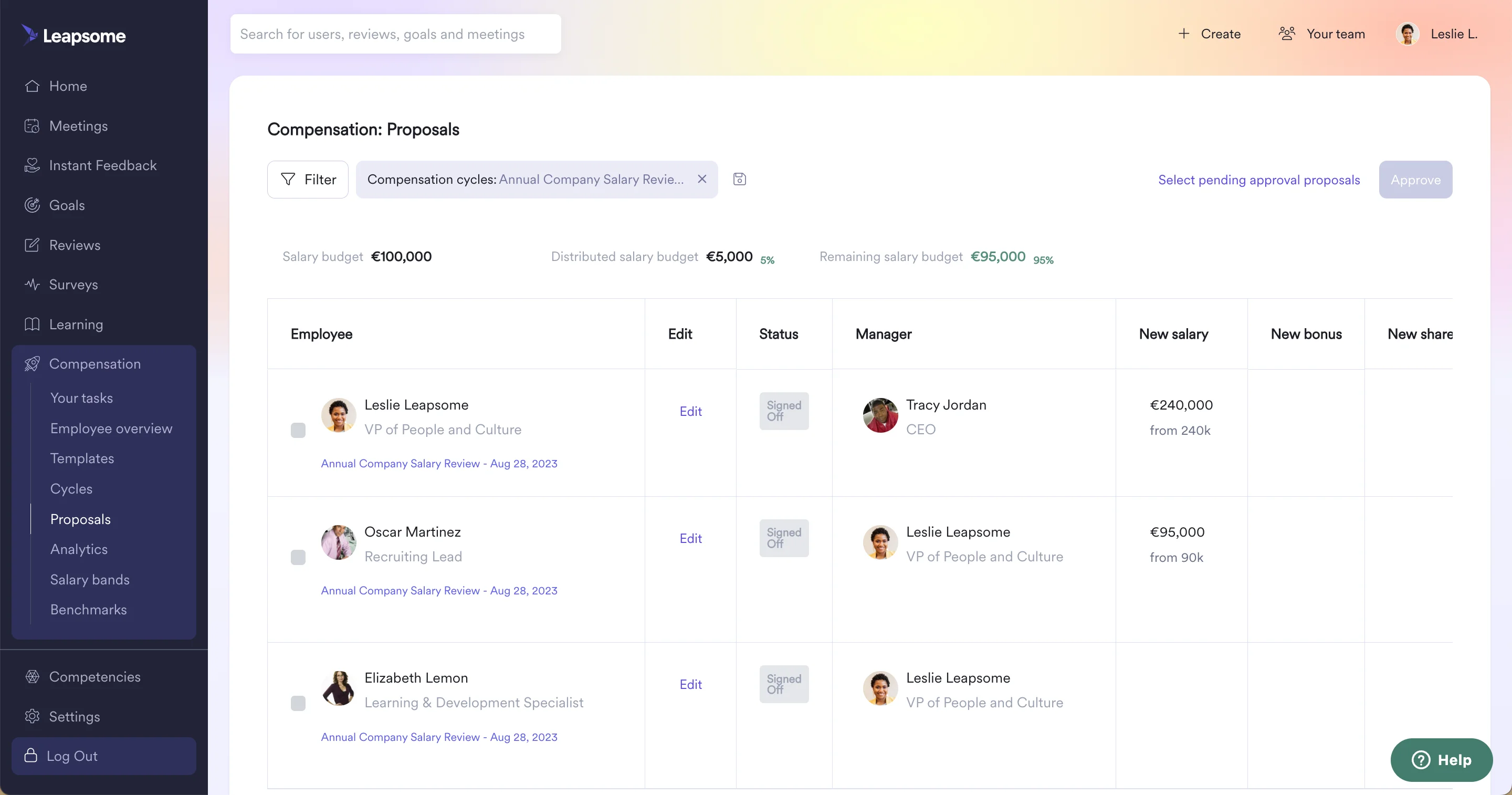
Merit cycle management, salary band benchmarking, and pay equity analysis. This module is an add-on with custom pricing and is typically adopted after the core performance and engagement modules are established. It connects directly to performance review outcomes, which is one of the more useful aspects of Leapsome's unified data model.
7. AI Copilot
Included across all plans at no extra cost. AI Copilot assists with drafting feedback, summarizing survey responses, generating performance insights, and flagging action plans for managers. As of May 2026, AI features are functional but still maturing. Several G2 reviewers note the AI assistance adds value on routine tasks while remaining limited on complex or nuanced HR decisions.
How Leapsome Works
Leapsome is organized around a central people data layer that connects all modules. Employee records feed into review cycles, goal data surfaces in 1-on-1 templates, survey results inform development plans, and compensation decisions tie back to performance ratings. That data connectivity is the strongest structural argument for choosing Leapsome over a set of point solutions.
Setup follows a modular path. Organizations typically start with one or two modules, most commonly performance reviews or engagement surveys, and expand from there. A single-module setup can be configured in two to four weeks. Full platform implementation covering performance, goals, engagement, learning, and HRIS typically takes one to three months depending on team size, data complexity, and how much process design work is required upfront.
Day to day, managers use Leapsome for review cycles, 1-on-1 agendas, goal updates, and feedback. Employees interact with surveys, self-assessments, and development plans. HR administrators manage configurations, run reporting, and oversee module-level setup. The mobile app covers core functions but is primarily designed for desk-based workflows. Frontline and field-based employees consistently report a less complete mobile experience than desktop users.
Pros
One G2 reviewer writes: "What I like best about Leapsome is how user-friendly and structured it is. It makes performance tracking, goal setting, and feedback very clear and easy to manage. I also appreciate how it helps improve communication and keeps everything organized in one place, which supports continuous learning and professional growth."
Another Capterra reviewer notes: "Leapsome is an excellent choice for companies (medium to large size) that are looking to improve the performance management, employee development and engagement. It stands out for its comprehensive feature set, ease of use and ability to drive culture of continuous feedback and growth."
- The all-in-one data model is the strongest case for Leapsome. Performance review outcomes connect to goal progress, goal data surfaces in 1-on-1 templates, and survey results feed into development plans. For organizations currently reconciling this data across three or four separate tools, the consolidation value is tangible and measurable.
- Review cycle automation reduces manual HR overhead significantly. Configurable templates, automated reminders, and calibration workflows mean HR teams spend less time chasing completions. A Capterra reviewer with 50 employees reported scheduling all review cycles in five minutes using Leapsome's template system.
- G2 and Capterra ratings reflect consistently high user satisfaction at scale. A 4.8/5 rating from over 2,200 G2 reviews is one of the highest sustained scores in the performance management category. Positive reviews consistently cite ease of navigation, organized goal tracking, and the quality of feedback workflows.
- AI Copilot is included at no additional cost across all plans. Most competitors charge separately for AI features or gate them to higher tiers. As of May 2026, AI Copilot covers feedback drafting, survey summarization, and performance insights, with ongoing development.
- Module flexibility allows phased adoption. Organizations can start with one or two modules and expand without switching platforms. For HR teams that cannot justify a full platform investment upfront, this reduces the barrier to entry compared to all-or-nothing pricing models.
Cons
Critical reviewers on Capterra write: "Leapsome has a very high variety of features, and we needed a software that has a few things 1. Employee feedback and reviews 2. Employee and business goals 3. Employee learning development It does a large variety of things, and does them mostly well, but it is clear that a lot of the software is not very well thought out which causes me problems, as the admin. I am often left struggling to explain why something is one way, or why I can't do something I think seems obvious."
A G2 reviewer adds: "I’d like to have more options for giving praise and for managing the team. Also, meeting notifications keep coming through even when a meeting has been canceled or when it was only meant to be a one-time meeting."
- Implementation scope is consistently underestimated. A full Leapsome deployment covering performance, surveys, goals, learning, and HRIS typically takes one to three months. Review template configuration is specifically cited as clunky by multiple reviewers. Organizations planning a 30-day launch timeline should scope carefully.
- Per-module pricing compounds quickly as you expand. Entry-level pricing of ~$3-$8/user/month per module looks manageable for a single workflow. At full platform adoption, total cost reaches $20-$40/user/month, which is comparable to integrated platforms that include payroll. Budget conversations at renewal often look different from what was approved at purchase.
- Launched surveys cannot be edited. Once an engagement survey is live, questions are locked. HR teams that run iterative feedback processes or need to adjust mid-cycle have no option but to wait for the next round. For organizations with agile survey practices, this is a structural limitation.
- Native payroll is not part of the platform. Leapsome prepares payroll data within the HRIS module but does not process it. Organizations that want payroll and people data in a single system will need to maintain a separate payroll tool or manage an integration.
- Mobile experience lags for non-desk workforces. Leapsome is built primarily for desk-based knowledge workers. Users in frontline, retail, manufacturing, or field-based roles consistently report a less complete mobile experience. The app covers core functions but is not designed to be the primary interface.
First-Hand Evaluation
We accessed Leapsome's 14-day free trial on 6 May 2026 and tested the platform with a simulated 75-person company dataset. Key observations:
- Performance review setup: Configuring a quarterly review cycle with self-assessment, manager review, and peer feedback took 34 minutes from blank slate to launch-ready. The template builder is flexible but requires more steps than simpler review tools. Switching between question types mid-template required navigating back to a prior screen rather than editing inline.
- Goal cascading: Company-level OKRs cascaded to team and individual goals cleanly, and progress rolled up automatically once numeric key results were configured. The high-to-low metric range limitation confirmed in G2 reviews was reproducible. Setting a goal that tracks reduction (e.g., reducing error rate from 10% to 2%) required a workaround.
- Engagement survey: Building a custom pulse survey took 8 minutes using the template library. The locked-survey limitation was confirmed. After launch, the edit button on question fields was disabled with a tooltip noting surveys cannot be modified once active.
- Mobile experience: Tested on iOS. Time-off requests, survey completion, and goal updates worked without issues. The 1-on-1 meeting notes interface was harder to navigate on mobile than desktop. Switching between agenda items required multiple taps where the desktop required one click.
- Pricing: We requested a pricing quote on 7 May 2026 for a 100-person organization using performance, goals, and engagement modules. The sales team responded within one business day with a bundled quote of $14.50/user/month, confirming that multi-module discounts apply and that the starting per-module rates are not additive at face value.
Pricing and Plans
Leapsome uses modular per-user pricing billed annually. Figures below are based on G2 pricing data (verified May 2026), OutSail independent buyer research (April 2026), and a direct quote request on 7 May 2026. A 14-day free trial is available without a credit card. Leapsome offers free platform access until December 2026 for organizations currently locked into a competing HRIS contract.
| Module | Est. Price (per user/month) | What's Included |
|---|---|---|
| Performance Management | ~$7-$8/user/month | Performance reviews, 360-degree feedback, continuous feedback, calibration tools, and review cycle automation. |
| Goals and OKRs | ~$5-$6/user/month | Company, team, and individual OKR tracking, goal cascading, and quarterly check-in workflows. |
| Engagement Surveys | ~$4-$5/user/month | Custom and research-backed pulse surveys, eNPS, AI-powered response analysis, and engagement benchmarks. |
| Learning and Development | ~$4-$5/user/month | Learning paths, skill-based content delivery, structured development plans, and course tracking. |
| HRIS (People module) | ~$3-$4/user/month | Employee records, org chart, onboarding workflows, absence management, and payroll data preparation. |
| Compensation | Add-on, custom pricing | Compensation benchmarking, merit cycle management, and pay equity analysis. Pricing requires a sales conversation. |
| Full platform (all modules) | ~$20-$40/user/month | Total cost depends on modules selected, headcount, and contract length. Multi-module and volume discounts available. AI Copilot included at no extra cost across all plans. |
Multi-module and volume discounts are available. A 100-person organization using three modules (performance, goals, engagement) was quoted $14.50/user/month in a direct sales conversation on 7 May 2026, confirming that bundled pricing is meaningfully below the sum of individual module rates. Dedicated customer success support is tied to larger annual contracts.
Our Rating
| Dimension | Score | Notes |
|---|---|---|
| Core feature depth | 4.5/5 | Performance, engagement, goals, learning, and HRIS in one platform. Compensation module is an add-on. No native payroll. |
| Integration ecosystem | 3.5/5 | Integrates with major HRIS and payroll tools, Slack, and Microsoft Teams. Integration depth is narrower than open API-first platforms. |
| User ratings (G2 + Capterra avg.) | 4.7/5 | 4.8/5 on G2 (2,200+ reviews); 4.6/5 on Capterra. Verified May 2026. |
| Pricing transparency and value | 3.0/5 | Modular pricing starts at ~$3-$8/user/month per module. No public all-in pricing. Full platform cost can reach $20-$40/user/month depending on module selection. |
| Implementation and onboarding | 3.0/5 | Single-module setup takes a few weeks. Full platform implementation typically runs one to three months. Review template setup is frequently cited as clunky. |
| Overall | 3.6/5 | — |
Best Use Cases
Leapsome fits a specific organizational profile. When the fit is right, the consolidation value is real. When it is not, the setup overhead and cost structure work against the buyer.
Leapsome is a strong fit for:
- Mid-market organizations with 100 to 1,000 employees that have a dedicated HR or People Ops function capable of managing a multi-module implementation and sustaining ongoing platform administration.
- Companies currently running three or more separate HR tools (a review tool, a survey tool, a goal tracker, a learning platform) where data reconciliation across systems is creating real overhead for the HR team.
- Series B to D technology and professional services companies that want one system to carry performance, engagement, and development from 100 through 500 employees without switching platforms mid-growth.
- Organizations where compensation decisions are directly tied to performance review outcomes and want that connection built into the system rather than managed manually across tools.
Look elsewhere if:
- You have fewer than 50 employees or a lean HR team without dedicated admin capacity. The setup scope and per-module cost structure work against smaller organizations, and lighter tools like 15Five or Teamflect deliver most of the core value at lower overhead.
- You need native payroll. Leapsome prepares payroll data but does not process it. If payroll and HR data need to live in the same system, BambooHR, Rippling, or Gusto are more appropriate depending on size.
- Your workforce is primarily frontline, field-based, or hourly. Leapsome's mobile experience is functional but not built for non-desk workflows.
- You need to launch in under 30 days. Full platform implementation realistically takes one to three months. Single-module setups are faster, but organizations expecting rapid deployment across multiple workflows should plan accordingly.
Alternatives and Competitors
These are the most commonly evaluated alternatives when Leapsome is on the shortlist:
- Lattice: The closest direct competitor in the all-in-one performance and engagement category. Stronger North American presence, more mature performance review workflows, and a similar price point (~$11/user/month for the talent management module). Better suited for organizations that prioritize performance depth over HRIS breadth.
- Culture Amp: A stronger option when engagement surveys and people analytics are the primary need rather than performance management. Culture Amp's benchmarking dataset (25M+ employees) is deeper than Leapsome's, and its DEI analytics tools are more developed. Performance management is available but is not the platform's core strength.
- 15Five: A more accessible option for organizations under 200 employees that want continuous feedback, weekly check-ins, OKRs, and engagement surveys without the configuration overhead of a full platform. Pricing is more transparent and the setup timeline is shorter.
- Teamflect: A strong fit for organizations running Microsoft 365 that want performance management, OKRs, 360 feedback, and engagement tools built natively inside Microsoft Teams, without a separate platform login. Lighter HRIS depth than Leapsome and no native payroll, but significantly lower adoption friction for Microsoft-first organizations.
- HiBob: A better fit when HRIS depth is as important as performance and engagement. HiBob covers employee records, onboarding, payroll integrations, and compensation alongside performance tools, making it a closer full-stack alternative to Leapsome than platforms that focus on talent management alone.
Final Verdict
If you are a mid-market organization (100-1,000 employees) with a dedicated People Ops team and a real fragmentation problem across HR tools, Leapsome is worth a serious evaluation. The unified data model, review cycle automation, and module flexibility are genuine strengths, and the G2 and Capterra ratings reflect sustained satisfaction at scale. Budget correctly from the start: include multi-module pricing in your comparison, not just the entry-level per-module rate, and plan for a one-to-three month implementation timeline rather than a rapid deployment.
If you are under 100 employees or running a lean HR function without dedicated admin capacity, Leapsome is likely the wrong call. The setup overhead and per-module cost structure are misaligned with smaller organizations. 15Five, Teamflect, or PerformYard deliver most of the core performance and engagement value with significantly less implementation burden and at lower cost.
If you need native payroll, deep HRIS compliance tooling, or a platform built for frontline workforces, Leapsome does not cover that ground. BambooHR or Rippling for US-based payroll and HRIS needs, or HiBob for a more complete mid-market people platform, are stronger fits depending on your size and compliance requirements.

.avif)