.svg)
Employee experience (EX) is the sum of everything an employee encounters, feels, and observes throughout their time with an organization, from first contact as a candidate to their final day and beyond. It spans three environments: the cultural (how it feels to work there), the physical (where and how they work), and the technological (the tools they use to do their jobs).
Key Takeaways
- Employee experience is broader than engagement. Engagement is an emotional outcome (commitment and discretionary effort) that a good experience produces. EX is the whole environment that shapes it.
- Highly engaged teams are 23% more profitable and 14 to 18% more productive than their least-engaged counterparts, per Gallup's meta-analysis of 183,000+ business units.
- Manager quality is a highly controllable EX driver. Gallup's research finds it account for at least 70% of the variance in team engagement scores.
- Forrester began incorporating employee experience into its Total Experience Score from 2026, recognizing that the conditions employees work under have a measurable influence on customer interaction quality.
What Is Employee Experience?
Employee experience is the organizational parallel to customer experience: the sum of every interaction an employee has with their employer, across every touchpoint and every stage of their time at the organization.
The term was popularized by The Employee Experience Advantage (Jacob Morgan, 2017), which analyzed 250+ global organizations and introduced the three-environments framework, one of the most widely used EX models.
Employee experience is shaped by three overlapping environments:
- Cultural environment: Generally considered the most influential of the three, it covers values, norms, leadership behavior, inclusion, purpose, and the intangible sense of how it actually feels to work there day to day.
- Physical environment: Encompassing the spaces and conditions in which people work, this includes office design, remote and hybrid arrangements, equipment, and any location-based resources that support or constrain how people get their jobs done.
- Technological environment: Every tool, system, and platform employees rely on to do their work falls here, from core business software and communication tools to mobile devices and the intranet.
EX is not the same as engagement or satisfaction. Satisfaction is a point-in-time reading; engagement is a behavioral outcome. Employee experience is the full environment that produces (or undermines) those outcomes, shaped at every touchpoint along the employee journey, not just during formal HR moments.
The Employee Experience Lifecycle
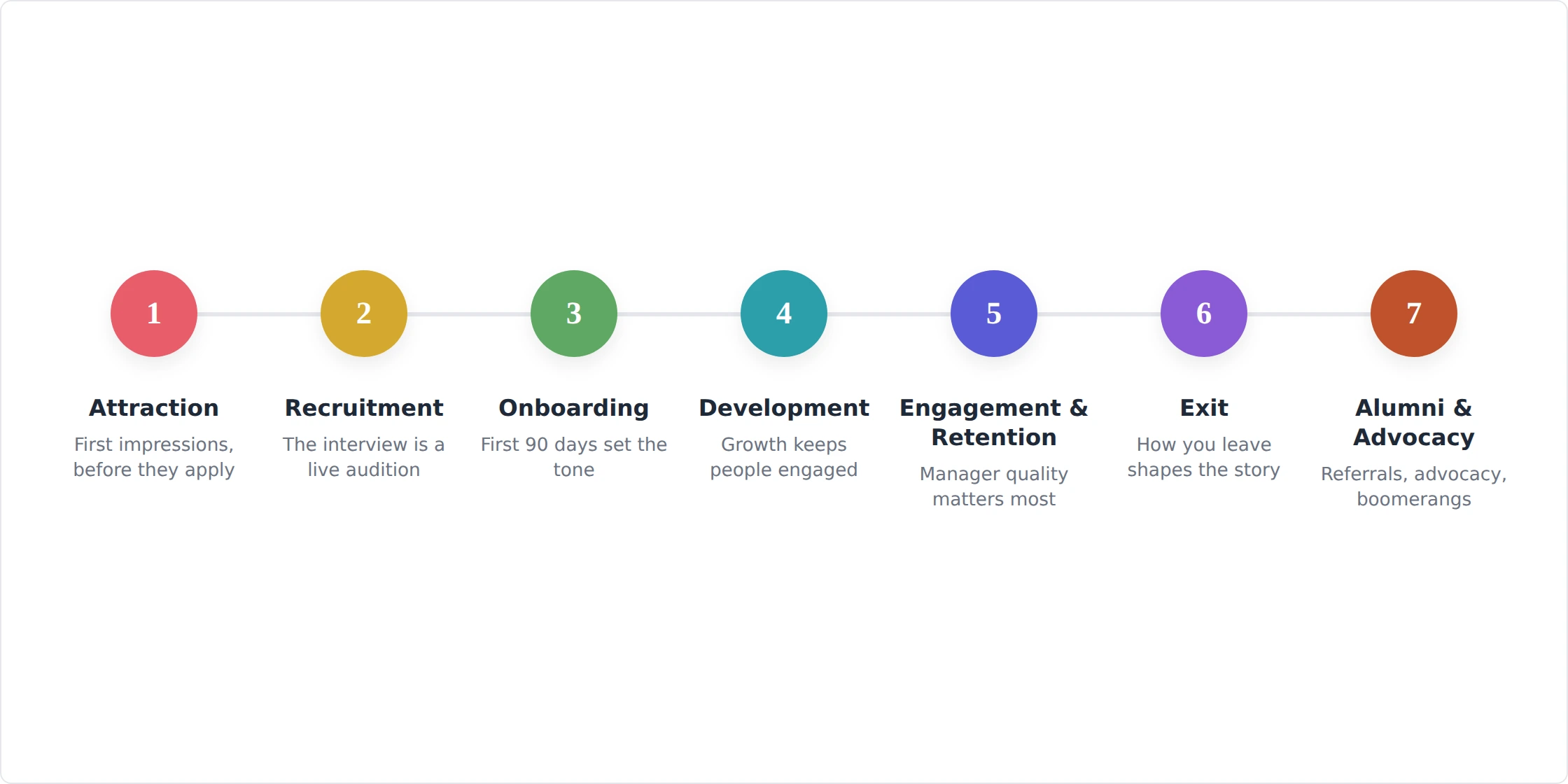
EX does not start on day one and end at resignation. It spans the entire arc of the employment relationship, and each stage shapes what comes next.
1. Attraction
Candidates form impressions of an organization long before they apply. Employer brand, job postings, Glassdoor reviews, and word of mouth from former employees all factor in. If the experience of engaging with a company feels unclear or generic at this stage, the best candidates move on. Good recruiting software makes a real difference here, helping organizations present a consistent, compelling face to the talent market.
2. Recruitment
The interview process is a live audition, not just for the candidate but for the organization. How quickly does the company respond? Are interviewers prepared? Is feedback given respectfully? These details signal what working there will actually feel like, often more accurately than any job description does.
3. Onboarding
This is the highest-leverage stage. A new hire's impression of the organization is most malleable in the first 90 days, and that impression tends to stick. Yet many companies still treat onboarding as a paperwork exercise rather than a designed experience. Structured programs improve time to productivity and reduce early turnover. Onboarding software helps make that consistency repeatable, especially for distributed or fast-growing teams.
4. Development
Once employees are settled, growth opportunities become the main thing keeping them engaged. Career pathing, access to learning, and manager investment in development all signal whether the organization sees the employee as a long-term asset. Attrition driven by lack of growth is frequently misread as a compensation problem. Development platforms help make learning and career progression visible and structured.
5. Engagement and Retention
The day-to-day experience of working somewhere: the relationship with a manager, whether effort gets recognized, access to flexibility, feeling psychologically safe enough to speak up. This is the stage where EX research is richest and where the most visible tools live, from engagement platforms and recognition software to well-being tools. It is also where manager quality matters most.
6. Exit
How someone leaves shapes what they say about the organization for years. A poorly managed exit turns a neutral departure into a negative story. A good one keeps the door open for boomerang hires, referrals, and employer brand advocacy that money cannot buy.
7. Alumni and Advocacy
Former employees are an underused asset. Those who left on good terms often become the organization's most credible recruiters, brand advocates, and even future customers. The employee journey does not end at the exit interview; it just changes form.
Employee Experience vs Employee Engagement
These two terms are frequently confused. The distinction matters because conflating them leads to measuring the wrong things and investing in the wrong places.
| Employee Experience (EX) | Employee Engagement | |
|---|---|---|
| What It Is | The full environment and journey an employee encounters across their time at the organization | An emotional outcome: the degree of commitment and discretionary effort an employee brings to work |
| Scope | Holistic: spans all three environments and all lifecycle stages | A point-in-time state reflecting how an employee feels right now |
| Relationship | EX is the cause | Engagement is an effect of good EX |
In practical terms: you cannot improve engagement by measuring engagement. You improve it by improving the experience that produces it. EX-focused organizations design the environment first and treat engagement scores as a downstream signal.
Why Employee Experience Matters
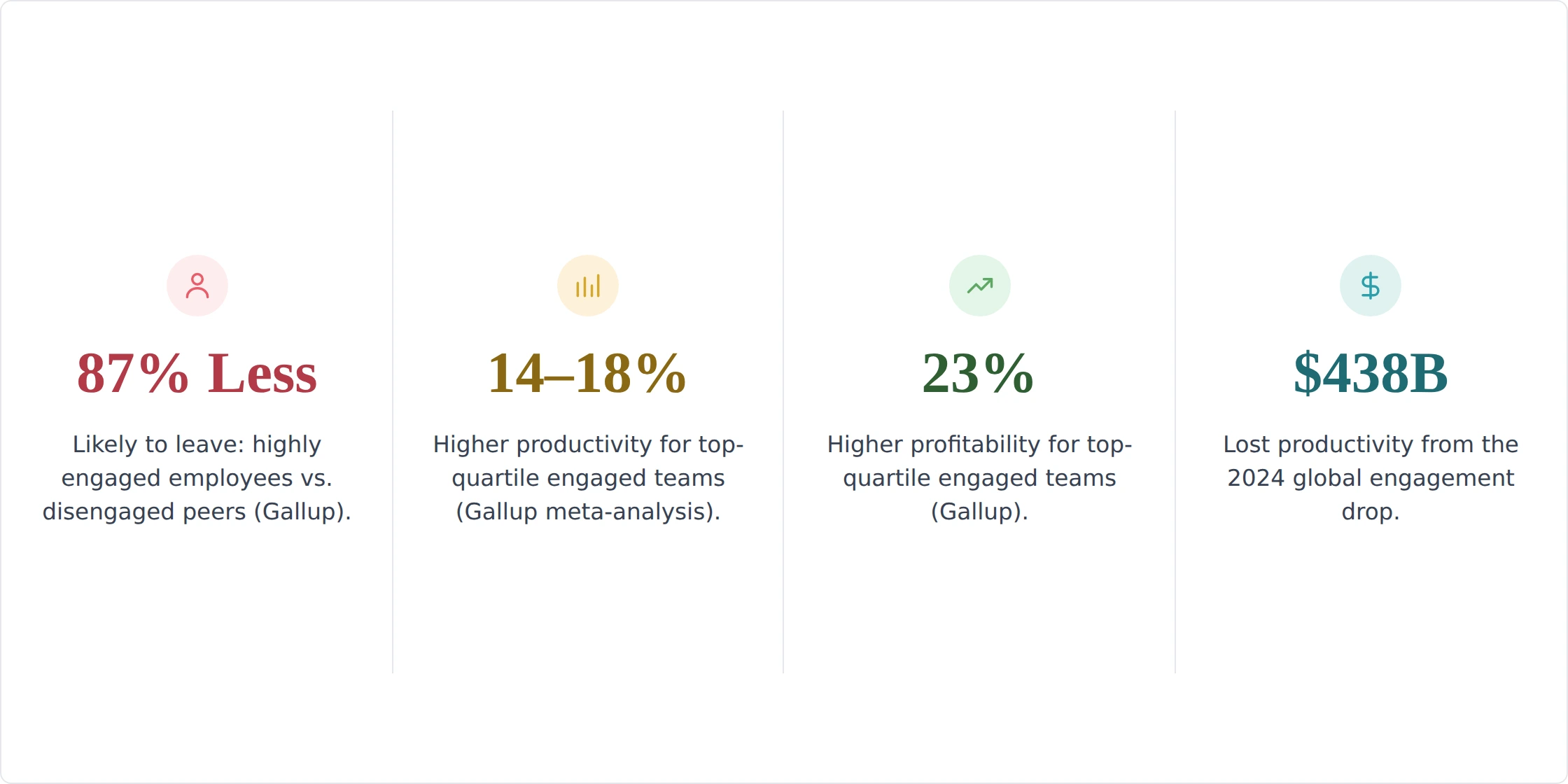
Three business outcomes consistently appear in the EX research:
- Retention: Employees who are highly engaged are 87% less likely to leave their organization than disengaged peers, according to analyses of Gallup's global engagement data. Replacing an employee is costly: Gallup's workplace research puts the cost at one-half to two times annual salary (50 to 200%), though estimates vary by role and source.
- Productivity and profitability: A Gallup meta-analysis shows top-quartile teams deliver 14 to 18% higher productivity and 23% higher profitability than bottom-quartile teams.
- Customer experience: Forrester added EX to its Total Experience Score from 2026, noting that employee conditions have a measurable influence on customer interaction quality. Its CX Index 2025 identified weaker employee experience among the ongoing challenges contributing to declining CX quality.
The scale is significant, as research estimates that the 2024 drop in global engagement (from 23% to 21%) cost the world economy $438 billion in lost productivity. Employee experience is not an HR nicety; it is an economic variable.
What Is Employee Experience Management (EXM)?
Employee experience management is the discipline of intentionally designing, measuring, and improving EX across all three environments and all lifecycle stages. Where traditional HR focused on compliance and administration, EXM treats the employee as the end user whose experience drives organizational outcomes.
In practice, EXM spans several functions and requires genuine cross-functional ownership:
- HR and People Ops leads the listening program, designs lifecycle touchpoints, and runs the people-facing programs across onboarding, development, and engagement.
- IT owns the digital employee experience: the quality and reliability of the tools, systems, and platforms employees use every day.
- Facilities and real estate shapes the physical environment, from office design to hybrid work infrastructure.
- Managers are the frontline EXM practitioners, whether they know it or not. Their day-to-day behavior is the single biggest variable in whether their team's experience is good or bad.
- Leadership sets the cultural environment through visible behavior and the decisions they make when values are tested.
In EX-mature organizations, EXM often means linking EX metrics (eNPS, lifecycle survey scores, exit interview themes) directly to business outcome data like retention rates, productivity, and customer satisfaction scores. That connection is what distinguishes EXM as a strategic discipline from EX as a loose collection of programs.
How to Measure Employee Experience
No single method captures the full complexity of the employee journey. Effective EX measurement combines:
- Annual or semi-annual EX surveys: Organization-wide baseline measurement across departments and tenures. Employee survey platforms help design, distribute, and analyze these programs.
- Pulse surveys: Short, frequent surveys (weekly or monthly) that track specific dimensions in near real-time. Value depends entirely on acting on what they reveal.
- Lifecycle surveys: Triggered at key moments: post-onboarding (30/60/90 days), mid-year, and exit. Captures stage-specific friction before it becomes turnover.
- Stay interviews: Structured conversations with current employees about what keeps them and what might lead them to leave. Among the most underutilized EX tools despite low cost and high signal value.
- eNPS: A single-question directional read on how likely employees are to recommend the organization as a place to work. Best paired with qualitative follow-up.
How to Improve Employee Experience
The most consistently effective levers, drawn from EX research and practice:
- Listen and act visibly. Surveying without responding is worse than not surveying at all. Close the feedback loop explicitly: name what changed and communicate what was heard but not acted on.
- Invest in manager quality. Gallup finds that managers account for at least 70% of the variance in team engagement scores. Manager development is consistently underutilized relative to the impact it produces.
- Design onboarding deliberately. The first 90 days set the tone for years. Structured onboarding with clear milestones, manager check-ins, and early wins has a disproportionate impact on long-term retention.
- Enable visible growth. Employees who cannot see a path forward start building one elsewhere. Internal mobility, transparent career frameworks, and learning access all signal organizational investment in the employee's future.
- Fix technology friction. Slow, fragmented, or poorly integrated tools compound frustration across every workday. Auditing and addressing DEX pain points produces measurable gains in productivity and satisfaction.
- Support well-being structurally. Flexible work, mental health resources, and workload manageability are EX conditions, not perks. Wellness platforms help scale support across distributed teams.
Digital Employee Experience (DEX)
Digital employee experience is the quality of an employee's interactions with workplace technology: devices, software, collaboration tools, and the digital workspace. DEX is the technological environment of the broader EX framework, now a distinct practice area as the proportion of work mediated by technology continues to grow.
It spans five core components, each of which can either support or undermine how employees experience their workday:
| DEX Component | What It Covers |
|---|---|
| Devices and Hardware | Laptops, mobile devices, peripherals, and the provisioning and support processes that keep them working reliably. |
| Core Business Software | The primary tools employees use to do their jobs: HRIS, ERP, CRM, productivity suites, and industry-specific platforms. |
| Communication and Collaboration Tools | Email, messaging (Slack, Teams), video conferencing, and document collaboration platforms that connect distributed teams. |
| Intranet and Knowledge Management | Internal portals, wikis, and knowledge bases where employees find policies, processes, and company information. |
| IT Support and Service | Helpdesk responsiveness, self-service portals, and how quickly employees can get technical issues resolved without losing working time. |
Poor DEX creates friction that compounds across every working hour. IT and HR are increasingly co-owners of DEX, requiring both technical remediation (fixing poor systems) and employee-centered design (building tools around how people actually work).
As AI reshapes workplace tooling, DEX has become an increasingly high-priority EX investment for organizations trying to remain productive and competitive.
Frequently Asked Questions (FAQs)
What is the difference between employee experience and employee engagement?
Employee experience is the full environment and journey spanning culture, physical space, technology, and every touchpoint from attraction to exit. Employee engagement is an outcome of that experience: the degree of commitment and discretionary effort an employee brings to work. EX is the cause; engagement is the effect.
Why does employee experience matter to business performance?
Gallup links top-quartile engaged teams to 21 to 51% lower turnover, 14 to 18% higher productivity, and 23% higher profitability. Forrester's CX Index 2025 also cites weaker EX as a factor in declining CX quality.
How do you measure employee experience?
The most effective programs combine annual EX surveys, pulse surveys, lifecycle surveys at key moments (onboarding, exit), stay interviews, and eNPS. No single method is sufficient. Employee survey platforms help run these programs systematically and analyze results by segment and tenure.
Who owns employee experience in an organization?
EX is co-owned across functions. HR leads the listening program and lifecycle design. IT owns the technological environment. Facilities owns the physical environment. Managers are the frontline EX designers for their teams. EX-mature organizations have a cross-functional function or council that coordinates across these owners.
.avif)