.svg)
Total rewards in HR is the complete package of monetary and non-monetary value an employer offers employees in exchange for their work. It goes beyond salary to include compensation, benefits, well-being, development, and recognition: the full set of reasons someone chooses to join, stay, and do their best work at an organization.
Key Takeaways
- Total rewards is broader than total compensation. Compensation (pay, bonuses, equity) is one component; total rewards includes benefits, well-being, development, and recognition as well.
- The WorldatWork Total Rewards Model (the recognized professional framework) organizes rewards into five elements: compensation, benefits, well-being, careers, and recognition.
- Most of what employers provide goes unseen. Total rewards statements surface the full value of the package, which improves employees' perception of what they receive.
- A total rewards strategy is not just about what you offer. It is about how you balance, benchmark, and communicate the complete package to attract and retain the right people.
What Is Total Rewards?
Total rewards is the complete value exchange between employer and employee. Rather than focusing on pay alone, it captures everything an organization offers in return for someone's time, skills, and effort: compensation, benefits, well-being, development, and recognition.
The Total Rewards framework was popularized around 2000, when the American Compensation Association rebranded as WorldatWork and promoted the Total Rewards Model as a strategic way to organize rewards rather than a list of perks. One common source of confusion is the difference between total rewards and total compensation.
Total compensation covers the monetary portion only, such as the base pay, variable pay, bonuses, and equity. Total rewards, by contrast, is the broader framework that includes total compensation plus benefits, well-being, development, and recognition. That distinction matters because candidates and employees evaluate far more than salary when deciding where to work, and organizations that compete only on pay leave significant retention leverage on the table.
The Components of Total Rewards
WorldatWork's current model organizes total rewards into five interdependent elements. Some frameworks (including those from SHRM and Mercer) add work-life flexibility as a sixth standalone element, though WorldatWork typically folds it into well-being. Either way, the core five are consistent across most definitions.
Here is what each element covers:
| Element | What It Covers | Examples |
|---|---|---|
| Compensation | All monetary pay | Base salary, bonuses, commissions, equity |
| Benefits | Financial security and health provisions | Health insurance, retirement plans, paid time off, disability coverage |
| Well-Being | Physical, emotional, financial, and social health support | EAP, mental health benefits, flexible work, financial wellness programs |
| Careers | Growth and development opportunities | Training, mentoring, career pathing, tuition assistance, internal mobility |
| Recognition | Formal and informal acknowledgment of contribution | Peer recognition, performance bonuses, awards programs, manager appreciation |
1. Compensation
Compensation is the monetary foundation of the package, covering base pay (salary or hourly wages), variable pay (bonuses, incentives, commissions, and profit-sharing), and equity (stock options, restricted stock units, or employee share plans). It is also the most visible element of total rewards and usually the first place organizations look when benchmarking against the market.
Getting compensation right requires a clear pay philosophy (whether the organization leads, matches, or lags the market) and a defensible pay structure to back it up. Moreover, pay equity analysis has become increasingly standard practice, particularly as pay transparency legislation expands across more jurisdictions. Compensation management platforms make it easier to run equity analyses, model pay structures, and keep benchmarking current.
2. Benefits
Benefits cover the non-wage provisions an employer provides to support employees' financial security and health: health insurance, dental and vision coverage, retirement savings plans, paid time off, disability insurance, and life insurance. Together, they create a floor of stability that employees rely on beyond their paycheck.
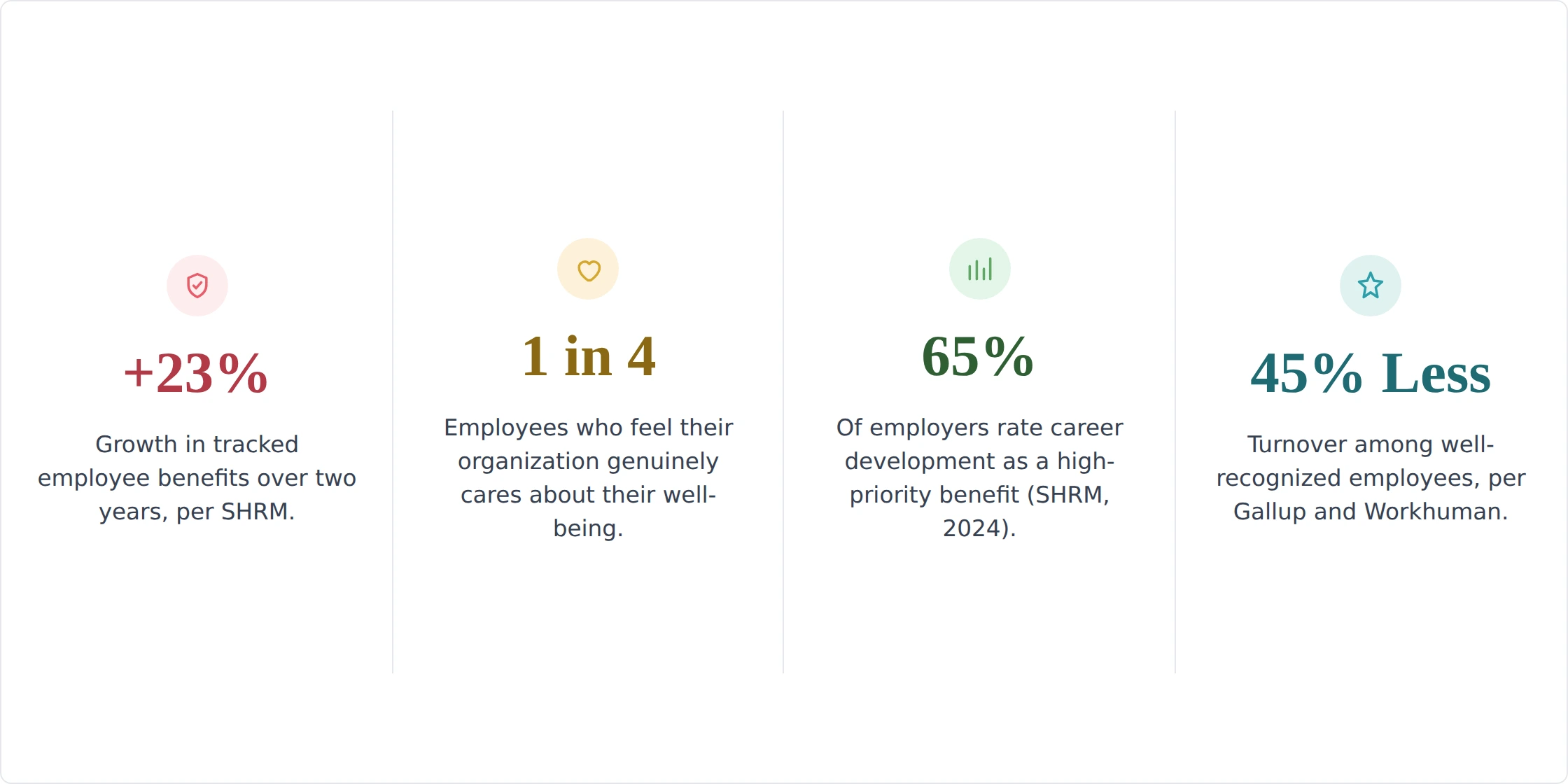
The benefits landscape has expanded considerably in recent years. The SHRM Employee Benefits Survey shows the number of tracked benefits rising from about 175 to 216 over a two-year period, a 23% increase in the range of offerings employers now provide.
Beyond the traditional health-and-retirement core, employers are also adding niche benefits such as mental health support, student loan assistance, and fertility coverage in response to more varied employee needs. Benefits administration platforms handle the operational side of this, including enrollment, carrier integrations, and ACA compliance.
3. Well-Being
Well-being covers programs and support that address employees' physical, emotional, financial, and social health. It is also the fastest-evolving element of total rewards, expanding well beyond gym memberships and EAPs (Employee Assistance Programs) to include financial wellness programs, mental health benefits, resilience training, caregiving support, and flexible work arrangements.
In many frameworks (including WorldatWork's current model), work-life flexibility sits within well-being. Flexible schedules, remote and hybrid options, and generous leave policies are all well-being levers, and employees increasingly treat them as table stakes rather than perks.
Still, that makes investment in this element particularly high-stakes: recent workplace well-being research, including The Center for Research 2025 Workplace and Employee Survey, suggests that only around one in four employees feel their organization genuinely cares about their well-being, and those who do show substantially higher retention and engagement. Employee wellness platforms help connect employees to those physical, financial, and mental health resources in one place.
4. Careers (Development)
The careers element covers growth and development opportunities: training and learning programs, mentoring and coaching, career pathing, internal mobility, tuition assistance, and professional certifications. WorldatWork labels this element "careers" in its current model, reflecting that employees increasingly weigh development as a reason to stay, or leave. That shift in priority has real strategic implications.
As skills-based approaches to work become more common, the careers element has grown accordingly in strategic importance, and the numbers reflect it. The 2024 SHRM Employee Benefits Survey found that 65% of employers rated professional and career development benefits as high-priority, behind health care, retirement, flexible work, and family care in the actual ranking. Employee development platforms support the operational delivery of this element, from learning management to career pathing and internal mobility.
5. Recognition
Recognition covers formal and informal acknowledgment of employee contribution: rewards and incentive programs, peer recognition, manager-led appreciation, performance bonuses tied to achievement, and team celebrations. It is also the element most directly tied to engagement and belonging.
The retention data on recognition is particularly compelling. Longitudinal research from Gallup and Workhuman following nearly 3,500 employees over two years found that well-recognized employees were 45% less likely to have turned over, and those receiving high-quality recognition were 65% less likely to be actively looking for another job. Rewards and recognition platforms provide the infrastructure for both formal programs and everyday peer-to-peer appreciation.
Why Total Rewards Matters
The business case for a deliberate total rewards approach rests on three outcomes:
- Attraction: Candidates compare the full employment package, not just base salary. As compensation benchmarks become more visible, with pay-transparency laws of some kind covering roughly 18 U.S. states plus Washington, D.C., organizations that clearly communicate the complete value of working for them have an advantage over employers that lead only with salary.
- Retention: Employees who feel holistically valued are more likely to stay. Gallup and Workhuman’s research found that well-recognized employees were 45% less likely to turn over within two years. SHRM’s 2024 State of Global Workplace Culture report also found that only 15% of employees who rated their culture as good or excellent were actively job-searching.
- Engagement: Gallup’s State of the Global Workplace reporting showed global employee engagement at about 21% in 2024, with later updates indicating it fell to around 20% in 2025. Strong recognition programs, development opportunities, well-being support, and clear communication of benefits can help organizations improve engagement by ensuring employees recognize the full value of their rewards package.
Underlying all three of these outcomes is a visibility problem that total rewards strategy directly addresses. Much of what employers provide (retirement contributions, the employer share of health premiums, wellness program costs, learning budgets) never appears on a paycheck and simply goes unnoticed by employees.
As a result, those who cannot see the full value of their package consistently underestimate what they receive, which quietly erodes the retention power of investments the organization is already making.
What Is a Total Rewards Strategy?
A total rewards strategy is the deliberate design of how an organization assembles, balances, and communicates its rewards package to support its talent and business goals. The distinction matters: a list of what you offer is not a strategy. Instead, a strategy is a considered set of choices about where to invest, how to differentiate, and how to make sure employees can actually see and value what they receive.
Building a total rewards strategy typically involves five steps:
- Assess the current mix. Audit what you currently offer across all five elements and gather data on what employees actually value. Survey data, exit interview themes, and manager feedback are all useful inputs.
- Define a rewards philosophy. A rewards philosophy sets the organization's position: do you lead the market, match it, or lag it, and on which elements? Many organizations lead on some dimensions (competitive base pay) while matching on others (benefits) and differentiating on less costly elements (recognition, flexibility, career development).
- Balance the mix against budget. Total rewards is not unlimited. Decisions about where to invest require trade-offs: more in base pay may mean less in development programs, or vice versa. The goal is a mix that resonates with your workforce and supports the talent outcomes you need.
- Benchmark against the market. Compensation and benefits benchmarking data (from surveys, compensation databases, and platforms like your payroll or HRIS provider) shows where you stand against competitors for talent. Benchmark regularly, not just at annual review cycles.
- Communicate clearly and consistently. A strong rewards package that employees cannot see or understand delivers less retention value than a weaker one that is well explained. Total rewards communication (including statements, onboarding materials, and manager training) is a strategic function, not an afterthought.
Once the strategy is set, a total rewards program becomes its operational expression: the specific policies, plans, and programs that deliver each element to employees day to day. In practice, the two evolve together over time, with program data continuously informing strategy adjustments.
What Is a Total Rewards Statement?
A total rewards statement is a personalized document that shows the full value of an employee’s compensation package, beyond base salary.
It typically includes salary, health-insurance contributions, retirement matches, paid time off, bonuses, and other employer-funded benefits. Once these benefits are included, total annual compensation can be 25% or more above base pay alone.
By making this value visible, total rewards statements help employees better understand their package, support retention conversations, and give managers a useful reference when discussing compensation or responding to outside offers.
Organizations often issue statements annually during performance reviews or at the start of a contract year, while some offer on-demand access through their HRIS. Payroll platforms may also include total rewards statement generation and compensation reporting.
Total Rewards Trends for 2026
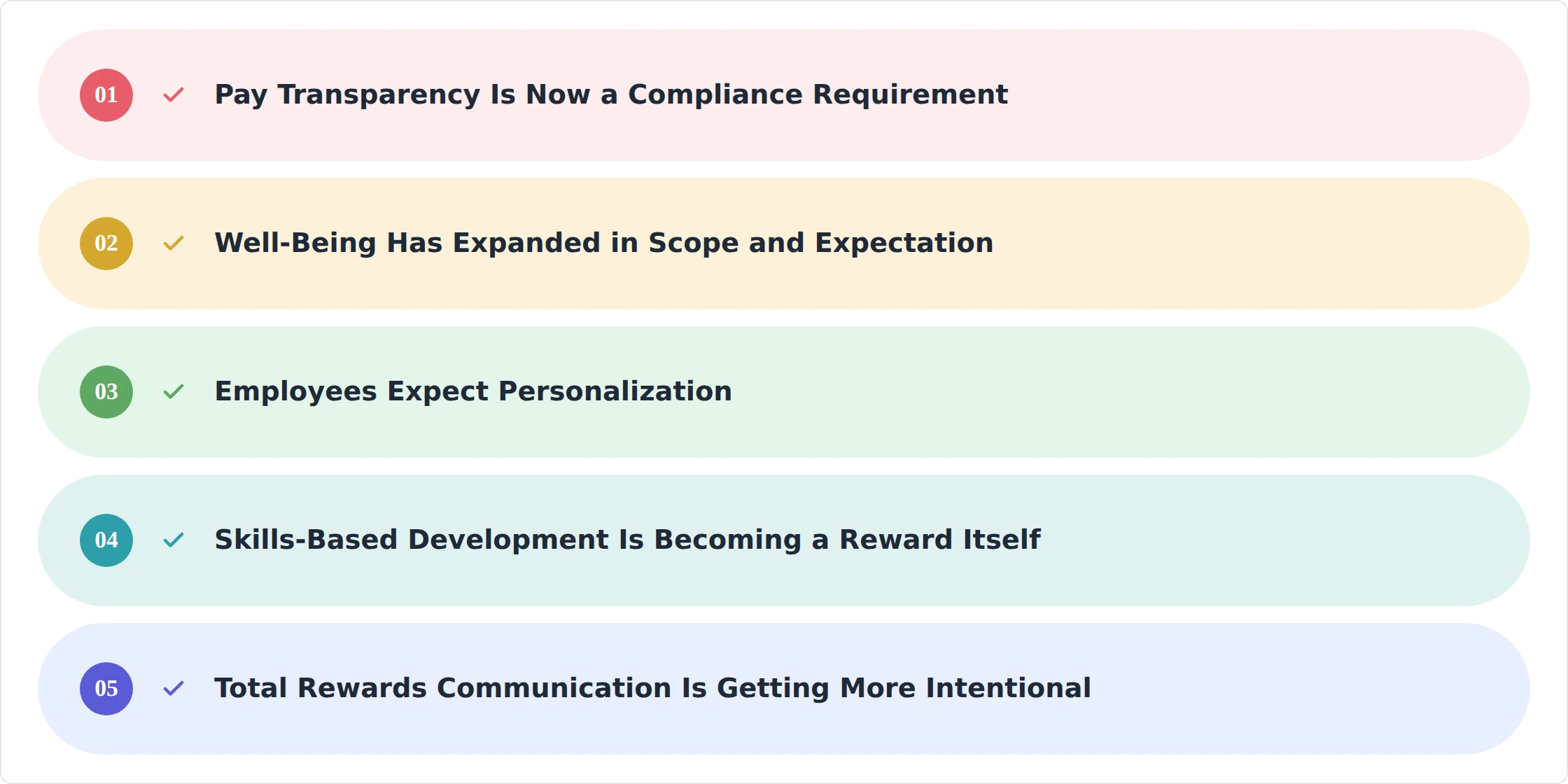
The total rewards landscape continues to shift. Five trends stand out heading into the second half of 2026.
1. Pay Transparency Is Now a Compliance Requirement
As of 2026, roughly 18 U.S. states plus Washington D.C. have enacted pay transparency laws of some kind, though the exact count varies slightly by source depending on how requirements are defined.
For multi-state and remote employers in particular, compliance often means meeting the strictest applicable law across all hiring locations. Importantly, WorldatWork frames transparency not just as a compliance issue, but as a trust issue: organizations that communicate compensation clearly are better positioned on employee belonging and leadership credibility.
2. Well-Being Has Expanded in Scope and Expectation
Financial wellness (helping employees manage debt, build savings, and plan for major expenses) has become a mainstream benefits category rather than a niche add-on. Mental health support has followed a similar trajectory: once treated as a supplemental offering, it is now a primary concern.
Additionally, flexibility (schedule, location, and leave) remains a top-ranked lever, with the majority of employers continuing to offer hybrid or flextime benefits, according to the SHRM 2025 Benefits Survey.
3. Employees Expect Personalization
A single-size rewards package increasingly fails to match a workforce with diverse needs across life stages, family situations, and priorities. In response, employers are experimenting with flexible benefits platforms (sometimes called "benefits wallets"), voluntary benefits menus, and development stipends that employees can direct toward their own priorities. WorldatWork identifies personalized benefits as one of the key accelerators driving total rewards design in 2026.
4. Skills-Based Development Is Becoming a Reward in Itself
As AI reshapes job content, employees increasingly value employers that invest in their skills and employability, not just their current role. As a result, development and reskilling opportunities are moving up the priority list, particularly among younger workers and those in roles with high automation exposure. Organizations that treat learning access as a reward, not just a cost center, are finding it a meaningful differentiator in competitive hiring markets.
5. Total Rewards Communication Is Getting More Intentional
Offering a strong rewards package is only half the work. Increasingly, organizations are investing deliberately in how they communicate that package throughout the employee lifecycle, not just at annual review time.
Total rewards statements, benefits literacy programs, manager training on total compensation conversations, and on-demand access to personalized reward summaries are all gaining traction as a result. The underlying insight is straightforward: value that employees cannot see does not retain them.
How Software Supports Total Rewards
No single platform covers the entire total rewards framework, but dedicated tools for each element reduce the administrative burden and improve the employee experience significantly. On the compensation side, compensation management platforms help HR teams model pay structures, run equity analyses, and generate total rewards statements.
For benefits, benefits administration platforms handle enrollment, carrier integrations, and ACA compliance. Rewards and recognition platforms, meanwhile, support both formal programs and informal peer appreciation. On the development side, employee development platforms track learning, support career pathing, and connect employees to growth resources. Finally, employee wellness platforms provide access to physical, financial, and mental health support.
The most practical starting point is to map your current tech stack against the five total rewards elements and identify where administration is manual, where data is fragmented, and where employee-facing visibility is weakest. Those gaps are typically where software investment delivers the clearest return.
Frequently Asked Questions
What is the difference between total rewards and total compensation?
Total compensation refers to all monetary pay: base salary, bonuses, commissions, and equity. Total rewards, by contrast, is the broader framework that includes total compensation plus non-monetary elements: benefits, well-being programs, development opportunities, and recognition. Total compensation is one component of total rewards.
What are the five components of total rewards?
According to the WorldatWork Total Rewards Model (the recognized professional framework), the five elements are: compensation, benefits, well-being, careers (development), and recognition. Work-life flexibility is sometimes listed as a sixth element in other frameworks (SHRM, Mercer), though WorldatWork typically places it within well-being.
What is a total rewards statement and why does it matter?
A total rewards statement shows an employee the full monetary value of what they receive from their employer, not just their salary. It matters because most employees underestimate their package when they only see their paycheck. Making the full picture visible improves perceived value and supports retention.
How do you build a total rewards strategy?
Start by auditing what you currently offer and what employees actually value. Then define your rewards philosophy, balance the mix against budget, benchmark against the market, and communicate the full package clearly to employees. Strategy is as much about communication as it is about what you offer.
Why does total rewards matter for employee retention?
Employees who feel holistically valued (not just well paid) are more likely to stay. Recognition is a documented retention driver: Gallup and Workhuman research shows well-recognized employees are 45% less likely to turn over within two years. Beyond recognition, development opportunities, well-being support, and the perceived fairness of the full package all affect whether employees stay or start looking elsewhere.
.avif)