.svg)
With U.S. job openings remaining high and nearly 40% of Fortune 500 chief human resources officers expanding their workforces, maintaining a stable talent pipeline is critical. However, choosing the right ATS is difficult because vendors sound identical, and a bad match locks you into an expensive system your team will avoid.
The enterprise market has also shifted dramatically over the past year due to major acquisitions. SAP acquired SmartRecruiters to merge enterprise roadmaps, Workday bought Paradox to add conversational AI screening, and iCIMS acquired Apli to expand its automation footprint into Latin America. Our evaluations reflect how these recent consolidations impact your options today.
This guide cuts through the noise by matching platforms to specific organizational profiles rather than offering a one-size-fits-all ranking.
Please note that this list focuses strictly on pipeline management from application to offer. For sourcing tools, talent CRMs, or candidate marketing, please see our broader recruiting software guide.
Here's a quick video walkthrough of our top 5 picks before we get into the full list of 10:
What to Look for in an Applicant Tracking System
Before booking demos, be honest about what your hiring operation actually needs. The five criteria below separate a useful evaluation from one that ends with a contract you regret.
1. Hiring Volume and Structural Fit
The most common ATS buying mistake is mismatching the platform's scale to the organization's actual hiring volume. A 40-person company does not need Workday Recruiting. A 2,000-person enterprise running high-volume hourly hiring does not need JazzHR.
Before evaluating any tool, map your realistic hire count over the next 18 months and match that number to the right tier. The platforms below are grouped by their natural fit range; use those groupings as your first filter.
2. Structured Hiring vs. Speed to Fill
Some platforms, most notably Greenhouse and Ashby, are built around structured hiring: scorecards, calibration sessions, consistent evaluation criteria enforced at the platform level. Others, like Workable and JazzHR, are built for speed, getting roles filled quickly with less process overhead. Neither approach is inherently better.
The right answer depends on whether your primary hiring problem is inconsistent quality or slow time-to-fill. Choosing the wrong philosophy creates friction that no amount of configuration will fix.
3. Analytics That Answer Leadership Questions
Basic reporting, applications per source, time-to-hire, pipeline counts, is standard in every ATS on this list. What separates platforms is whether they can answer harder questions: cost-per-hire by channel, quality-of-hire over 12 months, source-to-offer conversion rates. If data-driven recruiting is a genuine priority for your team, that distinction matters more than most features on a demo checklist.
4. Integration Depth, Not Integration Count
Every ATS marketing page lists hundreds of integrations. The relevant question is not how many integrations exist, but how deep the connections run on the 5 to 10 tools your team actually uses: your sourcing, HRIS platforms, calendar, background check provider, and onboarding system.
A two-way real-time sync between your ATS and HRIS is a materially different thing from a weekly CSV export. Ask vendors to demonstrate the specific integrations you need, not the full integration catalog.
5. AI Screening and Candidate Experience
Incomplete applications and slow response times cost organizations quality candidates at scale. AI-powered screening, automated status updates, and candidate self-scheduling address both problems directly and are now standard features across mid-market and enterprise platforms. Evaluate whether the AI functionality is genuinely operational or a roadmap item dressed as a current feature.
One governance note: organizations operating in the EU or hiring in US states with algorithmic hiring regulations (Illinois, New York City, Colorado, and others) need to verify that any AI screening tool meets applicable legal requirements. The EU AI Act classifies AI hiring tools as high-risk systems, with specific transparency and audit obligations. This is not a minor footnote; it belongs in your procurement checklist.
How We Evaluated Each ATS
Every platform in this article was evaluated against the same five criteria. The ranking reflects how each tool performs on these dimensions for its target buyer, not a single best-overall verdict. A platform that ranks lower may still be the right choice for a specific organizational profile.
1. User Satisfaction (G2 and Capterra)
Verified ratings, review counts, and category placements from G2 and Capterra as of May 2026. Higher review volume is weighted more heavily. A 4.8/5 from 5,000 reviews carries more signal than 5/5 from 30.
2. Feature Depth Relative to Buyer Profile
Whether the platform delivers what its target buyer actually needs, not raw feature count. An enterprise platform evaluated on SMB onboarding, or an SMB tool measured against enterprise governance requirements, would produce misleading results. Each tool is judged in its own category.
3. Pricing Transparency
Platforms with published, scannable pricing rated higher than those requiring a sales call to determine total cost. Pricing opacity is a documented friction point in ATS procurement and a meaningful editorial signal about how vendors treat prospective buyers.
4. Integration Quality
Verified depth on HRIS, sourcing, calendar, and background check integrations, not the marketing page's headline count. Two-way real-time sync rated higher than scheduled exports or manual workarounds.
5. Product Maturity in 2025–2026
Recent AI capability additions, roadmap transparency, and how each platform has adapted to the post-acquisition enterprise market (SAP-SmartRecruiters, Workday-Paradox, iCIMS-Apli) were factored into placement decisions.
The 10 Best ATS Software Platforms in 2026
The right ATS platform should optimize your entire hiring pipeline, reduce time-to-hire, and help interview teams make objective, data-driven decisions.
To help you cut through the noise, here is the definitive breakdown of the top hiring solutions available today, tailored to different organizational sizes, budgets, and recruitment strategies.
1. Greenhouse: Best Overall ATS for Mid-Market and Enterprise Structured Hiring
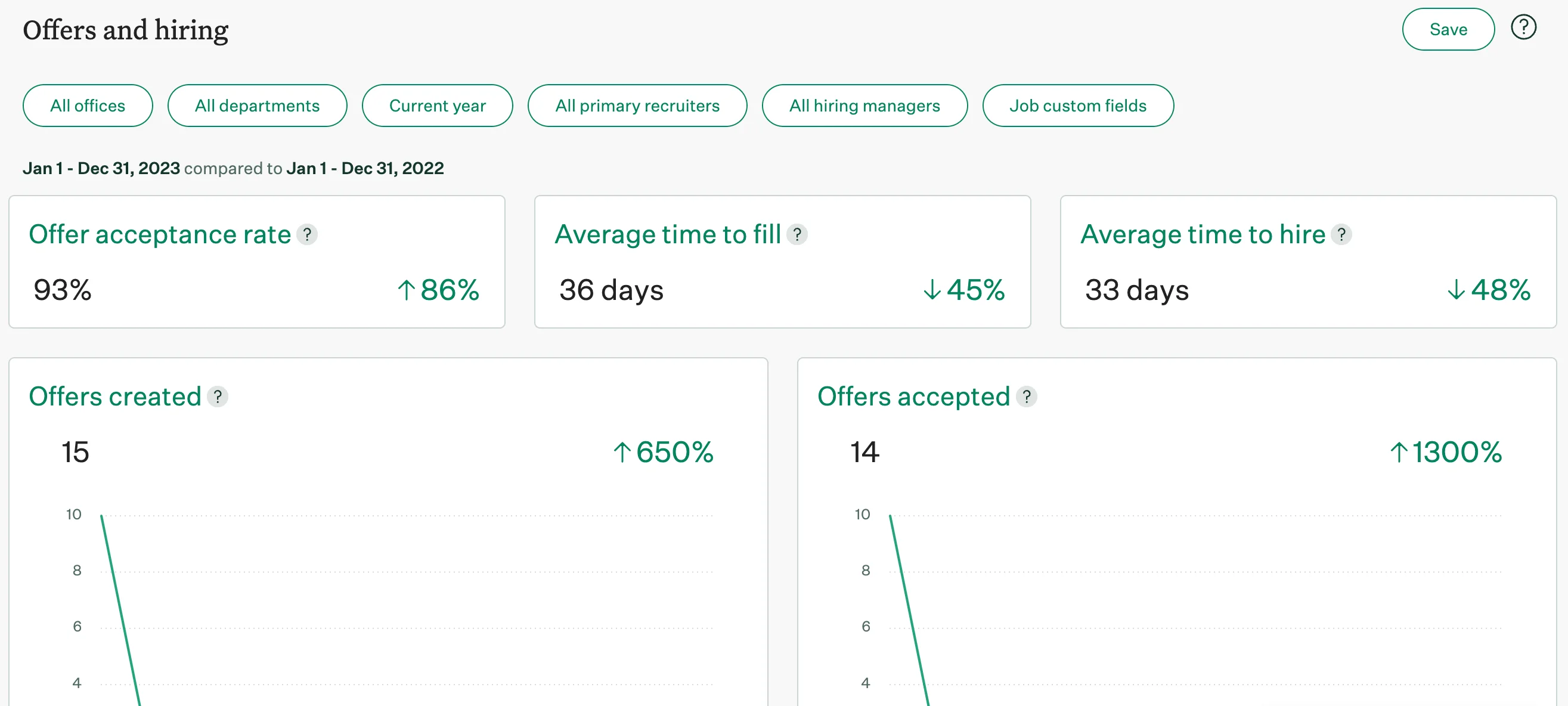
Greenhouse is the most widely adopted mid-market and enterprise applicant tracking system in this category, used by more than 8,000 organizations including Airbnb, Dropbox, and HubSpot.
Its core differentiator is not a feature list; it is a philosophy. The platform enforces structured hiring at the process level, with scorecards, calibration tools, and consistent evaluation criteria built into every stage.
Greenhouse was placed in the top 3 of G2 Winter 2026 rankings for overall user satisfaction in the ATS category, with a 98% satisfaction rating.
It is the strongest choice for organizations between 50 and 5,000+ employees where consistent hiring quality is the primary goal.
Key Features
- Structured interview kits with role-specific scorecards and calibration workflows
- Configurable pipeline stages with approval routing and compliance controls
- Custom fields and bulk candidate actions across pipeline stages
- Native integrations with major HRIS platforms, sourcing tools, and background check providers
- Offer management with approval chains and e-signature support
- Reporting suite covering time-to-hire, source performance, and pipeline health
- Greenhouse Recruiting and Onboarding available as a combined suite
Pros and Cons
Pros: "The tool is easy to use and has great functionality to create custom fields and filter from these. The bulk actions are excellent. Just waiting on bulk hire." — Capterra reviewer
- Structured hiring methodology is enforced at the platform level, not left to individual recruiter habits
- G2 Winter 2026 #1 ranking for overall user satisfaction (98%) provides strong independent validation
- Integration depth with HRIS, sourcing, and onboarding tools is among the best in the mid-market category
Cons: "The interface can feel a bit clunky, with too many clicks required to complete simple actions. Some of the reporting is also challenging, especially when working with date ranges. Overall, it’s a pricier ATS." — G2 reviewer
- Custom pricing with no publicly listed tiers makes early budget planning harder; the SMB entry point is reportedly around $6,500/year
- Advanced analytics are gated to higher-tier plans, which is a notable gap for data-driven TA teams
- Methodology rigidity can create friction for fast-moving teams where speed to fill outweighs process consistency
Pricing
Custom pricing across three tiers (Core, Plus, Pro). The entry-level tier is reportedly around $6,500/year for SMB; mid-market and enterprise pricing requires a direct quote.
2. Ashby: Best ATS for Analytics-Driven Mid-Market Teams
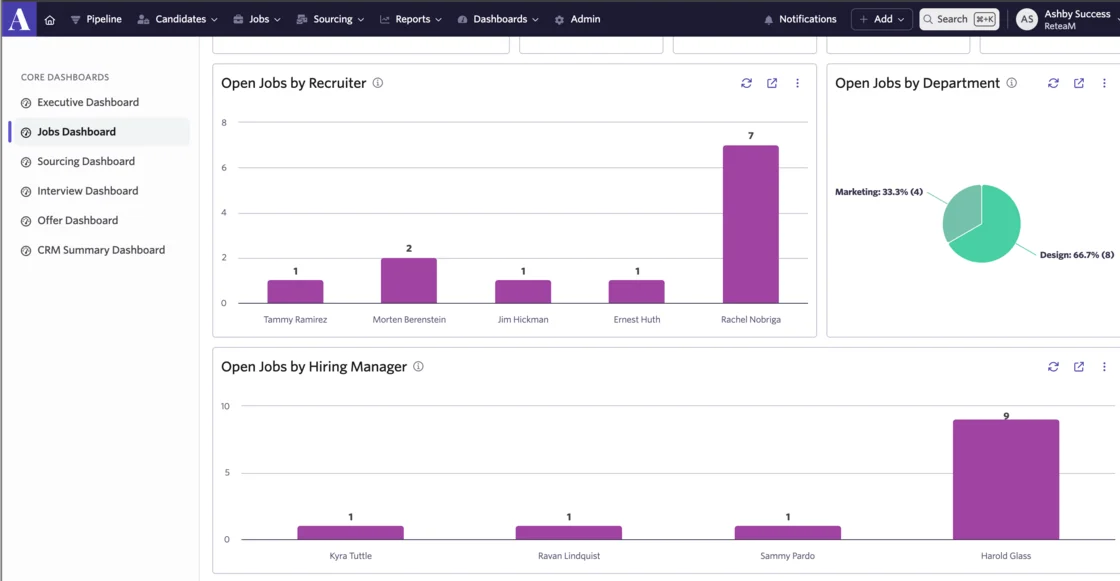
Ashby is built around a thesis that most ATS platforms quietly sidestep: recruiting is a data discipline, and the tools should reflect that. Its native analytics suite covers cost-per-hire, source-of-hire, quality-of-hire, and time-in-stage without requiring a separate BI tool or manual data exports.
Ashby is consistently rated among the highest in the category for interface usability. It is the right choice for teams between 50 and 500 employees where the TA leader wants reporting that answers leadership questions, not just pipeline counts.
Key Features
- Native analytics covering cost-per-hire, source-of-hire, quality-of-hire, and time-in-stage
- Structured interview kits with scorecard and calibration support
- Built-in scheduling automation and candidate self-scheduling
- AI-assisted candidate sourcing and pipeline management
- Custom pipeline stages and approval workflows
- Integrations with major HRIS, sourcing, and background check platforms
- Reporting dashboards designed for TA leadership, not just recruiter daily workflow
Pros and Cons
Pros: "I am able to easily view internal job posting, I can also easily refer candidates from my ashby and also post ashby links to my linkedn." — Capterra reviewer
- Best-in-class native analytics in the mid-market ATS category; no external BI tool required for substantive reporting
- Modern interface rated highly for usability across both recruiter and hiring manager workflows
- Scheduling automation and self-scheduling reduce coordination overhead on high-velocity pipelines
Cons: "Sometimes, bugs or feature requests take really long to be implemented but I know they have tons of things on their plate." — G2 reviewer
- Lower brand recognition than Greenhouse or Lever can create internal buy-in challenges with stakeholders who default to familiar names
- Less suited to high-volume hourly hiring, where speed and volume automation matter more than analytics depth
- Smaller integration marketplace than category leaders; verify specific integration availability before signing
Pricing
Custom pricing starts at $360 per month for companies with 11 to 25 employees (Foundations Plan, best for organizations with up to 100 employees). Other plans include the Plus Plan (best for organizations with up to 1,000 employees) and the Enterprise Plan (best for organizations with more than 1,000 employees).
3. Workable: Best ATS for Growing Companies That Want Speed Without Enterprise Overhead
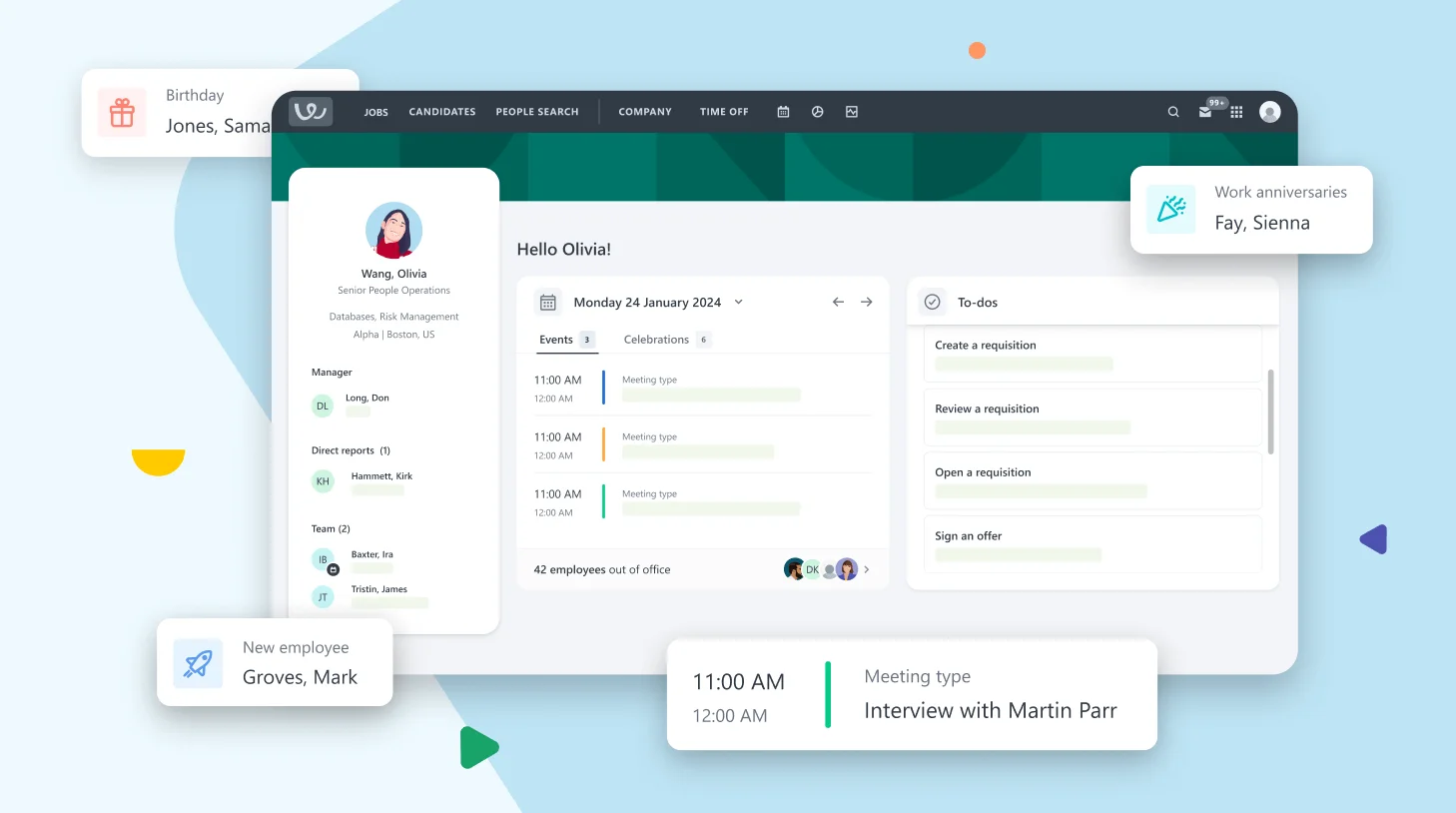
Workable sits in the middle of the ATS market in the best possible way: enough structure for growing TA teams, fast enough to deploy without a six-month implementation project, and priced transparently so buyers know what they're committing to before a sales call.
It posts to 200+ job boards, includes AI candidate screening and video interviewing natively, and integrates cleanly with tools like Slack and BambooHR. Best fit for organizations between 10 and 250 employees that need a capable recruitment management system without enterprise complexity.
Key Features
- AI-assisted candidate screening and automated shortlisting
- One-click posting to 200+ job boards including LinkedIn, Indeed, and Glassdoor
- Built-in video interviewing and asynchronous candidate review
- Slack and BambooHR integrations for hiring manager collaboration
- Customizable pipeline stages and offer management
- Careers page builder with no-code customization
- Reporting covering source performance, time-to-hire, and pipeline activity
Pros and Cons
Pros: "It is extremely user-friendly - both for the TA team and for hiring manager collaboration. I like how it integrates into other tools, such as Slack and BambooHR." — Capterra reviewer
- Published pricing removes the need for a sales call to determine whether the platform is in budget
- Fast deployment; most growing teams are running their first requisition within days, not months
- AI screening and video interviewing are included natively, not gated behind add-on pricing at the entry tier
Cons: "For most small and medium-sized businesses, Workable has become quite expensive. The only other item that could be interesting is allowing for unlimited People searches." — G2 reviewer
- Sits in an awkward pricing position for some buyers: more expensive than true SMB tools like JazzHR, and less analytically powerful than Greenhouse or Ashby at the upper end
- Analytics depth trails mid-market and enterprise competitors, which limits its usefulness as teams grow past 250 employees and TA reporting becomes more complex
- Per-job pricing on some plans can escalate costs unpredictably during high-hiring periods
Pricing
Workable offers three main pricing tiers that bundle recruiting and HR tools, scaling by company size: Standard ($299/month), Premier ($599/month), and Enterprise ($719/month).
While all plans include core applicant tracking, onboarding, and self-service HR tools, the Standard tier charges extra for add-ons like texting, video interviews, and performance reviews, which are fully included in the Premier and Enterprise tiers.
4. Lever: Best ATS + CRM Hybrid for Passive Candidate Pipelines
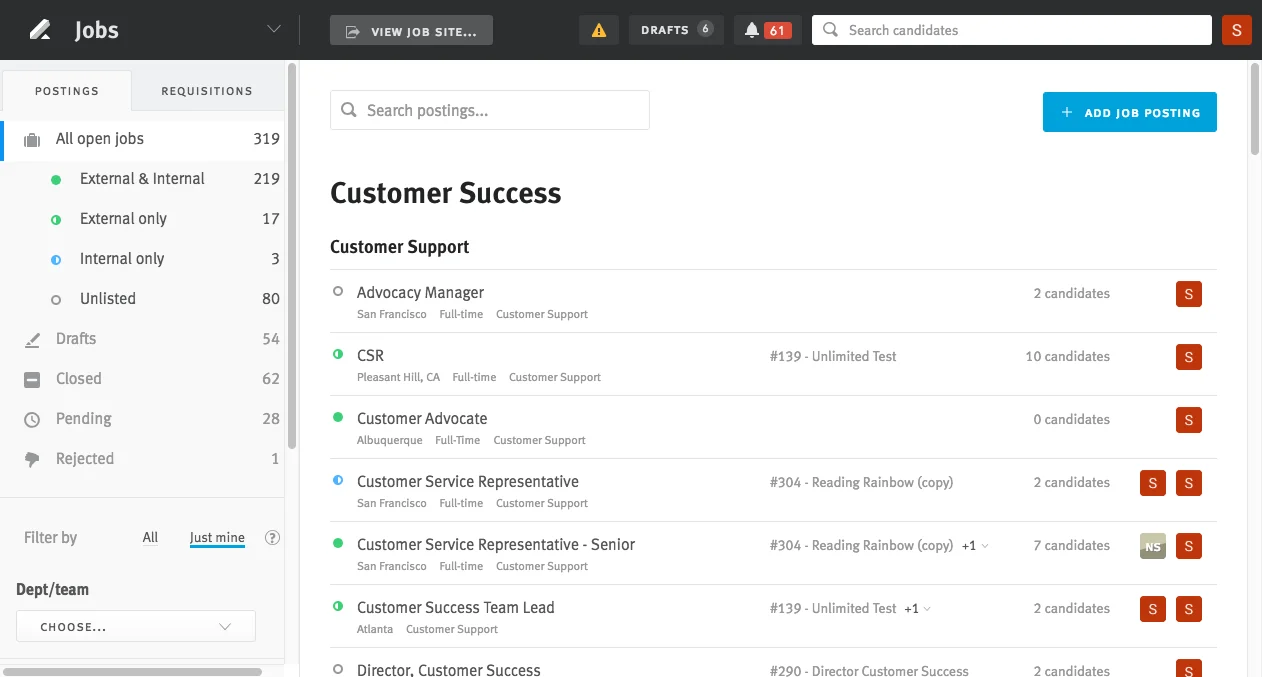
Lever combines an ATS with a native talent relationship management (TRM) system, making it the strongest option in this list for organizations that want to build and maintain passive candidate pipelines alongside active hiring.
Its LeverTRM feature supports nurture sequences, talent network management, and sourcing outreach from within the same platform as the hiring pipeline. It is a strong fit for organizations between 100 and 1,000 employees where sourcing passive talent is a meaningful part of the recruiting strategy.
Key Features
- LeverTRM: native talent CRM with nurture sequences and pipeline management for passive candidates
- ATS pipeline management with configurable stages and approval workflows
- Outlook and Google Calendar integrations for interview scheduling
- Diversity, equity, and inclusion reporting built into the analytics layer
- Offer management with e-signature and approval routing
- Two-way integrations with major HRIS and sourcing platforms
- Candidate referral portal and employee referral tracking
Pros and Cons
Pros: "Lever was simple for our IT team to set up and get integrated with our Outlook calendars and emails." — Capterra reviewer
- The only platform on this list that combines a full ATS pipeline with a native CRM and nurture workflow in one product
- Clean Outlook and Google Workspace calendar integrations that IT teams can deploy without significant configuration work
- DEI reporting built in by default, not as a paid add-on
Cons: "Data analytics is not good. Searches in questionnaire or filtering is not available. A calling option from the system can be more beneficial." — G2 reviewer
- Analytics depth is a genuine limitation; reporting on advanced metrics like quality-of-hire or cost-per-hire requires external tooling
- Custom pricing with no published tiers creates the same budget-planning friction as Greenhouse; buyers need a sales conversation before determining total cost
- Structured hiring methodology is lighter than Greenhouse, which may matter to organizations where interview consistency is a compliance or quality requirement
Pricing
Custom pricing. Generally starts around $3,500/year for smaller organizations; mid-market pricing requires a direct quote.
5. Workday Recruiting: Best ATS for Workday HCM Customers and High-Volume Hiring
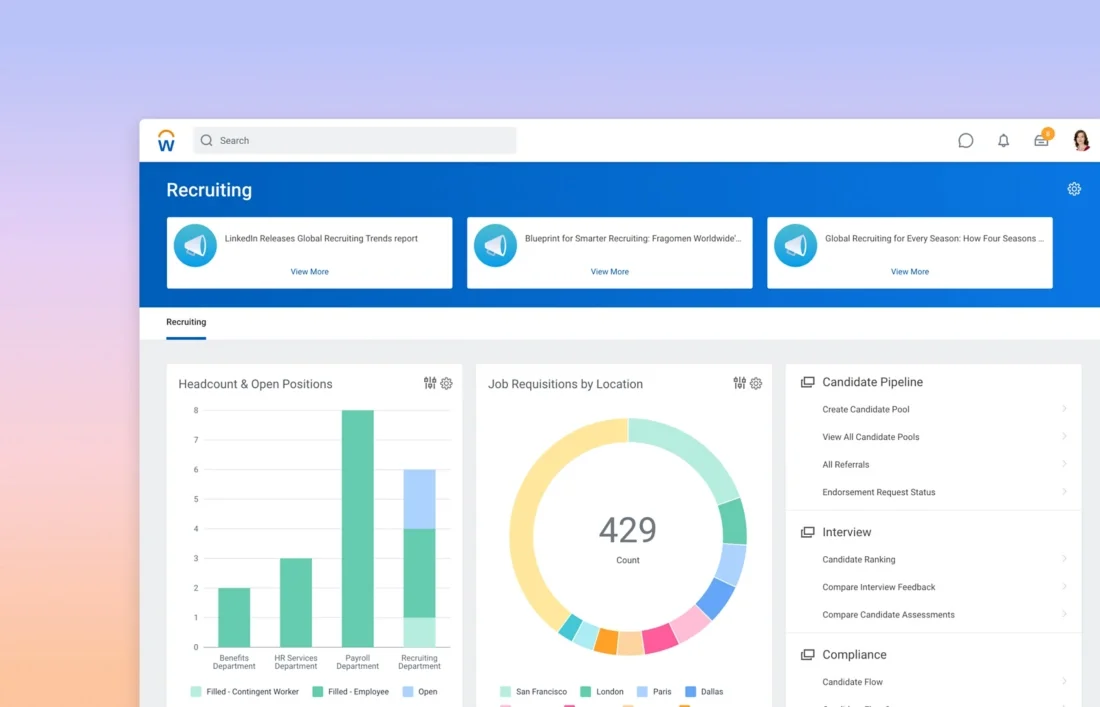
Workday Recruiting is not a standalone ATS purchase. It is the recruiting layer of the Workday HCM platform, and its value case depends almost entirely on whether your organization is already a Workday customer.
For those that are, the native integration eliminates the HRIS-to-ATS sync work that costs every other recruiting team hours per week. Workday's October 2025 acquisition of Paradox added conversational AI screening capabilities to the platform, which is a meaningful addition for organizations running high-volume or hourly hiring at scale.
Key Features
- Native integration with Workday HCM (no separate integration configuration required)
- Conversational AI screening via Paradox integration (added October 2025)
- Configurable hiring workflows with compliance guardrails for global organizations
- Offer management, onboarding handoff, and new hire setup within the same Workday environment
- Role-based access controls and audit trails aligned with enterprise compliance requirements
- Reporting connected to broader Workday HCM workforce analytics
Pros and Cons
Pros: "Workday Recruiting offers a standard workflow with multiple safety guardrails. It may be a great fit for very large organisations. We can also customise it to suit our company’s needs." — G2 reviewer
- Native Workday HCM integration means new hire data flows directly into payroll, benefits, and workforce planning without manual sync or middleware
- Paradox acquisition (October 2025) adds AI-powered candidate screening for high-volume and hourly hiring roles
- Compliance guardrails and audit trails are built to enterprise standards across multiple jurisdictions
Cons: "Workday is so highly customizable that it can become complex quickly, and configuring or changing certain workflows often requires more time and expertise than expected" — Capterra reviewer
- The value case collapses outside the Workday HCM ecosystem; organizations not already on Workday should look at purpose-built ATS platforms instead
- Recruiter UX is rated lower than purpose-built ATS platforms like Greenhouse or Ashby, particularly for day-to-day pipeline management
- The Paradox conversational AI integration, acquired in October 2025, is still maturing; verify current feature availability before committing
Pricing
Custom pricing, typically bundled as part of a broader Workday HCM contract. Not available as a standalone purchase. Contact Workday for a quote.
6. SAP SuccessFactors Recruiting: Best ATS for SAP Ecosystem Organizations and Global Hiring
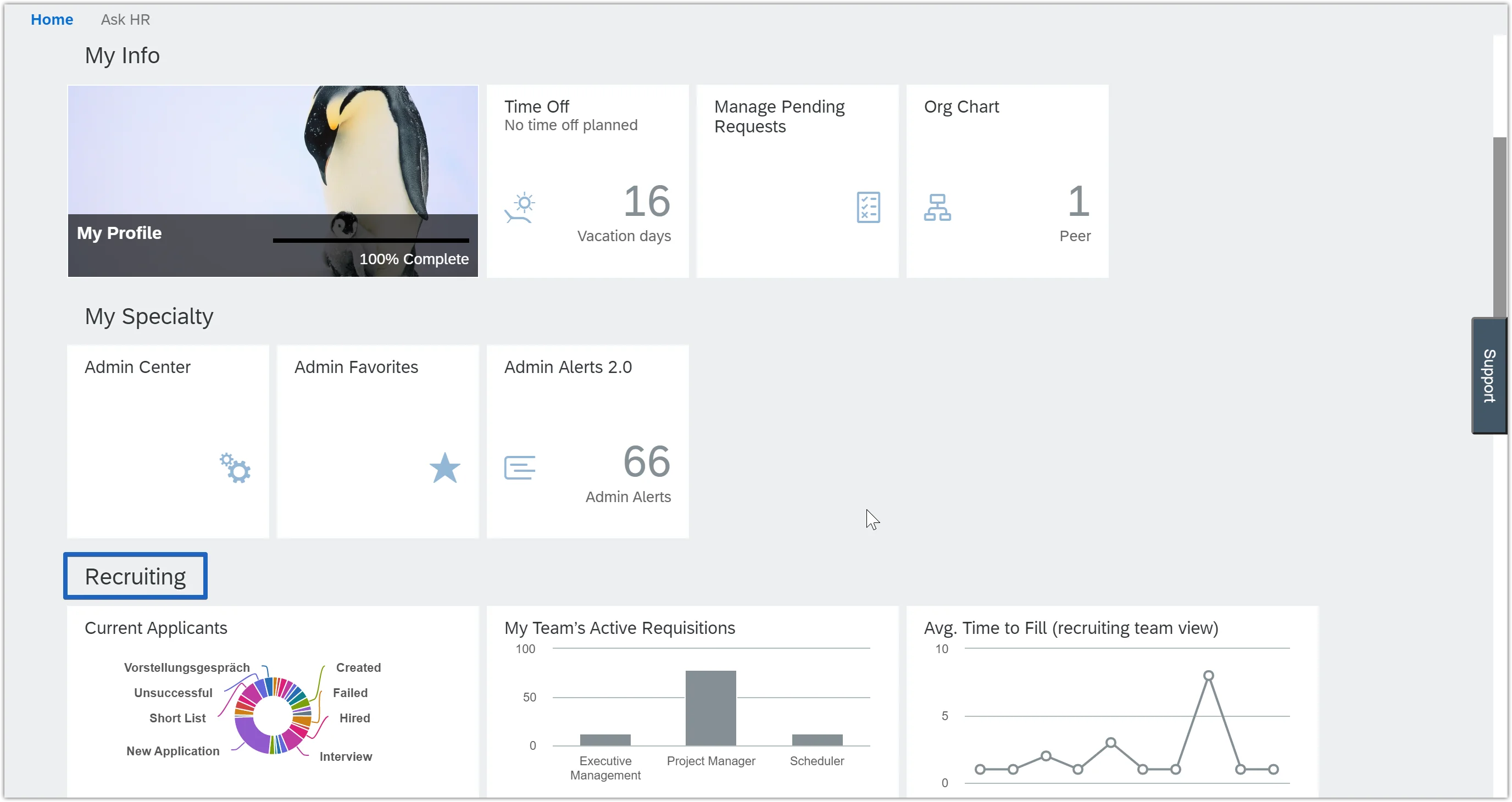
SAP SuccessFactors Recruiting is the enterprise ATS for organizations already running SAP's broader HCM suite. Following SAP's September 2025 acquisition of SmartRecruiters, the two recruiting roadmaps have been merged, with SAP positioning the combined platform as its go-forward enterprise recruiting solution.
The result is a product with deeper global localization than almost any competitor, covering 45+ country-specific compliance requirements, alongside native integration with SAP SuccessFactors HCM and SAP S/4HANA. Best for global enterprises where SAP is already the HR system of record.
Key Features
- Native integration with SAP SuccessFactors HCM and SAP S/4HANA (no middleware required)
- 45+ country-specific localization for global hiring compliance and local labor law requirements
- Combined roadmap with SmartRecruiters functionality following the September 2025 acquisition
- Configurable requisition and approval workflows for complex organizational structures
- AI-assisted candidate matching and screening
- Onboarding integration within the SAP SuccessFactors suite
- Enterprise-grade security, audit trails, and role-based access controls
Pros and Cons
Pros: "The best feature is the native integration with other SAP tools that allow you to leverage the existing data stored in the company's central instance." — Capterra reviewer
- Deepest global localization in the category; organizations hiring across 10+ countries with varying labor law requirements will find few alternatives at this level
- Native SAP integration eliminates the data sync work that third-party ATS platforms require when connecting to SAP HCM
- Combined SmartRecruiters roadmap (post-September 2025 acquisition) adds recruiter-facing UX improvements to the platform
Cons: "The level of complexity due to many features and need support and consulting" — G2 reviewer
- Implementation timelines run 12 to 18 months for large deployments; this is not a platform for organizations that need recruiting capability in the next quarter
- The SmartRecruiters integration is still transitional following the September 2025 acquisition; some combined roadmap features are not yet fully available
- Recruiter-facing UX trails purpose-built ATS platforms; day-to-day usability is a known limitation that SAP is addressing in the post-acquisition roadmap
Pricing
Custom pricing, typically part of an SAP SuccessFactors HCM contract. Not available standalone. Contact SAP for a quote.
7. iCIMS: Best Enterprise ATS for High-Volume Hiring and Global Workflow Automation
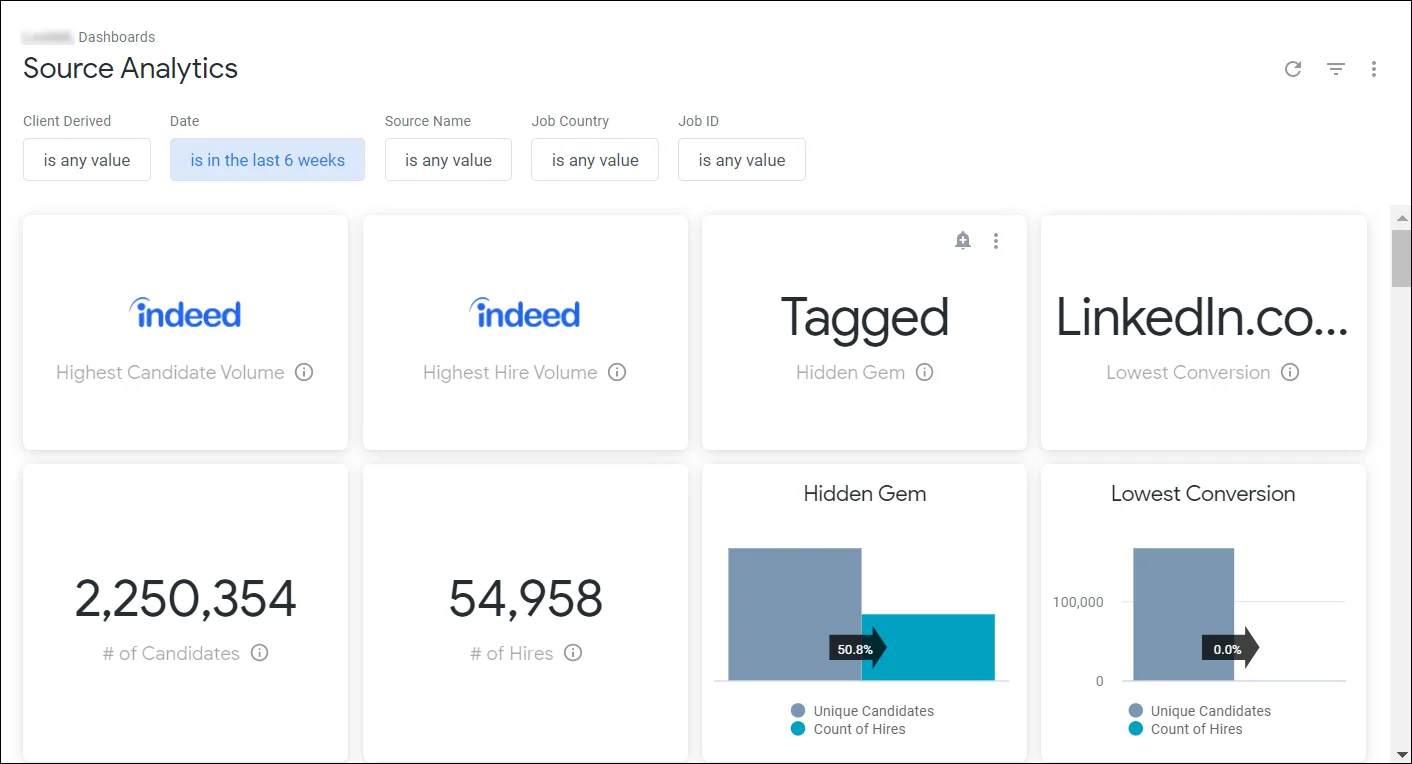
iCIMS is built for enterprise organizations with high-volume, multi-location, multi-jurisdiction hiring needs. With 5,000+ integrations and workflow automation depth that exceeds most competitors in the category, it is the platform that large TA teams reach for when the hiring operation has grown complex enough to require a real system of record, not just a pipeline tracker. The 2025 acquisition of Apli extended its automation capabilities into Latin American hiring markets.
Key Features
- High-volume hiring workflows with automation across requisition, screening, scheduling, and offer stages
- 5,000+ integrations including HRIS, sourcing, background check, and onboarding platforms
- Latin American hiring automation via the Apli acquisition (2025)
- Multi-brand and multi-location career site management
- Compliance and audit tooling for multi-jurisdiction hiring across the US and internationally
- CRM functionality for passive candidate pipeline management
- Reporting and analytics suite built for enterprise TA operations
Pros and Cons
Pros: "It was user friendly and easy to navigate and set up Candidate interview process which was great to navigate." — Capterra reviewer
- Workflow automation depth at scale is the strongest in this list; large TA teams with complex multi-step processes get more configurability here than from any other platform
- Integration breadth (5,000+) means iCIMS connects to almost every tool in an enterprise HR tech stack
- Latin American automation via the 2025 Apli acquisition makes it the most capable option for North and Latin American multi-market hiring
Cons: "The interface is still older and a platform hasn't updated. Switching the tab to the new items requires a new training process." — G2 reviewer
- Not appropriate for organizations below 1,000 employees; the platform's depth and price point ($25,000 to $140,000+/year) are calibrated to enterprise scale
- Implementation runs 6 to 12 months; teams that need capability quickly should look elsewhere
- The recruiter UX is less modern than Greenhouse or Ashby, which can affect daily adoption among recruiting teams
Pricing
Custom pricing. Typically $25,000 to $140,000+/year depending on organization size and module selection. Not publicly listed as of May 2026. Contact iCIMS for a quote.
8. Rippling Recruiting: Best All-in-One ATS for HRIS + ATS Consolidation
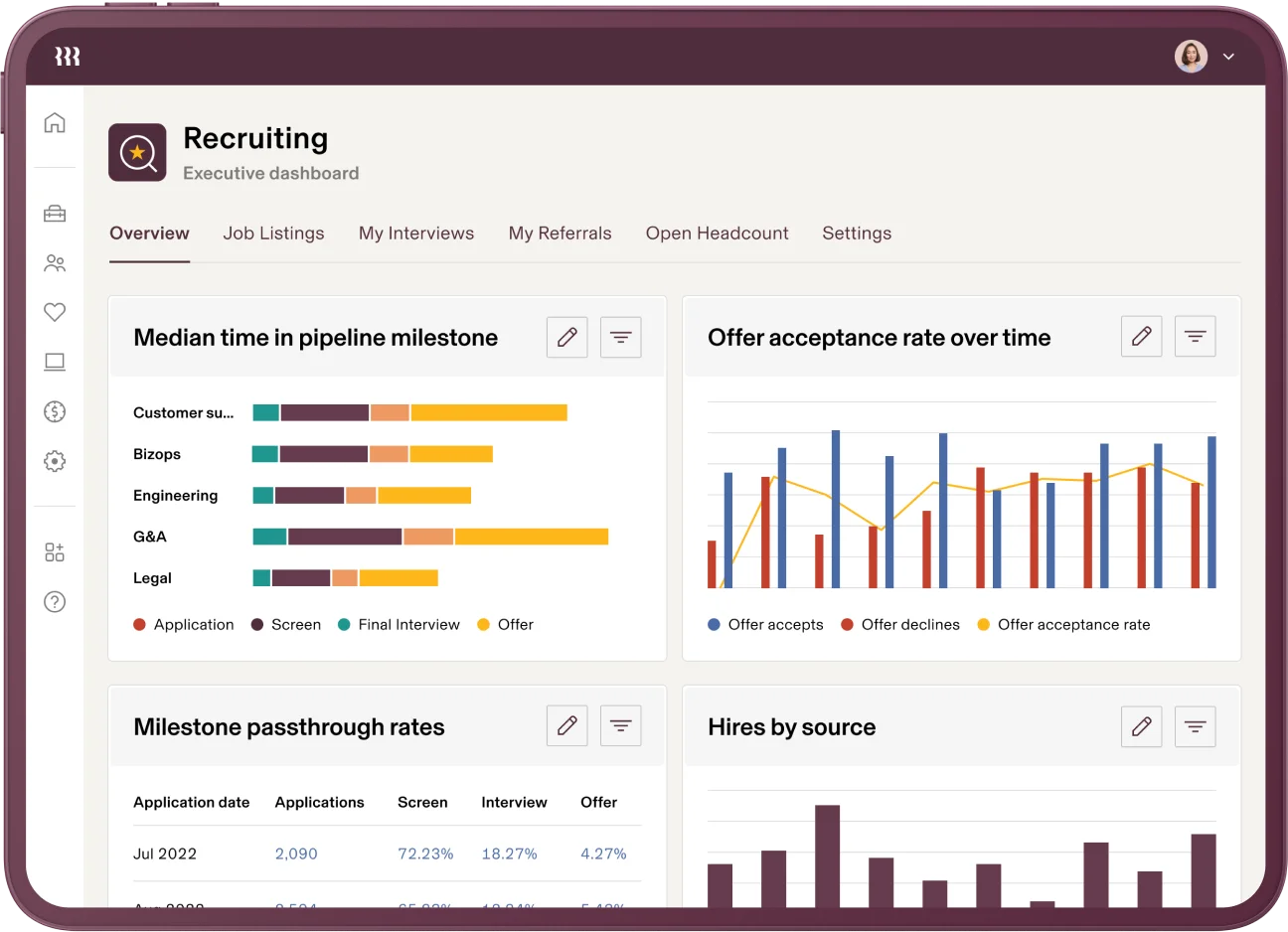
Rippling Recruiting is not a standalone best applicant tracking system. It is the recruiting module within Rippling's broader workforce management platform, covering HR, IT, payroll, and finance.
Its value case is specific: if your organization already runs Rippling for HRIS or is evaluating Rippling as an HRIS, adding the recruiting module eliminates the ATS-to-HRIS integration work entirely. New hires flow automatically into payroll, benefits, and IT provisioning without a separate data sync.
For organizations between 25 and 1,000 employees that want to consolidate vendors, it is worth a close look.
Key Features
- ATS pipeline management integrated with Rippling HRIS, payroll, benefits, and IT provisioning
- Automated hire-to-employee workflow: accepted offers trigger payroll enrollment, benefits selection, and device provisioning
- Customizable hiring workflows and approval routing
- Interview scheduling with calendar integration
- Job board posting and candidate tracking
- Reporting connected to Rippling's broader workforce analytics layer
Pros and Cons
Pros: "I like that we can clock in and also get pay and no mater if is deposit on your wise account or bank account , it gets there the same day." — Capterra reviewer
- Hire-to-employee automation is the clearest differentiator: accepted offers automatically trigger payroll, benefits, and IT onboarding without manual handoff
- Eliminates the ATS-to-HRIS sync work that costs every standalone ATS customer engineering time and ongoing maintenance
- Vendor consolidation benefit is real for organizations already evaluating Rippling as their HRIS
Cons: "Sometimes UI shows loading indicator for frequent visiting pages." — G2 reviewer
- The recruiting module cannot be purchased standalone; it requires a Rippling base platform subscription, which makes it irrelevant for organizations not on Rippling HRIS
- ATS feature depth is less mature than purpose-built platforms like Greenhouse or Ashby; structured hiring methodology and advanced analytics are notably lighter
- Less suitable for organizations where recruiting is a sophisticated, high-volume operation requiring enterprise-grade configurability
Pricing
Custom pricing. Available as an add-on to the Rippling base platform only. Not available as a standalone product. Contact Rippling for a quote.
9. JazzHR: Best Budget ATS for Small Businesses Making 10–50 Hires Per Year
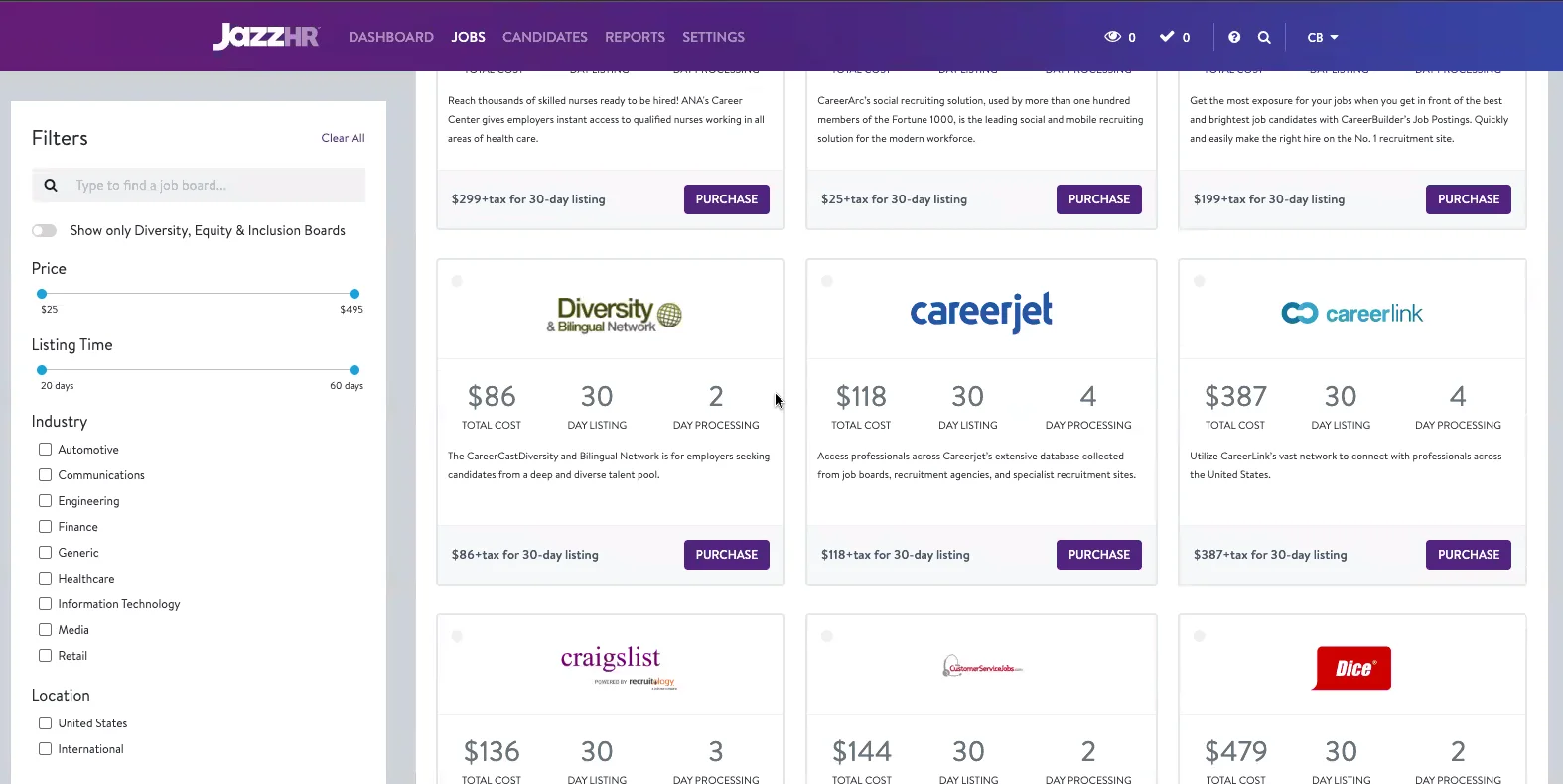
JazzHR is the most accessible entry point in this list for small businesses that need a functional applicant tracking system without enterprise pricing or a lengthy setup process.
Published pricing starts at $1,000 yearly, there is no implementation project to manage, and the platform covers the core recruiting workflow well enough for teams making fewer than 50 hires per year.
Native integration with BambooHR makes it a natural fit for small businesses already using BambooHR as their HRIS.
Key Features
- Customizable hiring workflows and pipeline stages
- Job posting to major job boards including Indeed and LinkedIn
- Collaborative hiring with hiring manager access and feedback collection
- Native BambooHR integration for HRIS data handoff
- Offer letter templates and basic onboarding workflow
- Reporting covering time-to-hire, source performance, and pipeline activity
- Custom application forms and screening questions
Pros and Cons
Pros: "I like how Jazz is easy to use, navigate, etc. It has all the functions I need as a human resources recruiter." — Capterra reviewer
- Published pricing at $1,000/year (Hero tier) removes the procurement friction that custom-pricing platforms create for small business buyers
- Fast setup; most small teams are running their first job posting the same day
- BambooHR integration handles the HRIS handoff cleanly for the most common small business tech stack pairing
Cons: "I find long term candidate management challenging with JazzHR." — G2 reviewer
- Talent pipeline management for passive candidates and long-horizon roles is limited; teams that want CRM functionality alongside ATS will need a separate tool
- Analytics depth is considerably lighter than mid-market platforms; not suitable for TA teams that report on cost-per-hire or quality-of-hire metrics
- Not built to scale above 250 employees; organizations growing into the mid-market range will likely outgrow JazzHR within 18 to 24 months
Pricing
JazzHR offers three hiring tiers billed annually, though monthly billing is also available. The entry-level Hero plan costs $1,000 per year, while the mid-tier Plus plan is priced at $3,480 per year. For comprehensive recruitment needs, the top-tier Pro plan is available for $5,508 per year.
10. Manatal: Best ATS for Recruitment Agencies and Very Small Businesses
Manatal holds the lowest entry price in this category at $15/user/month, which makes it a practical option for staffing agencies, solo recruiters, and small businesses making fewer than 20 hires per year. Its AI candidate matching and built-in recruitment CRM provide more functionality than the price point might suggest.
The platform is genuinely better suited to agency recruiting workflows and small in-house teams than to complex internal hiring operations.
Key Features
- AI candidate matching and automated candidate scoring
- Built-in recruitment CRM for client and candidate relationship management
- LinkedIn integration for candidate sourcing and profile import
- Customizable pipeline stages and job board posting
- Candidate database with search, filtering, and tagging
- Reporting covering pipeline activity, placement rates, and source performance
- Multi-job and multi-client management for agency workflows
Pros and Cons
Pros: "It is very responsive, comfortable platform and a real time saver and a very effective tracking software." — Capterra reviewer
- Lowest entry price in the category ($15/user/month) with a feature set that includes AI matching and CRM functionality not typically available at this price
- Agency-specific workflow support (client management, multi-job tracking, placement reporting) is a genuine differentiator for staffing firms
- Fast setup with no implementation project; most users are operational within a day
Cons
"Delayed support form customer support. the support is only over email." — G2 reviewer
- Customer support limited to email; teams that need phone or live chat support during active hiring periods will find this a real operational limitation
- Analytics depth is lighter than mid-market and enterprise platforms; not suited to TA teams that need cost-per-hire or source-of-hire reporting beyond basic pipeline counts
- Better calibrated to agency and small in-house recruiting than to complex internal hiring programs with structured evaluation requirements
Pricing
Manatal offers four yearly plans billed on a per-user, per-month basis. The Professional plan costs $15 for small teams managing up to 15 jobs and 10,000 candidates. The Enterprise plan is $35 for growing teams, offering unlimited jobs and candidates with workflow automation.
The popular Enterprise Plus plan is $55, adding user groups, advanced reporting, an open API, and AI integrations. For specialized needs, the Custom plan provides tailored integrations and dedicated support on demand.
How to Choose the Right Applicant Tracking System
With ten platforms in front of you, the right filter is buyer profile, not feature count. A few honest questions narrow the field quickly.
If more than 20% of your hires are hourly or high-volume, the evaluation should start with Workday Recruiting (if you're already on Workday HCM) or iCIMS (if you're enterprise-scale and standalone). Both platforms added AI screening capabilities in 2025 specifically for this use case.
If you're between 10 and 250 employees and need a fast deployment, Workable and JazzHR are the clearest starting points. Workable gives you more capability; JazzHR gives you lower cost. Your hiring volume over the next 18 months should drive that choice.
If analytics and data-driven recruiting are a priority, Ashby is the right evaluation regardless of your size in the 50-to-500 range. No other platform in this list matches its native reporting depth.
If you are building or maintaining passive candidate pipelines alongside active hiring, Lever's ATS+CRM model is the only option in this list that handles both workflows natively.
If enterprise scale with global compliance is the requirement, the evaluation comes down to your existing HCM ecosystem: SAP SuccessFactors if you run SAP, Workday Recruiting if you run Workday, and iCIMS if you run neither and need a standalone enterprise platform.
If you want to consolidate your ATS and HRIS into a single vendor, Rippling Recruiting deserves a serious look alongside a broader Rippling HRIS evaluation.
Find the Right ATS for Your Team
The right applicant tracking software is the one your recruiting team will actually use, that your hiring managers will engage with without a support ticket, and that gives your TA leader the data to make the case for headcount decisions. None of those things come from a feature checklist. They come from matching the platform's design philosophy to your organization's actual hiring operation.
Use the profiles and rankings above to build a shortlist of two or three tools, then demo with your real workflows: an active requisition, a hiring manager who doesn't check email, and a report your CHRO would actually read. The answer usually becomes clear within the first 30 minutes.
For broader recruiting technology context, including sourcing tools and talent CRMs that sit alongside your ATS, see our guide to the top recruiting software platforms in 2026. For HRIS evaluation alongside your ATS decision, our best HRIS software guide covers the integration considerations in detail.
.png)