
.svg)
Lattice is a capable platform, and that is worth saying plainly. Performance reviews, OKRs, engagement surveys, and people analytics in one place is a legitimate value proposition. The problem is not what Lattice does. The problem is what it costs by the time you have turned on enough modules to make it useful, how long it takes to roll out, and how much friction non-HR users report trying to find features buried inside the interface.
The four reasons organizations most commonly look for Lattice alternatives: Performance, Goals & OKRs, Engagement, Compensation and Grow are each priced per seat, so the total climbs with every product you add; every contract is billed annually with a $4,000 minimum, which rules out smaller teams; the UI has a documented learning curve that creates adoption friction for managers; and Lattice's Microsoft Teams app only sends notifications, so employees still open the web app to finish reviews. Our Lattice review breaks the cost down by team size.
If any of those sound familiar, the alternatives below are worth a closer look. Each one is evaluated against a specific Lattice limitation, not a generic feature checklist.
What to Look for in a Lattice Alternative
Not every Lattice alternative solves the same problem. Before booking demos, it helps to know which limitation you are actually trying to fix.
1. Match the Alternative to Your Specific Frustration
If price is the issue, PerformYard, 15Five Engage, and Teamflect all cost less and publish their rates. If engagement survey depth is the issue, Culture Amp is the clearest answer. If complexity is the issue, Workleap and PerformYard both deploy in days, not weeks. Switching platforms without a clear problem to solve tends to land organizations in the same place six months later.
2. Pricing Transparency and Total Cost of Ownership
Lattice now lists its per-seat prices, but the $4,000 annual minimum and annual-only billing still decide what a small team pays. Before shortlisting any platform, check whether pricing is published, whether it is modular or bundled, and what the minimum annual commitment is.
3. Tech Ecosystem Fit
Lattice is a standalone web app, and its Microsoft Teams app sends notifications only; employees act in the web app. For Microsoft 365 organizations, a Teams-native alternative eliminates the separate login problem that suppresses survey completion and review participation. For Slack-first teams, platforms with native Slack integration serve the same purpose. Ecosystem fit tends to affect adoption more than feature comparisons do.
4. Scalability for Your Current and Projected Headcount
PerformYard and 15Five Engage serve smaller teams well. Leapsome and Culture Amp scale into mid-market comfortably. Betterworks is built for enterprise complexity at 500 employees and above. Match the platform to where your team will be in 18 months, not just where it is today.
How We Evaluated Each Software
Every platform in this article was assessed against the same five criteria, with specific attention to how each one addresses a documented Lattice limitation. The rankings reflect how each tool performs on these dimensions for its target buyer, not a single best-overall verdict.
1. Addresses a Specific Lattice Limitation
Each tool was evaluated on whether it genuinely solves one of the four documented Lattice pain points: pricing complexity, UI and learning curve, engagement survey depth, or implementation overhead. Tools that clearly address one or more of these ranked higher than tools offering similar features without solving the core problem.
2. User Satisfaction
Verified ratings and review counts as of May 2026. Higher review volume was weighted more heavily. A 4.8/5 from 2,000 reviews carries more weight than a 5.0/5 from 40.
3. Pricing Transparency
Platforms with published, publicly accessible pricing ranked higher than those requiring a vendor conversation to determine cost. Lattice publishes seat prices but adds a $4,000 annual minimum, so alternatives with published prices and a lower entry cost got credit for that.
4. Feature Depth Relative to Buyer Profile
This was not a feature-count comparison. An SMB tool without enterprise governance features does not lose points for that. An enterprise platform without a smooth SMB onboarding path does not lose points for that either. Each tool was assessed on whether it delivers what its target buyer actually needs.
5. Implementation Speed and Adoption
Lattice rollouts take four to eight weeks. Platforms with faster time-to-value ranked higher for buyers where implementation overhead is the primary switching driver.
Top 10 Lattice Alternatives and Competitors in 2026
The tools below cover the full range of buyer profiles, from small teams looking for a lighter setup to enterprise organizations needing OKR-centric performance architecture. Each entry opens with the specific Lattice limitation it addresses.
1. Leapsome
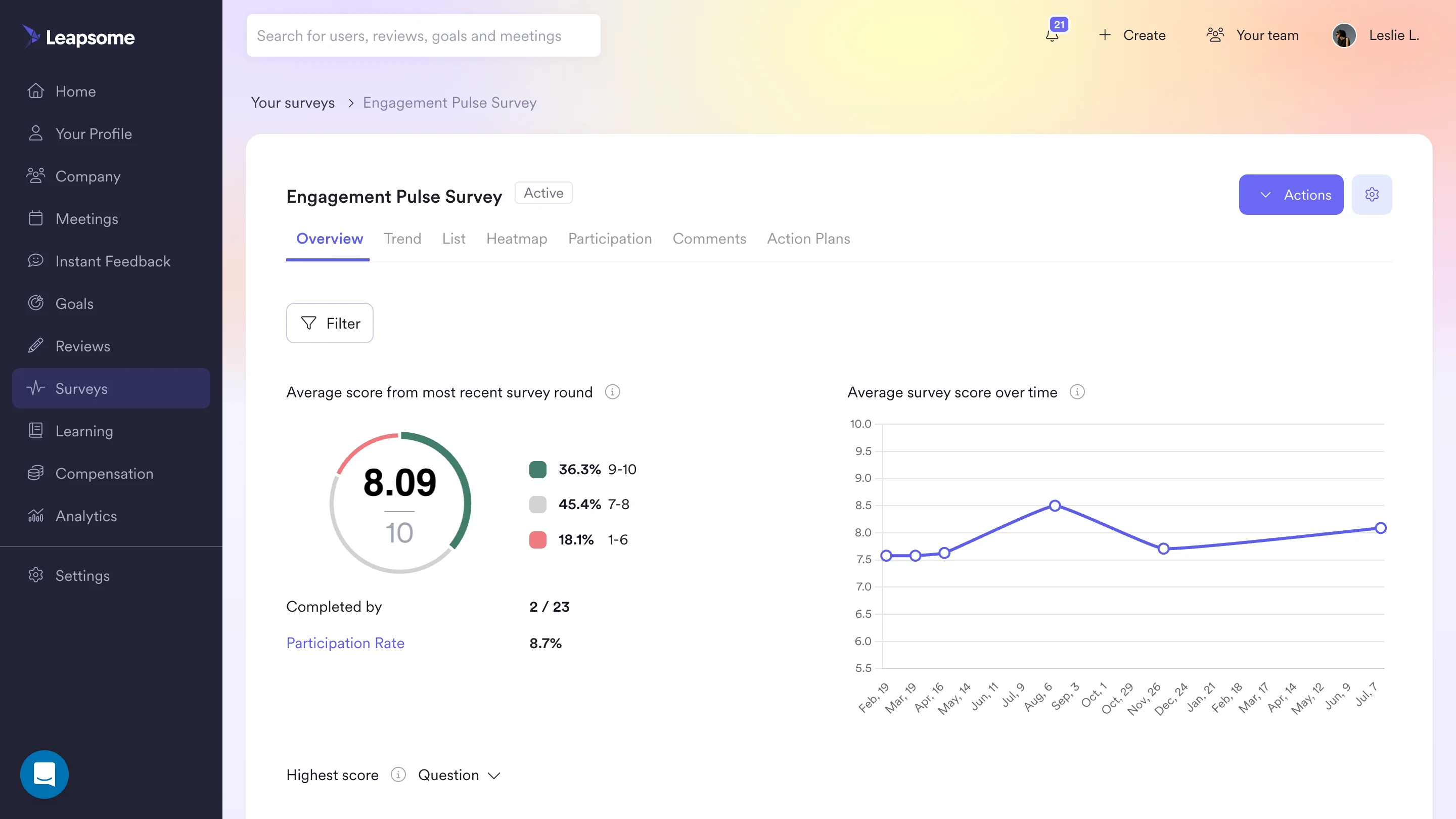
Lattice's most significant structural gap is what it leaves out: there is no HRIS layer, no learning management, and no compensation module without additional spend on top of the base price.
Leapsome closes all three. It covers performance reviews, engagement surveys, OKRs, learning, compensation, and an HRIS layer in one platform, at a price that holds up better than Lattice's modular structure as organizations grow.
Key Features
- Performance reviews with customizable cycles, 360-degree feedback, and calibration tools
- Engagement surveys with post-survey action planning workflows built into the platform
- OKR and goal tracking with cascading visibility from company level to individual contributor
- Learning management module with structured development paths tied to performance data
- Compensation review cycles connected to performance outcomes
- HRIS layer with centralized employee records and automated data syncing
- People analytics connecting engagement, performance, and development data in one view
Pros and Cons
Pros: "Leapsome has been great to work with! I’ve enjoyed the platform very much and it’s super simple to use!" - Capterra reviewer
- G2 rating of 4.8/5 from 2,400+ reviews, among the highest in the performance management software category
- Post-survey action planning closes the insight-to-action gap that Lattice users consistently flag
- Covers the full employee lifecycle in one platform without requiring separate tools for learning, compensation, or HR records
- Strong GDPR compliance posture, a genuine advantage for teams operating across multiple countries
Cons: "It could be helpful if the setup were easier. The setup process was straightforward, but having more guided onboarding tips and role-based setup templates would make it even easier for new users." - G2 reviewer
- Pricing is not publicly listed; organizations need to contact Leapsome directly for a quote, which adds time to the evaluation process
- Platform breadth means meaningful upfront configuration before the first review cycle runs
- Review template setup requires more initial effort than lighter alternatives like PerformYard or Workleap
Pricing
Pricing is not publicly listed as of May 2026. Contact Leapsome directly for a custom quote. A free demo is available.
2. Teamflect
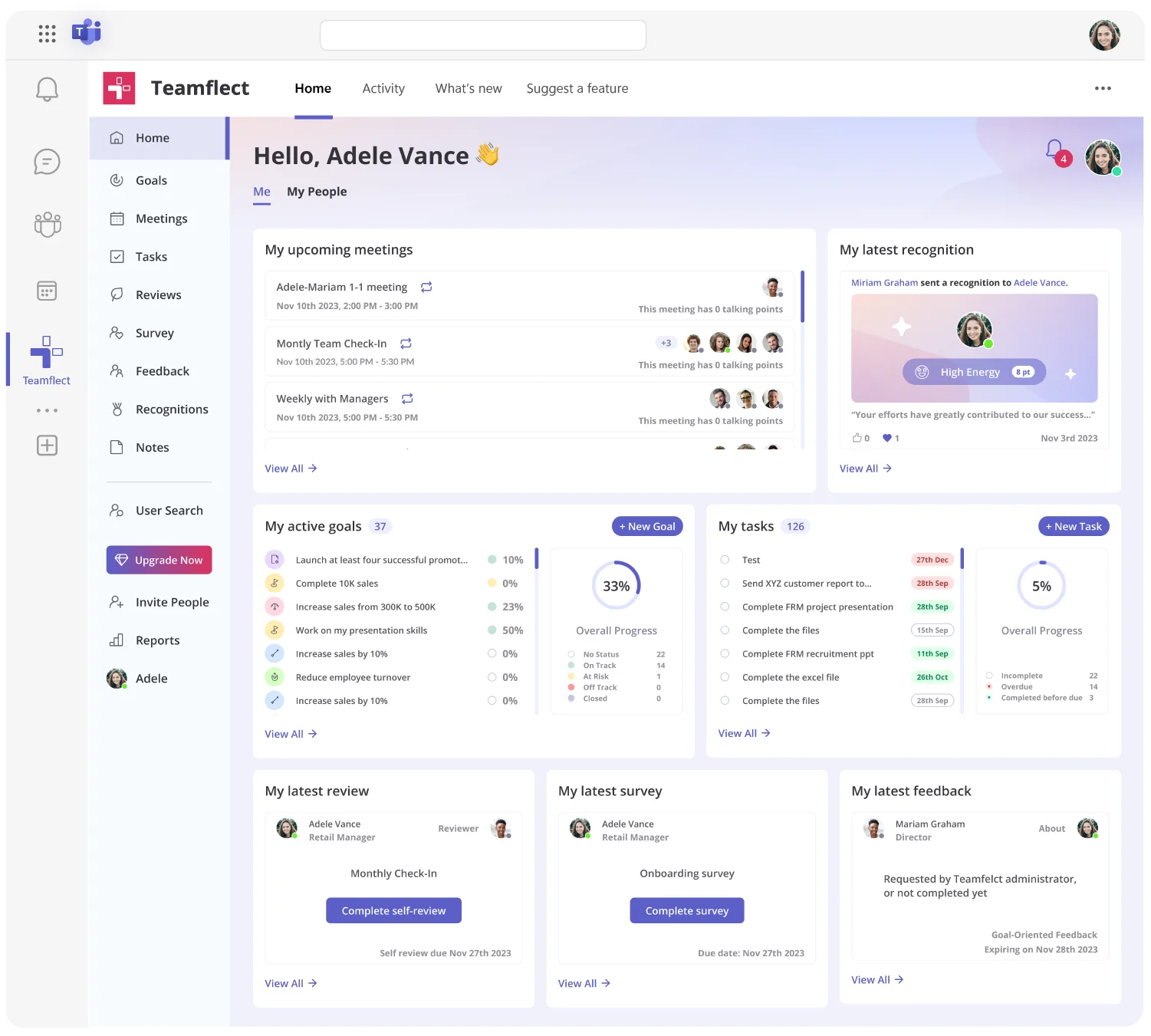
For organizations running Microsoft 365 as their primary work environment, Lattice's standalone web app creates a real adoption problem. Managers and employees have to log into a separate platform to complete reviews, respond to surveys, and update goals. Completion rates suffer.
Teamflect addresses this directly: performance reviews, 360-degree feedback, OKRs, 1-on-1 meeting agendas, engagement surveys, and recognition all happen inside Microsoft Teams and Outlook, where employees already spend their day. For a side-by-side look, see our Teamflect vs Lattice comparison.
Key Features
- Native Microsoft Teams and Outlook integration; no separate login required
- Performance reviews with customizable templates, 360-degree and self-assessment cycles
- OKR and goal tracking with cascading objectives and automated progress updates via Teams chat
- 1-on-1 meeting agendas with shared notes and action item tracking
- Engagement surveys with AI-generated summaries of qualitative responses
- Peer recognition through custom badges delivered in Teams channels
- AI agent inside Teams for HR queries and review workflow automation
Pros and Cons
Pros: "Teamflect connects our team in a way no other software has. The ability to maintain schedules, meeting notes and agendas, set goals and objectives, and complete reviews has been exceptionally helpful." - Captera reviewer
- Structurally higher adoption rates because the tool fits into existing daily workflows rather than requiring new ones
- Transparent, publicly listed pricing from a free plan up to $14/user/month ($11 billed annually); no sales call required to understand what it costs
- Quick implementation; most teams complete their first review cycle within days of setup
- Nonprofits receive up to 60% off annual contracts
Cons: "The user interface is sometimes clunky, and difficult to navigate or adapt to different screens especially when expanding text boxes for longer entries. Some of the features for tagging and categorizing are not always obvious either." - G2 reviewer
- Requires a Microsoft 365 environment; organizations on Google Workspace cannot use it, and Slack-first teams will not get the core benefit
- No HRIS layer; Teamflect does not replace a core HR system and works best alongside one
- No industry engagement benchmarking.
Pricing
Teamflect offers four plan tiers: a free Starter version for up to 10 users covering core review and OKR tools; an Essential plan ($9/user/month, or $7 billed annually) that adds analytics, training, and basic AI; a Professional tier ($14/user/month, or $11 billed annually) introducing extensive HRIS integrations and talent mapping; and a custom-priced Enterprise option for isolated cloud setups and advanced compliance.
3. 15Five
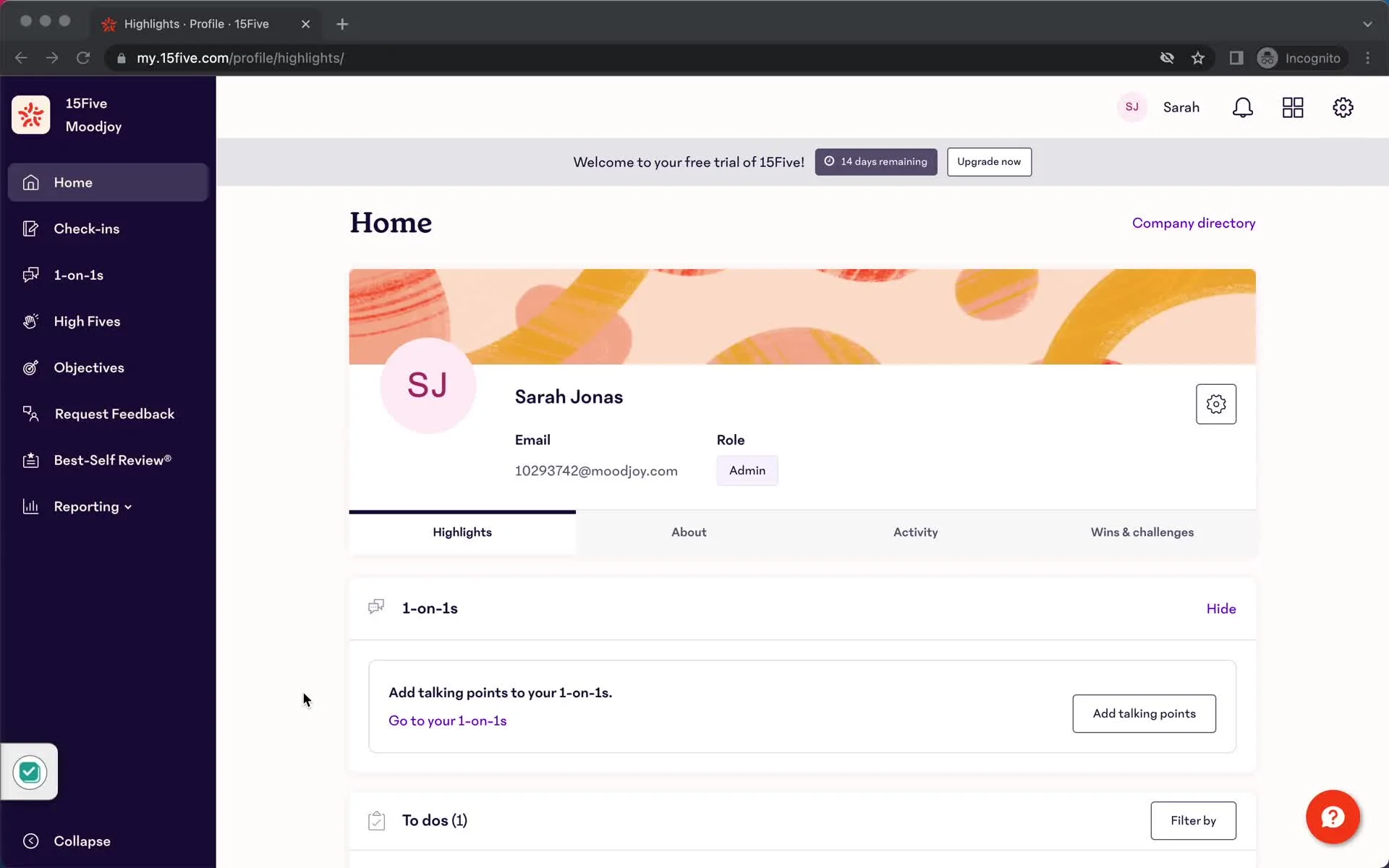
Lattice treats performance management as an HR project, with review cycles configured centrally and pushed out on a schedule. 15Five approaches it differently. The platform is built around the weekly check-in as the primary workflow, making manager engagement with team feedback a standing habit rather than a quarterly event.
For distributed and remote-first organizations where manager responsiveness is a significant retention factor, that structural difference is worth examining.
Key Features
- Weekly structured check-ins with a short-form format designed for both employee and manager completion
- Best-Self Review methodology with self-assessments, peer feedback, and manager reviews
- OKR and goal tracking with company-to-individual alignment
- 1-on-1 tools with shared agendas and talking-point prompts
- Manager scorecards and coaching resources included in higher tiers
- Recognition ("High Fives") with public visibility across the team
- Published pricing across all tiers
Pros and Cons
Pros: "The product is really helpful and scalable, especially when it comes to integrations. The design and layout are also very useful for the team. On top of that, it supports smaller review cycles, and the AI intelligence features feel very smooth to use." - G2 reviewer
- G2 rating of 4.6/5 from 1,900+ reviews
- Published pricing makes budget planning straightforward from the start
- Weekly check-in format is easy for managers to adopt without dedicated training
- Works well for distributed teams where consistent, low-friction manager touchpoints matter
Cons: "Would love for it to have some kind of widget where I can make simple updates in Slack or my Notion page." - Capterra reviewer
- No industry engagement benchmarking; Culture Amp covers that gap more thoroughly
- The weekly check-in cadence requires organizational buy-in to sustain; teams without manager commitment report fatigue over time
- Mobile experience trails the desktop version, which matters for field and frontline workers
- Survey analytics are less sophisticated than Culture Amp's for organizations where deep engagement measurement is the primary need
Pricing
15Five offers three main annually billed plans: Engage ($4/user/month) for employee surveys and data heat maps; Perform ($11/user/month) for continuous performance reviews, 360° feedback, and OKR tracking; and Total Platform ($16/user/month).
Optional add-ons are also available for standalone manager coaching, specialized compensation tracking, and deeper AI tools.
4. Culture Amp
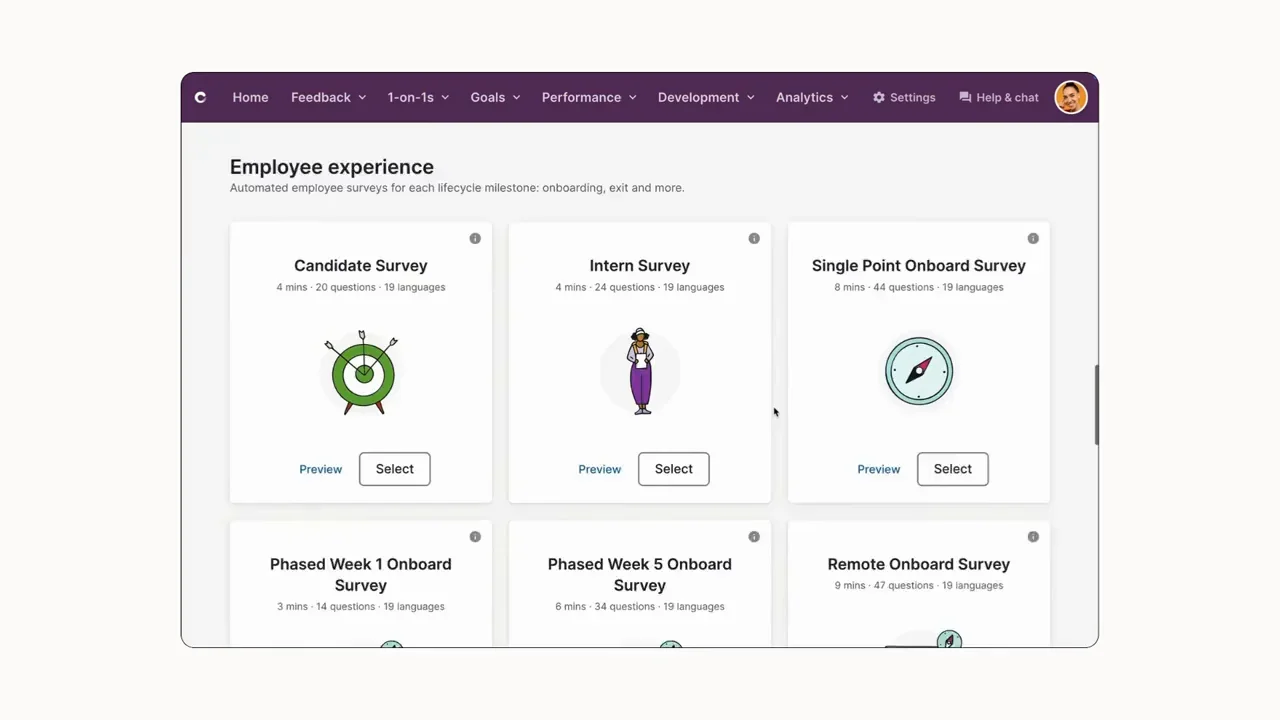
Lattice does engagement surveys. Culture Amp is built almost entirely around doing them better. The platform draws on benchmark data from more than 6,500 organizations, uses survey methodology developed with organizational psychologists, and provides people analytics depth that Lattice's engagement module does not match.
For HR teams where the primary frustration is that Lattice's survey data is good but not good enough, Culture Amp is the clearest answer on this list.
If employee engagement survey software is your primary buying criterion, Culture Amp is the natural starting point in that category.
Key Features
- Science-backed engagement surveys with benchmark data from 6,500+ organizations
- People analytics module covering engagement, performance, and retention trend analysis
- Performance Insights covering reviews, goals, and 1-on-1s
- Manager-facing coaching resources and action planning prompts tied to survey results
- Multi-language survey support for global organizations
- DEIB measurement and reporting tools
- Continuous listening programs alongside traditional annual engagement cycles
Pros and Cons
Pros: "I like how intuitive Culture Amp is. The layout is pretty straightforward and simple, without too many bells and whistles, making it easy to navigate. I appreciate its simplicity because it makes providing feedback less tedious." - G2 reviewer
- Benchmarking data from 6,500+ companies provides context that Lattice's engagement module cannot match
- G2 rating of 4.5/5 from 1,500+ reviews in the engagement category
- Strong people analytics depth for HR teams that need more than scores and trend lines
- Science-backed survey design gives the methodology credibility with skeptical leadership teams
Cons: "The language and semantics can sometimes be confusing, particularly when it comes to launching the surveys. It helps to have tech support close at hand.” - Capterra reviewer
- Pricing is not publicly listed, unlike Lattice's per-seat price list, and implementation can run 12 to 16 weeks for larger organizations
- The insight-to-action gap is a documented limitation; Culture Amp surfaces strong data but in-platform tools for manager follow-through are limited
- Customization of survey templates is more restricted than some buyers expect
- Support on lower tiers is less responsive than on enterprise contracts, per multiple G2 reports
Pricing
Culture Amp offers custom-quoted pricing across three core modules: Engage for sentiment surveys and retention analytics; Perform for 360-degree appraisals and OKR tracking; and Develop for career paths and capability mapping.
All plans include standard HRIS integrations, collaboration tools, and compliance features, with scalable administrative support and expert consulting tiered by organizational headcount.
5. PerformYard
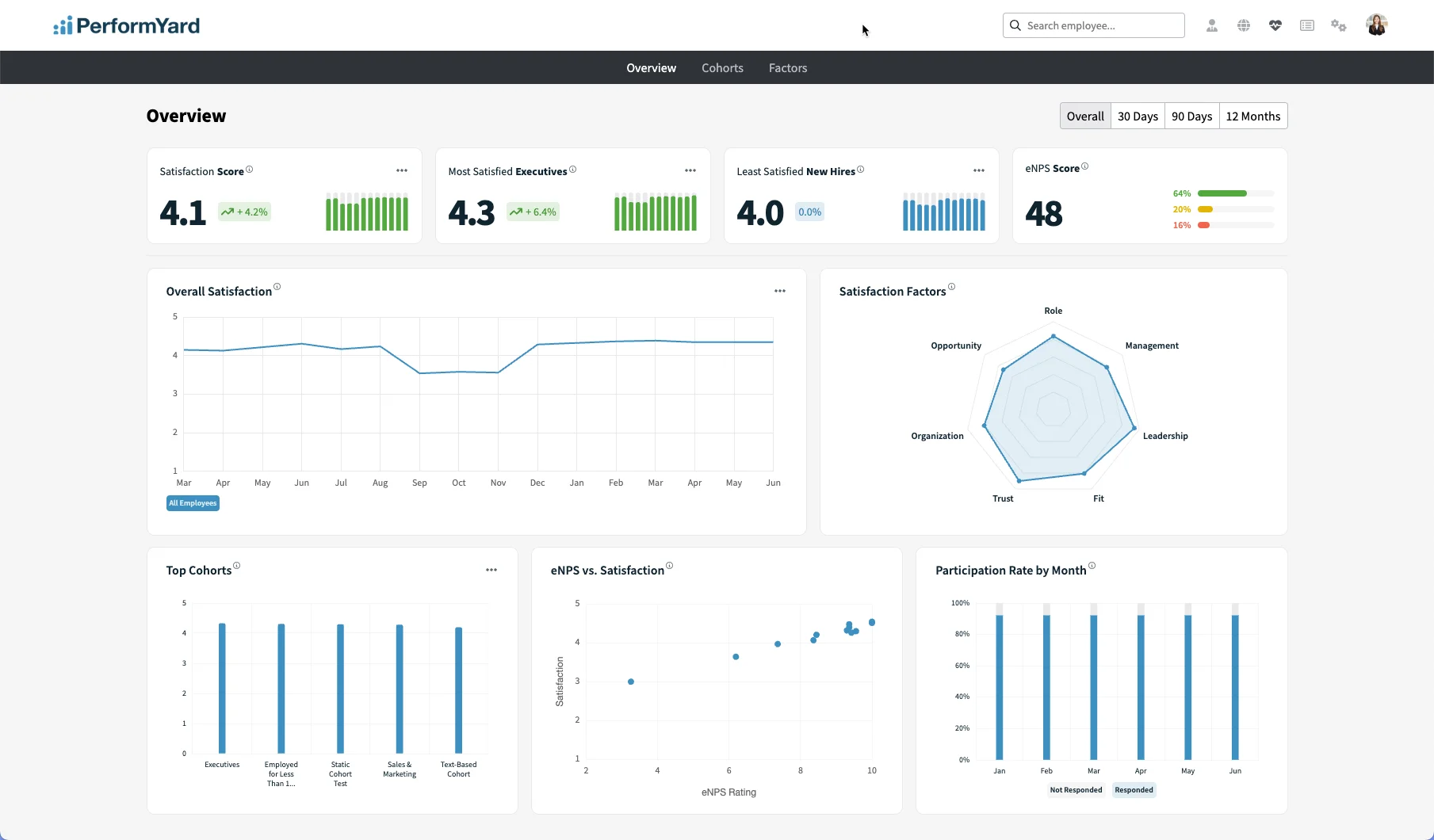
Lattice's $4,000/year minimum is a hard stop for smaller teams. PerformYard does not have that problem. It is a focused performance review and goal-tracking platform without Lattice's platform breadth, and that narrower scope is exactly the point.
Organizations that need review cycles, continuous feedback, and 360s running quickly, without configuring learning modules or compensation workflows they will not use, are the natural fit here.
Key Features
- Customizable performance review workflows for annual, semi-annual, and continuous cycles
- 360-degree feedback with configurable participant selection
- Goal tracking with alignment from team objectives to individual contributor work
- Continuous feedback and recognition tools
- Basic reporting and completion tracking for HR administrators
- Integration with common HRIS platforms including BambooHR and ADP
Pros and Cons
Pros: "PerformYard got the job done when it comes to annual performance reviews, as we didn't have a feature embedded with our talent management system at the time." - Capterra reviewer
- G2 rating of 4.7/5; consistently cited for ease of setup and low implementation friction
- Published pricing of $5 to $10 per user per month, significantly below Lattice's effective cost once modules are added
- Deploys in days, not weeks; for lean HR teams, that implementation speed is a real operational advantage
- Focused scope means less configuration overhead than Lattice or Leapsome for organizations that only need reviews and goals
Cons: "I am a first-time user, so I don't have much feedback here, but one thing I noticed is that my direct report can't view the review unless ALL signers have done so. It would be helpful for them to be able to access it as long as I, as the author, have signed it." - G2 reviewer
- No engagement survey module; organizations that need combined performance and engagement measurement will need a second tool
- No learning management or compensation features; PerformYard does one thing well and stops there
- Analytics depth is limited compared to Lattice, Leapsome, or Culture Amp
- Less suited for organizations above 300 employees that need complex calibration workflows or HRIS-level reporting
Pricing
PerformYard offers an annual performance management plan between $5 and $10 per user monthly, covering core review cycles, OKR tracking, continuous feedback, and dedicated support.
Organizations can customize their packages by adding PerformYard AI for feedback summaries (+$1 to $3), an employee engagement suite (+$1 to $3), collaborative meeting spaces (+$2 to $4), or an intuitive survey builder (+$2 to $4).
6. Workleap
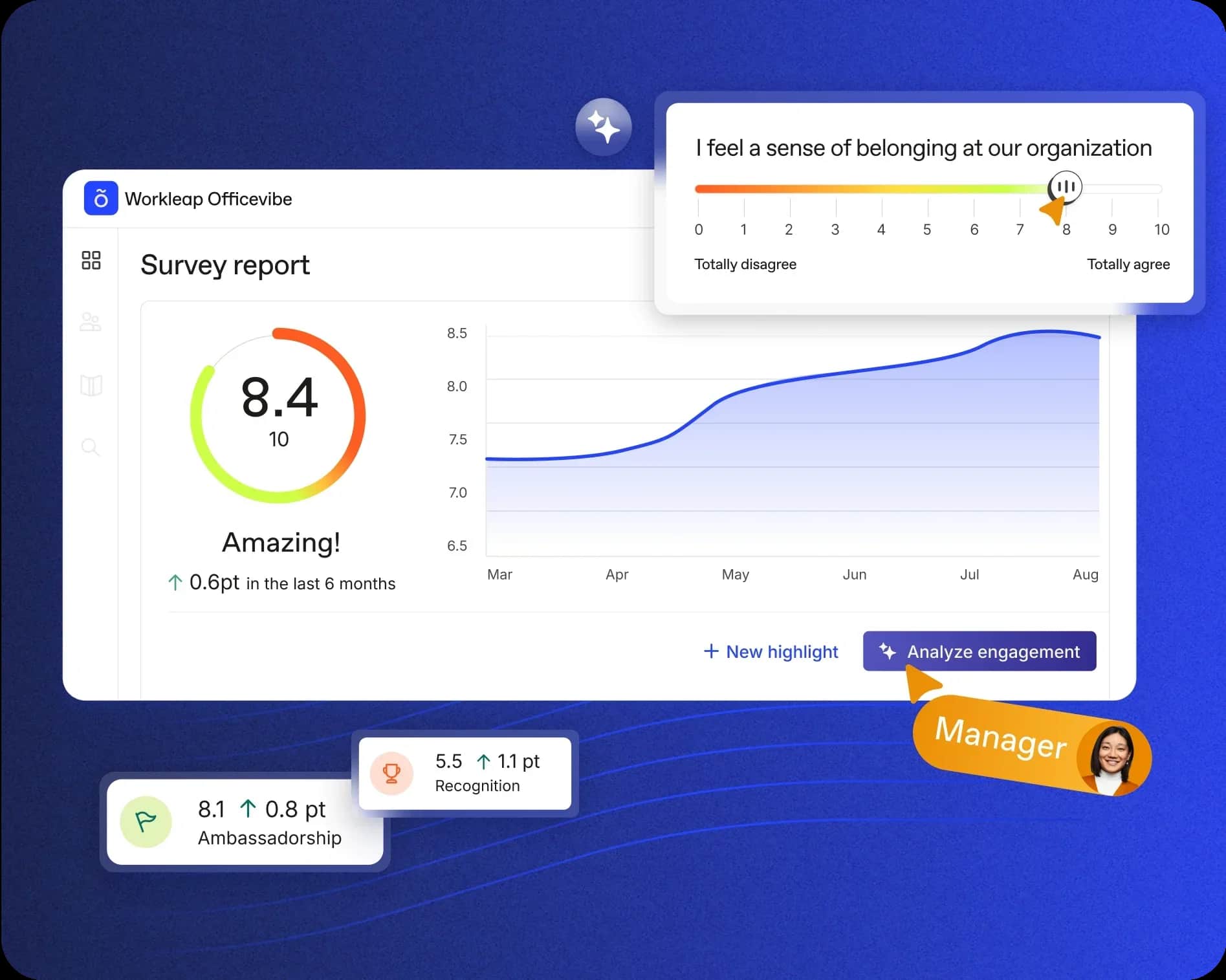
For organizations under 100 employees finding Lattice excessive in both cost and complexity, Workleap (previously known as Officevibe) is the most accessible entry point on this list.
Pulse surveys, peer recognition, basic 1-on-1 tools, and lightweight performance reviews deploy quickly at a price that does not require executive sign-off. The platform does not match Lattice's depth. For many smaller teams, that is a feature rather than a gap.
Key Features
- Automated weekly pulse surveys across 10 engagement metrics
- Anonymous feedback channels with manager visibility controls
- AI-powered manager insights that structure responses into actionable trends
- Good Vibes peer recognition built into the platform
- Basic 1-on-1 meeting tools and goal tracking
- Slack and Microsoft Teams integrations for in-workflow survey responses
Pros and Cons
Pros: "It is easy for the administrator to use and very easy for the employees to use. I like being able to read the feedback as well as see the group comparison numbers." - Capterra reviewer
- Free tier covers basic pulse surveys and recognition for unlimited users, a genuine option for budget-constrained teams
- Slack and Teams integrations allow employees to respond to surveys without leaving their primary workflow
- Very low learning curve; most employees and HR administrators are comfortable within hours of setup
- Fast deployment; smaller teams are often running their first pulse survey the same week
Cons: "Customization can be one of the downsides of Workleap. You may run into challenges when trying to tailor it to your specific needs and use cases." - G2 reviewer
- No formal performance review cycle in the base product; full review functionality requires an add-on, adding cost
- OKR tracking is available through a separate Workleap product, which creates additional complexity when bundling
- Analytics depth does not suit organizations that need enterprise-grade reporting or cross-cohort trend analysis
- Less well-suited for teams above 200 employees where engagement complexity outgrows the platform's architecture
Pricing
Workleap offers flat-rate annual plans: Standard ($4,999/year) covers core reviews, OKRs, engagement surveys, and basic AI; Pro ($11,999/year) adds salary benchmarking, custom segments, and API access; and Enterprise provides custom pricing for over 250 employees.
Organizations can also add an automated Manager Agent for $99 per manager monthly to handle performance drafting and leadership insights.
7. Betterworks
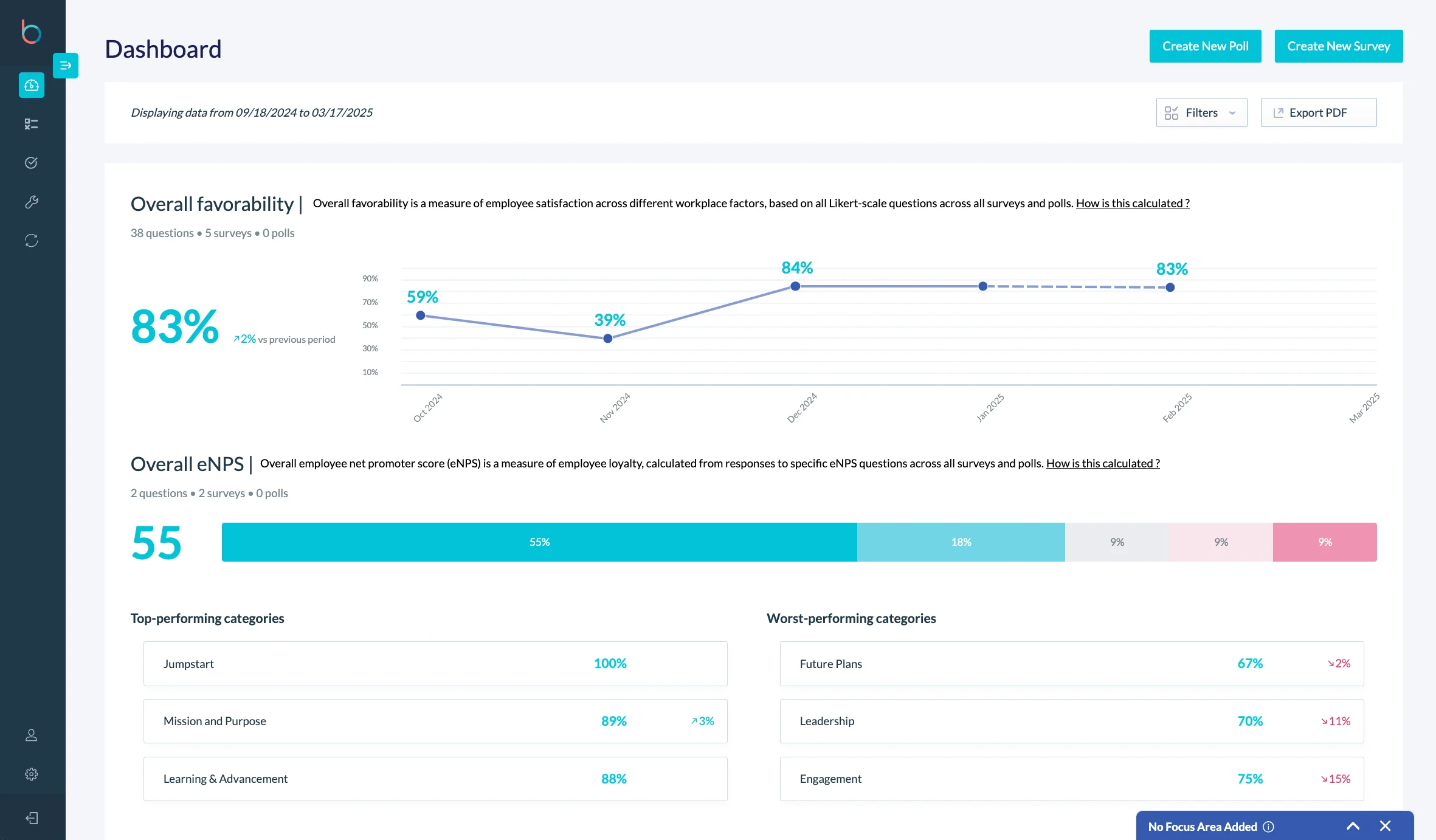
Lattice includes OKR software functionality, but it is secondary to the platform's review and survey architecture. Betterworks is built the other way around: OKRs are the central engine, and check-ins, feedback, and performance conversations all flow from goal progress.
For enterprise organizations above 500 employees where the primary Lattice frustration is insufficient goal alignment depth and unreliable HRIS integration, Betterworks is the most structurally different alternative on this list.
Key Features
- Sophisticated OKR framework with full cascade visibility from company strategy to individual contributor
- Continuous check-ins structured around goal progress rather than standalone surveys
- Performance review cycles with calibration tools and AI-assisted assessment for large organizations
- Manager conversation frameworks with coaching prompts and structured 1-on-1 templates
- People analytics with benchmarking and cross-module reporting
- Deep HRIS integrations with Workday, SAP SuccessFactors, ADP, and BambooHR
- AI retention-risk analytics added August 2025
Pros and Cons
Pros: "The most important thing its costumer support they answer so fast and the lady was very very nice to me and guide me with everything I needed." - Capterra reviewer
- Goal alignment transparency is the platform's strongest differentiator; the cascade from company OKRs to individual goals holds up in practice, not just in the demo
- HRIS integrations at the Workday and SAP level are deeper and more stable than Lattice's equivalents
- Structured check-in model gives managers a repeatable framework that does not depend on HR-initiated review cycles
- Newsweek 2025 AI Impact Award for the retention-risk analytics feature
Cons: "Navigating the application can be tricky." - G2 reviewer
- G2 rating of 4.3/5 from just 222 verified reviews is lower than most other tools on this list; UI and workflow clarity are consistent complaint areas across reviews
- Over-engineered for organizations below 500 employees; the platform's architecture assumes complex organizational structures
- Engagement survey depth is less mature than Culture Amp's
- Custom pricing with extended enterprise procurement timelines; not a quick evaluation process
Pricing
Betterworks offers custom-quoted pricing across two tiers: Mid-Market (500+ employees) for core performance essentials, and Enterprise (2,500+ employees) for a highly secure, all-inclusive setup. Both options bundle OKRs, ongoing feedback, AI-driven talent profiling, succession planning, and dedicated customer success support.
8. BambooHR
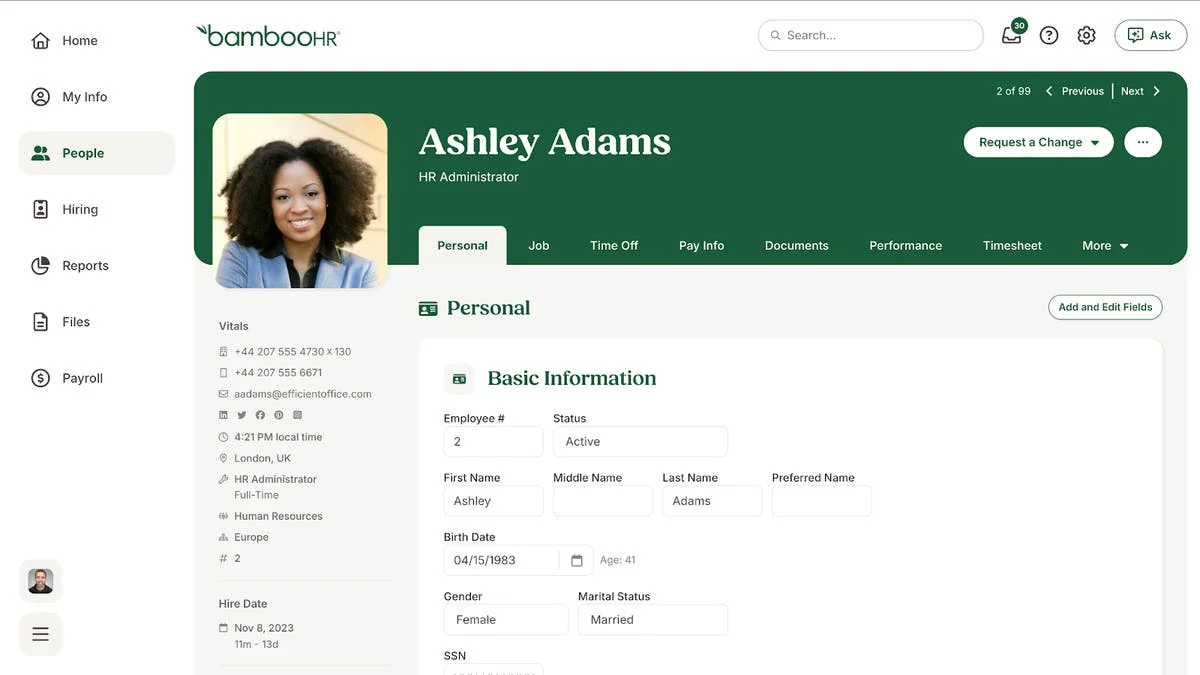
Lattice does not have an HRIS layer. For small and mid-sized organizations that want to consolidate HR records, onboarding, time-off tracking, and performance reviews in one platform, that gap is significant.
BambooHR covers the HRIS side competently and includes a performance management add-on. The performance module is less sophisticated than Lattice's, but for teams that need one platform instead of two separate tools, that trade-off is often worth making.
Key Features
- Core HRIS covering employee records, onboarding, document management, and e-signatures
- Time-off tracking and PTO management with employee self-service
- Performance Management add-on with customizable review templates and goal tracking
- 360-degree feedback available within the performance module
- Reporting and people analytics dashboards
- Applicant tracking system available as a separate module
- Integration library covering payroll, benefits, and productivity tools
Pros and Cons
Pros: "Tracking Leaves and company employee details whether they are working or who is on off on a given day has become very simple and it also great to verify other job info and perfonal info like tracking birth days." - Capterra reviewer
- Consolidates HR records and performance reviews in one platform, which Lattice cannot do
- G2 rating of 4.5/5 from 1,700+ reviews; broadly positive for the SMB segment it is designed for
- Self-service employee portal reduces administrative overhead for HR teams managing under 200 employees
- Simpler setup than Lattice for organizations whose primary need is HRIS plus basic review capability
Cons: "I feel that the flow to request time off could be improved. I'm always unsure whether my request will appear on my timesheet as I don't see anything until my manager has approved it." - G2 reviewer
- Performance module is an add-on, not a core product; the depth of dedicated platforms like Lattice or Leapsome is not matched here
- No engagement survey capability; organizations needing combined performance and engagement measurement need a second tool
- Performance reviews need the Pro plan ($17 per user per month), so teams on Core pay more to get them
- No compensation management; BambooHR's breadth on the HRIS side does not extend to compensation workflows
Pricing
BambooHR offers three monthly, per-employee tiers: Core ($10/user) for foundational HR data and onboarding; Pro ($17/user) adding performance reviews; and Elite ($25/user) introducing compensation management and advanced analytics. Volume and non-profit discounts apply, with modular add-ons available for payroll, time tracking, and benefits administration.
9. Engagedly
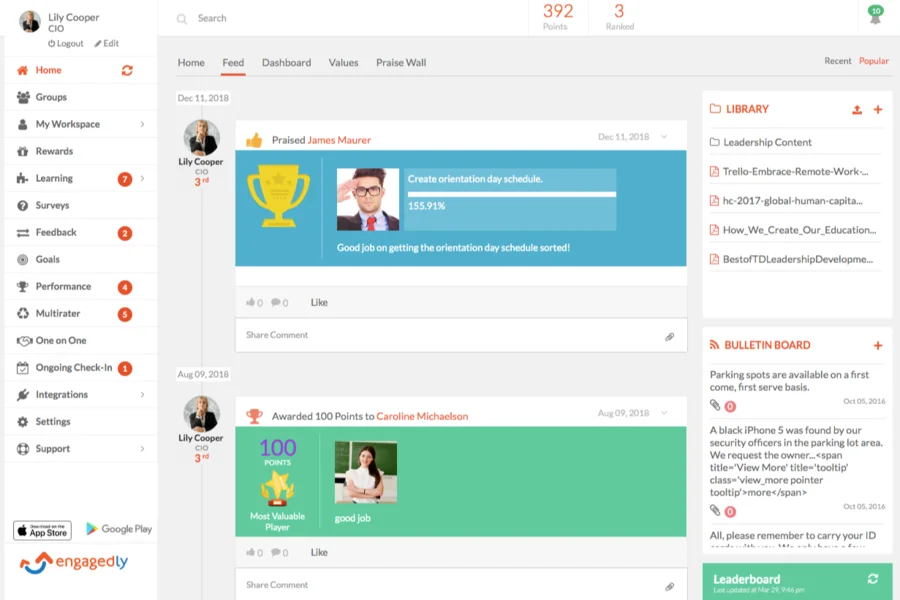
Lattice charges separately for performance, engagement, and growth modules. Engagedly bundles performance reviews, OKRs, learning management, engagement surveys, and social recognition into one platform with a single pricing structure. For organizations that want the combined capability of several Lattice modules without the accumulating per-module cost, Engagedly is worth a direct comparison.
Key Features
- Performance reviews with configurable cycles, 360 feedback, and goal alignment
- OKR tracking with company-to-team-to-individual cascading
- Learning management module with course creation and completion tracking
- Employee engagement surveys and sentiment tracking
- Social recognition and peer appreciation tools
- AI-powered performance and engagement insights
- Integration with common HRIS and payroll platforms
Pros and Cons
Pros: "It makes the process of performance review easy, standardized, and transparent." - Capterra reviewer
- Bundles performance, learning, engagement, and recognition in one platform, which addresses Lattice's module-stacking cost problem directly
- AI-powered insights add analytical depth without requiring a dedicated people analytics team
- Better suited to organizations that want an all-in-one talent platform without the complexity of a full enterprise HCM suite
Cons: "One disadvantage of Engagedly is the inability to award multiple badges in 1 post to the same user. I'd like to see some aestetic enhancements - maybe adding more color." - G2 reviewer
- Lower brand recognition than Lattice, Leapsome, or Culture Amp; fewer independent reviews available to assess real-world reliability
- UI is consistently noted in reviews as less modern than competing platforms
- People analytics are less sophisticated than Culture Amp's or Lattice's for HR teams with advanced reporting requirements
- A $7,500 yearly minimum, higher than Lattice's $4,000, rules it out for small teams
Pricing
Engagedly offers modular annual pricing with a $7,500 yearly minimum. Teams can mix and match functional suites: Manage Performance ($5 to $8/user/month), Learn & Grow ($3 to $5/user/month), and Engagement, Recognition, or Talent Mobility at $2/user/month each. Premium add-ons are available for compensation ($10), mentoring ($8), and frontline communication ($5).
10. Trakstar
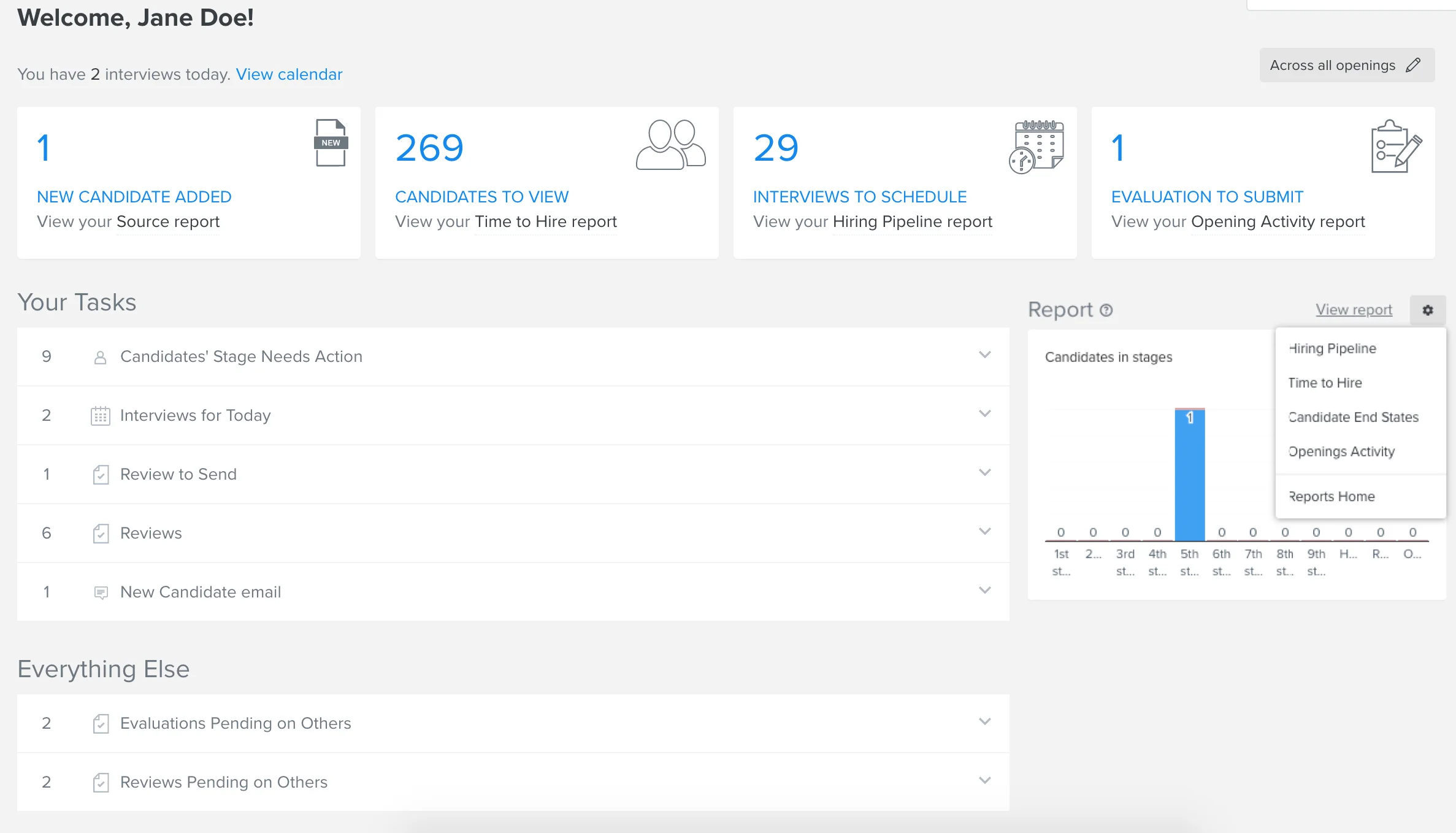
Trakstar's position on this list is specific: if your organization's primary frustration with Lattice is that it is too expensive and too complex for what you actually need, which is a reliable, customizable performance review tool, Trakstar is the most focused budget alternative available. It does not try to replicate Lattice's full platform. It runs review cycles well, costs less, and gets out of the way.
Key Features
- Customizable performance review workflows for annual, mid-year, and project-based cycles
- 360-degree feedback with configurable rater selection
- Goal tracking with manager and employee visibility
- Lightweight learning management module available as an add-on
- Reporting and completion dashboards for HR administrators
- Integration support for common HRIS platforms
Pros and Cons
Pros: "Employee performance, enhance engagement, and streamline talent development.” - G2 reviewer
- Significantly less expensive than Lattice for organizations that only need review automation
- Intuitive review interface reduces the manager adoption friction that Lattice users commonly report
- Fast to configure; lean HR teams can have review cycles running without extended implementation timelines
Cons: "Visually it looks quite basic, and I don't believe it's particularly customisable but I may be wrong as I'm not the main Admin." - Capterra reviewer
- No engagement survey capability; Trakstar does not address the combined performance-and-engagement use case
- Analytics depth is limited compared to Lattice, Leapsome, or Culture Amp; not suited to teams with serious reporting needs
- Smaller integration library than mid-market platforms
- Custom pricing; budget clarity requires a vendor conversation
Pricing
Trakstar utilizes a custom-quoted pricing model tailored to individual business needs. All personalized quotes feature unlimited data storage, ready-to-present analytics reporting, and extensive implementation support through Trakstar Academy and dedicated one-on-one sessions.
Find the Right Lattice Alternative for Your Team
The right Lattice alternative depends on which limitation you are actually trying to fix. If the issue is platform breadth and cost structure at the module level, Leapsome is the strongest like-for-like replacement. If your organization runs on Microsoft 365 and the standalone login problem is suppressing adoption, Teamflect is the clearest starting point, and the free plan covers up to 10 users with no time limit.
If engagement survey depth is the gap, Culture Amp addresses that directly. For smaller teams where Lattice's $4,000 minimum is the primary obstacle, PerformYard and Workleap both offer lower entry costs with published pricing.
Use the criteria and comparisons above to build a shortlist of two or three platforms, then run demos against your actual workflows rather than vendor scenarios. The tool that fits how your managers and employees actually work will always outperform the one with the most features on paper.
.png)