


.svg)
If your last staff questionnaire ran once a year and produced a report nobody opened again until the next cycle, you already know the problem pulse survey platforms solve.
Creating a resilient workplace culture starts with hearing what staff members have to say. Because active listening counts as an important leadership skill that can drive commercial success, organizations rely on these tools to collect immediate, actionable employee insights.
Instead of finding out about a problem eleven months late, platforms run short, automated questions on a weekly or monthly schedule so leaders see sentiment shift in near real time.
That is a different job than the deep, comprehensive style of engagement questionnaires most companies run once or twice a year. Some vendors on this list do both well. Others do one thing and do it precisely.
Our companion piece on engagement software covers the deeper, less frequent side of the category. This list stays on pulse-specific options built for continuous listening.
We ranked these ten options on three things above all else: whether delivery actually drives a usable response rate, whether the platform protects anonymity well enough that people answer honestly, and whether a low score turns into an action a manager actually takes.
What to Look for in Pulse Survey Software
Before ranking anything, it helps to know what actually separates a real pulse platform from a general survey builder wearing a pulse label. Five factors decide that, and they come up again and again in the entries below.
1. True Pulse Cadence and Automation
A genuine pulse survey app sends short, automated surveys on a set schedule, weekly or monthly, without someone needing to build and launch each round by hand. Look for question rotation, so employees are not answering the identical five questions every cycle, plus trend tracking that lines results up over time. A one-off questionnaire builder with a recurring option bolted on afterward is not the same tool.
2. Delivery Where Employees Already Work
Response rate is the number that decides whether a pulse program works, and delivery is what drives it. Tools that push surveys into Teams, Outlook, Slack, or a phone notification consistently beat tools that rely on an email link sitting in a crowded inbox. Match the delivery channel to where your workforce spends the day, not to whatever was easiest for the vendor to build first.
3. Anonymity and Psychological Safety
Honest answers depend on employees trusting that a response cannot be traced back to them. Look for a stated minimum group size before results display, commonly five respondents or more, and plain language about what a manager can and cannot see. Without that trust, pulse data measures compliance with a request, not actual sentiment.
4. Closing the Loop with Action Planning
A pulse score that never turns into a conversation or a visible change is a wasted cycle, and employees notice quickly when nothing follows a survey. Favor platforms with action-planning workflows, manager dashboards, and follow-up nudges built in. This is the step most programs skip, and skipping it is usually what erodes trust in the whole practice.
5. Analytics, Benchmarking, and Trends
A single pulse score rarely means much by itself. The value sits in the trend line across several cycles. Look for driver analysis that explains what is actually moving the number, and, where it matters to your organization, external benchmark data so a 7.2 has some context beyond your own history.
How We Evaluated Each Software
Every tool below went through the same five-part evaluation. A lower rank does not mean a weak product. It usually means the tool was built for a different job than pure pulse measurement, and the right pick for your team may not be the one sitting at the top.
1. Pulse Specialization
Whether the product was genuinely built around frequent, short, recurring surveys, or whether pulse functionality was added to a broader annual engagement or performance suite.
2. User Satisfaction on G2 and Capterra
Verified ratings and review counts as of June 2026, with more weight given to products backed by a meaningful volume of reviews rather than a handful of five-star outliers.
3. Response-Rate-Driving Delivery
How well the tool reaches employees inside Teams, Outlook, Slack, or a mobile app. Delivery channel is the single biggest lever on whether a pulse program gets a usable response rate.
4. Analytics and Action-Planning Depth
The strength of trend analysis, driver analysis, and the workflows that turn a low score into a manager conversation instead of a static chart nobody revisits.
5. Integration and Ease of Use
How cleanly the tool sits inside an existing HR and communication stack, and how much training a manager or employee needs before they will actually use it without reminders.
Pulse Survey Software Comparison Table
Our Top Picks for the Best Pulse Survey Software in 2026
Choosing the right pulse survey platform determines whether your feedback channels drive genuine action or collect digital dust. To help you find the ideal fit, we evaluated the market based on response rates, anonymity protection, and management follow-through.
1. CultureMonkey
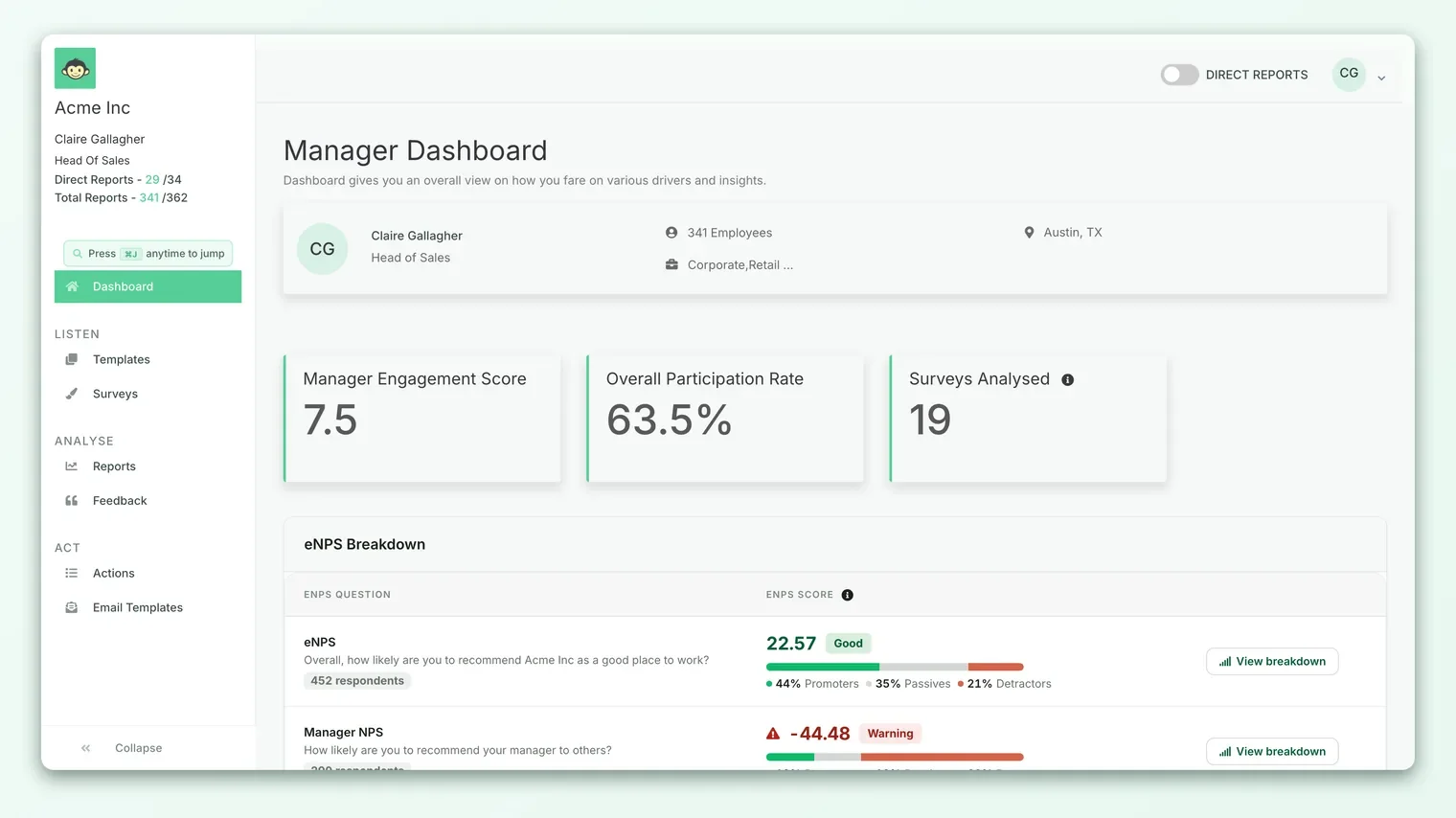
CultureMonkey is a dedicated pulse survey and engagement specialist, not a module tucked inside a broader HR suite, and that focus is why it leads this list. Every part of the product, from question rotation to AI-driven sentiment analysis, is built around the mechanics of continuous listening rather than around an annual review cycle it happens to also support.
For HR teams that want a tool whose entire roadmap is pulse measurement, this is the pure-play option on the list.
Key Features
- Automated recurring pulse surveys with question rotation and scheduling
- AI-driven sentiment analysis and driver identification
- Action-planning workflows tied directly to survey results
- Strong anonymity protections with configurable reporting thresholds
- Multi-channel delivery across email, Slack, Teams, and SMS
- Support for 100+ languages, useful for distributed or global workforces
Pros and Cons
Pros: "The CultureMonkey team has been outstanding, always responsive, patient, and proactive, even with the time difference. They worked closely with us to tailor their solution to our unique engagement framework, making the experience feel customized rather than generic." – Capterra review
- Purpose-built for pulse and continuous listening rather than repurposed from an annual survey product
- Anonymity and multi-channel delivery are built in rather than sold as an add-on
- Reviewers consistently single out implementation support as a strength, which matters for teams without a dedicated survey administrator
Cons: "It would be nice to be able to range the data for a window of time. The longer it is used, the less likely the older data is to stay relevant. For example, 2022 data about a manager may not reflect 2026 work life." – G2 review
- Smaller brand recognition and a thinner third-party integration marketplace than Culture Amp or Peakon
- Primarily a survey and feedback product; teams wanting a broader people platform will need to look elsewhere
- Pricing is not publicly listed, so budgeting requires a sales conversation before you can compare it against published-price competitors
Pricing
- No published pricing
- Quoted based on employee count, survey volume, and modules selected (engagement, exit, onboarding)
- Requires a demo call before a number can be attached
2. Teamflect
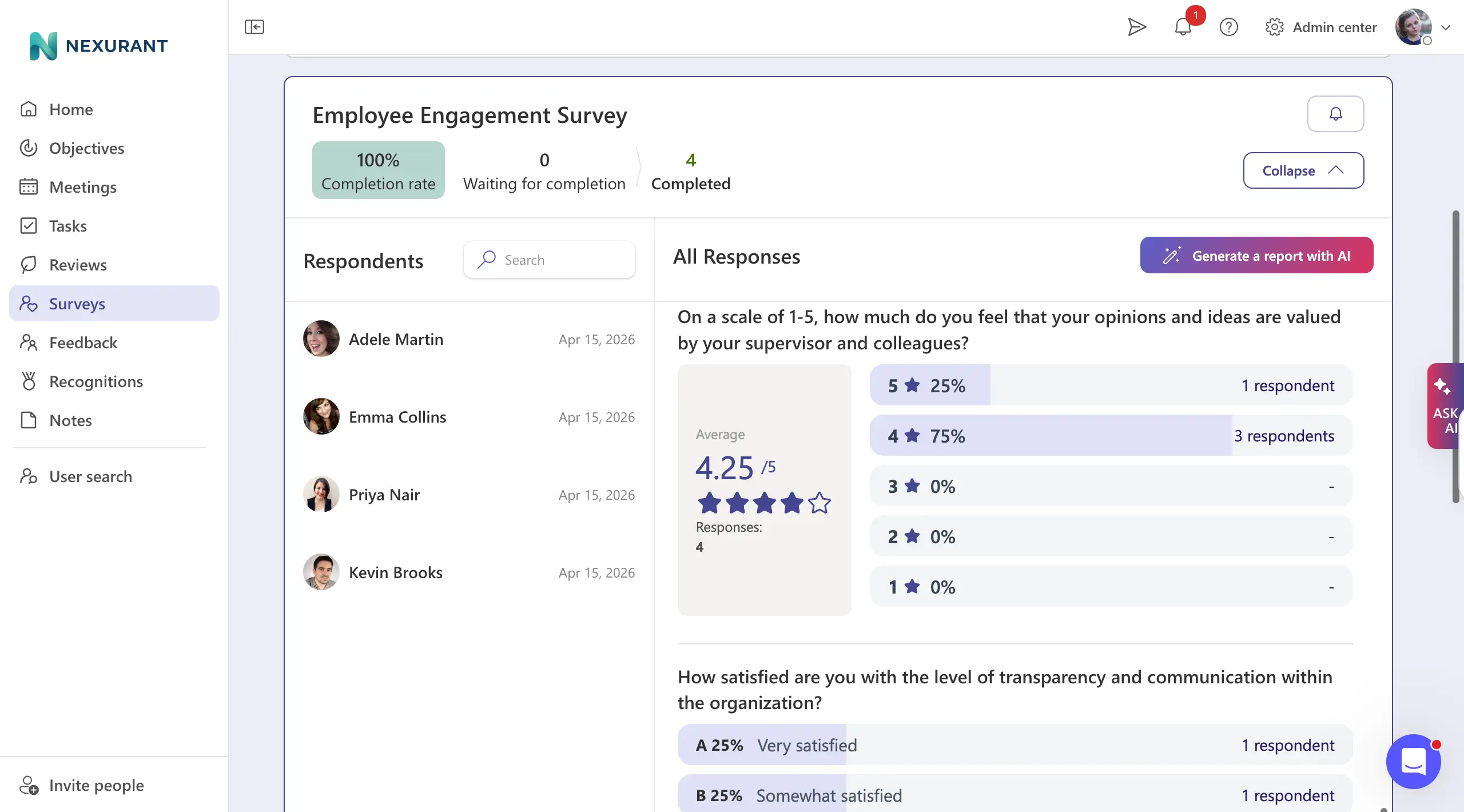
Teamflect is a Microsoft 365-native performance and pulse survey tool, and it earns the second spot on this list because of one specific mechanic: it delivers pulse surveys directly inside Teams and Outlook, where employees at a Microsoft-standardized company already spend most of their day.
That delivery advantage is exactly what pulse programs live or die on, since a survey that arrives as a Teams notification gets opened far more often than one sitting as a link in an email nobody has time to click.
Key Features
- Templated and custom pulse surveys sent natively through Teams and Outlook
- Question scheduling and recurring survey automation
- Anonymous surveys with multiple question types like: eNPS, likert scale, rating, ranking, and open ended.
- Recognition and check-in tools alongside pulse measurement
- Manager dashboards surfacing team-level sentiment trends
- SSO through Microsoft Entra ID and HRIS sync for employee data
- AI-assisted summaries of open-ended survey responses
Pros and Cons
Pros: "Conducting surveys and reviews is straightforward. I appreciate how user-friendly the platform is, making it simple for everyone to share their opinions without any complications." – G2 review
- Native Teams and Outlook delivery removes the adoption barrier that trips up standalone survey tools at Microsoft-first companies
- A free Starter tier for up to 10 users lowers the barrier to running a real pilot before committing budget
- Published, transparent pricing means you can budget for this without a sales call, unlike most of the enterprise names on this list
Cons: "On Integrations, it works best within the Microsoft ecosystem, so it may feel limiting for companies using a wider mix of third-party tools." – G2 review
- Requires a Microsoft account, so organizations outside the Microsoft 365 ecosystem lose the native-delivery advantage the rest of this entry is built around
- No core HR features like payroll, so pulse survey data still needs to sync with a separate HRIS for full employee context
Pricing
- Free Starter tier for up to 10 users
- Essential: $7/user/month
- Professional: $11/user/month
- Custom Enterprise pricing for larger organizations
- Annual billing saves 22%; qualifying nonprofits get up to 60% off
- No separate fees for support or training
3. Culture Amp
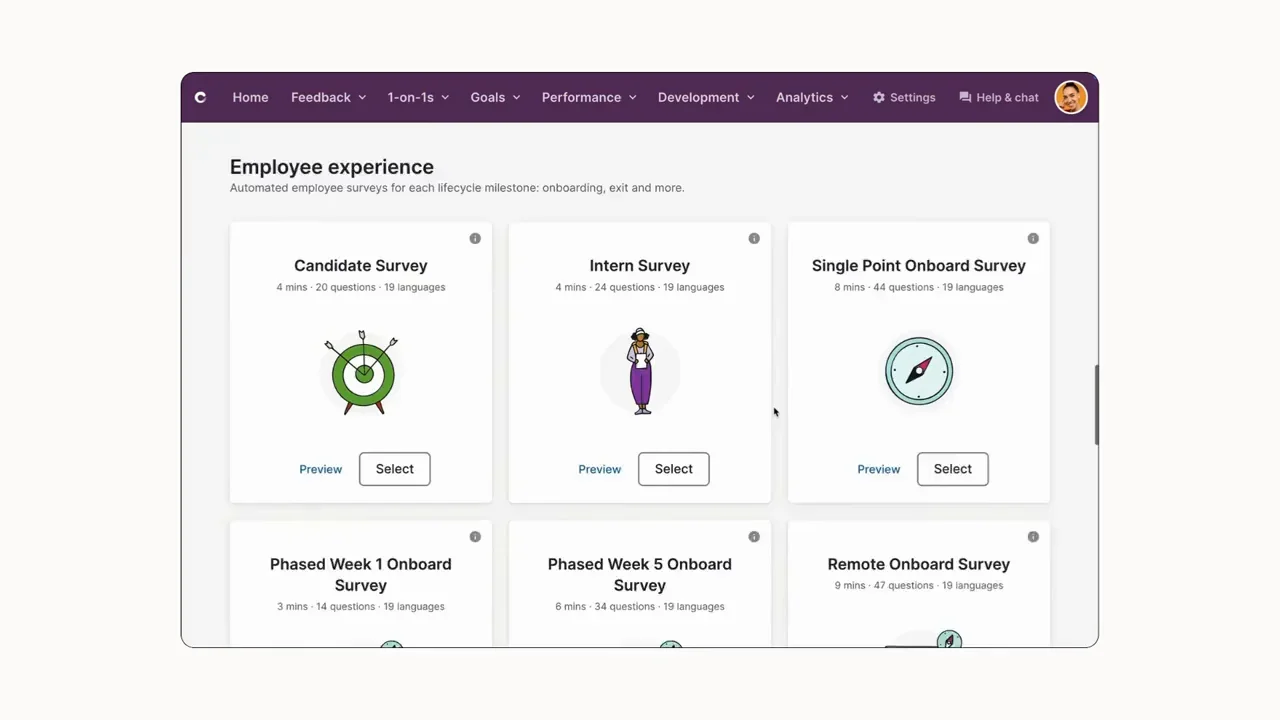
Culture Amp is an engagement and pulse platform built on people-science research, and its strength is context: a pulse score here comes paired with benchmark data drawn from thousands of other companies, so a manager can see whether a 6.8 is actually a problem or simply average for the industry. It sits inside a full employee-experience platform rather than functioning as a lightweight, single-purpose pulse tool.
Key Features
- Science-backed survey templates and question libraries
- Pulse surveys alongside comprehensive engagement and lifecycle surveys
- Driver analysis and engagement heatmaps by team and manager
- Cross-company benchmark data spanning industries and company sizes
- Action-planning workflows with optional People Scientist support on higher tiers
- Manager coaching content tied to survey results
Pros and Cons
Pros: "Hard to land on one thing but it has to be their people. The teams they put together are authentic, responsive kind, and really want to help us." – G2 review
- Benchmark data drawn from a large customer base gives scores context that smaller, newer platforms cannot yet offer
- Driver analysis and heatmaps go a level deeper than a simple pulse score, useful for larger HR teams that want to diagnose a problem, not just flag it
- People Scientist support on higher tiers is a genuine differentiator for HR teams without in-house survey expertise
Cons: "The language and semantics can sometimes be confusing, particularly when it comes to launching the surveys. It helps to have tech support close at hand." – Capterra review
- Pricing is not publicly listed, and third-party procurement data suggests annual contracts commonly land between $10,000 and $45,000 depending on headcount and modules
- There is no free plan, so smaller teams cannot pilot the product without a sales conversation first
- The platform is built for organizations that want comprehensive engagement measurement, and teams that only want a lightweight pulse tool may find it more platform than they need
Pricing
- No published pricing
- Third-party procurement data puts typical annual spend between $10,000 and $45,000
- Custom quote after a sales conversation
4. Workday Peakon Employee Voice
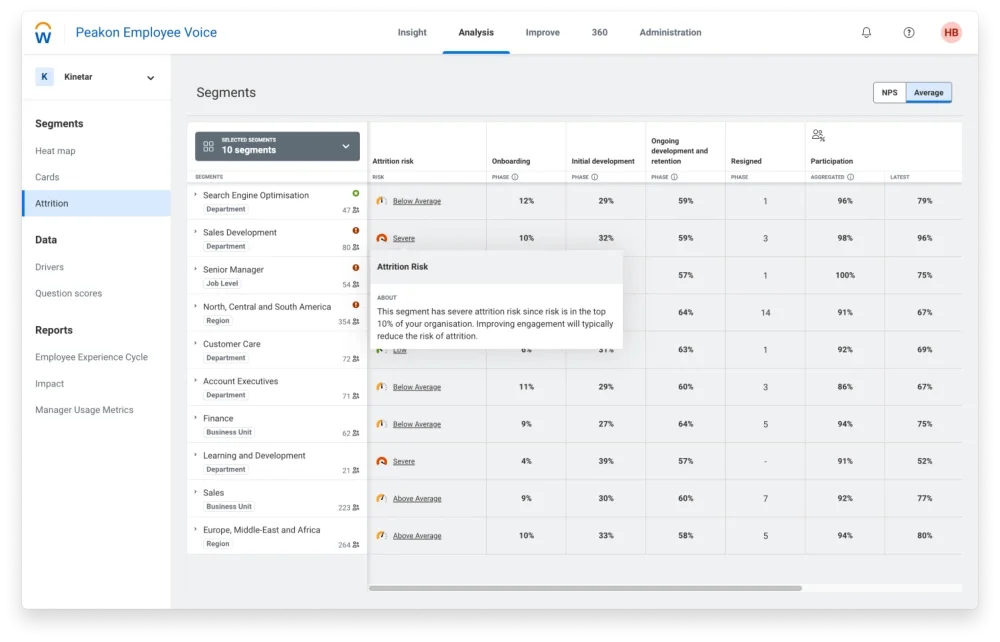
Workday Peakon Employee Voice is a dedicated employee-voice platform built for continuous listening at enterprise scale, and it is the strongest choice on this list for large organizations that already run on Workday HCM.
Its intelligent analytics layer, including attrition forecasting and benchmark-adjusted scoring, is built to handle the volume and complexity of a global, multi-thousand-employee pulse program rather than a lean team's weekly check-in.
Key Features
- Continuous pulse cadence with AI-driven sentiment analysis
- Attrition risk forecasting tied to survey responses
- Driver analysis and heatmaps across teams, locations, and demographics
- Large, standardized industry benchmark dataset
- Native integration with Workday HCM and other major HRIS platforms
- Manager-level action planning with follow-up tracking
Pros and Cons
Pros: "Survey responses are anonymous, which leads to more honest reviews that reflect reality better than when people identify themselves." – Capterra review
- One of the largest standardized benchmark datasets in the category, useful for enterprises that want external comparison, not just an internal trend line
- Attrition forecasting adds a predictive layer most pulse tools on this list do not offer
- Native Workday integration removes a data-sync headache for organizations already on that HCM
Cons: "At the beginning, the setup can be a bit complicated if you don't have a specialized team. Additionally, certain metrics may not be so easy to interpret for those who are not familiar with this type of data." – G2 review
- Priced against total headcount rather than active users, and third-party benchmarks put the entry point around $20,000 a year with no free trial
- Most valuable to organizations already inside the Workday ecosystem; the value proposition weakens outside it
- Implementation and admin overhead are heavier than the lightweight pulse tools on this list, which is a real cost for smaller HR teams
Pricing
- No published pricing
- Licensed per employee against total headcount, billed annually
- Third-party benchmarks put the typical entry point around $20,000/year
- No free trial offered
5. Workleap
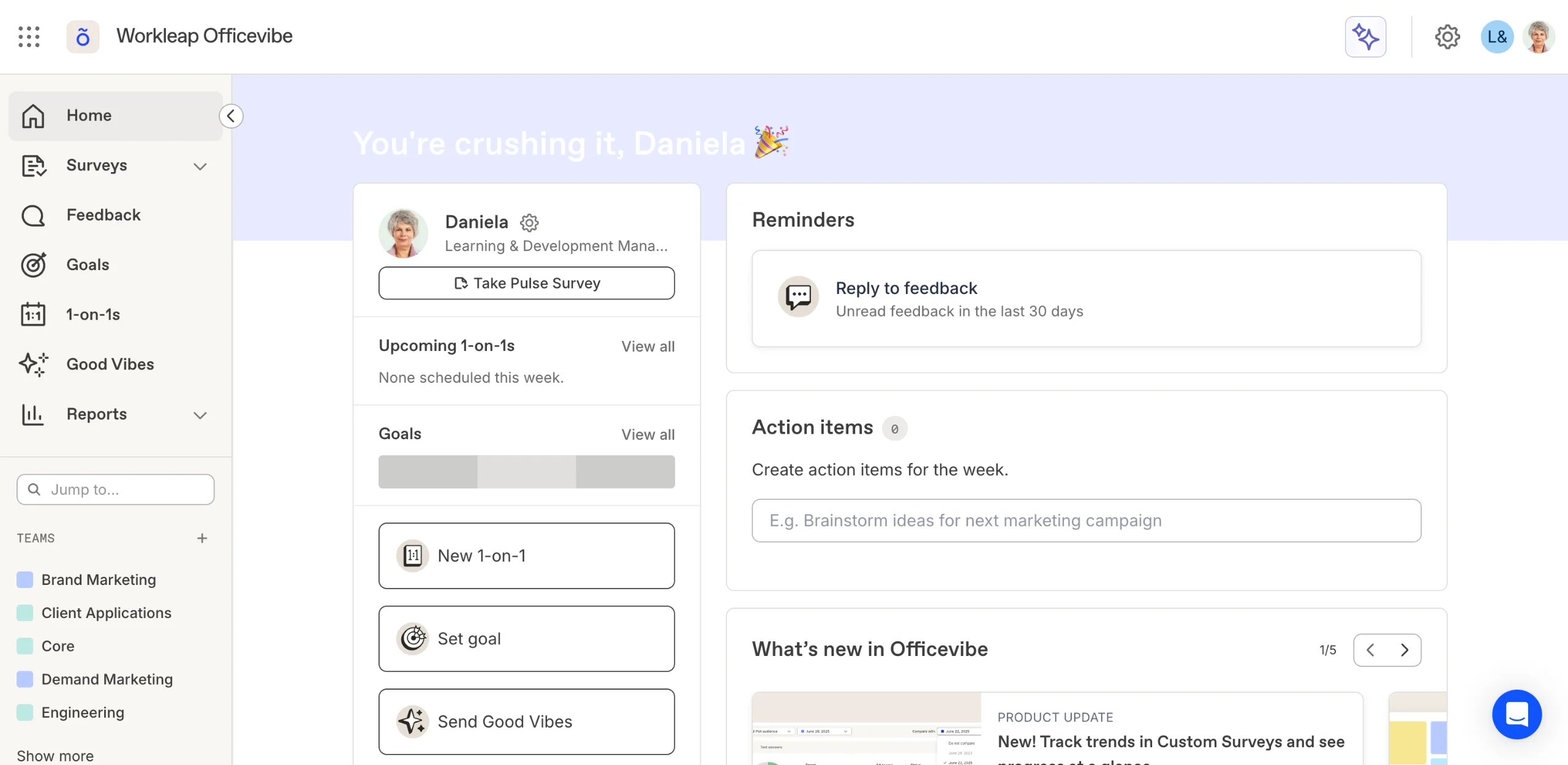
Workleap is one of the original pulse survey tools on the market, and it remains the strongest fit for SMB and mid-market teams that want automated recurring surveys without enterprise-level cost or complexity.
Weekly pulse surveys, anonymous feedback, and Good Vibes peer recognition run inside a single, simply priced product, which keeps it accessible to companies that do not have a dedicated survey administrator.
Key Features
- Automated weekly pulse surveys across ten core engagement metrics
- Good Vibes peer recognition tied to the same platform
- eNPS tracking alongside pulse scores
- AI-generated reporting and suggested action items
- Anonymous feedback channel separate from scheduled pulse cycles
- Integrations with Microsoft 365, Slack, and major HRIS platforms
Pros and Cons
Pros: "Very user friendly with little to no training needed for employees. Great pre-written questions that align with current climates." – Capterra review
- Question bank and automated cadence mean a small HR team can launch a real pulse program without survey-design expertise
- A free trial and a low, transparent starting price make it easy to pilot against a much larger competitor before committing budget
- Good Vibes recognition sits inside the same tool, so managers are not juggling a separate recognition platform
Cons: "The only thing I dislike is that customer service is handled entirely online through chat or self-help. There isn't a phone number you can call to speak with someone directly." – G2 review
- Analytics depth trails enterprise-grade tools like Peakon or Qualtrics, which matters once a program scales past a few hundred employees
- Support is chat and self-help only, with no phone line for organizations that want a direct line during an implementation issue
- It is one product inside the broader Workleap suite, so teams that later want performance or learning modules will be adding separate line items
Pricing
- Standard tier: $4,999/year (performance management and engagement)
- Pro tier: $11,999/year (adds advanced intelligence and compensation benchmarking)
- Custom Enterprise pricing for companies with 250+ employees
- Manager Agent add-on: $99/manager/month for AI-driven insights, review drafting, and decision assistance
6. Leapsome
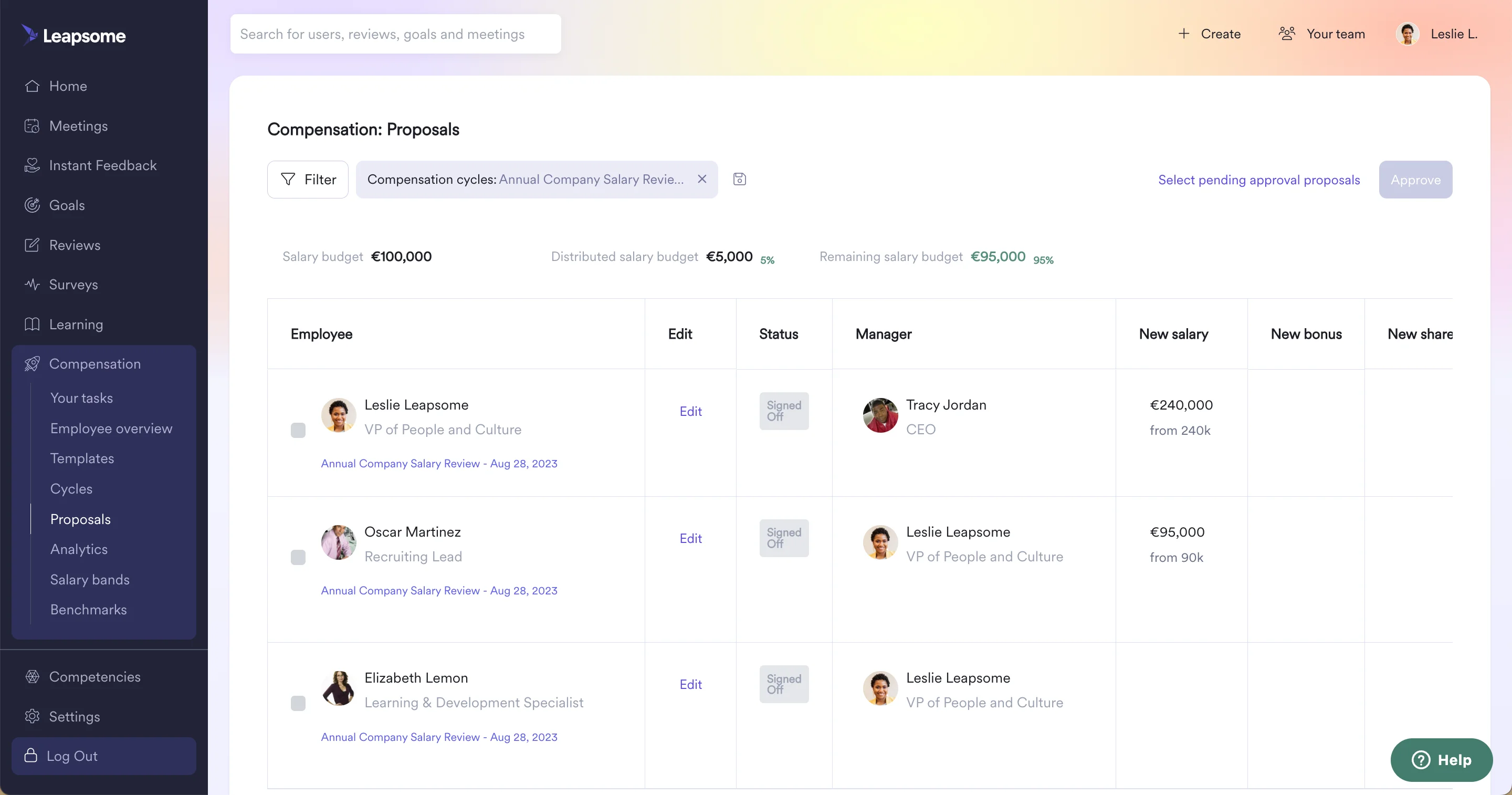
Leapsome is an all-in-one performance and engagement platform with a genuinely strong survey module, and it fits organizations trying to consolidate several point solutions, reviews, OKRs, engagement surveys, and learning, into one system rather than run separate tools for each. Pulse surveys here sit alongside a full performance suite instead of standing alone.
Key Features
- Recurring pulse and engagement surveys with customizable question libraries
- OKR and goal tracking integrated with survey data
- 360-degree feedback and structured performance review cycles
- Learning paths and development plan tracking
- Cross-cycle analytics linking engagement data to performance outcomes
- Available in 38 languages with SSO and ISO 27001 certification
Pros and Cons
Pros: "Leapsome has been great to work with! I've enjoyed the platform very much and it's super simple to use!" – Capterra review
- Consolidating reviews, OKRs, pulse surveys, and learning into one platform can genuinely reduce the number of tools an HR team has to administer
- G2 ratings are consistently strong across modules, not just the survey feature
- Modular pricing lets a team start with one product and add others later rather than buying the full suite upfront
Cons: "Adding quick links and clearer visual indicators would really help. I also think separating pending actions for myself versus my peers into separate windows would improve the overall experience." – G2 review
- Pulse surveys are one module within a broader platform, not a dedicated pulse specialist's core focus
- Published pricing is inconsistent across sources; expect to confirm exact figures directly with Leapsome rather than budgeting from a public price list
- More configuration is required than a focused, single-purpose pulse tool, which adds setup time for a lean HR team
Pricing
- Modular, per-user pricing starting around $8/user/month, scaling with modules and headcount
- Free trial available
- Full-platform pricing requires a custom quote
7. 15Five
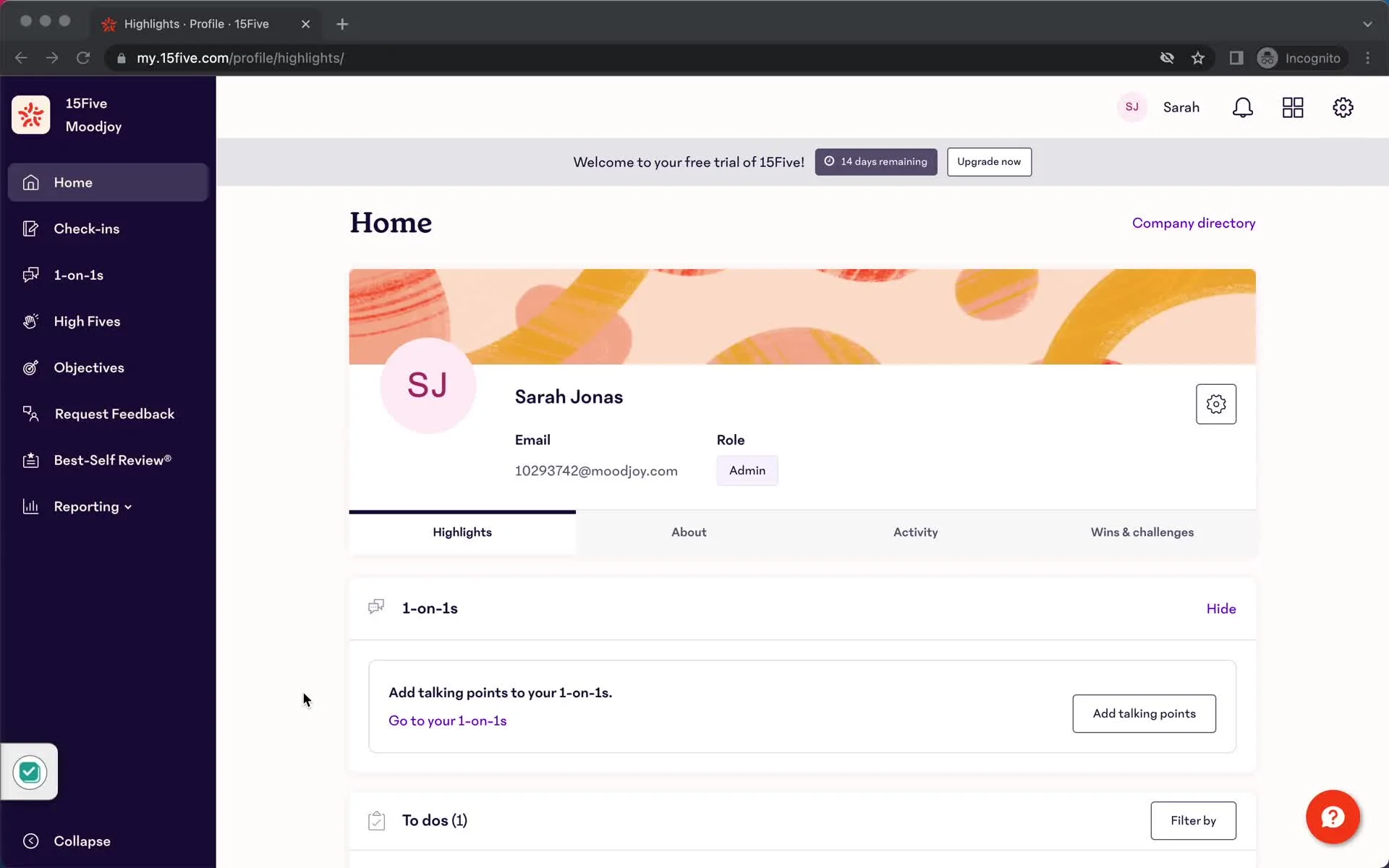
15Five is a performance management platform built around the weekly check-in, and its pulse and engagement surveys are woven directly into that cadence rather than delivered as a separate program.
For organizations that already run 15Five for continuous performance conversations, layering pulse measurement onto the same workflow means sentiment data shows up next to the manager conversations it is meant to inform.
Key Features
- Pulse and engagement surveys integrated with weekly check-ins
- Manager Effectiveness Indicator scoring tied to survey and check-in data
- 1-on-1 meeting agendas linked to survey follow-up
- OKR tracking alongside sentiment measurement
- AI-powered manager coaching add-on
- Benchmarking and analytics on the entry-level Engage tier
Pros and Cons
Pros: "15Five helps teams stay connected with check-ins, goal tracking, and feedback tools that support strong company culture." – Capterra review
- Publishing exact per-tier pricing ($4, $11, and $16 per user per month) makes budgeting easier than most competitors on this list that require a sales call
- Tying pulse data to the weekly check-in rhythm means sentiment surfaces where managers are already paying attention, rather than in a separate report
- A large G2 review base (1,800-plus reviews at 4.6/5) gives more confidence in the rating than tools with a handful of reviews
Cons: "The templates available for performance reviews could be a bit more varied but overall the platform has been working really well for our team and there are no major issues I have come across so far." – G2 review
- Survey and analytics depth are secondary to the performance management features that are the platform's actual center of gravity
- There is no external benchmarking database, so scores lack the industry context Culture Amp or Peakon can provide
- No permanent free plan; only a free trial is available before you commit to a paid tier
Pricing
- Engage tier: $4/user/month
- Perform tier: $11/user/month
- Total Platform tier: $16/user/month
- All billed annually
- Free trial available; no permanent free plan
8. Qualtrics EmployeeXM
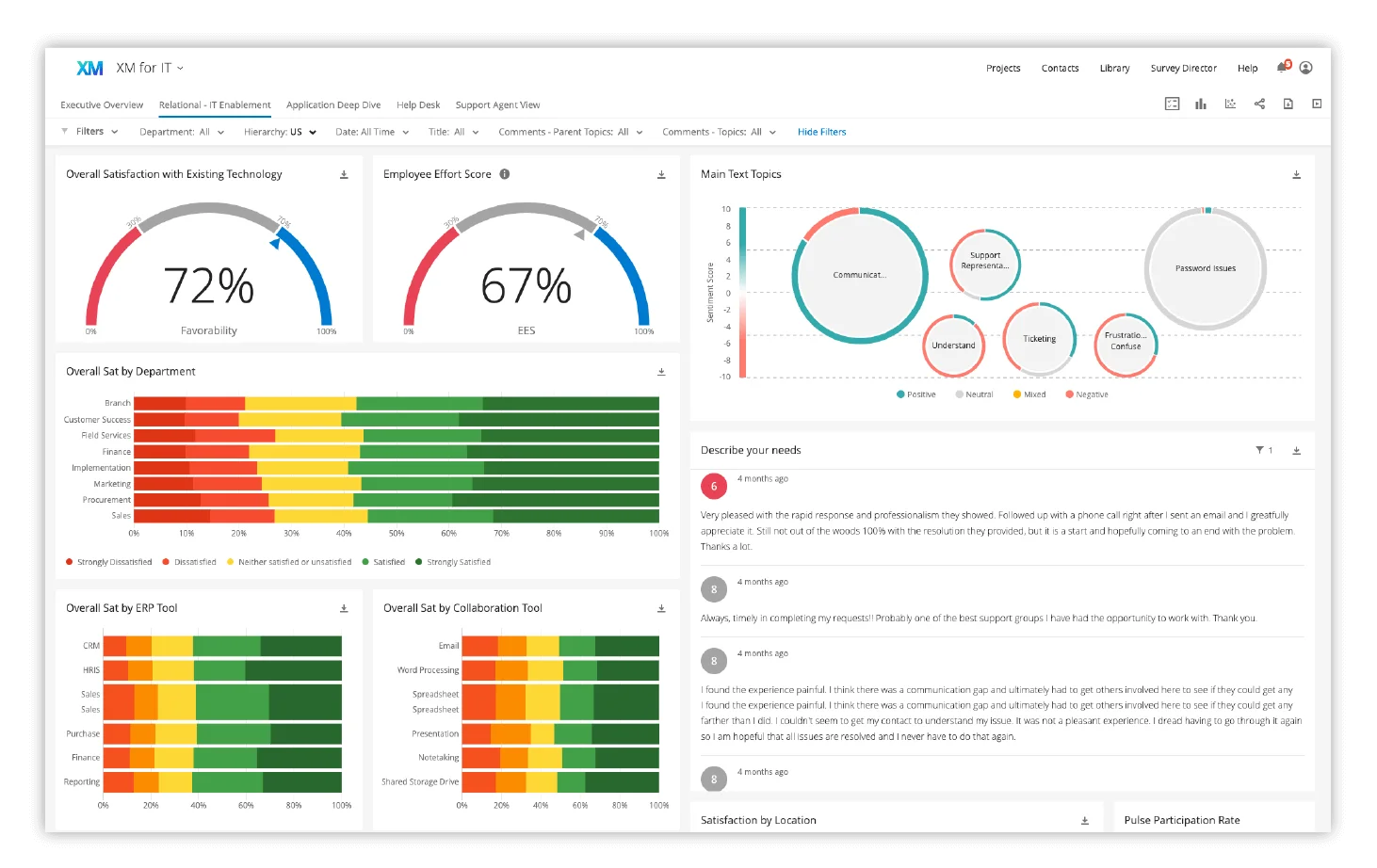
Qualtrics EmployeeXM is an enterprise experience management platform built for organizations running complex, large-scale listening programs, and it is the deepest analytics engine on this list by a clear margin.
Advanced statistical modeling, text analytics, and a full experience-management framework make it suited to dedicated people-research teams rather than an HR generalist running a simple weekly pulse.
Key Features
- Advanced statistical analysis including driver and conjoint modeling
- Text analytics for open-ended survey responses at scale
- Fully customizable survey design and question logic
- Workflow automation for closing feedback loops
- Enterprise-grade dashboards with role-based access
- Integration with a broad range of HRIS and workforce systems
Pros and Cons
Pros: "Qualtrics does a great job gathering information from employees and analyzing the data to best understand our engagement and areas of opportunity." – G2 review
- Statistical and text analytics depth outpaces every other tool on this list, which matters for organizations with a dedicated research or people-analytics function
- The broader experience-management framework can connect employee data to other feedback loops the organization already runs
- Highly configurable survey logic supports complex, multi-region listening programs that a lighter tool could not handle
Cons: "Extremely difficult to navigate and configure the org hierarchy and the dashboard data. Qualtrics doesn't provide full service customer support but instead refers to a third party consulting firm to assist." – Capterra review
- No public pricing, and third-party contract data puts typical enterprise spend somewhere in the $28,000 to $30,000-a-year range, with complex deployments running well beyond that
- Configuration and org-hierarchy setup carry a steep learning curve compared to purpose-built pulse tools
- The platform's depth is overkill for a team that just wants simple, recurring pulse surveys rather than a full research operation
Pricing
- No published pricing
- Third-party contract data suggests typical annual spend in the mid five figures for enterprise deployments
- Costs vary by license count, response volume, and modules; custom quote required
9. Lattice
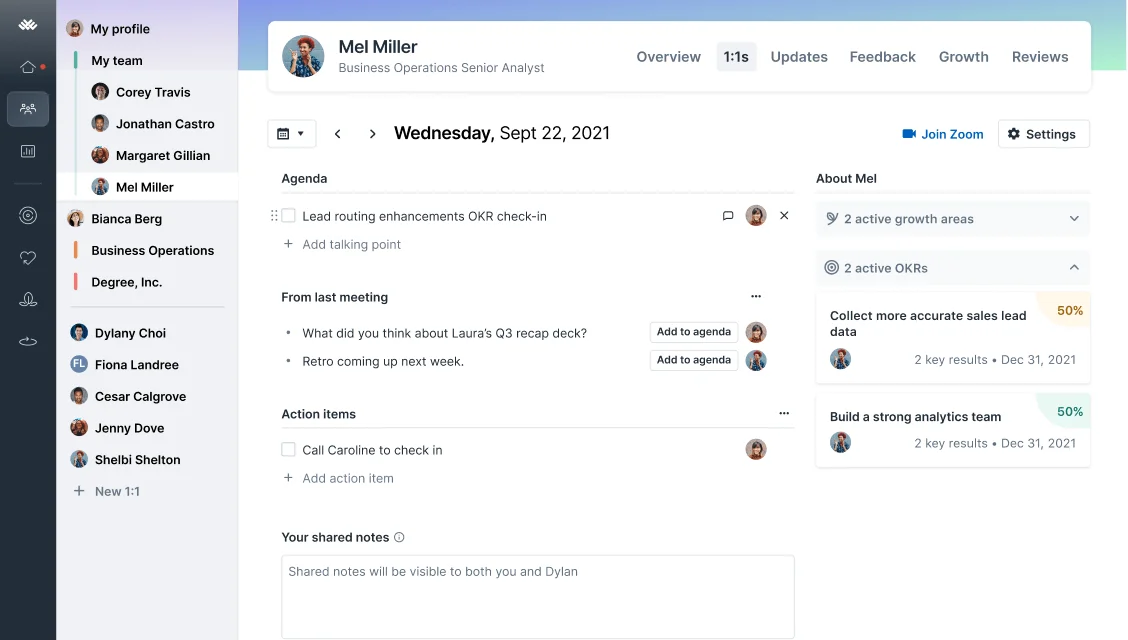
Lattice is a performance and people-management platform where pulse surveys exist as an add-on module connected to the same data as reviews, goals, and 1-on-1s. That connection is the appeal: a manager looking at a dip in engagement can see it next to the same employee's goal progress and recent review, rather than in an entirely separate tool.
Key Features
- Automated pulse surveys with real-time sentiment insights
- Engagement data tied directly to performance and goal-tracking modules
- OKR cascading across company, team, and individual levels
- Compensation planning module (separately priced) linked to performance data
- Manager 1-on-1 tools with agenda and note tracking
- Public recognition feed alongside survey and review data
Pros and Cons
Pros: "I think Lattice has improved, especially with the Pulse Survey feature that we now use. I feel that Lattice is an effective way for our team to stay connected and moving towards a common goal." – G2 review
- Sentiment data connected directly to goals and reviews gives managers context a standalone pulse tool cannot offer
- Published, modular per-user pricing means you can see the cost of adding the Engagement module without a sales call
- A large, established G2 review base backs up the platform's reputation across its performance modules, not just engagement
Cons: “A few areas for improvement include limited flexibility in custom reporting/analytics, occasional integration constraints with third-party tools, and pricing that could be more modular for smaller teams.” – G2 review
- Pulse surveys are one module within a broader platform, and the $4,000 annual minimum applies regardless of how small the engagement-only use case is
- Modular pricing escalates quickly once you add Engagement, Grow, and Compensation together, which can surprise budget owners who priced only the base plan
- Survey depth and benchmarking trail dedicated pulse specialists like CultureMonkey or Peakon
Pricing
- Modular pricing starting with a $13/seat/month Foundations package
- Custom builds using base products: Performance ($10), Goals ($8), Engagement ($4)
- Optional add-ons: Grow (+$4/seat/month), Compensation (+$6/seat/month)
10. Polly
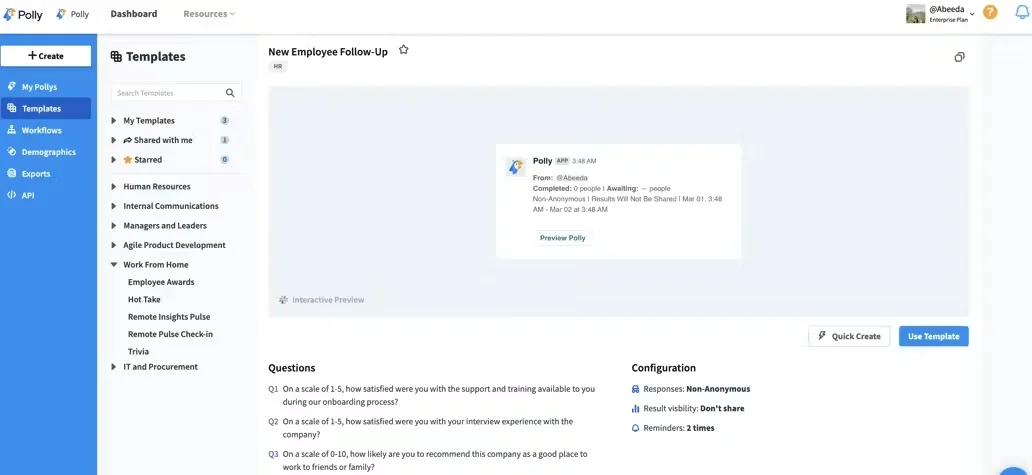
Polly is a Slack- and Teams-native polling tool built for teams that live inside chat and want fast, in-channel sentiment checks rather than a dedicated survey platform. It is the lightest-weight, most workflow-native option on this list, trading analytical depth for speed and near-instant adoption in chat-first cultures.
Key Features
- Recurring polls and pulse checks delivered natively in Slack and Microsoft Teams
- eNPS and quick sentiment templates alongside custom polls
- Demographic slicing to break results down by team or attribute
- Google Sheets integration for custom reporting and visualization
- Fun quiz and icebreaker templates for engagement outside formal pulse cycles
- API access for teams that want to build custom workflows on top of poll data
Pros and Cons
Pros: "It is integrated with Slack which is a big plus. Also the fun quiz has a big pool of questions from different themes to keep people hooked." – Capterra review
- Living directly inside Slack and Teams removes any adoption barrier for chat-first teams, and response rates in those cultures tend to be high
- A free plan makes it easy to pilot before committing to a paid tier
- The question and template variety keeps a lightweight tool from feeling like a bare-bones poll widget
Cons: "I've found it difficult to edit an existing poll, and I'm not even sure whether that's possible." – Capterra review
- Analytics and action-planning depth are noticeably lighter than any dedicated pulse platform on this list
- Best suited to teams that already live in Slack or Teams; it offers little for organizations without a chat-first culture
- Published pricing varies across third-party sources, so confirm current rates directly with Polly rather than budgeting from an outside estimate
Pricing
- Free plan available for basic polling
- Paid tiers exist, but published third-party pricing is inconsistent — confirm current rates directly with Polly
How to Start Your Pulse Survey Shortlist
The right pick depends less on a feature checklist and more on where your organization already sits.
- If you're on Microsoft 365 and Teams adoption is high: Teamflect's native delivery inside Teams and Outlook will likely drive a stronger response rate than any standalone survey tool you would otherwise have to convince employees to open separately.
- If you want a pure-play pulse specialist and don't need a broader HR suite: CultureMonkey is built specifically for this job, without the performance-management or compensation modules that come bundled into Lattice or 15Five.
- If you're an SMB or mid-market team without a dedicated survey administrator: Workleap's simple pricing and pre-written question bank get a real pulse program running fast, without needing survey-design expertise on staff.
- If you're an enterprise already on Workday or need deep statistical analysis: Workday Peakon or Qualtrics EmployeeXM are built for the scale and complexity your program actually has, even though both require a custom quote.
- If your team lives in Slack or Teams chat and wants speed over depth: Polly's in-channel polls will get answered faster than a link to a separate survey site, even if the analytics stay basic.
If you’re still deciding whether your organization needs a continuous pulse program, a periodic engagement survey, or both, our engagement software buying guide walks through that decision before you sit through a single demo.
For teams whose pulse needs are tangled up with performance reviews or 360 feedback, it's also worth a look at our performance management software and 360 feedback software roundups, since several vendors above sell pulse as one module inside a larger platform.
Final Word
Response rate decides whether a pulse program produces anything useful, and delivery is what decides response rate.
That explains why CultureMonkey leads this list as the top pure-play specialist and Teamflect takes second place for Microsoft 365 organizations. Meanwhile, the remaining spots are split among dedicated listening platforms, enterprise suites, and workflow tools built for chat-based teams.
Match the tool to where your employees already spend their day, protect anonymity without exception, and build the follow-up step into the program from day one. Skip any of those three, and the software you choose will matter far less than you think.
Ultimately, remember that a tool that scores well on features but gets ignored by staff is not a pulse platform. It is a dashboard nobody trusts.
.png)