.avif)
.svg)
For decades, the degree requirement sat at the top of almost every job posting, functioning as a filter built on a simple assumption: a diploma signals capability. The problem is that assumption has not held up. Organizations keep bringing in candidates who look qualified on paper and struggle on the job, while strong performers without traditional credentials never make it past the first screen.
That gap has pushed companies to rethink what they are actually measuring in the hiring process. Skills-based hiring is the most direct response to that problem. It shifts the basis of candidate evaluation from what someone studied or where they worked to what they can actually do. According to the NACE Job Outlook 2026 survey, 70% of employers now use some form of skills-based hiring, up from 65% the year prior.
This article explains what skills-based hiring is, how it differs from related approaches, what it takes to implement it, and where it works best. If you are deciding whether it belongs in your organization, this is the honest guide.
What Is Skills-Based Hiring?
Skills-based hiring is a recruiting approach that evaluates candidates based on their demonstrated ability to perform the tasks a role requires, rather than using degrees, job titles, or years of experience as stand-ins for competence. That might mean a structured skills assessment, a work sample test, a portfolio review, or a structured interview built around specific job-relevant scenarios. The core idea is direct measurement. Instead of inferring ability from credentials, you test for it.
Skills-Based vs. Skills-First Hiring
While the terms "skills-based" and "skills-first" are frequently used as synonyms, they represent distinct strategic approaches to talent acquisition. The difference lies in the degree of commitment to ability versus traditional qualifications. Understanding these nuances is essential for organizations looking to modernize their recruitment pipeline.
The comparison below outlines how these two models differ in their treatment of credentials and their typical application in the workforce.
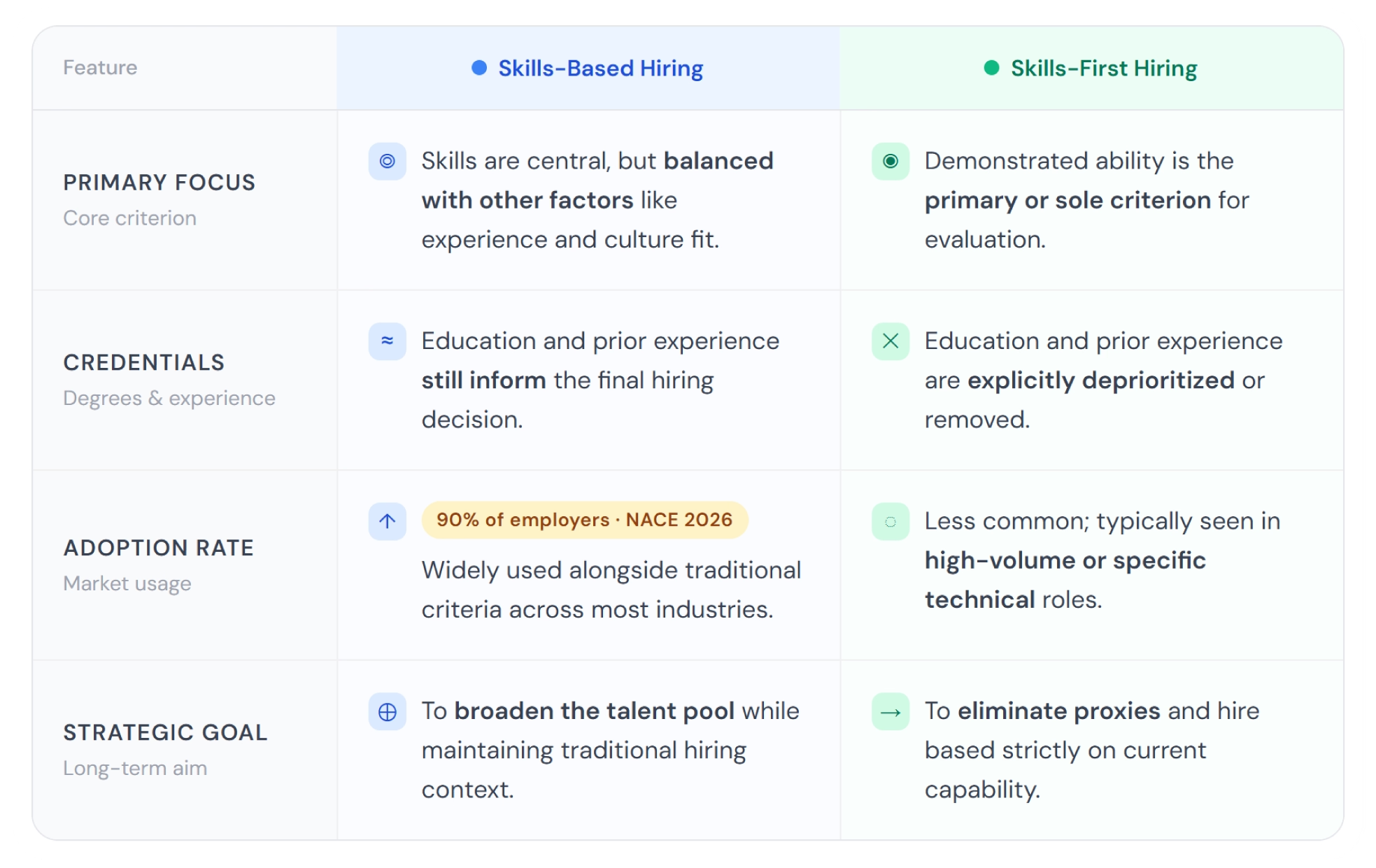
Skills-first hiring represents the most radical shift, treating demonstrated ability as the primary, and often sole, criterion. In this scenario, education and prior job titles are stripped away to ensure that a candidate's current capability is the only thing that matters. This "blind" approach is designed to eliminate the influence of pedigree and focus entirely on what a person can deliver on day one.
In contrast, skills-based hiring offers a more integrated path. It positions specific competencies alongside traditional context like work history and professional background. This model aligns with current market demands; NACE’s Job Outlook 2025 survey found that nearly 90% of recruiters now look for specific evidence of problem-solving on resumes, while almost 80% prioritize teamwork. Here, the skill is the proof, but the experience provides the narrative.
Ultimately, most organizations land on the skills-based model. It allows them to modernize their standards without completely abandoning the established signals of a traditional career path. True skills-first hiring remains a specialized tool, typically reserved for high-volume roles or technical positions where credentials hold little regulatory weight.
What Skills-Based Hiring Replaces
Skills-based hiring challenges several long-standing practices:
- Degree requirements as a default filter: Major employers including IBM, Google, Delta Air Lines, and Bank of America have dropped four-year degree requirements for a significant portion of their roles.
- GPA screening: The share of employers using GPA as a screening criterion dropped from 73% in 2019 to 42% in 2026, according to NACE.
- Years-of-experience minimums: Time spent in a role is often a weak proxy for what someone can actually do, particularly in fields where skills change quickly.
None of this means credentials become irrelevant. It means they stop functioning as shortcuts.
Why Companies Are Making the Shift
The adoption of skills-based hiring is not driven by ideology. It is driven by concrete problems with the way traditional hiring performs. Here are the four main reasons organizations are moving in this direction.
1. Credential Inflation Has Made Degrees Unreliable Signals
While the initial rush to drop degree requirements showed significant momentum, recent shifts suggest a more cautious approach from hiring managers. In 2023, more than half of companies (55%) removed bachelor's degree requirements for various positions. This push for skills-based hiring was most evident in entry-level roles, where 70% of employers moved away from the four-year degree as a mandatory gatekeeper.
2. It Expands the Talent Pool Significantly
When hiring criteria shift from credentials to capabilities, the pool of eligible candidates grows. According to the LinkedIn Economic Graph, skills-first approaches expand candidate pools by 10 times compared to title-based hiring. In male-dominated roles like AI-related roles, the same approach increases female candidate representation by 24% more than title-based methods. For organizations struggling to fill roles in competitive markets, that expansion is not a nice-to-have.
3. Better Hires Perform Better and Stay Longer
The predictive value of skills assessments is well-documented. McKinsey's 2024 research found that hiring for skills is five times more predictive of job performance than hiring for education, and twice as predictive as hiring for experience alone. Employees hired through skills-based processes also stay 9% longer than those hired through traditional methods, according to SHRM.
4. Traditional Proxies Do Not Account for Emerging Skill Requirements
AI-related skills rarely appear on resumes in any standardized format, yet demand for them has increased sharply. AI adoption in recruiting nearly doubled from 26% to 53% of organizations between 2023 and 2024.
When the skills that matter most are not captured in credentials or job titles, credential-based screening becomes even less reliable as a starting point.
How Skills-Based Hiring Works in Practice
Adopting a skills-based approach is not a policy change you can announce and walk away from. It requires making specific changes to how roles are defined, how candidates are evaluated, and how hiring teams make decisions.
Rewriting Job Descriptions
The first step is rebuilding job descriptions from the output backward. Rather than listing degrees, certifications, or years of experience at the top, a skills-based job description defines what the role requires in terms of competencies and what success looks like at 30, 60, and 90 days.
It also separates genuine requirements from inflated ones. Many job descriptions accumulate requirements over time without anyone asking whether all of them are truly necessary. Skills-based job writing forces that question into the process.
Assessment Methods Used in Skills-Based Hiring
Once the criteria are defined, the next challenge is measuring them reliably. The most common assessment methods include:
- Work sample tests: The candidate completes a task that represents actual work in the role. This is among the most predictive evaluation methods available.
- Standardized skills assessments: Technical or cognitive assessments built around role-specific competency areas.
- Structured behavioral interviews: Scenario-based questions with defined scoring criteria applied consistently across all candidates.
- Portfolio review: Evidence of prior work output used in place of, or alongside, job title history.
One critical note: assessment quality matters enormously. Generic assessments that are not designed for the specific role create legal exposure and frustrate candidates. Poorly designed assessments accelerate that abandonment.
Blind Evaluation Techniques
Many organizations pair skills-based hiring with blind screening, which removes names, school affiliations, and demographic identifiers from the initial review stage. Employers are increasingly using skills-based hiring to apply some form of blind filtering during initial screening. This reduces the risk of assessors making credential-adjacent assumptions before the evaluation has a chance to work.
Benefits and Honest Limitations
Adopting a skills-first approach marks a significant shift in how organizations identify and secure talent. By prioritizing proven abilities over traditional credentials, companies can move toward a more objective selection process. However, transitioning away from degree-based screening involves both clear advantages and practical hurdles that require careful management.
Benefits
The evidence in favor of skills-based hiring is substantial when it is implemented correctly:
- Better prediction of performance: Traditional resumes often act as proxies for privilege rather than capability. When you shift the focus to specific competencies, you are evaluating the direct "tools" a person uses to do the work. This leads to a selection process that is five times more accurate in identifying high performers compared to degree-based filtering alone.
- Lower mis-hire rates: Mis-hires are costly, often exceeding 30% of a first-year salary. Testing candidates on real-world tasks removes guesswork and ensures a strong match for the role.
- Faster time to hire: Skills-based testing enables automated screening, helping a significant number of companies speed up their hiring. Instead of manual resume reviews, recruiters use objective scores to find top talent, with an increasing number of firms cutting hiring time.
- Larger, more diverse talent pools: Removing degree mandates opens doors for "STARs" (Workers Skilled Through Alternative Routes). This strategy broadens the funnel to include veterans and self-taught experts, creating a representative workforce based on current ability rather than past credentials.
Honest Limitations
Most articles on this topic stop at the benefits. These limitations are real and worth knowing before you commit.
- Assessment design is difficult: A poorly designed assessment measures the wrong things. It can disadvantage qualified candidates and create legal risk if it has an adverse impact on a protected class and cannot be demonstrated as job-relevant. Not all assessment vendors offer validated, role-specific tests.
- Not every role qualifies: Licensed professions such as medicine, engineering, and law require credentials by regulation. Skills-based hiring is not a substitute for licensure requirements.
- Implementation takes real resources: Rewriting job descriptions, sourcing or building valid assessments, and retraining hiring managers represents a significant upfront investment of time and budget. The three most common implementation failures are unclear skill definitions, the absence of reliable assessment methods, and a disconnect between HR and learning and development teams.
- Removing degree requirements does not automatically remove bias: If the assessments themselves are poorly designed, or if evaluators are untrained, bias does not disappear. It shifts form. Skills-based hiring reduces certain risks while introducing others if not managed carefully.
Which Roles Is It Best Suited For?
Skills-based hiring does not apply equally to every type of role. Being clear about where it works well, and where it does not, will help you decide where to start.
- Strong fit: Technology, marketing, sales, customer success, operations, and data roles. These are positions where output is measurable, credentials have limited predictive value, and assessment is relatively straightforward.
- Moderate fit: Management and leadership roles. Skills-based assessment works well for technical and functional competencies, but judgment, team fit, and track record still matter and are harder to capture through standardized evaluation.
- Poor fit: Regulated professions that require licensure. A degree or certification in these roles is a legal prerequisite, not just a hiring preference. Skills-based evaluation does not change that.
If your organization is starting out, high-volume technical and operational roles tend to be the most
practical entry points. The assessment infrastructure is easier to build, the results are easier to validate, and the ROI shows up faster.
What Software Makes Skills-Based Hiring Possible?
Skills-based hiring at scale requires tools that can operationalize the approach across your full recruiting pipeline. Two software categories are most relevant. If you are in the early stages of evaluating tools, the top recruiting software list is a useful starting point while the dedicated ATS listicle is finalized.
Applicant Tracking Systems With Skills Frameworks
Modern ATS platforms allow job descriptions to be built around competencies rather than titles, and can track assessment outcomes through each stage of the pipeline. Platforms like Greenhouse and Workable include functionality designed to support this kind of structured, skills-centered workflow. See our full list of top applicant tracking systems to compare options.
Talent Assessment Platforms
Tools like TestGorilla and iMocha provide libraries of role-specific assessments that integrate directly with ATS pipelines, surfacing ranked candidates based on demonstrated ability rather than resume signals. Assessment software reviews will be linked here as they are published.
Ready to Put Skills-Based Hiring Into Practice?
If this approach makes sense for your organization, the next practical step is finding the tools that make it operationally viable.
Start with our top onboarding software list to see which onboarding platforms are built to support skills-based workflows. If you are also thinking about how performance evaluation connects to the hiring process, our guide on performance management software covers that side of the picture.
No single tool will transform your hiring process on its own. But the right infrastructure makes it far easier to move from a credential-based default to one that actually measures what matters.
.avif)