.svg)
The HR landscape in 2026 looks different than it did even a year ago. AI is moving from pilot to infrastructure, engagement is at a near-decade low, pay transparency laws are spreading across the US and EU, and managers, the people most responsible for team performance, are burning out faster than any other group.
These shifts are reshaping how HR teams hire, manage performance, structure compensation, and invest in technology. This guide breaks down the ten HR trends defining 2026, what is driving each one, and the practical decisions HR leaders need to make in response.
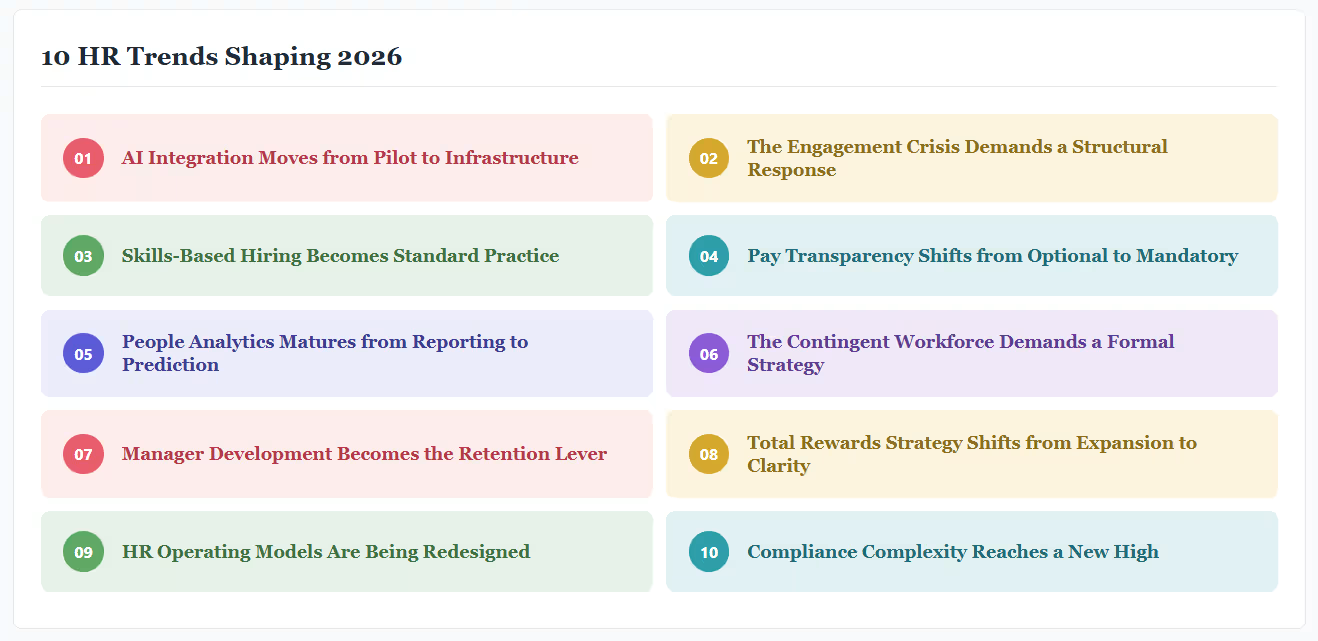
1. AI Integration Moves from Pilot to Infrastructure
AI has progressed beyond experimentation, with 78% of companies deploying it in at least one department by 2026. However, usage does not guarantee impact. Gartner reports that only 1 in 5 AI initiatives shows measurable ROI. For HR, the current challenge is no longer implementing the technology, but closing the distance between deployment and actual performance.
Why Most AI Investments Underperform
The primary failure occurs when companies layer AI-powered tools over old processes instead of restructuring work to suit the technology. Gartner’s survey of 426 CHROs highlights this, noting that transforming the HR operating model offers the highest potential for productivity gains at 29%. This data show that the bottleneck isn't the software; it is the organizational structure.
Deloitte’s 2026 Global Human Capital Trends research supports this shift. Organizations focusing solely on technical deployment are 1.6 times more likely to miss their targets than those prioritizing a human-centric strategy. When AI is treated as a mere software update rather than a fundamental change in how people and systems interact, it inevitably underperforms.
Agentic AI and the Governance Imperative
The next phase of HR technology is agentic. These systems move beyond assistance to perceive, decide, and act with minimal human intervention. Deloitte projects that 15% of corporate applications will support these autonomous agents by 2028. HR teams still struggling with current tools have little time left before this shift arrives.
Governance is mandatory. The EU AI Act prohibits using AI for emotion analysis or social scoring, while US states are requiring transparency and bias audits. HR must lead these efforts instead of outsourcing them to IT or Legal.
In 2026, the goal is not to buy more software. HR must redesign operating models, build oversight frameworks, and ensure technology delivers actual value. For those ready to evaluate platforms, a guide to AI-powered HR software is a practical starting point
2. The Engagement Crisis Demands Structural Response
While Gallup data shows global engagement continues to slide, the more pressing reality is found in LinkedIn’s 2026 Talent research. Over half of the global workforce (52%) is actively seeking new roles. These figures signal a profound disconnect that requires leaders to look closely at the specific conditions driving such high turnover intent.
The Manager Engagement Mechanism
The most telling data point in Gallup's 2025 research is not the overall engagement number. It is the manager engagement figure. Manager engagement dropped from 31% to 22% in a single year, the largest decline of any employee segment recorded. Since managers account for 70% of the variance in team engagement, a drop at the manager level cascades downward through every team they lead.
This means the engagement problem is not primarily a culture problem or a benefits problem. It is a manager problem, and it requires a structural response.
What Works and What Does Not
Standalone wellbeing programs do not move the needle on engagement when they are not supported by cultural change. The World Health Organization estimates 12 billion working days are lost annually to depression and anxiety. Deloitte finds a $4 return for every $1 invested in mental health programs, but only when those programs are embedded in how work is organized, not added on top.
What does move the needle: reducing manager spans of control, giving managers structured weekly check-in systems, and building team engagement scores into manager performance reviews. Research from the Talent Strategy Group's 2026 Performance Management Report found that organizations with three to four formal feedback conversations per review cycle report the highest performance effectiveness.
For HR teams building out their response, employee engagement software and engagement survey tools provide the infrastructure to track and act on these signals consistently. Bonusly can provide another way to strengthen engagement by making recognition a more consistent part of the employee experience.
3. Skills-Based Hiring Becomes Standard Practice
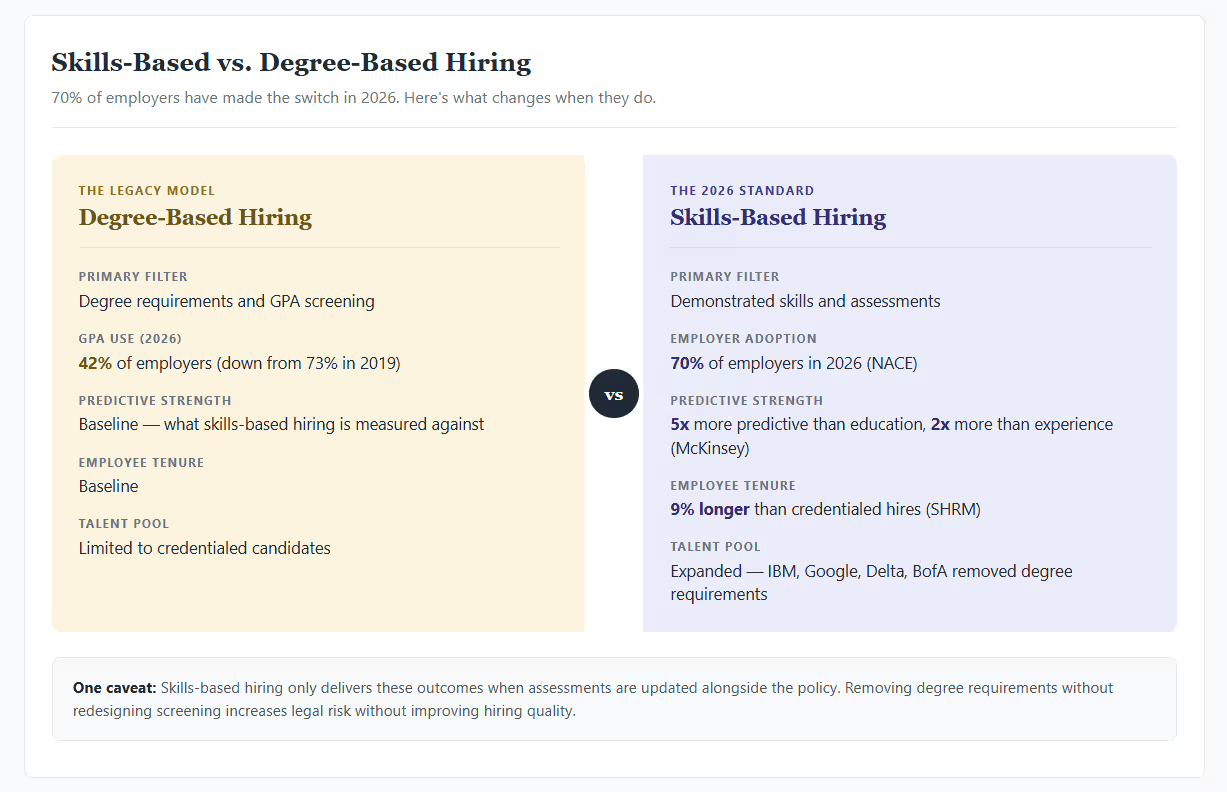
The move toward skills-based hiring is accelerating, with 70% of employers now adopting the practice according to the NACE Job Outlook 2026 report. Traditional metrics are losing their dominance; GPA screening fell from 73% in 2019 to just 42% this year.
Industry leaders like IBM, Google, Delta Air Lines, and Bank of America have already removed degree requirements for numerous positions, signaling a permanent change in how talent is evaluated.
The Implementation Quality Gap
Many companies adopt skills-based hiring in policy without actually updating their screening practices. This misalignment often stems from poor assessment quality, which can increase legal risks and damage the candidate experience without improving hiring outcomes.
The data confirms the value of a successful transition. McKinsey research shows that skills-based hiring is five times more predictive of performance than education and twice as predictive as work experience. Furthermore, SHRM data indicates that employees hired for their demonstrated skills stay 9% longer than those hired through traditional credentials.
Skills-based hiring is not the same as skills-first hiring. The former incorporates skills into existing processes. The latter redesigns the process around skills as the primary criterion. Organizations in the early stages should understand the difference before committing to either approach.
For recruiting infrastructure, top recruiting software options are worth evaluating alongside any process changes.
4. Pay Transparency Shifts from Optional to Mandatory
Pay transparency now covers the US workforce across 15 states, while the EU mandates compliance. By 2024, 60% of employers started sharing pay ranges in job ads, and the percentage is only expected to increase in the succeeding years. New leave benefits in states like Minnesota and Maine further add to the regulatory load.
For multistate and multinational employers, the compliance complexity is significant. Requirements vary across jurisdictions and are not always consistent with one another. ADP's 2026 HR compliance guidance identifies pay transparency as one of the most complex and rapidly shifting compliance areas this year.
The Internal Readiness Gap
Publishing salary ranges does more than satisfy a legal requirement. It surfaces internal pay equity gaps that many organizations have not addressed. Before complying with disclosure requirements, HR teams need to conduct pay equity audits, validate salary bands, and prepare managers to discuss compensation directly with employees. Most organizations are not ready for that conversation.
The compliance deadline should be treated as a forcing function for internal compensation work that many companies have deferred. Compensation management software can help organizations build and maintain the salary structures that make transparent communication possible.
5. People Analytics Matures from Reporting to Prediction
Deloitte’s 2026 research reveals that 83% of global companies still struggle with low workforce analytics maturity. According to McKinsey, only 12% of HR leaders conduct strategic planning with a three-year outlook or beyond. Meanwhile, 74% of employers report difficulty finding necessary skills. This disconnect highlights a structural gap between the urgent need for workforce intelligence and the current capacity to produce it.
The Shift to Predictive Capability
Organizations at the descriptive and diagnostic levels of analytics maturity are under increasing pressure to move toward predictive capability. AI tools are lowering the technical barrier. Predictive attrition modeling, skills gap forecasting, and capacity planning, once limited to large enterprises with dedicated analytics teams, are becoming expectations at mid-market organizations.
The most common obstacle is not the platform. It is data quality. Inconsistent data entry across HR systems, siloed records, and missing fields prevent analytics from producing reliable insight even when the technology is capable of more.
Where to Start
The most practical starting point is a focused business question, not a broad analytics strategy. "Why are we losing people in the first 18 months?" is more actionable than "we need a people analytics program." The answer to that question often lives in data organizations already have.
Our people analytics explainer covers the maturity framework and practical applications in more detail. It is a useful reference for HR teams assessing where they currently sit.
6. The Contingent Workforce Demands a Formal Strategy
Freelancers added $1.27 trillion to the US economy in 2024, while the global gig economy reached $3.8 trillion in revenue in 2022. With 5.6 million freelancers now earning over $100,000 annually, it is clear that contingent work has moved far beyond low-skill roles.
The Strategic Gap
Most organizations still treat contingent workers as exceptions to their workforce strategy rather than as a formal talent segment. They lack the processes to onboard, manage, and develop freelance talent at scale. Worker classification compliance, a growing source of legal risk across jurisdictions, often falls through the cracks when contingent hiring is treated as ad hoc.
Organizations that build explicit contingent workforce strategies, including clear classification frameworks, structured onboarding, and defined performance expectations, will have a meaningful talent advantage over those that continue managing freelancers case by case.
7. Manager Development Becomes the Retention Lever
As mentioned, managers influence 70% of team engagement, yet their own morale is in freefall. Engagement among leaders dropped from 30% to 27% recently, the sharpest decline of any group.
The observed trend is most severe among female managers and those under 35, who saw seven-point and five-point drops, respectively. This leadership burnout is the primary driver behind the broader workplace engagement crisis.
Moving Manager Development Up the Priority List
Most organizations invest in manager development as a periodic training event. That approach does not produce meaningful change in engagement or retention outcomes. The organizations that will outperform treat manager development as ongoing infrastructure, not an annual program.
Practical interventions that move the needle include reducing manager spans of control, implementing structured weekly check-in systems, integrating AI-assisted coaching tools, and holding managers accountable for team engagement scores in their own performance reviews.
Managers also need to recognize how subjective judgment can affect performance ratings. Performance review bias can influence ratings through recency, leniency, severity, similarity, and other common patterns, making structured criteria, calibration, and consistent documentation important parts of a fair review process.
According to SHRM, a CHRO priority list for 2026 explicitly includes mobilizing leaders through uncertainty as one of four top initiatives. It is a priority that consistently receives less investment than the data warrants.
Performance management software and 360-degree feedback tools provide the infrastructure to formalize manager accountability and development at scale.
8. Total Rewards Strategy Shifts from Expansion to Clarity
US companies are projecting average salary increases of 3.6% for 2026, a decline from the 4.4% peak seen in 2023. This cooling comes as health care expenses are expected to climb by 10%, straining benefit budgets that already represent nearly 30% of total compensation. Consequently, the period of aggressive benefits growth is slowing as organizations prioritize cost stability.
The Coherence Problem
Workforce benefits are more abundant than ever, yet employee understanding remains stagnant. NFP's 2026 research indicates that fragmented offerings across pay, wellness, and leave policies are causing significant decision fatigue. Even in well-funded organizations, this lack of cohesion creates inconsistent experiences that undermine the value of the investment.
The strategic response is not to add more. It is to make existing total rewards packages visible and comprehensible. Total rewards statements, clear compensation communications, and manager training on how to discuss pay and benefits are more valuable at this stage than another round of new offerings. Organizations that make compensation clear build employee trust faster than those that simply offer more and communicate it poorly.
9. HR Operating Models Are Being Redesigned
Eighty-nine percent of HR departments have either recently restructured or will do so by 2028. The traditional Centers of Excellence model, which separates talent acquisition, development, and rewards into silos, is becoming less effective. As AI platforms unify data and automate cross-functional tasks, organizations are shifting toward integrated structures that allow for faster, more cohesive decision-making.
What Is Replacing the Old Model
The direction is toward integrated, AI-enabled HR models where data moves across the employee lifecycle without functional handoffs. Platforms are connecting hiring data, performance data, compensation data, and engagement data in ways that specialist silos previously prevented. HR functions that do not adapt their structure to match the capability of their technology will consistently underperform.
The talent implication is also significant. Fifty-three percent of HR leaders report that recruitment is now more difficult than it was a year ago. The skills now in highest demand, AI oversight, HR analytics, and data-driven workforce strategy, are different from the skills that defined HR careers a decade ago.
10. Compliance Complexity Reaches a New High
HR compliance in 2026 is increasingly fragmented, driven by the EU AI Act, the EU Pay Transparency Directive, and a growing patchwork of US state laws. ADP identifies AI governance and pay transparency as this year's most complex regulatory hurdles. Because these requirements are often inconsistent across borders, manual tracking is no longer sustainable for multinational firms.
As a result, dedicated infrastructure is now essential. HRIS platforms with automated policy updates and built-in tracking have become functional necessities for maintaining cross-jurisdictional alignment. For those prioritizing these features, our guide on how to choose an HR software can help identify critical capabilities before comparing specific platforms.
What These HR Trends Mean for Your Software Investment
Not every trend on this list requires a new software investment. Some require process changes, structural redesign, or better use of tools already in place. The right starting point is clarity on which trends represent the biggest gaps in your organization today.
If you are thinking about HR software investment for the first time, or reassessing what you have, the HR software buying guide is the right next step before evaluating any specific tools or vendors.
.png)