
.avif)
.svg)
Culture Amp is a well-regarded platform, but it is not the right fit for every organization. The frustrations are well-documented: rigid survey and review workflows, pricing that is difficult to predict as you add features, analytics that surface good data but offer limited in-platform tools to help managers actually act on it, and workflow automation that starts to break down once headcount passes 100 or 200. If any of those pain points sound familiar, you are not alone, and the good news is that the market for Culture Amp alternatives has matured considerably.
This guide covers 10 of the best Culture Amp alternatives available in 2026. Each tool is evaluated against the specific limitations that tend to drive organizations away from Culture Amp in the first place, not just a generic feature checklist. Whether you need a deeper all-in-one platform, a Microsoft 365-native tool, or something lighter and more affordable, there is a strong option here for you.
What to Look for in a Culture Amp Alternative
Before you start booking demos, it helps to be clear on what you actually need. Not every Culture Amp alternative solves the same problems equally well. Here are four criteria worth examining before you shortlist anything.
1. Engagement Surveys That Connect to Action, Not Just Measurement
Culture Amp often provides great data but lacks the tools for managers to act on it, leaving follow-through to manual effort. When evaluating alternatives, look for platforms that offer specific recommendations and coaching prompts alongside scores. The ideal tool closes the feedback loop through integrated action planning or by embedding response mechanisms directly into existing workflows to ensure immediate follow-through. For organizations whose core need is frequent, lightweight pulse surveys rather than Culture Amp's full annual-survey infrastructure, a narrower dedicated tool is often the better fit.
2. Transparent, Predictable Pricing
Culture Amp’s unpublished pricing creates friction for HR Directors building business cases. Choosing an alternative that also requires a sales call for basic costs offers little improvement.
Verify if the vendor publishes rates online and whether pricing is modular or all-in-one. Confirm minimum contract values early. Look for platforms that offer clear, per-user monthly tiers or published plans to simplify budgeting. If a provider requires a custom quote, factor that extra step into your evaluation timeline.
3. Ecosystem Integration
Culture Amp is a standalone application, which can lower participation rates if employees must log in separately. Choosing a platform that fits your existing tech stack is often more important than comparing specific features.
If your company uses Microsoft 365, an alternative that operates natively inside Teams will likely see higher adoption without extra training. For Slack-centric organizations, prioritize tools with deep Slack integrations. Ensuring the software fits into your daily workflow is a critical, yet often overlooked, factor for success.
4. Scalability for Your Current and Projected Headcount
Culture Amp's workflows and data syncing can become inflexible as teams grow. To avoid outgrowing your software, evaluate how the platform handles complex organizational structures at triple your current headcount. Prioritize native HRIS integrations with automatic syncing over manual uploads. Confirm that performance cycle configurations can adapt to non-standard reporting lines.
Choose a platform optimized for your specific size to match your long-term expansion plans. Lattice and Culture Amp diverge here in a specific way: Lattice's modular pricing tends to scale more predictably at higher headcounts, while Culture Amp's structure is the one buyers most often flag as unpredictable once they pass 200 employees.
Top 10 Culture Amp Alternatives in 2026
The following tools cover a range of approaches, company sizes, and buyer profiles. Each entry opens by naming the specific Culture Amp limitation it addresses, so you can match your frustration to the right alternative quickly.
1. Leapsome
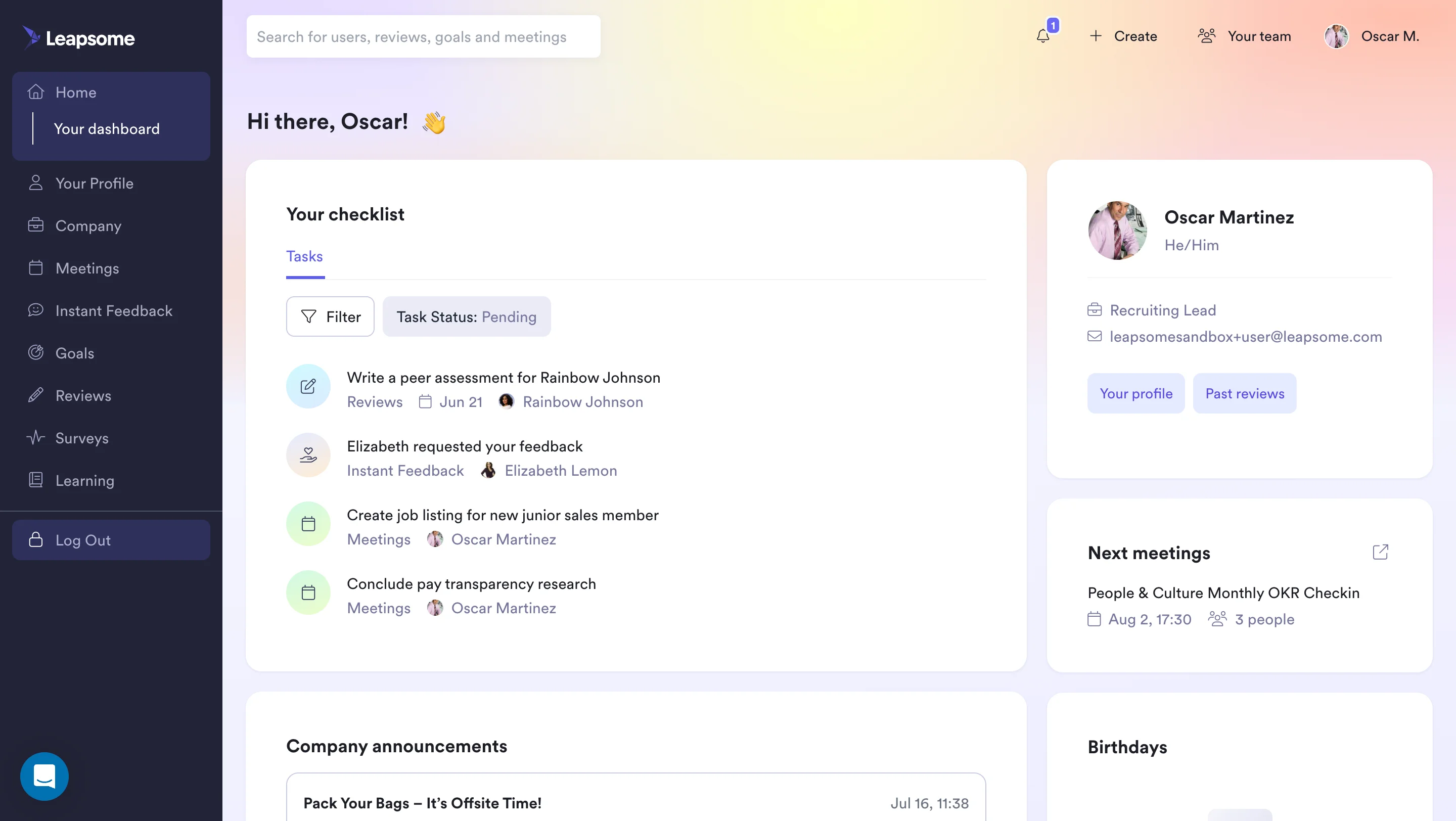
Leapsome serves as a comprehensive substitute for Culture Amp, especially for teams needing deeper performance reviews, OKR tracking, and HRIS connectivity. While Culture Amp functions as a specialized tool for engagement, Leapsome provides an integrated suite covering learning, compensation, and core HR data. Its robust GDPR standards also provide a distinct advantage for global operations.
Key Features
- Employee engagement surveys with action planning: Post-survey workflows that surface specific recommendations for managers, not just scores
- Performance reviews: Customizable cycles with 360-degree feedback, self-assessments, and calibration tools
- OKR and goal tracking: Cascading goals from company to individual level with real-time progress visibility
- Learning management: Structured learning paths and development planning tied to performance data
- Compensation management: Compensation review cycles connected to performance outcomes
- HRIS layer: Centralized employee records with automated data syncing
- People analytics: Reporting dashboards that connect engagement, performance, and development data in one view
What Makes Leapsome Stand Out vs. Culture Amp
- The platform goes well beyond Culture Amp's survey-and-performance scope by adding an HRIS layer, learning management, and compensation tools in the same system
- Post-survey action planning workflows close the insight-to-action gap that is Culture Amp's most widely reported shortcoming
- Strong European compliance posture and GDPR support for organizations with teams across multiple countries
Pros and Cons
Pros: "I like how Leapsome makes it easier to manage people and conduct year-end reviews. It's convenient because I can send a review and appraisal of a person at any time. The initial setup was easy." — G2 review
- Covers the full employee lifecycle from performance and engagement through learning and compensation in one platform
- High configurability across review templates, survey cadence, and goal frameworks without requiring vendor assistance
- G2 rating of 4.8 from 1,800+ reviews reflects consistent user satisfaction across company sizes
- Strong customer success support with a hands-on onboarding approach
Cons: "Integration is limited: I have noted that Leapsome's integration with other programs is limited." — Capterra review
- Pricing is not published and requires a custom quote, which adds time to the evaluation process
- Per-module pricing can compound quickly as organizations add capabilities
- Review template setup requires meaningful upfront configuration effort
Pricing
Leapsome’s pricing isn’t publicly listed, so you should contact Leapsome directly for a custom quote. A free trial is available.
2. Teamflect
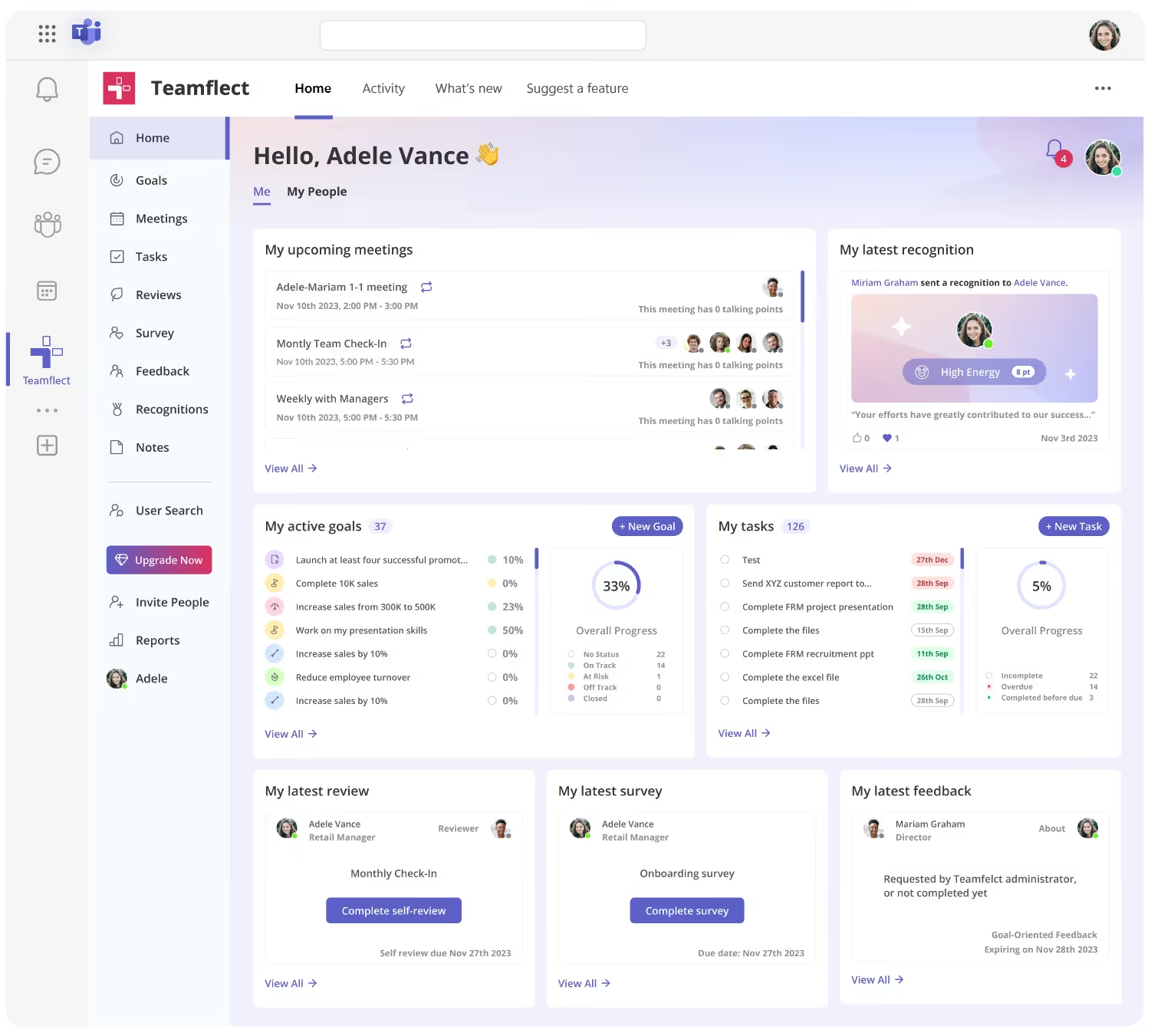
For organizations running Microsoft Teams as their primary work environment, Culture Amp's standalone login requirement is a genuine adoption problem. Completion rates on standalone survey platforms consistently drop when employees have to switch contexts to respond.
Teamflect solves this by operating entirely inside Microsoft Teams and Outlook; surveys, 360-degree feedback, performance reviews, goals, 1-on-1 meeting agendas, and recognition all happen within the interface employees already use daily.
Key Features
- Native Microsoft Teams and Outlook Integration: Operates entirely within the existing workspace, removing the need for external logins.
- Employee Engagement: Features pulse and anonymous surveys with AI summaries for qualitative data.
- Performance Management: Supports tailored 360-degree, self-assessment, and milestone-based review cycles.
- Goal Tracking: Includes cascading OKRs with automated progress updates via chat.
- Continuous Feedback and Recognition: Enables real-time feedback requests and peer recognition through custom badges in chat channels.
- Meeting Management: Provides synchronized agendas, tasks, and talking points accessible throughout the meeting lifecycle.
What Makes Teamflect Stand Out vs. Culture Amp
- The only Culture Amp alternative in this list that operates fully inside Microsoft Teams, removing the standalone login friction that suppresses survey completion rates in Microsoft 365 environments
- Transparent, published pricing with a genuinely functional free plan for teams under 10 users, addressing Culture Amp's pricing opacity directly
- Every paid plan includes a dedicated Customer Success Manager and free implementation support, with no additional onboarding fees
Pros and Cons
Pros: "The standout feature of Teamflect is its seamless integration within Microsoft Teams. It combines performance reviews, goal tracking, and feedback—all without leaving Teams. Efficient and engaging" — Capterra review
- Adoption rates are structurally higher because the tool fits into existing workflows rather than requiring a new one
- Quick implementation; most teams are running their first review cycle within days
- Covers performance reviews, goals, surveys, feedback, recognition, and 1-on-1s in one platform
- Nonprofits receive up to 60% off annual contracts
Cons: “I occasionally run into system errors, and I also experience update syncing issues with internal applications.” — G2 review
- Requires a Microsoft 365 environment. Organizations outside the Microsoft ecosystem may not benefit from Teamflect's core advantage and should evaluate a different option on this list
Pricing
Teamflect provides three pricing tiers, starting with a free version for up to 10 users that includes all primary features. The Essential plan costs $7 per user monthly, while the Professional plan is $11 per user monthly, adding talent management and advanced integration capabilities. Both paid tiers offer a 30-day free trial, and nonprofits are eligible for annual discounts of up to 60%.
3. Lattice

Lattice is the most direct Culture Amp competitor for organizations that want engagement surveys connected to a broader performance management workflow. Where Culture Amp treats surveys and performance reviews as its primary outputs, Lattice adds goal tracking and compensation tools and integrates them more tightly into one continuous people management experience. Its Slack-native pulse surveys are a particular advantage for non-Microsoft environments where completion rate friction is a real concern.
Key Features
- Employee engagement surveys: Pulse surveys, engagement surveys, and eNPS with Slack-native response options
- Performance reviews: Customizable cycles with self-assessments, manager reviews, and peer feedback
- OKRs and goals: Company-to-individual cascading goals with real-time progress tracking
- Compensation management: Compensation review cycles connected to performance data
- People analytics: Cross-module reporting on engagement, performance, and retention trends
- AI-assisted tools: Review writing assistance and engagement insight summaries
What Makes Lattice Stand Out vs. Culture Amp
- Slack-native pulse surveys drive materially higher completion rates in organizations that work primarily in Slack, a direct counter to Culture Amp's standalone login problem in that environment
- Compensation management within the same platform closes a gap Culture Amp leaves open
- One of the largest G2 review bases in the category, offering good signal on real-world reliability
Pros and Cons
Pros: "Easy to navigate, UI, then user friendly for 1:1's agenda to update and keep track. Retain all appraisal docs. in one platform." — Capterra review
- Strong G2 rating of 4.7 based on over 4,000 reviews
- Modular pricing lets teams start with one product and add capabilities over time
- Covers performance, engagement, goals, and compensation in one platform
- Clean interface with broad integration support including Slack, HRIS systems, and Workday
Cons: "High administrative friction and notification fatigue can make the tool feel more like a chore than a benefit." — G2 review
- Pricing is not published and requires a custom quote
- Per-employee costs can rise quickly for growing teams once multiple modules are active
- Some enterprise customization requires a higher-tier plan
Pricing
Lattice’s base pricing starts at approximately $11 per user per month, with add-ons for engagement, compensation, and grow modules at additional cost. A minimum annual agreement of $4,000 applies. Contact Lattice for a custom quote.
4. Workleap
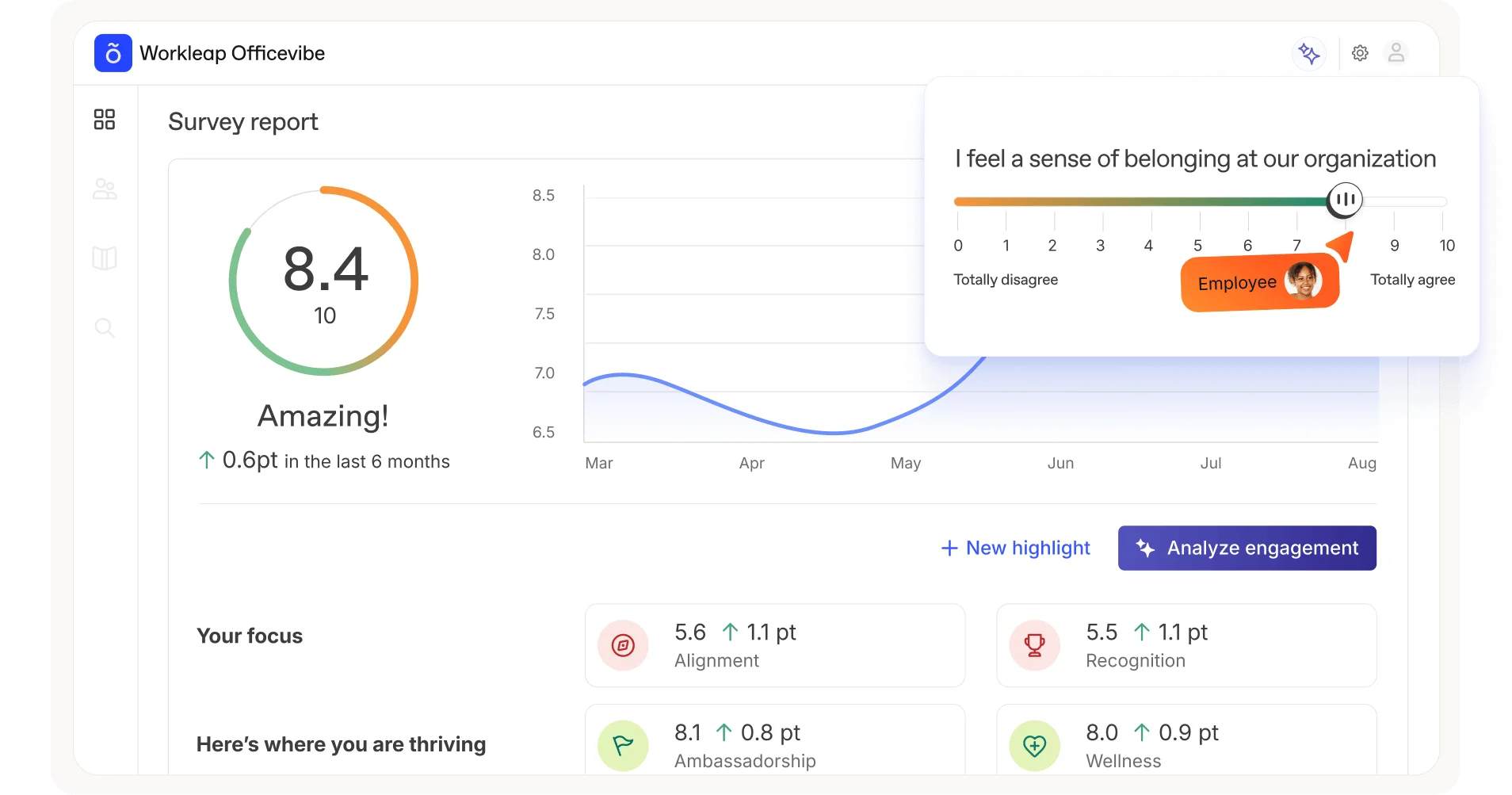
Culture Amp can feel like a significant investment for smaller organizations that primarily need engagement measurement and manager coaching, not a full performance suite. Workleap, the platform formerly known as Officevibe, is the most accessible entry point in this category.
Workleap covers pulse surveys, engagement metrics, anonymous feedback, and lightweight recognition without the implementation complexity or cost of a full-platform solution. For teams between 10 and 200 employees that want Culture Amp's core engagement measurement at a fraction of the cost, Workleap is worth serious consideration.
Key Features
- Pulse surveys: Weekly science-backed pulse questions across 10 engagement metrics, validated with Deloitte
- Anonymous feedback: Anonymous feedback channels with rules-based visibility controls for managers
- AI-powered manager insights: Automatically structures survey responses into trends and personalized action recommendations
- Recognition (Good Vibes): Peer-to-peer recognition built into the platform
- Integrated performance tools: Connects engagement data with performance reviews and 1-on-1 tracking
- HRIS and Slack integration: Direct integration with Slack and Microsoft Teams for in-workflow survey responses
What Makes Workleap Stand Out vs. Culture Amp
- Significantly lower cost than Culture Amp with a genuinely functional free tier, not a crippled trial
- Slack and Teams integrations allow employees to respond to pulse surveys without leaving their existing workflow, addressing the standalone login adoption problem
- Fast deployment for small teams; most organizations are running their first pulse survey within days of setup
Pros and Cons
Pros: "I like the appearance and the features. And Is easy to review and write the feedback for my peers and manager. Also can have control of the statistics." — Capterra review
- Free tier covers basic pulse surveys and recognition for unlimited users, a genuine advantage for budget-constrained teams
- Conversation-based feedback tools make it easier for managers to respond to team sentiment directly
- Very low learning curve for both HR administrators and employees
Cons: "Would appreciate more report features, as well as more flexbility on comp cycle sand boxes (like being able to unlock them)." — G2 review
- Performance review functionality is limited; Workleap requires a separate product add-on for full performance management, which adds cost
- OKR tracking requires a separate Workleap product, creating integration complexity
- Analytics depth is not suited to organizations that need enterprise-level reporting
Pricing
Workleap provides three modular plans at $5/user/month each. Officevibe covers engagement surveys and feedback, Performance handles review cycles and AI-guided assessments, and Compensation manages pay bands and total rewards. A 10-user minimum applies to the first two, while the Compensation module requires at least 100 users.
5. 15Five

Culture Amp's insight-to-action gap is most visible at the manager level. Survey data surfaces in a dashboard, and then managers are largely on their own to decide what to do with it. 15Five takes a different approach: it is built around the weekly check-in as a core workflow, making manager response to team feedback a daily habit rather than a post-survey project. For distributed and remote-first teams where manager effectiveness is a significant retention lever, that structural difference matters.
Key Features
- Weekly check-ins: Structured pulse questions sent to every employee on a weekly cadence, with manager response built into the workflow
- Engagement surveys: Scientifically validated survey templates with benchmark comparison
- Manager effectiveness tools: Manager scorecards, coaching prompts, and leadership development resources
- Performance reviews: Customizable review cycles with self-assessments and peer feedback
- OKRs and goals: Goal tracking with company-to-individual alignment
- Recognition ("High Fives"): Peer recognition with public visibility across the team
What Makes 15Five Stand Out vs. Culture Amp
- The weekly check-in model builds manager response into the product workflow rather than leaving it as a post-survey follow-up item, directly addressing the insight-to-action gap
- Published pricing gives budget clarity before any sales conversation, which is a meaningful contrast to Culture Amp's opaque model
- Manager coaching tools and scorecards go further than Culture Amp's manager-facing features
Pros and Cons
Pros: "The product is extremely easy to use for all types of teams within a company. We were able to integrate it with no complications. The check-ins are a great feature that ensure the right priorities are being focused on." — Capterra review
- Published pricing removes the evaluation friction that Culture Amp's quote-only model creates
- Weekly check-in model is easy for managers to adopt without significant training
- Connects engagement, performance, and coaching in one platform
- Works particularly well for distributed and remote-first teams
Cons: "Setting up the first review cycle took a bit of planning and coordination. Once the templates were in place, the process became much smoother and easier to repeat for future reviews." — G2 review
- Check-in and pulse questions can feel repetitive over time; customization options for survey content have been noted as limited in some user reviews
- Executive-facing dashboards are less intuitive than the manager-level experience, with some users reporting inconsistent layout and grouping
- Not well-suited to organizations above 500 employees that need enterprise-grade analytics
Pricing
15Five offers three annual tiers: Engage ($4/user/month) for surveys and analytics, Perform ($11/user/month) for OKRs and 360-degree feedback, and Total Platform ($16/user/month), which combines both with manager training. Each plan aims to reduce turnover and boost performance through data-driven insights.
6. Quantum Workplace

One of Culture Amp's most consistent weaknesses is what happens after the survey closes. Data is presented clearly, but in-platform tools for helping managers create specific action plans are limited.
Quantum Workplace is built around a connected data model that ties engagement surveys, performance reviews, 1-on-1 conversation records, and goal data together, and then uses that connected data to surface action planning recommendations.
For mid-market teams where Culture Amp's action gap has been the primary friction point, that is a meaningful structural difference.
Key Features
- Engagement surveys with action planning: Post-survey workflows that generate specific, team-level action recommendations for managers
- Performance management: Review cycles, continuous feedback, and 1-on-1 tools connected to engagement data
- Goal management: Cascading objectives tied to organizational strategy
- Recognition: Built-in recognition tools connected to performance and engagement data
- AI-generated insights: AI summaries of open-ended survey responses to reduce analysis time
- Real-time dashboards: Talent pipeline and engagement visibility across teams and departments
- HRIS integrations: Native connections to ADP, Workday, and BambooHR
What Makes Quantum Workplace Stand Out vs. Culture Amp
- Action planning workflows are a genuine product feature rather than an afterthought, with specific, team-level recommendations generated from survey results
- Connected data model across engagement, performance, goals, and recognition reduces the fragmentation that Culture Amp's siloed approach can create
- Dedicated customer success relationship from onboarding, which contrasts with Culture Amp's more variable support experience at smaller account tiers
Pros and Cons
Pros: "I like the idea of take care of the earth, paperless and all the other benefits for our company and others" — Capterra review
- Knowledgeable customer success team with a hands-on approach throughout the relationship, not just during implementation
- Strong analytics that surface meaningful patterns across teams and departments
- Good integration options with major payroll and HRIS platforms
Cons: "I found the UI to be kind of dense. It took me time to understand Quantum Metric, so maybe if the UI can be a little more user-friendly." — G2 review
- Minimum annual contract value limits fit for smaller teams
- Analytics depth can feel overwhelming witho
- ut proper initial setup and configuration
- Not a replacement for a core HRIS system; works best alongside an existing HR platform
Pricing
Quantum Workplace uses custom pricing with a minimum annual contract of $15,000. Contact Quantum Workplace directly for a demo and quote.
7. Betterworks
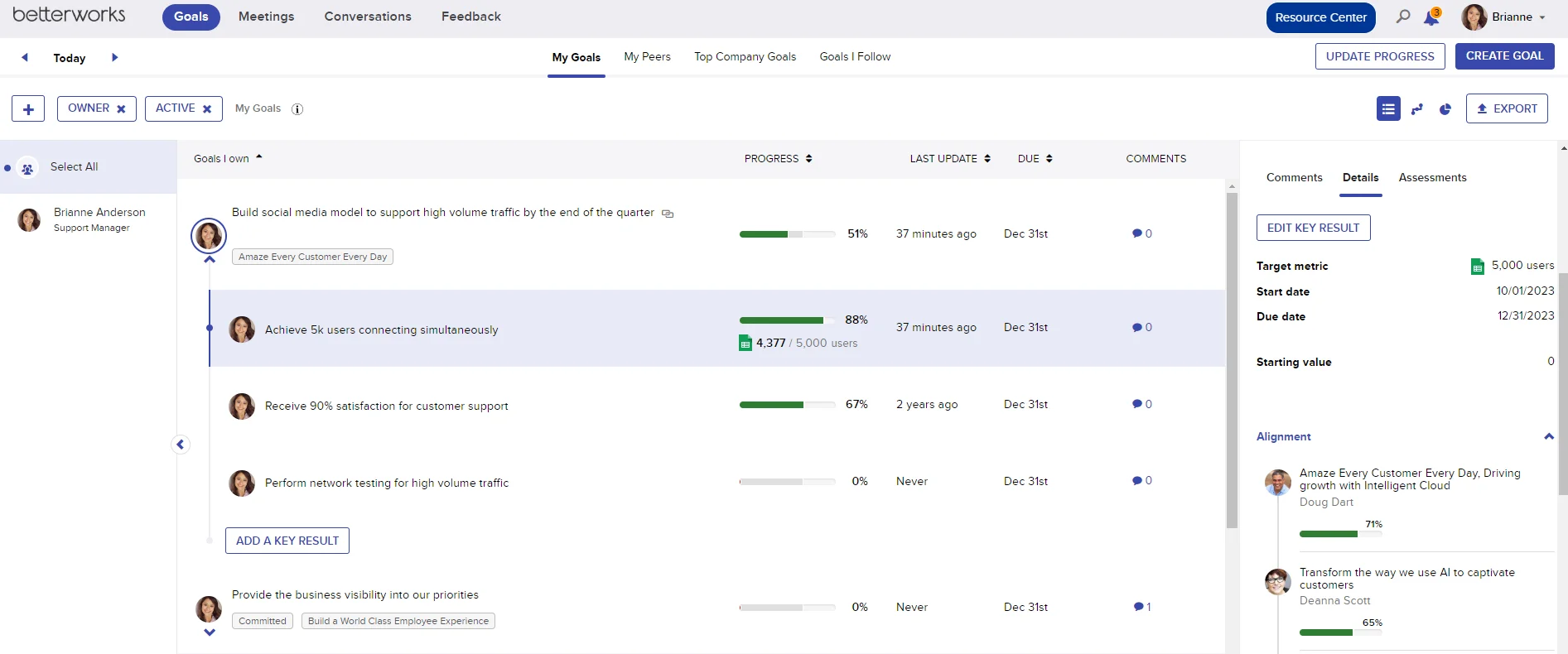
Culture Amp's OKR capabilities are functional but relatively shallow for enterprise organizations that need goals to be the connective tissue between individual performance conversations and company strategy.
Betterworks is designed around that use case. It is a continuous performance management platform where OKRs drive the structure of check-ins, feedback, and engagement measurement, rather than existing as a separate module alongside surveys.
For organizations above 500 employees where the primary Culture Amp frustration is lack of goal alignment depth and insufficient HRIS integration, Betterworks is worth evaluating.
Key Features
- OKR management: Sophisticated cascading goal framework from company level to individual contributor, with full visibility into contribution alignment
- Continuous check-ins: Structured check-in model built around goal progress rather than standalone surveys
- Performance reviews: Calibration tools and AI-assisted assessment for more consistent evaluations across large organizations
- Feedback and recognition: Manager conversation frameworks with coaching prompts and structured 1-on-1 templates
- People analytics: Benchmarking and reporting connected to performance, goal, and engagement data
- HRIS integrations: Deep native integrations with Workday, SAP SuccessFactors, ADP, and BambooHR
What Makes Betterworks Stand Out vs. Culture Amp
- OKR framework is the most mature in this comparison, designed for enterprise scale with full cascade visibility from company strategy to individual contribution
- Continuous check-in model reduces dependence on annual survey cycles, addressing Culture Amp's tendency toward episodic engagement measurement
- Enterprise HRIS integrations are deeper than Culture Amp's, with true bi-directional data sync to Workday and SAP
Pros and Cons
Pros: "Technology at the service of people streamlines the management of the OKRs methodology, allowing us to focus on strategic discussions and concentrate on what truly matters." — G2 review
- Goal alignment transparency is consistently praised; the cascade from company OKRs to individual goals is clear and practical
- Strong enterprise HRIS integrations reduce the data sync unreliability that Culture Amp users frequently report at scale
- Structured check-in model gives managers a repeatable framework rather than relying on post-survey follow-up
Cons: "the performance management solution reporting is also one of features betterworks provide which it help to improve businesses performance." — Capterra review
- Some users report usability issues and confusion from unclear UI feedback in certain workflows
- Historical goals and older entries can be difficult to locate as the platform grows
- Pricing is custom and not published; enterprise contracts typically involve extended procurement timelines
Pricing
Betterworks uses custom enterprise pricing. Contact Betterworks directly for a quote. No free plan or trial is publicly advertised.
8. Qualtrics XM (Employee Experience)

Culture Amp is a capable analytics platform, but it has limits. For enterprise organizations with dedicated people analytics teams that need predictive attrition modeling, AI-powered text analysis across thousands of open-ended responses, and cross-industry benchmarking at scale, Qualtrics XM for Employee
Experience is the only platform in this list that genuinely surpasses Culture Amp on analytics depth. It is also significantly more complex and more expensive than Culture Amp. If your organization does not have the headcount or technical capacity to configure and run it properly, that complexity becomes a liability rather than an advantage.
Qualtrics is best suited to organizations above 1,000 employees with dedicated HR analytics resources.
Key Features
- Predictive attrition modeling: AI-driven forecasting that identifies flight-risk employees and quantifies the business impact of retention strategies
- Text analytics: AI-powered analysis of open-ended survey responses at scale, surfacing sentiment patterns across large datasets
- Employee journey analytics: Connects engagement data across onboarding, mid-tenure, and exit to reveal patterns across the full employee lifecycle
- CrossXM integration: Links employee experience data with customer satisfaction and operational metrics for cross-functional analysis
- Custom survey design: Extensive survey customization with logic branching, multi-language support, and complex distribution options
- Benchmarking: Cross-industry engagement benchmarks at a scale Culture Amp cannot match
What Makes Qualtrics Stand Out vs. Culture Amp
- The only platform in this list that exceeds Culture Amp on analytics depth, with predictive modeling and text analytics capabilities that are genuinely enterprise-grade
- CrossXM integration connects employee data to customer experience and business performance metrics, a capability that has no equivalent in Culture Amp
- Handles large-scale survey programs across thousands of employees with high reliability and multi-language support
Pros and Cons
Pros: "Supports interaction and engagement of employee and HR Helps in feedback collection Has feedback analytic and reporting capabilities" — Capterra review
- Analytics capabilities are best-in-class for enterprise people analytics teams
- Highly customizable at every level: surveys, dashboards, reporting, and distribution workflows
- Reliable at scale; consistent uptime and strong compliance certifications
Cons: "The only thing I find frustrating with Qualtrics is that sometimes the downloaded raw data excel files is not in the right structure to find what i am looking for. It takes alot of data scrubbing to get what I need." — G2 review
- Significantly more complex than Culture Amp; requires dedicated configuration time and internal technical resources
- Reporting customization can feel rigid in certain dashboard configurations despite the platform's overall depth
- Enterprise pricing places it outside the realistic budget range for organizations below 1,000 employees
Pricing
Qualtrics XM uses custom enterprise pricing. No publicly listed per-user price is available. Contact Qualtrics for a tailored quote based on headcount and module selection.
9. Microsoft Viva Glint
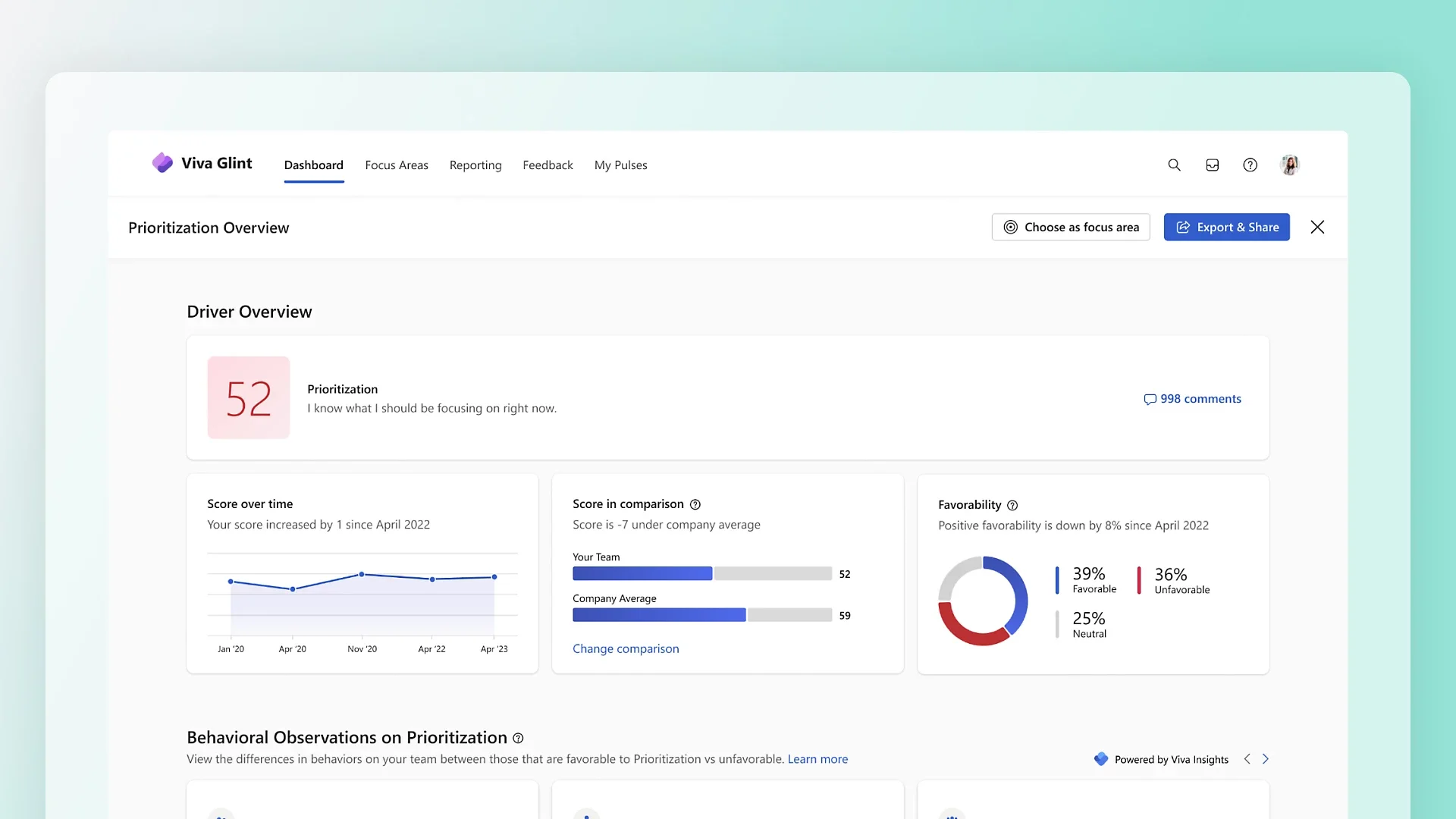
For enterprises with over 1,000 employees, Culture Amp’s separate login hinders participation. Microsoft Viva Glint removes this barrier by embedding surveys directly into the Microsoft 365 environment. This allows large organizations to leverage existing software investments and consolidate employee listening into a single, familiar ecosystem.
Key Features
- Pulse and engagement surveys: Customizable survey programs with anonymous response options and real-time result visibility
- AI-powered summarization: Microsoft Copilot integration to summarize employee feedback and draft manager-facing communications
- Action planning tools: Manager-facing resources to create targeted plans based on survey results
- Microsoft 365 integration: Native connection to Teams, Outlook, and the broader Viva suite
- Advanced analytics: Real-time dashboards, data segmentation, and predictive analytics for HR leadership
- Multi-language support: Survey content available in 70+ languages for global organizations
- Security and compliance: Enterprise-grade security aligned with Microsoft's compliance framework
What Makes Viva Glint Stand Out vs. Culture Amp
- Native Microsoft 365 integration removes the standalone login barrier entirely at enterprise scale, which is the primary driver of low survey completion in Microsoft-heavy organizations
- Included in Microsoft 365 enterprise plans or available as a Viva add-on, which can simplify procurement for organizations already in the Microsoft ecosystem
- Microsoft Copilot integration for feedback summarization and manager communication drafting is a practical AI feature that reduces the manual work of post-survey analysis
Pros and Cons
Pros: "I like the clear insights and dashboard provided by Viva Glint, which is easy to understand. The dashboard presents results in a superb way. I also find the survey template valuable." — G2 review
- Strong adoption rates driven by Microsoft 365 integration rather than requiring behavior change from employees
- Scales reliably to large, globally distributed workforces with multi-language support
- Real-time feedback analysis and dashboard visibility are consistently praised by users
Cons: "The only issue is when the team is small, and you only work with a small set of collegues; in those cases, it becomes hard to capture 360 feedback anonymously." — G2 review
- Survey templates offer limited customization relative to Culture Amp and other standalone platforms; adapting content to specific organizational needs requires workarounds
- Pricing is not straightforwardly published; Viva Glint is available as part of a Viva add-on and pricing depends on your existing Microsoft subscription tier
- Not a standalone performance management platform; organizations that need reviews and goals alongside engagement should pair it with another tool or consider a broader Viva suite investment
Pricing
Microsoft Viva offers three annual tiers beyond its basic Microsoft 365 features. Communications and Communities ($2/user/month) focuses on news and engagement; Workplace Analytics and Feedback ($6/user/month) adds Viva Glint surveys and organizational insights; and the Viva Suite ($12/user/month) integrates all tools, including learning management and Copilot AI.
10. Eletive
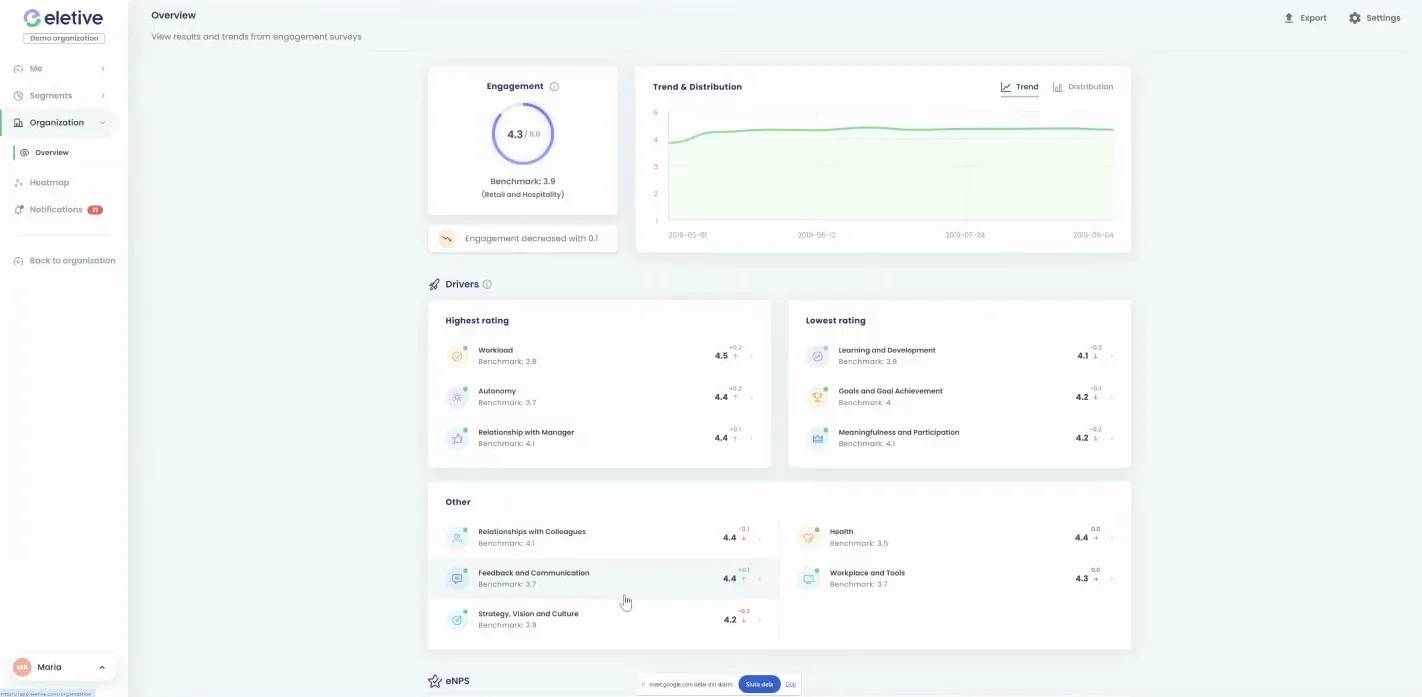
Eletive shifts engagement from a top-down process to an individual one. Unlike Culture Amp, it features a self-leadership module that empowers employees to manage their own well-being and growth independently. For European teams of 50 to 500 people, it provides a science-backed, GDPR-compliant alternative that prioritizes employee-level agency.
Key Features
- Continuous pulse surveys: Real-time engagement measurement with analytics dashboards surfacing potential risk areas
- Self-leadership module: Employee-facing tools that allow individuals to track their own wellbeing and access development resources independently
- Predictive analytics: Sentiment monitoring and predictive insights for HR teams to identify engagement risks before they compound
- Performance and development tools: Goal setting, development planning, and feedback tools alongside engagement measurement
- GDPR compliance: European-built platform with strong data privacy controls by default
- Deskless worker support: Mobile-first survey delivery designed for non-desk employees who are underserved by most engagement platforms
What Makes Eletive Stand Out vs. Culture Amp
- The self-leadership module is a genuine differentiator; employees are active participants in improving their own engagement rather than passive survey respondents waiting for manager action
- European-built platform with GDPR compliance built in from the ground up, rather than retrofitted as a compliance checkbox
- Supports deskless and frontline workers through mobile-first delivery, which Culture Amp's desktop-centric design does not address well
Pros and Cons
Pros: "I like that it gives employees a voice and makes feedback feel more continuous rather than a one-off exercise. The anonymity also makes it easier to be honest and share real concerns." — G2 review
- Science-backed survey methodology developed with organizational psychologists gives the platform credibility in research-oriented HR teams
- Self-leadership approach reduces dependence on manager responsiveness, which directly addresses Culture Amp's insight-to-action gap from the employee side
- Strong European footprint with a customer base concentrated in Scandinavia, the UK, and Germany
Cons: "User management is a bit tricky (who gets the survey and is the user base integration up-to-date). Reporting data out from the system does not work very well." — Capterra review
- Comparing survey results across segments or against historical data for the same team may require additional configuration that other platforms handle more automatically
- Smaller integration library than mid-market platforms like Lattice or Leapsome
- Less suitable for organizations above 500 employees that need enterprise-grade HRIS integration depth
Pricing
Eletive’s pricing (provided in Swedish) features three tiers: Essential for pulse surveys, Standard for engagement and self-leadership tools, and Professional for advanced AI-driven organizational insights. All plans require contacting their sales team for custom quotes.
How to Choose the Right Culture Amp Alternative
With ten solid options in front of you, the challenge is narrowing the field. A few practical questions will help.
1. What is your primary frustration with Culture Amp?
If it is the insight-to-action gap, Leapsome, 15Five, and Quantum Workplace all have specific product answers to that problem. If it is pricing opacity, Teamflect and 15Five publish their costs online. If it is platform rigidity at scale, Leapsome and Betterworks are designed for more complex org structures.
2. What does your tech stack look like?
If your organization runs on Microsoft 365, Teamflect or Viva Glint will structurally outperform any standalone alternative on adoption. If you are Slack-first, Lattice or Workleap are better fits. Ecosystem alignment is not a secondary consideration; it is often the deciding factor.
3. How large is your team, and how fast are you growing?
Workleap and 15Five are optimized for 50 to 500 employees. Leapsome, Lattice, and Quantum Workplace scale well into the mid-market. Betterworks and Qualtrics are built for enterprise complexity. Picking a platform matched to your actual scale prevents paying for unused features now or outgrowing the tool in 18 months.
4. How important is pricing transparency before you talk to a vendor?
Teamflect and 15Five publish their pricing. Leapsome, Lattice, Quantum Workplace, Betterworks, and Qualtrics all require a custom quote. If you need cost clarity before going to procurement, start with the tools that give it to you.
Find the Right Culture Amp Alternative for Your Team
The right alternative depends on which Culture Amp limitations are most affecting your team, which tools your people already use every day, and what your organization will look like in two years. Use the criteria and comparisons in this guide to build a shortlist of two or three platforms, then run demos with your real workflows in mind rather than the vendor's demo environment.
If your team runs on Microsoft 365 and wants to replace Culture Amp's standalone survey approach with a platform embedded directly in Teams, Teamflect is the clearest starting point. The free plan covers up to 10 users with no time limit, and paid plans include a dedicated Customer Success Manager from day one.
For organizations that need a more complete like-for-like Culture Amp replacement with deeper platform breadth, Leapsome is the strongest option in this comparison. A free trial is available to test it before committing.
.png)