.svg)
Put Betterworks and Lattice side by side and the feature lists look almost indistinguishable. Performance reviews, OKRs, continuous feedback, engagement surveys, Slack integration, AI tooling. Both platforms check every box. The confusion is understandable. The distinction matters.
Betterworks was built from the ground up around OKR methodology at enterprise scale. The core assumption is that a large organization runs on cascading goals, and that HR’s job is to connect company strategy to individual execution and make that connection visible to leadership in real time.
Lattice was built around a different organizational reality. Mid-market People Ops teams want performance, engagement, and compensation in one system. They want to start without a multi-month implementation project. And they need to build a budget case before speaking to sales.
These are different tools for different problems. The right one depends almost entirely on where your organization sits on those two dimensions.
Betterworks Overview
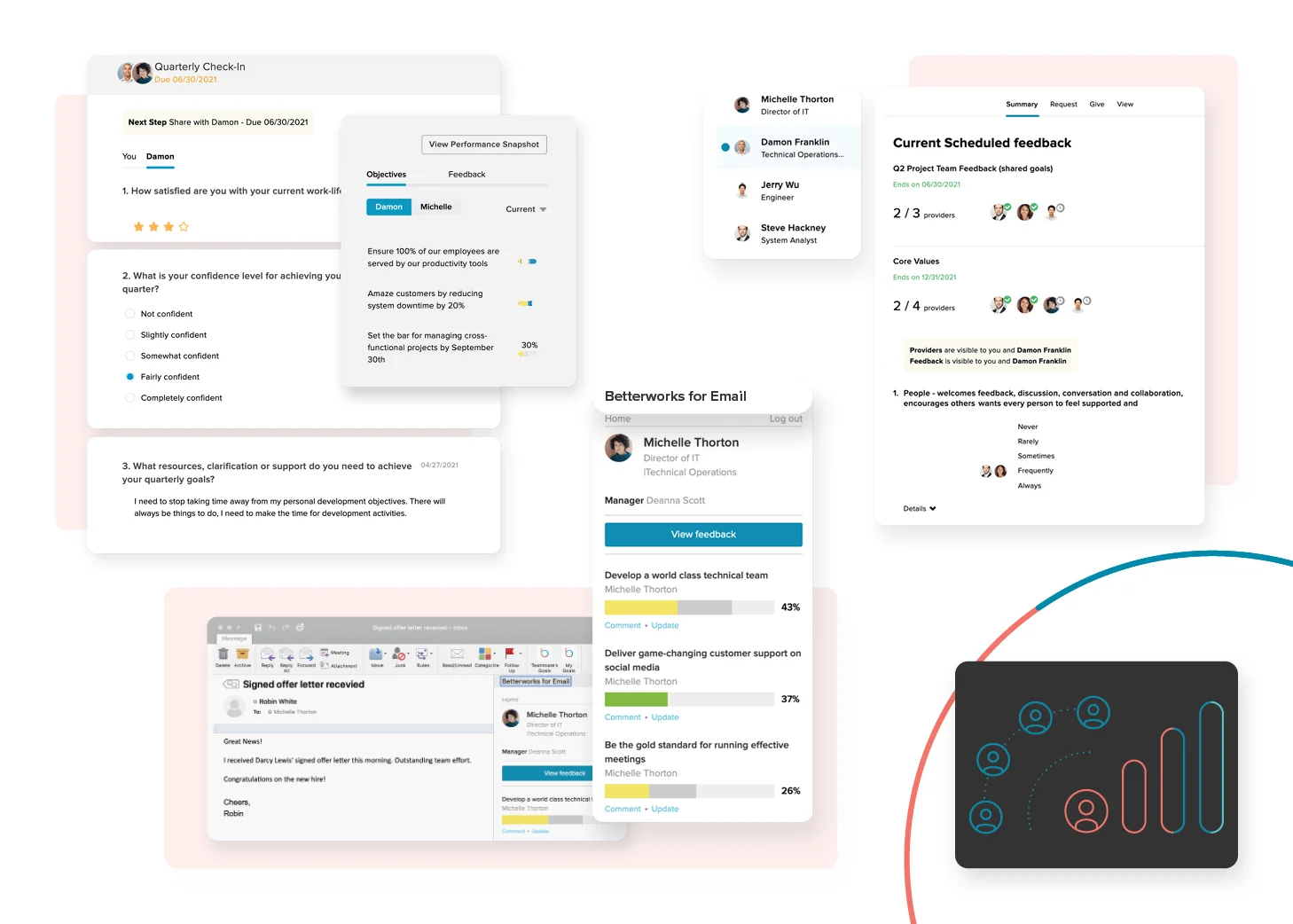
Betterworks started in 2013 with a single conviction: that OKRs only work when every level of an organization can see how their goals connect to the ones above them. Twelve years later, that conviction is still the architectural center of the platform.
Goal cascading, calibration, continuous feedback, and AI-powered execution oversight are all built around the same premise: performance management should be a strategic operating system, not an annual compliance event.
Organizations like Colgate-Palmolive, Intuit, and ATB Financial run it at enterprise scale. Its G2 rating of 4.3/5 from 220 verified reviews (June 2026) reflects a smaller but heavily enterprise-skewed base, with 57% of reviewers from organizations with 1,000+ employees.
Betterworks does not compete with your HRIS. It is engineered to sit alongside Workday or SAP SuccessFactors, with bidirectional data sync that writes calibrated ratings and performance summaries back to the system of record automatically. Organizations without that existing infrastructure are looking at the wrong platform, as are those that need native payroll, compensation planning, or benefits administration.
Key features include:
- Enterprise OKR and goal cascading: four-level alignment from company strategy to individual OKRs, with AI execution-risk detection that flags at-risk goals in real time via the Manager Command Center
- Continuous feedback via the CFR model (Conversations, Feedback, Recognition), structured check-ins, and AI-assisted conversation prompts
- Calibration module with side-by-side employee comparisons, visual rating distribution curves, drag-and-drop 9-box placement, and bias detection
- Engage module: pulse surveys and engagement analytics connected to performance data in the same system (acquired from Hyphen in 2020)
- Bidirectional HRIS integrations with Workday, SAP SuccessFactors, ADP, and Oracle; also integrates with Slack, Microsoft Teams, Outlook, Google Workspace, Jira, Asana, GitHub, and Salesforce
- January 2026 NextGen platform update: 400+ enterprise-requested features including AI performance trend anomaly detection, goal-writing assistance, and expanded Manager Command Center visibility
Lattice Overview
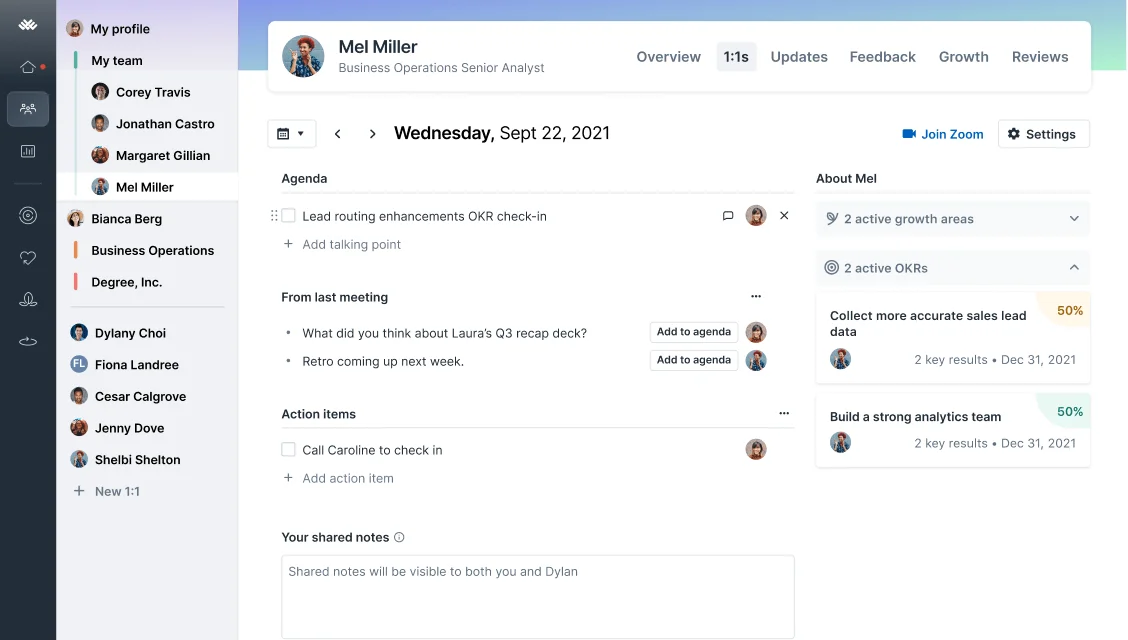
Where Betterworks goes deep on one problem, Lattice goes wide across many. Founded in 2015, it has grown into the go-to People Ops platform for mid-market HR teams that want performance reviews, OKRs, engagement surveys, and compensation planning under one roof.
It serves 4,500+ organizations and holds a G2 rating of 4.7/5 from 4,094 verified reviews (June 2026). That score is among the highest sustained ratings in the performance management category, and it is earned across a review base that skews 50–1,500 employees rather than enterprise.
One important update for 2026 buyers: Lattice announced the sunset of its HRIS module in July 2026. The compensation module is unaffected. Organizations that included the HRIS layer in their evaluation should confirm current product direction with Lattice before finalizing a business case.
Lattice is built on the argument that managing performance in one tool, engagement in another, and compensation in a spreadsheet creates enough operational overhead to justify a unified platform, even one that takes real configuration to get right.
Buyers who go in expecting plug-and-play report frustration. Buyers who invest in setup report that the data connections between performance, engagement, and compensation decisions are exactly what they came for.
Key features include:
- Customizable performance review cycles: self, peer, manager, and upward reviews in one packet with custom rating scales, flexible question types, and calibration tools across manager groups
- Goals and OKRs with company-to-individual cascading, visual goal trees, and direct linkage into performance review cycles
- Lattice Engage: pulse surveys, annual surveys, onboarding and exit surveys, and Mercer benchmarking data covering 64 countries and four benchmark tiers (updated May 2026)
- Compensation module (add-on, $6/seat/month): salary band benchmarking, merit cycle workflows, and pay equity analysis connected directly to review outcomes
- Lattice AI: calibration summaries, engagement trend analysis, and review writing assistance across all plans
- 50+ native integrations including Slack (strong), BambooHR, Workday, Rippling, ADP, and Greenhouse; Outlook integration exists but is documented as weaker than the Slack version
Betterworks vs Lattice: Feature Comparison
Both platforms cover the same broad category, but the way they approach each function reflects genuinely different design philosophies. The following breakdown covers the dimensions most relevant to a buyer choosing between them.
Goal and OKR Management
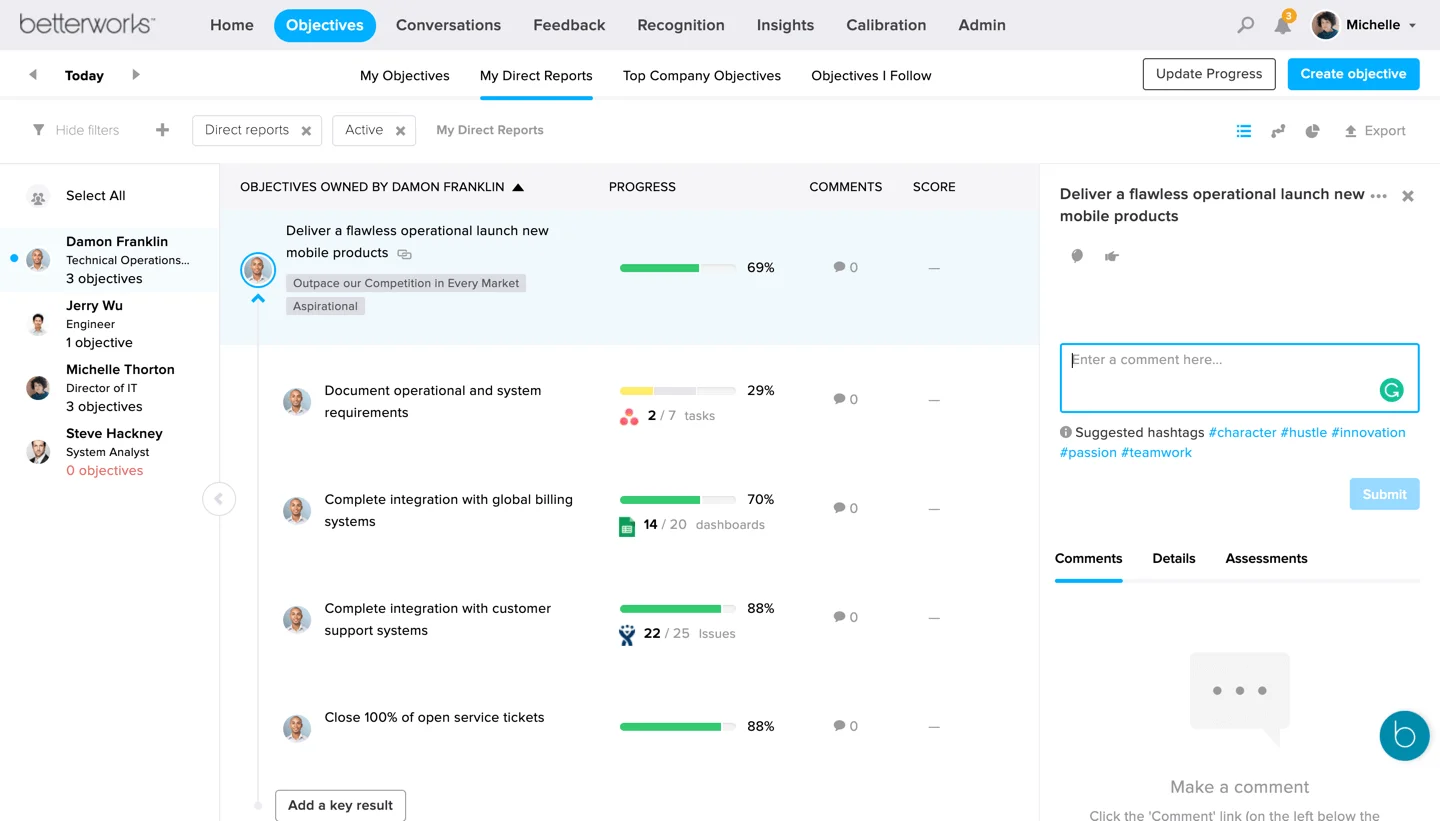
Betterworks is OKR-native in a way Lattice is not. Goal cascading is the platform’s organizing principle, not one module among many. The January 2026 AI execution-risk detection adds a capability that has no direct equivalent in Lattice: it flags at-risk goals in real time and surfaces alignment gaps in the Manager Command Center before a quarter ends in a miss. For enterprises where OKRs are the operating framework and leadership visibility into execution is a primary concern, this is meaningful infrastructure.
Lattice’s goal module is capable. Goals cascade from company to individual, link directly to performance reviews, and display in visual goal trees. For mid-market organizations running goals as one component of a broader performance program, it covers the requirement. Gartner and G2 reviewers at larger or more complex organizations consistently flag that the goal hierarchy becomes confusing as cross-functional ownership increases.
Verdict: Betterworks for enterprises where OKRs are the operating model and leadership visibility into execution is a primary concern. Lattice is adequate for mid-market teams where goals are one feature among several.
Performance Reviews and Calibration
Lattice’s review module is among the most configurable in the mid-market. Custom rating scales, flexible question formats, and multi-stage review packets give HR teams with specific performance philosophies real room to work. AI calibration summaries help HR teams run sessions without manual statistical preparation, which is a genuine advantage at 200–500 person organizations without a dedicated analytics function.
Betterworks’ calibration module operates at a different level for large-org normalization. Side-by-side employee comparisons, visual distribution curves across manager groups, bias detection, and demographic filtering make calibration a data-driven exercise rather than a facilitated discussion. At 1,000+ employees with dozens of managers, the gap between Lattice’s AI summaries and Betterworks’ calibration infrastructure is material for HR teams running formal calibration across business units.
Verdict: Lattice for mid-market organizations that need configurable reviews and faster calibration sessions. Betterworks for enterprises where calibration consistency across many managers is a documented equity and HR credibility concern.
Continuous Feedback and 1-on-1s
Lattice’s 1-on-1 tooling is a genuine strength in this comparison. Shared agendas, carry-forward action items, goal visibility in the meeting view, and Slack-native prompts combine into a workflow managers use consistently without significant training. Multiple G2 reviewers specifically credit the 1-on-1 feature as the reason manager adoption held up post-implementation.
Betterworks’ Conversations model covers continuous feedback with AI-assisted prompts, goal progress surfacing, and structured check-in templates. It is solid for enterprise teams where the manager-employee relationship is structured and HR-supported. It is not built around a weekly cadence the way Lattice’s 1-on-1 workflow is, and it is not the primary reason to choose the platform.
Verdict: Lattice for organizations where manager-employee conversation quality and consistent 1-on-1 cadence are the primary problem. Betterworks covers the requirement but is not differentiated on this dimension.
Engagement Surveys and Analytics
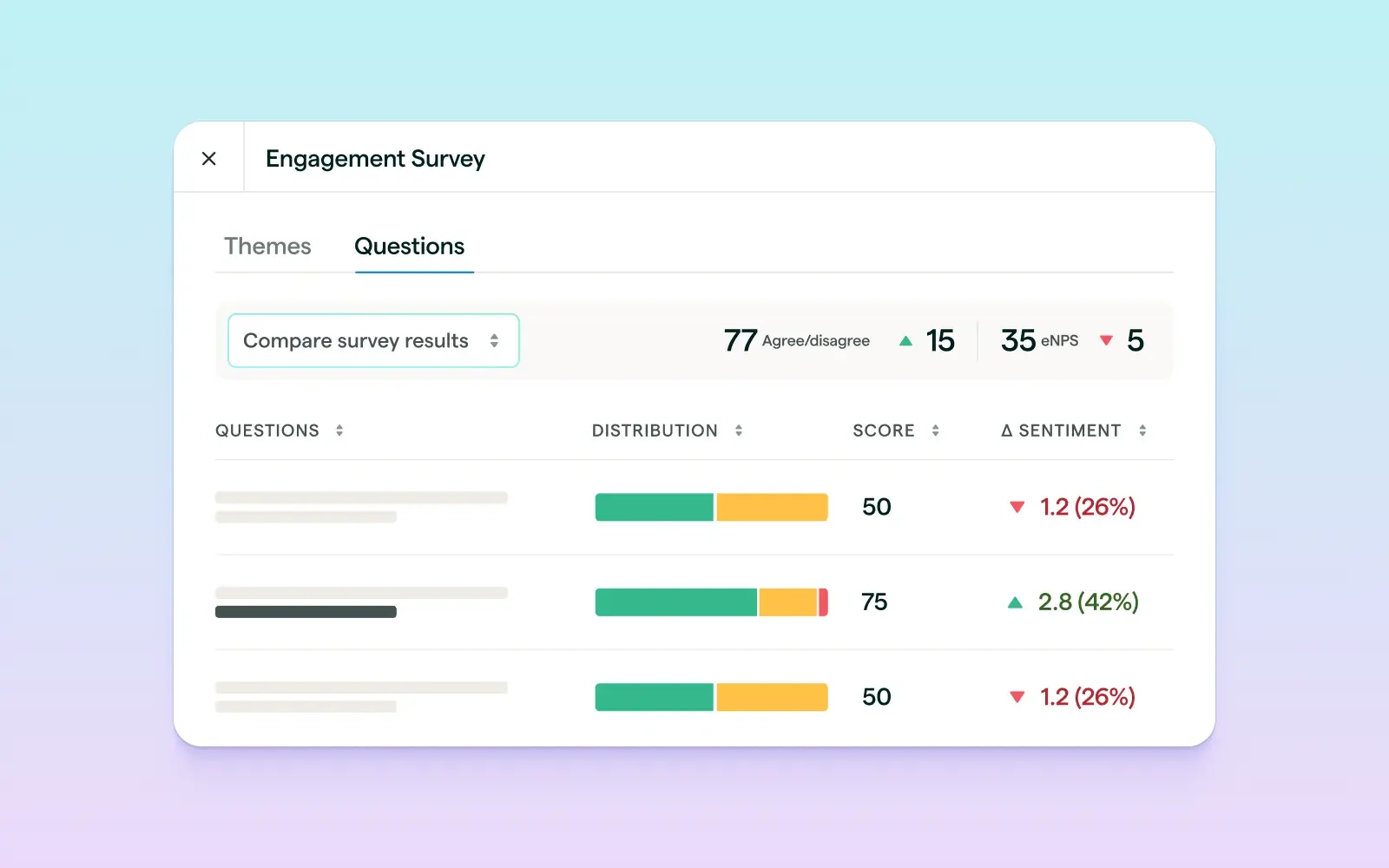
Lattice Engage is the stronger product. Mercer benchmarking data covering 64 countries and four tiers (updated May 2026), Slack-native survey delivery, demographic segmentation, and driver analysis give HR teams an external comparison baseline that most standalone survey tools do not provide. The engagement data connects directly to performance data in the same system, enabling the correlation analysis that makes engagement measurement useful rather than decorative.
Betterworks’ Engage module is functional and benefits from the same performance-engagement data connection. But it is newer, with less benchmarking depth and a smaller feature surface. For organizations where engagement analytics is one component of a broader performance program, Betterworks is sufficient. For HR teams that treat engagement measurement as a primary investment, Lattice is the better tool.
Verdict: Lattice. The Mercer benchmarking data and Slack-native delivery are differentiators that Betterworks does not currently match.
Compensation and Platform Breadth
Betterworks has no compensation module. Lattice’s compensation add-on ($6/seat/month) includes salary band benchmarking, merit cycle workflows, and pay equity analysis connected directly to review outcomes. For HR teams currently managing merit cycles in spreadsheets manually populated from their performance system, Lattice removes that integration step entirely.
The 2026 caveat: Lattice’s HRIS module is sunsetting in July 2026. The compensation module is not affected. Organizations that need a dedicated compensation tool alongside a different performance platform should evaluate those options separately.
Verdict: Lattice, with no competition from Betterworks on this dimension. If compensation management is in scope, this decision is effectively settled before the demos begin.
AI Capabilities
Betterworks’ AI is built for strategic oversight at scale. Execution-risk detection flags at-risk goals in real time. The Manager Command Center gives leadership a live view of goal completion rates, team alignment gaps, and at-risk programs. Performance trend anomaly detection and goal-writing assistance round out the January 2026 update. The use case is helping large organizations catch execution problems before they become quarter-end surprises.
Lattice AI centers on calibration summaries, engagement trend analysis, and review writing assistance. These are genuinely useful for mid-market HR teams running calibration and engagement programs without dedicated analytics support. The applications are narrower and more tactical than Betterworks’ strategic oversight model.
Verdict: Betterworks for enterprises that need AI-powered execution oversight at scale. Lattice AI is useful for its target segment but does not replicate Betterworks’ execution-risk detection or Manager Command Center functionality.
Integrations and Ecosystem
Lattice lists 50+ native integrations across a broader ecosystem: Slack, BambooHR, Rippling, ADP, Greenhouse, Workday, and more. For Slack-first organizations, native survey and recognition delivery into Slack is the adoption model that makes engagement programs sustainable rather than something employees ignore.
Betterworks’ integration coverage is deeper on enterprise HRIS. The bidirectional sync with Workday and SAP is production-tested in ways Lattice’s lighter Workday connection is not. For organizations where calibrated performance data needs to write back to the system of record automatically, Betterworks’ integration is the more reliable option. Microsoft Teams and Outlook are also handled more consistently than in Lattice, which is relevant for Microsoft-heavy environments.
Verdict: Lattice for total integration breadth and Slack-first teams. Betterworks for enterprise HRIS depth and Microsoft-first environments. Neither platform is natively Microsoft-first.
Implementation and Ease of Use
Lattice offers self-serve onboarding with published pricing. An HR team at a 200-person company can build a budget estimate from the pricing page, start a configuration, and move toward go-live without a sales conversation. The setup requires real effort because of the platform’s breadth, and G2 reviewers consistently note the learning curve, but the path is accessible without a structured implementation project.
Betterworks is sales-gated at every stage. The buying cycle runs 2–8 weeks. Implementation runs 2–4 months with structured change management. There is no self-serve tier, no free trial, and no published pricing. For organizations with a dedicated HR ops function and an existing HRIS implementation capability, this is manageable. For everyone else, it is a real barrier.
Verdict: Lattice. Self-serve onboarding and published pricing give it a material advantage for any organization that does not have enterprise-grade HR operations infrastructure already in place.
Pricing and Transparency
Lattice publishes its pricing publicly. The Foundations bundle (Performance + Goals & OKRs + Analytics + AI Agent) runs $11/seat/month with a $4,000 annual minimum. Individual modules start at $8/seat/month. A 300-person HR team can calculate a full-year budget estimate without speaking to sales.
Betterworks requires a sales call before any pricing discussion. Vendr’s anonymized contract dataset places the median Betterworks contract at $56,400/year, with a range of $7,430 to $124,267 and a per-employee rate of $6–$18/month. There is no number a buyer can use for planning without a direct vendor conversation.
Verdict: Lattice. For HR teams that need to get internal budget sign-off before engaging a vendor, Betterworks’ quote-only model is a practical obstacle. Lattice removes it.
Pricing Comparison
Between the two, only Lattice fully publishes its pricing. Betterworks requires a sales conversation before any figures are available. Lattice’s figures come directly from its published pricing page (verified June 2026). Betterworks figures are drawn from Vendr’s buyer guide and should be treated as market estimates, not quotes. Contact Betterworks directly for a figure relevant to your organization.
Lattice:
- Foundations bundle (Performance + Goals & OKRs + Analytics + AI Agent): $11/seat/month, annual billing
- Performance module standalone: $8/seat/month
- Goals & OKRs module standalone: $8/seat/month
- Engagement add-on: +$4/seat/month
- Compensation add-on: +$6/seat/month
- Growth add-on: +$4/seat/month
- HRIS: +$10/seat/month (sunsetting July 2026 — confirm with vendor)
- Annual minimum: $4,000. No free trial.
Betterworks:
- No published pricing. Quote-only at all tiers.
- Per-employee rate: $6–$18/month depending on module selection, headcount, and negotiated terms (Vendr, 2026)
- Median annual contract: $56,400 (Vendr observed range: $7,430–$124,267)
- Implementation fee: ~$25,000–$50,000 quoted separately
- No free trial. Sales call required to begin evaluation.
Worked example at 300 employees: Lattice Foundations at $11/seat/month runs $39,600/year. Adding Compensation (+$6) brings it to $61,200/year. Betterworks at 300 employees requires a direct quote; Vendr’s data suggests most organizations at this size pay somewhere in the $30,000–$65,000 annual range depending on module selection, but the only reliable number comes from the vendor.
Lattice is meaningfully more affordable for smaller organizations purchasing individual modules, and the pricing transparency alone has practical value for teams that need internal sign-off before a sales process. Betterworks can become cost-competitive at enterprise scale through volume negotiation, but it requires the sales conversation to get there.
Why Teams Choose Betterworks
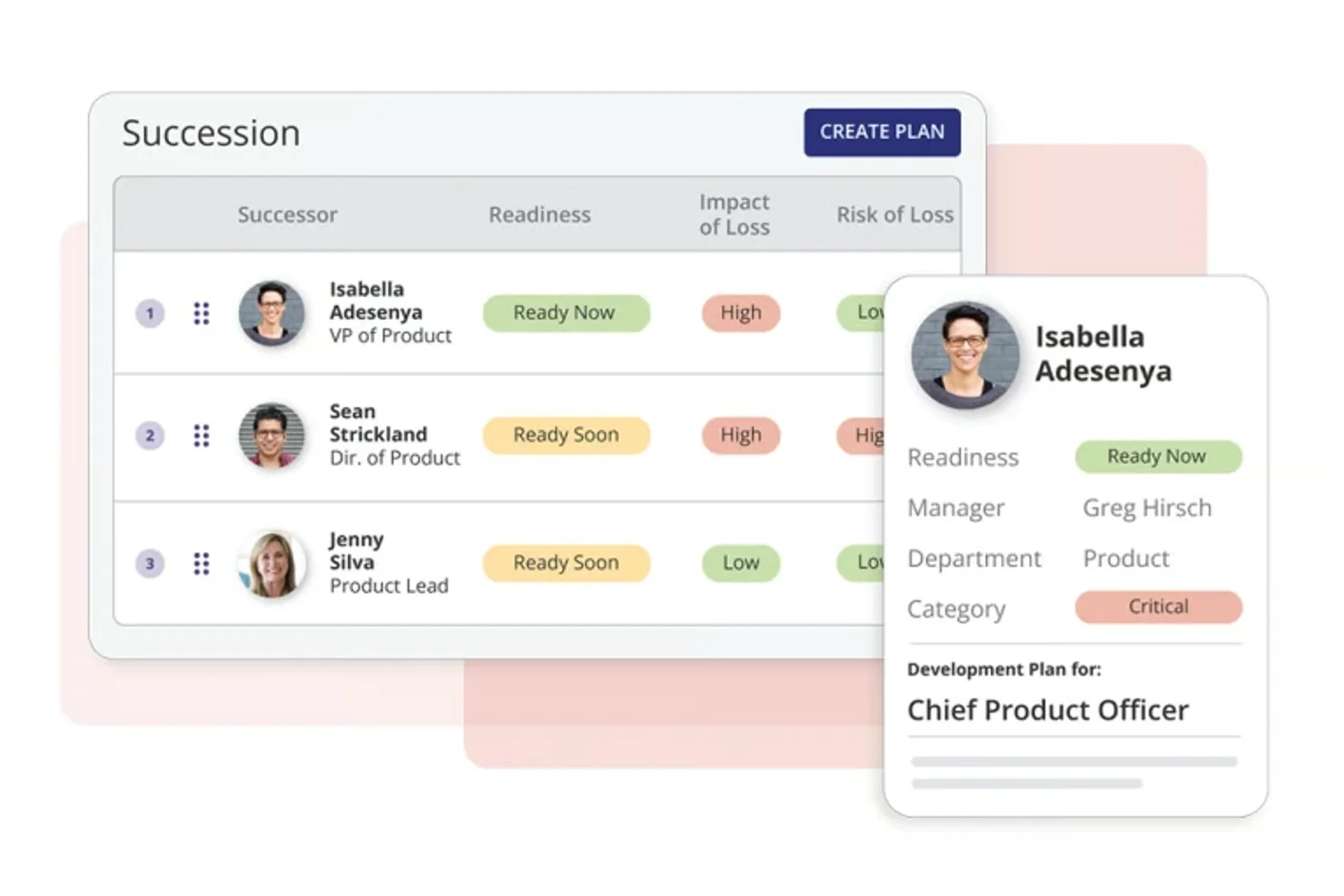
“Betterworks offers a modern interface for tracking goals, sharing feedback, and collaborating with others. Also I really appreciate the AI tools to enhance feedback texts, this is maybe my major advantage. In addition I never had issues with performance - the system seems to be stable and scalable.” – G2 reviewer
- Enterprise OKR infrastructure that goes beyond goal tracking: AI execution-risk detection, cascading alignment from company to individual, and a Manager Command Center that gives leadership real-time visibility into program execution
- Best-in-class calibration for large organizations: bias detection, distribution overlays, demographic filtering, and side-by-side comparisons in a workflow that makes calibration a data-driven exercise rather than a facilitated debate
- Production-tested bidirectional sync with Workday and SAP SuccessFactors, so calibrated performance data writes back to the system of record automatically and merit cycles start from current data rather than last year’s export
- Strong support quality: G2 reviewers rate quality of support at 9.1/5, which matters significantly for a platform with meaningful implementation complexity
- More consistent Microsoft Teams and Outlook integration than Lattice for organizations operating in Microsoft-first environments
Why Teams Choose Lattice
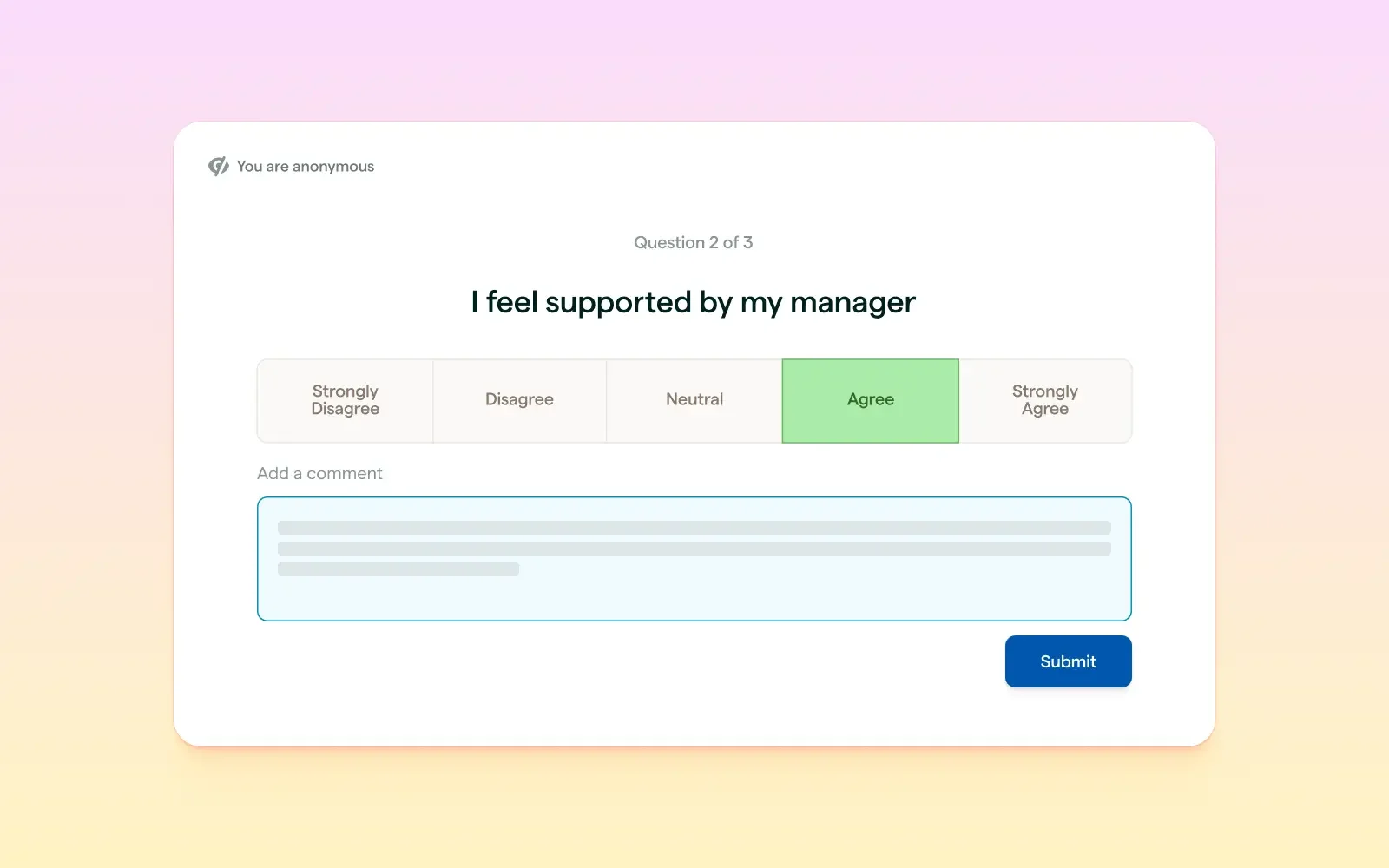
“I like how you can set goals and track them with ease. It is especially helpful when having one on ones with management or just for your own personal development.” – G2 reviewer
- Performance, engagement, and compensation in one system: the unified data model connects review outcomes to merit cycles and engagement trends without a separate integration or manual export step
- Published pricing lets HR teams build a budget estimate and get internal sign-off before any sales conversation, which is a practical procurement advantage Betterworks does not offer
- Mercer engagement benchmarking covering 64 countries and four benchmark tiers gives HR teams an external comparison baseline that most standalone survey tools do not provide
- Slack-native survey and recognition delivery results in meaningfully higher engagement program adoption for Slack-first organizations compared to email-based alternatives
- Self-serve onboarding and a faster path to deployment; a mid-market HR team can move from evaluation to live configuration without a structured implementation project
Which Tool Is Right For You?
Choose Betterworks If:
- Your organization has 500+ employees and OKRs are the operating framework, not one tool among many. The execution-risk AI and Manager Command Center are built for organizations that have committed to OKR methodology at scale, not those exploring it.
- You are already running Workday or SAP SuccessFactors and need performance data to write back to the system of record automatically, without a manual export step between systems.
- Calibration consistency across 20 or more managers is a documented HR credibility problem. Bias detection, distribution overlays, and demographic filtering are built for this specific challenge at enterprise scale.
- Your HR team has the bandwidth for a 2–4 month implementation. Betterworks delivers the most value to organizations with dedicated HR ops or HRIS administrators who can sustain the platform after go-live.
- Microsoft Teams and Outlook are the primary collaboration tools across the organization.
Choose Lattice If:
- Your team has 50–1,500 employees and you want performance, engagement, and compensation managed in one system rather than coordinated across separate tools.
- Compensation management is in scope. Lattice’s compensation module connects merit cycles and pay equity analysis directly to review data. Betterworks has no equivalent at any price.
- You need to build a budget estimate before engaging a vendor. Lattice’s published pricing makes that possible without a sales call.
- Slack is your primary collaboration tool. Slack-native survey delivery and recognition are the adoption model that makes engagement programs sustainable, not a convenience feature.
- You need to deploy in weeks rather than months. Lattice’s self-serve onboarding means a mid-market HR team can move from evaluation to live deployment without a structured implementation project.
Final Verdict
The choice between Betterworks and Lattice comes down to one question: are you buying an enterprise OKR and calibration platform, or a People Ops suite?
Betterworks is the right call for large enterprises where OKRs are the operating model, Workday or SAP is the HRIS of record, and calibration consistency across many managers is the HR team’s primary challenge. Its AI execution-risk detection and calibration infrastructure are not replicated at the same depth in Lattice. The implementation investment is real, but organizations that can absorb it get infrastructure Lattice does not offer.
Lattice is the right call for mid-market People Ops teams that want breadth, published pricing, and a faster path to deployment. If compensation management is in scope, the comparison is settled before it starts. If engagement benchmarking, Slack-native adoption, and a self-serve onboarding model matter to your team, Lattice wins those dimensions without contest.
For buyers who have ruled out both, Lattice vs 15Five covers the closest mid-market alternatives.
Frequently Asked Questions
What is the main difference between Betterworks and Lattice?
The core difference is operating model and scale. Betterworks is built for large enterprises where OKRs are the operating system, with enterprise-grade calibration, AI execution-risk detection, and deep HRIS integration. Lattice is built for mid-market People Ops teams that want performance, engagement, and compensation in one self-serve platform with published pricing.
Is Lattice or Betterworks more affordable?
Lattice is more transparent on price. The Foundations bundle runs $11/seat/month with a $4,000 annual minimum, making it possible to estimate a full-year cost without a sales conversation. Betterworks is quote-only. Vendr’s anonymized contract data puts the median at $56,400/year, with a per-employee rate of $6–$18/month depending on configuration and negotiated terms.
Is Lattice sunsetting its HRIS module?
Yes. Lattice announced the HRIS module sunset for July 2026. The compensation module is not affected and remains available as an add-on. Organizations evaluating Lattice for the HRIS layer should confirm the current product direction with Lattice directly before signing.
Can Betterworks replace Lattice, or vice versa?
For organizations that need compensation management, Betterworks cannot replace Lattice at any price. For enterprises at 1,000+ employees running Workday and treating OKRs as the operating model, Lattice is not a like-for-like replacement for Betterworks’ calibration depth and execution-risk AI. The two platforms serve meaningfully different organizational profiles.
Which is better for a mid-market team?
Lattice, in most cases. Its published pricing, self-serve onboarding, compensation module, and Slack-native engagement tools are better calibrated to the 50–500 employee range than Betterworks’ enterprise-first model. Betterworks becomes the stronger fit once an organization has committed to OKR methodology at scale and has the HR ops infrastructure to support a 2–4 month implementation.