.svg)
If you've reached the point of comparing Workday and SAP SuccessFactors head to head, you already know both platforms are Gartner Magic Quadrant Leaders for Cloud HCM Suites for 1,000+ Employee Enterprises. You've likely sat through vendor demos, reviewed analyst reports, and fielded proposals from Deloitte or Accenture. What you probably haven't found yet is a straightforward, vendor-neutral take on which one actually fits your organization's situation.
Neither platform is universally the better choice. The decision comes down to four specific factors: whether your organization runs SAP S/4HANA for ERP, the depth of global payroll localization you need, whether HR or IT is leading the procurement, and whether core HR and payroll or talent management is your primary investment driver. Get clear on those four, and this comparison will do the rest of the work.
Workday Overview
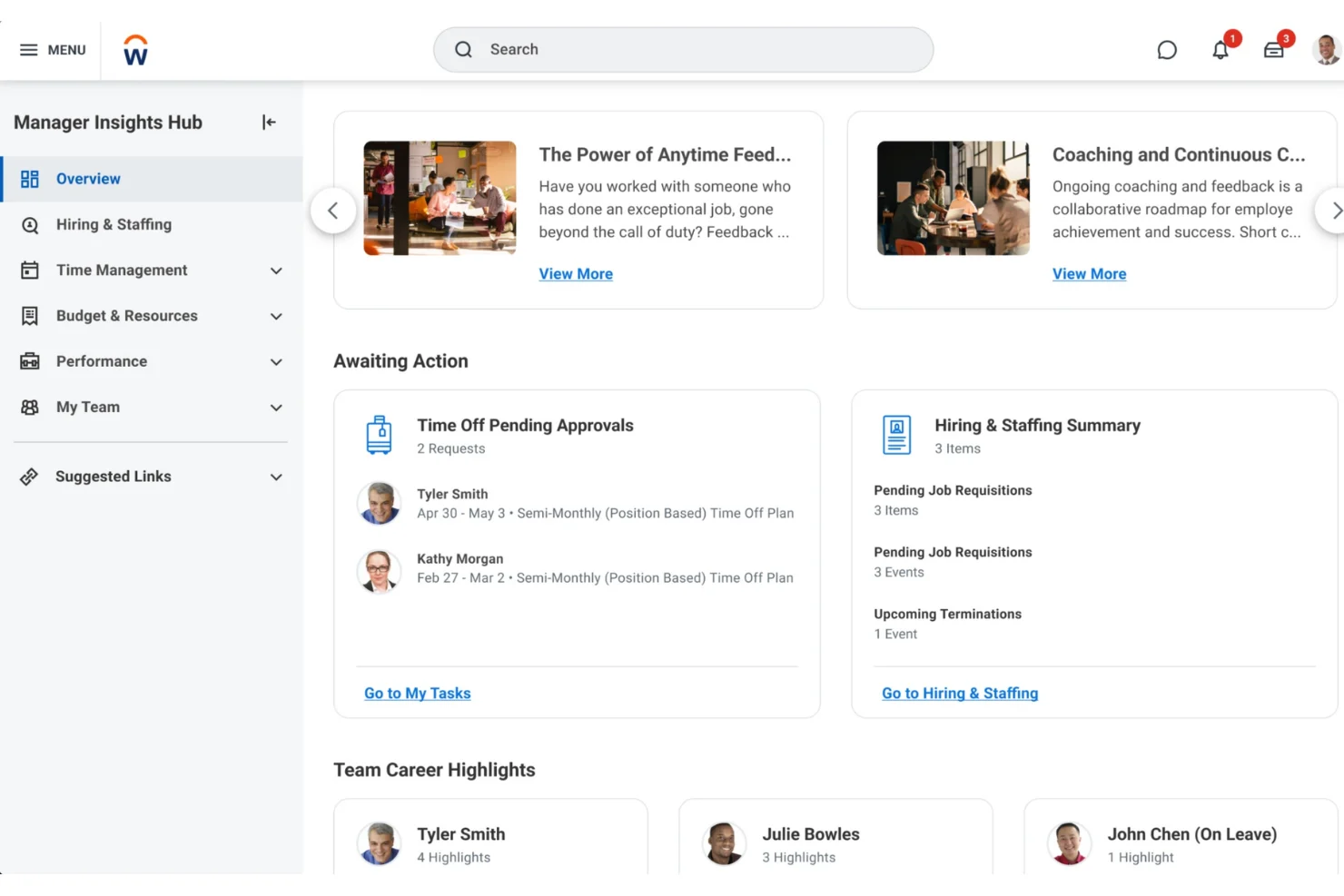
Workday launched in 2005, founded by former PeopleSoft executives who wanted to rebuild enterprise HR natively in the cloud rather than lift-and-shift an on-premise model. The platform has since expanded into financial management, planning, and analytics, but human capital management remains its center of gravity.
What Workday is built around is a single unified data model. HR, payroll, talent, and finance data live in the same system without middleware or custom integration layers holding them together. That architecture makes reporting cleaner, real-time analytics more reliable, and cross-functional workflows easier to maintain. It's also why Workday tends to do well in HR-led evaluations: the platform is designed so that an HRIS team can configure and run it without constant IT intervention.
Workday operates natively on Microsoft Azure infrastructure and integrates with a wide range of third-party tools, though its payroll engine handles direct processing in the US, Canada, the UK, and France. Beyond those four countries, global payroll runs through certified third-party partners.
Key features
- Core HR: employee records, org management, benefits administration, and time tracking
- Payroll: native processing in the US, Canada, the UK, and France; certified partner integrations for 60+ additional countries
- Talent management: performance reviews, goal setting, succession planning, and career development
- Recruiting and onboarding via Workday Talent Acquisition
- Workforce analytics and reporting built on the same data model as core HR
- Workday Peakon Employee Voice for continuous engagement and sentiment data
- Workday AI (Illuminate and HiredScore) for predictive analytics and candidate scoring
- Workday Extend for custom application development within the platform
Pros
“Vendor management and candidate management help to manage the data for business leaders, as well as with self-work productivity.” - Capterra review
- Features high-quality AI integration and modern cloud-based architecture.
- Outperforms competitors through features and functionality.
- Provides robust security and easy configuration.
- Allows customization using Workday Extend.
- Offers modern reporting and analytics capabilities.
- Includes a great mobile experience.
- Provides a community portal for collaboration, sharing configurations, and accessing training.
Cons
“The one thing I dislike about Workday HCM is that it has pretty limited customization. It would be nice if they allowed you to customize the entirety of the website but unfortunately it limits you to what you can customize.” - G2 review
- Can be challenging to configure, particularly when setting up custom workflows.
- Reporting tasks can be time-consuming.
- Certain features lack intuitiveness, which can slow down the onboarding process for new users.
- Performance issues occur during high-traffic periods like payroll cutoffs or review cycles.
- Web interface experience is occasionally sluggish with frequent loading delays between modules.
SAP SuccessFactors Overview
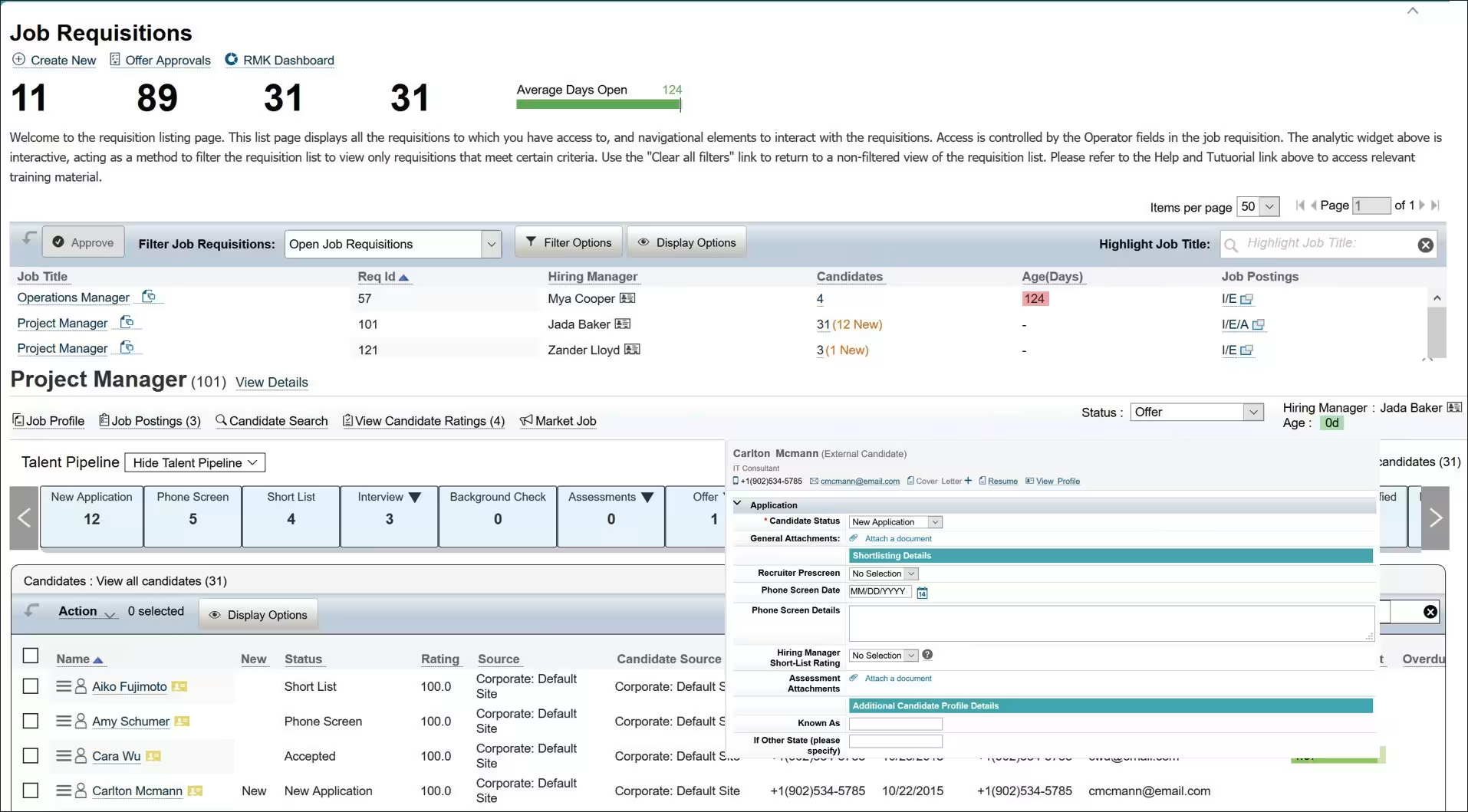
SAP SuccessFactors is the cloud HCM arm of SAP, the German enterprise software company that has been building ERP systems since 1972. SuccessFactors itself came into the SAP portfolio through an acquisition in 2012 and has been developed continuously since then as SAP's cloud-native HR offering. It is a distinct product from SAP HCM, which was SAP's legacy on-premise HR system.
Where SuccessFactors earns its place in enterprise shortlists is breadth. The suite covers the full employee lifecycle from recruitment through retirement, and it operates across more than 100 countries with localized payroll in 46 of them.
For organizations running SAP S/4HANA for finance and ERP, SuccessFactors integrates natively into the same data layer, reducing the integration build that would otherwise be required when connecting a third-party HCM platform to an SAP back end.
SAP embedded its Joule AI copilot across SuccessFactors modules in the second half of 2025, covering the majority of the platform's most-used tasks, per SAP's own documentation. The AI additions address some of the historical usability feedback, though the underlying configuration complexity of the platform has not changed.
Key features
- Employee Central: core HR, benefits, time off, and position management across 100+ countries
- Employee Central Payroll: localized payroll processing in 46 countries
- Recruiting and Onboarding modules
- Performance and Goals: OKR tracking, continuous feedback, and skills-based assessments
- Learning: a full learning management system with compliance training workflows
- Succession and Development: career pathing and talent pipeline planning
- Compensation management with benchmarking and equity analysis
- Workforce Analytics with SAP Joule AI integration
- Native integration with SAP S/4HANA and SAP ERP ecosystem
Pros
“What I like most about SAP SuccessFactors HCM is how it simplifies HR-related tasks by keeping everything in one place. Things like leave applications, attendance tracking, approvals, and accessing employee information feel much easier and more organized.” - G2 review
- Created a single source of truth for people data across global locations.
- Strengthened talent pipelines and accelerated HR cycles.
- Consolidated all core HR processes into one platform.
- Supports growth and scalability for international organizations.
- Provides reporting tools that deliver insights for data-driven decisions.
Cons
“Poor for an ease of use and easy to find what i need to do. It has potential but is frustrating. The formatting of objectives look v different on screen as you enter them to what they look like once entered. Needs more structure.” - Capterra review
- Can be complex to configure and less flexible for specific business needs.
- Reporting functionality is sometimes difficult to use.
- Requires significant effort for customization and driving user adoption.
- Initial setup is difficult and time-consuming.
- High costs for both software and service make it less accessible for smaller organizations.
- Extensive feature set necessitates specialized training for new users.
Pricing Comparison
Neither Workday nor SAP SuccessFactors publishes pricing. Both require a formal sales process, and actual contract values depend on employee headcount, modules selected, geography, contract length, and negotiation leverage. The figures below are third-party estimates and should be used for budgeting orientation only. Verify directly with each vendor before committing to a budget.
Workday HCM Pricing
Workday HCM is typically quoted at approximately $100-504 per employee annually at enterprise scale. Workday and its implementation partners typically charge approximately 100% to 150% of the annual software fees for implementation. A $500K annual subscription generally comes with a $500K implementation engagement.
Full-year total cost of ownership for a 5,000-employee deployment, including implementation, change management, and training, can reach $4.15M to $5.75M in year one, per third-party analysis of buyer data.
SAP SuccessFactors Pricing
SAP SuccessFactors uses a modular, per-employee-per-month pricing structure. Employee Central (core HR) is estimated at $8 to $12 PEPM. Organizations purchasing a full HCM suite of four or more modules typically pay $28 to $38 per employee per month for enterprises with over 1,000 employees. Implementation for enterprise deployments of the full suite runs $300,000 to $375,000 for a $300,000 annual purchase.
Feature Comparison
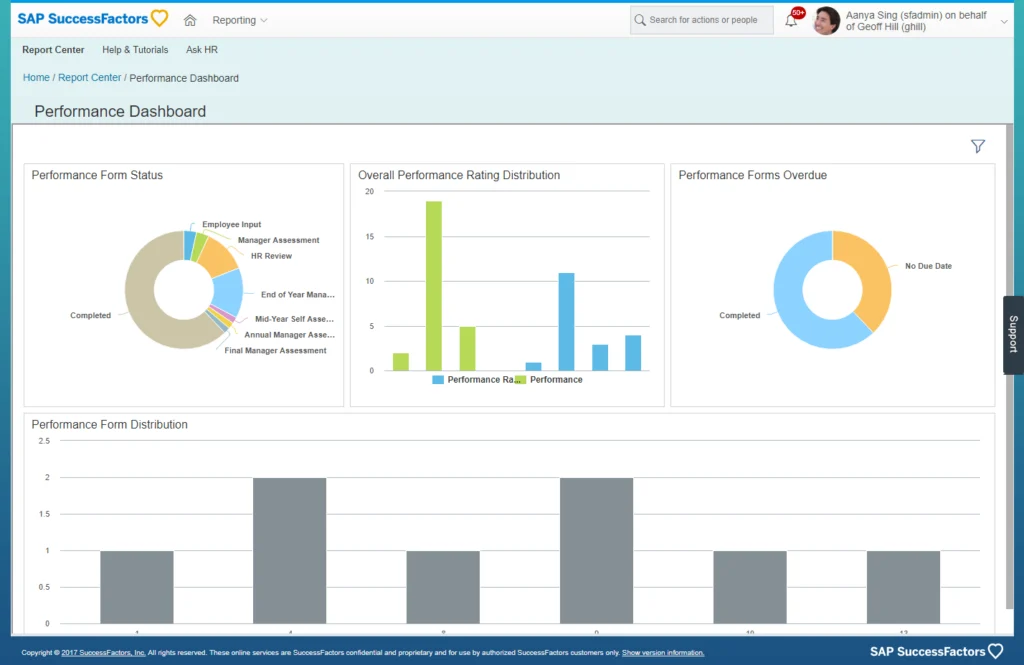
Selecting the right enterprise HCM platform requires balancing technical architecture against operational reality. The following comparison evaluates Workday and SAP SuccessFactors across the critical dimensions that define long-term platform success.
Core HR and Data Architecture
Workday utilizes a unified data model where HR, payroll, and finance live on a single layer. This ensures that changes surface immediately without middleware or sync cycles. Conversely, SAP SuccessFactors is modular; while integration is mature, it relies on connecting distinct modules.
However, for organizations already using SAP S/4HANA, SuccessFactors provides native ERP coherence that ties HR data directly to financial planning.
Verdict: Workday leads for non-SAP environments; SuccessFactors is the logical choice for SAP S/4HANA shops.
Global Payroll Coverage
Payroll localization is a primary differentiator for international enterprises. Workday offers native processing in four major markets (US, Canada, UK, and France) while relying on third-party partners for 60+ other countries. SAP SuccessFactors provides a deeper structural advantage, supporting localized payroll processing in 46 countries across Europe, Asia-Pacific, and Latin America.
Verdict: SAP SuccessFactors leads on global payroll depth and compliance.
Talent Management and Performance Tools
Both platforms offer comprehensive talent suites, including OKRs and succession planning. Workday excels at surfacing skill gaps and pipeline risks through AI that is tightly woven into its core analytics. SAP SuccessFactors counters with a highly intuitive "continuous feedback" interface and a Learning Management System (LMS) that is widely considered one of the most robust in the industry.
Verdict: Workday leads on talent-to-data integration; SuccessFactors leads for organizations prioritizing heavy L&D investment.
Analytics and Reporting
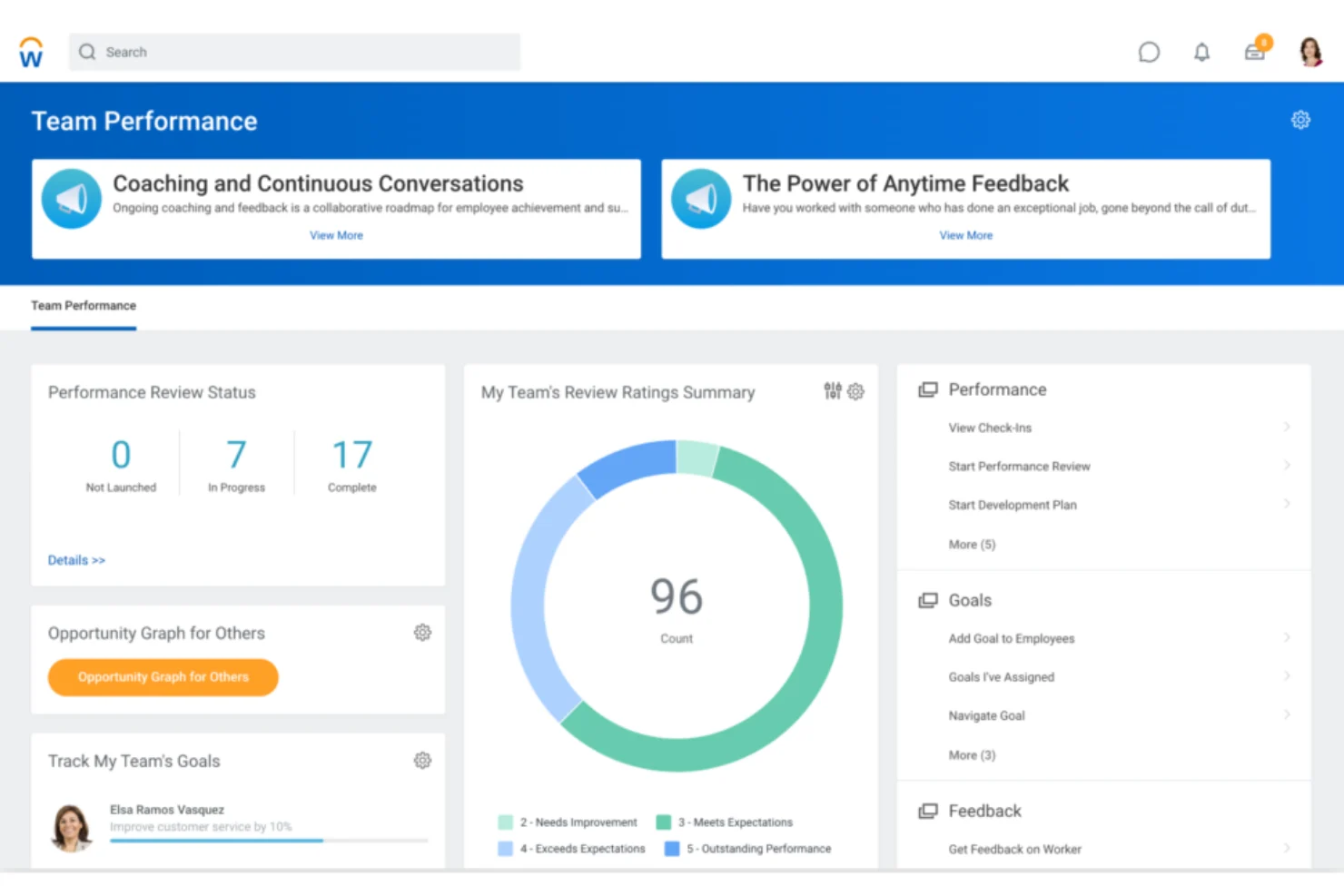
Workday’s reporting engine allows HR teams to build custom reports on live data without technical expertise. While SAP SuccessFactors offers sophisticated modeling through SAP Analytics Cloud, users often report a steeper learning curve and a greater need for dedicated technical resources to manage complex configurations.
Verdict: Workday leads on accessibility for HR administrators.
User Experience and Adoption
Workday consistently outpaces SuccessFactors in ease-of-use ratings, benefiting from a cloud-first design and a single codebase. While the introduction of the Joule AI assistant has significantly improved the SuccessFactors experience, its modular history occasionally results in inconsistent interface patterns compared to Workday’s seamless navigation
Verdict: Workday leads on user adoption and self-service accessibility.
SAP Ecosystem Integration
For organizations deeply embedded in the SAP ecosystem, SuccessFactors is the only platform providing native integration with S/4HANA without third-party builds. While Workday can connect via APIs, the resulting maintenance and integration overhead often make SuccessFactors the more efficient choice for CFOs and CIOs seeking a unified financial and HR back end.
Verdict: SAP SuccessFactors wins decisively for existing SAP environments.
Choose Workday If
- Your organization does not run SAP S/4HANA and has no near-term plans to adopt it
- HR is the primary owner of the procurement process and will be the primary system administrator post-implementation
- You need native payroll processing in the US, Canada, the UK, or France, or can work with Workday's certified global payroll partner network for additional markets
- Unified HR-finance reporting, where both data sets live in the same system, is a stated requirement from Finance or the CHRO
- Adoption rates and employee self-service usage are key success metrics for the HR technology investment
- Your organization is 1,000–25,000 employees with a dedicated HRIS team capable of managing ongoing configuration
Choose SAP SuccessFactors If
- Your organization runs SAP S/4HANA and IT is a co-owner or primary driver of the HCM selection
- You require localized payroll processing in more than 15 countries, particularly across continental Europe, Asia-Pacific, or Latin America
- Learning management is a top-three requirement alongside core HR and performance management
- You are consolidating from SAP HCM (on-premise) to a cloud HCM platform and need a supported migration path
- Your enterprise operates in 40+ countries and needs a single vendor to own both the HCM software and its multi-country compliance obligations
- Your procurement team has the capacity to manage a phased, modular rollout over 12–24 months
Final Verdict
The single most decisive differentiator in this comparison is SAP ecosystem dependency. For organizations running SAP S/4HANA, the native integration between SuccessFactors and SAP's ERP layer is a structural advantage that no amount of Workday's usability edge can fully offset. For organizations outside the SAP ecosystem, Workday's unified data model, stronger end-user experience (8.2 vs 7.7 on G2 ease of use), and HR-led configurability make it the more natural choice.
SAP SuccessFactors leads on global payroll coverage in 46 countries and learning management depth. Workday leads on reporting accessibility, user adoption, and architecture coherence for organizations not tied to SAP infrastructure.
Both hold a 4.4/5 rating on Gartner Peer Insights, and neither is a wrong answer at the enterprise scale. The question is which one fits the specific organizational conditions you're actually working with.
For a broader view of enterprise HR platforms, including alternatives worth considering if either of these clears the field, see our related resources:
- Best HR Software for Enterprises guide for a comprehensive review of high-scale platforms.
- Best HRIS Software guide for a detailed comparison of core systems of record across various business sizes.
- How to Choose HR Software guide for a framework for navigating the selection process.
.avif)