
.svg)
Most companies discover what an employer of record actually does the hard way: after a misfiled tax obligation in Germany, a contractor classification dispute in Brazil, or a six-figure legal entity setup they didn't need to build. EOR services exist to absorb that risk. The right provider acts as the legal employer for your international staff, handling payroll, benefits, tax filings, and local labor law compliance in countries where you have no registered entity of your own.
That is a different product from a PEO (Professional Employer Organization), which is a US-only co-employment model. It is also distinct from global payroll software, which processes payments but does not carry legal employer liability. If you're still sorting out which model actually fits your situation, knowing the difference between PEO vs EOR helps you in more depth. If you are hiring outside the US without a local entity, you need an EOR, not a PEO and not a payroll tool.
Setting up a legal entity in a new country costs between $25,000 and $100,000 and takes three to six months. For companies hiring one to ten people in a new market, that calculus rarely makes sense. The EOR model gives you compliant employment in days, not quarters, for a fraction of that cost.
The data backs this shift. The global EOR market reached $6.82 billion in 2025 and is growing at 9.24% annually. This growth is driven by necessity: 86% of HR leaders identify international labor law compliance as their biggest challenge. The demand is real, the stakes are high, and the provider you choose carries significant financial and legal consequences.
This list covers the 10 best employer of record companies available in 2026, evaluated on operating model, country coverage depth, pricing transparency, compliance track record, and support quality.
What to Look for in an Employer of Record
Before you start scheduling demos, get clear on the criteria that actually separate a reliable EOR provider from an expensive disappointment.
1. Operating Model: Owned Entity vs. Partner Network
This is the most consequential decision in EOR selection, and most buyers do not ask about it until something goes wrong. Owned-entity providers, including Deel, Remote, and Globalization Partners, employ their workers directly through their own legal entities in each country.
They bear compliance liability themselves. Partner-network providers, including Rippling, Papaya Global, and Multiplier, work through local third-party employers. Service quality and compliance depth vary country by country depending on who that partner is.
2. Country Coverage in Your Target Markets
A headline like "170+ countries" tells you almost nothing on its own. What matters is whether the provider has an owned entity or a quality partner in the specific countries where you plan to hire. A provider with owned entities in Germany, India, and Brazil is materially different from one relying on local partners in all three. Verify the operating model per country before shortlisting.
3. Pricing Transparency and Total Cost
EOR pricing generally falls between $199 and $1,000+ per employee per month. Some providers publish their rates openly; others require a sales call to get a number. Beyond the base rate, watch for salary deposit requirements, currency conversion margins, statutory benefits markups, and termination fees. The published per-employee rate often understates the real cost of the relationship.
4. Compliance Depth and Support Quality
The whole point of an EOR is compliance risk transfer. The questions worth asking before you sign: How quickly does the provider respond to local law changes? Are the labor law experts on their team in-house employees or third-party contractors? What happens when a local authority challenges the employment arrangement? Eighty-six percent of HR leaders say international compliance is their biggest headache.
The provider's ability to handle the edge cases that never show up in a sales demo matters more than the clean flow of the onboarding walkthrough.
5. Onboarding Speed and Employee Experience
Onboarding timelines vary from five to seven business days with providers like Multiplier and RemoFirst to four to six weeks in complex jurisdictions with partner-network providers. In competitive talent markets, a slow onboarding process loses candidates.
Evaluate the employee-side experience too: contract clarity, local-language support, benefits packaging, and payroll accuracy. The EOR's process is the first operational impression your new hire gets of your company.
How We Evaluated Each EOR Provider
Every platform in this article was assessed against the same five criteria. The ranking reflects performance for each tool's target buyer, not a single universal verdict. A provider ranked lower may still be the right choice for a specific country footprint, budget level, or organizational size.
1. Operating Model and Compliance Liability
The structural foundation of an EOR determines your ultimate legal risk. We evaluated whether a provider uses an owned-entity model (wholly owning the local corporate structures) or an aggregator/partner-network model (subcontracting to local firms).
Owned-entity providers earned higher marks for consistency, direct communication, and centralized liability. For aggregator networks, we looked past basic country counts to evaluate the longevity, depth, and legal strength of their third-party relationships.
2. User Satisfaction and Market Sentiment
We analyzed verified user reviews across major software evaluation platforms, including G2 and Capterra. Rather than looking solely at raw averages, our scoring heavily weights review volume and consistency over time. For instance, a 4.6 out of 5 score backed by 3,000 detailed customer reviews provides a much stronger signal of long-term operational stability than a 4.9 out of 5 based on only 50 responses.
3. Pricing Transparency
Hidden fees and unpredictable invoices are common pain points in global employment. We rewarded providers that maintain clear, published, and scannable pricing structures. In an industry where per-employee costs can easily reach $1,000 per month, extreme opacity or a refusal to provide baseline figures without a high-pressure sales call was treated as a notable editorial red flag.
4. Core Country Coverage Depth
While a massive total country count looks impressive on a marketing brochure, true operational capability matters most in high-demand hubs. We specifically evaluated how each EOR performs in the most heavily utilized international hiring markets: the US, UK, Germany, India, Brazil, Canada, Australia, Singapore, the Netherlands, and Spain. Total global reach was treated as a secondary metric to actual operational depth in these regions.
5. Support Quality and Onboarding Speed
When a localized payroll issue or compliance emergency arises, delayed responses can trigger immediate financial penalties. We examined documented onboarding timelines and support escalation paths. Platforms that provide in-house, dedicated local HR experts scored significantly higher than those that route frontline compliance questions through generic, third-party customer service agencies.
The 10 Best EOR Services in 2026
Evaluating the right global employment partner requires looking past marketing claims to examine their actual legal infrastructure, liability handling, and platform capability. The following profiles break down how the industry's leading platforms handle cross-border hiring, pricing structures, and workforce management.
1. Deel
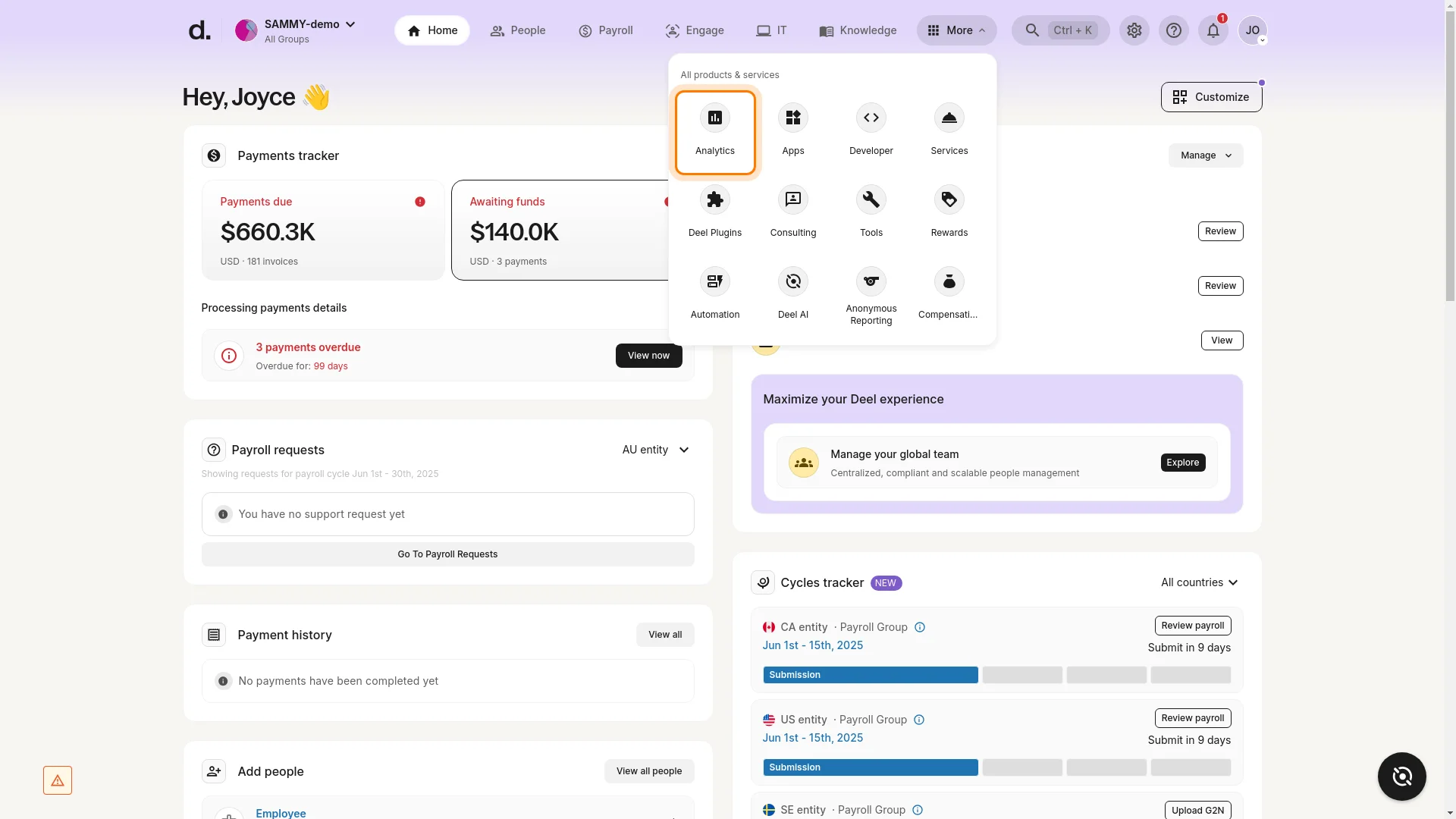
Deel holds the top position in this list for the same reasons it holds the top position on G2 across three categories: Employer of Record, Global Employment, and Multi-Country Payroll.
With over 37,000 customers and a hybrid operating model combining owned entities in major markets with a partner network for long-tail countries, Deel covers more ground than any single owned-entity provider and delivers faster onboarding than most enterprise competitors.
The platform bundles EOR with contractor management, global payroll, and equity management in one interface. That scope makes it attractive to companies moving from ad hoc international hiring to a structured global workforce strategy.
Key Features
- Hybrid operating model: owned entities in major markets, partner network for 150+ countries total
- 24/7 chat support with compliance specialists
- Onboarding in days for most markets; full onboarding workflow managed inside the platform
- Bundled contractor-to-employee conversion within the same platform
- Integrated equity and stock option management for international employees
- Automated local tax filings and benefits administration
- G2: #1 ranked in Employer of Record, Global Employment, and Multi-Country Payroll (May 2026)
Pros and Cons
Pros: "This a great product to keep all your contracts in one place. Very easy to use and to update information. Good layout of the app and the website.” - Capterra reviewer
- Breadth of country coverage is unmatched in a single platform, combining owned-entity depth in key markets with partner-network reach in the rest
- Onboarding speed and 24/7 support make it competitive for companies hiring in fast-moving talent markets
- Platform consolidation (EOR, payroll, contractor management, equity) reduces vendor count for scaling teams
Cons: "I think the tracking can be improved as well. Like, if the client already paid and you're just verifying it on the side of Deel, so it shows the accountability as well for the side of my client or Deel. This way, I know who I will ask." - G2 reviewer
- Hybrid model means compliance depth and service quality vary by country; verify the operating model for your target markets
- Tiered support escalation can slow resolution of complex compliance disputes
- Pricing is higher than budget providers like RemoFirst and Multiplier
Pricing
Deel provides monthly per-worker pricing across three primary global deployment models: Employee of Record (EOR) starting at $599 ($899 for enterprise), US PEO co-employment at $125, and Contractor Management starting at $49 ($325 for full compliance protection). Scalable modular add-ons are available for recruitment sourcing, applicant tracking, and background screening.
2. Remote
Remote operates on a 100% owned-entity model in 80+ countries, the largest fully owned footprint in the EOR category. Every worker employed through Remote is employed by a Remote-owned legal entity. No third-party local employers sit in the middle of the compliance relationship.
That structure matters most to organizations where compliance liability concentration is non-negotiable: regulated industries, companies with legal or financial exposure in complex jurisdictions, and HR teams that want a single accountable counterparty. Remote's in-house labor law experts are employees of Remote, not contractors or local agency staff.
Key Features
- 100% owned-entity model in 80+ countries; no partner network employment
- In-house local labor law experts, employed directly by Remote
- Transparent flat-rate pricing at $599/employee/month with no hidden fees
- Particularly strong in compliance-heavy markets including Germany, Brazil, and the Netherlands
- Equity management and stock option administration for international employees
- Automated benefits enrollment with locally compliant packages
Pros and Cons
Pros: "Remote allowed us to reach talent in countries that we otherwise couldn't employ in. We could safely employ across Europe without fear of local nuances in employment and tax law." - Capterra reviewer
- Fully owned-entity model delivers the highest compliance liability concentration available in the category
- Flat-rate pricing makes total cost predictable and comparable across markets
- In-house experts mean escalated compliance questions reach people with direct accountability
Cons: "Had a bit of a problem with downloading my salary slips at first but that was quickly resolved after I reached out support it was smooth sailing from there getting a problem fixed or taken care of is a breeze" - G2 reviewer
- Country coverage of 80+ is smaller than Deel's hybrid reach; for long-tail markets, this may be a constraint
- Flat-rate pricing may cost more than partner-network alternatives in simpler, lower-risk jurisdictions
- Brand recognition is strongest in HR and tech circles; less established in non-tech enterprise procurement
Pricing
Remote offers tiered monthly, per-worker pricing across three operational categories: Global Hiring via Employer of Record ($699) or US PEO ($99+); centralized international Payroll ($29); and Contractor Management starting at $29 ($99 for compliance indemnity, $325 for full Contractor of Record protection). Compliance-backed equity tracking can be added from $39 monthly.
3. Rippling
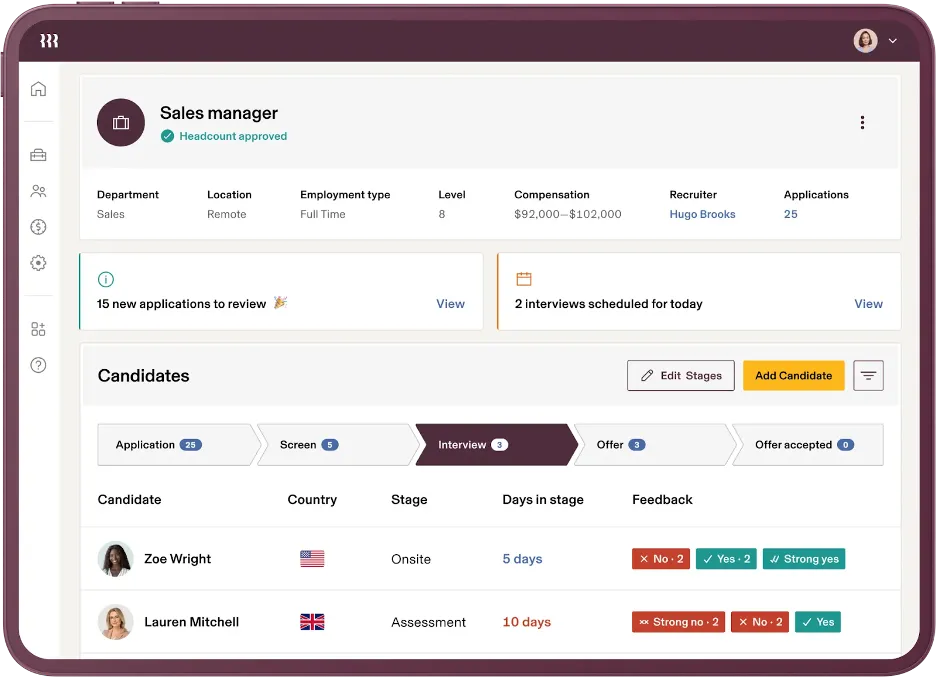
Rippling's EOR capability is a module inside a broader HR, IT, and finance platform rather than a standalone EOR product. For organizations already running HR, device management, and finance on Rippling, adding international employment inside the same system is operationally simpler than bringing in a separate EOR vendor.
The platform runs on a partner network model, which means compliance depth and service quality depend on the local fulfillment partner in each country. That is a meaningful consideration for organizations hiring in complex or high-risk jurisdictions. Rippling's primary EOR advantage is data unification, not compliance depth.
Key Features
- EOR module integrated with Rippling's HR, IT, and finance suite
- Partner network model covering international markets
- 90-second payroll runs for existing Rippling customers with unified data
- Automated benefits administration synced to the core HR platform
- Unified onboarding workflow covering device provisioning, app access, and employment setup in one flow
- Reporting across HR, payroll, and finance without manual data transfer
Pros and Cons
Pros: "I like the fact that Rippling combines HR, Payroll, Employee Management and Finance tools in one place.” - Capterra reviewer
- Platform unification is the strongest argument for Rippling EOR: no separate system, no data reconciliation, no additional login
- 90-second payroll runs are a genuine operational advantage for teams managing multi-country payroll at scale
- Existing Rippling customers face near-zero additional onboarding overhead to activate the EOR module
Cons: "Sometimes UI shows loading indicator for frequent visiting pages." - G2 reviewer
- Partner network model means compliance liability sits with local fulfillment partners, not Rippling directly; quality varies by country
- Primarily valuable for existing Rippling customers; companies not on the broader platform gain limited advantage over purpose-built EOR providers
- Complex cross-border compliance issues escalate to local partners rather than a Rippling in-house team
Pricing
Rippling utilizes a custom-quoted, modular pricing structure based on headcount. Businesses can pick and choose tools across three operational pillars: HCM (global payroll, benefits, and performance), IT Cloud (device management and app provisioning), and Spend Management (corporate cards, expenses, and bill pay).
4. Papaya Global
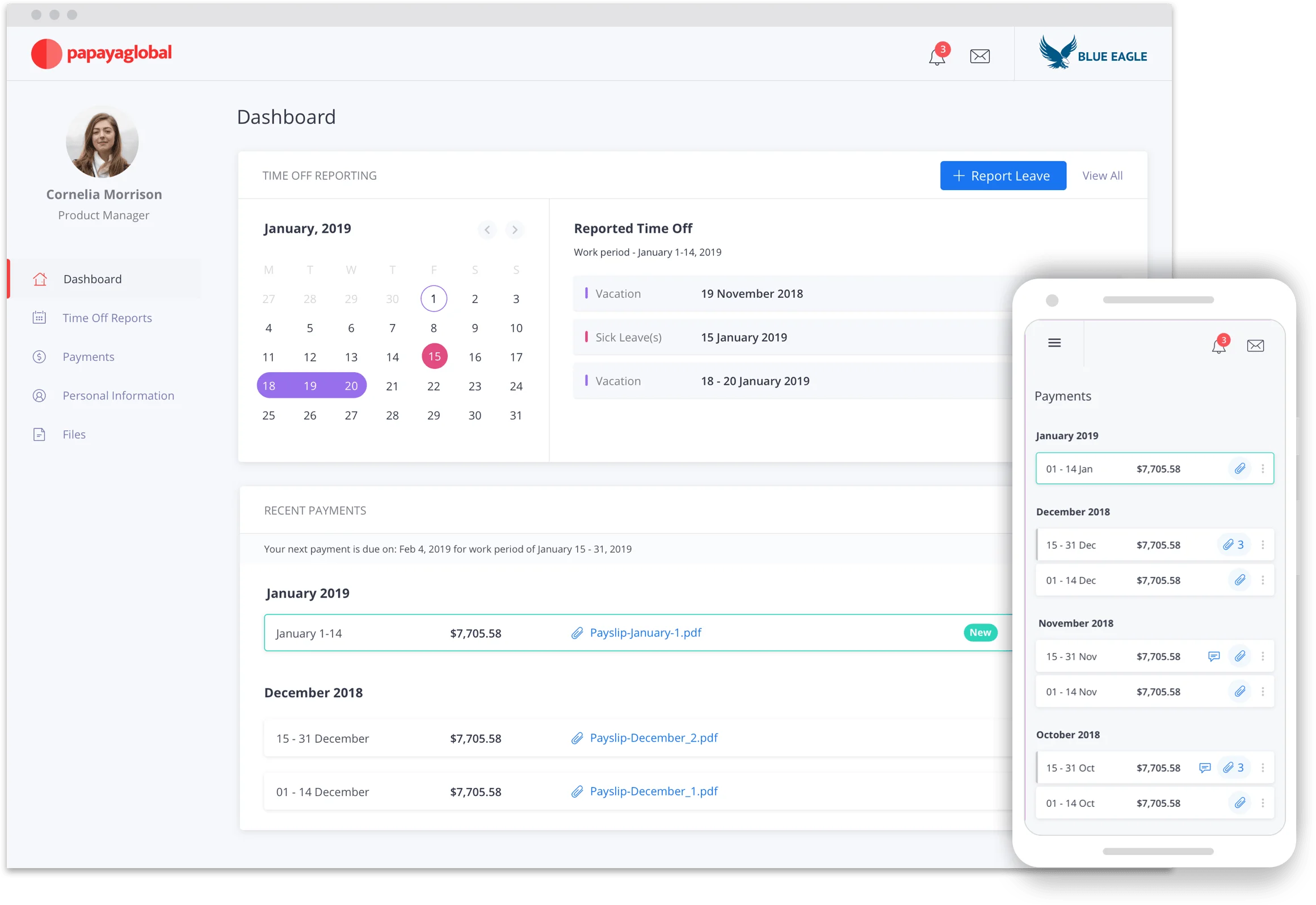
Papaya Global is positioned squarely at the enterprise end of the EOR market. The platform combines partner-network EOR with AI-driven payroll workflows, advanced compliance analytics, and a dedicated "center of excellence" model that assigns specialist teams to large accounts.
For organizations with 500+ international employees and multi-country payroll complexity, the analytics and oversight layer is genuinely differentiated. The trade-off is price and overhead. Papaya Global is among the most expensive options in this list, and its feature depth is unnecessary for companies hiring their first few international employees.
Key Features
- Partner network model with strong central compliance oversight
- AI-driven payroll workflows with automated anomaly detection
- Dedicated center-of-excellence model for enterprise accounts
- Advanced payroll analytics and compliance reporting dashboard
- Multi-currency payroll processing with central visibility
- Integration with major HRIS platforms including Workday and SAP
Pros and Cons
Pros: "Minimalist and easy-to-use UI. Also really like the ability to manage global payroll across multiple countries from a single platform.” - Capterra reviewer
- Analytics and compliance reporting depth exceed most competitors in this category
- Center-of-excellence model gives large enterprises a dedicated specialist team rather than shared support queues
- Clean UI is noted consistently across G2 and Capterra reviews
Cons: "Assistance with certain legal issues may sometimes lack precision and may require several follow-ups to obtain adequate answers.” - G2 reviewer
- Partner network model in long-tail markets means compliance depth depends on local partner quality
- Premium pricing at $699/employee/month positions this firmly out of reach for SMBs and early-stage companies
- Feature complexity is over-engineered for organizations under 200 employees
Pricing
Papaya Global provides transparent, per-worker monthly pricing starting at $499 for Employer of Record (EOR), $295 for Contractor of Record (COR), $29 for Payroll Plus, and $5 for basic Contractor Management. Custom quotes are available for full operational platform suites, and all plans include Payments OS infrastructure at $3.50 per transaction.
5. Globalization Partners (G-P)
.webp)
Globalization Partners founded the modern EOR category in 2012 and built its reputation on 100% owned-entity coverage. The company employs international workers through its own legal entities, bearing compliance liability directly in every market it serves.
For organizations operating in regulated sectors such as financial services, healthcare, and defense, G-P's combination of operating history and entity depth carries weight that newer entrants cannot replicate.
The platform is not designed for budget-conscious SMBs. Pricing is custom and enterprise-calibrated. Implementation timelines are longer than newer competitors. The trade-off is a compliance pedigree that matters in high-risk markets.
Key Features
- 100% owned-entity model; founded 2012, the longest operating history in EOR
- Particular depth in regulated jurisdictions: financial services, healthcare, defense contracting
- Custom enterprise pricing with dedicated account management
- Compliance documentation and audit support built into the platform
- Integrated IP protection and indemnification frameworks
- Multi-country workforce visibility dashboard
Pros and Cons
Pros: "I like that I can view all my documents in one table. After I filled in all my details, they were reviewed quite quickly. The support agent notified me promptly about the ways to sign my contract and answered all my questions very nicely.” - G2 reviewer
- Owned-entity model in every country means compliance liability sits entirely with G-P, not a local third party
- Operating history since 2012 provides a compliance track record that newer platforms lack
- Regulated-industry depth is stronger than any other provider on this list
Cons: "No fixed contact person, no possibility to contact us by phone, complicated and time-consuming billing system, no contact person who speaks German.” - Capterra reviewer
- Custom-only pricing makes early budget planning difficult; no public rate to benchmark against
- Billing complexity and lack of dedicated contact points are recurring themes in negative reviews
- UX trails younger platforms; interface has not kept pace with the product's compliance capabilities
Pricing
G-P offers annual per-seat pricing for its AI compliance agent across 50 countries and all 50 US states: Individual at $450/month ($5,400/year) and Teams at $500/month ($6,000/year, 2–9 seats) with shared knowledge capabilities. A custom-priced Enterprise tier adds SSO, audit logs, and dedicated support.
6. Multiplier
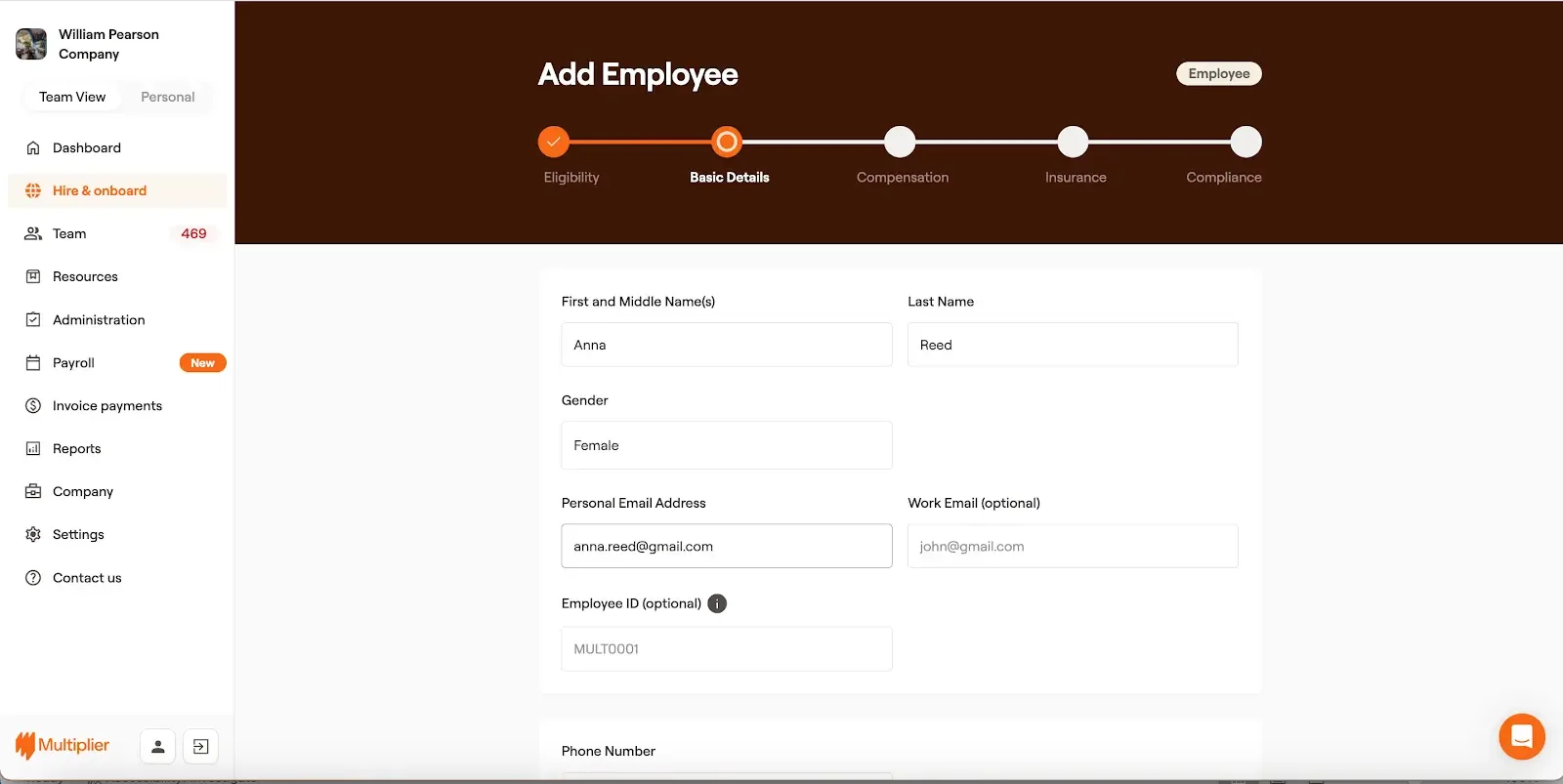
Multiplier competes on pricing predictability and onboarding speed. The platform uses a partner network model across 150+ countries with flat-rate pricing that removes the guesswork from budget planning. Onboarding runs five to seven business days in most markets, and the mobile-first employee experience is consistently rated well by users.
The partner network structure means compliance depth varies by country. For SMBs and mid-market companies prioritizing cost clarity over compliance concentration, Multiplier is a practical option. Organizations in regulated industries or complex jurisdictions should verify local partner quality before committing.
Key Features
- Partner network model across 150+ countries
- Flat-rate pricing with no hidden fees
- Onboarding in five to seven business days in standard markets
- Multi-currency payroll with automated local tax handling
- Mobile-first employee self-service portal
- Integrated contractor and full-time employee management
Pros and cons
Pros: "The platform is straightforward, onboarding is smooth, and the support team is generally responsive and helpful when dealing with cross-border hiring, payroll, compliance, and documentation." - G2 reviewer
- Flat-rate pricing model removes the per-country cost variability that complicates budget forecasting on other platforms
- Fast onboarding makes it competitive for companies moving quickly in talent-competitive markets
- Mobile-first design is rated more highly than most EOR platforms in its price range
Cons: "The worst EOR platform! No empathy and urgency on their mistakes especially on their lapses on releasing our pay check." - Capterra reviewer
- Partner network model means compliance depth and service quality vary significantly by country
- Negative reviews about payroll delays and dispute resolution are more frequent than owned-entity competitors
- Less mature enterprise feature set than Papaya Global or Globalization Partners
Pricing
The platform provides transparent, per-worker monthly pricing starting at $400 for Employer of Record (EOR) hiring and $40 for international contractor management. Custom team plans are available via sales for centralized multi-country payroll management and global visa or immigration processing.
7. Oyster HR
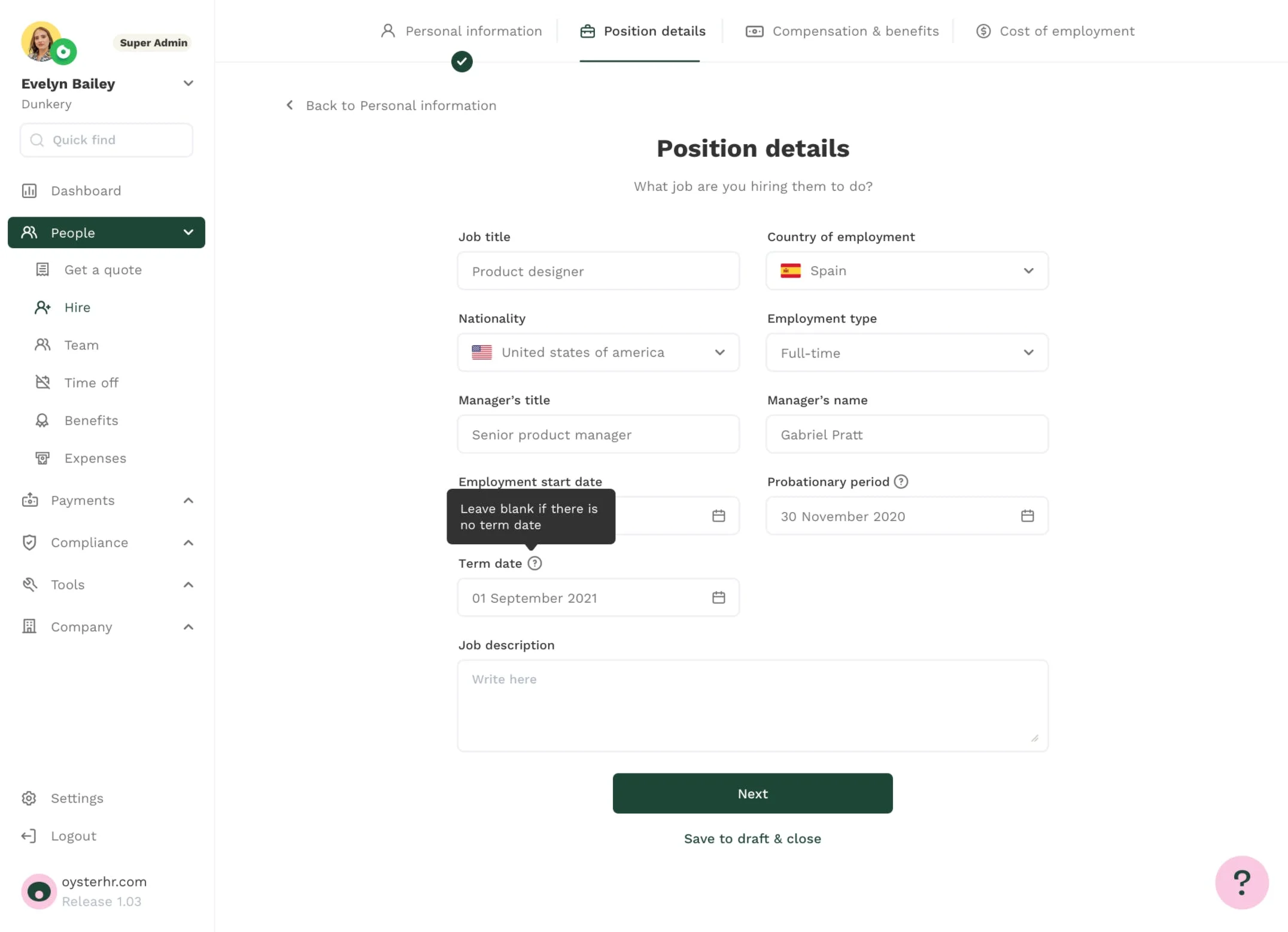
Oyster HR operates on a hybrid model, combining owned entities in selected markets with a partner network elsewhere. The platform built its following among remote-first technology companies, and its G2 rating reflects consistent satisfaction among engineering teams hiring global talent. The UX and onboarding workflow are among the more polished in the category.
Oyster sits above budget providers but below the enterprise pricing tier. It is a reasonable fit for 50 to 500 person remote first companies that want a clean employee experience without the overhead of enterprise-level configuration.
Key Features
- Hybrid model: owned entities in core markets, partner network elsewhere
- Onboarding workflow with contract generation, benefits enrollment, and compliance review in one flow
- Strong employee-facing portal with benefits transparency
- Equity support including stock options and share plans for international employees
- Time-off tracking and expense management integrated
- G2: 4.5/5 (May 2026)
Pros and Cons
Pros: "Transparent communication, trustful relationships, fast responses from Oyster Support Team. Outstanding support form the account managers." - Capterra reviewer
- Account manager support quality is cited consistently across positive reviews
- UX is cleaner than most EOR platforms in the mid-market price range
- Strong in technology and engineering hiring contexts
Cons: "Downsides is the fee they charge for using their services, it is quite high in my opinion but worth paying to achieve my goal of remote working." - G2 reviewer
- Country coverage is smaller than Deel or Remote, which may be a constraint for companies with broad geographic footprints
- Less enterprise feature depth than Papaya Global or G-P for organizations above 500 employees
- $499/employee/month is above budget-tier providers for organizations where cost is the primary filter
Pricing
Oyster offers per-worker monthly pricing starting at $699 for global Employer of Record (EOR) services, $114 for US PEO co-employment, and $29 for international contractor management. Additionally, organizations can access specialized on-demand HR advisory support through People Partner Services starting at $300 per hour.
8. Pebl (formerly Velocity Global)
.webp)
Pebl (formerly Velocity Global) covers 185+ countries using a hybrid model of owned entities in core markets and a partner network for long-tail coverage. What sets it apart is the bundled talent sourcing capability: organizations can use Velocity Global to find, hire, and employ international staff inside the same platform.
For mid-market and enterprise buyers who want hiring infrastructure alongside employment infrastructure, that combination reduces vendor count. The platform's enterprise focus and risk management framework make it less suited to early-stage companies or budget-driven hiring.
Key Features
- Hybrid model: 185+ countries with owned entities in core markets
- Bundled talent sourcing alongside EOR services
- Risk management framework with compliance and indemnification coverage
- Dedicated account management for enterprise clients
- Workforce management and reporting across multi-country employment
- Integration with major HRIS and ATS platforms
Pros and Cons
Pros: "It's a very simple and efficient tool. an excellent application for organizing and maintaining optimized business processes. I like that it's very intuitive and easy to use. Furthermore, it allows you to easily make and record changes." - G2 reviewer
- Talent sourcing bundled with employment infrastructure differentiates Velocity Global from pure-play EOR providers
- Risk management framework carries weight for enterprise procurement and legal review
- Intuitive interface noted across multiple G2 reviews
Cons: "Honestly my experience has been smooth, but if I had to nitpick: the login process can be a bit slow at times, and the dashboard occasionally takes longer to load.” - G2 reviewer
- Custom pricing only; no published rate to benchmark, which complicates early-stage budget planning
- Talent sourcing bundle adds value only for organizations that want help finding candidates, not just employing them
- Less brand recognition in mid-market than Deel or Globalization Partners
Pricing
Pebl provides AI-powered Employer of Record (EOR) services starting at $399 per employee monthly, alongside custom enterprise quotes. The platform enables businesses to compliantly hire, onboard, and pay workers across over 185 countries within 48 hours, featuring localized payroll, expense tracking, and regulatory indemnity protection.
9. RemoFirst
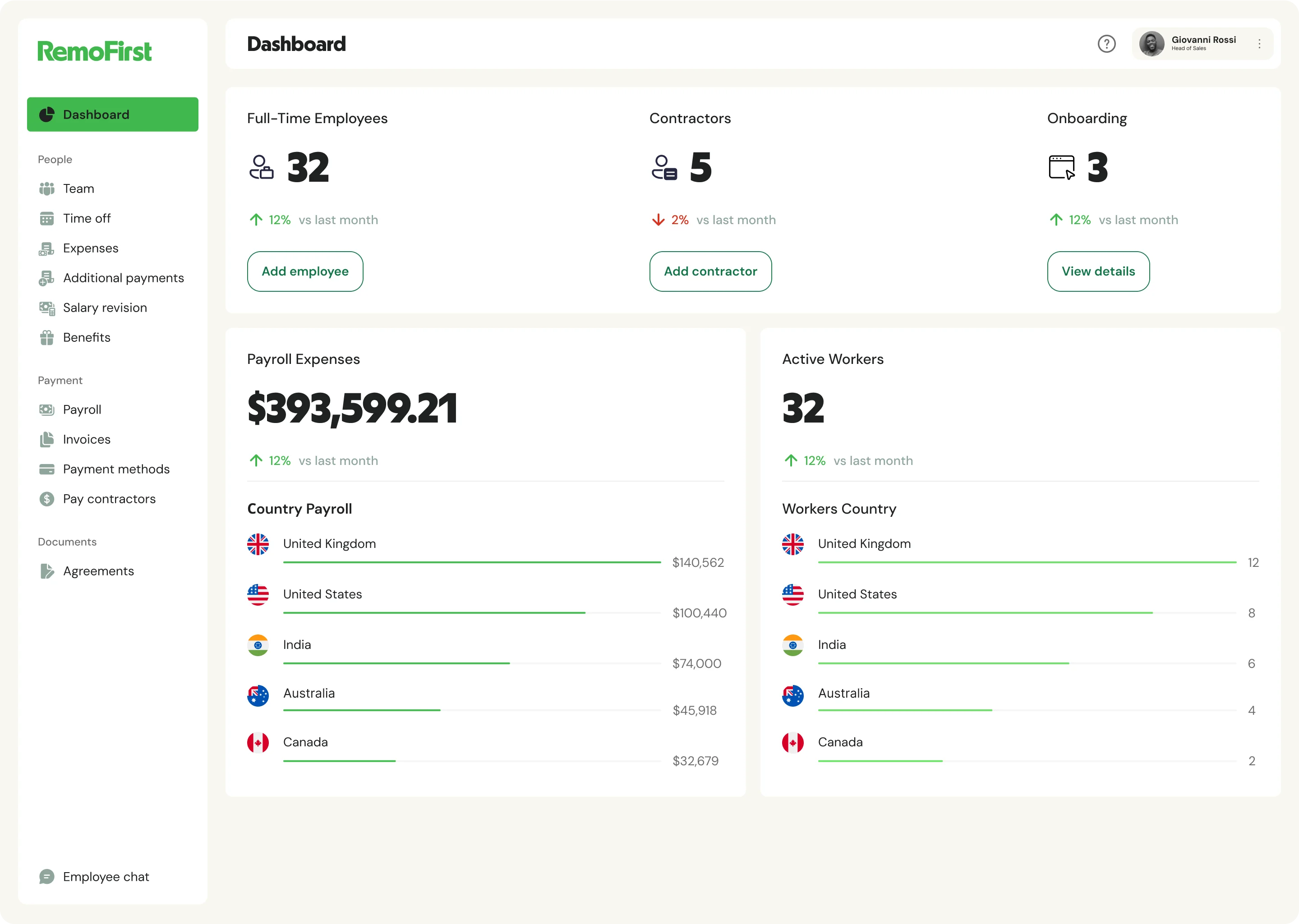
RemoFirst is the lowest-cost published option in the EOR category, covering 180+ countries through a partner network model. For startups making their first one to five international hires, the combination of low price and reasonable onboarding speed makes it a practical entry point into compliant global employment.
The trade-offs are real. A partner network model means compliance depth varies by country and by partner. The platform's feature set is lighter than enterprise competitors. Organizations that scale beyond their initial international hires will likely need to re-evaluate once the partner network's ceiling becomes visible.
Key Features
- Partner network model across 180+ countries
- Lowest published EOR pricing in the category at $199/employee/month
- Faster onboarding than enterprise providers in standard markets
- Contractor management available alongside EOR
- Benefits administration with local statutory compliance
- Expense management and time-off tracking
Pros and Cons
Pros: "Their team is very kind and patient in their communication. I appreciate how helpful they are when we have lots of local compliance questions. I can tell they care about my experience." - Capterra reviewer
- $199/employee/month is the clearest budget-friendly entry point in the category for companies with limited headcount
- Support team responsiveness is rated well across multiple reviews, particularly for straightforward compliance questions
- Fast onboarding makes it workable for companies that need to move quickly on their first international hires
Cons: "I use Expenses tab frequently and it has good layout, just suggestion to alphabetize the currency dropdown, maybe include a search option too, to not have to scroll and look for it one by one." - G2 reviewer
- Partner network model means compliance depth varies significantly by country; not suited to regulated industries or complex jurisdictions
- Feature set is noticeably thinner than enterprise platforms; ceilings appear faster as headcount grows
- Limited depth in analytics and reporting compared to mid-market and enterprise competitors
Pricing
RemoFirst offers global workforce management across 185+ countries, featuring Employer of Record (EOR) services at $199 per employee monthly. They also provide a Free Contractor tier for basic onboarding and document storage, alongside a Premium Contractor plan at $25 per person monthly for automated international payments.
10. Safeguard Global
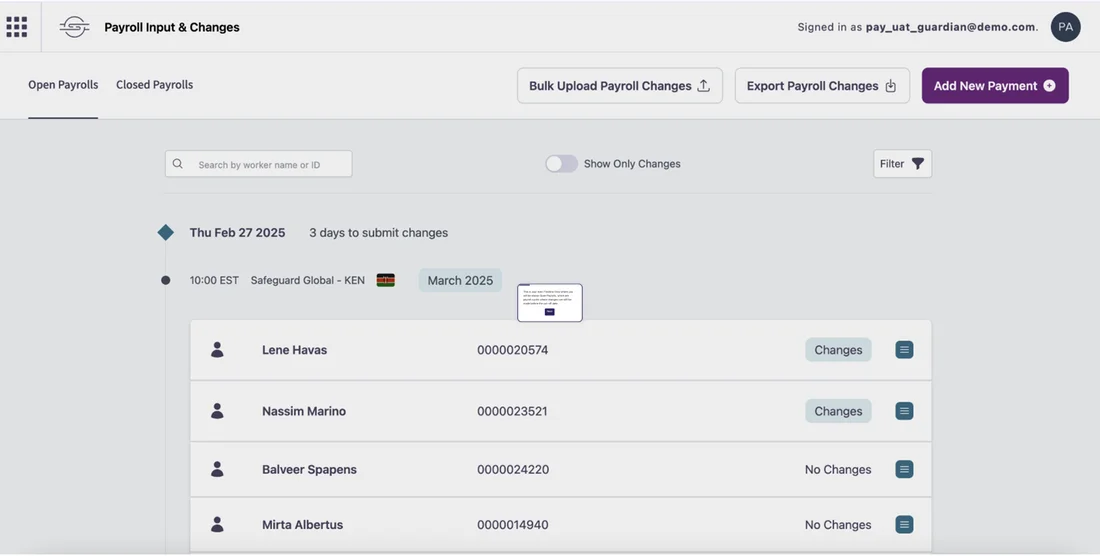
Safeguard Global covers 187 countries with a hybrid operating model built around embedded compliance and risk management for large enterprise accounts. The platform's track record is with multinationals managing 100+ international employees across multiple regions, and the feature set reflects that focus.
Dedicated compliance support, risk management frameworks, and tailored multi-region solutions are the core proposition. The platform is not designed for SMBs or early-stage companies, and the UX reflects an enterprise-first build rather than a consumer-grade product.
Key Features
- Hybrid model across 187 countries with embedded compliance and risk management
- Tailored solutions for large-scale multi-region employment
- Dedicated compliance support teams for enterprise accounts
- Workforce analytics and reporting for multi-country visibility
- Platform access management for HR administrators across regions
- Established enterprise track record dating back over a decade
Pros and Cons
Pros: "The follow up was quick and treated my case with care and expedited. " - G2 reviewer
- Compliance and risk management depth is well-suited to multinationals managing complex, multi-region employment
- Enterprise track record provides procurement credibility for large-organization vendor evaluation
- 187-country coverage with embedded compliance oversight
Cons: "Right now, it's the platform access. When people are given access, they tend to have issues getting to where they need to go, and we have multiple tickets to submit. It doesn't happen with everyone, but it seems to happen with the admins." - G2 reviewer
- Custom pricing only; no public rate, which creates friction in early budget planning
- Platform access and admin navigation are recurring pain points in G2 reviews
- UX is less modern than newer entrants to the category
- Enterprise-only positioning puts it out of reach for SMBs and most mid-market organizations
Pricing
Safeguard Global provides custom-quoted, transparent pricing for centralized global payroll and Employer of Record (EOR) services across 187 countries. The platform delivers full-service, compliant international expansion and workforce management for strategic organizations.
How to Choose the Right EOR Service for Your Organization
The right EOR depends on where you are hiring, how many people, and what level of compliance risk you can carry.
If compliance concentration is your primary requirement, start with Remote or Globalization Partners. Both operate exclusively on owned-entity models, which means no third-party employer sits between your worker and the compliance structure. Remote is the more accessible of the two on pricing; G-P carries deeper regulated-industry credentials.
If you are making your first international hires on a limited budget, RemoFirst's $199/employee/month published rate is the most transparent entry point in the category. Multiplier is a step up in platform maturity at a higher price point. Both use partner networks, so verify coverage in your target countries before committing.
If you are already on Rippling and want to add international hiring without a new vendor relationship, Rippling's EOR module is the obvious starting point. Be clear-eyed that you are trading compliance concentration for platform unification.
If you are scaling to 500+ international employees across multiple regions, Papaya Global's analytics layer, G-P's compliance depth, or Safeguard Global's enterprise model are each worth a closer look depending on your industry and country footprint.
If your team is remote-first and engineering-heavy, Oyster HR's UX and account manager quality have a strong track record in exactly that context.
For buyers still figuring out where EOR fits alongside their broader HR infrastructure, our HR software buying guide and HR trends for 2026 are useful context before you start vendor conversations.
Get Your International Hiring Under Control
International hiring without the right employer of record in place is one of the faster ways to create an expensive compliance problem. The providers in this list represent the strongest options across different buyer profiles, budgets, and compliance requirements in 2026.
Start with the operating model question. Ask every vendor which countries are owned-entity and which are partner-network before you schedule a demo. The answer tells you more about your actual compliance exposure than any feature list will.
If you are comparing two specific providers, the head-to-head comparisons on the site go deeper than this list can. And if you are evaluating EOR alongside global payroll tools, our payroll software guide covers the distinction in full.