.svg)
If you've landed here, you've probably already sat through at least one demo. You know what both products do. What you need now is a straight answer about which one fits your company, and why the other one doesn't
This comparison is written for four types of buyers: US companies making their first international hires, teams trying to consolidate a sprawling HR and IT stack, companies already hiring in 10 or more countries, and technical buyers for whom device management and identity are the real purchase driver.
Each profile gets a different verdict because the right answer is genuinely different for each. The dimensions that decide the call: EOR country depth, US payroll maturity, how far each platform's
HRIS and IT layer actually extends, pricing transparency, and one active lawsuit that every informed buyer deserves to know about.
The Short Answer: Which One Wins for Your Buyer Profile
Choosing between Deel and Rippling often comes down to a simple reality: they approached the same problem from opposite directions. Deel started with global compliance and built inward toward core HR. Rippling started with unified employee data and built outward to global hiring.
The Verdict Matrix at a Glance
To cut through the marketing copy, use this breakdown to see which platform aligns with your immediate operational scaling goals.
| Buyer profile | Winner | One-sentence rationale |
|---|---|---|
| US company making first international hires | Deel | Broader EOR coverage, published pricing, free HRIS up to 200 employees |
| Consolidating HR + IT into one platform | Rippling | No other platform in this tier unifies HR, IT, and Finance on a single data model |
| Hiring in 10+ countries at scale | Deel | 150+ country EOR coverage vs. Rippling's 80+; more transparent pricing at volume |
| IT and device management as primary pain | Rippling | Deel has no native equivalent to Rippling's device and identity layer |
Why the right answer depends on which problem you are solving
Deel and Rippling are frequently compared because they show up on the same shortlists for global hiring. That overlap is real but shallow.
Deel was built as a contractor and EOR platform first; everything since has been added on top of that foundation. Rippling was built as a unified workforce operating system first; global payroll and EOR came later. That difference in origin shapes every product decision each company has made since, and it shows up clearly in the dimensions below.
Picking the wrong one is not a minor inconvenience. It typically means either paying for IT and Finance modules you didn't need, or discovering that your EOR vendor covers 80 countries when you need 130.
Deel vs Rippling at a glance
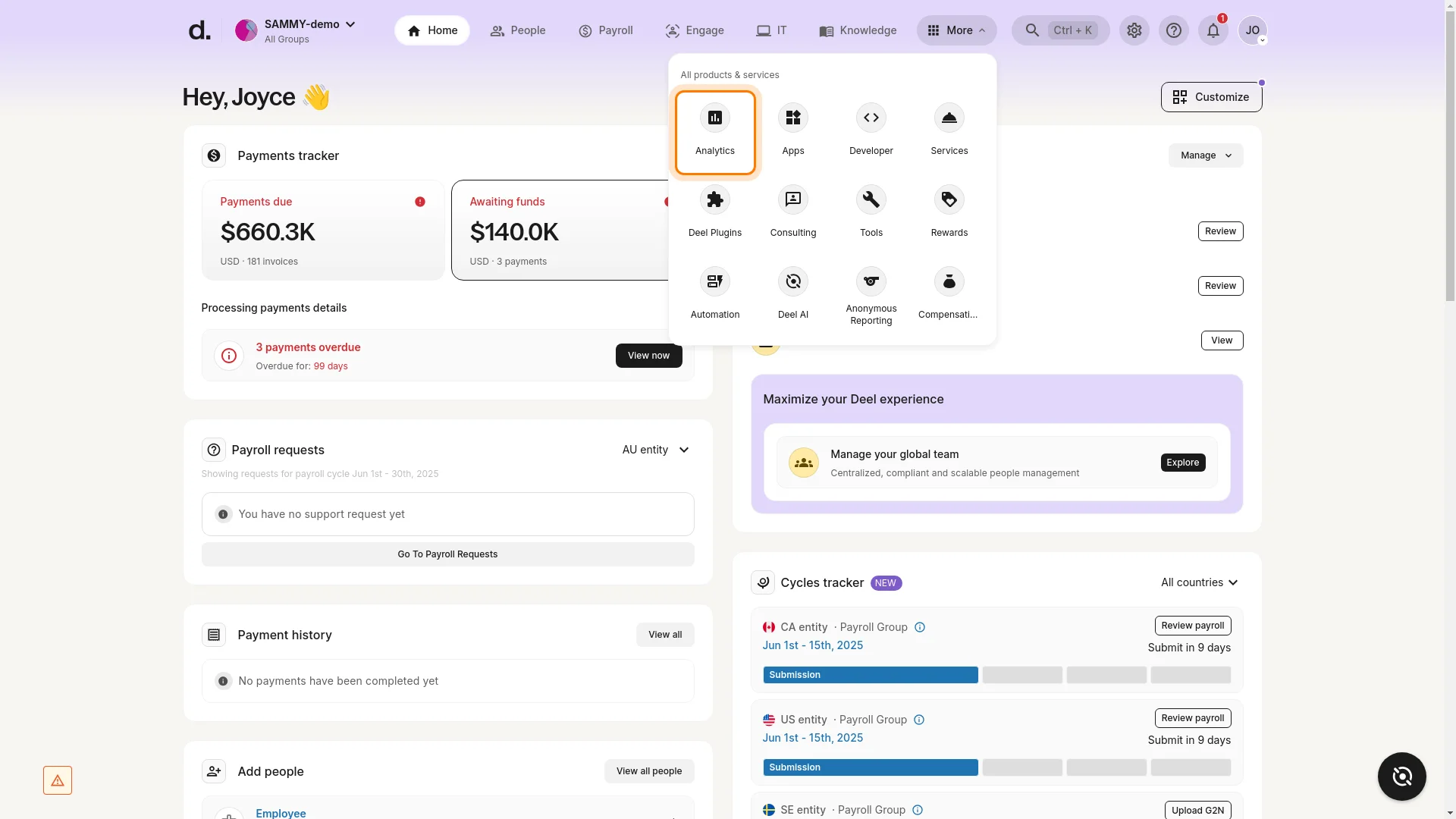
Choosing between Deel and Rippling requires looking beyond the marketing summaries. They approach workforce management from fundamentally different angles. Understanding where their capabilities converge and where their underlying architectures diverge is essential for selecting the platform that fits your operational needs.
Side-By-Side Specs
To see how these architectural differences impact specific features, this direct comparison maps out their core operational capabilities, compliance reach, and current software market standing.
| Deel | Rippling | |
|---|---|---|
| Founded | 2018 | 2016 |
| EOR country coverage | 150+ | 80+ |
| US payroll | Yes (newer product line) | Yes (core product, built natively) |
| HRIS | Yes (free up to 200 employees) | Yes (Unity platform, core product) |
| IT / device management | No | Yes (native, including MDM and SSO) |
| Contractor management | Yes ($49/month, published) | Yes (custom-quoted) |
| Finance / expense management | Limited | Yes (corporate cards, expense, AP) |
| Public pricing | Yes, across nine product lines | Base Unity platform only; modules are quote-based |
| G2 rating | 4.7/5 (6,500+ reviews, as of May 2026) | 4.8/5 (12,600+ reviews, as of May 2026) |
| Capterra rating | 4.9/5 (4,200+ reviews, as of May 2026) | 4.9/5 (3,000+ reviews, as of May 2026) |
Note on Ratings: Review counts and scores shift monthly. These figures reflect verified user data pulled at publication time in May 2026.
Where the Two Products Genuinely Overlap
Both platforms handle international contractor payments, global payroll, and a basic HRIS layer. A company that needs to pay contractors in Germany and Brazil, run US payroll, and store employee records will find that both products can cover that ground. The overlap is real enough that buyers reasonably put both on a shortlist.
Where They Are Structurally Different
Deel's center of gravity is global employment: getting people hired compliantly across borders, fast. Its HRIS and US payroll are good enough for many companies and free up to 200 employees, but they sit on top of an EOR-first foundation.
Rippling's center of gravity is the unified data model: one system of record for HR, IT, and Finance, with global payroll layered in. Its EOR coverage is narrower, but if you want to provision a MacBook, assign Okta access, and run payroll in the same workflow, Rippling is the only platform in this comparison that does it natively.
Origin and Product Strategy
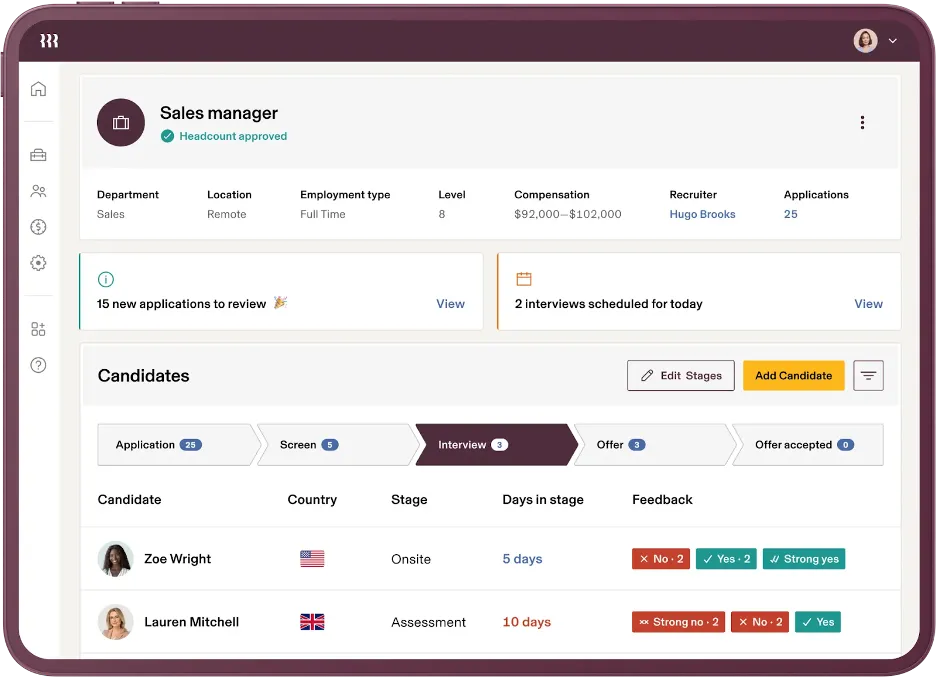
Features can be added overnight, but the underlying engineering philosophy dictates what a platform can and cannot do well years down the line. Examining how both platforms started reveals why they excel at entirely different operational tasks today.
Deel: EOR-First, Expanding Into HRIS and US Payroll
Deel launched in 2018 with a specific problem: paying international contractors compliantly without setting up a local entity. That was the entire product. EOR came next, then US payroll, then PEO, then the free HRIS layer called Deel HR. By 2025, Deel had nine distinct product lines with published pricing for each.
The product has grown substantially, but if you look at where the engineering and customer success investment has concentrated, it's in global hiring. That's where the product is deepest and where customer satisfaction is highest.
Rippling: HRIS and IT-first, Expanding Into Global Payroll And EOR
Rippling launched in 2016 with a different thesis: that HR, IT, and Finance should run on a single data model rather than a collection of integrated point solutions. US payroll, benefits, and device management were the original core. International payroll and EOR were added as modules in later years.
The Unity platform, which underpins the whole product, is what separates Rippling structurally from every other vendor in this comparison. Nothing Deel has built matches it for buyers who actually need what it does.
Why the Origin Story Still Matters in 2026
Both vendors have expanded aggressively. Deel now has a US payroll product. Rippling now has EOR coverage. Neither has caught up to the other's original strength. Buying Rippling for EOR depth is a reasonable decision for 80 countries; buying it as a replacement for Deel's 150-country coverage is not.
Buying Deel for unified IT and device management is not a decision worth making; the capability simply doesn't exist there. The origin story is not trivia. It's the shortest explanation of why these products behave differently in the dimensions that follow.
Global Hiring: EOR And Contractor Coverage
This is the dimension where Deel and Rippling diverge most sharply, and it's the most common reason buyers end up choosing Deel.
Country Coverage: 150+ vs 80+
Deel covers EOR in 150+ countries. Rippling covers 80+. For a company hiring its first employee in Vietnam or Nigeria or Colombia, that gap is either irrelevant or decisive depending on where the hire is.
Both vendors list country coverage on their websites; verify the specific countries you need before taking any published count at face value, since coverage quality varies by country regardless of which vendor's number you're looking at.
Owned Entities vs Partner Entities
Neither Deel nor Rippling operates its own legal entities in every country it covers. Both rely on third-party EOR partners in a meaningful portion of their coverage. Deel has disclosed using partners in approximately 40% of its covered countries. Rippling's proportion is less transparently published.
This matters because owned-entity EOR is generally faster and more predictable for onboarding; partner-entity EOR introduces a third party into the compliance chain. Ask both vendors, for every country you're actively hiring in, whether they operate through an owned entity or a partner. The answer affects your risk profile and sometimes your onboarding timeline.
Contractor Management and Contractor of Record
Deel's contractor management plan is published at $49/month per contractor. The free HRIS for up to 200 employees makes this particularly cost-efficient for contractor-heavy companies that don't need full EOR.
Rippling's contractor management pricing is custom-quoted. For companies managing 20+ contractors across multiple countries, the pricing transparency difference is meaningful at budgeting time, even if the actual costs come out similar after negotiation.
Onboarding Speed and Operational Reality
Deel markets an EOR onboarding time of two to three business days in most countries. Our review of G2 feedback from 2025 and 2026 suggests this is achievable in countries where Deel operates owned entities; partner-entity countries tend to run longer. Rippling's quoted onboarding timelines are similar, though G2 reviewers note more variability. For buyers with a specific hire date in mind, get a country-by-country commitment from whichever vendor you're evaluating, in writing.
Winner: Deel
Deel wins on global hiring. The 150+ country EOR coverage, published contractor pricing, and depth of experience in the international employment workflow give it a structural advantage over Rippling in this dimension. Rippling is a credible EOR vendor for companies operating in its 80-country coverage footprint, particularly when the unified IT layer matters. For buyers whose primary need is EOR breadth, Deel is the stronger call.
US payroll, benefits, and PEO
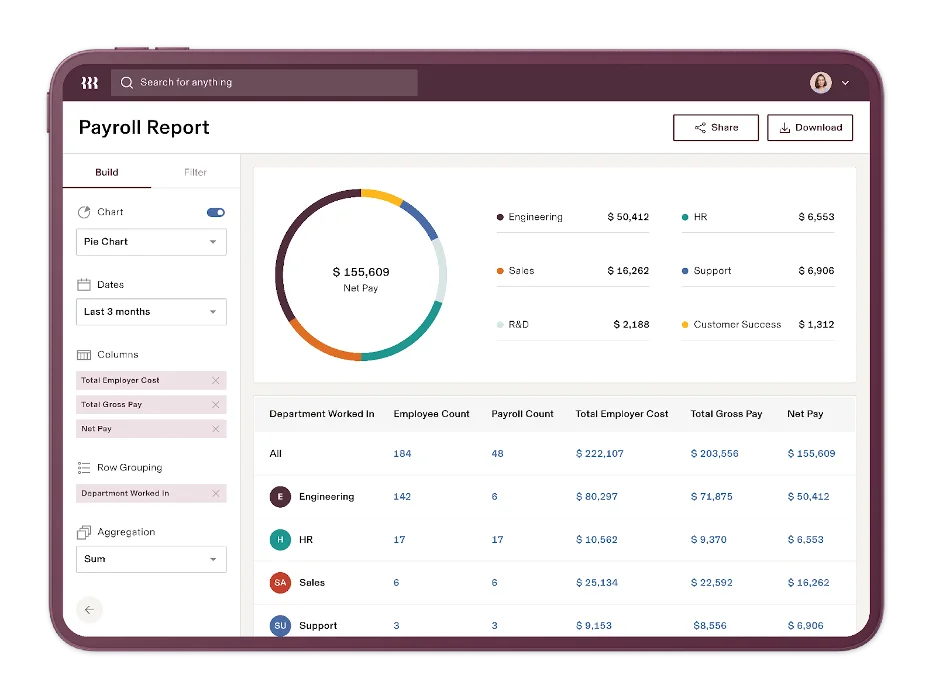
When evaluating platforms for domestic operations, the primary consideration shifts from cross-border compliance to localized tax handling and benefits administration depth. While both platforms provide comprehensive US infrastructure, their system capabilities reflect their distinct development paths.
Deel US Payroll and Deel US PEO
Deel added US Payroll and US PEO to its product lineup in 2023 and 2024 respectively. The PEO plan is priced at $125 per employee per month, which is publicly disclosed. This is the same company offering both a PEO and an EOR product side by side, which makes PEO vs EOR exactly the kind of distinction worth having settled before choosing between them. G2 reviewers in 2025 and early 2026 consistently describe the US payroll product as capable but less mature than Rippling's.
Rippling Payroll for US Operations
Rippling's US payroll was part of the original product. It runs on the same data model as HR, IT, and Finance, which means employee data entered once flows automatically into payroll without manual reconciliation. Rippling has marketed sub-90-second payroll runs for small teams; G2 reviewers at companies with 50 to 500 employees broadly confirm that US payroll is one of the platform's strongest features.
Multi-State Tax Handling and Benefits Depth
Rippling handles multi-state payroll with automated tax filing across all US states and territories. Benefits administration runs through direct carrier integrations rather than manual broker coordination. For companies with employees in eight or twelve states, this is practically significant. Deel's multi-state handling is improving, but its G2 complaint profile from 2025 to 2026 includes recurring mentions of edge-case friction in complex multi-state situations.
Winner: Rippling
For US payroll, benefits, and PEO, Rippling wins. It built this capability first and has compounded that investment for nearly a decade. Deel's US payroll is a reasonable option for companies whose primary need is global and whose US payroll situation is straightforward. It is not the stronger choice for companies where US payroll complexity is a genuine operational concern.
HRIS, IT, and the Unified Data Layer
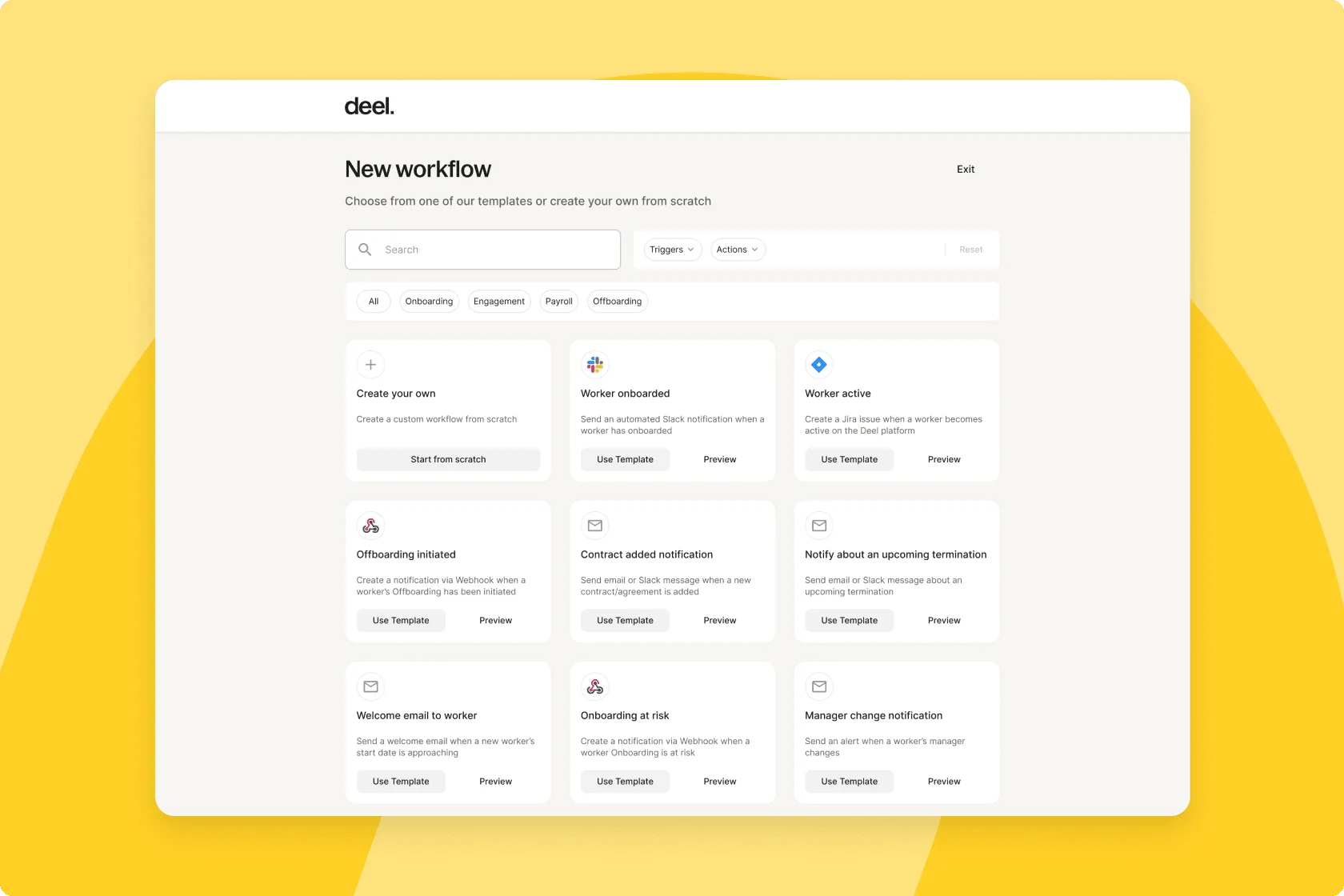
Beyond payroll, a core system must serve as the primary source of truth for your day-to-day operations. How an HR platform organizes its underlying database determines whether your administrative team spends their week managing employee files manually or running automated, system-wide workflows.
Deel HR: the Free HRIS Up to 200 Employees
Deel HR is a genuine HRIS product covering employee records, onboarding, time off, and basic reporting. It's free for up to 200 employees, which is a real pricing advantage for smaller companies running primarily on Deel's EOR and contractor products.
The limitation is what Deel HR is not: it has no device management, no SSO or identity layer, no app provisioning, and no expense or corporate card integration. It is an HR data store and workflow tool. For companies that have separate IT infrastructure and are not looking to consolidate it, that's entirely sufficient.
Rippling Unity: HRIS + IT + Finance on One Data Model
Rippling Unity is the platform layer that sits under every Rippling module. It is what makes Rippling structurally different from every other vendor discussed in this comparison.
When an employee is hired in Rippling, that single data entry triggers device provisioning, app access assignments, payroll setup, and benefits enrollment simultaneously. When an employee leaves, offboarding runs the same way in reverse.
The Unity data model eliminates the reconciliation steps that most HR teams run manually across four or five separate tools. That's the commercial thesis, and for buyers whose pain is actually the multi-tool reconciliation problem, it holds up.
Device Management, Identity, and SSO
Rippling offers native mobile device management (MDM), SSO through its own identity provider, and automated app provisioning across 650+ applications. This is the capability set that makes Rippling the obvious choice for IT-forward technical buyers.
Deel has no native equivalent. Deel integrates with identity tools like Okta and Workato, but those are third-party connections, not native capabilities built on the same data model. If unified device management is on your requirements list, Rippling is the only answer between these two vendors.
Winner: Rippling, Decisively
On HRIS depth and the unified IT layer, Rippling wins by a significant margin. Deel HR is good enough for its intended audience. Rippling Unity is a different category of product for buyers who need what it does.
Pricing Transparency and Total Cost of Ownership
When managing a global workforce, software costs extend far beyond the initial quote. A true assessment of value requires balancing upfront pricing visibility against the long-term compounding costs of adding operational modules as your business scales.
Deel Pricing: Published, Product-Line Based
Deel publishes pricing across nine product lines on its public pricing page. As of May 2026: Contractor Management $49/month per contractor, EOR Standard $599/month per employee, Global Payroll $29/month per employee, US PEO $125/month per employee, Core HR free up to 200 employees.
This transparency makes budgeting straightforward before you ever talk to a salesperson. It also makes apples-to-apples comparison possible, which is part of why Deel's pricing page ranks well on adjacent search queries.
Rippling Pricing: Published Base Plus Quote-Based Modules
Rippling publishes one number: the Unity base platform at $8 per employee per month plus a $35 monthly base fee. Every module beyond that, including EOR, Global Payroll, Benefits Administration, Device Management, and the Finance modules, is custom-quoted.
Third-party estimates from SelectSoftwareReviews and eorHQ (cited as estimates, not vendor-confirmed figures) put Rippling's EOR at $500 to $800 per employee per month depending on country and contract terms. These figures are third-party estimated. Get a specific quote from Rippling for your headcount and country mix before using any published estimate in a budget.
Three-Year Total-Cost Scenarios for Typical Buyers
Scenario A: 30-person US company, 5 international contractors. Deel Contractor Management at $49/month per contractor equals $245/month or approximately $8,820 over three years, plus Deel HR at no cost for under 200 employees. Rippling requires the Unity base fee plus contractor management and
HRIS modules; estimate $350 to $500/month based on third-party data, or $12,600 to $18,000 over three years. Deel is the more cost-efficient choice for this profile.
Scenario B: 150-person hybrid US/international company, EOR in 5 countries. Deel EOR at $599/month per EOR employee (5 employees: $2,995/month) plus US payroll and HRIS modules. Rippling EOR at estimated $500 to $800/month per employee (5 employees: $2,500 to $4,000/month) plus Unity base, US payroll, and Benefits.
Three-year costs converge in the $120,000 to $200,000 range depending on Rippling's actual quoted rate. Prices are comparable; the decision is driven by which platform's capabilities fit better.
Scenario C: 500-person globally distributed company, EOR in 10 countries. At this scale, both vendors negotiate custom rates. Published pricing is a starting point only. Get quotes from both, in writing, before modeling three-year TCO.
Hidden Costs Both Vendors Do Not Advertise
Deel requires a one-month gross salary deposit per EOR hire, held as a security deposit until the employee relationship ends. On a $80,000/year hire, that's $6,667 sitting outside your operating accounts per employee. Deel also applies FX conversion markups of 0.6% to 2% on international payments; this is disclosed in the contract but rarely mentioned in sales conversations.
Rippling's base fee structure means every employee on the platform, including employees who only use one module, contributes to the monthly base. Implementation services for Rippling at 100+ employees typically add $5,000 to $20,000 to year-one costs.
Winner: Deel on Transparency, Tie on Actual Cost at Scale
Deel wins on pricing transparency. The published rates make budgeting possible without a sales conversation. On actual total cost at scale, the two vendors are roughly comparable once module pricing and discounting are factored in. Neither is cheap. Both are priced for companies that have moved past the "let's use Gusto and hope" stage.
Integrations, AI Features, and Ecosystem
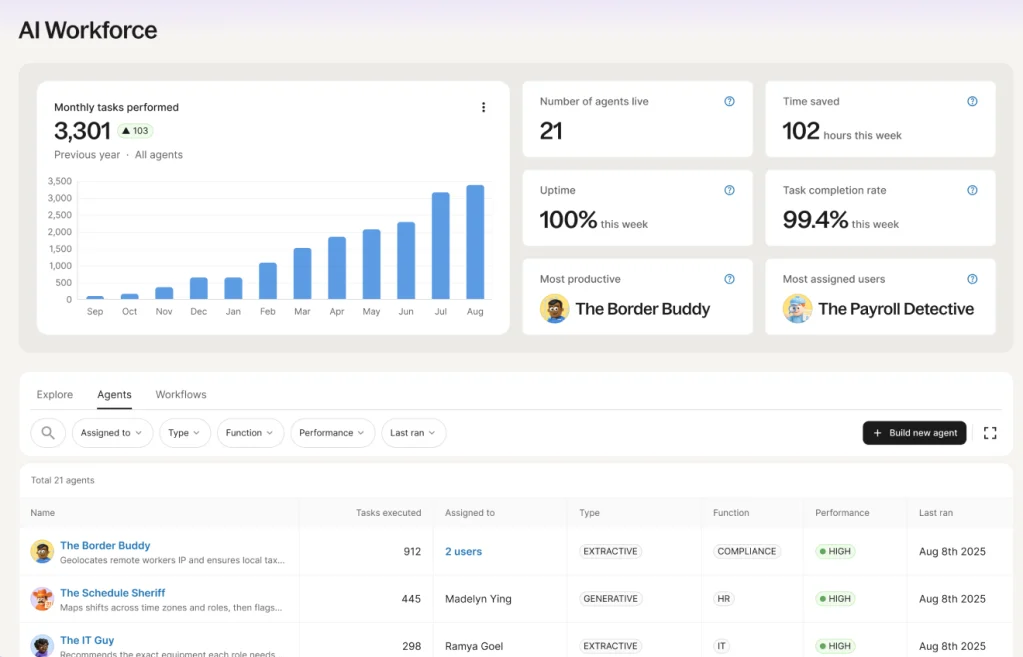
As an organization grows, its workforce platform cannot operate in a silo. True efficiency depends on how well the system communicates with your existing software stack, automates workflows using machine learning, and allows your engineering team to build custom internal tools.
Native Integrations and Third-Party Connector Depth
Rippling publishes 650+ native integrations covering HRIS, finance, identity, productivity, and developer tools. Deel publishes 200+ integrations. For buyers whose stack already includes Workday, Greenhouse, NetSuite, or similar enterprise tools, Rippling's integration depth is a practical advantage. For buyers running a leaner stack (Slack, Google Workspace, a basic ATS), both platforms cover the common connections adequately.
AI Features in 2026: What Is Real vs Demo Theater
Both vendors have marketed AI heavily since 2024. As of May 2026, the genuinely available capability is worth noting: Rippling launched natural-language querying across its unified HR, IT, and Finance data in March 2026, allowing operators to ask questions across datasets that previously required manual report-building. Deel has AI features in workflow automation and document generation, including employment contract drafting, plus a chat assistance tool.
API and developer experience
Rippling's API is more extensive and better documented, reflecting the platform's appeal to technical buyers. Deel has a developer API that covers its core workflows. For companies with engineering resources who want to build custom integrations, Rippling's API is the more capable foundation.
Winner: Rippling
On integrations, AI infrastructure, and ecosystem depth, Rippling leads. The 650+ native integration count and unified data model are structural advantages that compound as a company's stack grows.
Customer Reviews, Support, and Reputation
Evaluating user sentiment requires looking past aggregate scores to examine the specific operational friction points that surface after implementation. The customer feedback profiles of the platforms diverge significantly, revealing distinct operational trade-offs that prospective buyers must weigh.
G2 and Capterra Ratings, Side by Side
Both platforms carry nearly identical aggregate ratings as of May 2026. Deel: 4.7/5 on G2 across 6,500+ reviews, 4.9/5 on Capterra across 4,200+ reviews. Rippling: 4.8/5 on G2 across 12,600+ reviews, 4.9/5 on Capterra across 3,000+ reviews. The ratings do not differentiate the two platforms. The complaint profiles do.
Where Deel Customers Complain Most
Recurring user feedback on G2 and Capterra highlights several key operational friction points for organizations using the platform:
“Some features could be explained a bit better for new users, and certain processes may take a little time to fully understand at first. However, once you get familiar with the platform, everything works well.” — Capterra reviewer
- Support Response Times at Scale: Reviewers at companies with over 200 EOR employees note that complex, country-specific compliance or payroll issues can take longer than expected to resolve. Users report experiencing multiple support handoffs, with some complex resolution tracks taking up to two weeks.
- FX Markup Transparency: While the 0.6% to 2% foreign exchange markup on international payments is disclosed in final contracts, customers frequently note it is not prominently featured during the initial sales conversations.
- Initial Learning Curve: New users occasionally experience a slight adjustment period. Feedback indicates that certain workflows and features could benefit from clearer documentation to help administrators understand the system faster during initial setup.
- Partner-Entity Reliability: In regions where Deel operates via local third-party providers rather than its own owned corporate entities, a subset of reviews highlights occasional delays and compliance management friction.
Despite these challenges, user sentiment remains highly positive regarding Deel's core user interface design, the helpfulness of their initial onboarding support teams, and the overall return on investment for distributed global teams.
Where Rippling Customers Complain Most
Analysis of G2 and Capterra reviews highlights specific operational challenges that organizations face when adopting Rippling:
“Possibly more onboarding review for an employee who just learning the ropes in that organization. There is small difference from the app.” — Capterra reviewer
- Pricing Complexity and Module Upselling: A prominent theme involves unexpected costs. Users frequently note that the final bill was significantly higher than their initial quote because essential features are segmented into separate, custom-priced modules. As one user summary indicated, the baseline platform functions as an entry point rather than the final actual price.
- Extended Implementation Timelines: For mid-market companies with 200 or more employees, getting fully deployed can be a lengthy process. Reviewers report that complex configurations involving deep integrations across HR, IT, and Finance can take anywhere from 8 to 16 weeks to launch.
- End-User Onboarding Gaps: While administrative dashboards are highly capable, reviews point out a lack of structured, step-by-step guidance within the platform for new employees learning the system for the first time.
- Mobile vs. Desktop Inconsistencies: Some user feedback highlights a minor disconnect between the desktop portal and the mobile app experience, noting minor feature and layout variations between the two interfaces.
Even with these hurdles, the consensus among administrators is that Rippling's user interface remains exceptionally intuitive and easy to use on a daily basis without requiring exhaustive training manuals.
Verdict
No winner on this dimension. Both platforms score similarly with different complaint profiles. The right question is: which failure mode is less tolerable for your team?
The Ongoing Litigation: What Buyers Should Know
Since early 2025, Deel and Rippling have been engaged in active litigation involving allegations of corporate espionage, trade secret misappropriation, and unfair competition.
For procurement teams and executive stakeholders, understanding the current status of these disputes is important context, even though public reporting has not indicated material disruption to platform uptime or product delivery attributable to the cases.
The ongoing friction influences how both vendors approach market competition, contract negotiations, and client acquisition in 2026
Timeline of the Lawsuit, Briefly
In March 2025, Rippling filed a lawsuit against Deel in the U.S. District Court for the Northern District of California, alleging that Deel recruited a corporate spy in Rippling’s Dublin office to obtain confidential sales and business information, and asserting claims under federal racketeering and trade secret laws, including the Defend Trade Secrets Act, according to coverage from CNBC, TechCrunch, and Bloomberg Law. Deel has denied these allegations.
In April 2025, Deel filed its own civil suit against Rippling in Delaware state court, alleging that a Rippling employee impersonated a legitimate customer to gain unauthorized access to Deel’s platform and copy product and business details.
In January 2026, the Wall Street Journal reported that the U.S. Department of Justice had initiated a criminal inquiry and issued grand jury subpoenas related to allegations that Deel ran a covert operation inside Rippling; Deel has said it is not aware of any investigation targeting the company.
In early 2026, a federal judge in San Francisco allowed Rippling’s lawsuit against Deel to proceed, rejecting Deel’s effort to end the case at the pleading stage, according to Bloomberg Law’s reporting from the hearing.
What the Court Has Ruled So Far
As of May 2026, publicly available rulings in the U.S. case are procedural only. The decision to let Rippling’s lawsuit advance means the court found the allegations sufficient to move into discovery and potentially toward trial, but it is not a ruling that the alleged conduct actually occurred.
No court has found either party liable for the conduct alleged in these suits as of this writing; Rippling’s complaint sets out its view of the facts, and Deel’s public statements and court filings state its denials and counter‑allegations, and both should be read as advocacy positions rather than established fact.
Primary sources for current case status include the public Northern District of California docket (via PACER), Bloomberg Law’s case‑docket coverage, and TechCrunch’s ongoing reporting.
What This Should and Should Not Change in Your Decision
Both companies have continued to operate and serve their customer bases during the litigation, and public reporting has not identified litigation‑related disruptions to core product availability or customer support.
Neither party has been found liable for the conduct alleged by the other as of this writing. For most commercial buyers, the practical operational risk from the ongoing lawsuit appears low, and buyers continue to adopt and use both platforms.
For buyers in regulated industries, especially financial services, defense contracting, or government procurement, the active civil litigation and the reported DOJ inquiry may warrant additional procurement diligence, including review of vendor qualification policies and consultation with internal legal and compliance teams.
The existence of the lawsuits alone is not a decisive product comparison factor; the core evaluation should remain focused on product capabilities, roadmap fit, security posture, and commercial terms
Disclaimer
Last reviewed May 2026. This section reflects publicly available information as of that date. The litigation is active and may have developed further since publication. This is news reporting, not legal advice. Readers in regulated procurement environments should consult their own legal counsel and the public court docket directly.
Final Verdicts by Buyer Profile
To make the final decision actionable, the choice between these two platforms can be distilled down to your primary organizational pain point and your immediate hiring roadmap.
If you are a US company making your first international hires …
Choose Deel. Deel's EOR product was built for exactly this situation. Published pricing at $599/month per EOR employee means you can budget without a sales conversation.
The free HRIS up to 200 employees removes the need for a separate HR tool at this stage. If your international hiring needs are contained to one to five countries and your US payroll situation is straightforward, Deel is the lower-friction, lower-cost path.
If you are consolidating a multi-tool HR + IT stack …
Choose Rippling. No other platform in this tier puts HR, IT, and Finance on a single data model. If your current situation involves separate tools for HRIS, payroll, device management, identity, and expense tracking, and those tools do not talk to each other reliably, Rippling is the only vendor in this comparison that addresses all of those in one place.
The implementation is not trivial and the pricing is not transparent upfront, but for buyers whose actual problem is stack fragmentation, Rippling's Unity platform is the right structural answer.
If you are hiring in 10+ countries at scale …
Choose Deel. The 150+ country EOR coverage is the deciding factor. At 10 or more active EOR countries, the probability that at least one of them falls outside Rippling's 80-country coverage is meaningful.
Deel's deeper experience in the international employment workflow, including compliance infrastructure, contractor-to-employee conversion paths, and country-specific onboarding, reflects years of concentrated investment in exactly this problem.
Get country-by-country confirmation of owned-entity vs. partner coverage for your specific hire locations before signing. Our best global payroll software guide covers additional options worth evaluating alongside Deel.
If IT and device management are your primary pain …
Choose Rippling, and stop comparing it to Deel on this dimension. Deel has no native device management, no SSO layer, and no unified identity infrastructure.
If the reason you're looking for a new platform is that your IT and HR systems don't connect, Rippling is the only answer between these two vendors. The EOR limitation at 80 countries is a real constraint; if your hiring needs extend beyond that, you may need Rippling for IT/HR and a separate EOR vendor for specific countries.
Alternatives Worth Considering
If you've read the verdicts above and neither finalist is a clean fit, these platforms are worth adding to your evaluation.
Remote: the closest direct alternative on EOR
Remote is the most direct Deel competitor on global EOR. It covers 180+ countries, operates more owned entities proportionally than either Deel or Rippling, and publishes pricing at comparable rates. For buyers who want Deel-style EOR depth but want a second option to pressure-test pricing and country coverage, Remote is the right place to look. See our Deel vs Remote comparison for a head-to-head.
Multiplier and Oyster: lower-cost EOR alternatives
Multiplier and Oyster both offer EOR at lower price points than Deel's published rates, with narrower country coverage and lighter HRIS layers. They are worth evaluating for companies with straightforward EOR needs in a small number of countries and genuine price sensitivity. Neither competes with Deel on coverage breadth or with Rippling on unified platform depth.
Gusto: for US-only operations
If you read this comparison and realized your actual needs are domestic, Gusto is the right place to start. Strong US payroll, benefits, and a light HRIS, all at transparent pricing significantly below either Deel or Rippling. No international EOR. See our Rippling vs Gusto comparison for a head-to-head on the US-only segment. Paycor is worth a look in the same US-only category, particularly for mid-sized companies that want more HR depth than Gusto's lighter feature set.
BambooHR and HiBob: for HRIS-first buyers
If the purchase driver is core HR data management and neither global payroll nor device management is a near-term need, BambooHR and HiBob both offer more mature HRIS products than Deel HR, at lower price points than Rippling's full Unity platform. See our Rippling vs BambooHR comparison for more detail on the HRIS-first segment.
How This Comparison Was Prepared
This comparison draws on G2 and Capterra review data queried in May 2026, both vendors' public pricing pages and product documentation as of May 2026, third-party pricing estimates from SelectSoftwareReviews and eorHQ for Rippling modules not publicly priced, and primary-source reporting from TechCrunch, Bloomberg Law, Inc., Forbes, and the Wall Street Journal for the litigation section.
We demoed Deel's EOR and contractor management workflows in March 2026. Rippling's Unity platform was evaluated through a guided demo in April 2026. Pricing figures from third-party sources are identified as estimates; verify with each vendor before using in a budget.
.avif)