.svg)
Most hiring teams seeking new solutions are not building from scratch. Research shows that 61% of employees work at organizations with policies for fair hiring, pay, or promotions, and 52% attend regular workplace DEI training.
Yet, even with these frameworks, many teams review their data after six months and find an unidentifiable leak in their applicant funnel. The issue is rarely a lack of intent. Instead, it is usually a specific structural gap: coded language in job posts that deters applicants, sourcing routines that rely on the same predictable networks, or interviews where evaluation remains inconsistent and unrecorded.
The top diversity recruiting software options in 2026 do not solve every issue simultaneously because no single platform has that capability. Establishing that realistic expectation is the primary objective of this guide.
What Is Diversity Recruiting Software?
Diversity recruiting software refers to tools that help organizations reduce bias, broaden candidate pipelines, and measure outcomes at specific stages of the hiring process.
The category spans five distinct sub-types: inclusive job-description writing, diverse candidate sourcing, bias-reducing evaluation and structured hiring, DEI analytics and measurement, and Office of Federal Contract Compliance Programs (OFCCP) compliance for federal contractors.
Buying a sourcing tool will not fix biased interview scorecards. Buying an analytics platform will not source more diverse candidates. Match the tool to the stage where your funnel actually breaks.
What to Look for in Diversity Recruiting Software
Before you start booking demos, take ten minutes to identify which part of your hiring funnel is the real problem. The five criteria below follow the five sub-categories of this market.
1. Match the Tool to Your Specific Funnel Stage
A job-description writing tool addresses the top of the funnel. A sourcing platform addresses pipeline. A structured hiring tool addresses evaluation. An analytics platform measures all of it. Buying the wrong sub-category and expecting it to solve a different problem is the most common purchasing mistake in this category.
2. Prioritize Bias Reduction That Is Explainable
Any tool that screens or ranks candidates using AI must be able to explain its logic and allow human override. Black-box AI screening creates real legal exposure under New York City Local Law 144 and the EU AI Act, both of which require documented bias audits for automated hiring tools. If a vendor cannot clearly articulate how its algorithm makes decisions, that is a risk, not a feature.
3. Confirm ATS Integration Before Signing
Diversity recruiting tools rarely replace your ATS. They layer on top of Greenhouse, Workday, Lever, or your existing system of record. Before buying, verify real-time, two-way integration with your specific ATS. "Integrates with most ATSs" is not a yes.
4. Require Stage-by-Stage Funnel Reporting
A tool that reports how many diverse candidates were added to the top of the funnel is giving you activity data, not outcome data. The platforms worth buying show you diversity at each stage: sourced, screened, interviewed, and hired. Stage-by-stage reporting tells you where the drop-off actually happens.
5. Match Compliance Depth to Your Real Obligations
Federal contractors operating under OFCCP requirements need tools built specifically for that compliance context. Organizations in regulated jurisdictions need audit trails and documented processes. If you are a private employer with no federal contracts and no state-specific reporting obligations, a compliance-heavy platform may be more than you need. Size the compliance features to your actual requirements.
How We Evaluated Each Software
We reviewed over 25 active diversity recruiting tools in May 2026, narrowing the selection to 10 based on specific performance standards. User ratings were verified through G2 and Capterra.
Specialized Functionality
We assessed how effectively each platform addresses its primary purpose rather than counting features. Specialized tools often outperform broad platforms that attempt to handle every task.
User Feedback
We analyzed review scores and totals from May 2026. Platforms with higher review volumes received greater weight because a large sample size offers a more reliable indicator of quality than a high score from a few users.
Objective Methodology
We prioritized providers that offer transparent bias audits, clear AI logic, and documented methodologies over companies that rely on marketing language without technical verification.
System Integration
We confirmed direct, real-time connections with major applicant tracking systems like Greenhouse, Workday, and Lever. General API availability was not considered a sufficient substitute for built-in integration.
Metric Tracking
We favored platforms that track candidate demographics across every phase of the hiring process. Software that only measures initial applicant sourcing received lower ratings.
The 10 Best Diversity Recruiting Tools in 2026
To find the right software, it helps to look at where candidate drop-off actually happens. The market has shifted away from general platforms toward specialized software built for specific stages of the hiring pipeline.
The 10 platforms below have been categorized by their primary strength, allowing you to target the exact stage where your candidate funnel is losing traction.
1. Textio
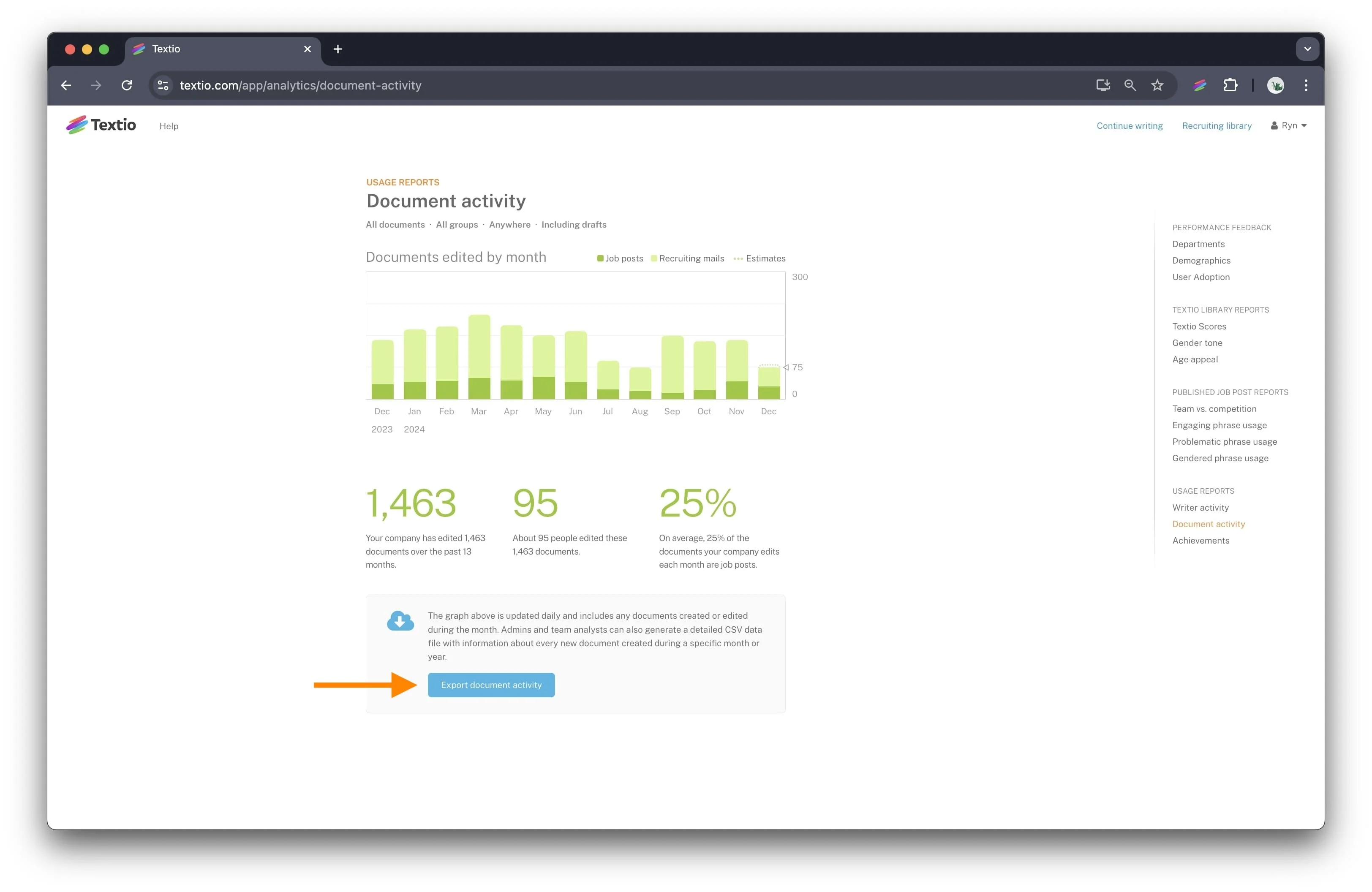
Textio sits at the top of the funnel and addresses something most organizations underestimate: the language in your job posts is already filtering out candidates before they apply. The platform flags exclusionary phrasing in real time as recruiters write, drawing on a large dataset of language patterns correlated with applicant pool diversity.
It works across job descriptions and recruiting communications, not just the initial posting. For teams whose diversity problem starts at the application stage rather than sourcing or evaluation, Textio is the most direct lever available.
Key Features
- Real-time language scoring that flags exclusionary and gendered phrasing as you type
- Suggested rewrites with explanations, not just flags
- Analytics showing how language changes correlate with applicant pool shifts
- Integrations with major ATSs including Greenhouse and Workday
- Coverage for recruiting communications beyond job descriptions, including outreach messages and offer letters
Pros and Cons
Pros: "Textio has proven to be a value add to our team and our DE&I mission and programs. The contextual check is great!" - Capterra reviewer
- Top-of-funnel impact: The platform provides measurable value at the very beginning of the hiring process.
- More representative talent: Consistent usage leads to more diverse and representative applicant pools within two to three hiring cycles.
- Real-time skill building: Recruiters learn and improve while writing, thanks to an immediate feedback loop, rather than reviewing their output after publishing.
Cons: "It would be great if there were better integrations with the ATS so hiring managers could write the JD directly in the job creation flow." - G2 reviewer
- Top-of-funnel limitation: Textio only optimizes language at the initial application stage.
- No downstream impact: It does not improve evaluation consistency or report on diversity metrics throughout the later stages of the hiring funnel.
- No passive sourcing: The tool cannot surface or find diverse candidates who haven't already applied.
- Supplemental tools required: Organizations facing diversity or bias issues after the application stage will need to use a different platform alongside it.
Pricing
Textio is an AI suite providing tools for performance feedback, recruiting, and interview feedback. Trained to eliminate bias, it integrates with existing HR systems and offers real-time guidance via custom corporate packages or a free trial.
2. SeekOut
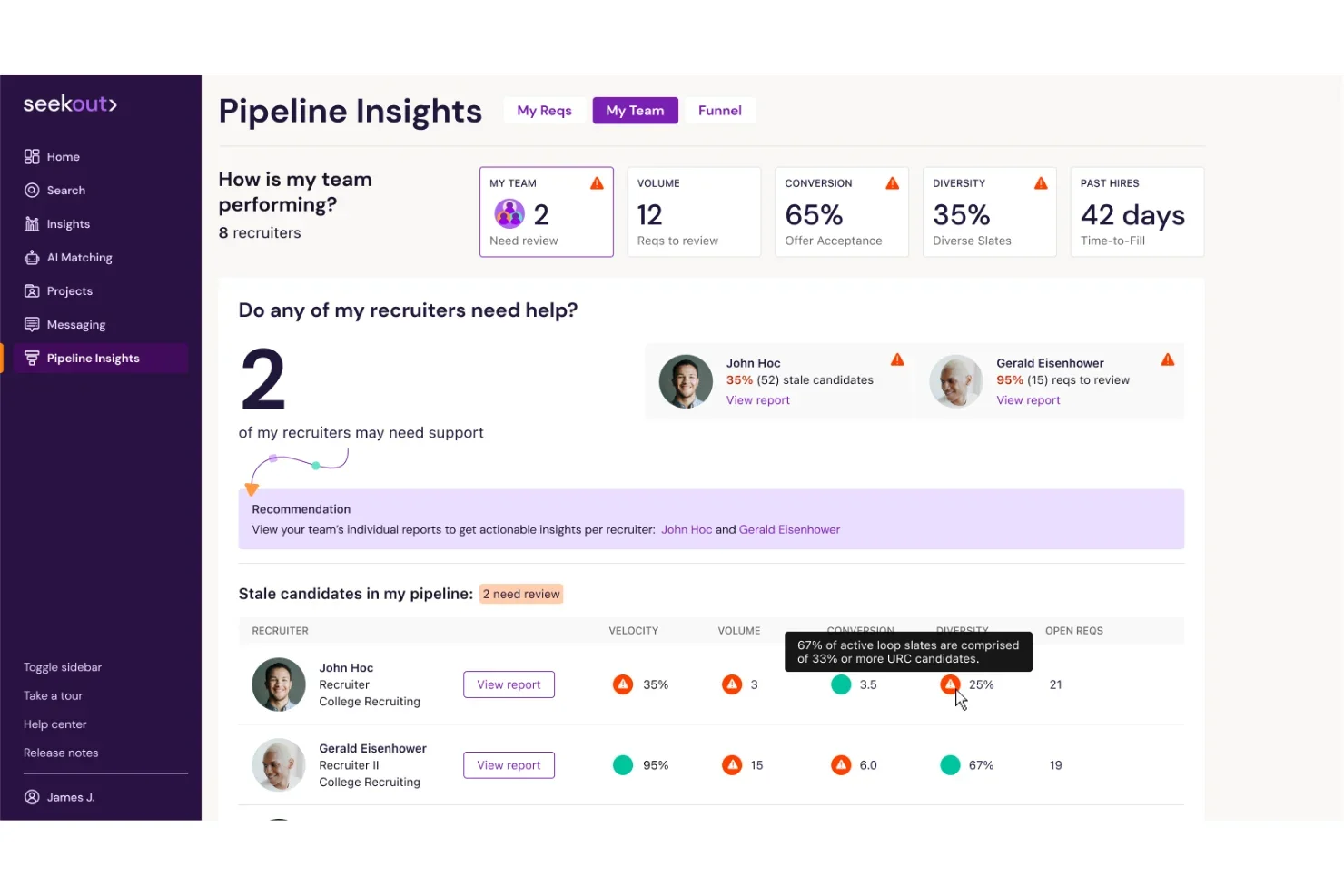
SeekOut is a talent search and sourcing platform built for teams that need to proactively find diverse candidates rather than wait for inbound applications. Its database covers more than 800 million profiles, with diversity filters that allow recruiters to search by self-reported demographic attributes, underrepresented backgrounds, and skills rather than pedigree proxies like employer or school name.
It is a strong fit for sourcing roles where the standard pipeline produces uniform results and where waiting for applications is not an option.
Key Features
- Search across 800M+ profiles with diversity-specific filters
- Skills-based search that reduces reliance on school and employer pedigree as proxies
- Talent insights showing diversity benchmarks by role, industry, and geography
- Integrations with Greenhouse, Lever, Workday, and major ATS platforms
- Outreach tools for direct candidate engagement from within the platform
Pros and Cons
Pros: "I love that there are more specific search filters. I often use SeekOut over LinkedIn." - Capterra reviewer
- Competitive advantage: The depth of the diversity filter sets it apart from general talent search tools.
- Targeted improvement: Recruiters see a measurable boost in top-of-funnel representation, especially when sourcing for roles where traditional pipelines typically fall short.
Cons: "Sometimes the data is not accurate with LinkedIn, we don´t find the profile or even the contact information is incorrect." - G2 reviewer
- Sourcing focus: SeekOut operates purely as a talent sourcing tool.
- Core limitations: The platform does not address interview and evaluation bias, generate DEI analytics, or manage compliance reporting.
- Data quality issues: Reviewers frequently flag contact information accuracy as a known limitation.
- Alternative alignment: Organizations struggling with diversity during the interview and evaluation stages will find more relevance in a different platform.
Pricing
SeekOut features two AI hiring options: Recruit, a self-service tool for automated sourcing, screening, and outreach, and Spot, a managed service combining AI with human recruiters to increase hiring capacity. Custom pricing is available upon request.
3. Eightfold AI
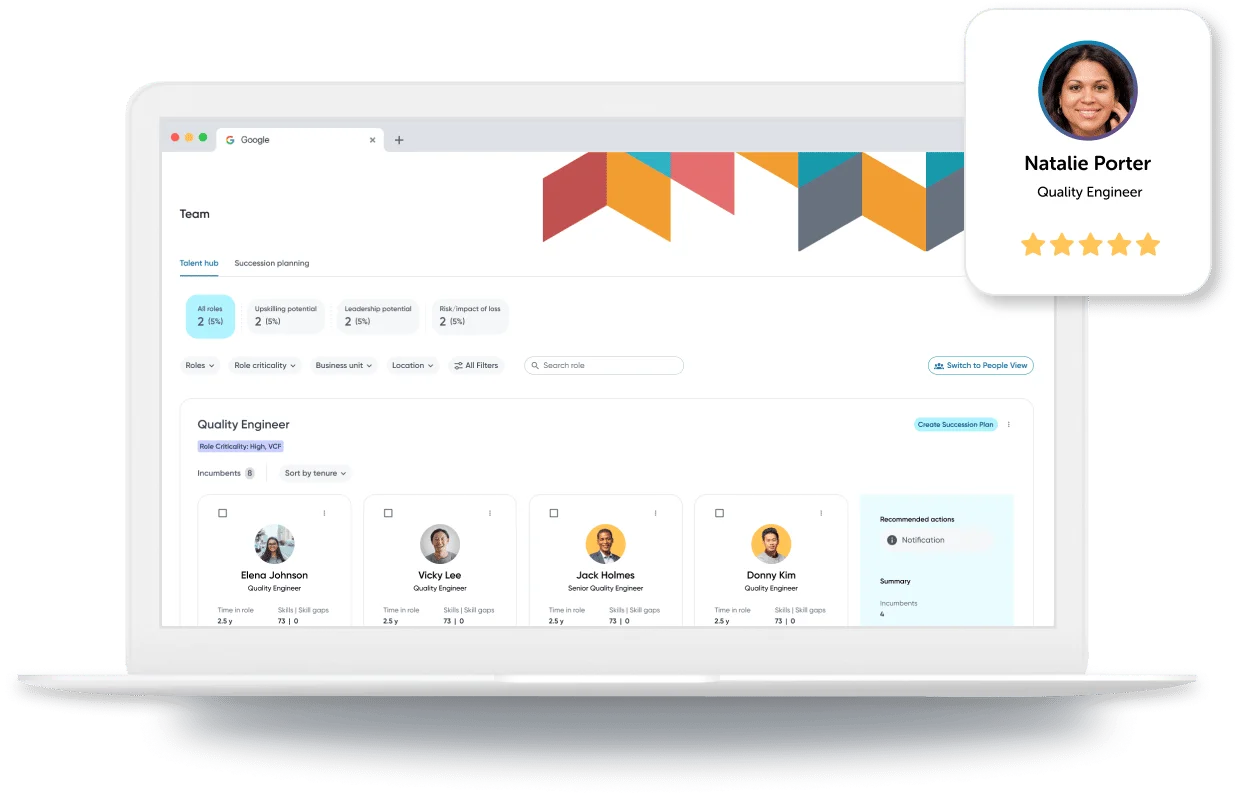
Eightfold AI operates at the evaluation and matching stage. Its AI matches candidates to roles based on skills and demonstrated potential rather than job titles and educational pedigree, which structurally reduces the proxy-bias that conventional screening introduces.
The platform covers internal mobility and workforce planning alongside external recruiting, making it a broader talent intelligence system rather than a point solution. It is built for enterprise scale. Organizations with fewer than 500 employees will likely find the implementation scope disproportionate to their needs.
Key Features
- Skills-based AI matching that reduces pedigree and credential bias in screening
- Internal mobility tools that surface qualified internal candidates alongside external applicants
- Candidate rediscovery from existing ATS databases using updated skills data
- Diversity analytics built into the matching and pipeline reporting layer
- Integrations with Workday, SAP SuccessFactors, Greenhouse, and other enterprise platforms
Pros and Cons
Pros: "I think it is a great HR tool that uses AI and provides an easy to use and great way for managing internal HR and applications." - Capterra reviewer
- Mitigates screening bias: By focusing on skills-based matching, it addresses a critical bias point missed by traditional sourcing tools—preventing diverse candidates from being automatically screened out during credential-based shortlisting.
- Compliance ready: The platform's methodology is fully documented and explainable, which is essential for meeting the strict regulatory standards of NYC Local Law 144 and similar automated employment decision tool (AEDT) laws.
Cons: "It creates dependency with Workday Application Tracking System." - G2 reviewer
- High implementation complexity: As an enterprise platform, deployment takes multiple months and requires dedicated HRIS support.
- Mid-to-large market focus: The high pricing structure and extensive setup requirements make it impractical for most organizations with fewer than 500 employees.
- Faster alternatives: Buyers prioritizing a quick deployment for AI matching should consider platforms like hireEZ or SeekOut instead.
Pricing
Eightfold unifies workforce data into a secure platform featuring a 24/7 multilingual AI Interviewer that provides structured insights for human-led hiring decisions. Contact them directly for custom pricing.
4. hireEZ
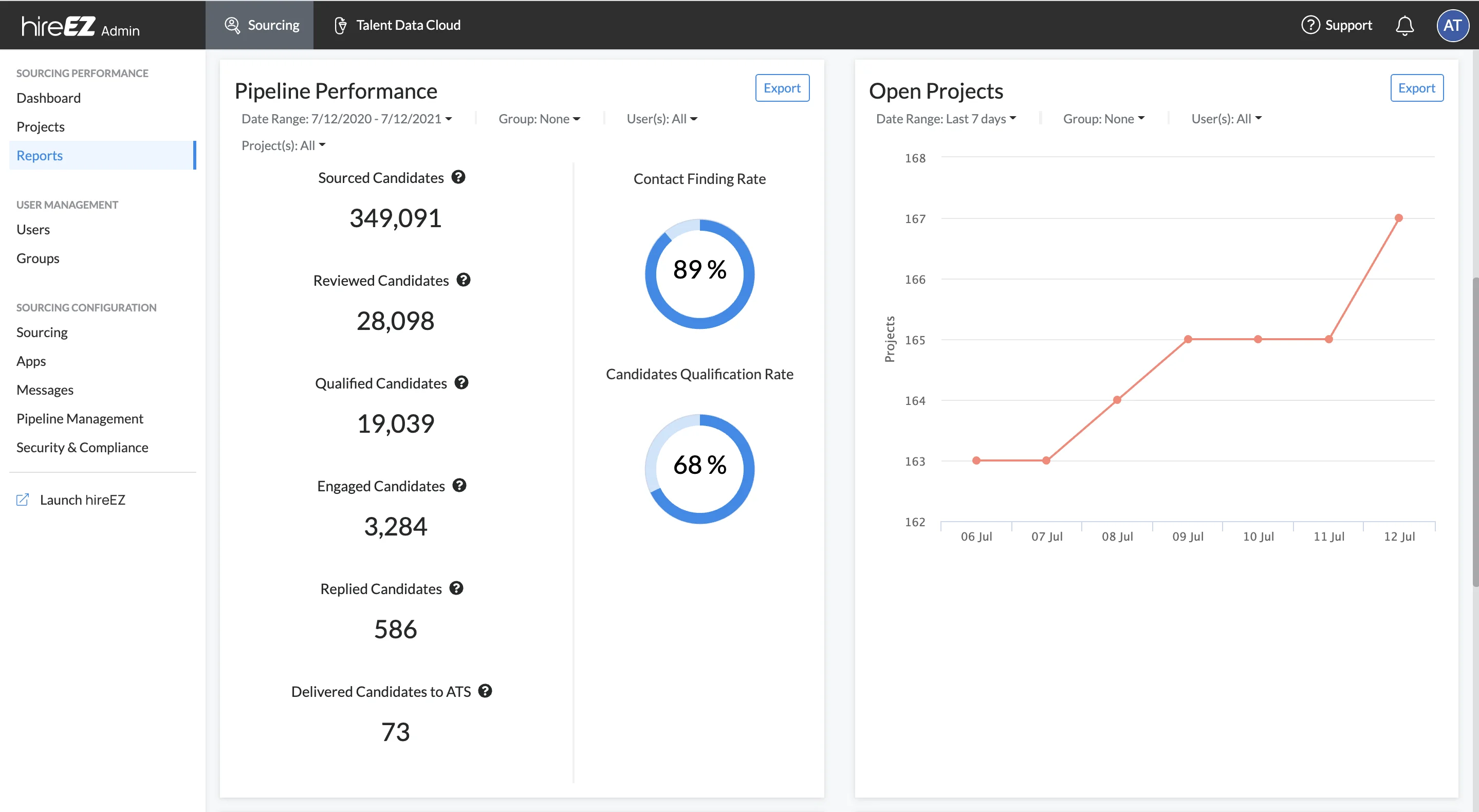
hireEZ is an outbound sourcing platform that combines AI-driven candidate discovery with diversity filters and automated outreach sequences. Where SeekOut excels at deep search, hireEZ adds an automation layer that reduces the manual effort of running large-scale diversity sourcing campaigns.
Recruiters can build targeted outreach to underrepresented candidate pools and track engagement without managing sequences manually. It is best suited to high-volume hiring environments where sourcing speed matters as much as sourcing quality.
Key Features
- AI sourcing with diversity-specific filters across multiple data sources
- Automated outreach sequences with follow-up scheduling
- ATS integrations including Greenhouse, Lever, Workday, and Bullhorn
- Market insights showing talent availability and diversity by role and geography
- Candidate engagement tracking across sequences
Pros and Cons
Pros: "hireEZ allows to an easy recruitment process and use of AI to help minimize reviewing multiple applications." - Capterra reviewer
- Reduces manual workload: Combining diversity filters with automated outreach eliminates the high administrative burden that typically makes manual diversity sourcing unsustainable for smaller, lean recruiting teams.
- Scalable campaign management: The platform is highly effective for organizations that need to execute and manage simultaneous sourcing campaigns across multiple job openings.
Cons: "The data accuracy isn't always reliable. At times, we receive contact information for a relative instead of the intended person.” - G2 reviewer
- Verify data accuracy: Reviewers frequently report data quality issues, making verification critical during a trial.
- Sourcing focus only: The tool lacks features for evaluation bias, stage-by-stage funnel analytics, or compliance reporting.
- Automated outreach risk: Impersonal or high-frequency automated sequences can alienate diverse candidates and harm the employer brand.
Pricing
hireEZ turns your ATS into an active hiring system by automating candidate research, sourcing, screening, outreach, and scheduling. Contact them directly to book a demo and receive custom pricing.
5. Greenhouse
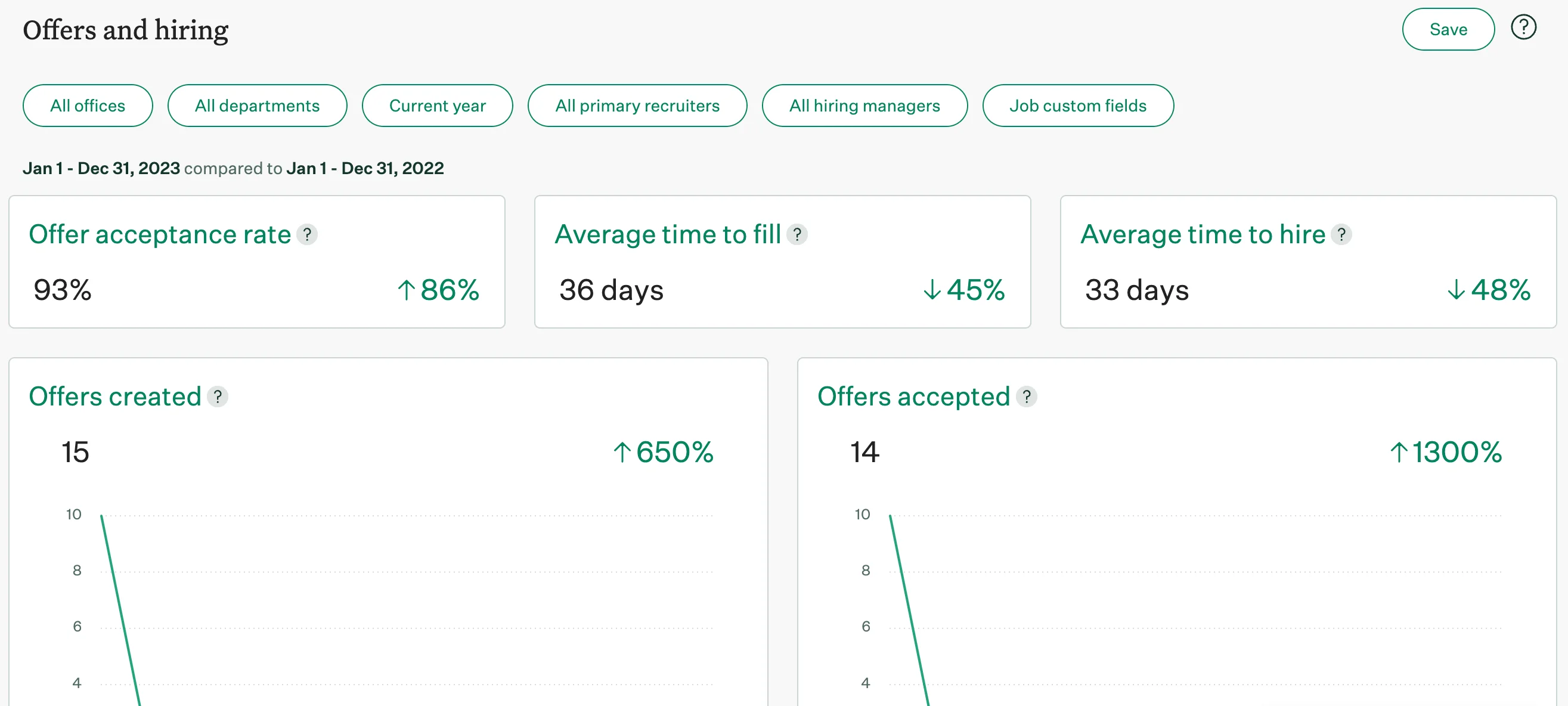
Greenhouse addresses bias at the evaluation stage rather than sourcing. As one of the leading recruiting software platforms in the market, it embeds DEI features directly into the hiring workflow: structured interview kits, standardized scorecards, and anonymized application review reduce the evaluator inconsistency that produces biased hiring outcomes.
For organizations whose diversity problem is in the interview and selection stage, Greenhouse is the most complete option available. It is worth being clear that Greenhouse is an ATS first. The diversity features are strong, but they function as part of a broader hiring system rather than a standalone DEI tool.
Key Features
- Structured interview kits that standardize questions and evaluation criteria across interviewers
- Customizable scorecards that reduce unstructured, impression-based evaluation
- Anonymized application review to reduce name and photo-based bias in early screening
- DEI reporting across the hiring funnel by stage
- Integrations with HRIS, payroll, and sourcing platforms
Pros and Cons
Pros: "The tool is easy to use and has great functionality to create custom fields and filter from these. The bulk actions are excellent. Just waiting on bulk hire." - Capterra reviewer
- Core differentiator: A structured hiring framework with standardized scorecards ensures more defensible hiring decisions, supporting both diversity goals and legal compliance.
- Category leader: The platform offers some of the deepest review capabilities and strongest integration libraries in the ATS market.
Cons: "Here are some features with bulking like reorganizing my application questionnaire; I have to do it individually. I spoke with someone from Greenhouse, and they are working on it." - G2 reviewer
- Requires consistent compliance: Diversity features are only effective if the team actively uses them; structured kits and scorecards fail to reduce bias if interviewers fill them out after the conversation.
- Demands strategic rollout: Organizations adopting Greenhouse for diversity goals must establish clear expectations and structured training to ensure interviewer compliance.
Pricing
Greenhouse is a full-lifecycle hiring platform that automates candidate matching, verifies applicant identity, and provides structured tools for bias-free evaluation. Contact them directly to book a demo and receive custom pricing.
6. Datapeople
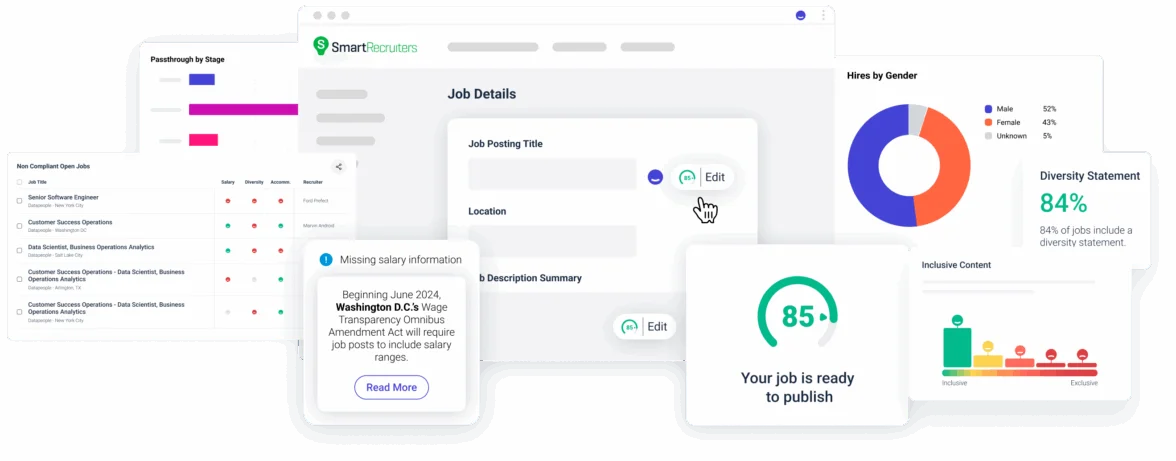
Datapeople combines two capabilities that are often sold separately: real-time language guidance for job descriptions and recruiting analytics that connect language decisions to actual hiring outcomes. Unlike a pure writing tool, Datapeople shows you whether the changes you make to job posts translate into measurable shifts in applicant pool diversity.
That feedback loop is what makes it more useful than a language checker alone. It fits best in recruiting teams that want both top-of-funnel language improvement and the analytics to prove whether it is working. For a broader view of HR analytics software, it is worth reviewing what purpose-built analytics platforms offer alongside tools like Datapeople.
Key Features
- Real-time language guidance during job-post creation with inclusivity scoring
- Recruiting analytics connecting job-post language to applicant pool data
- Job posting performance tracking across channels
- ATS integrations including Greenhouse and Lever
- Team-level reporting on language patterns across hiring managers
Pros and Cons
Pros: "The advice the tool gives you is to make changes to your job postings to make them more inclusive." - Capterra reviewer
- Validates writing impact: Combines real-time writing guidance with outcome analytics to immediately prove whether language changes actually improve recruitment results.
- Boosts top-of-funnel diversity: Teams consistently report a more diverse applicant pool, backed by clear data to prove ROI to stakeholders.
Cons: "Sometimes it's hard to meet the scores when changing the information on the job description, but once you get used to the tool it's easier." - G2 reviewer
- Niche functionality: Operates strictly as a job-post optimization and basic analytics tool; it does not source candidates, fix evaluation bias, or support OFCCP compliance reporting.
- Limited analytics depth: Lacks the advanced capabilities of dedicated DEI analytics platforms, making it insufficient for tracking diversity metrics through the screening, interviewing, and offer stages.
Pricing
Datapeople provides three job description and compliance tiers: Comply for brand and anti-bias monitoring, Architect for AI job building and integrations, and Attract for team collaboration and recruitment marketing analytics. Contact them directly for custom pricing.
7. Diversio
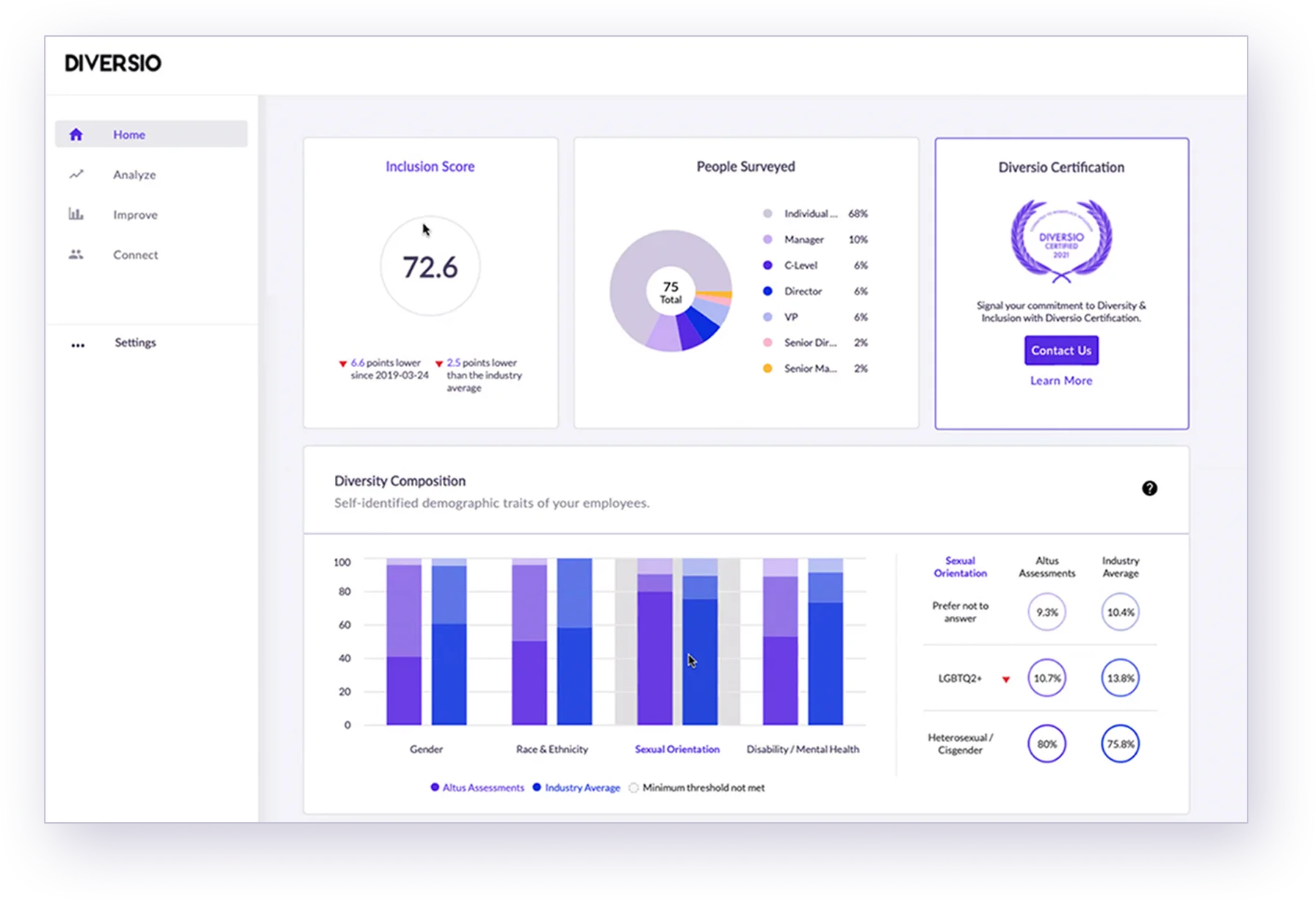
Diversio sits in the measurement sub-category. Rather than sourcing candidates or reducing bias in job posts, it measures whether a diversity program is producing results across the full employee lifecycle, from hiring through retention. The platform uses AI-driven analysis to identify where gaps exist and surfaces recommendations for where to focus.
It is the right tool for organizations that need to move from anecdotal reporting to data-backed accountability. Diversio works best when paired with a sourcing or evaluation tool that generates the funnel data it needs to analyze.
Key Features
- Funnel diversity measurement across sourcing, hiring, and retention stages
- AI-driven gap analysis with prioritized recommendations
- Benchmarking against industry diversity data
- Survey tools for measuring inclusion alongside diversity metrics
- Integrations with HRIS and ATS platforms for automated data ingestion
Pros and Cons
Pros:
- Diversio offers highly specialized, executive-ready reporting that translates raw internal metrics into clear diversity and inclusion data dashboards.
Cons:
- Because the software focuses strictly on data measurement rather than candidate sourcing or evaluation, it lacks any native recruiting mechanisms.
- It depends entirely on clean, consistent funnel data from connected third-party systems to generate accurate analysis.
- Organizations with fragmented applicant tracking data or manual workflows must resolve their data quality issues before the analytics features can function properly.
Note on Pros and Cons: Diversio currently lacks sufficient review volume on G2 and Capterra to establish a user-sourced rating. This section will be updated with user feedback as public marketplace reviews become available.
Pricing
Diversio provides DEI and engagement solutions including a DEI Platform ($10,000 to $36,000+) for surveys and benchmarking, the Optimo attrition tracker ($5/PEPM), Workplace Training ($22/pp to $6,500+), and Consulting Packages ($12,000–$35,000+). Contact them directly for custom quotes and demos.
8. Circa (Mitratech)
.webp)
Circa, now part of Mitratech, is built for federal contractors who operate under OFCCP affirmative action obligations. It combines a diversity job-posting network with outreach tracking, applicant flow documentation, and the compliance reporting structure that OFCCP audits require. For organizations where compliance is a hard requirement rather than a best-practice goal, Circa is the most purpose-fit option on this list.
Non-federal-contractor organizations will find the compliance layer more than they need. The platform's recruiting and sourcing features exist in service of the compliance framework rather than the other way around.
Key Features
- Job posting distribution across a diversity-focused employment network
- OFCCP-compliant applicant flow and outreach documentation
- Affirmative action reporting tools and audit trail generation
- Compliance consulting resources and regulatory update notifications
- Integration with major ATS platforms for applicant data flow
Pros and Cons
Pros: "I love the fact that they have so many resources to help; everything is pretty clear on where to go and who can help." - G2 reviewer
- Eases audit burdens: The compliance resource library and support structure significantly reduce the manual effort federal contractors face when gathering outreach evidence and applicant flow records for OFCCP audits.
- Reliable compliance documentation: Robust tools make it easier for organizations to document, track, and prove their diversity outreach efforts to regulatory bodies.
Cons: "The value for my money and the slowness on the app. At some time it is hard to get through to the right or next page." - Capterra reviewer
- Outdated interface: The user interface feels noticeably dated compared to newer platforms on the market.
- Performance issues: Regular user complaints highlight platform performance issues, making a thorough trial assessment critical before committing.
- Restrictive focus: The compliance-heavy structure is built specifically for federal contractors, making it restrictive and less effective for general diversity recruiting purposes.
Pricing
Custom pricing. Contact Circa (Mitratech) for a quote.
9. Mathison
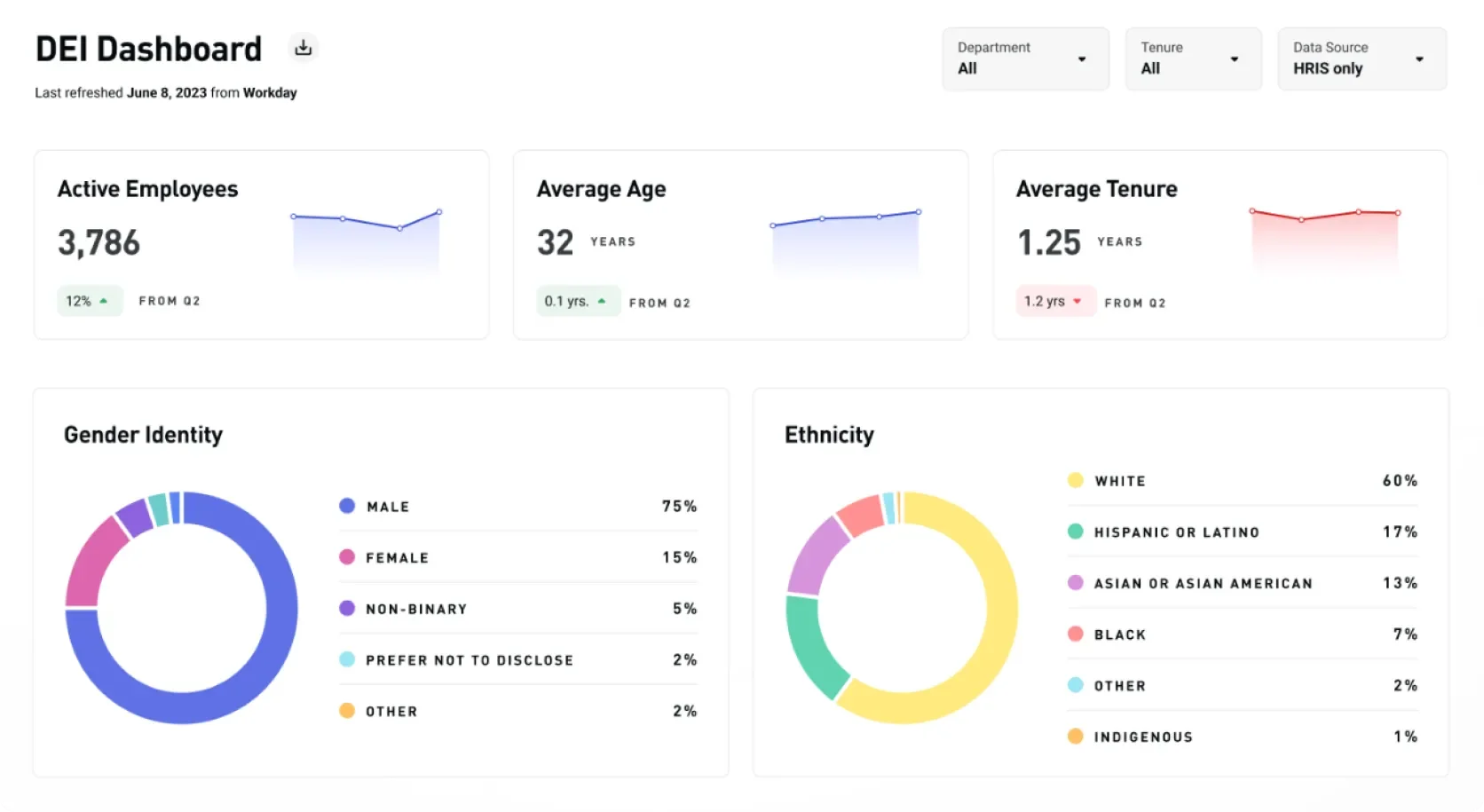
Mathison takes a different approach from most tools on this list. Rather than excelling in one sub-category, it combines diverse candidate sourcing, structured measurement through its Equal Hiring Index framework, and DEI education content in a single platform. For organizations building a diversity recruiting program from scratch and looking for a structured starting point rather than a collection of point solutions, that breadth is genuinely useful.
The trade-off is depth. Specialist platforms in sourcing, language, and analytics each outperform Mathison within their category. The question is whether consolidation matters more than depth at your current program stage.
Key Features
- Diverse candidate sourcing through a network of DEI-focused job boards and talent communities
- Equal Hiring Index, a structured measurement framework for diversity hiring outcomes
- DEI training and education content for hiring managers and recruiters
- Bias-reduction guidance integrated into the hiring workflow
- ATS integrations for applicant data sync
Pros and Cons
Pros:
- The platform combines sourcing, measurement, and education into a single system, which minimizes the vendor fragmentation that occurs when managing multiple niche tools.
- The proprietary Equal Hiring Index establishes a standardized, uniform framework for tracking organizational progress and identifying operational gaps over time.
Cons:
- Because the platform covers a broad range of features across the entire employee lifecycle, individual functionalities lack the technical depth found in specialized, standalone software.
- Teams that already possess separate platforms for sourcing, structured interview tracking, and DEI analytics may find the features redundant.
Note on Pros and Cons: Mathison currently lacks sufficient review volume on G2 and Capterra to establish a public, user-sourced rating. This section will be updated as verified marketplace reviews become available.
Pricing
Mathison provides a culture intelligence platform that tracks inclusion, scans for language bias, and delivers data-driven action roadmaps across the employee journey. Contact them directly to book a demo and receive custom pricing.
10. Gem
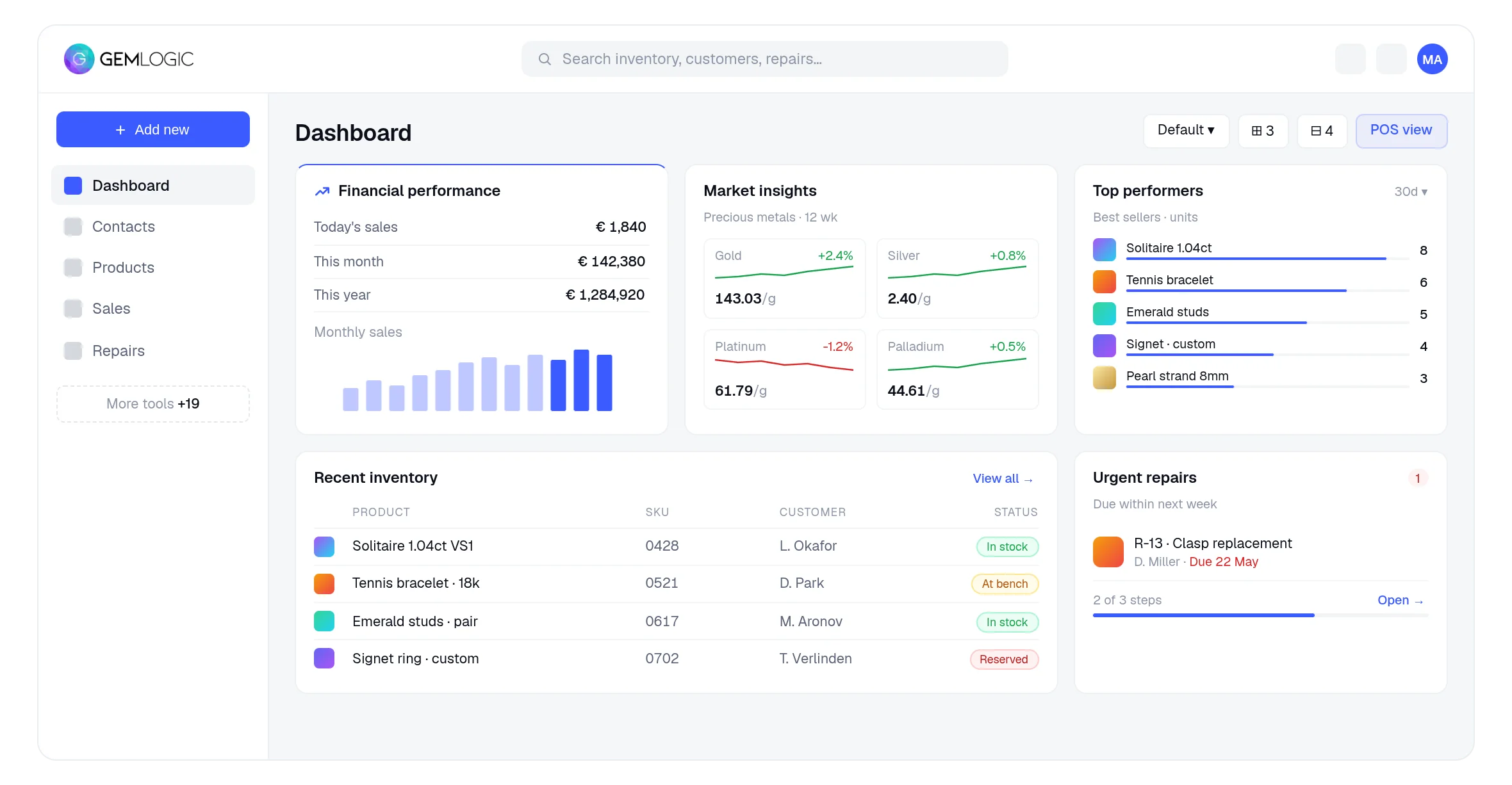
Gem is a talent CRM with sourcing analytics and pipeline tracking built in. For recruiting teams that already use Gem as their sourcing and relationship management platform, the diversity analytics layer adds meaningful visibility into pipeline composition without requiring a separate tool. Diversity sourcing filters, funnel reporting, and outreach analytics sit inside the same platform recruiters use for everyday sourcing work, which increases the likelihood of consistent use.
Teams that do not currently use Gem as a CRM will not find it the most direct path to diversity sourcing capability. A dedicated tool like SeekOut or hireEZ offers more sourcing depth as a starting point.
Key Features
- Diversity sourcing analytics showing pipeline composition by demographic attribute
- CRM pipeline tracking with diversity visibility at each stage
- Automated outreach sequences with engagement tracking
- ATS integrations including Greenhouse, Lever, and Workday
- Reporting on sourcing channel diversity and recruiter outreach patterns
Pros and Cons
Pros: "Scheduled sequences are the best! Love the automated follow ups." - Capterra reviewer
- Low-friction upgrade: For existing Gem users, adding the diversity analytics layer integrates into their established workflow without requiring a new software deployment.
- Tied to sourcing data: Diversity reporting connects directly to the platform's highly rated outreach automation, linking sourcing activity straight to diversity metrics.
Cons: "The pricing feels too high, and at times the place can feel crowded." - G2 reviewer
- High total cost: Diversity features are tied directly to the broader CRM, meaning organizations pay for the entire platform even if their primary focus is strictly DEI recruiting.
- Premium pricing: The overall cost sits at the higher end of the category spectrum.
- Scalability hurdles: As team usage scales, the interface becomes increasingly complex to navigate.
Pricing
Gem offers recruiting software across three tiers: Startups (up to 100 FTE) for sourcing automation and analytics; Growth (101–1,000 FTE) for scheduling, advanced analytics, and unlimited AI sourcing; and Enterprise (1,000+ FTE) for custom ATS integrations and security. Talent marketing and ATS connectors are available as add-ons. Contact sales for custom pricing.
How to Choose the Right Diversity Recruiting Software for Your Team
The right platform depends on where in your hiring funnel the gap actually is. Work through these four buyer profiles before you book a demo.
- If your applicant pool lacks diversity: Start at the top of the funnel. Textio or Datapeople will address language-driven drop-off. SeekOut or hireEZ will address sourcing. Most teams need both: inclusive language pulls in candidates the job post was previously deterring, while proactive sourcing reaches candidates who would not have found the role through inbound channels.
- If diverse candidates apply but do not make it through screening: The problem is in evaluation, not sourcing. Greenhouse's structured hiring tools are the most complete solution for reducing evaluator inconsistency and documenting bias-reduced decision-making. Eightfold AI addresses the same problem at the AI-screening layer for enterprise HR environments.
- If you need to measure and report on DEI program outcomes: Diversio is purpose-built for this. Datapeople covers it at the job-post level. Mathison includes measurement through its Equal Hiring Index framework. Any of these can serve as the reporting layer over an existing program if the sourcing and evaluation tools are already in place.
- If you are a federal contractor with OFCCP obligations: Circa is the clear choice. No other platform on this list provides OFCCP-compliant documentation and outreach tracking as its primary function.
For teams still deciding whether a point solution or a broader recruiting platform is the right move, it helps to map the full diversity recruiting workflow before the first vendor call. Our guide on choosing HR software walks through that process.
It is also worth reading how skills-based hiring connects to diversity outcomes. Reducing credential and pedigree requirements at the screening stage is one of the most structurally effective changes a hiring team can make, and several platforms on this list, Eightfold AI in particular, are built around that principle.
For teams evaluating AI-powered HR software more broadly, the AI matching category overlaps significantly with what the top diversity recruiting tools offer.
Start Building a More Representative Hiring Process
The platforms above solve real problems at specific stages of the hiring funnel. None of them works well as a standalone purchase made without a clear diagnosis of where the funnel breaks. The most common mistake in this category is buying a sourcing tool to fix an evaluation problem, or buying an analytics tool before there is clean funnel data to analyze.
Use the sub-category framework in this guide to identify your specific gap first. Then use the "Best for" labels and buyer profiles above to narrow your shortlist to two or three tools before booking demos.
If you are building a broader HR tech stack alongside a diversity recruiting initiative, start with our guide on how to choose HR software. For teams evaluating the full recruiting category alongside diversity-specific tools, the top recruiting software listicle covers the broader ATS and sourcing market.
.avif)