.svg)
Most software categories have a clear moment when the business case becomes obvious. For performance management software, that moment tends to arrive after a painful review cycle: managers submitting ratings the night before the deadline, employees reading feedback they can't act on, and HR spending three weeks chasing down forms.
The software didn't cause the problem. But it's also not solved yet. This article covers the 10 most well-documented benefits of performance management software, each anchored by a named source and a specific feature that delivers it. It also includes a section on when PM software fails to deliver these benefits, because any honest treatment of the category has to address that.
If you're building a business case for leadership or evaluating platforms for the first time, the evidence here is meant to be usable, not just reassuring.
What Is Performance Management Software?
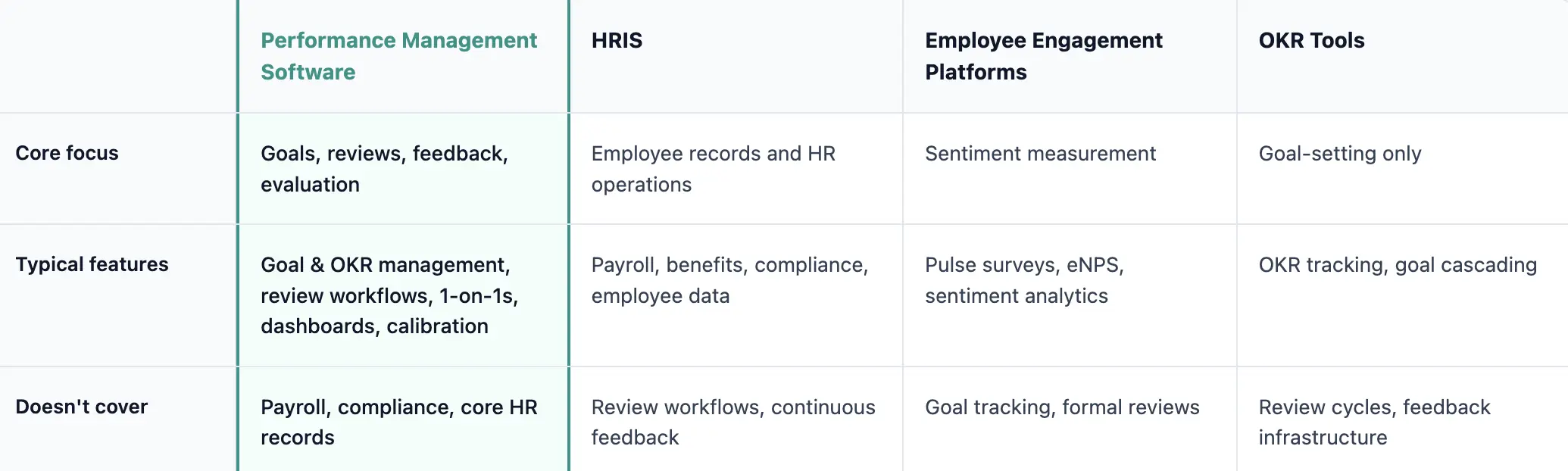
Performance management software is a category of HR technology that structures and supports the ongoing process of setting goals, tracking progress, delivering feedback, and evaluating employee performance.
It's distinct from a full HRIS (which primarily stores employee records and manages HR operations), employee engagement platforms (which focus on sentiment measurement), and standalone OKR tools (which handle goal-setting without the broader review and feedback infrastructure).
In practice, a performance management system typically includes some combination of goal and OKR management, performance review workflows, continuous feedback tools, 1-on-1 meeting templates, manager dashboards, and calibration features.
Leading platforms in the category include Lattice, 15Five, Leapsome, Culture Amp, and Workday HCM. Some, like PerformYard and Teamflect, specialize in specific buyer segments or tech stack integrations.
The 10 Benefits of Performance Management Software
Keeping a growing team aligned requires more than just tracking check-ins. It demands clear data, structured communication, and continuous feedback. Performance management software automates these processes, transforming how companies develop talent and measure success. Here are ten proven benefits of implementing a dedicated platform.
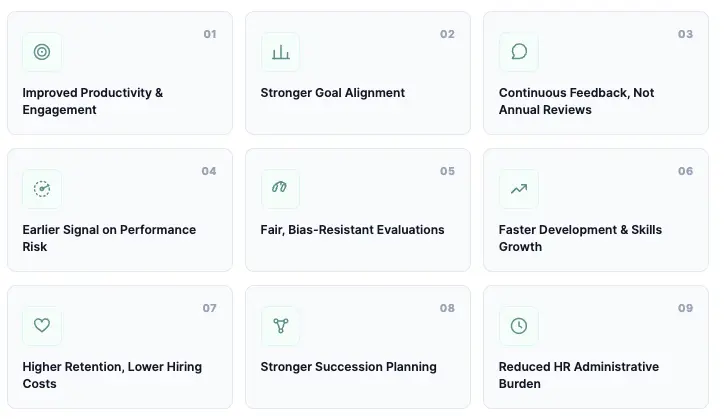
1. Improved Employee Productivity and Engagement
Gallup's 2024 State of the Global Workplace report found that global employee engagement had fallen to 20%, the lowest level recorded in over a decade. That's not a management philosophy problem, it's a structural one. Most organizations simply don't have reliable systems for maintaining the goal clarity, regular feedback, and performance visibility that engagement research consistently ties to.
Performance management software addresses the structural gap. Structured goal-setting gives employees clear targets. Progress dashboards make those targets visible without requiring a status meeting. Real-time feedback closes the loop between effort and recognition. For a platform built specifically around peer recognition and rewards, Bonusly is worth a look.
15Five publishes customer data showing 88% of users report improved manager-employee relationships within six months of implementation. For organizations where engagement has been measured but not improved, this kind of operational infrastructure is the missing layer.
For a broader view of the engagement side of the equation, see our guide to the best employee engagement software.
2. Stronger Alignment Between Individual and Organizational Goals
One of the most consistent findings in organizational research is the gap between company strategy and what individual employees are actually working on day-to-day.
The mechanism is straightforward: when company-level goals cascade to department, team, and individual level with visible linkages, employees understand how their work connects to the broader direction. Performance management systems deliver this through cascading OKR frameworks, real-time progress dashboards, and cross-team goal visibility.
Lattice and Leapsome both built their platforms around OKR methodology from early in their product development, specifically because alignment is one of the most measurable outputs a PM platform can produce. For organizations where "strategic alignment" exists in the all-hands deck but not in day-to-day work, this feature is where the ROI starts.
If your organization is evaluating dedicated goal-setting tools alongside full PM platforms, our top OKR software guide covers the distinction.
3. Continuous Feedback That Replaces the Annual Review
The research on annual performance reviews is not favorable. Gallup found that only 14% of employees strongly agree their performance review inspires improvement. Separately, 65% of employees say they want more feedback than they currently receive..
The annual review fails not because managers lack good intentions but because feedback delayed by 12 months isn't actionable. Performance management software shifts the cadence. 15Five built its platform around the concept of a weekly employee check-in that takes 15 minutes to complete and 5 minutes for a manager to review.
Lattice's 1-on-1 module supports continuous conversations alongside formal review cycles. Adobe's 2012 decision to eliminate annual reviews and replace them with regular "check-ins" is the most-cited case study in the category: voluntary turnover fell by 30% in the years following the change, per Adobe's own disclosures and subsequent Harvard Business Review coverage.
For a closer look at the feedback infrastructure that supports continuous review models, see our 360-degree feedback software guide.
4. Earlier Identification of High Performers and Performance Risks
Most organizations identify performance problems when they become visible to the naked eye: a missed deadline, a team complaint, a resignation. By then, the cost of intervention is higher than it needed to be. One of the more durable advantages of performance management systems is the ability to surface signals earlier.
Workday operates more than 65 production AI use cases, including skills inference and attrition prediction models that flag patterns weeks or months before they'd surface in a manager conversation.
Beyond predictive modeling, the more immediate value is performance dashboards that aggregate review scores, goal progress, and feedback frequency into a single view. Calibration tools allow HR and senior managers to compare performance distributions across teams and spot both outliers and underdeveloped high-potential employees before they leave.
Workday HCM, Ashby, and Visier all offer analytics-heavy approaches to early performance identification. Even mid-market platforms like Lattice and Culture Amp have built meaningful dashboards into their core product.
5. Fair, Consistent, and Bias-Resistant Evaluations
Research published by Harvard Business Review found that without structured calibration, managers exhibit measurable rating bias by gender, race, and tenure. The problem isn't unique to bad managers, it's a consequence of unstructured evaluation. When each manager assesses employees against their own mental model of what "good" looks like, the resulting ratings reflect manager-employee similarity more than actual performance.
Calibration sessions, supported by tools like Lattice and Culture Amp Performance Insights, allow cross-manager comparison using consistent data. Lattice and Culture Amp take real differences into this: Lattice leans on 9-box grids and compensation-linked calibration, while Culture Amp weights its Performance Insights more toward engagement-correlated analytics.
The same methodology that Greenhouse pioneered for structured interview kits in hiring applies directly to performance evaluation: consistent criteria, applied consistently, by every evaluator. Understanding the different forms of performance review bias can help HR teams build more consistent evaluation processes.
Our 360-degree feedback software guide covers the peer feedback layer that further reduces single-manager bias.
6. Faster Employee Development and Skills Growth
McKinsey's HR Monitor 2025 found that 77% of organizations have formal skills taxonomies, but only 30% connect that data to individual development planning. The skills data exists. The bridge between that data and actual employee growth typically doesn't.
Performance management platforms close the gap through individual development plans that connect directly to review outcomes. When a performance review identifies a skills gap, a well-implemented PM system routes that finding into a development plan, links it to recommended learning content, and tracks progress over time.
Leapsome and Lattice both include development planning modules that pull from performance review data and, in Leapsome's case, connect directly to integrated learning pathways. For organizations where development conversations happen but development plans don't, this is the structural mechanism that turns intent into outcome.
Career coaching software addresses a related but narrower gap: the actual coaching relationship itself, rather than the planning and tracking infrastructure a PM platform provides.
7. Higher Retention and Lower Hiring Costs
The business case for retention doesn't need much elaboration: SHRM's Human Capital Benchmarking Report (2025) estimates that replacing one employee costs between 50 and 200% of their annual salary, depending on role complexity.
For a 200-person company with 20% annual turnover, that figure runs into millions of dollars each year. What the number often obscures is how much of that turnover was avoidable. Joint research from Workhuman and SHRM (2025) found that employees who feel regularly recognized are 45% less likely to leave within two years.
That's not a culture slogan; it's a measurable behavior tied to a specific management practice. Performance management software delivers the infrastructure for that practice: regular recognition built into check-in workflows, growth visibility through development plans, and manager coaching tools that surface disengagement signals before they become resignation letters.
8. Stronger Succession Planning and Talent Visibility
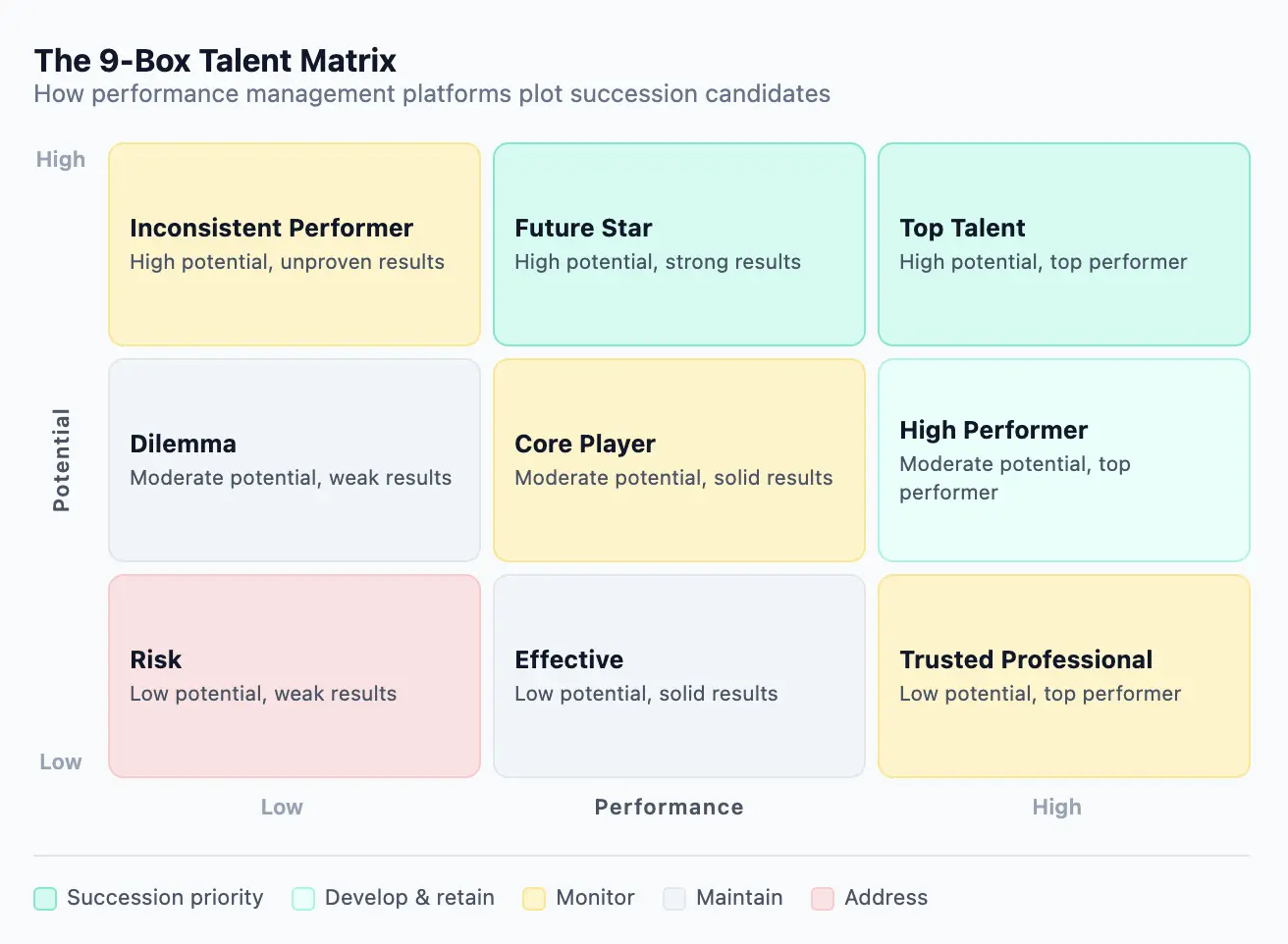
McKinsey's 2025 research found that only 12% of US HR leaders engage in strategic workforce planning beyond a one-year horizon. For most organizations, succession planning is a spreadsheet that gets updated once a year and reviewed when someone unexpectedly leaves. The result is reactive: organizations scramble to fill critical roles rather than developing internal candidates in advance.
Performance management systems support a more structured approach through 9-box talent matrices, succession dashboards, and readiness assessments. These tools aggregate performance history, development progress, and manager assessments into talent profiles that make internal succession candidates visible and comparable.
Workday, SAP SuccessFactors, and Lattice all offer succession planning modules; for mid-market organizations, Lattice's implementation is meaningfully simpler than enterprise HCM alternatives without sacrificing core functionality.
For dedicated succession planning tools, see our best succession planning software guide. For more on the workforce planning process itself, our workforce planning article covers the broader strategic framework.
9. Reduced HR Administrative Burden
This one is operational, not strategic, and it often matters more to the HR team building the business case than to the leadership team approving the budget. HR teams consistently report 60 to 80% reductions in performance review cycle administration time after implementing PM software, based on customer data published by multiple platforms.
For a 500-person organization running two formal review cycles per year, that reduction translates to several hundred hours redirected from form collection and reminder emails to actual coaching and development work. The features delivering this reduction are less glamorous than OKR dashboards: automated reminders, template libraries, centralized records, e-signature integration, and completion tracking.
PerformYard and 15Five both position rapid implementation and low HR administration overhead as core selling points, specifically because administrative burden is one of the most frequently cited reasons organizations look for a new PM platform in the first place.
10. Data-Driven Workforce Decisions
McKinsey's HR Monitor 2025 found that 93% of organizations formally document employee skills in their HR systems, but only 30% use that data when making workforce decisions. The data exists in most organizations. The problem is that it sits in systems that weren't designed to inform decisions, managed by processes that don't connect to the questions leadership is actually asking.
Performance management systems address this through analytics dashboards, custom reporting, integrated talent profiles, and, in more mature platforms, predictive modeling. Ashby in recruiting and Visier in HR analytics represent what a mature analytics layer looks like: the leading PM platforms, including Workday, Culture Amp, and Lattice, are converging on similar capabilities at the workforce level.
The questions these tools can answer in practice, which teams have the highest attrition risk, which high performers are under recognized, which managers have the widest performance distribution across their teams, are the questions that tend to move leadership from interested to convinced. For a dedicated look at HR analytics tools, see our best HR analytics software guide.
When Performance Management Software Fails to Deliver
A platform can track goals and schedule check-ins, but it cannot force meaningful communication. When organizations fail to see the promised results from their software, the root cause is rarely the technology itself, but rather how it is introduced and maintained.
Manager non-adoption
The most thoroughly documented finding in engagement research is that the manager-employee relationship drives more than 70% of variance in team engagement. Performance management software gives managers structure, prompts, and tools. It cannot replace the willingness to use them.
Organizations that implement PM platforms without pairing them with manager training consistently report lower adoption and weaker outcomes than those that treat the platform as one component of a broader behavior-change effort.
Surface-only implementation
Many organizations deploy PM software for the annual or biannual review cycle and then close the application for the remaining 10 months. Every continuous-feedback benefit, such as the 14.9% lower turnover Gallup associates with continuous feedback, and the engagement gains tied to regular recognition, depends on the platform being used consistently throughout the year. If your organization is running annual reviews today, the software doesn't change that by itself.
Gamed metrics
Any goal-tracking system creates an incentive to manage the goal rather than the outcome behind it. Performance management software amplifies this risk by making goal progress more visible across the organization.
The countermeasure is rigorous goal design, OKRs structured around outcomes rather than activities, combined with calibration workflows that catch rating inflation. The absence of measurement is not the solution.
How to Choose Software That Actually Delivers These Benefits
Evaluating PM software against a feature checklist produces a different result than evaluating it against the specific outcomes you're trying to achieve. Four criteria matter more than most.
Match the platform to your organizational size and maturity
Lattice, 15Five, and Leapsome serve organizations with roughly 50 to 2,000 employees well. PerformYard is well-suited to organizations of 25 to 500 employees that need solid review and goal management without broader platform overhead. Workday and SAP SuccessFactors are designed for enterprises of 1,000 or more. Buying above your scale wastes the budget on complexity you can't use. Buying below it creates ceilings you'll hit within two years.
Evaluate the continuous-feedback mechanics, not just the review cycle
Annual review automation is a baseline expectation in 2026, not a differentiator. What separates good platforms from adequate ones is whether managers actually conduct weekly check-ins and 1-on-1s inside the tool and whether the platform is designed to make that realistic for a manager with eight direct reports. Ask vendors for adoption data from existing customers, not feature demonstrations.
Verify analytics depth against your specific reporting needs
Most platforms ship with dashboards. Fewer have the analytics depth to answer the questions that matter to HR leadership: cost-per-hire variance by performance rating, attrition risk modeling by team, or high-performer recognition gaps by manager. Test the analytics directly with your own data, not the pre-loaded demo environment.
Check the integration with your HRIS
PM software that requires manual employee list maintenance breaks within months. Real-time HRIS sync, not scheduled CSV imports, is the operational difference between a platform that scales and one that doesn't. Ask for technical documentation on the integration before any contract conversation.
For a curated shortlist of platforms that meet these criteria, see our guide to the best performance management software in 2026.
Next Steps
The business case for performance management software is well-supported by data. The harder part is identifying which platform fits your organization's size, tech stack, and current HR maturity.
Our independently evaluated guide to the best performance management software in 2026 covers the leading platforms with scored rubrics, verified pricing, and honest assessments of who each tool is and isn't built for.
If you're still working through what to look for before comparing platforms, our companion article on what to look for in performance management software covers the evaluation framework in more detail. For broader HR software investment decisions, our HR software buying guide is the right starting point.
.avif)