.svg)
Every executive table agrees that long-term staffing strategy is vital, yet most organizations still treat hiring as an immediate fire to put out. According to SHRM, 92% of HR professionals recognize the importance of workforce planning, yet only 42% believe their organization executes it effectively.
This gap highlights a common reality: workforce planning is highly praised in annual strategy meetings but quickly sidelined when immediate hiring targets and urgent requisitions take over. As a result, companies are forced into a reactive cycle, where emergency hiring costs far outpace the investment needed for proactive planning.
This guide clarifies what workforce planning truly entails, outlines a step-by-step process, and identifies the common pitfalls to avoid.
What Is Workforce Planning?

Workforce planning is the strategic, data-driven process by which an organization ensures it has the right people, with the right skills, in the right roles, at the right time to meet its business objectives. It involves analyzing the current workforce, forecasting future talent demand, identifying gaps, and building strategies to close them through hiring, development, or workforce restructuring.
Three concepts anchor the whole framework:
- Supply, which describes the workforce you currently have, including headcount, skills, tenure, and turnover patterns
- Demand, or the workforce you'll need to deliver your business strategy over a defined time horizon
- Gap, which is the difference between the two, which becomes the workforce planning problem statement
Everything else in the process is about closing that gap in the most effective way possible.
Why Workforce Planning Matters
The cost-of-inaction argument for workforce planning is fairly concrete, and it's worth making explicit before getting into the process. Without a deliberate strategy, organizations face significant financial and operational strain.
The Real Cost of Turnover
SHRM's Human Capital Benchmarking Report puts the average cost per hire at $4,700. Replacing an employee, depending on role complexity, runs 50% to 200% of their annual salary when you account for lost productivity, recruiting costs, and ramp time.
Beyond cost control, forward-looking strategies directly impact organizational agility. According to SHRM's 2026 research, organizations that predict workplace trends are 61% more likely to excel at driving change, compared to just 45% of those that do not.
The Reactive Hiring Cycle
Without a workforce plan, organizations tend to fall into a predictable, damaging pattern:
- A critical role opens up without warning.
- The team rushes to hire, shortening the evaluation window.
- The rushed process produces a weaker candidate pool.
- The wrong person is selected, or a qualified candidate is placed into a poorly defined role.
- The new hire leaves within eighteen months, and the cycle repeats.
Proactive vs. Reactive Management
Strategic workforce planning does not eliminate attrition or skills gaps entirely. Instead, it reduces the frequency of this emergency-response cycle and replaces it with a more deliberate, less expensive approach.
The financial and operational difference between a well-run hiring process and a reactive one compounds over time, particularly for organizations scaling quickly or navigating automation-driven role changes.
Strategic vs Operational Workforce Planning
Strategic and operational workforce planning are two concepts that describe genuinely different activities, and conflating them is one of the more common planning errors. Both types of planning matter: operational planning keeps the business running today, while strategic planning determines whether you are building the team required for tomorrow.
Operational Workforce Planning
Operational workforce planning is short-term and tactical. It covers immediate staffing needs: open requisitions, current team capacity, coverage for upcoming leave, and next quarter's headcount budget. Most organizations do this by default, even if they don't call it workforce planning. It is the tactical work that happens in a hiring manager's spreadsheet and a weekly HR standup.
Strategic Workforce Planning
Strategic workforce planning operates on a longer horizon, typically three years or more. It shifts the focus from current vacancies to future capabilities, asking questions like:
- What skills will our business need as we expand into new markets?
- Which roles are at high risk of automation over the next five years?
- Are we building toward the organizational design our strategy requires, or just backfilling what we lose?
Despite its importance, long-term planning remains rare. McKinsey's 2025 research found that only 12% of US HR leaders engage in workforce planning at this horizon.
Key Differences At a Glance
Without a strategic layer, even well-executed operational planning remains reactive, filling immediate gaps rather than anticipating structural shifts. The table below outlines how these two approaches compare across core operational areas.
The Workforce Planning Process
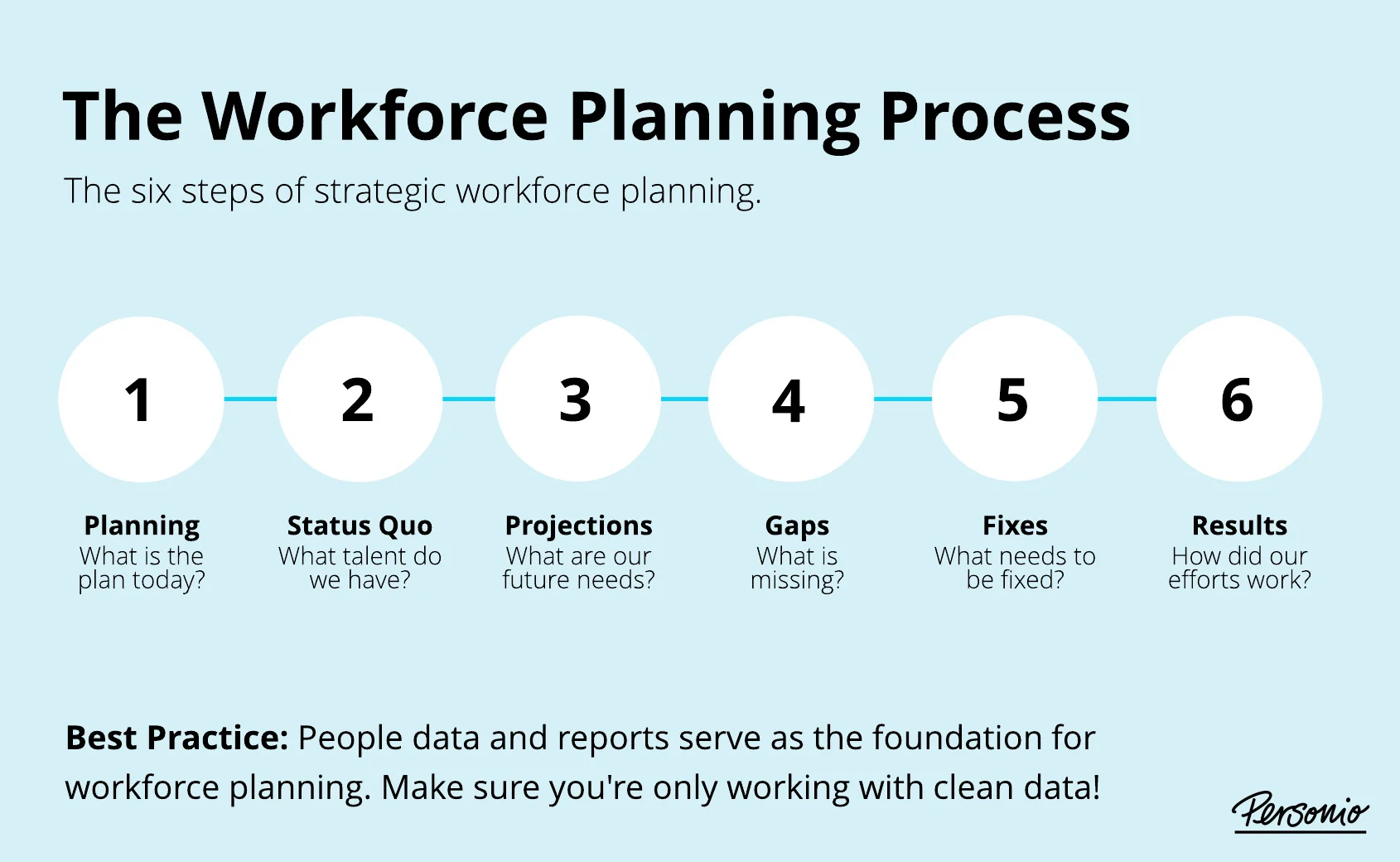
A structured workforce planning process has six steps. The sequence matters because each step builds on the outputs of the one before it.
Step 1: Align with Business Strategy
Workforce planning starts with the business plan, not the HR plan. Before analyzing headcount or skill gaps, the planning team needs to understand where the organization is headed over the next one to five years: revenue targets, new product lines, planned market expansion, automation initiatives, and any significant organizational changes.
The workforce required to deliver that strategy becomes the demand side of the equation. A workforce plan that's not grounded in the business strategy tends to reflect past assumptions rather than future requirements.
Step 2: Analyze Your Current Workforce
The supply analysis inventories the workforce you have today. That means headcount by team and function, skills available across the organization, performance levels, tenure distribution, demographic data, and turnover patterns by role and department.
This step is heavily dependent on the quality of your HRIS data. If employee records are incomplete, skills data is outdated, or turnover reasons aren't tracked systematically, the supply picture will be unreliable, and every subsequent step will compound that error. Before running the analysis, it's worth auditing the data itself.
Step 3: Forecast Future Demand
With the business strategy in hand, the next step is projecting the workforce you'll need to execute it by role, skill level, and timeframe. This involves more than headcount math. It requires accounting for known disruptions: which roles automation will affect, where retirements are likely to create gaps, how scaling plans will change team composition.
SHRM's 2026 data brief, based on a survey of more than 20,000 US workers, found that 15.1% of US jobs are at least 50% automated and 7.8% rely heavily on generative AI. Organizations that haven't incorporated that kind of data into their demand forecast are likely underestimating how much their workforce needs to shift.
Step 4: Identify the Gaps
Comparing the supply analysis to the demand forecast produces the gap analysis, which is the actual workforce planning problem statement. Gaps tend to fall into three categories: too few people relative to projected needs, skill mismatches where the right headcount exists but not the right capabilities, and geographic or organizational misalignment where people are in the wrong locations or reporting structures. Naming the type of gap matters because each one calls for a different response.
Step 5: Build the Action Plan
For each identified gap, the planning team decides how to close it. The options are not limited to hiring. Internal development programs can build skills that don't yet exist in the workforce. Contractor or gig arrangements can cover capacity needs that don't warrant a permanent hire.
Restructuring can realign people toward higher-priority functions. Automation can reduce demand for certain roles. Most action plans combine several of these approaches. Each action needs a budget owner, a timeline, and a metric for evaluating whether it worked.
Step 6: Execute and Review
A workforce plan that gets written and filed is not a workforce plan. It's a document. The most common failure mode in workforce planning is not poor analysis; it's the absence of any mechanism for updating the plan as conditions change.
At a minimum, the plan should be reviewed quarterly against actual hiring results, attrition data, and changes to the business strategy. Workforce planning is an ongoing process, not an annual deliverable.
Workforce Planning Examples
The theory behind workforce planning is abstract until you see it applied. Here are three scenarios that illustrate how matching supply and demand looks across different industries and horizons.
Scenario 1: Tech Company Engineering Capacity
A 300-person software company is building toward a major product launch in Q3 of the following year. The roadmap calls for three new features, each requiring specialized backend engineering skills that the current team lacks in sufficient depth.
- Demand Forecast: Analysis of the product roadmap identifies a need for six senior backend roles and four data infrastructure roles, all required to be in place by Q1.
- Supply Analysis: Evaluation of the current team shows two internal engineers who could develop into senior roles with structured development over eight months.
- Action Plan: The company builds an internal development track for those two engineers, reducing the external hiring requirement to four senior roles and one data infrastructure hire, saving on recruiting costs and preserving institutional knowledge.
Scenario 2: Retail Organization Seasonal Capacity
A national retailer needs to triple its frontline workforce to handle a twelve-week holiday rush. Instead of treating all holiday hiring as an interchangeable volume play, the company uses historical data to plan more strategically.
- Demand Forecast: The company projects seasonal foot traffic and transaction volumes to calculate the exact headcount needed per store location.
- Supply Analysis: HR reviews post-holiday retention data from prior years to identify high-performing seasonal workers who typically want to stay long-term.
- Action Plan: The plan distinguishes between pure seasonal hires and roles worth converting to permanent staff. It allocates different budgets and sourcing strategies to each category, securing long-term talent while managing short-term labor costs.
Scenario 3: Manufacturing Company Automation Transition
A manufacturing plant running a modernization program will automate three production lines over an eighteen-month period. This technological shift will reduce the need for roughly forty traditional machine operators.
- Demand Forecast: While the automation eliminates operator roles, it creates a new demand for specialized equipment maintenance and quality control technicians.
- Supply Analysis: A skills-mapping exercise identifies which of the forty affected operators possess adjacent technical skills or high aptitude for mechanical troubleshooting.
- Action Plan: The company launches a targeted reskilling program that successfully transitions twenty-two of the forty workers into the new technical roles. The remaining eighteen positions are managed through a combination of voluntary separation packages and natural attrition, avoiding the disruption and cost of involuntary layoffs.
The Core Logic
Every industry faces different operational hurdles, but effective workforce planning always follows the same basic formula: measure the talent you have, forecast the talent your strategy requires, and build a deliberate plan to close the gap.
Common Workforce Planning Models
Most organizations use a hybrid approach rather than adopting one framework wholesale. A working knowledge of the main models helps when designing a process that fits your specific business context.
CIPD/SHRM Gap Model
This is the traditional supply-demand-gap framework. As the foundation of most modern workforce planning, it focuses on forecasting future needs, analyzing current talent supply, and building action plans to bridge the difference. If your organization is earlier in its workforce planning maturity, this model is the most practical starting point.
HCI 8-Step Approach
Developed by the Human Capital Institute, this formally structured framework emphasizes analytical discipline at each stage. It places heavy emphasis on strategic alignment and deep data tracking, making it common in mature HR functions that possess dedicated analytics resources.
OPM Model
Created by the US Office of Personnel Management specifically for federal agencies, this five-step framework is highly formalized. It is exceptionally well-suited to public-sector environments, government contractors, and highly regulated industries where compliance, transparency, and strict, structured role definitions are priorities.
Skills-Based Planning
This contemporary approach centers its analysis on skills rather than rigid job titles. Instead of planning for a specific number of "Data Analyst" roles, it maps the underlying capabilities the business needs, such as data visualization or statistical modeling, and analyzes where those skills exist or can be built.
Common Mistakes to Avoid
Most workforce planning failures follow recognizable patterns. If you're building or auditing a planning process, check against this list.
- Counting heads instead of skills: Ten people with outdated skills can represent a larger gap than four well-placed, highly capable ones. Headcount is a proxy for capacity; skills are the actual planning unit.
- Treating it as a one-time annual exercise: Business conditions change quarterly. A plan that's only revisited once a year is out of date for most of its life.
- Disconnecting skills data from the plan: McKinsey's HR Monitor found that 93% of organizations document employee skills in HR systems, but only 30% connect that data to workforce planning. Documenting skills and using them in planning are different activities.
- Focusing exclusively on hiring while ignoring retention: Retention failures generate the gaps that hiring is trying to fill. A workforce plan that doesn't address why people leave will keep producing the same problem.
- Building the plan without finance: A workforce plan that doesn't survive a budget conversation has limited value. Involving finance early ensures the action plan reflects what the organization can actually fund.
Workforce Planning Software and Tools
At a small scale, workforce planning can run on spreadsheets. At a larger scale, or in organizations with complex structures and high attrition, spreadsheets introduce data quality problems that undermine the analysis.
The software categories that support workforce planning are:
- HRIS systems act as the data foundation. Employee records, org structure, skills data, and turnover reporting need to live in a reliable, well-maintained system.
- HR analytics platforms connect HR data to business outcomes, including turnover prediction and capacity modeling.
- Workforce management software handles operational planning, including scheduling, time tracking, and capacity utilization for shift-based or frontline workforces. Dedicated workforce planning platforms like Visier, Orgvue, and ChartHop offer advanced scenario modeling and analytics for organizations running formal workforce planning functions.
- Succession planning software addresses the adjacent challenge of leadership pipeline planning, ensuring critical roles have ready talent when vacancies arise.
Selecting tools from these categories depends heavily on your current infrastructure and long-term goals. Because workforce planning relies so heavily on clean, interconnected data, evaluating new tools requires a clear framework.
If you are currently auditing your tech stack or preparing to invest in new platforms, our how to choose HR software buyer's guide breaks down the essential selection criteria, integration requirements, and vendor assessment strategies you need to find the right match.
Moreover, two related concepts are also worth understanding alongside workforce planning: people analytics, which provides the data infrastructure workforce planning depends on, and skills-based hiring, which connects directly to the skills-first planning models described above.
Next Steps
If you're starting from scratch, the first step is not software. It's data quality. Run an audit of your HRIS records: what's complete, what's outdated, and what's missing entirely. Every subsequent step in the workforce planning process depends on the reliability of that foundation.
.avif)