.svg)
Rather than compressing a year of feedback into one annual review, continuous performance management spreads it across regular check-ins, updated goals, and ongoing conversations.
Implementation runs through eight steps:
- Decide what happens to ratings and compensation
- Name an executive sponsor
- Define the check-in
- Rewrite goals so they can change mid-cycle
- Train managers on delivering feedback
- Pilot in one function for a full quarter
- Choose tooling only after the process works
- Review the program quarterly
The decisions in steps one and two can shape the success of the remaining rollout.
Key Takeaways
- Continuous performance management replaces the once-a-year review with regular check-ins, updated goals, and feedback that happens throughout the year.
- Manager capability decides whether it works. Employees who get valuable feedback are five times more likely to be engaged, per Gallup and Workhuman, but rollouts usually stall when training covers the software instead of the conversation.
- U.S. employee engagement hit an 11-year low of 30% in 2024, and Gallup ties much of that decline to how performance management itself is run, not just how often reviews happen.
What Is Continuous Performance Management?
Continuous performance management supplements or replaces the traditional annual-review cycle with year-round check-ins, goal updates, and feedback. Getting this right matters because small problems compound when they sit unaddressed for months at a time, and by the time an annual review surfaces them, the moment to course correct has usually passed.
Gallup found that U.S. employee engagement hit an 11-year low of 30% in 2024. This research identifies ineffective performance-management practices among several factors associated with employee detachment.
In a continuous model, the annual review, if it exists, summarizes a year of documented conversations rather than reconstructing one from memory. What changes is not whether ratings exist, but when and how performance information flows.
Continuous Performance Management vs Traditional Performance Management
The table below shows how the two models differ across the dimensions that matter most for implementation planning:
How to Implement Continuous Performance Management: 8 Steps
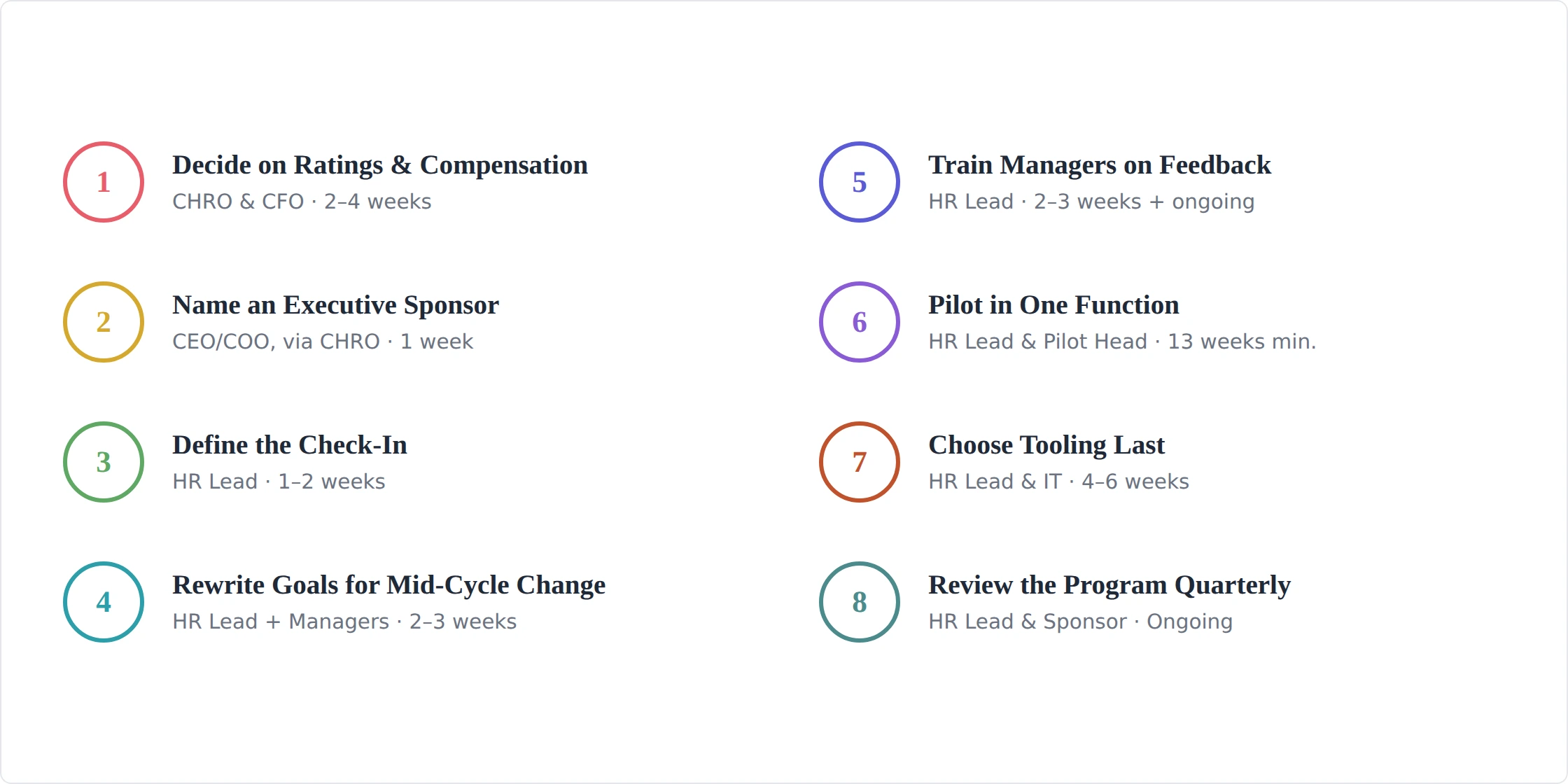
Work through these in sequence. The decisions made in the first two steps can shape the success of the remaining rollout, and skipping them can create issues that are harder to address during the pilot.
Step 1: Decide What Happens to Ratings and Compensation
Owner: CHRO and CFO | Duration: 2 to 4 weeks
Before any manager communication goes out, the CHRO and CFO need to settle one question: does the continuous check-in cadence change how performance feeds into pay and promotion, or does it sit alongside the existing rating structure unchanged? If it remains unclear, employees may interpret check-ins as evaluative rather than developmental.
Example: You can keep numeric ratings while formally documenting that check-ins are developmental and do not feed directly into merit pay. Communicate this in the program launch email and include it in a check-in FAQ sent to all employees before the first session.
Step 2: Name an Executive Sponsor
Owner: CEO or COO, identified by the CHRO | Duration: One week to identify; present throughout the rollout
Leadership buy-in is a sentiment. An executive sponsor is a person with a name, a budget line, and a standing agenda item who absorbs the political friction of the change at the level where it is heaviest. Without one, that friction lands entirely on HR. A steering committee with no single accountable person rarely sustains momentum.
Example: You can ask your COO to block 30 minutes on the quarterly all-hands agenda to report on check-in completion rates, framing the program as a business priority rather than an HR initiative. When managers push back on the time investment, the sponsor addresses it directly rather than delegating the response to HR.
Step 3: Define the Check-In
Owner: HR lead | Duration: 1 to 2 weeks to design; documented before the pilot begins
The check-in is the unit of the system. Rather than giving managers a range to interpret, define a concrete default they can adopt immediately. 'It depends on the manager' is not a design decision; it is the absence of one.
Example: You can set a default of biweekly, 30 minutes, manager-initiated but employee-led. The employee brings progress on current goals, anything blocking them, and one development question. The manager brings one specific observation from the past two weeks. Both parties take notes in a shared running document.
Step 4: Rewrite Goals So They Can Change Mid-Cycle
Owner: HR lead with manager input | Duration: 2 to 3 weeks, completed before the pilot begins
Annual goals can become outdated when business priorities change mid-year. Before the pilot begins, give managers explicit permission to modify goals in writing, define who can approve a change, and require a brief log entry for every modification. For employees joining mid-year, first goals are often set during onboarding, where onboarding software and performance management systems should connect.
Example: You and a direct report may agree in May that a product launch goal is no longer relevant after a strategic pivot. Log a two-sentence note in the goal record explaining the change and what replaced it. At year-end, the review reflects the updated goal rather than the obsolete original.
Step 5: Train Managers on Delivering Feedback
Owner: HR lead (design); direct manager of managers (delivery) | Duration: 2 to 3 weeks before the pilot; ongoing after
Manager capability is often among the most significant factors in whether continuous PM works. Gallup and Workhuman (2024) found that employees who strongly agree they receive valuable feedback are five times as likely to be engaged, 57% less likely to report burnout, and 48% less likely to be looking for another job. The bottleneck is not the platform; it is managers who can deliver that feedback consistently.
Example: Rather than a one-hour platform walkthrough, you can run a two-session workshop. The first covers how to open a check-in that invites honesty and how to give specific behavioral feedback. The second is a role-play where managers practice the conversation they dread most: telling an employee their performance is below expectations in a way that is honest, specific, and actionable.
Step 6: Pilot in One Function for a Full Quarter
Owner: HR lead and pilot function head | Duration: 13 weeks minimum
A pilot shorter than a full quarter may not reveal how the process holds up after initial adoption. Some failure modes may emerge only after several check-ins, once initial novelty has faded and managers are under delivery pressure. Establish baseline metrics before the pilot begins so success or failure is a matter of evidence, not opinion.
Example: You can pilot with the customer success function, 35 employees across three managers. Before week one, capture current check-in frequency, a two-question employee pulse on feedback quality, and manager time investment. At week six, a mid-pilot pulse may surface that one manager's check-ins are running 10 minutes and covering only task status. You can address it before it compounds for the rest of the quarter.
Step 7: Choose Tooling Only After the Process Works on Paper
Owner: HR lead and IT | Duration: 4 to 6 weeks of evaluation after the pilot completes
Buying a platform before defining the process can embed unresolved process decisions into the configuration. Settle the check-in cadence, goal architecture, rating structure, and how check-ins connect to review cycles before evaluating any software. Our performance management software roundup covers the leading platforms, and our comparison pages let you evaluate options side by side, including AI-powered HR tools.
Example: After a successful pilot, you can evaluate three platforms and eliminate two early because their goal modules don't support mid-cycle edits with a change log. Select the one that maps directly to the check-in format and goal architecture your pilot validated, not necessarily the one with the most features.
Step 8: Review the Program Quarterly and Publish What Changed
Owner: HR lead and executive sponsor | Duration: Ongoing; 2-week review cycle per quarter
Continuous PM requires its own continuous review cycle. Every quarter, assess check-in completion rates, feedback quality scores, and goal currency. When feasible, communicate the changes made in response to recurring feedback from employees and managers. Participation may decline if employees do not see how their feedback informs improvements to the process.
Example: After Q2, you can publish a one-paragraph update to all employees: 'Based on your feedback, we shortened the check-in agenda from five questions to three. The two we removed were about long-term career goals, which managers told us felt premature for a 30-minute session. We have moved those to the quarterly development conversation instead.'
What Does a Realistic Rollout Timeline Look Like?
The following six-month timeline covers the period from the leadership decision to the end of the pilot. Full organization rollout, if the pilot succeeds, typically takes another quarter.
How Do You Measure Continuous Performance Management?
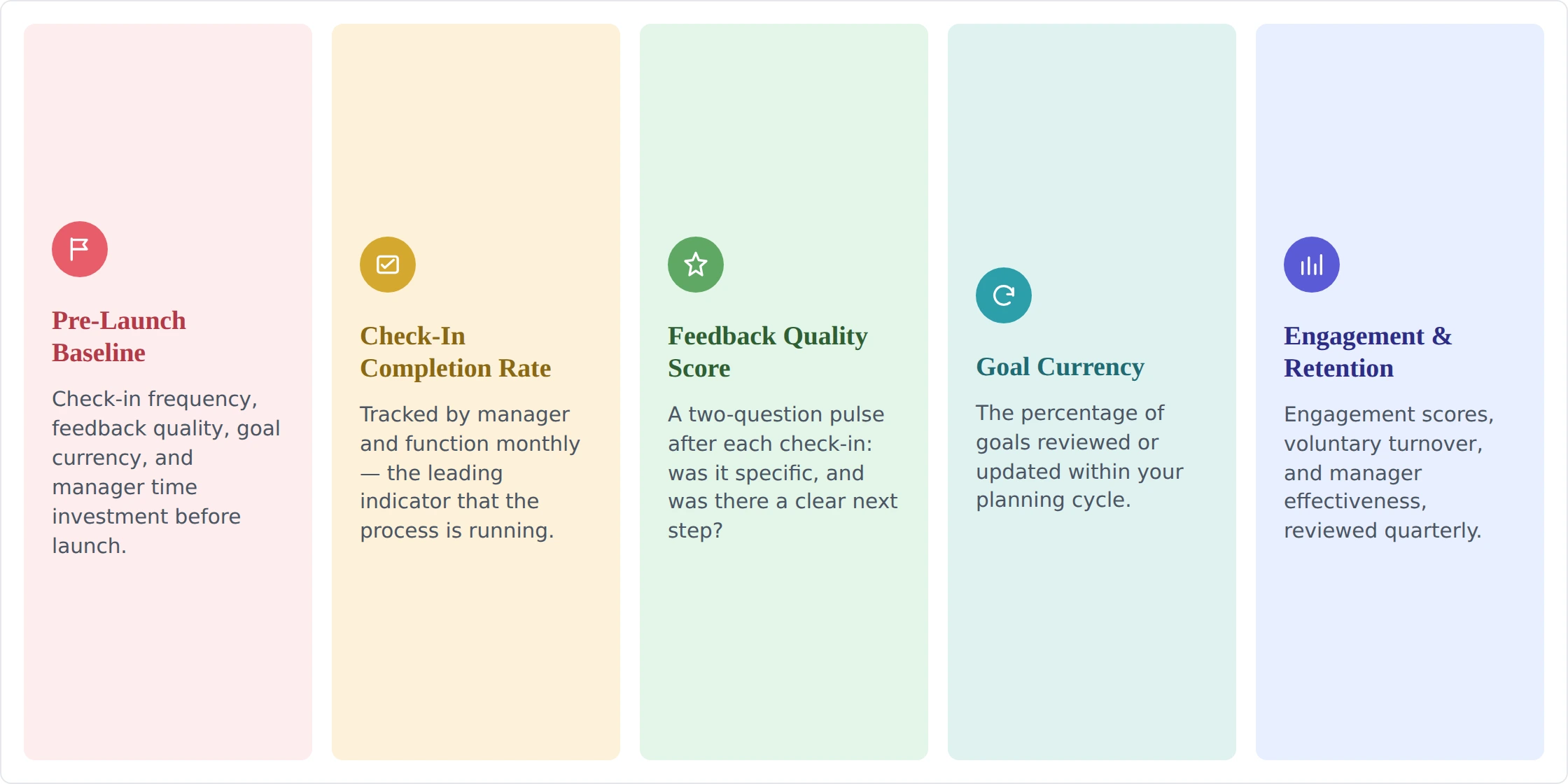
Measurement has three layers: baseline capture before the program launches, leading indicators that show whether the process is running as designed, and lagging indicators that show whether it is producing the outcomes it was designed to produce. Set reporting cadences before launch so measurement happens by design, not reactively.
- Pre-Launch Baseline: Capture current check-in frequency, employee-reported feedback quality from a pre-launch pulse survey, goal currency (the percentage of goals reviewed or updated within a timeframe that fits your planning cycle), and manager time investment in performance-related conversations.
- Check-In Completion Rate: Track by manager and function monthly. This is the leading indicator that tells you whether the process is running at all. Set a completion-rate target based on the team's size, workload, and intended cadence. Investigate sustained declines or meaningful variation across managers.
- Feedback Quality Score: A two-question employee pulse after each check-in session. Keep it short: did the conversation cover something specific, and did you leave with a clear next step? Score monthly and flag outlier managers early.
- Goal Currency: The percentage of goals reviewed or updated within a timeframe that fits your planning cycle. A high proportion of outdated goals may indicate that goal reviews are not keeping pace with changing work priorities. Track alongside completion rate.
- Engagement and Retention Outcomes: Employee engagement scores by function, voluntary turnover rate against pre-program baseline, and manager effectiveness from skip-level feedback. Use HR analytics tools to track trend lines rather than point-in-time snapshots. Review quarterly.
Why Do Continuous Performance Management Rollouts Fail?
Continuous performance management rollouts can lose momentum over time. Common implementation risks include the following:
Do You Need Performance Management Software?
Not immediately, and not before the process is defined. Continuous performance management can run on a shared document, a calendar invite, and a consistent conversation. Most organizations benefit from purpose-built tooling after the process is validated, because software reduces the administrative overhead of check-in scheduling, goal tracking, and documentation.
Our performance management software roundup covers the leading platforms and what to evaluate in each. If you're comparing specific options, our comparison pages and platform reviews cover pricing, features, and implementation in detail.
Frequently Asked Questions (FAQs)
How is continuous performance management different from annual reviews?
Annual reviews evaluate performance once or twice a year, typically reconstructed from memory or sparse documentation. Continuous performance management creates a year-round record through regular check-ins, so the end-of-year conversation summarizes documented evidence rather than attempting to reconstruct the year. Ratings may or may not be part of a continuous model; that is a design decision, not a definitional one.
How long does it take to implement continuous performance management?
Plan for six months from the leadership decision to the end of the pilot: roughly eight weeks for design and training, thirteen weeks for a full-quarter pilot, and four to six weeks for evaluation and expansion planning. Full organization rollout, if the pilot succeeds, adds another quarter. Organizations that compress this timeline may have less opportunity to identify and address issues before expanding the program.
How often should check-ins happen in a continuous PM model?
There is no universal minimum cadence. Choose a sustainable rhythm based on the role, team size, and purpose of the conversation. Biweekly or monthly structured check-ins may suit many teams, supplemented by timely informal feedback. Gallup's research associates more frequent manager feedback with higher engagement, though employees' preferences differ. Adjust by function and context, not by manager preference alone.
Does continuous performance management mean removing ratings?
No, ratings are a design decision, not a defining feature of continuous PM. Some organizations keep ratings and add the continuous check-in cadence around them. Others decouple ratings from the conversation frequency so check-ins are explicitly developmental rather than evaluative. Others remove numeric ratings entirely and rely on documented check-in history to inform compensation and promotion decisions. Each path has trade-offs; none is universally correct.
What is the biggest reason continuous PM rollouts fail?
Manager capability is a frequent factor. The system depends on managers having honest, specific, developmentally useful conversations on a regular cadence. Many managers have not been trained to do this, and many training programs cover the platform rather than the conversation. Another common failure is skipping or shortening the pilot, which means the organization may encounter problems at scale that a longer pilot would have surfaced in a controlled setting.
.avif)