.svg)
A software engineer who cannot picture what comes after her current title will eventually look for the answer somewhere else. That is the quiet math behind a large share of voluntary exits: not pay, not benefits, but the absence of a visible next step.
Gallup’s latest research reveals that one in four American employees feel they lack career advancement opportunities. Overlooking this issue is risky, as growth potential is a primary driver of engagement, loyalty, and team cohesion. Since professional development acts as a significant form of recognition, failing to provide it can stifle these metrics and ultimately impede business success.
This guide covers what career pathing means as something an organization builds, not something an individual figures out alone. It walks through the main types of career paths, how the term differs from a career ladder and a few other related concepts, and why the practice earns a real line item in a talent strategy.
The Quick Answer
Career pathing is the practice of an organization mapping the possible routes an employee can take to grow their skills, scope, and title over time. It covers vertical promotions, lateral moves, and cross-functional shifts alike, and the organization builds and supports the routes rather than leaving employees to guess at what is possible.
Three things to take from that:
- Career pathing is employer-built. An individual planning their own next move is a related but separate activity.
- A path does not have to point straight up. Lateral and cross-functional moves count just as much as promotions.
- Software can track paths and skills at scale, but a small organization can start with a spreadsheet and a set of honest conversations.
What Is Career Pathing?
Career pathing is the organization's side of career growth. Where an employee might ask "what do I want to do next," career pathing asks "what routes have we actually built, and does the person doing the work know they exist." That distinction matters because a company can offer plenty of individual career coaching and still have no career pathing to speak of, if none of that coaching connects to defined internal routes.
A working career pathing effort usually rests on three parts.
- Defined paths: the actual routes between roles, whether that means a formal job architecture or a simpler map of "what roles tend to lead where."
- Named competencies: the skills and behaviors each step on a path requires, so movement is based on capability rather than tenure.
- Development plans: the specific actions, training, or stretch work that closes the gap between where someone sits now and where a path leads next.
Building out the competency frameworks and individual development plans behind each of those routes is a project of its own. Our companion guide on career pathing frameworks covers the models, the maturity stages, and a template you can adapt directly.
Career Pathing vs. Related Terms
Career pathing can easily be mistaken for other HR terms, as words in this space get used loosely, and that looseness costs HR teams credibility with employees who can tell the difference. The table below draws the lines clearly.
A related term worth a quick mention: career mapping. Most practitioners use it as a near-synonym for career pathing, though some reserve it for the visual or documented output (the literal map) rather than the practice as a whole. Either usage is defensible, and the two terms are close enough that you will see them used interchangeably in most HR software.
Types of Career Paths
A career pathing program that only accounts for promotions is missing most of the ways people actually grow. Five patterns cover nearly everything HR teams build:
- Vertical paths: The traditional promotion track: individual contributor to team lead to manager to director. This is what most people picture when they hear "career ladder."
- Lateral paths: A move to a different role at a similar level, often to build breadth. A marketing associate moving into a product marketing role without a title change is a lateral move.
- Cross-functional (diagonal) paths: A move that combines a level shift with a change in function, such as a support engineer moving into a mid-level product role.
- Dual-ladder paths: Parallel tracks for individual contributors and managers, so a senior engineer can keep advancing in scope and pay without becoming someone's manager.
- Branching or network paths: Less linear routes that reflect how skills actually connect across an organization, where one role opens several plausible next steps instead of one.
Why Career Pathing Matters
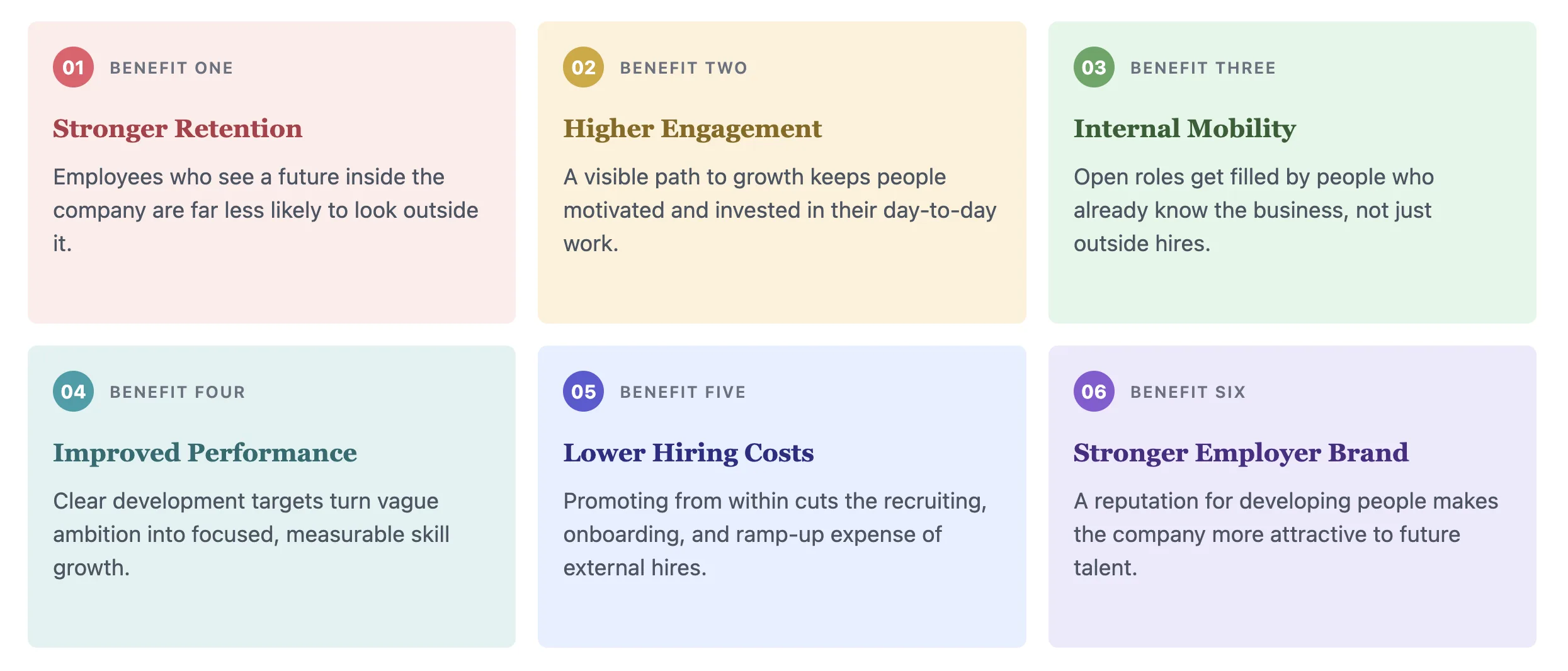
When companies provide clear trajectories, they create an environment where employees feel seen, valued, and invested in for the long term. Here are key reasons why career pathing matters in an organization:
Employee Retention
The link between growth and staying put shows up in nearly every major workforce study. Gallup's research found that organizations investing in employee development see stronger retention, productivity and innovation than those that do not, and that pattern holds across industries.
Internal Mobility Over External Hiring
LinkedIn's 2025 Workplace Learning Report found that 55% of career development champions and 48% of all other organizations now treat internal mobility as a higher priority for the year ahead, up from where it sat a year earlier. Filling a role from inside also keeps institutional knowledge in the building, something an external hire cannot bring with them on day one.
Succession Readiness
Career pathing and succession planning meet at the top of the organization, where broad-based routes for everyone start feeding a smaller pool of people ready for named leadership roles. A workforce with visible paths tends to arrive at that pool with more depth and less scramble.
These benefits extend beyond mere retention metrics. According to SHRM, growth opportunities represent the most significant influence on overall mental well-being, outranking even job security. This evidence suggests that organizations should view career pathing as a foundational investment in staff health rather than a standard HR strategy.
How Career Pathing Works in Practice
Turning the idea into a working program means building competency frameworks for each role, mapping the skill gaps between roles on a path, and putting individual development plans in place that close those gaps on a real timeline. Managers carry a lot of this weight day to day: regular career conversations, honest skill assessments, and visible sponsorship for employees who are ready to move. A continuous performance management helps organizations build regular updates and supporting a more consistent approach to the process.
None of that has to start with software. A mid-size organization can map its first few paths in a shared document and a set of structured 1:1 conversations. The frameworks, the maturity stages, and a usable template for building this out from scratch live in our companion guide on career pathing frameworks.
Career Pathing in Practice: Real-Life Examples
Retail and logistics giants have put real budget behind this. Walmart runs pipeline programs that move frontline associates into truck driver and technician roles, two positions facing industry-wide talent shortages.
- Josh Allen, Group Director of Enterprise Frontline Learning at Walmart, notes that roughly 75% of the company's salaried managers started in hourly positions, a sign the practice runs deep rather than serving as a talking point.
- Amazon's Career Choice program takes a different route into the same problem. Since 2012, the program has upskilled more than 300,000 employees across 14 countries by prepaying tuition for GEDs, degrees, and certifications for frontline workers.
Both examples show the same underlying idea: a defined route, a named skill gap, and a company willing to fund the distance between the two.
Career Pathing Software
Spreadsheets and manager judgment work for a while, but they stop scaling once an organization has more than a handful of departments or more roles than one HR generalist can hold in her head.
Career management software helps at that point by keeping skills data, path definitions, and development plans in one place instead of scattered across documents nobody updates.
The category covers a range of tools, from dedicated career and skills-mapping platforms to employee development modules built into broader performance management platforms.
What a given organization needs depends on its size, its existing HR stack, and how much of this work managers can realistically own without a system behind them.
If you are ready to compare options, our Top 10 Career Management Software listicle ranks the leading tools on feature depth, pricing, and real user feedback.
FAQs
What is career pathing?
Career pathing is the practice of an organization mapping the routes an employee can take to grow their skills, scope, and title. It covers promotions, lateral moves, and cross-functional shifts, and the organization builds the routes rather than leaving employees to work it out alone.
What is the difference between career pathing and a career ladder?
A career ladder is a single, vertical line of promotions. Career pathing is broader: it includes lateral and cross-functional moves alongside promotions, reflecting the fact that growth does not always mean moving straight up.
What is the difference between career pathing and succession planning?
Succession planning identifies specific successors for named leadership roles. Career pathing applies to the entire workforce and covers every plausible route, not just the small set of roles succession planning is built to protect.
What are the main types of career paths?
The five main types are vertical, lateral, cross-functional (or diagonal), dual-ladder, and branching or network paths. Most organizations use a mix rather than relying on just one pattern.
Why is career pathing important for employee retention?
Employees who cannot see a next step tend to look for one elsewhere. Gallup research links clear growth and development opportunities to stronger retention, and organizations that build visible paths give employees a reason to grow in place instead of leaving.
Who is responsible for career pathing: HR, managers, or employees?
All three play a part. HR designs the paths and competency frameworks, managers run the actual career conversations and sponsor movement, and employees drive their own development within the routes the organization has built.
Does career pathing require software?
No. A smaller organization can map its first paths in a document and structured conversations. Software becomes useful once the number of roles, paths, and employees outgrows what a manual system can track reliably.
.avif)